

Last Updated: June 25, 2026
Thank you for visiting! By the way… any links on this page that lead to products on Amazon and other stores/partners are affiliate links Aquarium Store Depot earns a commission if you make a purchase.
A dedicated frag tank changes everything about how you approach coral keeping. Once you have one, you stop being a reef keeper and start being a coral grower. That’s a different mindset, and it’s one of the most satisfying transitions in the saltwater hobby.
I fragged my first coral years ago and immediately got hooked on the swap scene. Meeting up with local reef clubs, trading frags for species I’d never owned, building credit at the LFS for supplies and salt. A frag tank made all of that possible. It gave me a dedicated grow-out space that I could control independently of my display.
But most articles about frag tanks miss the single most important variable: tank height. Shallower is almost always better for fragging. Lower water depth means better light penetration to every frag, easier access without reaching into deep water, and faster daily maintenance. Most people pick a frag tank based on footprint. They should pick it based on water height first.
EXPERT TAKE | MARK VALDERRAMA
After years of running frag systems, my top advice to serious reefers is to look at Lo-Boy tanks: low-profile, wide-footprint aquariums purpose-built for frag work. The low height (typically 8 to 12 inches, or 20 to 30 cm) gives you direct access to every frag without arm-deep reaches, your lighting sits closer to the corals delivering higher PAR with less wattage, and the wide surface area gives you more rack real estate per gallon. If you’re just getting into fragging, the tanks listed below work great. If you’re growing frags at volume, calling on vendors, selling at swaps regularly, a Lo-Boy purpose-built setup changes how efficiently you can work. It’s not a luxury upgrade. It’s the right tool for the job.
What Is a Frag Tank?
A frag tank is a dedicated aquarium where coral frags are grown out. These corals come from your main display tank: you cut (frag) them and move them into the frag tank to heal and grow in a clean, controlled environment. The key advantages over keeping frags in your display are independent parameter control and pest isolation. If your frag tank gets a flatworm outbreak or a coral pest problem, it stays in the frag tank. Your display is protected.
What People Get Wrong About Frag Tanks
Most beginners assume any small reef tank works as a frag tank. It doesn’t. A standard all-in-one reef tank designed for a display prioritizes viewing angle and aesthetics. A proper frag tank prioritizes lighting efficiency, flow patterns, and access. The difference matters when you’re trying to grow corals, not just keep them alive. A tall display tank with a beautiful scaping job delivers poor PAR to the bottom where frags sit on racks. A shallow, wide frag tank with the light close overhead delivers consistent PAR across every frag plug with no shading from rockwork.
The Biggest Mistake
Connecting your frag tank to your display too early. An integrated system sounds appealing because it shares the stable parameters of a mature display. The problem: when (not if) you get a coral pest in your frag tank, it transfers to your display instantly. A coral pest outbreak in an integrated system means treating both tanks simultaneously, which is expensive and disruptive. Run your frag tank as a standalone system until you’ve established strong quarantine habits and are confident in your pest inspection routine.
BUY OR SKIP?
Buy a dedicated frag tank if: You’re actively fragging corals and running out of rack space in your display or sump, you want to sell or trade frags seriously, or you want to quarantine new coral arrivals before introducing them to your display.
Skip a dedicated frag tank if: You’re a casual reef keeper with one display tank and no plans to expand, or you haven’t yet mastered stable parameter maintenance in your display. Get the display dialed in first. The frag tank is a tool for serious growth, not a shortcut to a better reef.
Types of Frag Tank Setups
The Display Method
This is how most of us start. A magnetic coral rack in the display keeps frags visible and saves money. The problem is visual: racks in a display tank look cluttered and undermine the aesthetic you spent months building. If you have more than two racks in your display, you need a dedicated frag tank.
The Sump Method
A fourth chamber in your aquarium sump with a grow light overhead works and costs little if you have the space. The downside is access: sumps live in cabinets, which means bending down and working in tight quarters every time you handle your frags. Flow is also limited to what your overflow and return pump provide, with limited ability to customize the pattern for coral health.
The Integrated Frag Tank
A separate tank plumbed into your display shares stable parameters without requiring its own filtration system. Good stability. Bad pest containment. As mentioned above, an integrated system means one pest problem becomes two tank problems. Most advanced reefers eventually move away from integrated systems for this reason.
The Standalone Frag Tank
The right long-term answer. Separate filtration, independent parameters, total pest isolation. The standalone setup costs more and requires you to maintain stable water independently of your display, but it gives you maximum control and maximum protection. This is where serious fraggers eventually land, and the tanks reviewed below are all standalone-capable setups.
WHY THIS RANKING
I ranked these tanks on three dimensions that determine real-world frag tank performance: Frag Access (how easy it is to reach and work corals daily), Lighting Efficiency (how well the tank height and footprint deliver PAR to frag plugs), and System Integration (how cleanly it plumbs into a standalone or sump-based system). A tank that scores well on aesthetics but poorly on frag access doesn’t belong at the top of this list. I’m ranking for function, not looks.
My Recommendation for Hardcore Fraggers: Go Low
If you’re serious about frag volume, look into what the hobby calls a Lo-Boy tank: a low-profile, wide-footprint aquarium specifically built for frag work. The low height (typically 8 to 12 inches, or 20 to 30 cm) gives you direct access to every frag without reaching into deep water, your lighting sits closer to the corals, and the wide surface area gives you more rack real estate. The tanks listed below work great as starting points. But if you’re growing frags at scale, a Lo-Boy purpose-built setup is what I’d point you toward.
In a hurry? I recommend the Innovative Marine Lagoon
| Picture | Name | Size | Link |
|---|---|---|---|
Editor’s Choice! 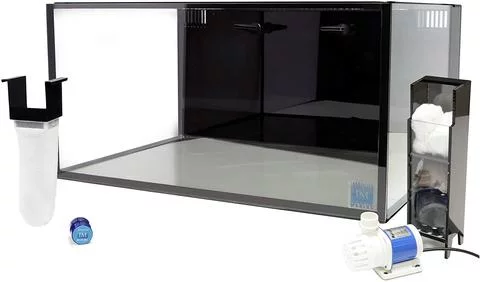 | Nuvo Fusion 25 Lagoon |
| Click For Best PriceBuy On Amazon |
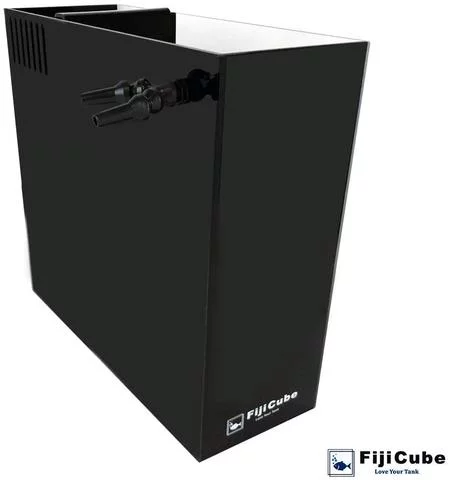 | Fiji Cube All-In-One Kit |
| Buy On Amazon |
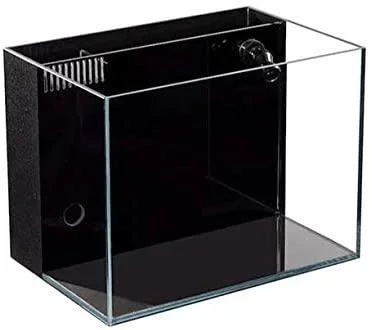 | Lifegard Crystal Aquarium |
| Buy On Amazon |
 | Modular Marine Rimless Frag Tanks |
| Buy On EBay |
 | LuckReef Acrylic Frag Tanks |
| Buy On EBay |
The Top 5 Frag Tanks (Reviews)
1. Nuvo Fusion 25 Lagoon
Editor’s Choice
Purpose-built frag tank geometry. 12-inch depth, wide lagoon footprint, best light-to-frag distance of any AIO on this list. The right tool for serious frag work.
The Nuvo Fusion 25 Lagoon is the closest thing to a purpose-designed frag tank in the AIO market. The 12-inch (30 cm) water depth is the key feature. That shallow depth means your light sits close to every frag on the rack, delivering high PAR without needing an expensive high-wattage fixture. You can dial in flow easily with the dual DC return pump outlets, and you have room to work without submerging your arm to the shoulder to reach a plug on the bottom.
The ultra-clear glass gives you excellent coral color rendering for evaluating frag health and growth. The included mesh lid matters: wrasses are a common pest-control addition to frag tanks, and wrasses jump. This tank accounts for that. The only honest downside is price. It’s not cheap. But it’s purpose-built, and that shows in every dimension choice.
ASD Frag Suitability Score: 8.7/10 Frag Access 9/10, Lighting Efficiency 9/10, System Integration 7/10.
Pros
- 12-inch depth: ideal frag geometry, best light penetration on this list
- Dual DC pump outlets, excellent flow control
- Mesh lid included for wrasse containment
- Ultra-clear glass
Cons
- Expensive
- Glass makes it heavy and less portable
2. Fiji Cube All-In-One Kit

Best DIY frag tank conversion kit. Turns a cheap 20-gallon long (12 inches tall) into a functional AIO frag tank. Best system integration of any option on this list.
When people ask how to build a frag tank for as little money as possible, my answer is always the same: catch a dollar-per-gallon sale at a chain pet store, buy a 20-gallon long, and convert it with the Fiji Cube All-In-One Kit. The 20-gallon long is 30 inches (76 cm) in length and 12 inches (30 cm) tall, which puts it in the ideal shallow frag tank geometry. The Fiji Cube kit converts it into a back-compartment AIO system, hiding all your filtration equipment and giving you an unobstructed view of your corals. If you can find a 33-gallon long aquarium (48 inches, or 122 cm), the 20-gallon AIO kit fits that tank as well, giving you considerably more rack surface area for the same investment.
The included pump is underpowered. Add a wavemaker for proper coral flow, and budget for that upfront. The kit itself runs on the pricier side for what it is, but the combination of dollar-per-gallon tank plus Fiji Cube kit still undercuts any comparable pre-built frag tank at this size.
ASD Frag Suitability Score: 8.3/10 Frag Access 8/10, Lighting Efficiency 8/10, System Integration 9/10.
Pros
- Best system integration flexibility of any AIO option
- Pairs with cheap standard tanks for total cost savings
- Works with 20-gallon long and 33-gallon long tanks
Cons
- Pump is underpowered, wavemaker required
- Kit itself is not cheap
3. Lifegard Crystal Aquarium

Good capacity AIO at an attractive price. Ultra-clear glass for display-quality clarity. Better for mixed coral display fragging than pure production volume.
Lifegard’s Crystal Aquarium is an ultra-clear glass AIO at an attractive price point. At 24 gallons with integrated back compartments, it’s a capable starter frag tank. The clarity is excellent for evaluating coral coloration and growth, which makes it particularly good if you’re keeping mixed coral types at different light demands rather than running a pure high-production frag setup.
The main limitation is the 16-inch (41 cm) tank height. That’s taller than ideal for pure frag work. Light has to travel further to reach bottom plugs, which means either more wattage in your LED or accepting lower PAR at the bottom of the rack. The included pump is calibrated for freshwater and lacks the flow intensity a reef frag system needs. Plan for a powerhead addition. Glass also means this tank doesn’t travel to frag swaps.
ASD Frag Suitability Score: 7.3/10 Frag Access 7/10, Lighting Efficiency 7/10, System Integration 8/10.
Pros
- Ultra-clear glass, excellent color rendering
- 24 gallons, solid capacity
- Attractive price for the build quality
Cons
- 16 inches tall, less ideal depth for frag lighting efficiency
- Pump lacks flow for reef application
- Glass: not portable for swaps
4. Modular Marine Rimless Frag Tanks
Acrylic tanks with external overflow designed to plumb into a sump. Best choice for running multiple frag tanks off one filtration system.
Modular Marine is a Texas-based acrylic and 3D-printed reef products maker with a long eBay track record. Their frag tanks are unique on this list because the overflow is external, which means the tank requires a sump connection to operate. That’s not a flaw, it’s a design choice for reefers running multiple frag tanks off one filtration system. If you’re building a frag farm with two or three tanks sharing a central sump, Modular Marine’s system is purpose-built for that architecture.
Pros
- Acrylic construction, lightweight and portable
- External overflow designed for multi-tank sump systems
- Custom sizing available
Cons
- Requires a sump, not standalone-capable
- More expensive than standalone AIO options
5. LuckReef Acrylic Frag Tanks
Lightweight acrylic frag tanks in multiple sizes with low depth geometry. Best option for frag swaps and portable coral transport.
LuckReef’s acrylic frag tanks come in multiple custom sizes with the low depth geometry that serious frag work requires. These are the tanks to buy when you’re heading to a frag swap: lightweight acrylic, correct shallow dimensions, attractive pricing. My personal experience with their eBay customer service has been consistently responsive. The bare-bones nature (no pump, no media included) keeps the price accessible but means you’re building the system yourself.
Pros
- Low profile dimensions, correct frag geometry
- Acrylic: lightweight for transport to swaps
- Multiple size options, good pricing
Cons
- Bare bones: no pump, media, or filtration included
- eBay-only availability
MARK’S TOP PICK
The Nuvo Fusion 25 Lagoon is the clear pick if you have the budget. The 12-inch depth is purpose-built frag geometry and nothing on this list matches the light-to-coral distance efficiency. If budget is the constraint, the Fiji Cube kit plus a dollar-per-gallon 20-gallon long delivers comparable frag function at significantly less cost. For frag swap portability, LuckReef is the answer. For multi-tank sump systems, Modular Marine is the purpose-built option.
ASD Frag Tank Suitability Scores
I score each tank on three dimensions that determine real-world success for a dedicated frag setup, not just general reef use.
Nuvo Fusion 25 Lagoon: Frag Access 9/10 | Lighting Efficiency 9/10 | Integration 7/10 | ASD Overall: 8.7/10 The low-profile lagoon shape is purpose-built for frag work. Best light-to-frag distance of any AIO on this list.
Fiji Cube All-In-One Kit: Frag Access 8/10 | Lighting Efficiency 8/10 | Integration 9/10 | ASD Overall: 8.3/10 Best system integration of the AIO options. Pairs with cheap standard tanks for best overall value.
Lifegard Crystal Aquarium: Frag Access 7/10 | Lighting Efficiency 7/10 | Integration 8/10 | ASD Overall: 7.3/10 Rimless clarity is great for display fragging; less optimized for pure production at 16-inch depth.
Standard Lo-Boy (DIY): Frag Access 10/10 | Lighting Efficiency 10/10 | Integration 8/10 | ASD Overall: 9.3/10 If you’re serious about frag volume, nothing beats a custom lo-boy. 8 to 12-inch (20 to 30 cm) depth means every frag gets optimal light and you can reach every rack without difficulty.
ASD note: The single biggest variable most reviews ignore is tank height. For fragging specifically, shallower is almost always better. It reduces shading between frag racks, improves light penetration consistency, and makes daily maintenance significantly faster.
WHAT MOST PEOPLE MISS
Flow pattern matters as much as flow rate in a frag tank. Most new frag keepers add a powerhead and aim it across the tank, creating a single directional current. Corals on one side get direct flow; corals on the other get minimal circulation. For frag tanks, alternating flow or a wavemaker set to a gyre pattern delivers more consistent water movement to every frag plug on every rack position. This is why the Nuvo Lagoon’s dual return outlets matter: you can split the return flow to opposite ends of the tank, creating natural turbulence instead of a single directional current. Small detail, real difference in coral growth rates.
Frequently Asked Questions
Do I need a sump for a frag tank?
No. The AIO tanks on this list (Nuvo Lagoon, Fiji Cube Kit, Lifegard Crystal) run as standalone systems with internal filtration. A sump adds stability and filtration capacity, but it’s not required. The Modular Marine tanks are the exception: their external overflow design requires a sump connection.
What size frag tank do I need?
Bigger is more stable, but height matters more than footprint. A 20 to 30-gallon tank at 12 inches (30 cm) or less in height is the sweet spot for most reefers entering the frag tank category. More surface area means more rack positions. More height means worse light penetration and harder coral access.
What lighting works best for a frag tank?
Most reef LEDs designed for nano tanks work well in shallow frag tanks because the reduced water depth brings the light closer to the corals. A mid-range LED like the AI Prime or Kessil A80 covers a 20 to 25-gallon frag tank adequately. For higher production, two fixtures staggered to cover the full rack footprint gives you more consistent PAR across every position.
Can I put fish in my frag tank?
Small wrasses for pest control (six line, yellow coris) work well and serve a real function. Keep fish light. Heavy bioload in a small system creates ammonia spikes that damage corals. A wrasse or two for pest control is smart. A full fish community in a 25-gallon frag tank creates water quality problems.
How do I prevent coral pests in a frag tank?
Dip every coral before it enters the frag tank. No exceptions. A standard coral dip (Coral Rx, Revive, or similar) removes the majority of coral pests before they establish. Inspect frags under magnification before and after dipping. Flatworms and red bugs are the most common frag tank pests and both are visible if you look for them.
Closing Thoughts
A frag tank is where casual reef keeping becomes serious reef growing. The Nuvo Fusion 25 Lagoon is the best off-the-shelf option for reefers who want a purpose-built setup that doesn’t compromise on the dimensions that matter. The Fiji Cube kit paired with a cheap 20-gallon long is the best budget path to the same geometry. If you’re going to frag swaps, LuckReef’s portable acrylic tanks are built for exactly that use case.
For quality coral frags to start your frag tank with, check out Flip Aquatics and Dan’s Fish. Both ship quality livestock and are reliable sources I recommend for stocking a new frag system.
References
- Seriously Fish: Species profiles and care data
- FishBase: Taxonomy and scientific data
- Practical Fishkeeping: Husbandry and care advice
- About the Author
- Latest Posts

I’m Mark Valderrama, founder of Aquarium Store Depot and a fishkeeper with over 25 years of hands-on experience. I started in the hobby at age 11, worked at local fish stores, and have kept freshwater tanks, ponds, and reef tanks ever since. I’ve been featured in two best-selling aquarium books on Amazon and built this site to share practical, experience-based fish keeping knowledge.

Leave a Reply