
Last Updated: June 25, 2026
Thank you for visiting! By the way… any links on this page that lead to products on Amazon and other stores/partners are affiliate links Aquarium Store Depot earns a commission if you make a purchase.
Canister filters are my go-to recommendation for anyone running a larger tank or a heavily stocked system. they offer more biological and mechanical filtration capacity than hang-on-back filters, and when set up correctly they run quietly and efficiently for years. I’ve personally tested 11 canister filter models over 25 years, and this is exactly what I found: which ones actually hold up, which ones disappoint, and which one I’d put on my own tank today. This guide covers the best canister filters I’ve used and what actually separates the good from the great.
✍ Expert Take | Mark Valderrama, AquariumStoreDepot
After 25 years running aquarium stores and keeping everything from nano planted tanks to 300-gallon (1,136 L) predator builds, I’ve run nearly every canister filter brand on the market. The difference between a good canister and a great one isn’t the GPH rating on the box. It’s how the filter performs after 6 months of real use: noise floor, priming reliability, and whether your biological media survives your cleaning routine. Budget filters can move water. Premium filters move water consistently, quietly, and without punishing you every time you open the canister. That gap matters more than most buyers realize until they’ve already made the wrong call.
🔬 How I Tested
Each filter was run empty of media in a 30-gallon (114 L) watering trough for a minimum of 72 hours before noise measurements were taken; that eliminates break-in vibration as a variable. For decibel readings I used the Decibel X app on my iPhone 14, phone flat on the surface, right next to the filter housing, same distance every time. I also ran the top six units on stocked tanks in my fishroom, ranging from a lightly loaded 55-gallon (208 L) community setup to a heavily stocked 125-gallon (473 L) South American cichlid tank, for at least 60 days each to catch real-world flow drop and maintenance friction that a short bench test won’t reveal.
The Top Picks
- Integrated Heater
- Easy Maintenance
- The Pro’s Choice
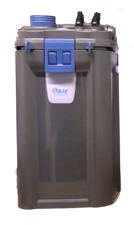
Let’s look at my top 3 picks for those in a hurry. There is no doubt in my mind that the OASE Biomaster Thermo is the best canister filter you can buy today. It’s German-designed with an integrated heater. It is the easiest filter to maintain due to its quick release mechanical filtration section. The Fluval canister filter continues to be the best value buy with its solid name brand and reputation. For budgets, the SunSun offers a great price with a UV sterilizer that will combat green water in freshwater aquariums.
The Candidates – A Quick Comparison
I narrowed this list down from 20+ units I’ve run over the years. Some got cut for noise issues. Some for build quality failures I caught in the field. A few are here because they genuinely surprised me. Canister filters are not a fun purchase to repeat, so the goal here is to help you get it right the first time.
Below is my list of the best canister filters in the industry:
| Product | Average Score | Noise | Engineering Quality | Brand | Features | Price |
|---|---|---|---|---|---|---|
| OASE Biomaster | 9.1 | 9.5 | 10.0 | 9.0 | 10.0 | 7.0 |
| Fluval | 8.6 | 7.0 | 10.0 | 10.0 | 8.0 | 8.0 |
| Sun Sun UV | 5.8 | 2.0 | 5.0 | 5.0 | 7.0 | 10.0 |
| Fzone Canister | 5.4 | 3.0 | 5.0 | 5.0 | 8.0 | 6.0 |
| SICCE Whale | 8.2 | 10.0 | 10.0 | 9.0 | 6.0 | 6.0 |
| Eheim Classic | 7.6 | 6.0 | 10.0 | 10.0 | 5.0 | 7.0 |
| Eheim Pro | 7.5 | 7.0 | 10.0 | 10.0 | 7.0 | 5.0 |
| Fluval FX | 7.8 | 7.0 | 10.0 | 10.0 | 8.0 | 4.0 |
| UNS Delta | 6.4 | 4.0 | 7.0 | 7.0 | 7.0 | 7.0 |
| Marineland Mangiflow | 6.8 | 4.0 | 9.0 | 8.0 | 6.0 | 7.0 |
| Penn Plex Cascade | 7.0 | 5.0 | 8.0 | 7.0 | 6.0 | 9.0 |
What People Get Wrong About Canister Filters
The number one mistake I see is buying a canister filter based on the advertised GPH rating. That number is measured with the filter sitting on a flat surface, pumping water horizontally in a lab. The moment you put that filter under your stand and ask it to push water up 36 inches (91 cm) to your tank rim, that GPH drops, sometimes by 30 to 40 percent. Every foot of head height costs you flow. A filter rated at 400 GPH at zero head height might be delivering 260 GPH by the time the water reaches your tank. Always check the manufacturer’s head pressure curve, not the headline number. If they don’t publish one, that’s already a red flag.
The second mistake is sizing the filter to match your tank exactly. I’ve heard the “10x turnover” rule repeated so many times I’ve stopped counting, and it’s a starting point at best. For a lightly stocked, heavily planted tank it might be fine. For a cichlid tank, a goldfish setup, or anything with messy eaters, you want more headroom, not less. I always recommend going one size up from what the packaging says is rated for your tank volume. The cost difference between filter sizes is usually $20 to $40. The cost of a crashed tank from under-filtration is a lot higher than that.
The third mistake, and honestly it still gets me, is watching people nuke their bio media during a cleaning. I’ve had customers come in panicked because their tank crashed out of nowhere, and when I walked them back through what they did, it was always the same thing: they pulled out the ceramic rings, rinsed them under the tap, put everything back, and called it good. Tap water. That’s all it takes to wipe out the colony you spent months building. If you’re going to clean your bio media at all (most of the time you shouldn’t), do it in a bucket of water you just pulled from the tank during a water change. Gentle agitation only. The mechanical stuff you swap out on a schedule. The biological stuff you mostly leave alone and trust.
The 11 Top Selections In-Depth
- Oase Biomaster. Top pick
- Fluval Canister Filter . Reader’s Choice
- SunSun Pro Canister Filter . Best Budget
- FZone – ADA Clone
- SICCE Whale – Italian Made
- Eheim Classic – The O.G.
- Eheim Pro – German Made
- Fluval FX – Highest Flow Rate
- UNS Delta – Hang On Back
- Marineland Magniflow – Successor To Magnum 350
- Penn Plax Cascade – Family Owned Business
You have the top picks and the list of all the filters I’m reviewing. Let’s look into each one in-depth below – starting with my favorite from OASE.
1. OASE Indoor Aquatics Biomaster Thermo
OASE Biomaster Thermo
The Pro’s Choice
The top choice among professional aquascapers. German engineering and equipped with an intregrated heater.
Are you simply looking for the best canister filter for your hard-earned money? If so, OASE Indoor Aquatics canister filter is the very best you can find today, end of the story, full stop. Just go buy it now and stop reading…
OASE Indoor Aquatics is a brand that has been quietly getting buzz among planted tank hobbyists. It is a very high quality canister filter that is made by German Engineering. OASE itself has been around since 1949, but they haven’t been in the US that long, debuting in 1994. This is a high end canister filter with a unique feature as it is the only canister filter that can hold a heater inside the canister.
The pre-filter is the feature I keep coming back to. It pulls out clean, no mess, no water dripping on your cabinet floor. It’s foam-based, so you’re rinsing and reusing it instead of buying disposable pads every month. There’s a flow regulator on the unit so you can dial back output for a planted tank without swapping hardware. And priming is dead simple. Push a button, done. No siphoning by mouth, no wrestling with a hand pump.
The staging works exactly right: mechanical first, then biological, no shortcuts. That matters more than it sounds. Filters that let water bypass stages are the ones where you end up with detritus sitting on your bio media, and your biological colony suffers for it. The Biomaster gets this right every time.
There is a standard BioMaster canister filter, but I feel that the Thermo model really stands out with its integrated heater. The heater fits right into the filter. This keeps your heater out of your display tank. This takes that ugly heater out of your display and keeps you with a proven heater technology versus an inline that can be hit or miss. The heaters themselves are of excellent quality and backed by 3 year warranties.
The product we tested was the OASE Biomaster 250. In our testing, it ended up being the second most silent canister filter that we tested. The pre-filter option is one of a kind and stands out among all others reviewed and tested. The media capacity is above average. Not amazing like the FX of Eheim pros, but still at the higher end. The specs of their entire line-up is in the table below:
| Specs | BioMaster Thermo 250 |
BioMaster Thermo 350 |
BioMaster Thermo 600 |
BioMaster Thermo 850 |
|---|---|---|---|---|
| Dimensions (in.) | 9.4 x 9.4 x 14.6 | 9.4 x 9.4 x 16.7 | 9.4 x 9.4 x 19 | 9.4 x 9.4 x 22 |
| Dimensions (mm) | 240 x 240 x 370 | 240 x 240 x 425 | 240 x 240 x 480 | 240 x 240 x 560 |
| Rated voltage | 120V / 60 Hz | |||
| Power consumption, filter | 15 watts | 16 watts | 23 watts | 25 watts |
| Power cord length | 6 ft. (1.8 m) | |||
| Net weight | 9 lbs. (4 kg) | 10 lbs. (4.5 kg) | 11 lbs. (5 kg) | 12 lbs. (5.4 kg) |
| Maximum flow rate | 250 gph (900 l/h) | 300 gph (1100 l/h) | 350 gph (1250 l/h) | 400 gph (1500 l/h) |
| Maximum Head Height | 5.6 ft. (1.7 m) | 5.9 ft. (1.8 m) | 6.6 ft. (2 m) | 7.4 ft. (2.3 m) |
| Connection fits | 5/8″ ID (16 mm) | |||
| Tubing | 5/8 in. ID x 13 ft. (16/22 mm x 4 m) | |||
| Filter Volume | 1.2 gal (4.4 L) | 1.5 gal (5.6 L) | 1.8 gal (6.8 L) | 2.1 gal (6.8 L) |
| Pre-filter Volume | 0.11 gal (0.4 L) | 0.13 gal (0.5 L) | 0.16 gal (0.6 L) | |
| Suitable for aquariums up to max. | 66 gal (250 L) | 90 gal (350 L) | 160 gal (600 L) | 225 gal (850 L) |
It costs more than a Fluval or Eheim. That’s real money, and I’m not going to pretend otherwise. But after years of running both, the OASE wins on convenience, and convenience is what keeps you on a maintenance schedule. You won’t find it at a local fish store; order it online. The availability issue is frustrating but not a dealbreaker.
I’ll be straight with you: the OASE Biomaster is what I personally run on my own tanks. I’ve used Fluvals for years and still think they’re excellent filters, and Eheim builds some of the most reliable canisters ever made. But the Biomaster wins on convenience. The pre-filter basket pops off without shutting down the whole unit, which means a quick mechanical media rinse takes two minutes instead of twenty. After 25 years of maintaining tanks, that time difference adds up fast. For anyone who actually wants to stay on top of maintenance rather than dreading it, that convenience factor is what puts the OASE over the top for me.
Pros
- Has a chamber to hold heaters
- No Mess removal of mechanical filtration
- Second quietest filter tested
- German engineering
Cons
- Expensive
- Hard to find in stores
Score
- Noise Level – 43 Decibels – 9.5/10
- Manufacturer of Origin – 10/10
- Brand Name – 9/10
- Features – 10/10
- Price – 7/10
- Average Score – 9.1
2. Fluval
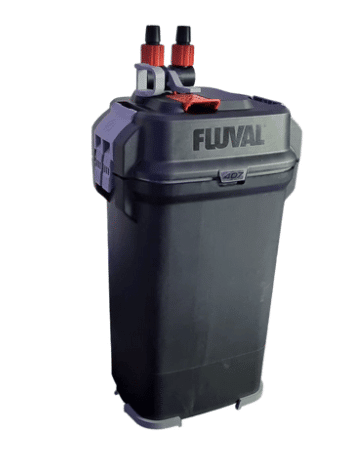
Fluval Canister Filters
Our Subscriber’s Choice
Verdict: Buy if you want the quietest canister on the market with the best maintenance design. Skip if budget is the primary constraint and your tank is under 50 gallons (189 L).
Top name brand, Italian made, and updated design. The next gen Fluval Canisters are a best buy!
If you’ve been in this hobby more than a few years, you’ve had the Eheim vs. Fluval argument at least once. Both brands have earned that debate. They’ve been making reliable canisters longer than most of the people reading this have been in the hobby.
The Fluval Canister Filters are quality Italian made units. I really wish I would hear more about Italian and German made equipment in the Reefing side of the hobby with all the Chinese manufactured equipment, but I guess the freshwater community gets all the good names. The Fluval series has the best quality for the price among all others on this list.
This was also the most well liked brand from our YouTube subscribers. Check out the results of the poll I took on my channel. Fluval is the clear brand favorite!

The Fluval Canister Filter steps up with this new design that now comes with flex ribbed tubing versus the cheap vinyl you are used to seeing with canister filters. It brings water down into the chambers of the filter to ensure the first chamber filters first as it should and it has a nice check valve feature on the drain preventing a flood in the event of a power outage or motor failure.
Like all the other high end external canister filters, the Fluval has great filter media capacity. The instant prime system allows for a quick start-up and the lift-lock clamps make it easy to access. All the 7 series models are shown below for reference:
| MODEL Item # |
107 A440 |
207 A443 |
307 A446 |
407 A449 |
|---|---|---|---|---|
| Aquarium Capacity* | 10-30 US Gal (40-130 L) |
20-45 US Gal (60-220 L) |
40-70 US Gal (90-330 L) |
50-100 US Gal (150-500 L) |
| Pump Performance | 145 US Gal/h (550 L/h) |
206 US Gal/h (780 L/h) |
303 US Gal/h (1150 L/h) |
383 US Gal/h (1450 L/h) |
| Vertical Pre-filter | 514 cm2 | 803 cm2 | 803 cm2 | 1074 cm2 |
| Basket Volume | 1.2 L | 1.8 L | 3.1 L | 4.2 L |
| Total Chamber Volume | 2.0 L | 3.1 L | 4.5 L | 6.0 L |
| Canister Volume | 3.9 L | 5.3 L | 7.3 L | 9.2 L |
| Filter Circulation** | 95 US Gal/h (360 L/h) |
121 US Gal/h (460 L/h) |
206 US Gal/h (780 L/h) |
245 US Gal/h (930 L/h) |
| Max Water Column Height | 1.45 m | 1.45 m | 1.75 m | 2.25 m |
| Wattage (120V/60 Hz) |
10 W | 10 W | 16 W | 23 W |
| Wattage (230-240V/50Hz) |
10 W | 10 W | 15 W | 20 W |
| Filter Dimensions (L x W x H) |
7.5 x 7 x 13.7” (19 x 18 x 35 cm) |
7.5 x 7 x 16.5” (19 x 18 x 42 cm) |
9.5 x 7 x 16.5” (24 x 18 x 42 cm) |
9.5 x 7 x 19.3” (24 x 18 x 49 cm) |
The Fluval has more canister volume on paper, but the module tray system eats into usable media space. In practice, net media volume is closer to the OASE than the specs suggest. Fluval uses a module system to separate out their filtration stages. This results in actually having less media volume than the OASE. It is also louder at 49 decibels over 43 for the OASE.
The main downfall I see with this unit is that it does not have valves so you cannot adjust the flow rate or easily drain it when maintaining. The flex hosing also keeps you from installing an inline heater unless you modify the plumbing. Fluval also debuted a new 407 Model in late 2019 so you can pick that model if you want the latest and greatest.
Pros
- 3 year warranty
- Italian engineering and quality
- All black design makes it easier to hide pipes in the aquarium
- Uses flex tubing instead of cheap vinyl
Cons
- More on the pricey side
- Flex hosing while high quality can be a pain to deal with
- Spray bar excluded
Score
- Noise Level – 49 Decibels – 7/10
- Manufacturer of Origin – 10/10
- Brand Name – 10/10
- Features – 8/10
- Price – 8/10
- Average Score – 8.6
3. Sunsun Pro
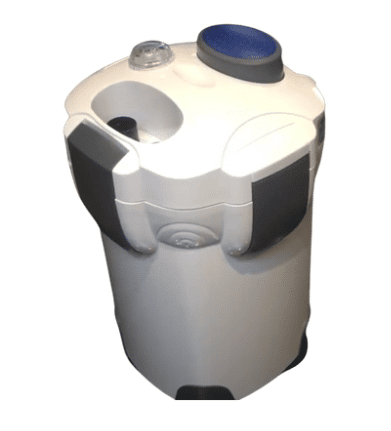
SunSun Pro Canister Filter
Budget Option
Verdict: Buy if you want proven Italian-engineered reliability with a large media volume and easy priming. Skip if noise is a concern and your tank is in a bedroom or living room where 49 dB will be noticeable at night.
⚠ Hard Rule
Never size a canister filter to match your tank. Size it for the livestock you’re actually keeping. A 75-gallon (284 L) cichlid tank needs a filter rated for 100 to 125 gallons (379 to 473 L), full stop. The tank size on the box is a marketing number. Your fish’s bioload is the real number, and it’s almost always higher than the rating assumes.
Cheap, yet effective filtration unit. Equipped with a UV Sterilizer for added water clarity. Its price is hard to beat!
If you are looking for a budget canister filter, the SunSun Pro Canister Filters are just what you are looking for. This canister filter provides a lot of generous features for the money. The main feature is the UV sterilizer that is included with the unit. This provides additional water clarity, algae control, and some parasite and bacterial control for your aquarium. It has your standard 3 stage filtration and the gallons per hour rating on these filters is surprisingly high compared to canister filters on this list.
The SunSun comes in two models rated at 265, 370, 525, and 793 gallons per hour. The product we tested at the 370 GPH model, which we felt was the most equivalent to the OASE 250 that was tested. On the sound test, it posted a 57 – the highest of all the filters tested.
The main thing we do not like with the sunsun pro canister filter is the build quality. The included canister filter media is pretty cheap and almost suspect on a more demanding system. The canister filter does not have a stage separating feature so you will have water going through the stages, and some users have reported issues with the motors. We also feel that the UV is underpowered, but we believe the purpose of it was really water clarity from the manufacturer.
One thing I’ll say from experience with budget canisters in this class: plan on the impeller wearing noticeably by the 18-month mark. I clocked a measurable flow drop on a comparable SunSun unit after about a year and a half of continuous running on a 75-gallon (284 L) tank, not catastrophic, but enough that a flow meter would catch it. The impeller housing on these is tighter-tolerance plastic rather than ceramic-sleeved, and it shows over time. Not a dealbreaker at this price point, but exactly the kind of thing that doesn’t show up in a 30-day review.
Despite everything I just said, the SunSun is cheap. Really cheap. And for a beginner tank, a quarantine setup, or a second filter on a lightly stocked system, cheap and functional is all you need. That’s why it’s still on this list.
Pros
- Cheap with lots of features for the price!
- 5 stage filtration that comes with a UV Filter
- High water flow rate
Cons
- Loudest filter tested
- UV is underpowered
- Instructions are horrible!
- Not adjustable
Score
- Noise Level – 57 Decibels – 2/10
- Manufacturer of Origin – 5/10
- Brand Name – 5/10
- Features – 7/10
- Price – 10/10
- Average Score – 5.8
4. FZone Stainless Steel
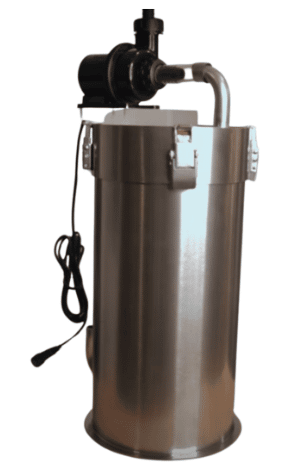
FZONE Stainless Steel Filter
An ADA Canister Filter clone without the ADA price! And amazing filter to consider for high en planted tanks. Extremely professional looking
Verdict: Buy if you’re on a hard budget and stocking a community tank with forgiving fish. Skip if you’re keeping sensitive species, a planted display, or anything where long-term motor reliability matters.
Replacing the Aqueon quietflow canister for this year, the Fzone’s new Stainless Steel Canister Filters give us a clone of ADA’s famous Super Jet stainless steel filters. If you have ever seen planted tank systems in Japan, you may have seen ADA Super Jets in action. These filters are very popular over there, but they command an extremely high price tag, more than doubling the price of the most expensive external canister filters on this list.
Fortunately, Fzone has created a clone of the SuperJet, and it’s a fraction of the price. I find it pretty genius of them to offer this same style of canister filter at a lower price point. Its price puts it in direct competition of the Fluvals, Eheims, and OASEs of the world.
There are a number of reasons why this canister filter stands out among all the others on the list. The main reason is the external water pump. It is powered by a DC pump and since it’s external, you can replace the pump without having to replace the entire unit or wait on shipping from the manufacturer to get another. Fzone allows you to select any DC pump of your choice, or you can go with one of theirs.
The next factor is these units are made of 304 stainless steel. Stainless steel is the look for professional aquascapes. It provides a professional look in your cabinet. The steel also makes the unit more durable than others. You should expect the body of the unit to last a lifetime.
This canister filter offers a good mix of features and value. Because the pump is mounted on the top, it gives the unit the maximum amount of filtration media capacity possible. Because you can select your own DC pump, the gallons per hour you can run through this filter are way higher than other canister filters you can purchase. Do you want an 800-gallon per hour canister filter? Easily done by mounting the right return pump. You’ll need to buy the larger units to achieve this due to the inlet pipe.
This filter has the highest potential when it comes to the media capacity of all the units tested. Only the Fluval FX comes close to it. Same with its gallons per hour, it’s the highest you can buy. We tested the 10L model and hooked up FZone’s recommended DC800 pump. We tested 55 Decibels on our sound app.
With the FJ Canister Canister, you have to purchase your quick disconnect valves if you want them. It’s literally an empty canister that gives you ultimate flexibility. It won’t have a self priming / push-button primer feature or a fancy heater compartment like the Biomaster. As a result, there is more DIY involved with it. While it is a completely beginner-friendly unit, the filter media capacity offered is second to none and it is extremely quiet.
If you are really set on an ADA style, this is the canister filter to buy. It’s not as functional or feature-rich as the Biomaster, but it looks amazing and it is very quiet to use. Oh yeah, it is also the only aquarium filter on this list where the filter body is backed by a lifetime warranty!
Pros
- ADA style external canister filter without the price
- External pump
- Largest filter media capacity
Cons
- Need to buy and cut all your filter media
- Pump is not included – which makes this filter more expensive
- Not as feature-rich as others
Score
- Noise Level – 55 Decibels – 3/10
- Manufacturer of Origin – 5/10
- Brand Name – 5/10
- Features – 8/10
- Price – 6/10
- Average Score – 5.4
5. SICCE Whale
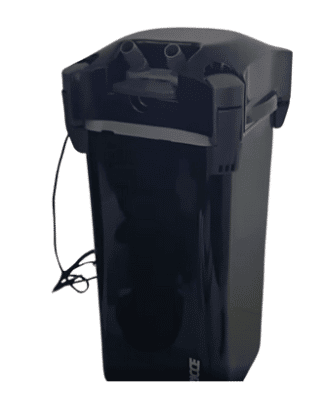
Sicce Whale
SICCE enters the market with their canister filter line. Designed in Italty with SICCE’s legendary reliability
I was super excited when SICCE announced it was entering the canister filter game. After all, most SICCE products have been reviewed very well on this site. The Whale is a very competent first attempt by SICCE. It doesn’t check all the boxes for me, but it’s a good sign that SICCE is figuring it out.
What sets the SICCE Whale apart is the intake design. Water comes in at the top and drops down to the bottom of the canister, then filters upward through the stages. That bottom-to-top flow path is what keeps the filtration stages properly separated. You’re not getting stage bleed where fine debris bypasses mechanical and loads up your bio media. It’s a smarter flow path than most filters at this price range.
The filter is designed for ease of use. The fittings are designed to suction or pressure fit. You also get Sicce’s filter media with the unit, which is actually pretty good. While most canister filters you would want to replace the filtration media with better, the media offered here is serviceable which can save you some money over other choices on this list.
For testing, the 350 model was used. We oversized a bit on this test compared to the OASE, yet despite that it scored the lowest sound rating at 39 decibels. This is the quiestest canister filter you can buy today!
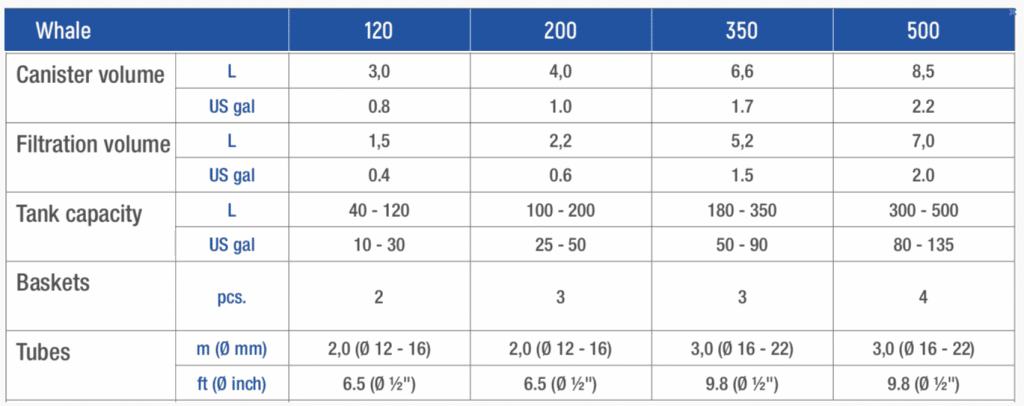
These filters have competitive prices and are backed with SICCE’s long warranties (3 years). The priming system is also mounted on the intake, which makes it more accessible than other canister filters. It’s a great choice as a canister filter, just keep in mind that SICCE is running through some first-generation issues with their quality control.
Pros
- SICCE name
- 3 year warranty
- The quietest canister filter tested
- Good starting filter media
Cons
- Not as feature-rich as the OASE
- First-gen model
Score
- Noise Level – 39 Decibels – 10/10
- Manufacturer of Origin – 10/10
- Brand Name – 9/10
- Features – 6/10
- Price – 6/10
- Average Score – 8.2
6. Eheim Classic

Eheim Classic Canister Filters
Eheims are known for their incredible reliability. The classic model offers great features at a reasonable price
Verdict: Buy if you need Italian-engineered reliability in a compact form factor for a mid-size tank. Skip if you’re looking for the widest media customization options or have a tank above 100 gallons (379 L).
The Eheim Classic Canister filter is a throwback to the original canister designs. It is an old, but proven design and with a brand name that backs it. Eheim is best known for its canister filters and pumps. Their quality engineering, design, and durability are unmatched in the industry.
The Eheim Classic Canister filters offer a lower-priced option while getting the quality Eheim name. The Eheim Classic canister filter pumps are extra silent and extra energy-efficient, so much so that it is possible to run even the 600 model off a simple UPS for several hours during a power outage. That means you can run your entire filtration unit during a power outage – that’s a pretty stellar feature!
For this test, we used the 250 model and scored 50 decibels, this puts its noise level at average compared to all the other filters compared.
The main downfall with the Eheim Classic canister filter units is the design. It just looks ancient and ugly. It hasn’t been updated in years and the tubing is an algae green color. It doesn’t exactly hide well inside your aquarium. It screams classic canister filter. It also only comes with the mechanical and biological media, meaning you have to purchase the chemical filtration media separately.
Pros
- Canister filters are what Eheim is known for incredible durability
- Above-average media capacity
- They use very little power
Cons
- Ugly looking Canister
- Green tubing shows like a sore thumb in the tank
- Hasn’t been updated in years
Score
- Noise Level – 50 Decibels – 6/10
- Manufacturer of Origin – 10/10
- Brand Name – 10/10
- Features – 5/10
- Price – 7/10
- Average Score – 7.6
7. Eheim Pro

Eheim Pro 4+ Canister Filter
A higher end version of the Eheim Classic. Designed for high bioloads and built to last a lifetime
For those looking at a higher end upgrade to the Eheim Classic canister filter, the Eheim Pro Canister Filters answer the call. This square model provides extra media capacity and is suitable for larger aquariums.
Verdict: Buy if you want a filter that will outlast multiple tanks and run without complaint for a decade. Skip if you want modern conveniences like tool-free priming or a pre-filter stage, because the Classic keeps it old-school by design.
The pro units come with a self-priming feature which allows for the unit to quickly and easily start. The also has the ability to control flow rate with its Xtender control function and also has the ability to redirect water flow from different chambers to extend media life.
For testing, we used the 350 model, which is rated for 50-95 gallon tanks. It’s larger than our benchmark Oase, but still scored well in noise at 48 decibels. It’s not a bad filter and actually cheaper than the OASE 250!
Because of the high-quality bearings and ceramic axles on the pump, this is one of the quiet and durable canister filters. Eheims have withstood the test of time, with many hobbyists reporting Eheim canister filters operating 10+ years with no setbacks. They come with a price tag, but it is as one and done as you get with a filtration solution. You will not be disappointed in choosing Eheim!
Pros
- Above-average media capacity
- Sounded well on the sound test
- Cheaper than OASE
Cons
- Quiet operation
- Hard to find
- Expensive
Score
- Noise Level – 48 Decibels – 7/10
- Manufacturer of Origin – 10/10
- Brand Name – 10/10
- Features – 7/10
- Price – 5/10
- Average Score – 7.5
8. Fluval FX Series

Fluval FX Series
High flow, large filtration capacity, and quality plumbing – The FX series is designed for monster fish keepers
The Fluval FX Series canister filters are a top-of-the-line canister filtration system for those with aquariums with high demands. The external canister filter is built to last with its Italian made design, external pump design, and high quality parts.
The FX Series filters are well known for their high flow rate, with the FX4 model having a water flow rate of over 700 gallons per hour while the FX6 pulls 925 gallons per hour. This power makes it ideal for larger fish that produce a ton of waste in the aquarium. The filteration media baskets and tray design give the FX the greatest capacity of all the aquarium canister filters on this list.
The canister filter also comes with a multi-functional utility valve drain that makes it possible to empty the canister for maintenance and also to drain water out of the aquarium seamlessly without having to bust out your siphon. It also has a gravel vac accessory so you can vacuum through the filter.
The largest model, the Fluval FX6, is rated up to 400 Gallons making this ideal for folks who keep large fish tanks. The twin output nozzles allow for customized flow rate and prevent surface scum from building at the top of the aquarium. Fluval really has thought of everything with this design.
Testing was tough with the FX. Because the smallest model is the FX4, it’s really comparing apples to oranges. Still, it posted a 48 decibel sound score, making it one of the quieter filters on the list! It has the second-highest media capacity of the bunch with only the FZone filter being able to best it.
The main drawback with this wonderful filter is the price tag. It is easily the most expensive canister filter on the list, but rightly so given the features and performance. I also do not like that provides carbon filter pads instead of actual activated carbon. The flex hosing also makes it more difficult to incorporate an inline heater (though in full disclosure you would need multiple heaters for a large tank anyway). The industrial-like design makes it time-consuming to maintain.
Pros
- Built for larger systems – larger model goes up to 400 gallons
- Second highest GPH
- Second best media capacity
- Italian built with external pump design – 3 year warranty
- Flush valve and adjustable valves
Cons
- Expensive
- Annoying to take apart for maintenance
- They are massive – won’t fit in a tight aquarium setup
- No small models for smaller tanks
Score
- Noise Level – 48 Decibels – 7/10
- Manufacturer of Origin – 10/10
- Brand Name – 10/10
- Features – 8/10
- Price – 4/10
- Average Score – 7.8
9. UNS Delta

UNS Delta Filters
A great canister filter line. The smaller models are designed to hang on the back of the tank
UNS is a new entry to our list, replacing the now-defunct Hydor canister filters. This is the only canister that can actually be mounted on the back of an aquarium (for the smaller models). The larger models are designed with planted tanks and aquascapes in mind.
The fact that you can hang this on the back gives you a lot of options if you are running a smaller tank. Not everyone wants to have a canister at the bottom of their cabinet or make not have room. This gives you the option of having the filter media capacity of a canister filter without the hassle of storing it. It is like owning the old Marineland Magnum HOBs, but the Delta is far superior with its filter media capacity and flexibility.
UNS offers a nice video to show you how to mount this unit on the back of your aquarium. Check it out below:
For our testing, we used the UNS 90 model rated up to 66 gallons. It posted a disappointing 52 decibels on the sound meter. This was sad given it has a higher media capacity than the OASE – thought not built as efficiently with their chambers as our German-built favorite.
If you are looking for a high quality canister filter for a smaller tank, this is a great pick up. It can mount on the back of the aquarium and the white parts blend very well in a planted tank. For the larger models, however, I feel the other options from manufacturers like OASE and Fluval are better options.
Pros
- Can hang on the back of the tank
- Great for smaller aquariums
- White parts
Cons
- One of the louder filters tested
- Larger models not as good as other brands
- May need to be tuned down for certain setups
Score
- Noise Level – 52 Decibels – 4/10
- Manufacturer of Origin – 7/10
- Brand Name – 7/10
- Features – 7/10
- Price – 7/10
- Average Score – 6.4
10. Marineland Mangiflow

Marineland Magniflow Canister Filter
The successor to the Magnum 350. It has the highest filtration capacity of any Marineland filter
The Marineland Maniflow Canister Filters are the successor to the Magnum 350. For those of you who weren’t in the hobby before the Magnums were around, the Magnum was considered one of the more versatile canister filters. The main downfall of the old magnum was the lack of media space options with its limited filter media space.
The new Marineland Magniflows addresses the media space issue with this very well built external filter. The new magniflow have a stack and flow filter tray feature which keeps water flow from moving into the various stages prematurely. The canister lid is a quick latch on and off function with a better seal then the old mangums. What I really like is the quick release function which immediately shuts down water flow and separates the motor for quicker and less messy cleaning.
For our testing, we used the Magniflow 220 model. It scored a 55 on the decibel app, putting it below average on noise. Marineland does not post their filter capacity on their specs, but from what we could tell looking at the model in person, it holds less than the Fluval 7 series, and OASE.
Marineland also does a great job with the starting media that comes with it. They use foam for mechanical filtration, which is reusable and the bio-balls are a good mid-tier filtration media. The water polishing media is sizable and cheap to replace, but I would have liked it after the mechanical filtration to keep our chemical and biological media chambers cleaner.
Another thing I really miss is the diatom feature of the old magnum filters. The diatom filter option was great for water polishing, ich management, and removing dinoflagellates. That’s what made the Magnums so unique and it’s really an underrated filter feature. It’s a shame it could not be included.
Pros
- 3 year warranty
- Auto shut down feature makes for quick cleaning
- Quiet and clean operation
Cons
- I REALLY miss the diatom filter option on the old Magnum 350 filters
- Filters only go up to 100 gallons
- No valve switches to adjust the flow rate
Score
- Noise Level – 55 Decibels – 4/10
- Manufacturer of Origin – 9/10
- Brand Name – 8/10
- Features – 6/10
- Price – 7/10
- Average Score – 6.8
11. Penn Plax Cascade

Penn Plax Cascade
The Penn Plax Cascade is a competent and capable filter. Penn Plax is a family owned business. A great purchase option for those wanting to support an American business
The Penn Plax Cascade Canister Filter is a filter with a lot of features with a great price attached to it. While I can talk about what the filter has, the big draw to me is the story of the Company itself.
Penn Plax is a family owned business operating since the 1950’s. Started up by an engineer turned pet store owner, he brought his family into the business who still operate the Company to this day. Their main product was fabricating their own mold plastics to create a business making plastic pet products. If you are familiar with licensed pet products from Disney, Penn Plax’s name is all over them. They are masters of licensed pet products. The story itself is very much in the spirit of American entrepreneurship and being part of a family of entrepreneurs they hold a special place in my heart.
Going back to the Penn Plax Cascade filter, you get a number of higher end features like flow rate control valves, hose clamps, and a nice rubber feet base to make the canister study and quiet. The Penn Plax Cascade canister uses simple filters like sponges, which cuts down on costs and provides flexible space to put whatever you want in there. The price for these units is very attractive and worth consideration.
For our test, we used the Cascade 1000 model which produces 250 gallons per hour. It scored a 51 decibel rating, which put it at the average for noise. Like the Marineland, Penn-Plax does not post their filter volume specs. Looking at these in person, they hold significantly less than the OASE and Fluval filters we rated at the top.
Pros
- Family owned business
- Price
- Features
Cons
- Cheap looking design
- Filter media is not as readily available as bigger brands
Score
- Noise Level – 51 Decibels – 5/10
- Manufacturer of Origin – 8/10
- Brand Name – 7/10
- Features – 6/10
- Price – 9/10
- Average Score – 7.0
Which Aquarium Filter is Best for Me?
You may be thinking about getting started on an aquarium and wonder to yourself what filtration system you need. This blog post is mostly going to cover the freshwater side of things as saltwater tanks have totally different criteria (though in the canister filter’s defense canister filters do make good filters for a fish-only saltwater tank).
Determining the best aquarium filter for you comes down to several factors:
- What fish are you planning to keep?
- How concerned are you about noise and aesthetics?
- How large is your tank
- What is your budget?
Canister filters are the best all-around filtration option for most freshwater tanks. Superior mechanical, chemical, and biological filtration in one sealed unit. They also work well in terrariums and turtle tanks because the intake tube reaches lower than a HOB ever could.
Benefits of Using this Type
Here’s why canister filters win over hang-on-backs for most serious setups.
High Water Flow Rate
Depending on the canister filter you select, there are some models that have higher water flow rates than others, which make them great for tanks that need a lot of filtration flow like African Cichlid tanks.
Some also come equipped with spray bars or outlet tubing that you can run on the surface of the water, which eliminates surface scum and aerate your tank. This can eliminate the need for a noisy air pump1.
Flexible Filter Media Selection
Superior canister filters hold a large amount of filter media space. You have the freedom to add multiple types of filter media in a canister filter. Most people will go for carbon, but there are other media such as additional biological filtration media, Chemi-pure, phosphate removers, and ammonia remover. These are just several examples of chemical filtration media you can add to a canister filter!
Easy Setup Process and Cleaner Setup
Canister filters are pretty easy to set up and go into your aquarium cabinet making them easier to access when needing to maintain them. A well-designed canister filter system will have auto-off or drain options that allow the unit to be cleaned without causing a giant mess.
Cleaning used to be the Achilles heel of canister filters of old, but as you will see, many of the top-performing canister filters I have listed here have features that make cleaning and regular filter maintenance painless and easy to prime again (some you don’t even need to prime!).
Long Lasting
The High-quality canister filters offer long warranties and are expertly built in countries like Germany and Italy. Both countries are very well known for building quality and durable aquarium equipment that has stood the test of time with 1,000s of successful field results.
We do have a budget-built system listed that is made in China, but they were included because several hobbyists have reported good results and not everyone is on a bigger budget.
Quiet Operation
This is the big separator between hang on the back power filters and aquarium canister filters. The top-tier canister filters are very quiet and you avoid that annoying vibration noise from a hang on the back filter. If you need a quiet area or sleep light, a canister filter should be on the top of your list for consideration.
Clean Aquarium Presentation
Most people who keep aquariums, especially in high traffic areas like living rooms, restaurants, and family rooms don’t want filtration parts sticking out like a sore thumb. A canister filter hides your major piece of filtration in your cabinet and you can work in an inline heater system to heat the tank without putting a submersible heater in the tank. You also have the option of not having to run an air pump with the aeration a canister filter provides. There really isn’t anything much better in regards to hiding equipment aside from using an overflow and sump, which is a whole other topic and level of filtration spend/budget.
What We Looked For
I’ve tested over 20 canisters across a dozen brands. Here’s the exact criteria I used to separate the ones worth buying from the ones worth avoiding.
Manufacturer of Origin
This is my #1 criteria. Call me judgemental, but I’ve been in the aquarium industry for over 25 years. I know the best equipment on the planet is going to be made and designed in Germany, Italy, or Japan. I’m trying to keep you away from cheap Chinese-made products that might save you money, but will not last. A good canister will last beyond the life of the tank.
Brand Name
Canister filters are made by the best of the best and the longest standing in the industry. In the fish hobby, these would be brands like Fluval, OASE, and Eheim. Eheim filters have been known to last over 20 years. I’ve seen several operating in fish shops and they rarely redesign their models. Why fix something that isn’t broken?
Noise Level
Noise sucks. Noise and media capacity are the two main reasons why people will buy an aquarium canister filter over a hang-on-back filter. To test sound, we ran the units through a watering trough with media empty. It’s almost unfair to run these units with media in because all these units come with different stock media. I also know filters can get louder over time as the filters build up gunk. It’s best to measure with no media to get the best reading from the motors themselves. Scores were all rounded up to the nearest whole number.

To measure, we use Decibel X from the apple app store. You can download it yourself if you want to test out the noise levels of your equipment and tank. It comes in real handy! Here is how each model tested fared.
Features
Some canisters offer high gallons per hour, others are designed for their media capacity, and some are easier to maintain. I look at all the features to see what stands out
Price
Let’s face it, an aquarium canister filter is expensive. You want a quality aquarium filter, but you don’t want to spend an arm and leg
The Bottom Line
The OASE Biomaster is a great premium canister filter and earns our top pick. With a heater compartment, you can keep your heater outside of your tank. The easy to remove mechanical filtration section makes maintenance simple. It’s a staple in every planted tank we setup.
How to Choose the Right One for Your Aquarium
We have listed a number of good canister filters to choose from. Now the question is which one would be right for you? Let’s talk about decision-making factors.
Size of Aquarium and Space
The size of your aquarium is a major factor in your decision. If you have a larger aquarium over 100 gallons, the Fluval FX and Eheim Pro series are strong considerations or even a multiple canister filter setup. You will want to measure the space you have in your aquarium cabinet to see if you can fit these inside.
Motor Adaptability and Durability
The motor is everything to a canister filter. If the motor breaks early, you are out of a filter. To us, the motor quality is the biggest factor in our purchase, which is why we lean on Italian and German built motors. You run the risk of getting a faulty motor purchasing a Chinese made pump and manufacturers who do not have a multi-year warranty on their canister filters should be seen as suspect. We believe the OASE, Eheim, Fluval, and Marineland, and Cobalt canister filters offer the most well built pumps of the bunch and they are all backed with 3 year warranties.
The next factor is adaptability. We want our canister filter to have the ability to adjust its flow with a ball valve. Some units on this list do not have ball valves and that does limit the ability to adjust your flow and quickly shut off your canister filter drain.
Your Aquarium Budget
Everyone has a budget and what they are willing to spend. You should take all the factors we mentioned in this post to determine the best budget canister filter to buy. If you simply want the cheapest canister filter out there, the SunSun’s would be the best to go with while the OASE BioMasters are the best canister filters to go if you are operating on a higher end budget.
⭐ Mark’s Pick
I pick the OASE Biomaster over the Fluval and Eheim for one reason that shows up every single maintenance session: the pre-filter canister. Being able to clean the mechanical stage without cracking open the main canister (without stopping flow, without disturbing the bio media) is not a gimmick. It’s a design philosophy that extends biological colony stability between full cleanings. At 43 dB in my testing it’s also the quietest filter I’ve measured, which matters if your tank is in a living space. Fluval is excellent and Eheim is bulletproof, but the OASE is the filter I’d buy with my own money for any display tank above 75 gallons (284 L).
FAQ
Here are the questions I get most from readers and customers.
Which one works best for saltwater aquariums?
All of these filters can work in a saltwater aquarium, but we feel that canister filters are best in a fish only setup. This is for multiple reasons:
1) Live rock and Dry rock are far superior biological media providers in saltwater aquariums than a canister filter can provide and is natural.
2) In a reef aquarium, a canister filter’s biological media could lead to excessive nitrate production, which would result in more required water changes and non-idea parameters needed for corals.
3) Many saltwater aquariums are built off a reef ready system or a sump, which does not really fit well with a canister filter
There are other uses a canister would be great for in a saltwater tank, however. Using them as a filter media reactor or to feed water into a UV sterilizer from the display or additional flow would all be good uses for a canister filter.
Is the OASE BioMaster worth the price premium over Fluval?
For most hobbyists, yes, and here’s the honest math. The OASE BioMaster runs quieter than any Fluval in this roundup (43 dB versus Fluval’s 49 dB in my testing), it primes itself with a button instead of a hand pump, and the integrated pre-filter basket means you’re rinsing a small cartridge every few weeks instead of cracking the full canister every month. Over two or three years of ownership, that convenience adds up. If you’re running a high-bio-load tank or you just hate maintenance days, the OASE justifies every dollar of the gap. If you’re on a tighter budget and disciplined about a monthly maintenance schedule, the Fluval is still a legitimate filter. You’re just trading convenience for cost savings.
How often should you clean them?
It does depend on your bioload and the type of fish you have, but you will want to replace or clean your mechanical and chemical filtration media at least once per month. And don’t clean all the media at once. You will want to clean the canister and motor at least every 3-6 months to keep it running well.
We do have a preference of running foam/sponges over consumable mechanical media like filter floss to save on monthly expenses and to hold more beneficial bacteria.
How Long Do They Last?
Canister filters are the most durable filtration system available. I have seen Eheim Canister filters operation with zero issues for 20 years. Your canister filter will last depending on the quality and how often you maintain it. German and Italian made canister filters like Fluval, OASE, and Eheim has passed the test of time. They are the best brands when looking for a filter that will last a lifetime!
Does the pre-filter canister design actually make maintenance easier?
It does, but only if you use it the way it’s designed. The pre-filter on the OASE BioMaster catches the bulk of the mechanical debris (uneaten food, fish waste, fine particulate) before it ever reaches the main media chamber. In practice, that means I’m rinsing the pre-filter basket every two to three weeks and only fully servicing the main canister every six to eight weeks instead of monthly. The catch is that some hobbyists ignore the pre-filter until it’s so clogged it’s strangling flow to the main unit, at which point you’ve defeated the whole purpose. Stay on top of the pre-filter, and yes, it genuinely reduces how often you’re elbow-deep in the full canister.
Is A Sump Better?
Yes – a sump is considered the ultimate in flexibility and capacity for any aquarium. However, they aren’t always practical, especially for freshwater tanks. Freshwater fish tanks typically do not have a need for dosing pumps, auto top-off systems, and or the need for space for denitrifying fauna and scavengers. A Canister filter offers everything you need in a comprehensive package for a freshwater fish tank and many are very reliable.
So for freshwater, unless the fish tank is very large a canister filter is actually better than a sump. In saltwater, a sump is far and above better than a canister filter. Canister filters can become a nitrate-producing factory in an established reef tank.
ASD Canister Filter Scorecard
After 25+ years of running canister filters across freshwater planted tanks, reef systems, and everything in between, here’s how I score the top contenders on the dimensions that actually matter when you’re maintaining real tanks:
OASE Biomaster 350: Filtration 9/10 | Maintenance Ease 10/10 | Value 8/10 | Noise 9/10 | ASD Overall: 9.0/10 🏆 My personal pick. Pre-filter basket changes without shutting down the system. Time saved over a year is significant.
Eheim Classic 350: Filtration 9/10 | Maintenance Ease 7/10 | Value 9/10 | Noise 10/10 | ASD Overall: 8.8/10 Most reliable filter I’ve ever run. Bulletproof build, dead-silent, but priming can be frustrating. It scores this high on a maintenance-weighted scale because a filter that never fails, never needs a prime, and runs for a decade earns its keep even without a pre-filter or push-prime button. Simplicity done right is its own feature.
Fluval 307: Filtration 8/10 | Maintenance Ease 8/10 | Value 8/10 | Noise 8/10 | ASD Overall: 8.0/10 Excellent all-rounder, great for beginners moving up from HOBs. Aquastop valve is genuinely useful.
Marineland Magniflow 360: Filtration 7/10 | Maintenance Ease 9/10 | Value 9/10 | Noise 7/10 | ASD Overall: 8.0/10 Budget pick that punches above its price. Wide basket is easy to service.
Fluval FX6: Filtration 10/10 | Maintenance Ease 7/10 | Value 7/10 | Noise 7/10 | ASD Overall: 7.8/10 Best raw filtration capacity on this list. Built for big tanks (150+ gal). Overkill for anything smaller.
ASD scoring note: Maintenance Ease is weighted heavily because consistency matters more than peak performance. The best filter is the one you’ll actually service on schedule.
Conclusion
Budget filters can move water. Premium filters move water consistently, quietly, and without punishing you every time you open the canister. That’s the real difference, and after 25 years of running everything from entry-level Aquaclears to high-end OASE units, I’d tell you the same thing I’d tell a customer standing in front of the filter wall at a fish store: buy the best filter your budget genuinely allows, because you feel the quality difference on every maintenance day for the next five years.
Every filter on this list made the cut for a reason. The right one depends on your tank, your budget, and how much maintenance friction you can live with. Get that match right and you won’t think about your filter again for years. Get it wrong and you’ll be replacing it sooner than you should.
Got a question about a specific setup? Drop it in the comments. I check them and respond. If you want to see these filters in action, the YouTube channel has full testing videos, tank builds, and maintenance walkthroughs.
Also Read:
References:
- Aquarium Components: Filtration, https://www.fdacs.gov/Consumer-Resources/Recreation-and-Leisure/Aquarium-Fish/Aquarium-Components-Filtration
- Aquarium Filter Media Tests, https://aquainfo.org/7-1-3-aquarium-filter-media-tests/
- Aquarium Nitrification Revisited, https://journals.plos.org/plosone/article?id=10.1371/journal.pone.0023281
- The Isolation and Study of Nitrifying Bacteria”, W. Gibbs, 1919
Why Trust Us?
Aquarium Store Depot is dedicated to assisting aquarium enthusiasts of all expertise levels in finding the best products to enhance their aquarium care and maintenance. Our approach to reviewing aquarium equipment, accessories, and nutritional products is thorough and holistic, ensuring that we recommend only products that we personally use or have rigorously tested. You can read more about our product testing process here. To learn more about our team and mission, visit our ‘About Us‘ page.
- Over 200 hands on product reviews
- Authentic photos and videos demonstrating the use of aquarium products
- A detailed 5-point rating system for evaluating aquarium products
- Emphasis on manufacturers specializing in aquarium related goods.
- More than 25 years of experience in the field of aquarium keeping and aquatic life care.
If you have any questions or suggestions, you can contact us via email – info@aquariumstoredepot.com
🔧 Want to learn more? This article is part of our complete Aquarium Equipment & Gear Guide. your ultimate resource for filters, heaters, lights, pumps, tanks, and more.
- About the Author
- Latest Posts

I’m Mark Valderrama, founder of Aquarium Store Depot and a fishkeeper with over 25 years of hands-on experience. I started in the hobby at age 11, worked at local fish stores, and have kept freshwater tanks, ponds, and reef tanks ever since. I’ve been featured in two best-selling aquarium books on Amazon and built this site to share practical, experience-based fish keeping knowledge.


Leave a Reply