
Last Updated: May 18, 2026
Thank you for visiting! By the way… any links on this page that lead to products on Amazon and other stores/partners are affiliate links Aquarium Store Depot earns a commission if you make a purchase.
Let me be blunt: no fish tank truly cleans itself. That’s marketing language, and after 25 years in this hobby I’m tired of seeing people get burned by it. What “self-cleaning” actually means is that certain tank designs reduce manual maintenance through smarter filtration, aquaponic biology, or bottom-draining systems. The best ones genuinely cut your workload. The worst ones are all-in-one tanks wearing clever branding. Water changes are still non-negotiable. Not one tank on this list eliminates them. But the right design can cut your maintenance time significantly, and a few of these go further by putting living plants to work as your biological filter.
I’ve handled every type of setup on this list through my stores and my own tanks. Here’s what actually delivers versus what just sounds good on a product page.
EXPERT TAKE | MARK VALDERRAMA
The aquaponics-style tanks on this list are the only ones that come close to genuinely self-sustaining. The plants do real biological filtration work when stocked correctly. Pure filtration-only “self-cleaning” tanks reduce effort, but you’re still doing water changes every 1 to 2 weeks. Know what you’re buying before you spend the money. If your goal is zero maintenance, no tank exists for that. If your goal is significantly less maintenance, an aquaponic setup at the right fish load can get you there.
What People Get Wrong About Self-Cleaning Tanks
Most buyers assume “self-cleaning” means set it up, add fish, and walk away. That assumption leads directly to dead fish within a month. These tanks still require you to cycle them before adding livestock, monitor water parameters, and top off water lost to evaporation. The aquaponic systems also need you to manage plant health, trim roots, and occasionally replant. “Self-cleaning” is a maintenance reduction, not an elimination. The people who get the most out of these tanks are the ones who go in with that understanding from day one.
The Biggest Mistake Buyers Make
Overstocking. The self-cleaning mechanism in aquaponic tanks is the plants processing fish waste. That system has a capacity limit. Put too many fish in, and the waste load overwhelms the plants, ammonia spikes, and your fish die. The 10-gallon AquaSprouts kit supports 2 to 3 small fish comfortably. The 3-gallon Back to Roots supports one small fish. People see “self-cleaning” and figure they can add more fish because the tank handles it. It doesn’t work that way.
BUY OR SKIP?
Buy if: You want to significantly reduce (not eliminate) maintenance, you’re interested in aquaponics, or you want a beginner-friendly setup for a child that limits the most tedious upkeep tasks.
Skip if: You expect zero work, you want to keep a large collection of tropical fish, or you already have experience and want a serious aquarium. A standard tank with good filtration will serve you better and give you more fish-keeping flexibility.
What Makes a Good Self-Cleaning Fish Tank (My Criteria)
- Does the self-cleaning mechanism actually work, or is it marketing?
- Is the filtration sized properly for the tank volume?
- Is the build quality solid enough to last more than a year?
- Does it give you enough capacity to house fish humanely?
- Is the price honest for what you’re getting?
WHY THIS RANKING
I ranked these tanks on four factors: how genuinely effective the self-cleaning mechanism is, whether the tank size supports fish humanely, build quality and longevity, and price-to-value. Aquaponic systems score higher on the genuine self-cleaning scale because the biology is real. Pure filtration-based “self-cleaning” systems score lower because they’re just good filters in prettier packages. Novelty tanks score last because they’re too small for fish welfare.
My List of Self-Cleaning Fish Tank Candidates
In a hurry? I recommend the AquaSprouts Garden!
| Picture | Name | Size | Link |
|---|---|---|---|
|
Editor’s Choice!
|
AquaSprouts Garden |
|
Buy On Amazon |
|
Best Value
|
Back To The Roots Water Garden |
|
Buy On ChewyBuy On Amazon |
|
Budget Option
|
biOrb Classic Aquarium Kit |
|
Buy On ChewyBuy On Amazon |
 |
EcoLife Aquaponics Indoor Garden System |
|
Buy On Amazon |
 |
biOrb Flow |
|
Buy On ChewyBuy On Amazon |
 |
EcoQubeC Aquarium |
|
Buy On Amazon |
 |
As Seen On TV My Fun Fish Tank |
|
Buy On Amazon |
The Top Choices (Reviews)
1. AquaSprouts Garden
AquaSprouts Garden
Editor’s Choice
The closest thing to a genuinely self-sustaining fish tank. Plants do real biological filtration work. Best aquaponics intro kit on the market.
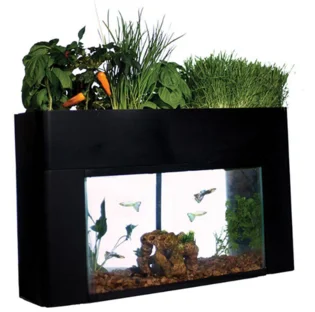
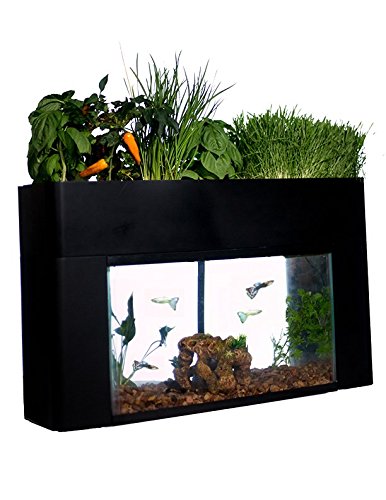
The AquaSprouts Garden is the real deal when it comes to self-cleaning tanks. The concept is simple: fish waste feeds the plants in the grow bed above, the plants clean the water, and that water cycles back down. It’s actual aquaponics, not marketing spin. The 10-gallon capacity gives you enough space for a small school of fish and a grow bed large enough to produce herbs, lettuce, or leafy greens year-round.
The custom-molded grow bed fits neatly over a standard 10-gallon tank. The included light bar extends to accommodate taller plants, which removes the dependency on natural light placement. The water pump pushes dirty tank water up to the clay pebble grow media, the plants process the nutrients, and aerated clean water drains back down. When it’s running right, you’re doing occasional water top-offs and plant maintenance, not weekly gravel vacuuming.
One honest note: the 10-gallon tank is not included. You’ll need to purchase one separately. That’s the main surprise buyers encounter. The kit also costs more than most beginner tanks. It’s made in the USA and worth the price, but set your budget accordingly.
Pros
- Genuine aquaponic biology, not just clever filtration
- Grows vegetables year-round
- Extensible light bar, no window placement required
Cons
- Tank sold separately
- Higher price point
2. Back To Roots Water Garden
Back To The Roots Water Garden
Best value aquaponic kit. Combines self-cleaning biology with an accessible price point. Ideal for one small fish.
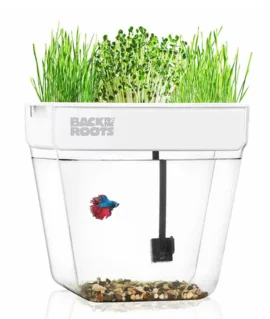
If the AquaSprouts price stops you, the Back to the Roots Water Garden is the smart alternative. Same aquaponic biology, smaller scale. At 3 gallons, it supports one small fish comfortably. The kit comes with everything you need to start, and the fish waste feeds the plants above on the same cycle. It doesn’t have a light bar, so you’ll need to place it near a window or clip on a grow light. That’s the main limitation at this price point.
This tank works best as a desk or counter setup. One betta, one plant tray, manageable maintenance. If you want to grow full vegetables, move up to the AquaSprouts. But for the entry-level price, the Back to Roots delivers real aquaponic function that most “self-cleaning” tanks don’t come close to matching.
Pros
- Accessible price point
- Complete kit, ready to start
- Real aquaponic self-cleaning biology
Cons
- 3 gallons limits fish options to one small fish
- No included light stand
3. biOrb Classic Aquarium Kit

biOrb Classic Aquarium
Budget Option
OASE’s best-in-class bottom-up filtration in a simple bowl format. Not true aquaponic self-cleaning, but excellent low-maintenance filtration design.
I’m not a fan of fish bowls. The biOrb Classic by OASE is one of the few exceptions I’ll make. OASE builds serious filtration equipment, and they brought that engineering discipline to this small tank. The bottom-up filtration design pulls dirty water to the bottom and pushes filtered water out the top, which is how professionally designed commercial pond systems work. At 4 gallons, it’s appropriately sized for a betta or a small group of nano fish.
This isn’t aquaponic self-cleaning. The biology here is purely filtration-based. But the filtration is genuinely well-designed for the size. With the right low-light plant setup, the biOrb can get close to a planted self-sustaining system. Without plants, you’re still doing water changes, just less frequently than with a cheaper comparable tank.

Pros
- OASE engineering, best filtration design at this size
- 4 gallons, appropriate for a betta
- Complete kit with lighting and pump
Cons
- Not genuinely self-cleaning without plants
- Won’t grow vegetables
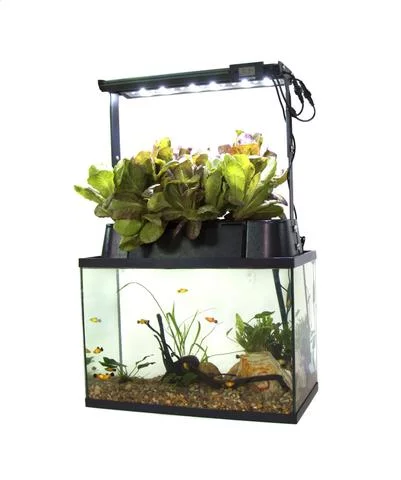
4. EcoLife Aquaponics Indoor Garden System
ECO-Cycle Garden System
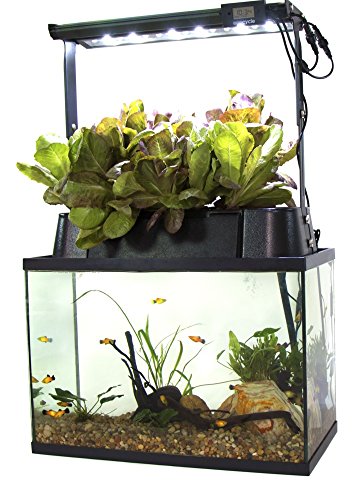
The largest aquaponics kit available. Supports a 20-gallon tank with LED grow lighting included. Real vegetable production capacity.
The EcoLife Aquaponics Indoor Garden System is the heavy hitter on this list. It supports a 20-gallon aquarium, giving you enough capacity for a real fish community, not just one or two fish. The included LED grow light is a natural spectrum fixture, so it complements your living space instead of blasting that purple-pink grow light glow across the room. At 20 gallons, this is the only aquaponic kit on the list where goldfish are a realistic option, though goldfish grow large and add substantial bioload over time.
The price is the sticking point. It’s the most expensive kit on this list by a significant margin. For that reason I don’t put it at the top overall. But if budget isn’t the constraint and you want maximum aquaponic capacity, this is the setup to buy.
Pros
- 20 gallons, largest aquaponic kit available
- Natural spectrum LED grow light included
- Serious vegetable production capacity
Cons
- Most expensive option on this list
- Tank not included
- Large footprint
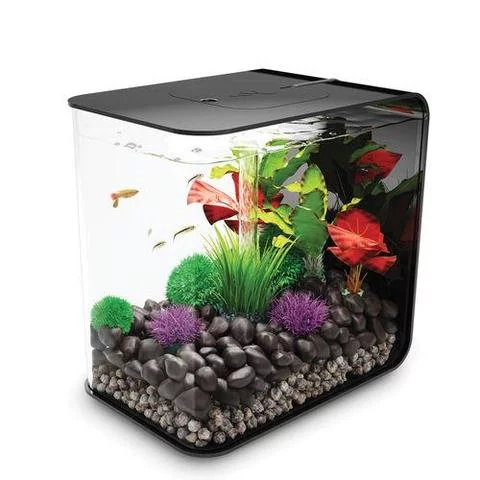
5. biOrb Flow
biOrb Flow
Step up in size from the Classic. Acrylic construction makes it lightweight. Best biOrb if you want more fish room.
The biOrb Flow is the same bottom-up filtration system as the Classic, scaled up to 8 gallons and built with acrylic instead of glass. Acrylic gives you better optical clarity than most low-iron glass tanks and makes the tank lightweight enough to move without the structural risk of glass. At 8 gallons, you have meaningful room for a small community: a trio of nano fish, or a betta with some shrimp.
Like the Classic, this is a filtration-based system, not aquaponics. You’re still doing water changes. The selling point is ease: clean setup, quality filtration, and durable build from OASE. Choose the Flow over the Classic when you want more swimming space. Choose the Classic when counter space is the limiting factor.
Pros
- 8 gallons, meaningful fish room
- Acrylic: lightweight and highly clear
- Same quality OASE filtration as the Classic
Cons
- More expensive than comparable glass tanks
- Not genuine aquaponic self-cleaning
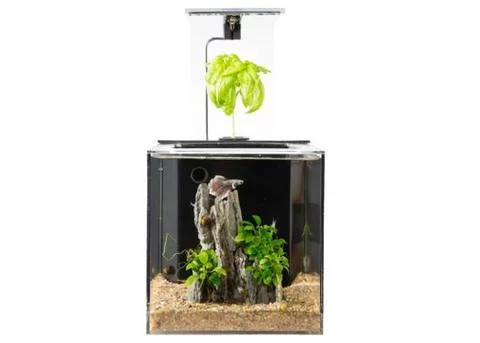
6. EcoQubeC Aquarium
The EcoQube has the right idea and the wrong execution. The filtration box in the rear compartment keeps equipment clean and gives you the clearest front viewing panel of anything on this list. The grow area handles one plant, which limits the aquaponic effect significantly. At 1 gallon, the tank is technically too small for most fish. I don’t recommend any betta in a 1-gallon tank long-term, regardless of what the marketing suggests. If the makers scale this to 3 to 5 gallons in a future version, it becomes a serious contender. For now, it’s a proof of concept.
Pros
- Cleanest internal presentation on this list
- Good included lighting
Cons
- 1 gallon is too small for fish welfare
- Single plant limits aquaponic effectiveness
- Availability can be limited
7. My Fun Fish Tank
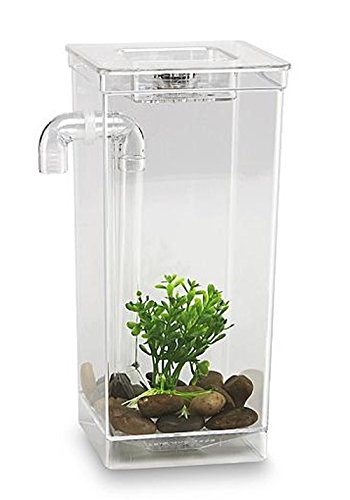
As Seen on TV My Fun Fish Tank
Interesting concept: gravity drains dirty water as you add new water. But at half a gallon, it’s too small for any fish. Ghost shrimp only.
The My Fun Fish Tank uses gravity to drain dirty water when you add fresh water. The mechanism is clever. The size is the problem: half a gallon is not appropriate for keeping fish. I include it here to say clearly: don’t put fish in it. Ghost shrimp at most. It’s a novelty item. If the same gravity-drain mechanism were applied to a 3-gallon tank, it would genuinely challenge the biOrb for the budget spot. But as built, it’s too small to recommend for fish.
Pros
- Genuinely clever gravity drain mechanism
- Very affordable
Cons
- Half a gallon: too small for fish welfare
- Drain mechanism prone to clogging
- Novelty item, not a real aquarium
MARK’S TOP PICK
The AquaSprouts Garden is the clear winner. It’s the only tank on this list where the self-cleaning mechanism is real and scalable: plants doing actual biological filtration at 10 gallons. The Back to Roots Water Garden is the best value if you want the same aquaponic concept at a lower price and smaller scale. If you want a pure filtration-based low-maintenance tank without the aquaponics, the biOrb Classic delivers the best-engineered filtration system in its class.
My Recommendation
The best self-cleaning fish tank is the AquaSprouts Garden. At 10 gallons with real aquaponic biology, it’s the only tank where nature is doing meaningful work for you. The Back to Roots is the best budget option when you want aquaponics at a smaller scale. The biOrb Classic wins the pure filtration category for people who just want the best low-maintenance small tank without the plant element.
Should You Buy a Self-Cleaning Fish Tank?
Good fit if:
- You want to significantly reduce (not eliminate) cleaning time
- You’re interested in aquaponics and growing herbs or greens
- You want a beginner or child-friendly setup that limits the most tedious maintenance tasks
- You have limited time and want a compact system that handles itself between water changes
Avoid if:
- You expect zero maintenance (that tank doesn’t exist)
- You want to keep more than a few fish or larger species
- You already have fish-keeping experience and want a serious aquarium setup
- Your primary goal is a visually impressive display tank
Another Approach: The Low-Tech Planted Tank
There’s another path worth knowing about that doesn’t involve any of these kits. A heavily planted low-tech tank with a light fish load can run for months between water changes. The plants absorb the nitrates, the bacteria handle ammonia, and a modest fish population stays within what the biology can process. I’ve achieved similar results in my own reef tank over the years. In freshwater, the main challenge is fertilization: heavily planted tanks need nutrients, and those often come from water changes. It takes more experience to balance than a kit, but it’s worth considering if you already have some fish-keeping background and want a naturalistic solution rather than an off-the-shelf kit.
WHAT MOST PEOPLE MISS
The self-cleaning tanks that advertise “no water changes ever” are missing one key variable: fish accumulate dissolved solids (TDS) in their water that plants and filters don’t remove. Even the best-running aquaponic system benefits from a 10 to 20% water change every few weeks to reset TDS levels. The tanks on this list reduce your maintenance load significantly. None of them truly eliminate it. Build that expectation in from day one and you’ll get years of satisfaction from these setups. Don’t, and you’ll be disappointed inside of a month.
Frequently Asked Questions
Do self-cleaning fish tanks actually work?
Yes, but not in the way most people expect. Aquaponic models genuinely reduce maintenance because live plants process fish waste as nutrients. Filtration-based models reduce the frequency and effort of cleaning but don’t eliminate water changes. No tank on the market maintains itself completely without any human involvement.
What fish work best in self-cleaning tanks?
Small, low-bioload fish are best: bettas, guppies, endlers, small tetras like neons or embers, and nano species like chili rasboras. Avoid goldfish in small aquaponic kits (they produce too much waste) and any fish that requires warm tropical temperatures if the tank doesn’t have a heater.
How often do you still need to do water changes?
With a properly stocked aquaponic system, every 2 to 4 weeks for a small top-off or partial change. With filtration-only self-cleaning tanks like the biOrb, every 1 to 2 weeks. Neither eliminates water changes entirely.
Can you put a betta in a self-cleaning tank?
Yes, but only in tanks 3 gallons or larger. The Back to Roots Water Garden at 3 gallons is the minimum viable size for a betta. The EcoQubeC at 1 gallon is too small for long-term betta health regardless of its self-cleaning claims.
Are aquaponic tanks hard to set up?
The kits on this list are designed to be beginner-friendly. You still need to cycle the tank before adding fish (2 to 4 weeks), and you’ll need to learn basic plant care. But compared to a full planted aquarium, these systems are significantly more approachable.
Closing Thoughts
Self-cleaning fish tanks are worth the investment if you understand what you’re actually buying. An aquaponic kit like the AquaSprouts Garden genuinely delivers on the promise: living plants doing real biological work to reduce your maintenance load. The biOrb series delivers best-in-class filtration for people who want a low-maintenance tank without the plant element. Skip the half-gallon novelty items entirely. A tank that’s too small for fish isn’t low-maintenance, it’s a fish welfare problem waiting to happen.
If you’re ready to get started, check availability at Flip Aquatics for live plants and livestock to stock your new setup, or browse Dan’s Fish for quality fish suited to smaller tanks. Both are reliable sources I recommend without hesitation.
References
- Seriously Fish: Species profiles and care data
- FishBase: Taxonomy and scientific data
- Practical Fishkeeping: Husbandry and care advice
- About the Author
- Latest Posts

I’m Mark Valderrama, founder of Aquarium Store Depot and a fishkeeper with over 25 years of hands-on experience. I started in the hobby at age 11, worked at local fish stores, and have kept freshwater tanks, ponds, and reef tanks ever since. I’ve been featured in two best-selling aquarium books on Amazon and built this site to share practical, experience-based fish keeping knowledge.
Leave a Reply