
Last Updated: June 27, 2026
Thank you for visiting! By the way… any links on this page that lead to products on Amazon and other stores/partners are affiliate links Aquarium Store Depot earns a commission if you make a purchase.
Five-gallon tanks are tricky because the stocking options are genuinely limited, and I see a lot of bad advice online suggesting fish that have no business being in that small a space. I’ve set up 5-gallon tanks myself for bettas and nano fish, and done right they can look absolutely stunning. The key is respecting the volume and sticking to species actually suited for it.
A 5-gallon tank does not equal easy. It equals less forgiving. Parameters swing faster, ammonia spikes happen faster, and recovery time for mistakes is minimal. This is why I usually recommend these tanks to hobbyists who have already cycled a tank and understand water chemistry, not beginners who want a low-commitment setup.
Expert Take | Mark Valderrama, AquariumStoreDepot
I’ve kept 5-gallon tanks myself, and the ones that look genuinely beautiful have one thing in common: they were built around a single species concept. A male betta in a planted 5-gallon is a showpiece. A school of 10 chili rasboras against dark substrate and stem plants is one of the most visually striking things in the hobby at any tank size. Where people go wrong is trying to stock these tanks like a community aquarium. You can’t. Pick one concept, build the tank around it, and keep up with weekly water changes. That’s the formula.
Key Takeaways
- A 5-gallon tank is not a beginner tank. Small water volume means faster parameter swings and less margin for error. Weekly water changes are non-negotiable.
- Stick to one species concept per setup. A male betta alone, a school of nano fish, or an invertebrate colony. Mixing species in a 5-gallon rarely works well.
- Guppies, neon tetras, and goldfish do not belong in a 5-gallon tank long-term. These are common recommendations that are wrong.
- Chili rasboras, ember tetras, scarlet badis, and pea puffers are genuinely suited for this size. The betta is the most popular choice for good reason.
- Filtration and a heater are required for most species on this list. There are no shortcuts on equipment in a 5-gallon.
How to Think About Stocking a 5-Gallon Tank
ASD 5-Gallon Stocking Tiers
Tier 1 (Best choice for most people): Single male betta. One fish, manageable bioload, massive personality, and genuinely beautiful in a planted 5-gallon. This is the benchmark. Everything else on this list is for people who want something different from a betta.
Tier 2 (Excellent for experienced nano keepers): A species-only school of true nano fish: chili rasboras (10 to 12), ember tetras (8 to 10), or celestial pearl danios (6 to 8). Requires a well-cycled, planted tank and consistent maintenance.
Tier 3 (Invertebrate colony): Cherry shrimp, amano shrimp, or a combination shrimp tank. Low bioload, fascinating behavior, excellent for planted setups. Not fish, but worth including because a 5-gallon shrimp colony is one of the most rewarding setups at this scale.
The 13 Best Fish and Invertebrates for a 5-Gallon Tank
1. Betta Fish
Mark’s Pick: Best Fish for a 5-Gallon Tank
The betta is my top recommendation for a 5-gallon tank, and not just because it’s popular. A male betta in a well-planted 5-gallon with a heater and gentle filtration is genuinely one of the most visually rewarding setups in freshwater fishkeeping. The personality, the finnage, the daily interaction. It’s the full package at a small scale. Keep one male, no other fish, and build the environment around him. You’ll get a fish that recognizes you at the glass and flares at his own reflection for entertainment. Use code ASDFISH at Flip Aquatics for a discount on quality betta stock.
- Scientific Name: Betta splendens
- Adult Size: 2.5 to 3 inches (6 to 7.5 cm)
- Care Level: Moderate
- Temperament: Aggressive toward other bettas; generally peaceful with no tank mates
- Diet: Carnivorous. Feed live or frozen foods, quality pellets
- Origin: Thailand, Vietnam, Cambodia
- Temperature: 75 to 80°F (24 to 27°C)
- Swimming Level: Midwater and top
Betta fish are the most popular fish for nano tanks for good reason. These beautiful fish come in dozens of varieties with different color patterns and fin shapes. You should keep only one male per tank as males are highly aggressive toward each other. Bettas have big personalities, recognize their owners, and can even learn simple behaviors like jumping for food. A 5-gallon is the minimum tank size. A heater and a gentle filter are required.
2. Guppy (Males Only, Trio)
- Scientific Name: Poecilia reticulata
- Adult Size: 2 inches (5 cm)
- Care Level: Easy
- Temperament: Peaceful
- Diet: Omnivore
- Origin: Caribbean and northeastern South America
- Temperature: 63 to 82°F (17 to 28°C)
- Swimming Level: Midwater and top
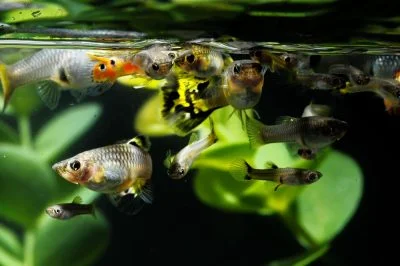
Guppies can work in a 5-gallon, but only as a trio of males without females. If you keep males and females together, you will have a breeding population within weeks and a severely overstocked tank shortly after. Three males in a well-maintained 5-gallon, no females, is a reasonable setup with a lot of color movement. The males are smaller and significantly more colorful than females.
3. Chili Rasbora
- Scientific Name: Boraras brigittae
- Adult Size: 0.8 inch (2 cm)
- Care Level: Easy
- Temperament: Peaceful
- Diet: Carnivore. Live or frozen micro-foods, quality micro pellets
- Origin: Southeast Asia (Borneo)
- Temperature: 68 to 82°F (20 to 28°C)
- Swimming Level: Midwater
Chili rasboras are one of the smallest fish in the hobby at under 1 inch (2.5 cm). In a planted 5-gallon with dark substrate, a school of 10 to 12 chili rasboras is one of the most visually striking nano setups you can build. They are peaceful enough to coexist with shrimp and snails. Keep them in a species-only setup as they struggle to compete for food with larger fish. No heater required in most homes.
4. White Cloud Mountain Minnow
- Scientific Name: Tanichthys albonubes
- Adult Size: 1.5 inches (4 cm)
- Care Level: Easy
- Temperament: Peaceful
- Diet: Omnivore
- Origin: China
- Temperature: 58 to 72°F (14 to 22°C)
- Swimming Level: Midwater
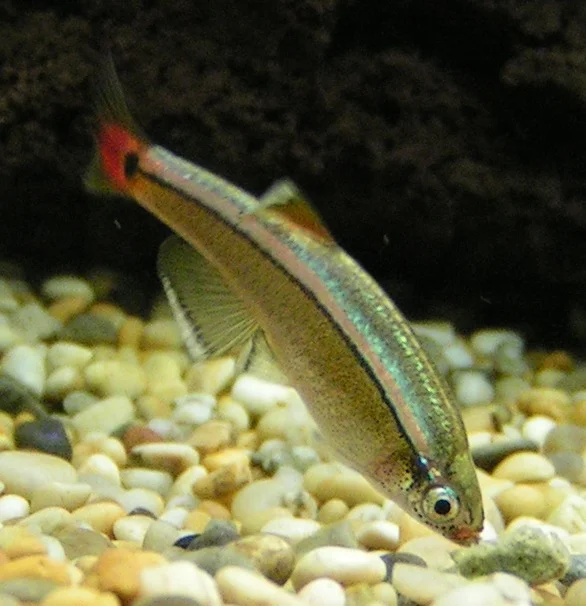
White cloud minnows are beautiful, cold-tolerant fish that work in a 5-gallon without a heater. They prefer cooler water than most tropical species (58 to 72°F / 14 to 22°C), which actually makes them a better choice than bettas for rooms that run cool. Keep a small group of four. These fish look better in a group than alone.
5. Scarlet Badis
- Scientific Name: Dario dario
- Adult Size: 0.5 to 0.75 inches (1.2 to 2 cm)
- Care Level: Moderate to advanced
- Temperament: Semi-aggressive (males territorial with each other)
- Diet: Carnivore. Needs live or frozen micro-foods. Rarely accepts dry food.
- Origin: India
- Temperature: 64 to 79°F (18 to 26°C)
- Swimming Level: Bottom and midwater
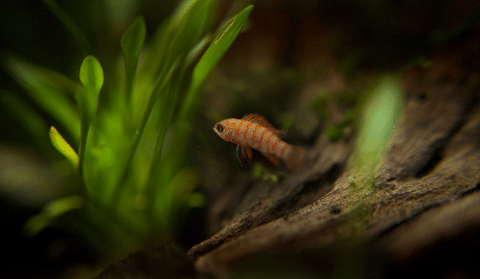
Scarlet badis are tiny fish with exceptional color. The males are among the most vibrantly colored fish available at this size. The catch: they will rarely eat dry food. You need to be prepared to feed live or frozen micro-foods (micro worms, baby brine shrimp, daphnia) consistently. They are also shy and poor competitors, so keep them in a species-only setup with one male and a group of females.
6. Dwarf Pea Puffer
- Scientific Name: Carinotetraodon travancoricus
- Adult Size: 1 inch (2.5 cm)
- Care Level: Moderate
- Temperament: Aggressive. Species-only tank required.
- Diet: Carnivore. Live and frozen foods. Snails for beak maintenance.
- Origin: India
- Temperature: 72 to 82°F (22 to 28°C)
- Swimming Level: Midwater
Dwarf pea puffers are tiny fish with a predator brain. They will attack anything they perceive as competition or prey, which means no tank mates. One pea puffer in a planted 5-gallon is an excellent single-species setup. They need live and frozen foods (brine shrimp, bloodworms, micro-worms, and snails to keep their beaks worn down). Their curiosity and intelligence make them one of the most engaging fish in the hobby at this scale.
7. Celestial Pearl Danio
- Scientific Name: Celestichthys margaritatus
- Adult Size: 0.75 inch (2 cm)
- Care Level: Moderate
- Temperament: Peaceful (males can be territorial with each other)
- Diet: Omnivore
- Origin: Myanmar
- Temperature: 68 to 78°F (20 to 26°C)
- Swimming Level: Midwater
Celestial pearl danios are stunning. Pearl-spotted bodies with red-orange fins. In a planted 5-gallon, a group of 6 to 8 looks genuinely remarkable. They are shy, so dense plant cover is important for natural behavior and color expression. Males are territorial with each other, so provide enough visual breaks in the planting. Safe with shrimp.
8. Cherry Shrimp
- Scientific Name: Neocaridina heteropoda
- Adult Size: 1.5 inches (4 cm)
- Care Level: Easy
- Temperament: Peaceful
- Diet: Omnivore. Biofilm, algae, shrimp pellets.
- Origin: Taiwan
- Temperature: 65 to 85°F (18 to 29°C)
- Swimming Level: Bottom
Cherry shrimp are an excellent alternative to fish for a 5-gallon tank. Start with 10 to 15 shrimp in a planted setup and they will breed and establish a self-sustaining colony. Keep them in a shrimp-only tank. Most fish will prey on them, including fish typically considered peaceful. A shrimp colony in a planted 5-gallon with dark substrate is genuinely beautiful and low maintenance once established.
9. Amano Shrimp
- Scientific Name: Caridina multidentata
- Adult Size: 2.5 inches (6 cm)
- Care Level: Moderate
- Temperament: Peaceful
- Diet: Omnivore. Excellent algae eater.
- Origin: East Asia
- Temperature: 65 to 85°F (18 to 29°C)
- Swimming Level: Bottom
Amano shrimp are the best algae-eating shrimp available. They are more durable than cherry shrimp and do excellent work in planted tanks. In a 5-gallon, 3 to 5 Amano shrimp can coexist with a male betta (usually), though individual betta temperaments vary and some will hunt shrimp. Introduce the shrimp before the betta and provide dense planting for refuge.
10. Female Betta (Single)
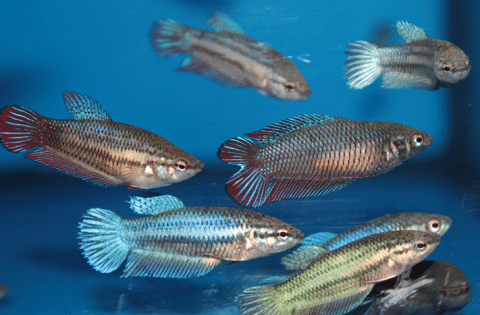
Female bettas are less aggressive than males and can be kept alone in a 5-gallon as a quieter alternative. Less dramatic fins and colors than the males, but still a good-looking fish with genuine personality. Do not attempt a female sorority in a 5-gallon. The minimum for a sorority is a 20-gallon long, and even then it requires careful management.
11. Endler’s Livebearer (Males Only)
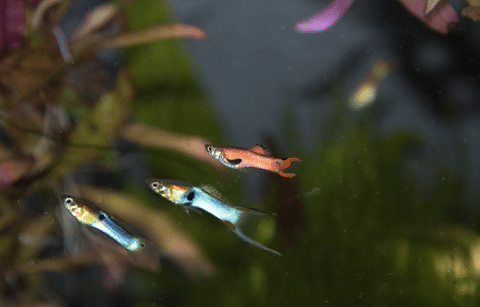
- Scientific Name: Poecilia wingei
- Adult Size: 0.75 to 1.25 inches (2 to 3 cm)
- Care Level: Easy
- Temperament: Peaceful
- Diet: Omnivore
- Origin: Venezuela
- Temperature: 75 to 86°F (24 to 30°C)
- Swimming Level: Midwater and top
Endler’s livebearers look like small, vivid guppies and are one of the best-colored nano fish available. Males only in a 5-gallon. If you add females, breeding will quickly overstock the tank. A group of 4 to 5 males in a planted 5-gallon is active, colorful, and low maintenance.
12. Ember Tetra
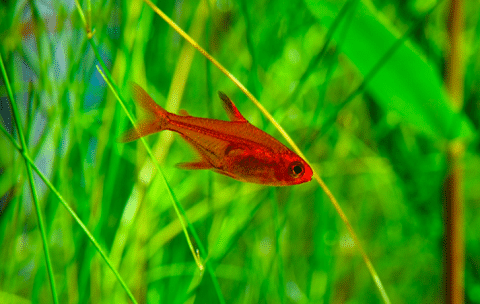
- Scientific Name: Hyphessobrycon amandae
- Adult Size: 0.8 inches (2 cm)
- Care Level: Easy
- Temperament: Peaceful
- Diet: Omnivore
- Origin: Brazil
- Temperature: 68 to 82°F (20 to 28°C)
- Swimming Level: Midwater
Ember tetras are small, orange-red, and peaceful. In a planted 5-gallon, a school of 8 to 10 ember tetras is visually striking and bioload-appropriate. They prefer planted tanks where they feel more comfortable and color up better. A dark substrate and soft lighting bring out their best coloration.
13. Emerald Dwarf Rasbora
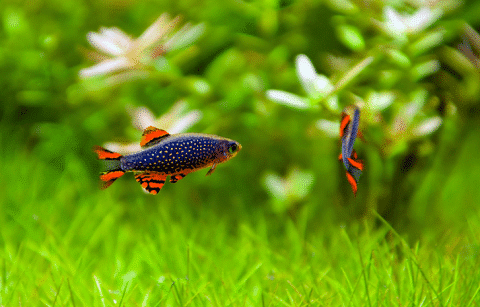
- Scientific Name: Microrasbora erythromicron
- Adult Size: 0.8 inches (2 cm)
- Care Level: Moderate
- Temperament: Peaceful (males can be territorial)
- Diet: Omnivore
- Origin: Myanmar
- Temperature: 68 to 75°F (20 to 24°C)
- Swimming Level: Bottom and midwater
The emerald dwarf rasbora is an amazing nano fish species with turquoise body banding and orange-red fins. They need higher pH water (7.0 to 7.5) and appreciate a densely planted tank. They are shy, so live plants are important for natural behavior. A group of 6 to 8 works well in a 5-gallon planted setup.
What Does NOT Work in a 5-Gallon Tank
Avoid These in a 5-Gallon Tank
- Goldfish. Goldfish are cold water fish that grow to 6 to 12 inches (15 to 30 cm) and produce enormous waste. A single goldfish in a 5-gallon is inadequate on every metric. This is one of the most common and most damaging beginner mistakes.
- Neon tetras (school). Neon tetras need a minimum school of 8 to 10 fish to be comfortable, and they need a mature, stable tank. A 5-gallon with 10 neon tetras is overcrowded and produces more ammonia than most filtration systems can handle properly. Neons belong in a 10-gallon minimum.
- Guppies with females. A trio of males only works. Any female added will trigger breeding and you will have dozens of fry within weeks.
- Corydoras catfish. Corydoras are schooling fish that need a group of 5 to 6 minimum. That is too many fish for a 5-gallon bioload. They belong in a 20-gallon+.
- Any fish over 1.5 inches (4 cm) in groups. The bioload math does not work. At this tank size, larger fish in groups exhaust the system rapidly.
Choosing Your 5-Gallon Concept: Side-by-Side Comparison
| Species | Group Size | Heater Required | Shrimp Safe | Difficulty | Best For |
|---|---|---|---|---|---|
| Betta (male) | 1 | Yes | Sometimes | Moderate | Most hobbyists |
| Chili rasbora | 10 to 12 | No (cool room ok) | Yes | Easy | Planted nano builds |
| Ember tetra | 8 to 10 | Yes | Yes | Easy | Planted community look |
| Pea puffer | 1 | Yes | No | Moderate | Personality fish keepers |
| Cherry shrimp colony | 10 to 20 | No | Shrimp only | Easy | Low-maintenance planted |
| Scarlet badis | 1 male + 2-3 females | Yes | Yes | Advanced | Experienced nano keepers |
How to Set Up a 5-Gallon Tank
Filtration
A filter is required. No exceptions. In a 5-gallon tank, ammonia builds fast. Your options are a hang-on-back filter sized for the tank (look for low-flow models with adjustable output), a small internal power filter, or a sponge filter powered by an air pump. The sponge filter is my preference for nano tanks: gentle flow, easy to clean, and provides surface area for beneficial bacteria. Use a pre-filter sponge on any intake to prevent small fish and shrimp from being pulled in.
Heating
For tropical species (bettas, chili rasboras, ember tetras, pea puffers), a small 25-watt adjustable heater is essential. Temperature swings in a 5-gallon happen fast. A heater maintains the stability your fish need. Always pair with a thermometer. The Fluval Spec V is a solid all-in-one option if you want the tank, light, and filtration in one package.
Plants and Substrate
Live plants are strongly recommended in a 5-gallon. They absorb ammonia and nitrates, provide hiding cover that reduces stress, and dramatically improve the visual quality of the tank. Good low-maintenance options for a 5-gallon: java fern, anubias nana, java moss, and bucephalandra. None of these require CO2 injection or high-output lighting.
Dark substrate (dark gravel or black sand) makes nano fish and shrimp look their best. It also reduces stress in naturally shy species like chili rasboras and scarlet badis.
Aquarium Maintenance in a 5-Gallon: The Hard Truth
Weekly water changes are not optional in a 5-gallon tank. This is the single biggest factor in keeping fish healthy at this scale. Change 20 to 30% of the tank volume every week. Vacuum the substrate during water changes to remove waste buildup. Match the temperature of the replacement water to the tank before adding it, and treat with a water conditioner to neutralize chlorine and chloramine.
Test your water weekly for ammonia, nitrite, and nitrate. Both ammonia and nitrite should read zero in a properly cycled tank. Nitrate should stay below 20 ppm with weekly water changes. If ammonia or nitrite are reading above zero, you have a problem that needs to be addressed immediately. In a 5-gallon, these numbers can rise to dangerous levels within 24 to 48 hours.
Where to Buy Fish for Your 5-Gallon
Most of the fish on this list are easy to find at local aquarium stores, but true nano fish like chili rasboras and scarlet badis can be harder to track down. These are my recommended online sources:
FAQ
How many fish can you keep in a 5-gallon tank?
It depends entirely on the species. One male betta is the right number for that species. Ten chili rasboras works well. For schooling nano fish like ember tetras, 8 to 10 is appropriate. The old inch-per-gallon rule is not a reliable guide. Focus on bioload and adult size, not fish count.
Can you keep 2 fish in a 5-gallon aquarium?
For most species, the answer is no. Two fish creates a community dynamic that 5 gallons cannot support well. The exception is male-only livebearers (2 to 3 males of endlers or guppies). Bettas and pea puffers are always solo in a 5-gallon.
Is a 5-gallon tank big enough for a betta?
Yes. A 5-gallon is a perfectly good betta tank. It’s significantly better than the small cups or 1-gallon bowls bettas are often sold in. A heater, a gentle filter, and live plants make a 5-gallon an excellent home for a single male betta.
What else can live in a 5-gallon besides fish?
Cherry shrimp, amano shrimp, and freshwater snails (nerite snails, mystery snails) all work well. A 5-gallon shrimp colony with a few nerite snails and dense planting is one of the most low-maintenance setups you can build at this scale.
Do I really need weekly water changes in a 5-gallon?
Yes. Weekly water changes are the most important maintenance task in a nano tank. The smaller the water volume, the faster water quality degrades. Skipping water changes in a 5-gallon leads to ammonia and nitrate buildup that will stress or kill your fish faster than in larger tanks. There is no workaround for this.
Final Thoughts
A 5-gallon tank done right is one of the most satisfying setups in the hobby. The key word is done right. Pick one species concept, build the environment around that species, and commit to the maintenance schedule. A male betta in a planted 5-gallon, a school of chili rasboras against dark substrate, or a shrimp colony in a lush planted setup. All three are genuinely beautiful. All three require respect for the constraints of the tank size.
What does not work is treating a 5-gallon like a small community tank. The volume is too limited for that. Choose your concept, do it well, and the tank will reward you for it.
Where to Find 5-Gallon Nano Fish
True nano fish can be hard to find locally. These suppliers reliably stock the species on this list:
- Flip Aquatics – Quality livestock with a 30-day guarantee. Good source for bettas, chili rasboras, ember tetras, and shrimp. Use code ASDFISH for a discount.
- Dan’s Fish – Reliable for nano fish and specialty invertebrates that can be hard to find locally.
- About the Author
- Latest Posts

I’m Mark Valderrama, founder of Aquarium Store Depot and a fishkeeper with over 25 years of hands-on experience. I started in the hobby at age 11, worked at local fish stores, and have kept freshwater tanks, ponds, and reef tanks ever since. I’ve been featured in two best-selling aquarium books on Amazon and built this site to share practical, experience-based fish keeping knowledge.


Leave a Reply