
Last Updated: June 25, 2026
Thank you for visiting! By the way… any links on this page that lead to products on Amazon and other stores/partners are affiliate links Aquarium Store Depot earns a commission if you make a purchase.
Rainbow Sharks are territorial bottom dwellers that get more aggressive with age. The cute juvenile at the pet store becomes a tank bully within months.
Rainbow sharks are not sharks. They are territorial bottom dwellers with an attitude problem.
Rainbow sharks are not sharks. They are territorial bottom dwellers with an attitude problem.
Table of Contents
- What Most Care Guides Get Wrong About Rainbow Shark What to Know Before Adding One to Your Tank
- Brief Overview of Rainbow Sharks
- Classification
- Origin and Natural Habitat
- What Do They Look Like?
- How Big Can They Get?
- How Long Do They Live?
- Temperament and Activity Level
- What are Good Tank Mates for Them?
- What do they eat?
- Albino
- Breeding
- Care
- Diseases
- FAQs
- Is the Rainbow Shark What to Know Before Adding One to Your Tank Right for You?
- How the Rainbow Shark What to Know Before Adding One to Your Tank Compares to Similar Species
- Final Thoughts
- The Reality of Keeping Rainbow Shark
The Rainbow Shark looks ordinary in a store and transforms in a proper tank. After keeping rainbowfish for decades, I know the difference between a washed-out store specimen and a fully colored adult is staggering. This guide covers exactly what you need to bring out its best.
Store rainbowfish look nothing like properly kept adults. The transformation takes patience.
Keeping Rainbow Shark long-term requires consistent water quality, proper diet, and a tank that meets their specific needs. This is not a set-and-forget species.
When kept right, the Rainbow Shark is one of those fish that makes the entire hobby worth it.
Let’s get started!
What Most Care Guides Get Wrong About Rainbow Shark What to Know Before Adding One to Your Tank
The biggest mistake I see with rainbow shark what to know before adding one to your tanks is underestimating their aggression. Guides will label them “semi-aggressive” and move on. In practice, that label doesn’t tell you much. Tank layout, stocking density, and territory management all play a huge role in whether these fish coexist or constantly fight. Tank size is another area where most guides get it wrong. The minimum listed on most care sheets is exactly that, a minimum. For long-term success, especially if you’re keeping a group, I always recommend going at least one size up from whatever the guide suggests. Finally, diet gets oversimplified. Pellets alone won’t cut it. In my 25+ years keeping fish, I’ve found that variety in diet directly affects color, growth, and overall vitality. Include frozen foods, quality pellets, and occasional vegetable matter for the best results.
The Reality of Keeping Rainbow Shark
This species has specific needs most generic guides skip. The Rainbow Shark does not thrive in average community conditions. It needs targeted water parameters, the right diet, and compatible tank mates. Half-measures lead to chronic stress and shortened lifespans.
Observation is your best tool. Watch this fish daily. Changes in color, activity level, or feeding response tell you more about water quality and health than any test kit alone.
Long-term success requires consistency. Regular maintenance, stable parameters, and a consistent feeding schedule are the foundation of keeping the Rainbow Shark healthy for years.
Biggest Mistake New Owners Make
Treating this fish like a generic community species. The Rainbow Shark has specific requirements that differ from the typical tropical fish setup. Ignoring those differences leads to problems within the first few months.
Expert Take
After 25 years of keeping Rainbow Shark, the single most important factor is consistency. Stable parameters, regular feeding, and a maintenance schedule you actually follow matter more than any piece of equipment.
Brief Overview of Rainbow Sharks
| Scientific Name | Epalzeorhynchos frenatum |
| Common Names | Ruby shark, Red-finned shark, rainbow sharkminnow, green fringelip labeo, whitefin shark, and whitetail sharkminnow. |
| Family | Cyprinidae |
| Origin | Mekong, Chao Phraya, Xe Bangfai, and Maeklong in Indochina |
| Diet | Omnivore |
| Care Level | Moderate |
| Activity | High/ very active |
| Lifespan | 5 to 8 years (approx.) |
| Temperament | Aggressive / Dominant |
| Tank Level | Bottom |
| Minimum Tank Size | Min. 50 gallons |
| Temperature Range | 72 ° F to 80 °F |
| Water Hardness | 5 to 11 dH |
| pH Range | 6. 8 |
| Filtration/Water Flow | Fast (mimicking the river basins) |
| Water Type | Freshwater |
| Breeding | Egg-layer |
| Difficulty to Breed | Difficult to breed |
| Compatibility | Moderate (get along with freshwater fish of the same size) |
| OK, for Planted Tanks? | Yes, especially for hard-leaved vegetation |
Classification
| Order | Cypriniformes |
| Family | Cyprinidae |
| Genus | Epalzeorhynchos |
| Species | E. Frenatum (Fowler, 1934) |
Origin and Natural Habitat
Rainbow shark (Epalzeorhynchos frenatum) is nothing like true sharks; they are freshwater fish, live peacefully with their kin, and feed on algae and plankton. However, they were named after the mighty sharks because of the upright dorsal fin that strikes a close resemblance to sharks while swimming.
The rainbow sharks originated from Southeast Asia, particularly Thailand, and are now commonly found in the freshwater basins of Mekong, Chao, Phraya, Xe Bangfai, and Maeklong.
Unfortunately, the habitat destruction in the wild resulted in the decreased population of rainbow sharks. However, in nature, they are bottom dwellers and mostly live in sandy substrates.
Even though rainbow fish is a peaceful breed, it gets territorial and might give a tough time to their smaller tank mates. Therefore, it’s a good idea to keep a few fish in the aquarium, that is closer to their own size. Also, rainbow sharks are a little high-maintenance and might pose a challenge to novice fish keepers.
So, choose wisely!
What Do They Look Like?
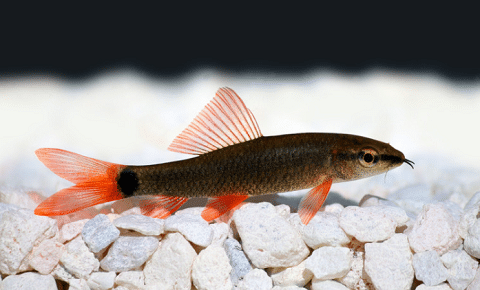
As I mentioned before, Rainbow sharks are commonly known as red-finned sharks, which earned their name because of the dorsal fin.
And if you see them swimming, you might mistake them for baby ocean sharks for once!
However, rainbow sharks are small and have elongated and slender backs with flat stomachs. Their fins, as the name suggests, are bright red with somewhat orangish hues. The bright red-orangish fins pop out against their dull grey bodies.
The dorsal fins of rainbow sharks comprise 11 branched rays with a prolonged fin tail. Like ocean sharks, the rainbow shark’s face is flat, but the snout is somewhat rounded along with an elongated body that tapers off at the tail.
What’s the difference between the males and females?
Before stating the differences here, I’d like to emphasize that male rainbow sharks are very dominant and aggressive toward their gender. Therefore, I always recommend keeping rainbow sharks carefully; one male in a tank is enough!
Coming back to the variations, there’s not much to name their gender, especially for juvenile rainbow sharks. To clearly reveal the gender, it’s always best to wait until the sharks grow completely and reach adulthood.
An adult rainbow shark has a thin body with bright red-colored fins and black lines on its tailfins. Comparatively, female rainbow sharks possess faded coloration with more pronounced bellies and the black, grey lines on the tailfins are absent in females.
How Big Can They Get?
After about 2 years, rainbow shark reaches its full potential size, which is approximately 6 inches in length. In some rare cases, the rainbow shark might grow as long as 8 inches. However, they only get that large in bigger tanks.
In any case, due to their size and active behavior, large aquarium tanks are a necessity for rainbow sharks.
Interestingly, both male and female red-tail sharks are almost the same size in all varieties, and they sexually mature when they are four inches in length.
How Long Do They Live?
Under favorable conditions, rainbow sharks have proven to live for approximately 5-8 years in captivity. However, few claims suggest they live longer in nature.
The lifespan of rainbow sharks depends on:
- Overall tank and water environment
- Diet rich in vegetable and protein matter
- Perfect sandy substrate for bottom-dwelling
Temperament and Activity Level
One thing that I genuinely love about the Rainbow shark breed is its agile and lively nature (video source).
Also, since they are bottom dwellers, they enjoy their time in the water grazing for food.
Therefore, many aquarists discourage tanks or aquariums for the rainbow shark as the confined space might trigger their aggressive side. As a result, they might attack smaller sharks and ultimately kill them.
Nonetheless, if you want to keep a group in home aquariums, make sure to install a large tank.
Mature ones are territorial
Juvenile rainbow sharks are social and get along with other fish pretty well.
But as soon as they reach adulthood, they become standoffish and solitary, asserting dominance in the presence of other fish.
To cater to this, I advise making tunnels, caves, and crevices for hiding. Also, it’s advisable to plant dense and healthy vegetation for the well-being of other fish and thriving a healthy community that involves fewer accidents.
What are Good Tank Mates for Them?
Well, if you ask me, I’d say, no mates are always better!
You might argue that they get along with true loaches and plecos really well.
Yes, I agree!
But in the wild only. In captivity, the rainbow sharks are quite aggressive and territorial. And like I mentioned before, they are bottom-dwellers; they don’t enjoy the company of other scavengers.
And this brings me to the conclusion that bottom dwelling tank mates should always be avoided for Rainbow sharks.
However, if you’re still adamant, I advise you to introduce your red-fin shark to a pre-occupied tank with only a few fish to reduce the likeliness of harassment.
Red-fin sharks are compatible with upper and middle tank dwellers, including.
- Danios
- Rasboras
- Gouramis
- Barbs
- Rainbowfish
- Clown Loach
- Indian Loach
- Snails
Also, while introducing rainbow sharks to their tank mates, be wary of their size and personality so that they could defend themselves.
Least Compatible Tank Mates
The worst tank mates for Rainbow sharks are shy and small fish, which are easily dominated.
Also, avoid bottom dwellers, very large, and aggressive tank mates including.
What do they eat?
The fact that rainbow sharks are omnivorous makes them voracious eaters. Also, they are not finicky and enjoy plants and prey.
The feeding habits in their native habitat rely on decaying plants, plankton, algae, insects, larvae, worms, and much more.
However, in captivity, since we target good coloration and a healthy lifespan, it’s best to include high-quality vegetable and protein matter.
For exquisite coloration and luster, I recommend feeding plants to the fish, such as lettuce, cucumber, cabbage, etc.
Also, they are bottom-dwellers, so make sure you get sinking pellets so they don’t miss out on some good nutritional diet.
Juveniles should munch on a protein-rich diet (brine shrimp, worms, and live food) to remain healthy and become brighter and stronger as they age.
However, since rainbow sharks are scavengers, they sometimes might overeat, which results in some illnesses. Therefore, it’s best to start feeding once a day to understand their pattern and adjust the diet accordingly.
Normally 2 feeding sessions a day comprising 5 minutes of feeding works the best for rainbow sharks.
Below is the list of recommended food you should incorporate into the diet of your rainbow shark.
- Insect larvae
- Algae (tablets/wafers)
- Bloodworms
- Tubifex Worms
- Brine Shrimp
- Daphnia
- Artemia
- Pellets
- Flakes
- Vegetables (peas, cucumber, zucchini, lettuce, and spinach)
Albino
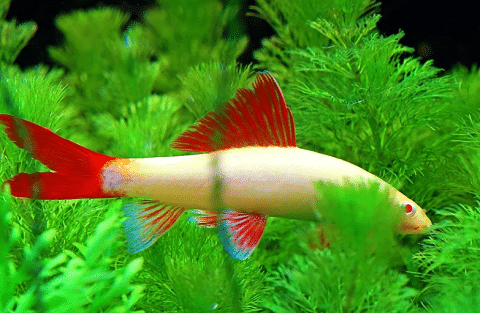
The most common and popular variation of Rainbow sharks is the Albino variant.
The Albino rainbow shark possesses white abdomens with bright red eyes and fins that make them stand out in the tank. Though the variety is extremely rare, it is fondly loved by aquarists.
Albinos are very active, bottom-dwellers that feed on biofilm, plankton, and other organisms in the freshwater. Juvenile Albinos are sociable and amicable. However, as they age, they become more distant and aloof. Hence, they don’t get along with fish of their own kind including Flying Foxes, and Siamese bottom feeders.
If you’re planning on keeping your Albinos in a small tank, think again!
Albino rainbow shark is known to be a very active jumper, so it demands large tanks with ample water flow and decent filtration. I also recommend installing protective aquarium lids, just so you don’t have to deal with accidents.
As long as the diet of Albinos is, get your fresh veggies ready, as Zucchini, Cucumber, and other high-quality vegetable and protein matter (brine shrimps, frozen bloodworms) are ideal for Albino Rainbow Sharks.
Personally, I would recommend Albino Rainbow shark to experienced fish keepers because:
- High-maintenance
- Slightly aggressive
Breeding
Let me be very honest here.
If you’re raising rainbow sharks for the purpose of breeding, it’s time to move on!
That’s because the chances of breeding rainbow sharks, especially in captivity, are close to none.
Firstly, in their juvenile years, it’s impossible to distinguish between males and females. Secondly, rainbow sharks are so dominant and aggressive that they barely allow other fish to share the tank.
Therefore, there are few successful results of breeding rainbow sharks in aquariums (video source).
In nature, it’s a different story.
Rainbow sharks or Ruby sharks, like mentioned earlier, reach their sexual maturity as soon as they are 4 inches. The females lay eggs and males fertilize them later.
The ideal breeding months of Rainbow sharks are October and November. Thereafter the male fertilizes the eggs and the eggs are then transferred to a separate tank until the fry appears after a week.
The fry depends on high-quality protein so that they develop vibrant red fins and a healthy luster.
Care
Luckily, you don’t need to care much about the rainbow shark as it enjoys its own company and eats whatever is accessible to them.
However, if you are someone who believes in the healthy nurturing of their pet fish, the tank size, balanced, and water quality of the aquarium should be your top priority.
Tank Size
While keeping the rainbow shark, know that we don’t start small here.
That being said, 50 gallons tank size is the bare minimum, that too for one rainbow shark.
If you’re planning on keeping multiple rainbow sharks, be sure to provide substantial tank space.
Also, the length of your tank should at least be four feet long and 18 inches wide, considering a single fish.
Since rainbow shark is an active jumper and avid swimmer, it’s best to keep the tank big and wide so that your adorable red-finned pets can get the most of their lives.
Water Parameters
An interesting factor that keeps most aquarists from raising rainbow sharks is their fondness for their natural environment.
It’s almost impossible to recreate the natural conditions for rainbow sharks to reduce their aggression and dominance.
However, all we can do is try!
Rainbow sharks originally come from Southeast Asia’s freshwater basins where the water temperature ranges between 72°F to 82°F.
Therefore, the optimal water temperature for the rainbow shark falls somewhere between 77°F.
So, I suggest maintaining the water temperatures of your tank between 72°F to 82°F with the help of a premium heater that sets the temperature effectively.
Also, in the wild, these sharks enjoy river water that flows at a higher speed.
Therefore, maintain the water movement of the tank between moderate or fast to mimic their natural habitat.
Water pH and Hardness
Water pH and hardness are essential to maintain for keeping rainbow sharks calm and stress-free.
The ideal pH level ranges between 6 to 8 pH while the water hardness should be no less or more than 5 to 11 dH.
Substrate and Water Flow
Being a freshwater fish, the rainbow shark loves sandy bases. Also, many aquarists believe that’s a plus point because the sand is easy to clean and seldom collects food and other fish food waste that may be harmful to your fish.

Natural sand is excellent for bottom feeder fish to forage around in.
Besides sand, you may opt for round gravels that are not too edgy or sharp to avoid potential injuries.
Additionally, as I mentioned before, the water flow should also be maintained to entertain your rainbow shark. I recommend installing small jets and air-stones to control the constant water pressure and flow.
If your tank houses more than one rainbow shark and is over 125 gallons, you can make use of controllable wavemakers, including EcoTech, IceCap, and several others.
Aquascape Decors
If you want to keep Rainbow sharks as your pet, I cannot stop stressing enough about recreating their natural habitat as they get quite upset in plain captivity.
The river basins in Thailand are filled with hiding places and natural vegetation. Therefore, you should consider freshening up the aquarium experience.
The sandy substrates help their scales from damaging when they are scavenging at the bottom and the hiding places give them plenty of space to spend their time in solitude.
I recommend setting up a tank with driftwood, boulders and pebbles, caves, and rock formation with lots of other decorations to keep your red-finned shark busy and happy.
Aquatic plants with hard foilage are also an excellent option to change their game. Since they are omnivorous, they like to munch on plants and green algae. Therefore, aquarists suggest keeping hard-leaved plants in the aquariums.
Also, the plants and decorations reduce the chances of conflicts between the different fishes. Nevertheless, if your tank houses just one rainbow shark, the decors and plantations are pretty straightforward.
Furthermore, it helps them to have a peaceful corner for themselves to feel safe and secure. When they feel unharmed, they are pleasant and lively.
The best plants for rainbow sharks are.
- Java Fern
- Anubias
- Hornwort
- Lemon Bacopa
- Vallisneria
- Amazon sword
Lighting
If you ask me, I’d say lighting isn’t a requirement for rainbow sharks. However, it’s always best to follow a natural day and night cycle to offer them their natural lifestyle.
Also, stronger illumination help algae to develop in your tank, which allows easier grazing for your rainbow minnow.
However, sometimes the bright lightings might get a little overwhelming for your sharks. Therefore, I recommend installing LED lights that are more economical and programmable.
Proper Filtration
The rainbow shark demands exceptional water quality, tank size, and proper sanitization and filtration.
Rainbow sharks cannot stand low oxygen levels and toxins such as nitrates, nitrite, and Ammonia. So, a filter would be essential for raising a healthy rainbow shark.
For filters, I recommend investing in a canister filter better than the HOB.
That’s because the ideal range of rainbow shark filters should be 360GPH and above, and the canister filter will provide just that.
If you have small sharks in your aquarium tank, fret not!
Canister filters is easily adjusted and provide the perfect volume for your tank.
Diseases
In terms of diseases and other illnesses, rainbow sharks are pretty hardy. But like any other freshwater fish species, they sometimes catch illnesses that are common and can easily be treated.
Some of the diseases are discussed as under.
Swim Bladder Disease
If you notice your rainbow fish swimming queerly, you might mistake it with the fun behavior.
However, it’s much more than that!
The swim bladder disease is a serious medical condition when a fish cannot swim properly and have difficulty controlling their ability to swim or float.
Symptoms
- Standing on the head
- Swimming upside down
- Distended belly
- Loss of appetite
- Curved back
- Floating on the sides
Causes
The major cause of swim bladder disease is the compression or squeezing of the swim bladder by overeating, gulping air, or constipation.
Some other causes also include.
- Bacterial infection
- Cysts
- Egg bound, in females
- Parasites
- Fatty liver tissues
Constipation
If you have spent much time looking after aquarium fish, you might have noticed stingy feces, hanging from the fish.
That’s the major symptom of constipation.
When that occurs, wait for a few days and it should be gone on its own. But in severe cases, feeding a balanced diet that includes peas, brine shrimp along salt baths should help alleviate the symptoms.
Symptoms
- Stingy and hanging feces
- Bloating
- Laziness
Causes
- Lack of fiber
FAQs
Will they eat other fish?
In wild, no!
However, things rainbow sharks are semi-aggressive when they are kept in captivity and might attack other small fish or fish of their own kind.
Therefore, it’s best to stick with one or a maximum of two fish, provided that there is ample space in the tank and other decors.
Which fish can live with them?
You can keep fish that are upper and middle-tank dwellers and possess a powerful personality that can defend back.
- Rainbowfish
- Barbs
- Indian Loach
- Gouramis
- Clown Loach
- Snails
How aggressive are they?
Albino Rainbow sharks are of the same kind as normal rainbow sharks. Therefore, they show aggression and dominance towards other smaller fish and fish that are too shy to fight back.
How big of a tank do they need?
Rainbow sharks need ample space and time to adjust to their tanks. Therefore, keeping the tank as big as at least 50 gallons would suffice the needs of your rainbow shark.
That being said, the tank size should also increase when the number of fish increases.
Are they aggressive?
Yes, rainbow shark (Ruby shark) is pretty aggressive and shows some serious behavioral problems. Therefore, a novice fish hobbyist can hardly keep up with them.
Not only they are aggressive but demanding as well. The tank size, the decors, the vegetation, pH, and Oxygen levels should fall under the recommended range to keep your rainbow shark happy.
ASD Difficulty Rating: Tier 2 – Intermediate — Rainbow sharks are territorial and aggressive toward similar-looking fish. One per tank is the rule.
Hard Rule: Keep only one rainbow shark per tank. Two rainbow sharks in the same aquarium means constant aggression, chronic stress, and likely death for the subordinate fish.
Is the Rainbow Shark What to Know Before Adding One to Your Tank Right for You?
Before you add a rainbow shark what to know before adding one to your tank to your tank, it’s worth asking whether this species actually fits your setup and your goals. Here’s a quick breakdown to help you decide.
This species is a good fit if:
- You have a large enough tank to manage territories. Cramped conditions amplify aggression.
- You’re comfortable managing aggression through stocking ratios, line of sight breaks, and tank layout.
- You can commit to regular water changes. These fish produce more waste than many smaller species.
- You’re not planning a peaceful community tank. Rainbow Shark What to Know Before Adding One to Your Tanks need tank mates that can hold their own.
- You enjoy watching active, interactive fish. Cichlids have personality that smaller species simply don’t match.
- You have backup plans. Sometimes a particular fish just doesn’t work out, and you need a way to rehome it.
- You’re feeding a varied, high-quality diet. Color and health depend on nutrition.
If most of those points line up with your setup, the rainbow shark what to know before adding one to your tank is worth serious consideration. If several don’t, it’s better to choose a species that matches your tank now rather than trying to make it work.
Avoid If:
- You want to keep multiple shark-like fish together – rainbow sharks do not tolerate them
- Your tank is under 55 gallons (208 L) – territory becomes compressed and aggression increases
- You keep other bottom-dwelling territory-holders like red-tail sharks or large loaches
- You want a peaceful community fish – rainbow sharks actively patrol and defend their space
How the Rainbow Shark What to Know Before Adding One to Your Tank Compares to Similar Species
Want an easy community fish? This is not it. Want a species that rewards dedicated care? The Rainbow Shark delivers if you put in the work.
Choosing between similar species is tricky. Here’s how the rainbow shark what to know before adding one to your tank stacks up against some common alternatives.
The rainbow shark what to know before adding one to your tank occupies a specific niche in the aquarium hobby, and direct comparisons really depend on what you’re looking for. In my experience, the most common question people ask is whether they should choose the rainbow shark what to know before adding one to your tank or something similar that’s more widely available. The answer comes down to three things: tank size, water parameters, and what other fish you’re keeping. If your setup matches what the rainbow shark what to know before adding one to your tank needs, it’s hard to beat. If not, there are alternatives worth exploring.
Final Thoughts
Rainbow shark is a beautiful freshwater aquarium fish that adds grace to your home. However, if you cannot afford a bigger tank, I suggest you keep looking for other better and smaller alternatives like nano fish.
One thing that I would strongly advise is recreating the natural environment within the tank with the recommended decors and aquascape.
Also, a happy rainbow shark is mellow and decent. So, make sure to gear up all the essentials before you bring one home.
- About the Author
- Latest Posts

I’m Mark Valderrama, founder of Aquarium Store Depot and a fishkeeper with over 25 years of hands-on experience. I started in the hobby at age 11, worked at local fish stores, and have kept freshwater tanks, ponds, and reef tanks ever since. I’ve been featured in two best-selling aquarium books on Amazon and built this site to share practical, experience-based fish keeping knowledge.
Leave a Reply