
Last Updated: June 25, 2026
Thank you for visiting! By the way… any links on this page that lead to products on Amazon and other stores/partners are affiliate links Aquarium Store Depot earns a commission if you make a purchase.
South American cichlids are the most diverse and dramatic group of freshwater fish in the hobby, and after 25+ years of keeping them, I can tell you they are also the most rewarding. This single family covers an absurd range of sizes and personalities. You can set up a 20-gallon planted tank with a pair of Apistogramma dwarf cichlids, or you can dedicate an entire room to a 200-gallon Peacock Bass setup. No other group gives you that kind of range.
What makes South American cichlids so fascinating is how many ecological niches they fill. Eartheaters like the Red Head Tapajos sift sand through their gills to find food. Dwarf cichlids like Apistogramma and rams stake out tiny territories in leaf litter. Discus cruise in slow-moving blackwater schools. Oscars bulldoze everything in sight. And predators like the Dwarf Pike Cichlid ambush prey from cover. They all belong to the family Cichlidae, but their care requirements, tank setups, and temperaments could not be more different from one another.
At Aquarium Store Depot, we have been building detailed care guides for the most popular South American cichlid species. This A-Z directory puts all 32 species in one place. Click any linked name below to jump straight to the full care guide, and check back regularly as we continue publishing new profiles.
A | B | C | D | E | F | G | H | I | J | K | L | M | N | O | P | Q | R | S | T | U | V | W | X | Y | Z
A
- Agassiz’s Dwarf Cichlid (Apistogramma agassizii) — Colorful wild-type apisto. Size: 3.5 inches (9 cm) | Temperament: Semi-Aggressive | Min Tank: 20 gallons
- Altum Angelfish (Pterophyllum altum) — Tall wild angelfish. Size: 7 inches (18 cm) body, 14 inches (36 cm) tall | Temperament: Peaceful | Min Tank: 55 gallons
- Angelfish (Pterophyllum scalare) — The classic freshwater angelfish. Size: 6 inches (15 cm) | Temperament: Semi-Aggressive | Min Tank: 30 gallons
B
- Blood Parrot Cichlid (hybrid) — Controversial but popular hybrid. Size: 8 inches (20 cm) | Temperament: Semi-Aggressive | Min Tank: 55 gallons
- Blue Panda Apisto (Apistogramma panduro) — Striking blue and orange dwarf. Size: 3 inches (7 cm) | Temperament: Semi-Aggressive | Min Tank: 20 gallons
- Bolivian Ram (Mikrogeophagus altispinosus) — Hardy dwarf cichlid. Size: 3.5 inches (9 cm) | Temperament: Peaceful | Min Tank: 30 gallons
- Borellii Dwarf Cichlid (Apistogramma borellii) — Hardy beginner apisto. Size: 3 inches (7 cm) | Temperament: Peaceful | Min Tank: 20 gallons
C
- Checkerboard Cichlid (Dicrossus filamentosus) — Delicate checkerboard pattern. Size: 3.5 inches (9 cm) | Temperament: Peaceful | Min Tank: 20 gallons
- Chocolate Cichlid (Hypselecara temporalis) — Large peaceful cichlid. Size: 12 inches (30 cm) | Temperament: Semi-Aggressive | Min Tank: 75 gallons
- Cockatoo Dwarf Cichlid (Apistogramma cacatuoides) — Most popular apisto. Size: 3.5 inches (9 cm) | Temperament: Semi-Aggressive | Min Tank: 20 gallons
D
- Demon Eartheater (Satanoperca jurupari) — Peaceful sifting eartheater. Size: 10 inches (25 cm) | Temperament: Peaceful | Min Tank: 75 gallons
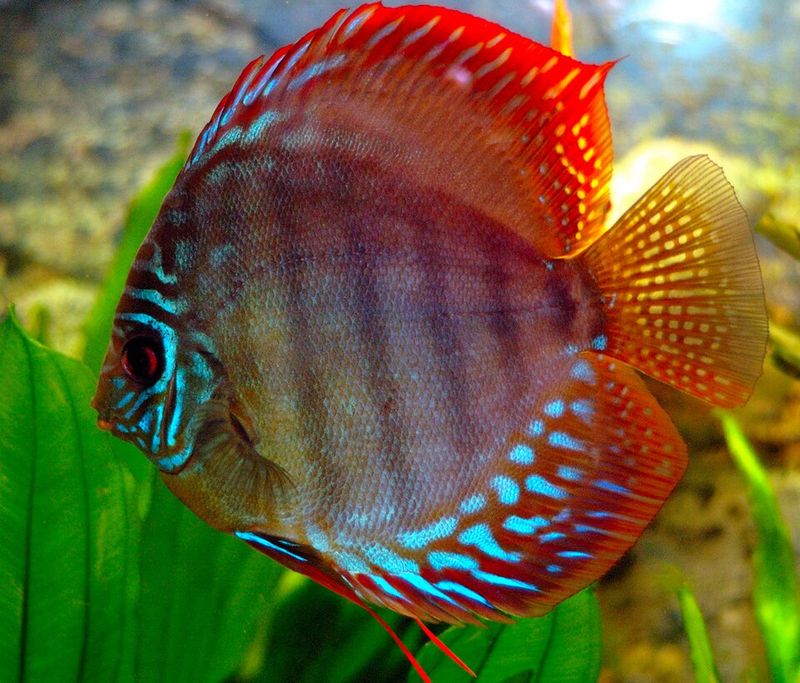
- Discus (Symphysodon spp.) — King of the aquarium. Size: 8 inches (20 cm) | Temperament: Peaceful | Min Tank: 55 gallons
- Dwarf Flag Cichlid (Laetacara curviceps) — Underrated peaceful dwarf. Size: 3 inches (8 cm) | Temperament: Peaceful | Min Tank: 20 gallons
- Dwarf Pike Cichlid (Crenicichla regani) — Predatory but manageable pike. Size: 6 inches (15 cm) | Temperament: Semi-Aggressive | Min Tank: 40 gallons
E
- Electric Blue Acara (Andinoacara pulcher) — Stunning blue color morph. Size: 6 inches (15 cm) | Temperament: Semi-Aggressive | Min Tank: 30 gallons
F
- Festivum (Mesonauta festivus) — Flag cichlid, mid-water swimmer. Size: 6 inches (15 cm) | Temperament: Peaceful | Min Tank: 55 gallons
G
- German Blue Ram (Mikrogeophagus ramirezi) — Most popular dwarf cichlid. Size: 3 inches (7 cm) | Temperament: Peaceful | Min Tank: 20 gallons
- Golden Dwarf Cichlid (Nannacara anomala) — Hardy golden dwarf. Size: 3.5 inches (9 cm) | Temperament: Semi-Aggressive | Min Tank: 20 gallons
- Green Terror (Andinoacara rivulatus) — Bold and territorial. Size: 12 inches (30 cm) | Temperament: Aggressive | Min Tank: 75 gallons
H
- Hongsloi Apisto (Apistogramma hongsloi) — Vibrant red and blue apisto. Size: 3 inches (7 cm) | Temperament: Semi-Aggressive | Min Tank: 20 gallons
I
- Inka Apisto (Apistogramma baenschi) — Rare and colorful Peruvian apisto. Size: 3 inches (7 cm) | Temperament: Semi-Aggressive | Min Tank: 20 gallons
K
- Keyhole Cichlid (Cleithracara maronii) — Most peaceful SA cichlid. Size: 5 inches (12 cm) | Temperament: Peaceful | Min Tank: 30 gallons
M
- Macmaster’s Dwarf Cichlid (Apistogramma macmasteri) — Brilliant red-finned apisto. Size: 3 inches (7 cm) | Temperament: Semi-Aggressive | Min Tank: 20 gallons
O
- Oscar (Astronotus ocellatus) — The dog of the fish world. Size: 14 inches (35 cm) | Temperament: Aggressive | Min Tank: 75 gallons
P
- Peacock Bass (Cichla kelberi) — Monster predator. Size: 24 inches (60 cm) | Temperament: Aggressive | Min Tank: 200 gallons
- Pearl Cichlid (Geophagus brasiliensis) — Iridescent and hardy. Size: 10 inches (25 cm) | Temperament: Semi-Aggressive | Min Tank: 55 gallons
R
- Red Head Tapajos (Geophagus pyrocephalus) — Stunning eartheater. Size: 8 inches (20 cm) | Temperament: Peaceful | Min Tank: 55 gallons
- Redhump Eartheater (Geophagus steindachneri) — Colorful mouthbrooder. Size: 6 inches (15 cm) | Temperament: Peaceful | Min Tank: 55 gallons
S
- Severum (Heros severus) — Underrated alternative to Discus. Size: 8 inches (20 cm) | Temperament: Semi-Aggressive | Min Tank: 55 gallons
T
- Threadfin Acara (Acarichthys heckelii) — Dramatic fin extensions. Size: 8 inches (20 cm) | Temperament: Semi-Aggressive | Min Tank: 55 gallons
- Three-Stripe Apisto (Apistogramma trifasciata) — Small and feisty apisto. Size: 2.5 inches (6 cm) | Temperament: Semi-Aggressive | Min Tank: 20 gallons
U
- Uaru (Uaru amphiacanthoides) — Large disc-shaped herbivore. Size: 10 inches (25 cm) | Temperament: Semi-Aggressive | Min Tank: 75 gallons
Species Coming Soon
We are actively working on care guides for more South American cichlid species. This is one of the largest and most varied groups in the freshwater hobby, and new species continue to enter the trade every year, especially in the Apistogramma genus. Check back as we continue expanding this directory with detailed care guides for each species.
Frequently Asked Questions
Are South American cichlids aggressive?
It depends entirely on the species. Dwarf cichlids like Bolivian Rams, Keyhole Cichlids, and many Apistogramma species are genuinely peaceful community fish. Mid-size species like Angelfish and Severums are semi-aggressive and need some planning around tankmates. And then you have Oscars, Green Terrors, and Peacock Bass, which are full-on aggressive predators that need species-appropriate setups. Always research the specific species before mixing them with other fish.
What size tank do I need for South American cichlids?
Tank size ranges from 20 gallons for dwarf cichlids like Apistogramma and German Blue Rams up to 200+ gallons for monster species like Peacock Bass. Most mid-size species like Angelfish, Electric Blue Acaras, and Severums do well in 30 to 55-gallon tanks. Eartheaters and larger species typically need 55 to 75 gallons minimum because they produce a lot of waste and need swimming room.
Do South American cichlids need special water?
Many South American cichlids come from soft, acidic blackwater habitats and do best with a pH between 6.0 and 7.0 and low to moderate hardness. Species like Discus, wild-caught Apistogramma, and Altum Angelfish can be demanding about water parameters. However, plenty of tank-bred species, including Bolivian Rams, Angelfish, Severums, and Cockatoo Dwarf Cichlids, have adapted to a wide range of tap water conditions. If you are a beginner, start with tank-bred specimens and you will have a much easier time.
Can I keep multiple cichlid species together?
Yes, but you need to plan carefully. Mixing dwarf cichlids with mid-size community cichlids works well in larger tanks. A 55-gallon tank with Angelfish, a pair of Bolivian Rams, and some Corydoras is a classic setup that works. Avoid pairing aggressive species with peaceful ones, and always provide enough territory with driftwood, rocks, and plants so each fish can claim its own space. Eartheaters are surprisingly good community cichlids despite their size because of their peaceful temperament.
What do South American cichlids eat?
Most South American cichlids are omnivores and do well on a varied diet of high-quality pellets or flakes supplemented with frozen foods like bloodworms, brine shrimp, and mysis shrimp. Eartheaters need sinking pellets they can sift through sand. Predatory species like Oscars, Peacock Bass, and Dwarf Pike Cichlids need protein-heavy diets including pellets, shrimp, and fish. Uaru are one of the few herbivorous cichlids and need a diet heavy in spirulina and blanched vegetables.
Closing Thoughts
South American cichlids are the group that keeps pulling you deeper into the hobby. You start with an Angelfish or a pair of German Blue Rams, and before you know it, you are setting up a dedicated Apistogramma breeding tank or planning a 75-gallon eartheater biotope. The diversity in this group is unmatched. Whether you want a showpiece Discus tank, a planted dwarf cichlid setup, or a big bruiser like an Oscar with real personality, South American cichlids have you covered.
This directory will continue to grow as we publish new care guides. If there is a South American cichlid species you want us to cover next, drop a comment below and let us know.
References
- Cichlidae Species List — FishBase
- Apistogramma Genus Overview — Seriously Fish
- Geophagus Genus Overview — Seriously Fish
- South American Cichlid Articles — Practical Fishkeeping
- About the Author
- Latest Posts

I’m Mark Valderrama, founder of Aquarium Store Depot and a fishkeeper with over 25 years of hands-on experience. I started in the hobby at age 11, worked at local fish stores, and have kept freshwater tanks, ponds, and reef tanks ever since. I’ve been featured in two best-selling aquarium books on Amazon and built this site to share practical, experience-based fish keeping knowledge.
Leave a Reply