
Last Updated: June 25, 2026
Thank you for visiting! By the way… any links on this page that lead to products on Amazon and other stores/partners are affiliate links Aquarium Store Depot earns a commission if you make a purchase.
Table of Contents
- The Reality of Keeping Discus Fish
- Key Takeaways
- Species Overview
- Classification
- Origin & Natural Habitat
- Appearance & Identification
- Average Size & Lifespan
- Care Guide
- Tank Mates
- Food & Diet
- Breeding & Reproduction
- Common Health Issues
- Common Mistakes to Avoid
- Where to Buy
- Frequently Asked Questions
- What It Is Actually Like Living With Discus Fish
- Closing Thoughts
- References
Discus are the most demanding freshwater fish in the hobby. They need pristine water, elevated temperatures, and a level of consistency that most hobbyists are not prepared to deliver. One missed water change and they stop eating. Inconsistent parameters and they get hole in the head. I have kept discus for over 20 years and I still treat every water change like it matters, because with discus, it does. If your maintenance routine is not rock solid, this fish will punish you for it. The king of the aquarium, but only if you serve it.
The fish that turns your hobby into a lifestyle.
What Most Care Guides Get Wrong About Discus Fish
The biggest myth in the discus world is that they’re impossibly difficult to keep. Modern captive-bred discus are significantly hardier than the wild-caught specimens that earned discus their difficult reputation decades ago. I’m not saying they’re easy. They still need warm water (82-86°F), excellent water quality, and a proper diet. But the idea that only expert-level aquarists can keep discus alive is outdated. What hasn’t changed is the need for commitment. Discus demand frequent water changes (I recommend at least 50% weekly), premium-quality food, and stable parameters. They’re not difficult because they’re fragile. They’re difficult because they’re demanding.
But let’s not sugarcoat it. Discus have earned their reputation as a demanding species, and that reputation exists for a reason. They need warm water, pristine conditions, consistent maintenance, and a level of attention that goes well beyond what most community fish require. In my 25+ years in the hobby, I’ve watched plenty of fishkeepers try to cut corners with discus, and it never ends well. This guide is for the folks who want to do it right from the start. We’ll focus primarily on the wild species, though bred variants are widely available and hardier.
The Reality of Keeping Discus Fish
Discus are not a fish you add to an existing setup. You build the entire tank around them.
Water changes are your job now. Discus need 25 to 50 percent water changes multiple times per week. Not once a week. Not when you get around to it. This is non-negotiable.
Temperature limits your options. At 82 to 86F, most common community fish cannot live with discus. Your tank mate list is short and specific.
Groups are mandatory. Discus are social cichlids. A single discus is a stressed discus. Keep 5 or more, which means 55 gallons minimum and ideally 75 or larger.
Diet determines color. Cheap flake food produces dull discus. High-quality pellets, frozen bloodworms, and beefheart mix are what bring out the color you paid for.
Biggest Mistake New Discus Fish Owners Make
Buying one or two discus and adding them to an existing community tank. Discus need to be the centerpiece of a tank built for their specific needs. Water too cool, tank mates too aggressive, water changes too infrequent. Any of those and you have expensive, faded, stressed fish.
Expert Take (Mark Valderrama, AquariumStoreDepot)
Give discus a 75-gallon minimum with a group of 5 or more, bare bottom or fine sand, 82 to 86F, and commit to water changes multiple times per week. Feed a varied diet of quality pellets, frozen foods, and beefheart mix. The reward is unmatched.
Key Takeaways
- Temperature requirements are non-negotiable. Discus need 82-86°F (28-30°C), warmer than most tropical fish, which limits compatible tank mates
- Water quality must be exceptional. Frequent water changes (often 25-50% multiple times per week) are standard for serious discus keeping
- Best kept in groups of 5 or more in a minimum 55-gallon tank, though larger groups in bigger tanks produce the best results
- Wild discus are a species complex comprising Symphysodon discus, S. Aequifasciatus, and S. Tarzoo, with numerous captive-bred color variants available
- Peaceful but sensitive. Discus stress easily and do best in calm environments with subdued lighting and minimal disturbance
Species Overview
| Field | Details |
|---|---|
| Scientific Name | Symphysodon spp. (S. Discus, S. Aequifasciatus, S. Tarzoo) |
| Common Names | Discus, Discus Fish, Pompadour Fish, King of the Aquarium |
| Family | Cichlidae |
| Origin | Amazon River basin, South America |
| Care Level | Advanced |
| Temperament | Peaceful |
| Diet | Omnivore |
| Tank Level | Middle |
| Maximum Size | 8 inches (20 cm) |
| Minimum Tank Size | 55 gallons (208 liters) |
| Temperature | 82 to 86°F (28 to 30°C) |
| pH | 5.0 to 7.0 |
| Hardness | 1 to 8 dGH |
| Lifespan | 10 to 15 years |
| Breeding | Substrate spawner (parental care with mucus feeding) |
| Breeding Difficulty | Difficult |
| Compatibility | Peaceful community (warm water species only) |
| OK for Planted Tanks? | Yes (heat-tolerant plants only) |
Classification
| Taxonomic Level | Classification |
|---|---|
| Order | Cichliformes |
| Family | Cichlidae |
| Subfamily | Cichlinae |
| Genus | Symphysodon |
| Species | S. Discus Heckel, 1840 (Heckel Discus); S. Aequifasciatus Pellegrin, 1904 (Blue/Brown Discus); S. Tarzoo Lyons, 1959 (Green Discus) |
The taxonomy of discus has been debated for decades and remains somewhat contentious. The genus Symphysodon was established by Heckel in 1840, with S. Discus (the Heckel discus) as the type species. Symphysodon aequifasciatus was described by Pellegrin in 1904 as the blue or brown discus, and S. Tarzoo was described by Lyons in 1959 as the green discus, though some taxonomists consider tarzoo a subspecies of aequifasciatus rather than a full species.
What matters for aquarists is understanding that wild discus vary significantly depending on their collection locality. Fish from different river systems display distinct color patterns and may have different water parameter preferences. Captive-bred discus, which represent the vast majority of what’s available in the hobby today, have been selectively bred into dozens of color varieties and are more adaptable to a wider range of water conditions than their wild counterparts.
Origin & Natural Habitat
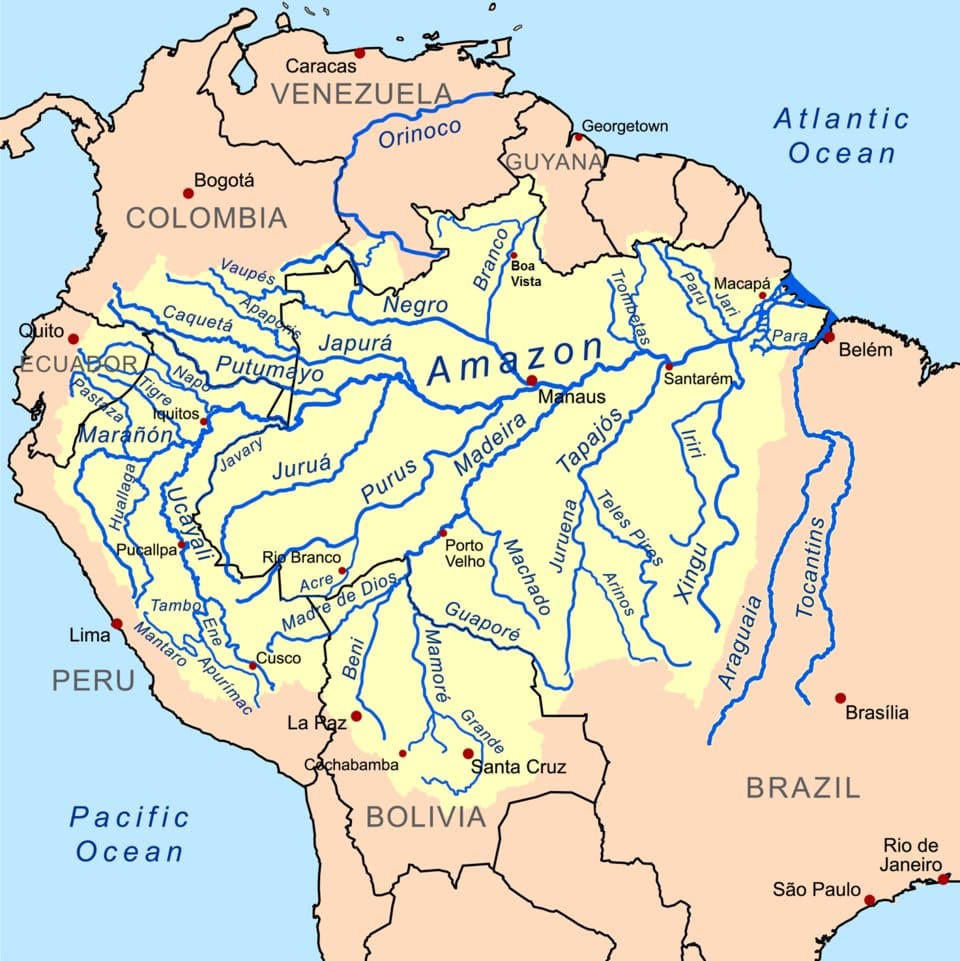
Discus are found throughout the Amazon River basin in Brazil, with different species and populations occupying different tributaries and drainage systems. Symphysodon discus (Heckel discus) is primarily found in the Rio Negro system. Symphysodon aequifasciatus ranges more widely through the central and eastern Amazon, particularly the Solimoes system. Symphysodon tarzoo occurs in the western Amazon, with notable populations in Peruvian and Colombian tributaries.
In their native waters, discus inhabit slow-moving tributaries, forest pools, and floodplain lakes. They favor sheltered areas around submerged tree roots, fallen branches, and dense vegetation where the water is calm and heavily shaded. The water in these habitats is very warm (often above 84°F / 29°C), extremely soft, and acidic, with pH values sometimes dropping below 5.0 during the dry season.
The leaf litter and tannin-stained water of their native habitat creates a dimly lit, tea-colored environment. Wild discus school together in these sheltered areas, often hovering motionless among root structures before darting out to catch small invertebrates. Replicating at least some elements of this environment in the aquarium helps bring out natural behavior and reduces stress.
Appearance & Identification
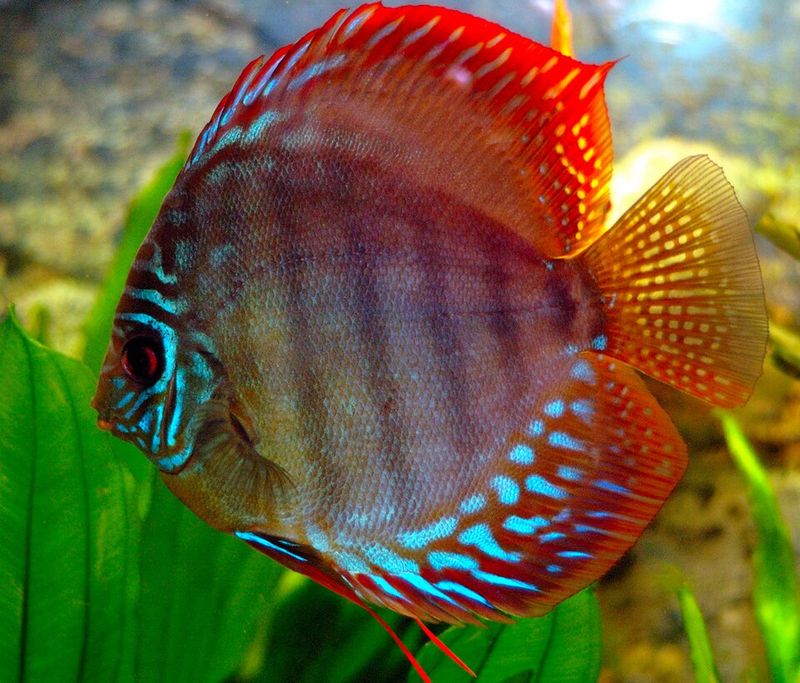
The most immediately recognizable feature of any discus is the body shape: laterally compressed into a nearly perfect disc (hence the name). This extreme compression gives them their distinctive round profile when viewed from the side, while from the front, they appear remarkably thin. The fins are continuous and rounded, with long trailing edges on the dorsal and anal fins that complete the circular silhouette.
Wild Heckel discus (S. Discus) show a brownish-red body with prominent vertical bars, including a very pronounced central bar that distinguishes them from other species. Blue and brown discus (S. Aequifasciatus) display horizontal blue striations over a brown to reddish-brown base, with more evenly distributed vertical bars. Green discus (S. Tarzoo) show red spotting on a greenish-brown body, often with striking red spots on the face and body.
Captive-bred variants span an enormous range of colors and patterns, from solid reds, blues, and whites to patterned varieties like pigeon blood, snakeskin, and leopard. While these bred forms are stunning, they all descend from the same wild species complex and share identical care requirements.
Male vs. Female
Sexing discus is difficult and unreliable outside of breeding behavior. There are no consistent external differences visible to most keepers. Some experienced breeders claim males will have thicker lips, slightly larger overall size, and a more pointed dorsal fin, but none of these traits are definitive.
| Feature | Male | Female |
|---|---|---|
| Body Size | Slightly larger on average | Slightly smaller on average |
| Lip Thickness | Reportedly thicker (not reliable) | Reportedly thinner (not reliable) |
| Dorsal Fin | May be slightly more pointed | May be slightly more rounded |
| Breeding Tube | Narrow and pointed (visible only when spawning) | Wider and rounder (visible only when spawning) |
| Forehead Profile | May develop slight nuchal hump with age | Generally smoother profile |
The only reliable method of sexing discus is observing spawning behavior. The female’s ovipositor is wider and more rounded than the male’s narrower breeding tube. As with many cichlids, the best approach to getting a breeding pair is to start with a group of 6 or more juveniles and allow pairs to form naturally.
Average Size & Lifespan
Adult discus reach 6-8 inches (15-20 cm) in diameter, though well-fed specimens in spacious tanks can occasionally reach 9 inches. Growth rate depends heavily on water quality, diet, and tank size. Juvenile discus grow relatively quickly during their first year with frequent feedings and daily water changes, but growth slows significantly after reaching about 4-5 inches.
With excellent care, discus commonly live 10-15 years in captivity. There are reports of well-maintained specimens living beyond 15 years. These are not short-term fish. A healthy discus tank is a long-term project that rewards patience and consistency.
ASD Difficulty Rating: Tier 3 – Advanced
Discus are the most demanding commonly kept freshwater fish. They require stable temperatures of 82-86 degrees F (28-30 degrees C), very soft acidic water, multiple water changes per week, and high-quality live or frozen foods. Not a beginner fish by any measure.
Care Guide
Tank Size
A minimum of 55 gallons (208 liters) is needed for a small group of discus, but bigger is genuinely better with this species. A 75-gallon or larger tank provides more stable water parameters and gives the fish room to establish a natural social hierarchy without constant conflict. For a group of 5-6 adults, a 90 to 125-gallon tank is ideal.
Tank height matters with discus. Their tall body shape means they benefit from tanks with at least 18-20 inches of water depth. Standard 55 and 75-gallon tanks work well in this regard. Avoid long, shallow tanks that limit vertical swimming space.
Water Parameters
| Parameter | Recommended Range |
|---|---|
| Temperature | 82 to 86°F (28 to 30°C) |
| pH | 5.0 to 7.0 |
| General Hardness | 1 to 8 dGH |
| Ammonia | 0 ppm |
| Nitrite | 0 ppm |
| Nitrate | Below 10 ppm (ideally below 5 ppm) |
The temperature range is the most critical parameter. Discus need consistently warm water, and drops below 80°F (27°C) will stress them and make them susceptible to disease. Wild discus and breeding pairs do best at the higher end of the range (84-86°F), while captive-bred discus being kept in display setups is comfortable at 82-84°F.
Wild discus strongly prefer soft, acidic water, and breeding requires pH below 6.0 with minimal hardness. Captive-bred discus are more adaptable and can thrive in slightly harder, more neutral water, but they still shouldn’t be kept in hard, alkaline conditions. Whatever your parameters are, stability matters more than hitting a specific number.
Filtration & Water Flow
Filtration needs to be effective without creating strong currents. Discus come from still to very slow-moving water, and strong flow stresses them. A quality canister filter or sponge filter (or combination of both) works well. Many discus keepers favor sponge filters for breeding setups because they provide gentle biological filtration without creating turbulent water movement.
Regardless of your filtration setup, frequent water changes are the cornerstone of successful discus keeping. Many experienced keepers perform 25-50% water changes multiple times per week. For juvenile discus being grown out, daily water changes aren’t uncommon. The replacement water must be temperature-matched and dechlorinated. Discus are acutely sensitive to temperature swings.
Lighting
Discus prefer subdued lighting that mimics the dimly lit forest pools of their natural habitat. Bright, harsh lighting causes stress and encourages them to hide. If you’re keeping live plants (which you need for a display tank), use moderate LED lighting and include floating plants to create shaded areas where the discus can retreat. A dimmer or timer that gradually increases and decreases light intensity is a nice touch.
Plants & Decorations
A well-planted discus tank is one of the most beautiful setups in the hobby. The challenge is finding plants that tolerate the high temperatures discus require. Good options include amazon swords (Echinodorus spp.), vallisneria, anubias, java fern, and various stem plants that handle warmth well. Avoid cold-water species that will melt at 84°F.
Driftwood is an excellent addition to a discus tank. It releases tannins that slightly acidify the water and create the natural tea-colored tint these fish experience in the wild. Tall pieces of driftwood with branching structures mimic the submerged roots and branches of their native habitat. Some keepers run bare-bottom tanks for easier cleaning, especially with juvenile discus or breeding setups, but a planted tank is ideal for a display group.
Substrate
Fine sand works well for discus display tanks. It looks natural and is easy for discus to pick through for missed food particles. Some keepers prefer bare-bottom tanks for hygiene purposes, since uneaten food and waste are easier to spot and remove. For planted discus tanks, a nutrient-rich substrate capped with fine sand or an aquasoil designed for planted setups works well. Avoid sharp or coarse gravel.
Is the Discus Fish Right for You?
Before you commit to this species, here’s an honest assessment of whether it fits your setup and experience level.
- The most visually stunning freshwater fish available. Nothing else in freshwater comes close to a healthy school of discus in a planted tank.
- Requires serious commitment to water quality. 50%+ weekly water changes are standard, not optional.
- High temperature requirement limits tank mate options. 82-86°F rules out many common community fish.
- Best kept in groups of 5 or more. Discus are social fish that display better behavior and less stress in groups.
- Not a beginner fish, but not impossible either. If you’re willing to commit to the maintenance schedule, modern captive-bred discus are achievable for dedicated intermediate keepers.
- Expensive to set up and maintain. Quality discus, a large heated tank, premium food, and the ongoing cost of water changes add up quickly.
Tank Mates
Choosing tank mates for discus comes down to two non-negotiable requirements: the companion species must tolerate high temperatures (82-86°F) and must be peaceful enough not to outcompete the discus for food or cause stress through aggressive behavior. Discus are slow, deliberate eaters, and faster, more aggressive fish will beat them to every meal.
Best Tank Mates
- Cardinal tetras. The classic discus companion. They thrive at high temperatures and their blue-red coloring complements discus beautifully
- Rummy-nose tetras. Another excellent warm-water tetra that schools tightly, adding movement and color
- Sterbai corydoras. One of the few corydoras species that tolerates the warm temperatures discus require
- German blue rams. Another warm-water cichlid that coexists peacefully with discus in adequately sized tanks
- Bristlenose plecos. Useful algae cleaners that leave discus alone, though watch for any that develop a taste for slime coat grazing
- Hatchetfish. Peaceful surface dwellers that occupy a different zone than discus
Tank Mates to Avoid
- Aggressive cichlids. Oscars, Jack Dempseys, convicts, and other pugnacious cichlids will terrorize discus
- Fast, aggressive feeders. Tiger barbs, serpae tetras, and Buenos Aires tetras will outcompete discus at feeding time and may nip fins
- Cold-water species. Most danios, white cloud mountain minnows, and similar fish that prefer temperatures below 78°F
- Large plecostomus. Common plecos can develop a habit of sucking on discus slime coat, causing serious stress and injury
- Boisterous species. Any fish that creates constant movement and commotion in the tank will stress discus
Food & Diet
Discus are omnivores with a preference for protein-rich foods. In the wild, they feed on small invertebrates, insect larvae, and planktonic organisms. In captivity, a varied diet is essential for maintaining their health and vibrant coloration.
High-quality discus-specific pellets or granules should form the dietary foundation. These are formulated with the protein levels and vitamins discus need. Supplement with frozen bloodworms, brine shrimp, mysis shrimp, and white worms on a rotating basis. Many serious discus keepers also prepare homemade beef heart or seafood mix, though this is supplemental rather than a staple.
Feed adult discus 2-3 times daily, offering only what they can consume within a few minutes. Juvenile discus being grown out should be fed more frequently, up to 4-5 smaller meals throughout the day. Remove any uneaten food promptly, as leftovers decay quickly in the warm water and degrade water quality. Speaking of which, the warm temperatures that discus require also mean that organic waste breaks down faster, which is another reason why frequent water changes are so critical.
Breeding & Reproduction
Breeding Difficulty
Difficult. While captive-bred discus are somewhat easier to breed than wild specimens, successfully raising fry requires significant effort, dedication, and often a separate breeding setup. The unique aspect of discus breeding is that fry feed on a special mucus secreted by the parents’ skin, which means the parents play an active role in fry survival that can’t easily be replicated artificially.
Spawning Tank Setup
A dedicated breeding tank of 40-55 gallons works well for a pair. Many breeders use bare-bottom tanks for hygiene. Provide a vertical spawning surface such as a broad-leafed plant (amazon sword is traditional), a cone-shaped spawning device, a PVC pipe stood upright, or a piece of slate leaned against the wall. The pair will clean their chosen surface meticulously before spawning.
Water Conditions for Breeding
Wild discus and many captive-bred lines require very soft, acidic water for successful spawning. Target a pH of 5.5-6.5 with hardness below 3 dGH. Temperature should be at the higher end of their range, 84-86°F (29-30°C). Use reverse osmosis (RO) water or very soft tap water. Some breeders add peat filtration or Indian almond leaves to condition the water.
Conditioning & Spawning
Condition the pair with frequent feedings of high-protein foods: bloodworms, brine shrimp, and quality pellets. When ready to spawn, the pair will darken in color, select and clean a vertical surface, and begin passing over it in alternating fashion. The female deposits rows of adhesive eggs, followed by the male who fertilizes each pass. A typical clutch contains 100-300 eggs, though experienced pairs may produce more.
Egg & Fry Care
Both parents fan and guard the eggs, which hatch in approximately 48-60 hours at 84°F (29°C). The wrigglers remain attached to the spawning surface for another 2-3 days before becoming free-swimming. Here’s where discus breeding gets truly unique: free-swimming fry immediately attach to the parents and begin feeding on a special protein-rich mucus secreted by their skin. The fry will alternate between both parents. This mucus feeding stage lasts about 1-2 weeks and is critical for fry survival.
After the mucus feeding stage, fry is transitioned to freshly hatched baby brine shrimp and gradually weaned onto finely ground flake or commercial fry food. First-time parents often eat their eggs or fail to produce adequate mucus. Patience is key, as most pairs improve with each spawning attempt. Frequent small water changes in the fry tank are essential for healthy growth.
Common Health Issues
Discus Plague
This is the term used for a severe, often fatal illness that presents as darkening of the body, excessive mucus production, white stringy feces, lethargy, and loss of appetite. It can spread rapidly through a tank and is believed to involve a combination of viral, bacterial, and parasitic agents. Treatment is challenging and involves raising water temperature to 90-92°F (32-33°C), adding metronidazole, and performing large daily water changes. Prevention through quarantine of new fish and maintaining pristine water conditions is the best approach.
Internal Parasites
White, stringy feces, weight loss despite eating, and lethargy are hallmarks of internal parasitic infections. Hexamita and intestinal worms are common culprits, particularly in wild-caught specimens. Treatment with metronidazole (for Hexamita) or praziquantel (for intestinal worms) is effective. Quarantine all new discus for at least 2-4 weeks before introducing them to an established tank.
Gill Flukes
Rapid breathing, flashing (rubbing against objects), and clamped fins can indicate gill flukes (Dactylogyrus spp.). These parasites attach to the gills and cause inflammation. Treatment with praziquantel or formalin-based medications is effective. Gill flukes are more common in wild-caught discus but can occur in any fish stressed by poor water conditions.
Hole in the Head (HITH)
Similar to oscars, discus are susceptible to hole-in-the-head disease, which presents as pitting around the head and lateral line. This condition is strongly linked to poor water quality (especially high nitrates), nutritional deficiencies, and Hexamita infection. Treatment involves improving water quality, supplementing the diet with vitamins, and using metronidazole when parasites are suspected. Maintaining nitrates below 10 ppm and feeding a varied, vitamin-rich diet are the best preventive measures.
Hard Rule
Discus require 82-86 degrees F (28-30 degrees C) and 2-3 water changes per week. Drop below 80 degrees F, skip water changes, or keep them in hard neutral tap water, and you will see disease, color loss, and early death – not eventually, but quickly.
Common Mistakes to Avoid
- Keeping the water too cool. Discus need 82-86°F minimum. Keeping them at “normal” tropical temperatures of 76-78°F weakens their immune system and leads to disease
- Skipping water changes. You cannot maintain discus long-term without frequent, substantial water changes. This is the single biggest factor in discus health
- Keeping too few fish. A single discus or a pair will be stressed and hide constantly. Groups of 5 or more establish a natural social hierarchy and display better behavior
- Mixing wild-caught with captive-bred discus. Wild specimens often carry parasites and diseases that captive-bred fish have no immunity to. Quarantine is absolutely essential
- Choosing aggressive tank mates. Discus are timid fish that will stop eating and deteriorate quickly when bullied or outcompeted for food
- Temperature fluctuations during water changes. Always temperature-match new water carefully. Even a 2-3 degree swing can trigger stress and disease
Where to Buy
Buying discus from a reputable source is more important with this species than perhaps any other freshwater fish. Poorly kept discus carry internal parasites, are stressed from shipping and crowded conditions, and may never recover to full health. Buying from quality sources saves you enormous headaches down the road.
Flip Aquatics is a trusted option for quality freshwater fish, and Dan’s Fish is another reputable source. Both ship with live arrival guarantees and maintain high standards for the fish they sell. When shopping for discus, ask about the fish’s history, how long they’ve been in the seller’s facility, and what they’ve been eating.
When selecting discus, look for bright, vibrant coloration, round body shape, clear eyes, and active swimming behavior. Avoid dark or clamped discus, fish with pinched bellies, or any individual in a tank where other fish appear ill. Always quarantine new discus for a minimum of 2-4 weeks before adding them to your display tank.
Frequently Asked Questions
Are discus good for beginners?
, no. Discus require precise temperature control, frequent water changes, and careful attention to water quality that can overwhelm first-time fishkeepers. That said, a dedicated beginner who does thorough research and commits to the maintenance schedule can succeed. Captive-bred discus are considerably more forgiving than wild-caught specimens.
How often do discus need water changes?
Most successful discus keepers perform at least 25-30% water changes 2-3 times per week. Some do daily changes, especially when growing out juveniles. The key is consistency. Discus do not tolerate accumulating nitrates or fluctuating water chemistry. Whatever schedule you choose, stick to it religiously.
How many discus should I keep together?
A minimum of 5-6 discus is recommended. In smaller groups, dominant fish can bully subordinates relentlessly. Larger groups of 8 or more will disperse aggression and create a more natural social dynamic. A single discus will hide, refuse food, and decline in health.
What’s the difference between wild and captive-bred discus?
Wild discus display natural color patterns specific to their collection locality and require softer, more acidic water. They’re more challenging to keep and prone to internal parasites. Captive-bred discus come in a wide range of selectively bred color varieties, are more adaptable to different water conditions, and are hardier. For most hobbyists, captive-bred discus are the better choice.
Do discus need a bare-bottom tank?
No, though many breeders and serious keepers use bare-bottom tanks because they’re easier to keep clean. A well-maintained planted tank with sand substrate is perfectly suitable for discus and looks much more attractive. The key is that whatever substrate you use, you need to keep it clean. Uneaten food rotting in the substrate is a fast track to water quality problems.
Can I keep discus in a planted tank?
Absolutely, and it’s one of the most stunning setups in the hobby. The challenge is finding plants that handle the 82-86°F water discus require. Amazon swords, vallisneria, anubias, java fern, and certain stem plants like Staurogyne repens do well at these temperatures. Avoid cold-water plant species that will struggle in discus-temperature water.
What It Is Actually Like Living With Discus Fish
This is the part no other care guide gives you. Forget water parameters for a minute. Here is what it is actually like to share your tank with this species.
They have more personality than you expect. The Discus Fish is not a fish that just sits in the background. Once settled in, they become interactive, curious, and responsive to your presence.
Feeding time reveals their character. Watch how the Discus Fish approaches food and you will see real personality. Some are bold, some are cautious, and their feeding behavior tells you a lot about their mood and health.
They establish routines. After a few weeks, your Discus Fish will have favorite spots, preferred paths through the tank, and predictable patterns. Learning these routines makes you a better keeper.
Color is a health indicator. The Discus Fish’s coloration is a real-time report card on your husbandry. Vibrant color means happy fish. Faded color means something is wrong. Pay attention.
How the Discus Fish Compares to Similar Species
The freshwater angelfish is the most practical alternative for keepers who love the tall, elegant South American cichlid look but aren’t ready for discus-level commitment. Angelfish thrive at standard tropical temperatures (76-82°F), eat readily available foods, and don’t require the intensive water change schedule that discus demand. They’re about 60% of the visual impact at 10% of the difficulty. Many discus keepers started with angelfish, and it’s a natural progression to move from one to the other.
The severum cichlid is often called the “poor man’s discus” because of its similar round body shape and South American origins. Severums are dramatically hardier, tolerate wider water conditions, and cost a fraction of what quality discus cost. They lack the discus’s refined beauty and come in fewer color varieties, but they offer 80% of the experience at 20% of the difficulty. If you want a large, round, colorful South American cichlid without the maintenance demands, the severum is the honest recommendation.
Closing Thoughts
Discus do not forgive sloppy water changes. They just stop eating.
Discus are not easy fish, and anyone who tells you otherwise either hasn’t kept them or hasn’t kept them well. They demand warm water, frequent maintenance, careful tank mate selection, and a willingness to invest the time and money that quality fishkeeping requires. But there’s a reason they’ve been called the king of the freshwater aquarium for decades.
A properly maintained group of discus, gliding through a planted tank under subdued lighting, is one of the most breathtaking sights in the freshwater hobby. If you’re willing to commit to the care they require, they’ll reward you with years of beauty and fascination. Start with captive-bred specimens if you’re new to discus, invest in quality filtration, keep up with your water changes, and don’t cut corners on food. The fish will tell you if you’re doing it right.
This article is part of our South American Cichlids species directory. Explore more South American cichlid care guides.
References
- Seriously Fish. Symphysodon aequifasciatus species profile. seriouslyfish.com
- FishBase. Symphysodon aequifasciatus (Pellegrin, 1904). fishbase.se
- Ready, J.S. Et al. (2006). Color pattern variation, distribution, and phylogeography of Symphysodon. Hydrobiologia 568: 209-225.
- Practical Fishkeeping. Discus care guide. practicalfishkeeping.co.uk
Recommended Video
- About the Author
- Latest Posts

I’m Mark Valderrama, founder of Aquarium Store Depot and a fishkeeper with over 25 years of hands-on experience. I started in the hobby at age 11, worked at local fish stores, and have kept freshwater tanks, ponds, and reef tanks ever since. I’ve been featured in two best-selling aquarium books on Amazon and built this site to share practical, experience-based fish keeping knowledge.
Leave a Reply