
Last Updated: June 25, 2026
Thank you for visiting! By the way… any links on this page that lead to products on Amazon and other stores/partners are affiliate links Aquarium Store Depot earns a commission if you make a purchase.
Table of Contents
- Key Takeaways
- Species Overview
- Classification
- Origin & Natural Habitat
- Appearance & Identification
- Average Size & Lifespan
- Care Guide
- Tank Mates
- Food & Diet
- Breeding & Reproduction
- Common Health Issues
- Common Mistakes to Avoid
- What Most Keepers Get Wrong
- The Reality of Keeping Java Loach
- Should You Get This Fish?
- Species Comparison
- Where to Buy
- Frequently Asked Questions
- Closing Thoughts
- Recommended Video
- References
If the standard kuhli loach is the social butterfly of the loach world, the Java loach is its quieter, more understated cousin. No bold bands or flashy patterns, just a sleek, reddish-brown body that disappears into leaf litter and substrate like it was designed to be overlooked. And honestly, that’s part of the appeal. There’s something satisfying about keeping a fish that looks exactly like it belongs in a shaded forest stream, threading through driftwood roots in the dim glow of a planted tank.
This is not the fish you buy to impress guests. It’s the fish you buy because you understand what makes a tank feel alive at dusk.
The Java loach goes by several names, Black Kuhli Loach, Chocolate Kuhli, Cinnamon Loach, and the taxonomy gets confusing fast. What most hobbyists call a “Java loach” is Pangio oblonga, a close relative of the popular banded kuhli (Pangio semicincta) but without the stripes. In my 25+ years in the hobby, I’ve seen these fish mislabeled at stores more often than correctly identified. This guide will tell you exactly what you’re keeping and how to get the most out of them.
Key Takeaways
- Unbanded kuhli loach, same eel-like body and behavior as the popular kuhli, but with uniform brown to reddish-brown coloration instead of stripes
- Sand substrate is non-negotiable, these fish burrow and sift constantly; gravel damages their barbels and causes chronic stress
- Groups of 6 or more required, Java loaches kept alone or in pairs hide permanently and display no natural behavior
- Soft, acidic water preferred, pH 5.5 to 7.0; adapts to neutral conditions if the transition is gradual
- Nocturnal, provide hiding spots and dim lighting; they become active and visible at dusk
- Long-lived, 8 to 10 years with proper care; this is a multi-year commitment, not a starter fish
Species Overview
| Field | Details |
|---|---|
| Scientific Name | Pangio oblonga (Valenciennes, 1846) |
| Common Names | Java Loach, Black Kuhli Loach, Chocolate Kuhli, Cinnamon Loach |
| Family | Cobitidae |
| Origin | Java, Sumatra, Borneo, Peninsular Malaysia, Thailand |
| Care Level | Easy to Intermediate |
| Temperament | Peaceful |
| Diet | Omnivore (micropredator) |
| Tank Level | Bottom |
| Max Size | 3.2 inches (8 cm) |
| Min Tank Size | 20 gallons (76 L) |
| Temperature | 70–79°F (21–26°C) |
| pH | 5.5–7.0 |
| Hardness | 0–8 dGH |
| Lifespan | 8–10 years |
ASD Difficulty Rating: Easy to Intermediate
Java loaches are manageable fish, but they have three requirements that trip people up: fine sand substrate (mandatory, not optional), group size of 6 or more, and a lid with zero gaps. Get those three things right and the rest of their care is straightforward. Skip any one of them and the fish will stress, hide, or end up on the floor.
Classification
| Taxonomic Level | Classification |
|---|---|
| Order | Cypriniformes |
| Family | Cobitidae |
| Subfamily | Cobitinae |
| Genus | Pangio |
| Species | P. oblonga (Valenciennes, 1846) |
The Java loach was originally described by Achille Valenciennes in 1846 as Cobitis oblonga from specimens collected near Bogor in West Java, Indonesia. It was later reclassified into the genus Pangio, and you’ll sometimes still find the older synonym Acanthophthalmus javanicus in older aquarium literature, that old generic name refers to the subocular spine found beneath each eye in all Pangio species.
Taxonomy note: The genus Pangio is a taxonomic challenge. Molecular analysis by Kottelat and Lim (1993) suggests that P. oblonga actually represents a complex of closely related species with at least four distinct genetic lineages already identified. The fish sold as “Java loach” or “Black Kuhli” in the hobby may represent more than one species. Banded and unbanded species are surprisingly intermixed at the genetic level. Don’t be surprised if this species gets split or reclassified in the coming years.
Origin & Natural Habitat
The Java loach is native to Southeast Asia with a wide distribution across Java, Sumatra, Borneo, Peninsular Malaysia, and Thailand. The type locality is near the city of Bogor in West Java, Indonesia, but the species has been recorded across a broad range. Some reports extend distribution to Vietnam, Laos, Cambodia, and parts of Myanmar and Bangladesh, though these more distant records may involve related species within the P. oblonga complex.
In the wild, Java loaches inhabit shallow, slow-moving forest streams, swamps, oxbows, and backwaters. They’re commonly found in ancient peat swamp forests where the water is stained dark brown with tannins from decomposing vegetation. These blackwater environments are characterized by very soft, acidic water, sometimes with a pH as low as 3.5, and deep accumulations of leaf litter on sandy substrates.
The substrate in their native habitat is fine sand mixed with decomposing leaves and organic debris. They spend their time partially buried or threading through leaf litter in shaded, dimly lit environments. Water is sluggish, with minimal current, and forest canopy keeps light levels low. Understanding this natural habitat is the key to keeping these fish properly.
Appearance & Identification
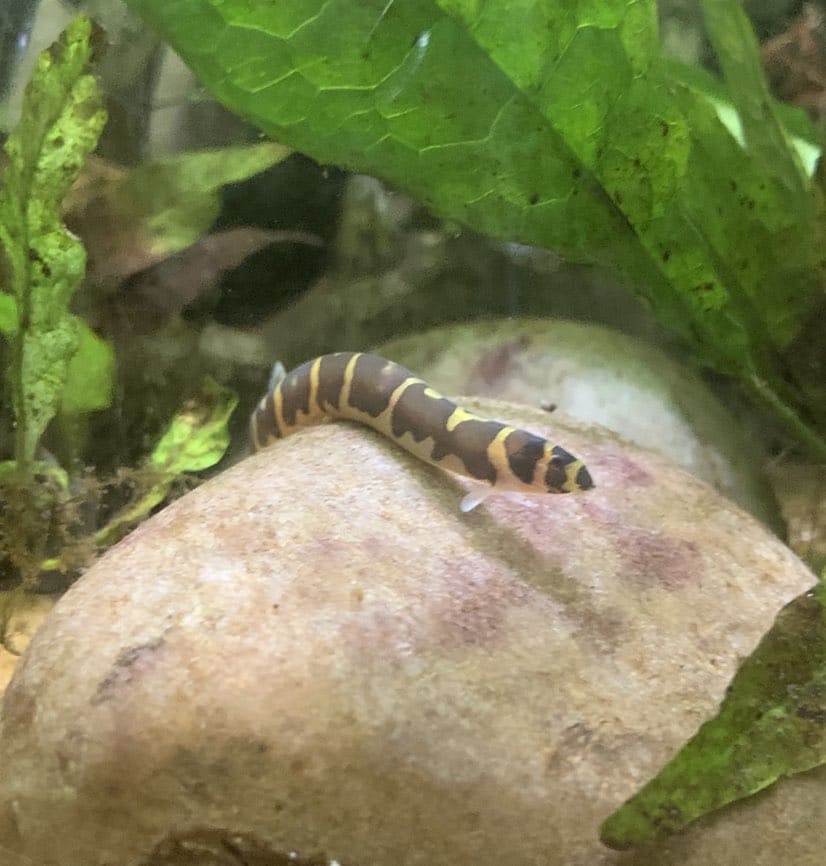
The Java loach has the same elongated, eel-like body shape that makes all Pangio species instantly recognizable. The body is cylindrical and slightly compressed laterally, tapering toward a small, rounded tail. The dorsal fin sits far back on the body, close to the tail, a distinctive feature of the genus.
Where the Java loach diverges from its more popular banded cousin is coloration. Instead of the alternating dark and light bands that define the kuhli loach (Pangio semicincta), the Java loach wears a uniform reddish-brown to dark chocolate brown, sometimes approaching near-black in certain specimens. The belly is slightly lighter. Some individuals show a faint dark bar at the base of the caudal fin. The body has reduced or absent scales, giving it a smooth, slightly slimy feel, one reason these fish slip through surprisingly small gaps.
Like all Pangio, the Java loach has three pairs of barbels around its downturned mouth, which it uses to probe the substrate for food. There’s a small, bifid (forked) subocular spine beneath each eye, a defensive structure. Handle these fish carefully and avoid fine-mesh nets where the spines can tangle and cause injury.
Key identification point: P. oblonga lacks nasal barbels and has a relatively deeper body compared to similar plain-colored species like Pangio pangia, which is a noticeably slimmer fish.
Male vs. Female
| Feature | Male | Female |
|---|---|---|
| Body Shape | Slimmer, more streamlined | Heavier-bodied, especially when gravid |
| Size | Slightly smaller | Slightly larger |
| Pectoral Fins | First ray thickened and branched | First ray thinner, not branched |
| Belly (from above) | Flat | Rounded when carrying eggs |
Sexing Java loaches is difficult outside of breeding condition. The most reliable external difference is the modified first pectoral-fin ray in males, which is thickened and branched compared to the thinner ray in females. Females carrying eggs appear noticeably plumper from above, and you can sometimes see a greenish tint through the belly wall from developing eggs.
Average Size & Lifespan
Java loaches reach a maximum of about 3.2 inches (8 cm) in total length, with most aquarium specimens settling at 2.5 to 3 inches (6–7.5 cm). They’re slightly shorter and deeper-bodied than the banded kuhli loach (P. semicincta), which can reach closer to 4 inches (10 cm).
With proper care, Java loaches live 8 to 10 years, and some hobbyists report specimens exceeding a decade. These are long-lived fish for their size. When you bring them home, you’re committing to years of consistent care. Lifespan is directly tied to water quality, diet, and stress levels. Loaches kept alone or in small groups in poorly maintained tanks will have significantly shorter lives.
Care Guide
Tank Size
A minimum of 20 gallons (76 L) for a group of Java loaches. While they’re small fish, they need floor space more than water volume. A longer, shallower tank with a footprint of at least 24 × 12 inches (60 × 30 cm) is ideal. These are horizontal swimmers that spend their lives on or near the bottom, surface area matters far more than height.
For a larger group of 10 or more, which is when they’re genuinely at their best, a 30-gallon long (114 L) or larger is the better choice. More floor space means more foraging territory and less competition for hiding spots.
Water Parameters
| Parameter | Ideal Range |
|---|---|
| Temperature | 70–79°F (21–26°C) |
| pH | 5.5–7.0 |
| General Hardness (GH) | 0–8 dGH |
| Carbonate Hardness (KH) | 0–4 dKH |
| Ammonia / Nitrite | 0 ppm |
| Nitrate | Below 20 ppm |
Java loaches come from soft, acidic waters and do best in similar conditions. A pH in the low to mid 6 range with soft water is ideal, though they adapt to neutral conditions if the transition is gradual. They’re more sensitive to water quality issues than many tropical fish, ammonia and nitrite must be at zero, and nitrates should stay low through regular water changes.
The sweet spot temperature-wise is around 75°F (24°C). These aren’t high-temperature fish. They tend to be more active at slightly cooler temperatures within their range.
Filtration & Water Flow
Gentle filtration is essential. Java loaches come from calm, sluggish waters and don’t appreciate strong currents. A sponge filter or a hang-on-back filter with a reduced flow rate works perfectly. If you’re using a canister filter, baffle the output or use a spray bar to diffuse the flow across the surface.
One critical detail: Java loaches will squeeze into filter intakes. Cover all intake tubes with a pre-filter sponge. I’ve seen these fish end up inside hang-on-back filter compartments, their thin, eel-like bodies fit through surprisingly small openings. A tight-fitting lid with no gaps is also essential. These fish are escape artists, especially during the first few nights in a new tank or during barometric pressure changes.
Lighting
Dim lighting is strongly preferred. In the wild, Java loaches live under dense forest canopy in deeply shaded water. Bright overhead lighting keeps them stressed and hidden. If you’re running a planted tank with moderate to high lighting, make sure there are shaded areas under driftwood, broad-leaved plants, or floating plants where the loaches can retreat during the day.
Floating plants, Amazon frogbit, red root floaters, water lettuce, provide the dappled shade they prefer and help significantly. You’ll notice Java loaches become much more active and visible as lighting levels drop toward evening.
Plants & Decorations
Think forest floor. Driftwood, smooth stones, leaf litter, and low-light plants create the ideal environment. Indian almond leaves, oak leaves, and other dried botanicals serve a dual purpose, they provide hiding spots and release tannins that mimic the blackwater conditions these fish evolved in.
Java fern, anubias, and cryptocoryne species are excellent plant choices because they tolerate the low light these loaches prefer. Provide multiple hiding spots throughout the tank, lengths of PVC pipe, coconut shells, and densely planted corners all work. The more secure your loaches feel, the more you’ll actually see them out and foraging.
Substrate
This is the single most important aspect of a Java loach setup: fine sand. These fish spend their lives on and in the substrate. They burrow, sift, and probe with their delicate barbels constantly. Coarse gravel damages their barbels, prevents natural foraging, and causes chronic low-grade stress that shortens lifespan.
Hard Rule: Fine sand substrate. Not coarse sand, not gravel, not “I’ll cover it with a thin layer.” Fine sand, 2 to 3 inches (5–7.5 cm) deep. Java loaches that can’t burrow properly are Java loaches that are slowly declining. This is the single care requirement that makes or breaks keeping this species successfully.
Fine play sand, pool filter sand, or dedicated aquarium sand like CaribSea Super Naturals are all excellent choices. If you see your Java loaches diving headfirst into the sand and disappearing, that’s not a problem, that’s a sign they’re comfortable. Avoid any substrate with sharp edges or coarse texture.
Tank Mates
Java loaches are among the most peaceful bottom dwellers you can keep. They ignore other fish almost entirely and are only interested in foraging through the substrate. That said, they’re small, shy, and nocturnal, you need tank mates that won’t bully, outcompete, or eat them.
Best Tank Mates
- Small rasboras, harlequin rasboras, chili rasboras (Boraras brigittae), and other Boraras species from similar habitats
- Small tetras, ember tetras, neon tetras, green neon tetras
- Other Pangio species, kuhli loaches (P. semicincta) school alongside Java loaches naturally
- Corydoras catfish, similar temperament and habitat preferences; provide enough floor space for both groups
- Sparkling gouramis (Trichopsis pumila), calm mid-dwellers from similar blackwater habitats
- Otocinclus catfish, gentle algae eaters that won’t compete for the same food
- Dwarf shrimp, cherry shrimp and Amano shrimp coexist well; very small shrimplets may occasionally be eaten
- Nerite snails, excellent cleanup crew with zero conflict potential
Tank Mates to Avoid
- Cichlids, even smaller species like rams can harass bottom-dwelling loaches; larger cichlids will eat them
- Large or aggressive loaches, clown loaches and yoyo loaches outcompete and intimidate Java loaches
- Fin-nipping barbs, tiger barbs and similar species will harass them
- Large catfish, anything big enough to swallow a 3-inch loach
- Aggressive bottom dwellers, red-tailed sharks, rainbow sharks, and territorial plecos will bully them off prime substrate territory
- Hyperactive species, giant danios and other high-energy swimmers create too much commotion for these shy fish to settle
Food & Diet
Java loaches are micropredators in the wild, they sift through substrate and leaf litter to extract tiny invertebrates: insect larvae, small crustaceans, and worms. In the aquarium they readily accept a variety of foods, but you need to make sure food actually reaches them on the bottom.
High-quality sinking pellets or wafers form the base diet. Supplement regularly with frozen or live foods: bloodworms, brine shrimp (Artemia), Daphnia, and microworms. These protein-rich foods mimic their natural diet and keep them in peak condition.
Because Java loaches are primarily nocturnal feeders, add food shortly after lights go out. If you only feed during the day when other fish are most active, your loaches often go hungry. A targeted feeding with a turkey baster near their favorite hiding spots at dusk is one of the best tricks for ensuring they eat well. Feed small amounts daily or every other day, overfeeding creates water quality problems faster than underfeeding.
Expert Take (Mark Valderrama, AquariumStoreDepot) In my time managing fish stores, the most common complaint about Java loaches was “they hide all day, I never see them.” And almost every time, the issue was the same: two or three fish in too-bright a tank on gravel, being fed during the day. These fish are completely different animals in a group of 10, with sand, in dim light, fed at dusk. I’ve watched a dozen of them emerge together at feeding time and forage as a pack, it’s genuinely one of the more natural things you’ll see in a home aquarium. The setup matters more than the fish does.
Breeding & Reproduction
Breeding Difficulty
Breeding Java loaches in captivity is difficult and rarely accomplished intentionally. Most successful spawning events are accidental, with hobbyists discovering tiny fry in established, well-planted tanks. There’s no reliable, repeatable breeding protocol established for this species in the hobby.
Spawning Tank Setup
If you want to attempt breeding, set up a dedicated spawning tank of at least 10 gallons (38 L) with a sand substrate, plenty of fine-leaved plants or spawning mops, and gentle sponge filtration. Java moss and similar dense plant material provides ideal egg-catching surfaces. Keep the tank dimly lit and heavily planted.
Water Conditions for Breeding
Very soft, acidic water appears important, target a pH of 5.5 to 6.5 and very low hardness (under 3 dGH). A slight temperature drop followed by warmer water may trigger spawning behavior by simulating seasonal rainfall patterns. Some hobbyists have reported success with water changes using slightly cooler, softer water to mimic the onset of the wet season.
Interestingly, one well-documented captive spawning event occurred in harder, more alkaline conditions (pH 7.8 to 8.0 with higher mineral content) than expected, suggesting these fish can surprise you when conditions are otherwise optimal in ways we don’t fully understand yet.
Conditioning & Spawning
Condition breeding candidates with protein-rich live and frozen foods for several weeks. Bloodworms, blackworms, and Daphnia are excellent conditioning foods. Females ready to spawn appear noticeably plumper from above, and you may see a greenish tint from developing eggs through the belly wall.
Spawning in Pangio species typically involves the pair swimming in close contact, with the female releasing adhesive green eggs that stick to plant surfaces or scatter into the substrate. The process usually occurs at night, which is another reason these spawning events are rarely observed.
Egg & Fry Care
Adults will eat their own eggs if given the chance, remove the parents or the egg-laden plants after spawning. Eggs typically hatch within 24 to 48 hours depending on temperature. Fry are tiny and feed on their yolk sac initially, then graduate to infusoria and freshly hatched baby brine shrimp. Keep the rearing tank dimly lit with excellent water quality and very gentle sponge filtration. Growth is slow, taking several months before young loaches begin to resemble miniature adults.
Common Health Issues
Ich (White Spot Disease)
Java loaches are particularly susceptible to ich, and their reduced or absent scales make them more vulnerable. The catch is that they’re also more sensitive to medications, especially copper-based treatments, which can be lethal to scaleless fish. If you need to treat ich, use half-dose medication specifically labeled safe for scaleless fish, or use the heat treatment method: gradually raise the temperature to 86°F (30°C) over 48 hours with increased aeration.
Skinny Disease (Internal Parasites)
Loaches can be susceptible to internal parasites, which manifest as gradual wasting even when the fish appears to eat normally. If a Java loach becomes noticeably thinner despite regular feeding, internal parasites are the likely culprit. Medicated food containing levamisole or praziquantel can help, but prevention through quarantine of all new arrivals is the better approach. Since virtually all wild-caught specimens may carry internal parasites, a prophylactic deworming treatment on new arrivals is recommended.
Bacterial Infections
Poor water quality is the primary trigger for bacterial infections in loaches. Red streaking on the body, ulcers, or patches of discoloration are warning signs. Because these fish spend all their time on the substrate, they’re more exposed to bacterial concentrations in the lower water column. Maintain pristine water quality and vacuum the substrate regularly, but gently, since your loaches may be buried under the sand.
Common Mistakes to Avoid
- Using gravel substrate, The number one mistake. Java loaches need fine sand. Period. Gravel damages their barbels, prevents burrowing, and causes chronic stress.
- Keeping them alone or in pairs, Solo Java loaches hide constantly and never display natural behavior. Six is the minimum; eight to ten is where they truly come alive.
- Not covering the tank, Java loaches are escape artists, especially in new setups or during weather changes. A tight-fitting lid with zero gaps is essential.
- Leaving filter intakes uncovered, Their slender bodies fit through surprisingly small openings. Pre-filter sponges on all intake tubes are mandatory.
- Full-dose medications, Scaleless fish are extremely sensitive to copper and many common treatments. Always use half-dose products labeled safe for scaleless fish, or use heat treatment for ich.
- Feeding only during the day, As nocturnal feeders, they miss daytime meals when other fish are competing. Add sinking foods after lights out.
- Bright lighting with no refuge, This creates stressed, perpetually hidden loaches. Floating plants, driftwood, and dim lighting transform their behavior.
What Most Keepers Get Wrong
“I never see them”, and they think that’s the fish, not the setup. The most common complaint about Java loaches is that they hide all day and never come out. That’s almost always a setup problem: too few fish, too much light, gravel substrate, daytime-only feeding. These fish are not naturally invisible. In the right conditions they’re surprisingly active and interesting to watch. The issue isn’t the fish, it’s that the tank doesn’t feel safe to them.
Treating “black kuhli” as if it’s just a color variant of the regular kuhli. The banded kuhli (Pangio semicincta) and the Java loach (Pangio oblonga) are different species. Their care is nearly identical, but they’re not the same fish, and the identification matters when you’re trying to understand what you have, whether you’re trying to breed them, or whether the fish you’re getting is what you think it is. At stores, these are frequently mislabeled. Know what you’re buying.
Underestimating the group size requirement. Three Java loaches in a tank looks like no Java loaches in a tank. They need the security of numbers to emerge and forage naturally. Going from 3 to 8 fish is not a minor upgrade, it changes everything about how the fish behave.
The Reality of Keeping Java Loach
Dusk is when they show up. Java loaches are nocturnal, and that’s genuinely the best way to experience them. As room lights dim and the aquarium light drops, they emerge from their hiding spots and start foraging together through the substrate and leaf litter. A group of 10 moving through a planted tank at dusk is one of the most natural, satisfying things you can watch in a home aquarium. It looks like an actual forest floor habitat, which, if you’ve set it up right, it essentially is.
They pile on each other. Find the best hiding spot in the tank, a tight cave under a piece of driftwood, a dense clump of java moss, and you’ll often find your entire group of loaches there in a tangle. This is completely normal social behavior. These fish find comfort in physical contact with each other. It’s not competition; it’s community.
The first few weeks are quiet. Newly introduced Java loaches often disappear entirely for the first week or two. They’re exploring, establishing, and adjusting. Don’t panic. Don’t add more fish. Just maintain the setup and give them time. Months in, you’ll have a group that reliably comes out at feeding time and is significantly bolder than those first cautious days.
They bring a tank to life without being the centerpiece. Java loaches aren’t the fish you build a tank around, they’re the fish that makes the tank feel complete. Mid-level rasboras, floating plants, leaf litter on fine sand, and a pack of Java loaches foraging in the dimming light: that’s a cohesive, natural-looking tank. Not because of any one element, but because all the pieces are working together.
Should You Get This Fish?
Good Fit If:
- You’re setting up a soft-water Southeast Asian or blackwater themed tank
- You already have fine sand substrate or are planning for it
- You want a bottom-level fish that adds natural behavior without aggression
- You’re patient, these fish reward a slow, careful setup rather than an impulsive purchase
- You want something genuinely different from the usual community fish options
- You’re planning to keep a group of 8 or more in a 30-gallon (114 L) long or larger
Avoid If:
- You want a fish that’s actively visible throughout the day
- You have gravel substrate and don’t want to change it
- You’re keeping cichlids, aggressive barbs, or other species that will bully bottom-dwellers
- You want to keep just 1 to 3 fish, the group requirement is real, not a suggestion
- You’re not willing to feed at dusk or provide nocturnal feeding opportunities
Species Comparison
If you’re considering a Java loach, you’ve probably also looked at the Kuhli Loach and the Rosy Loach. Here’s how they compare:
Java Loach vs. Kuhli Loach (Pangio semicincta): Same genus, same care requirements, different coloration. The kuhli has the alternating dark and light bands; the Java loach is uniformly brown. They can be kept together and will school alongside each other naturally. Choose the kuhli loach if you want more visual contrast; choose the Java loach if you prefer a subtler, forest-floor aesthetic. Either way the care is identical, just pick which look appeals to you and keep them in groups.
Java Loach vs. Rosy Loach (Petruichthys sp. ‘Rosy’): The rosy loach is even smaller (around 1 inch / 2.5 cm) and is genuinely active during the day, much more visible than Java loaches. Rosy loaches work best in nano tanks (10–20 gallons) in groups of 15 or more. Choose rosy loach if you want a small, diurnal, highly visible nano loach for a smaller tank. Choose Java loach if you want a slightly larger, more reclusive loach that rewards a naturalistic setup and patient observation.
Java Loach vs. Panda Loach (Yaoshania pachychilus): Panda loaches are significantly harder to keep, they need cool, fast-flowing, highly oxygenated water and don’t adapt to typical tropical community tank conditions. They’re not a substitute for Java loaches in most setups. Choose panda loach only if you’re specifically building a cool-water, high-flow hillstream biotope and have the experience for a more demanding species.
Where to Buy
Java loaches appear in the trade somewhat regularly, though less commonly than banded kuhli loaches. The biggest challenge is correct identification, many stores sell them as generic “black kuhli loaches” or “chocolate kuhlis,” sometimes mixed in with banded kuhli shipments. Online specialty retailers are generally more reliable for correctly identified specimens.
Expect to pay $4 to $8 per fish. Since you’re buying a group of at least 6, factor that into your budget. Most specimens are wild-caught from Southeast Asia. Quarantine all new arrivals for at least two weeks before adding to your display tank, wild-caught loaches can carry internal parasites, and a prophylactic deworming with praziquantel on new arrivals is a smart precaution.
Frequently Asked Questions
What is the difference between a Java loach and a kuhli loach?
The main difference is coloration. The kuhli loach most commonly sold in stores (Pangio semicincta) has alternating dark and light bands along its body. The Java loach (Pangio oblonga) has uniform brown to reddish-brown coloration without bands. The Java loach is also slightly smaller and deeper-bodied. Care requirements are virtually identical, and the two species can be kept together, they’ll often school alongside each other.
Can Java loaches live with shrimp?
Adult dwarf shrimp like cherry shrimp and Amano shrimp are generally safe with Java loaches. The loaches may eat very small shrimplets if they stumble across them while foraging, but they don’t actively hunt shrimp. In a well-planted tank with plenty of hiding spots, a cherry shrimp colony can thrive alongside Java loaches, just don’t expect 100 percent survival of newborn shrimp.
Why do my Java loaches hide all the time?
Almost always a setup problem, not a fish problem. Check these in order: group too small (need 6 minimum, 8+ preferred), lighting too bright, no adequate hiding spots, gravel instead of sand substrate, or daytime-only feeding. Fix the underlying condition and the hiding behavior changes. These fish become significantly bolder and more active once they feel genuinely secure.
Do Java loaches burrow in the sand?
Yes, regularly. Java loaches dive into fine sand and may disappear completely, with only their head or barbels visible. This is perfectly normal and healthy behavior, it’s how they feel secure and how they forage naturally. It’s one of the main reasons sand substrate is required, not optional, for this species.
How many Java loaches should I keep?
Six is the minimum; 8 to 10 or more is where they really thrive. In larger groups, Java loaches are significantly bolder and more active. You’ll see them foraging together in a little pack, sometimes piling on top of each other in their favorite hiding spot. Fewer than 6 produces stressed, permanently hidden fish that rarely emerge. These are highly social animals despite being nocturnal.
Are Java loaches sensitive to medication?
Yes, significantly. Like all scaleless or reduced-scale fish, Java loaches are far more sensitive to medications than fully scaled species. Copper-based treatments can be lethal even at standard doses. Always use half-dose medications labeled safe for scaleless fish, and consider heat treatment for ich as a safer first option. Prevention through good water quality and quarantine is always better than treatment.
Will Java loaches jump out of the tank?
Yes. They’re escape artists, particularly in new setups or during barometric pressure changes. A tight-fitting lid with every gap sealed, around filter intakes, heater cords, airline tubes, is essential. These fish can squeeze through openings that look impossibly small for their body size.
Closing Thoughts
The Java loach doesn’t grab attention with flashy colors or dramatic patterns. It earns your appreciation slowly, through its burrowing behavior, through the social dynamics of a proper group, through the way it brings a forest-floor authenticity to a well-scaped tank that few other fish can match.
Get the setup right: fine sand, a group of at least 8, dim lighting, leaf litter, and a feeding schedule that respects their nocturnal nature. When you sit down at dusk and watch a group of Java loaches emerge to forage through the botanicals, threading over and under each other in the half-light, that’s one of the most natural, rewarding things you can witness in a home aquarium. They’re proof that sometimes the most interesting fish are the ones you have to take a closer look to appreciate.
Recommended Video
Check out our loach tier list video where Mark ranks the most popular loach species in the hobby:
References
- SeriouslyFish. Pangio oblonga, Black Kuhli Loach. Accessed 2025.
- Froese, R. and D. Pauly, Eds. FishBase. Pangio oblonga (Valenciennes, 1846). Accessed 2025.
- Kottelat, M. and S.H. Lim (1993). A review of the genus Pangio (Teleostei: Cobitidae) in the Malay Peninsula, with descriptions of six new species. Ichthyological Exploration of Freshwaters 4(2): 141–164.
- SeriouslyFish. Pangio semicincta, ‘Kuhli’ Loach. Accessed 2025.
The Java loach is one of the 23+ loach species we cover in our complete species directory. Whether you’re looking for nano loaches, hillstream specialists, or classic community bottom-dwellers, the full guide covers them all. Loaches: Complete Species Directory →
- About the Author
- Latest Posts

I’m Mark Valderrama, founder of Aquarium Store Depot and a fishkeeper with over 25 years of hands-on experience. I started in the hobby at age 11, worked at local fish stores, and have kept freshwater tanks, ponds, and reef tanks ever since. I’ve been featured in two best-selling aquarium books on Amazon and built this site to share practical, experience-based fish keeping knowledge.
Leave a Reply