
Last Updated: June 25, 2026
Thank you for visiting! By the way… any links on this page that lead to products on Amazon and other stores/partners are affiliate links Aquarium Store Depot earns a commission if you make a purchase.
Table of Contents
- What Most Care Guides Get Wrong
- The Reality of Keeping Emperor Tetra
- Key Takeaways
- Species Overview
- Classification
- Origin & Natural Habitat
- Appearance & Identification
- Average Size & Lifespan
- Care Guide
- Is This Fish Right for You?
- What People Get Wrong
- Tank Mates
- Food & Diet
- Breeding & Reproduction
- Common Health Issues
- Common Mistakes to Avoid
- Where to Buy
- Frequently Asked Questions
- What It Is Actually Like Living With Emperor Tetra
- How It Compares to Similar Species
- Closing Thoughts
- Recommended Video
- References
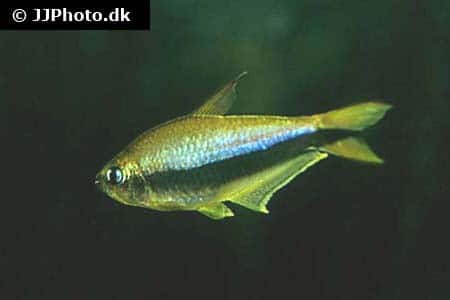
The emperor tetra is one of the most regal-looking freshwater fish you can keep. Mature males develop extended dorsal and caudal fin rays and an iridescent purple-blue body that photographs poorly and looks incredible in person. This is not a fish you appreciate from pictures. You have to see it live.
No photo does the emperor tetra justice. It is a fish you have to see in person to understand.
The Reality of Keeping Emperor Tetra
Males are dramatically different from females. Male emperor tetras develop deep purple-black coloring, extended tail fin rays, and iridescent blue eyes. Females are lighter and lack the fin extensions. You need both sexes for the best display, and at least 2 to 3 males to see the full range of male behavior.
The iridescent blue eye is mesmerizing. Under the right lighting, the emperor tetra’s eyes glow an electric blue that is unlike anything else in the small tetra world. This feature alone makes the species worth keeping.
They are peaceful but not pushovers. Emperor tetras hold their own in a community without being aggressive. They are not timid fish that hide. They occupy space with quiet confidence and rarely get bullied by other similarly-sized species.
Biggest Mistake New Owners Make
Keeping them under bright white lighting on a light background. The purple-black coloring and the blue eye iridescence both need dark backgrounds and moderate lighting to show properly. Bright lights flatten the colors completely.
The emperor tetra is one of the most elegant freshwater fish you can keep at this size. It does not demand attention through flash or brightness. It earns it through refinement. For keepers who appreciate subtle beauty, this is a top-tier choice.
Key Takeaways
- One of the most visually striking tetras with purple iridescence, a dark lateral stripe, and a unique trident-shaped tail
- Eye color reveals the sex – males have blue eyes, females have green eyes
- Hardy and beginner-friendly, adaptable to a wide range of water conditions
- Keep in groups of 6-10 for natural behavior and the best male displays
- 20-gallon minimum with dim lighting and planted tank for optimal coloration
Species Overview
| Field | Details |
|---|---|
| Scientific Name | Nematobrycon palmeri |
| Common Names | Emperor Tetra, Palmer’s Tetra |
| Family | Acestrorhamphidae |
| Origin | Atrato & San Juan River basins, Colombia |
| Care Level | Easy |
| Temperament | Peaceful |
| Diet | Omnivore |
| Tank Level | Mid |
| Maximum Size | 1.6 inches (4.2 cm) |
| Minimum Tank Size | 20 gallons (75 liters) |
| Temperature | 73-81°F (23-27°C) |
| pH | 5.0-7.5 |
| Hardness | 1-12 dGH |
| Lifespan | 3-6 years in captivity |
| Breeding | Egg scatterer |
| Breeding Difficulty | Moderate |
| Compatibility | Community |
| OK for Planted Tanks? | Yes |
Classification
| Taxonomic Level | Classification |
|---|---|
| Order | Characiformes |
| Family | Acestrorhamphidae (reclassified from Characidae, Melo et al. 2024) |
| Subfamily | Rhoadsiinae |
| Genus | Nematobrycon |
| Species | N. Palmeri (Eigenmann, 1911) |
Emperor tetras are easy to care for but the male-to-female ratio matters. Too many males in close quarters leads to competition and stress. Keep groups balanced.
The emperor tetra was described by Carl Eigenmann in 1911 and named after the collector, T. Palmer. The genus name Nematobrycon refers to the thread-like extension of the central caudal fin ray that’s a hallmark of this fish. There are only two species in the genus: N. Palmeri (the emperor tetra) and N. Lacortei (the rainbow emperor tetra).
Note on reclassification: The 2024 phylogenomic study by Melo et al. Moved the emperor tetra from the old catch-all family Characidae into the new family Acestrorhamphidae, placed within the subfamily Rhoadsiinae. FishBase has already updated to reflect this new classification.
Origin & Natural Habitat
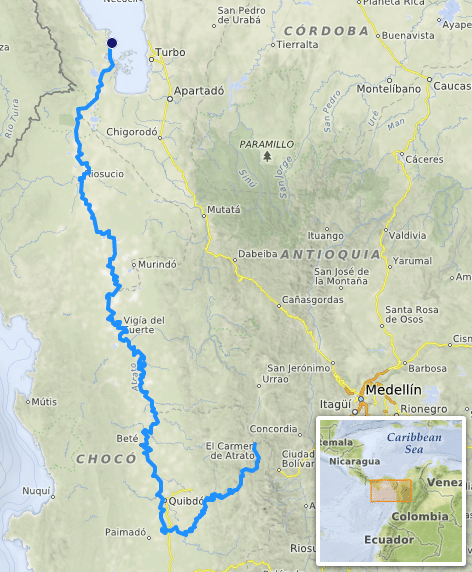
The emperor tetra is endemic to Colombia, specifically the Atrato and San Juan river basins in the Choco department on the country’s Pacific coast. This is a region of incredibly high biodiversity and heavy rainfall, with dense tropical forests surrounding the river systems.
In the wild, emperor tetras inhabit slower-moving sections of rivers, minor tributaries, and backwater areas. The water is soft and slightly acidic, shaded by dense riparian vegetation. Substrates are sandy with abundant leaf litter and submerged wood. These are calm, shaded environments with relatively warm, stable water temperatures.
Understanding their natural habitat explains why emperor tetras look their absolute best in planted aquariums with dim lighting, dark substrates, and plenty of natural structure like driftwood and leaf litter.
Appearance & Identification
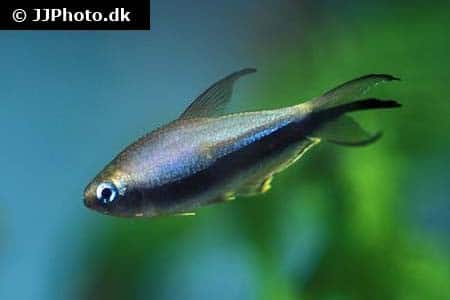
The emperor tetra has a moderately deep, laterally compressed body with a color scheme that’s unlike any other common tetra. The body has a warm cream-to-golden base overlaid with a deep purple-blue iridescence that shifts and shimmers as the fish moves. A bold dark lateral stripe runs from the snout through the eye to the base of the tail, and the fins take on yellow-gold tones with dark edging.
The standout feature is the trident-shaped caudal fin. In mature males, the central ray of the tail fin extends into a distinctive spike, creating a three-pronged appearance that’s completely unique among popular aquarium tetras. No other commonly kept tetra has this feature.
Male vs. Female
Emperor tetras are one of the easiest tetras to sex, thanks to several clear differences:
- Eye color – Males have brilliant blue irises, while females have green irises. This is the quickest way to tell them apart.
- Fins – Males develop much longer, more extended dorsal, anal, and caudal fins. The central caudal ray extension (the “trident”) is much more pronounced in males.
- Coloration – Males are more intensely colored with deeper iridescence.
- Body shape – Females are slightly rounder and deeper-bodied, especially when carrying eggs.
Average Size & Lifespan
Emperor tetras reach about 1.4 to 1.6 inches (3.5-4.2 cm) in standard length, putting them in the medium range for commonly kept tetras. They’re a bit larger than neon tetras but smaller than bleeding hearts or Congo tetras.
With proper care, expect a lifespan of 3 to 6 years. Some well-maintained specimens can push past 5 years, which is on the longer end for small tetras.
Care Guide
Tank Size
A 20-gallon tank is the recommended minimum for a group of 6-8 emperor tetras. They need enough space for males to establish small territories and display without constantly clashing. A 30-gallon or larger tank is ideal if you want a bigger group or a multi-species community.
Water Parameters
| Parameter | Ideal Range |
|---|---|
| Temperature | 73-81°F (23-27°C) |
| pH | 5.0-7.5 |
| Hardness | 1-12 dGH |
| KH | 1-8 dKH |
Emperor tetras are adaptable and tolerate a fairly wide range of conditions. That said, they show their most intense iridescence in soft, slightly acidic water with some tannins. Driftwood and Indian almond leaves help create ideal conditions naturally. The key is stability – avoid sudden parameter swings.
Filtration & Water Flow
Moderate flow is ideal. They come from slower-moving waters, so don’t blast them with a strong current, but they can handle more flow than some of the more delicate nano tetras. A hang-on-back or canister filter turning over 4-5 times the tank volume per hour works well. Weekly water changes of 20-25% keep things clean.
Lighting
Subdued to moderate lighting brings out the best in emperor tetras. Their iridescent purple-blue coloration is most visible under gentle, angled lighting rather than harsh overhead lights. Floating plants are your friend here – they create natural shade patterns that really make the iridescence pop.
Plants & Decorations
A well-planted tank with driftwood and a dark substrate is the ideal setup. Live plants provide territory boundaries that help manage male territoriality, and the dark background makes their iridescent coloration stand out dramatically. Java fern, Anubias, Cryptocoryne, and floating plants all work beautifully. Dried leaf litter adds a natural biotope feel.
Is the Emperor Tetra Right for You?
Emperor tetras reward patient keepers with one of the most elegant displays in freshwater fishkeeping. Here’s who should keep them:
- You’re patient. Emperor tetras take 6-8 months to reach their full stunning potential
- You have at least a 20-gallon tank, ideally 30 gallons, to let males develop properly
- You want a tetra that rivals some dwarf cichlids in terms of finnage and elegance
- You appreciate deep purple-blue iridescence. Fully mature males are breathtaking
- You want a peaceful species that works with virtually any community tank mate
- Don’t bother if you expect instant gratification. The payoff with emperors is long-term and worth the wait
What People Get Wrong
The most common mistake is expecting electric colors like neon or cardinal tetras. Emperor tetras are elegant, not flashy. The fan-shaped caudal fin on males and the blue-purple iridescent stripe are distinctive and refined — they reward close attention rather than jumping out from across the room.
Second mistake: buying too many males. Male emperor tetras develop elaborate finnage and become competitive in close quarters. A group skewed too heavily male will result in chasing, stress, and fin damage. Two females per male gives the best results in a community tank.
Third: not providing enough plants and visual breaks. Emperor tetras use plants to establish loose territories. In an open, sparsely planted tank they become restless and more aggressive. Dense planting with open swimming lanes lets them behave naturally.
Tank Mates
Best Tank Mates
- Other peaceful tetras (rummy-nose, cardinal, neon, ember tetras)
- Corydoras catfish – ideal bottom-dwelling companions
- Pencilfish – gentle mid-level fish from similar habitats
- Hatchetfish – top-dwelling fish that fill a different zone
- Dwarf cichlids (rams, Apistogramma) – natural South American biotope pairing
- Honey gouramis – peaceful, complementary centerpiece
- Bristlenose plecos – peaceful algae eaters
- Otocinclus – small, peaceful bottom feeders
Tank Mates to Avoid
- Large aggressive cichlids – anything that could eat or bully them
- Very active, boisterous species – tiger barbs and giant danios will outcompete and stress them
- Other emperor tetras in too-small groups – males is territorial, so keep enough females to distribute attention
Food & Diet
Emperor tetras are omnivorous micropredators. In the wild, they feed primarily on small insects, larvae, and invertebrates. In the aquarium, they accept a wide range of foods and are not picky eaters.
A high-quality flake or micro-pellet makes a good daily staple. Supplement with live or frozen foods like daphnia, baby brine shrimp, cyclops, and bloodworms (in moderation) for the best coloration and overall health. Daily feeding of small live or frozen foods is recommended by Seriously Fish for optimal condition and breeding readiness.
Feeding tip: Feed small portions once or twice daily. Emperor tetras are active feeders but have small mouths, so appropriately sized food is important.
Breeding & Reproduction
Emperor tetras are egg scatterers and are considered not particularly difficult to breed, making them a good species for hobbyists looking to try tetra breeding.
Spawning Tank Setup
Set up a separate 10-gallon breeding tank with dim lighting and fine-leaved plants like Java moss or spawning mops. Use a mesh or marble layer on the bottom to protect eggs. Water should be soft and slightly acidic – pH 6.0-6.5, temperature 78-80°F, with minimal hardness.
Conditioning & Spawning
Condition a breeding pair with plenty of live foods for 1-2 weeks. Males will display intensely, showing off their extended fins and iridescent coloration. Spawning typically occurs in the morning, with the female scattering eggs among the plants.
Egg & Fry Care
Remove adults after spawning to prevent egg predation. Eggs hatch in 24-36 hours, and fry become free-swimming 4-5 days later. Feed infusoria or liquid fry food initially, then graduate to microworms and baby brine shrimp as the fry grow. Growth is moderate, and juveniles begin showing adult coloration at about 2-3 months.
Common Health Issues
Emperor tetras are hardy, but they’re susceptible to the standard tropical fish diseases:
Ich (White Spot Disease)
The most common ailment. White spots on body and fins, usually triggered by temperature fluctuations or stress. Raise temperature gradually to 82°F and treat with standard ich medication.
Fin Rot
Bacterial deterioration of the fins, particularly concerning in males with their beautiful extended finnage. Usually caused by poor water quality. Improve conditions with extra water changes and treat with antibacterial medication if needed.
General Prevention
Quarantine all new fish for 2-3 weeks. Maintain stable water parameters and keep up with regular water changes. A varied diet supports a strong immune system. Emperor tetras are robust when their basic needs are met.
Common Mistakes to Avoid
- Keeping too few – In groups smaller than 6, males become overly territorial and females get harassed. Groups of 8-10 are ideal.
- Bright lighting – Their iridescent coloration washes out under harsh lights. Subdued lighting with floating plants is the way to go.
- Not enough structure – Males establish small territories. Without plants and driftwood to break sight lines, aggression within the group increases.
- Expecting color from juveniles – Young emperor tetras look pretty plain. The deep purple iridescence and fin extensions develop as they mature, so give them time.
- Missing the trident tail – Sometimes pet stores sell emperor tetras with damaged or nipped caudal fins. The central ray extension grows back, but it takes time.
Where to Buy
Emperor tetras are moderately available at local fish stores and widely available online. Pricing is typically $4-8 per fish. The “black emperor tetra” variant (a selectively bred darker form) may be available at slightly higher prices.
Make sure the tank is fully cycled first. Emperor tetras need stable, clean water to show their best coloring, and ammonia or nitrite spikes in a new tank will set them back immediately.
For quality stock with live arrival guarantees, check Flip Aquatics and Dan’s Fish. Both retailers regularly carry emperor tetras and ship healthy, well-acclimated specimens.
Frequently Asked Questions
How can you tell male and female emperor tetras apart?
The easiest method is eye color. Males have brilliant blue irises, while females have green irises. Males also develop much longer fins, a more extended central caudal ray (the “trident”), and more intense iridescent coloration. Females are slightly rounder and deeper-bodied.
What is the black emperor tetra?
The black emperor tetra is a selectively bred color variant of Nematobrycon palmeri with significantly darker overall coloration. The body is much darker (almost black in some specimens) while retaining the characteristic iridescence and trident tail. Care requirements are identical to the standard emperor tetra.
Are emperor tetras aggressive?
Not truly aggressive, but males are mildly territorial. They establish small domains in the aquarium and will display and posture at other males that enter their space. This behavior is normal and rarely causes injury in a properly sized, decorated tank. Keeping a group of 8-10 with more females than males manages this behavior effectively.
Why does my emperor tetra’s tail look different?
If the trident-shaped tail is missing or irregular, it may have been nipped by tank mates or damaged during shipping. The central caudal ray extension will regrow over time in good conditions. It’s also possible you have a young specimen that hasn’t fully developed the extension yet, or a female (whose caudal ray is less extended).
What size tank do emperor tetras need?
A minimum of 20 gallons for a group of 6-8. A 30-gallon or larger tank is recommended for a proper school of 10 or more, especially in a community setup. Males need enough space to establish territories without constant conflict.
What It Is Actually Like Living With Emperor Tetra
Male emperor tetras have a presence that exceeds their small size. The deep purple-black coloring and elongated fins give them a regal bearing that stands out in any community.
The blue eye glow is most visible during the first hour after lights come on and during social interactions. It is a small detail that makes checking the tank a genuine pleasure.
They move through the tank with a deliberate, unhurried pace. There is no frantic swimming or darting. Everything about this fish says calm authority.
They pair exceptionally well with other subtle species like pencilfish, corydoras, and small rasboras.
How the Emperor Tetra Compares to Similar Species
Emperor Tetra vs. Blue Emperor Tetra
Blue emperor tetras deliver more intense blue coloration but are more assertive in temperament. Regular emperors are the more predictably peaceful option and work in a wider range of community setups. Blue emperors need more careful management of group dynamics and tank mate selection. If peace is your priority, stick with regular emperors. If you want maximum blue impact and can handle slightly feistier fish, blue emperors are the upgrade. Check out our Blue Emperor Tetra care guide for more details.
Emperor Tetra vs. Diamond Tetra
Diamond tetras and emperor tetras are often compared because both develop impressive finnage on mature males. Diamond tetras lean toward iridescent sparkle while emperors offer deep purple-blue with flowing rays. Both need time and space to reach their potential. Diamond tetras are slightly hardier and less demanding about tank size. Emperors are more colorful and elegant when fully mature. In a large planted tank, a school of each species creates one of the most visually stunning tetra displays possible. Check out our Diamond Tetra care guide for more details.
Closing Thoughts
The emperor tetra is one of the hobby’s most underappreciated fish. When you see a mature male in a well-planted tank – that deep purple iridescence glowing under soft lighting, the trident tail fanned out, those piercing blue eyes – it’s genuinely one of the most beautiful freshwater fish you can keep. And it’s not even that difficult to care for.
Give them a planted tank with dim lighting, soft water, and a proper group of 8-10, and you’ll have one of the most impressive tetra displays in the hobby. They’re especially stunning alongside rummy-nose tetras for schooling contrast, or paired with cardinal tetras for a South American biotope theme.
Recommended Video
Check out our tetra tier list video where we rank the most popular tetras in the hobby, including the emperor tetra:
References
- Nematobrycon palmeri Profile – Seriously Fish
- Nematobrycon palmeri (Eigenmann, 1911) – FishBase
- Emperor tetra – Wikipedia
- Phylogenomics of Characidae – Melo et al, 2024
- About the Author
- Latest Posts

I’m Mark Valderrama, founder of Aquarium Store Depot and a fishkeeper with over 25 years of hands-on experience. I started in the hobby at age 11, worked at local fish stores, and have kept freshwater tanks, ponds, and reef tanks ever since. I’ve been featured in two best-selling aquarium books on Amazon and built this site to share practical, experience-based fish keeping knowledge.
Leave a Reply