
Last Updated: June 25, 2026
Thank you for visiting! By the way… any links on this page that lead to products on Amazon and other stores/partners are affiliate links Aquarium Store Depot earns a commission if you make a purchase.
Table of Contents
- What Most Care Guides Get Wrong
- The Reality of Keeping Blue Emperor Tetra
- Key Takeaways
- Species Overview
- Classification
- Origin & Natural Habitat
- Appearance & Identification
- Average Size & Lifespan
- Care Guide
- Is This Fish Right for You?
- What People Get Wrong
- Tank Mates
- Food & Diet
- Breeding & Reproduction
- Common Health Issues
- Common Mistakes to Avoid
- Where to Buy
- Frequently Asked Questions
- What It Is Actually Like Living With Blue Emperor Tetra
- How It Compares to Similar Species
- Closing Thoughts
- Recommended Video
- References
The blue emperor tetra is a wild-caught specialty fish that demands specific conditions. Soft water, low pH, dim lighting, and dark substrate. Skip any of these and the blue coloration never develops. This is a fish for experienced keepers who can provide what it needs, not for someone looking for an easy splash of blue.
Blue emperor tetras in hard water are gray fish. In soft, acidic water, they are electric blue. There is no middle ground.
The Reality of Keeping Blue Emperor Tetra
Group size is not a suggestion. The minimum school size for blue emperor tetra is not just a guideline. In small groups, these fish lose color, become stressed, and display abnormal behavior. A proper group of 6 to 8+ is where you start to see natural schooling behavior, full color expression, and the confidence that makes them worth keeping.
Tank mate selection requires thought. The blue emperor tetra is not aggressive in the traditional sense, but it is assertive enough to cause problems with the wrong companions. Slow-moving, long-finned species are targets. Fast, short-finned fish of similar size are fine. Plan your community around this reality.
Hardy does not mean indestructible. The blue emperor tetra tolerates a range of conditions, but it still needs basic care. Ammonia spikes, dramatic temperature swings, and neglected water changes will catch up to even the toughest species. The difference is margin of error, not immunity.
Store appearance is not home appearance. Fish in store tanks are stressed, crowded, and under inappropriate lighting. The blue emperor tetra almost always looks better in a properly set up home aquarium than it does at the store. Dark substrate, live plants, and appropriate lighting bring out colors and behaviors you will never see in a retail environment.
Biggest Mistake New Owners Make
Adding them to a peaceful community tank without researching compatibility. The nipping and chasing will stress your existing fish, and by the time you realize the problem, fin damage is already done.
In my 25+ years in the hobby, I have consistently found that the hardiest species are the most underrated. The blue emperor tetra is a perfect example. It is easy to keep, rewarding to watch, and it does not demand the kind of obsessive maintenance that more sensitive species require.
Key Takeaways
- Stunning sexual dimorphism – males are deep blue-purple with blue adipose fins, females have orange-red adipose fins, making mixed schools visually striking
- Peaceful and easy to keep – one of the more beginner-friendly tetras with minimal aggression when properly schooled
- Thrives in subdued lighting – colors wash out under bright lights, so floating plants and a dark substrate are key
- Keep in groups of 8+ – smaller groups can lead to fin nipping, though this reputation is largely overblown
- Prolific breeders – one of the easier tetras to breed in captivity with the right conditions
Species Overview
| Field | Details |
|---|---|
| Scientific Name | Inpaichthys kerri |
| Common Names | Blue Emperor Tetra, Purple Emperor Tetra, Royal Tetra, Kerri Tetra |
| Family | Characidae |
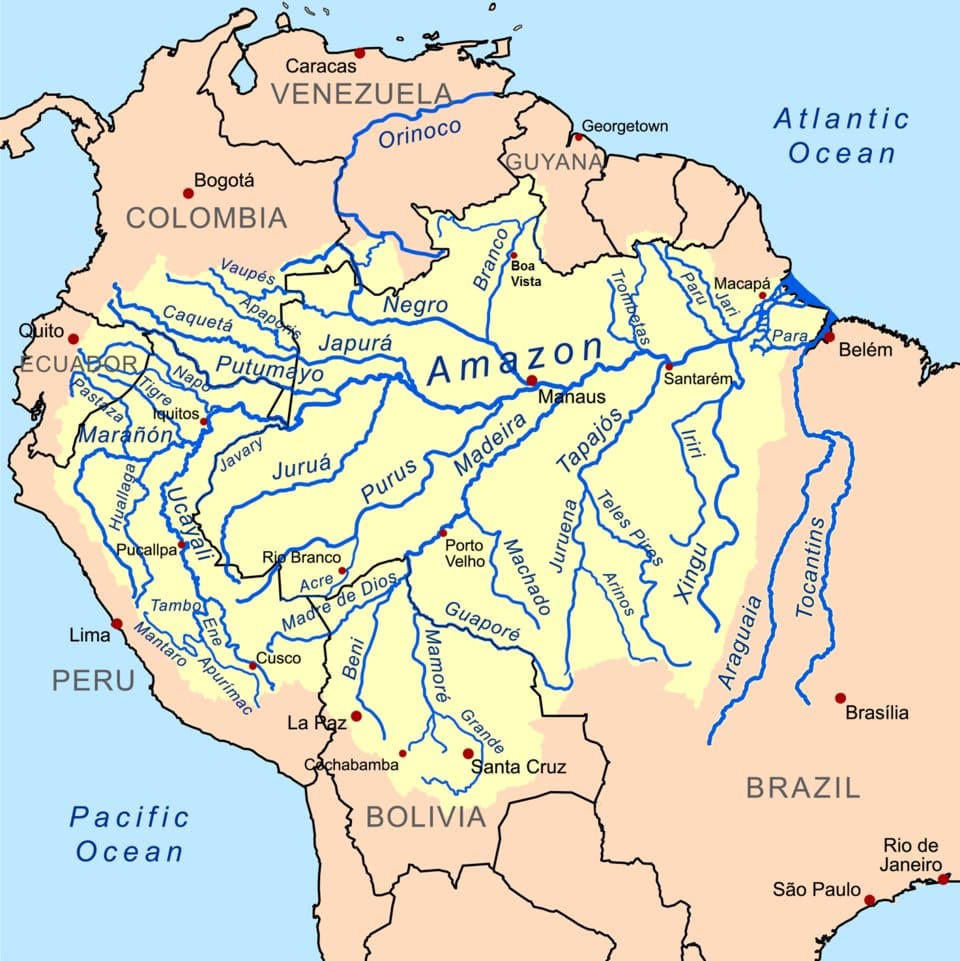
| Origin | Aripuanã River, upper Madeira River basin, Mato Grosso, Brazil |
| Care Level | Easy |
| Temperament | Peaceful |
| Diet | Omnivore |
| Tank Level | Mid |
| Maximum Size | 2 inches (5 cm) |
| Minimum Tank Size | 20 gallons (75 liters) |
| Temperature | 75-82°F (24-28°C) |
| pH | 5.5-7.0 |
| Hardness | 1-10 dGH |
| Lifespan | 4-6 years in captivity |
| Breeding | Egg scatterer |
| Breeding Difficulty | Moderate |
| Compatibility | Community |
| OK for Planted Tanks? | Yes |
Classification
| Rank | Name |
|---|---|
| Kingdom | Animalia |
| Phylum | Chordata |
| Class | Actinopterygii |
| Order | Characiformes |
| Family | Characidae |
| Genus | Inpaichthys |
| Species | I. Kerri |
The blue emperor tetra is one of the most overlooked beginner tetras. Easy to keep, hardy, and visually distinctive in the right planted setup.
Inpaichthys kerri was described by Géry and Junk in 1977. The genus name is derived from INPA (Instituto Nacional de Pesquisas da Amazônia), the Brazilian research institute where the type specimens were housed, combined with the Greek “ichthys” meaning fish. The species name honors Warwick Estevam Kerr, a Brazilian geneticist. Inpaichthys is a monotypic genus, meaning I. Kerri is the only species within it. The genus has remained within the family Characidae following the 2024 phylogenomic revision by Melo et al.
Origin & Natural Habitat
The blue emperor tetra is native to the Aripuanã River system, a tributary of the upper Madeira River in Mato Grosso state, northwestern Brazil. This is deep Amazon basin territory, and the fish lives in slow-moving tributaries and small forest streams where the water is warm, soft, and acidic. Heavy canopy cover keeps the environment dimly lit, with the water stained a tea-brown color from tannins released by decomposing leaves and wood.
The substrate in these habitats is typically soft sand covered with a thick layer of leaf litter. Fallen branches and submerged roots provide shelter and create complex microhabitats. The water flow is gentle, and the overall environment is relatively still compared to the main river channel. This preference for calm, shaded conditions directly informs how to set up their aquarium.

Appearance & Identification
The blue emperor tetra has a laterally compressed, moderately deep body shape typical of many Characidae species. What makes it visually exceptional is the combination of a vibrant blue-purple body color with a prominent dark horizontal stripe running from behind the eye to the caudal peduncle. The body has an iridescent quality that shifts between blue and violet depending on the angle of light.
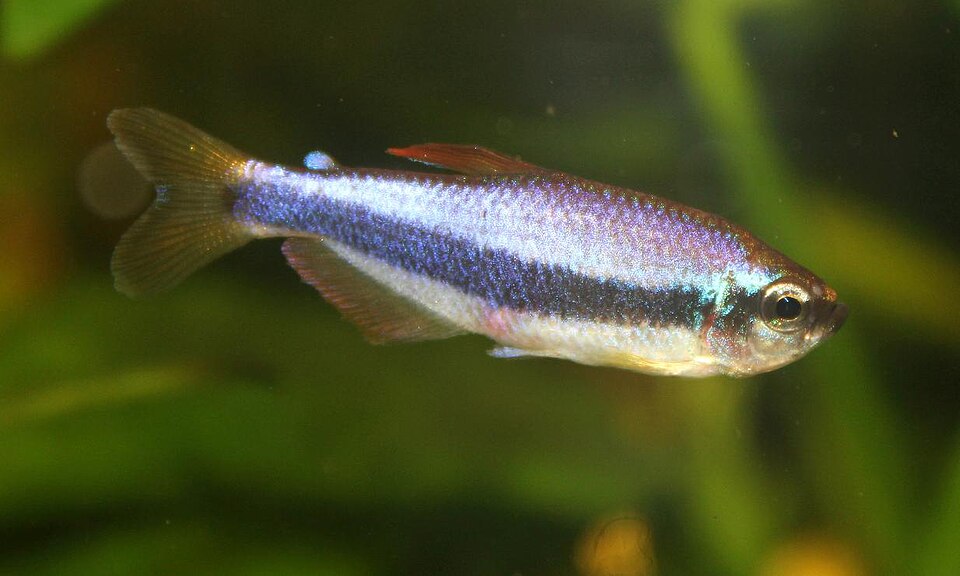
The easiest way to tell males from females is the adipose fin. Males have a blue adipose fin that matches their body color, while females display an orange to reddish adipose fin that contrasts beautifully. Males also are slimmer with more saturated coloration, while females are slightly rounder through the body and carry a softer, more muted version of the same blue-purple tones. In a well-conditioned school, the contrast between the sexes creates a really attractive visual display.
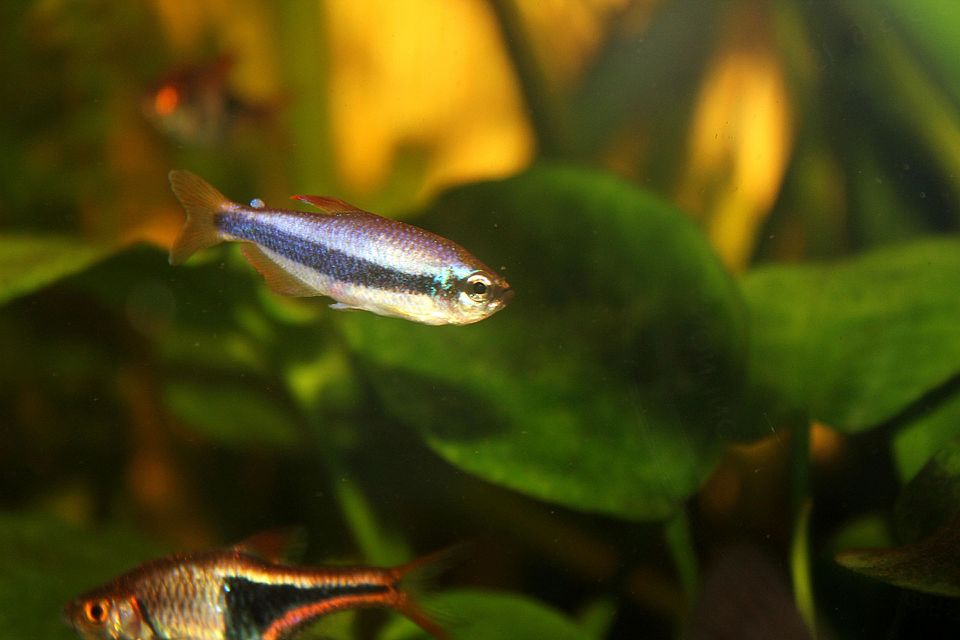
The scales have a subtle metallic sheen, and the fins are mostly translucent with a slight yellowish or bluish tint. The eyes are relatively large and have a silver-green ring. Overall, this is a fish that photographs well but looks even better in person, especially under low-light conditions where the iridescence really comes alive.
Average Size & Lifespan
Blue emperor tetras reach a maximum size of about 2 inches (5 cm), with most individuals settling around 1.5 inches in typical aquarium conditions. They’re a compact tetra, roughly the same size as a neon or cardinal tetra but with a slightly deeper body profile.
With good care, blue emperor tetras can live 4 to 6 years, which is longer than many comparable small tetras. Clean water, varied nutrition, and stress-free conditions (proper school sizes, compatible tank mates) are the biggest factors in reaching the upper end of that range.
Care Guide
Tank Size
A 20-gallon tank is the recommended minimum for a school of blue emperor tetras. They’re not quite as active and frenetic as some tetras (like blue tetras), so they don’t need massive swimming space, but they still appreciate room to move. A longer tank footprint is more valuable than a taller one since they primarily occupy the middle water column.
Water Parameters
- Temperature: 75-82°F (24-28°C)
- pH: 5.5-7.0
- General Hardness (GH): 1-10 dGH
- Carbonate Hardness (KH): 1-5 dKH
Blue emperor tetras prefer soft, acidic water, which reflects their blackwater origins. They can adapt to slightly harder water if introduced gradually, but they won’t thrive in hard, alkaline conditions. If your tap water runs hard, use RO/DI water blended with tap to bring the parameters down. Indian almond leaves and driftwood help naturally buffer the pH toward the acidic range while also releasing tannins that these fish find comforting.
Tank Setup
Subdued lighting is critical for blue emperor tetras. Under bright lights, their colors fade and they become visibly stressed. Use floating plants like Amazon frogbit or dwarf water lettuce to diffuse overhead light, and consider a dark substrate (black sand or dark gravel) that doesn’t reflect light upward. The difference in coloration between a well-lit tank and a dimly lit one is dramatic.
Plant the background and sides densely, leaving open swimming areas in the center. Driftwood, bogwood, and dried leaf litter on the substrate create a natural biotope look that these fish respond to positively. A blackwater setup with tannin-stained water brings out the absolute best in their coloration and closely replicates their natural habitat.
Filtration & Maintenance
A standard hang-on-back or sponge filter works well. These fish come from calm waters, so keep the flow rate gentle. Strong currents stress them out and cause them to hide. Weekly water changes of 20-25% are sufficient, using water that matches the tank’s temperature and chemistry. Since they prefer soft, acidic conditions, avoid using filter media that raises pH or hardness (like crusite or coral substrate).
Is the Blue Emperor Tetra Right for You?
The blue emperor tetra is a premium species that rewards time and proper setup. Here’s who should be keeping them:
- You want a tetra with genuine blue coloration. Not many tetras deliver real blue
- You’re patient enough to wait 4-6 months for full color development
- You can keep a group of 8+ where male sparring gets distributed across the school
- You have a 30-gallon or larger tank with both open space and planted refuge areas
- You want a statement fish that’ll be the centerpiece of a community setup
- Not ideal for tanks with very timid species. Males display with enough gusto to startle delicate fish
What People Get Wrong
The most common mistake is confusing the blue emperor tetra with the emperor tetra (Nematobrycon palmeri). They are completely different species. The blue emperor tetra (Inpaichthys kerri) is smaller, more electric blue, and has different care needs. In stores they are sometimes stocked alongside each other under similar names. Confirm the scientific name before buying.
Second mistake: keeping too few. Like most tetras, blue emperor tetras in groups under 6 are skittish, hide frequently, and fail to show the schooling behavior or coloration they are capable of. A proper group of 10 or more in a planted tank produces the active, visible schooling display this species is known for.
Third: expecting the same visual impact as the regular emperor tetra. The blue emperor tetra is a smaller, faster fish with a different kind of visual appeal. In the right setup — planted tank, dark substrate, warm lighting — the metallic blue flash is striking. Under harsh store lighting it looks unremarkable. Context matters.
Tank Mates
Blue emperor tetras are genuinely a semi-assertive community fish that’s peaceful toward other species but males will spar among themselves. Keep them in groups of 8+ with 2-3 females per male. They have a lingering reputation as fin nippers, but in my experience this almost always traces back to being kept in groups that are too small. A school of 8 or more rarely causes problems with tank mates.
Good Tank Mates
- Other small tetras – cardinal tetras, ember tetras, green neon tetras, rummy nose tetras
- Dwarf cichlids – Apistogramma species, ram cichlids (they share similar water parameter preferences)
- Corydoras catfish – peaceful bottom dwellers that complement the mid-level tetras perfectly
- Otocinclus – another gentle South American species that shares the same soft water needs
- Pencilfish – Nannostomus species are ideal companions in a blackwater biotope
- Hatchetfish – marble or silver hatchetfish occupy the surface level and won’t compete
- Small rasboras – harlequin rasboras, lambchop rasboras
Tank Mates to Avoid
- Large or boisterous fish – blue emperor tetras are easily intimidated by aggressive tank mates
- Aggressive cichlids – anything territorial enough to chase them will cause chronic stress
- Very large fish – anything that could eat them (even peaceful large fish pose a predation risk)
- Hard water species – African cichlids and livebearers that need high pH and hard water are a mismatch
Food & Diet
Blue emperor tetras are easy to feed. They’re true omnivores that accept virtually anything offered. A high-quality micro pellet or flake food forms a solid daily base. Supplement two to three times per week with frozen or live foods like brine shrimp, daphnia, bloodworms, or white mosquito larvae. These protein-rich supplements are important for maintaining vibrant coloration and overall health.
They feed primarily in the mid-water column but will readily take food from the surface. Feed small amounts two to three times daily rather than one big feeding. Their small stomachs process food quickly, so frequent small meals are more efficient than infrequent large ones.
Breeding & Reproduction
Blue emperor tetras are among the more breedable tetras in the hobby. They’re prolific egg scatterers when conditions are right. Set up a dedicated breeding tank (10-15 gallons) with very soft, acidic water (pH 5.5-6.0, GH under 3). Keep the lighting dim or use a dark cover to darken the tank. Add fine-leaved plants like java moss or spawning mops for egg deposition.
Condition a pair or small group with plenty of live and frozen foods for 1-2 weeks. Males will display to females, showing off their deeper coloration and posturing near the plants. Spawning usually occurs in the early morning hours. The female scatters eggs among the plants while the male fertilizes them. A healthy female can deposit up to 100-150 eggs per spawning.
Remove the adults immediately after spawning as they will eat the eggs. The eggs hatch in 24-36 hours, and the fry become free-swimming around day 3-4. Feed infusoria or commercial liquid fry food for the first week, then transition to freshly hatched baby brine shrimp. The fry grow relatively quickly and begin showing color at around 6-8 weeks.
Common Health Issues
Blue emperor tetras are hardy once established, but they is sensitive during acclimatization. Ich is the most common ailment, typically triggered by temperature drops during water changes or the stress of transport. A quarantine period of 2-3 weeks for all new fish prevents introducing diseases into your main display.
Columnaris (cotton mouth/body fungus) will sometimes appear, particularly in tanks with poor water quality or rapid parameter swings. Neon tetra disease, despite the name, can affect other small characins including blue emperor tetras. Watch for patchy loss of color, white cysts, and erratic swimming. There is no effective treatment for neon tetra disease, so prevention through quarantine is critical.
The best disease prevention is simple: maintain excellent water quality with regular changes, avoid sudden parameter shifts, feed a varied diet, and quarantine new arrivals. These fish are not fragile, but they do not tolerate negligence well either.
Common Mistakes to Avoid
- Bright lighting without cover. Blue emperor tetras need dim conditions to look their best. Without floating plants or diffused lighting, they’ll appear washed out and stressed.
- Keeping them in hard, alkaline water. They originate from very soft, acidic environments. Water above pH 7.5 or GH above 12 can cause chronic stress and health issues.
- Too few in the school. Groups under 6 often show more aggression and fin nipping. Invest in at least 8 to see natural, relaxed behavior.
- Pairing with intimidating tank mates. These are gentle fish that don’t compete well with boisterous or aggressive species. Keep them with equally calm companions.
- Skipping the acclimation. They is sensitive to sudden parameter changes. Use drip acclimation over 30-60 minutes when introducing them to a new tank.
Where to Buy
Blue emperor tetras are becoming increasingly available as their popularity grows. Many local fish stores carry them, and they’re reliably stocked by online retailers. Check Flip Aquatics for tank-bred specimens, or browse Dan’s Fish for quality stock. Expect to pay around $4-7 per fish, with bulk pricing often available for groups of 6 or more.
When shopping, look for active fish with vivid coloration and clear eyes. Males should show a distinct blue adipose fin. Avoid any fish from tanks where individuals appear lethargic or show signs of disease (white spots, frayed fins, or pale patches).
Frequently Asked Questions
What’s the difference between a blue emperor tetra and a regular emperor tetra?
They’re completely different species in different genera. The regular emperor tetra (Nematobrycon palmeri) is larger, has a distinctive trident-shaped tail, and belongs to a different evolutionary lineage. The blue emperor tetra (Inpaichthys kerri) is smaller, has a more conventional tail shape, and is characterized by its blue-purple body and sexually dimorphic adipose fin coloration.
Are blue emperor tetras fin nippers?
They have a mild reputation for occasional nipping, but it’s largely preventable. In groups of 8 or more, fin nipping is rare because any competitive behavior gets directed within the school. Problems typically arise only when they’re kept in groups under 6 or in tanks that are too small.
Can I keep blue emperor tetras in a blackwater tank?
Absolutely, and this is where they look their absolute best. A blackwater setup with tannin-stained water, leaf litter, and dim lighting closely replicates their natural habitat. Their blue-purple iridescence against the amber-toned water is stunning. Add Indian almond leaves, driftwood, and a dark substrate for the full effect.
How can I tell male and female blue emperor tetras apart?
The adipose fin is the easiest tell. Males have a blue adipose fin, while females have an orange to red-orange adipose fin. Males are also slimmer and show more saturated blue-purple coloring. Females are rounder, especially when full of eggs, with slightly muted tones.
Do blue emperor tetras need soft water?
They strongly prefer soft, acidic water and will show their best colors and behavior in these conditions. Tank-bred specimens can tolerate moderate hardness (up to around 10 dGH), but they won’t do well in hard, alkaline water. If your tap water is hard, consider mixing with RO water to bring parameters into range.
What It Is Actually Like Living With Blue Emperor Tetra
In a proper school, blue emperor tetra display natural movement patterns that are genuinely engaging to watch. The fish interact with each other, establish subtle hierarchies, and move through the tank with purpose.
They spend most of their time near the surface, which fills a level of the tank that many other species ignore. This makes them excellent complements to mid-water and bottom-dwelling fish.
Feeding time is when their personality comes out. They learn your routine quickly and will anticipate feeding before you even open the lid.
Their color and behavior improve over time as they settle into a stable environment. Fish that have been in the same tank for months look noticeably better than recently added stock.
They coexist peacefully with virtually every other appropriately-sized community fish. This compatibility makes tank planning straightforward.
How the Blue Emperor Tetra Compares to Similar Species
Blue Emperor Tetra vs. Emperor Tetra
Regular emperor tetras are more widely available, less expensive, and more predictably peaceful. They share the elegant finnage but lean more toward purple-blue iridescence rather than the blue emperor’s deeper, more saturated blue. In terms of behavior, regular emperors are calmer. Better suited for peaceful communities with small tank mates. Blue emperors are the more dramatic choice with more intense color, but they come with more social dynamics to manage. For a mixed community, regular emperors are safer. For a species-focused or semi-assertive community, blue emperors are the showpiece. Check out our Emperor Tetra care guide for more details.
Blue Emperor Tetra vs. Blue Tetra
Blue tetras are another option for hobbyists chasing that blue coloration, but they’re a completely different fish in terms of behavior. Blue tetras are larger, more aggressive, and need to be kept with robust tank mates. Blue emperor tetras are the more refined option. They deliver blue coloration in a smaller, more manageable package with less aggression risk. If you have a large tank with bigger fish, blue tetras might work. For a standard community setup, blue emperor tetras are the far better choice. Check out our Blue Tetra care guide for more details.
Closing Thoughts
The blue emperor tetra deserves more attention than it gets. In a hobby that sometimes overlooks subtlety in favor of the brightest, boldest fish, the blue emperor offers something different: an understated elegance that reveals itself under the right conditions. Give it a dimly lit, well-planted tank with soft water and a proper school, and it rewards you with coloration that rivals species twice its price. The sexual dimorphism adds a layer of visual interest that most tetras simply can’t match. It’s a fish that gets better the longer you watch it.
Recommended Video
Check out our Tetra Tier List video where we rank different tetra species and discuss their pros and cons for the home aquarium.
References
- Géry, J. & Junk, W.J. (1977). Inpaichthys kerri n. G. N. Sp, um novo peixe caracídeo do alto rio Aripuanã, Mato Grosso, Brasil. Acta Amazonica, 7(3), 417-422.
- Melo, B.F, Ota, R.P, et al. (2024). Phylogenomics of Characidae, a hyper-diverse Neotropical freshwater fish lineage, with a phylogenetic classification including four families. Zoological Journal of the Linnean Society, 202(1).
- Froese, R. And D. Pauly, Editors. (2024). Inpaichthys kerri. FishBase. fishbase.se
- Seriously Fish. Inpaichthys kerri – Purple Emperor Tetra. seriouslyfish.com
- About the Author
- Latest Posts

I’m Mark Valderrama, founder of Aquarium Store Depot and a fishkeeper with over 25 years of hands-on experience. I started in the hobby at age 11, worked at local fish stores, and have kept freshwater tanks, ponds, and reef tanks ever since. I’ve been featured in two best-selling aquarium books on Amazon and built this site to share practical, experience-based fish keeping knowledge.
Leave a Reply