
Last Updated: June 25, 2026
Thank you for visiting! By the way… any links on this page that lead to products on Amazon and other stores/partners are affiliate links Aquarium Store Depot earns a commission if you make a purchase.
Table of Contents
- Key Takeaways
- Species Overview
- Classification
- Origin & Natural Habitat
- Appearance & Identification
- Average Size & Lifespan
- Care Guide
- Tank Mates
- Food & Diet
- Breeding & Reproduction
- Common Health Issues
- Common Mistakes to Avoid
- What Most Keepers Get Wrong
- The Reality of Keeping Polka Dot Loach
- Should You Get This Fish?
- Species Comparison
- Where to Buy
- Frequently Asked Questions
- Closing Thoughts
- Recommended Video
- References
There are loaches that blend into the background and loaches that absolutely demand your attention. The polka dot loach falls firmly into the second category. With bold black and yellow patterning that looks like someone hand-painted each fish, Botia kubotai is one of those species that stops visitors mid-sentence when they spot it in your tank.
A group of polka dot loaches in a mature tank doesn’t just live in it, they argue over it, click at each other during feeding time, and pile into the same cave even when there are clearly enough caves for everyone.
It’s also one of the more recently described loaches in the hobby, only formally named in 2004, yet it’s already a staple among loach enthusiasts. What I appreciate about this species after 25+ years in the hobby is that it combines genuine visual appeal with a personality that keeps you watching. They’re not quite beginner-level, group size, tank maturity, and medication sensitivity are all real requirements, but they’re absolutely manageable for anyone with some experience. Here’s everything you need to keep them healthy.
Key Takeaways
- Striking black and yellow pattern that changes dramatically as the fish matures, no two adults look exactly alike
- Highly social, must be kept in groups of at least 5 to 6, with 10+ being where their personality truly shows
- 55-gallon (208 L) minimum, active swimmers that use the full tank length; don’t rationalize a smaller setup
- Scaleless fish, sensitive to medications containing copper; requires pristine water quality
- Effective snail predators, they’ll systematically eliminate most pest snail populations
- Not bred in home aquariums, commercial breeding uses hormone induction; virtually all specimens are wild-caught
Species Overview
| Field | Details |
|---|---|
| Scientific Name | Botia kubotai |
| Common Names | Polka Dot Loach, Angelicus Loach, Burmese Border Loach, Marble Loach, Cloud Botia |
| Family | Botiidae |
| Origin | Ataran River basin, Myanmar (Salween River drainage) |
| Care Level | Moderate |
| Temperament | Peaceful in groups; semi-aggressive alone or in pairs |
| Diet | Omnivore; strong snail predator |
| Tank Level | Bottom to Mid-water |
| Max Size | 6 inches (15 cm) |
| Min Tank Size | 55 gallons (208 L) |
| Temperature | 72–82°F (22–28°C) |
| pH | 6.0–7.5 |
| Hardness | 2–10 dGH |
| Lifespan | 8–12 years |
ASD Difficulty Rating: Moderate
Polka dot loaches earn their Moderate rating through three requirements that must all be met simultaneously: a minimum group of 5 to 6, a 55-gallon or larger tank, and a biologically mature setup. They’re also medication-sensitive and require pristine water quality. Get the group size and tank maturity right and the rest of their care is very manageable. Skip either requirement and you’ll have stressed, aggressive fish and constant health problems.
Classification
| Taxonomic Level | Classification |
|---|---|
| Order | Cypriniformes |
| Family | Botiidae |
| Subfamily | Botiinae |
| Genus | Botia |
| Species | B. kubotai (Kottelat, 2004) |
The species was formally described by Maurice Kottelat in 2004 and named after Katsuma Kubota, a Thai aquarium exporter who first recognized these fish as something new when collectors brought them across the Myanmar-Thailand border in 2002. It’s a genuinely recent addition to the hobby, which partly explains why breeding knowledge is still so limited and why virtually all specimens in the trade remain wild-caught.
A second population was discovered in 2006 in the Suriya River within Thailand’s Thungyai Naresuan Wildlife Sanctuary, another Salween tributary, extending the known range slightly. The species has been consistently maintained within Botia since its description with no reclassifications to date.
Origin & Natural Habitat
The polka dot loach is endemic to the headwaters of the Ataran River basin in Kayin (Karen) State, Myanmar. The Ataran is a tributary of the larger Salween River system, and the species was first collected near the Three Pagodas Pass area along the Myanmar-Thailand border. The type specimens came from Megathat Chaung, a forest stream in the upper Ataran drainage.
In the wild, these loaches inhabit relatively slow-flowing sections of well-oxygenated headwater streams shaded by forest canopy. The substrate is typically a mix of sand and rock with submerged driftwood and leaf litter providing cover. In some collecting locations, aquatic plants like Pogostemon helferi and Cryptocoryne species grow among the rocks. Sympatric species include Syncrossus berdmorei, various small cyprinids, and other loaches.
Understanding this habitat points directly at what they need in captivity: moderate flow, structured hiding spots, subdued light, and biologically rich water from a mature, established tank. They’re not a fish that thrives in new setups.
Appearance & Identification
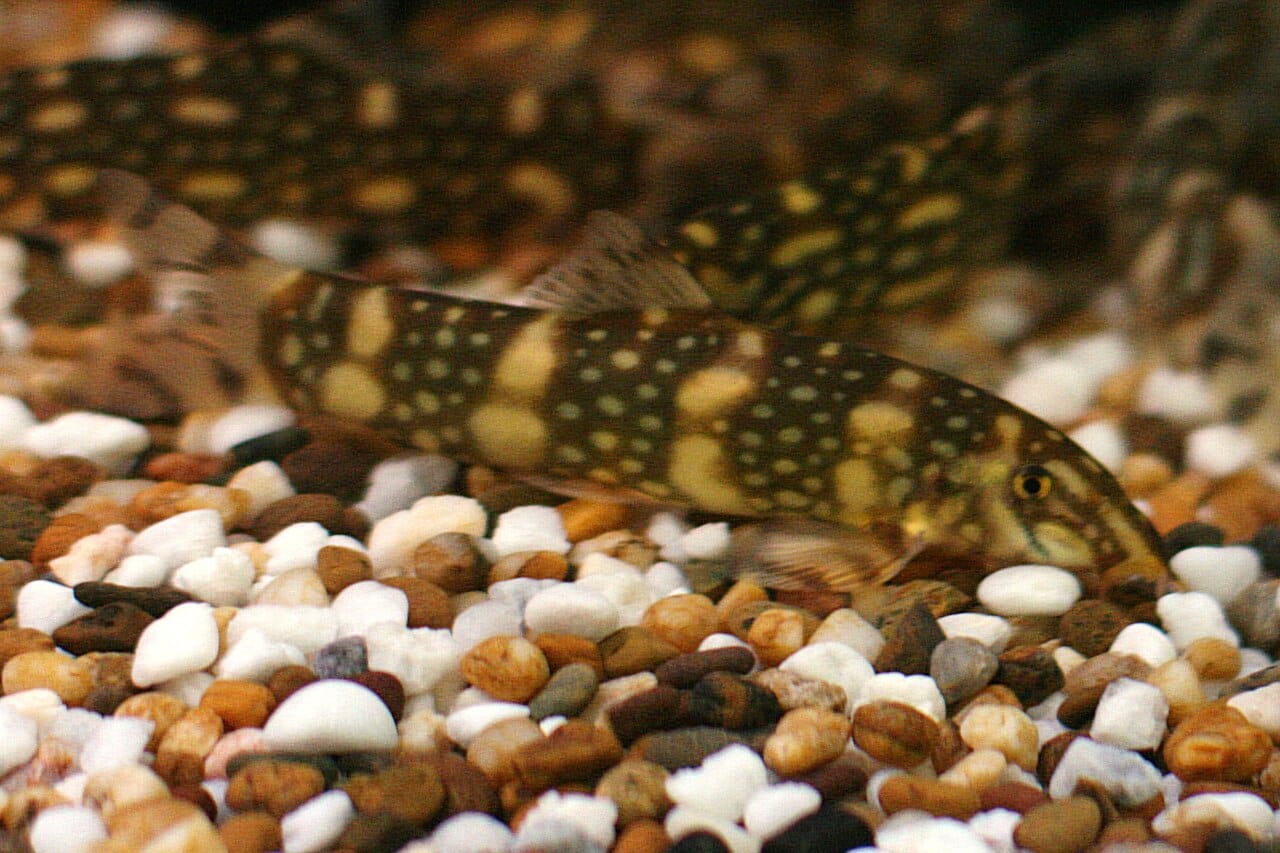
This is one of the most visually distinctive loaches in the freshwater hobby. Juveniles display bold black bands and bars on a bright yellow to cream background, creating the “polka dot” appearance the common name comes from. The body shows three broad black horizontal stripes intersected by five vertical bars, with the yellow spaces between them forming elongated blotches and spots.
What makes this species particularly interesting is how dramatically the pattern changes as the fish matures. Through a process called anastomosis, the dark bands gradually break down and merge, and no two adults end up looking exactly alike. Some develop a more marbled appearance; others retain more defined spotting. Color intensity shifts based on mood, health, and environment, stressed or recently imported fish often appear washed out compared to settled specimens in stable water.
The body shape is typical of Botia: laterally compressed with a slightly arched back and a pointed snout equipped with four pairs of barbels for foraging. Like all botiid loaches, they have a bifid suborbital spine beneath each eye that can be erected defensively. Handle carefully, the spines catch in mesh nets and can injure the fish.
Male vs. Female
| Feature | Male | Female |
|---|---|---|
| Body Shape | Slimmer, more streamlined | Fuller, rounder belly when mature |
| Snout | More elongated with fleshier lips | Slightly more curved |
| Size | Slightly smaller on average | May grow slightly larger |
| Coloration | No reliable difference | No reliable difference |
Sexing polka dot loaches is subtle and only reliable with sexually mature adults. Outside of breeding condition the differences are minimal. Females develop a noticeably rounder profile when full of eggs, that’s the most consistent visual cue available to hobbyists.
Average Size & Lifespan
Polka dot loaches reach a maximum of about 6 inches (15 cm) in captivity, though most specimens settle at 4 to 5 inches (10–13 cm). They grow at a moderate pace, typically reaching full size within two to three years under good conditions.
With proper care, expect a lifespan of 8 to 12 years. Like most botiid loaches, they’re long-lived fish that reward consistent keepers. Water quality is the dominant factor in reaching the upper end of that range. Fish kept in clean, stable water with a proper diet will reliably outlive those in subpar conditions, the difference can be several years.
Care Guide
Tank Size
A minimum of 55 gallons (208 L) for a group of polka dot loaches. These are active swimmers that use the full length of the tank, so a longer footprint matters more than height, a standard 4-foot (120 cm) tank is the starting point. For a group of 10 or more (where their social behavior truly shines), a 75-gallon (284 L) or larger is a better choice.
Hard Rule: A group of 5 minimum, not 1, not 2, not “I’ll add more later.” A single polka dot loach or a pair is a stressed, often territorial fish that redirects social energy into bullying other bottom-dwellers. The social hierarchy that makes these fish enjoyable to watch only forms in a proper group. Under-stocking is the most common reason people have bad experiences with this species.
A tight-fitting lid is also non-negotiable. Polka dot loaches are accomplished escape artists, especially during the first few weeks in a new tank. Every opening needs to be secured.
Water Parameters
| Parameter | Recommended Range |
|---|---|
| Temperature | 72–82°F (22–28°C) |
| pH | 6.0–7.5 |
| General Hardness (GH) | 2–10 dGH |
| Ammonia | 0 ppm |
| Nitrite | 0 ppm |
| Nitrate | Below 20 ppm |
Stability matters more than hitting exact numbers, but polka dot loaches do best in soft to moderately hard, slightly acidic to neutral water. Weekly water changes of 30 to 50 percent are essential, scaleless fish are more sensitive to dissolved waste than scaled species. Always use a dechlorinator and match the temperature of new water closely to avoid thermal shock.
Filtration & Water Flow
Strong filtration is a must, aim for a turnover rate of at least 4 to 5 times the tank volume per hour. A canister filter is the best option for a tank this size. Adding a powerhead or spray bar creates the moderate current that replicates their well-oxygenated stream habitat. These loaches appreciate movement but don’t need heavy turbulence, moderate, consistent flow with good surface agitation for gas exchange is the goal.
Lighting
Polka dot loaches naturally come from shaded forest streams and prefer subdued lighting. Bright overhead lights keep them hidden more than necessary. If you’re running a planted tank, standard LED lighting is fine as long as you provide shaded areas with driftwood, overhanging plants, or floating vegetation. Dimmer conditions encourage bolder, more active behavior during the day.
Plants & Decorations
Caves, driftwood, and rocky formations are essential. Polka dot loaches are notorious for cramming themselves into tight spaces, they’ll pile on top of each other in a favorite cave even when there are more than enough alternatives. Provide at least one hiding spot per fish, though more is always better. Smooth river rocks stacked to create crevices, PVC pipe sections, and coconut shells all work well.
Live plants work well with polka dot loaches. Hardy species like Anubias, Java fern, and Cryptocoryne tolerate the lower light levels and attach to the driftwood and rocks already in the tank. Floating plants, Amazon frogbit, water lettuce, cut down light intensity naturally and are one of the easiest ways to improve the setup for these fish.
Substrate
Fine sand or smooth rounded gravel is the right choice. Polka dot loaches spend considerable time foraging along the bottom, sifting with their sensitive barbels. Rough gravel or sharp-edged substrates damage those barbels over time and impair their ability to find food. A sand and smooth rock combination best replicates their natural habitat.
Tank Mates
In a proper group, polka dot loaches are generally peaceful community fish. In a small group or alone, they become nippy and territorial toward other bottom-dwellers. In a group of 5 or more, they establish their own social hierarchy and largely leave other species alone. The key is never keeping fewer than 5, and selecting tank mates that can handle the loaches’ energetic, social nature.
Best Tank Mates
- Medium-sized barbs (tiger barbs, cherry barbs, odessa barbs), active enough to hold their own
- Larger tetras (Congo tetras, emperor tetras, diamond tetras), occupy mid-water and stay out of loach territory
- Rasboras (harlequin rasboras, scissortail rasboras), peaceful mid-water schoolers
- Other botiid loaches (clown loaches, yoyo loaches), similar social needs; ensure adequate tank space
- Larger corydoras (sterbai, bronze, emerald), coexist well in spacious tanks with enough floor area
- Bristlenose plecos, armored catfish the loaches will leave alone
- Pearl gouramis or moonlight gouramis, calm upper-level fish that fill a different niche
Tank Mates to Avoid
- Long-finned species (bettas, fancy guppies, angelfish, long-fin tetras), polka dot loaches are fin nippers; flowing fins are too tempting
- Very small fish (neon tetras, celestial pearl danios, microrasboras), may be bullied or outcompeted for food
- Snails and ornamental shrimp, polka dot loaches are natural snail predators; cherry shrimp and smaller species will be eaten
- Aggressive or territorial cichlids, conflict over bottom territory
- Slow-moving, delicate bottom-dwellers, may be harassed by the loaches’ active, boisterous behavior
Food & Diet
Polka dot loaches are enthusiastic omnivores that eat almost anything that sinks to the bottom. High-quality sinking pellets or wafers should form the base diet. Feed once or twice daily, offering only what they can consume in a few minutes.
Supplement the staple diet with variety. Frozen or live bloodworms, brine shrimp, tubifex, daphnia, and mosquito larvae are all eagerly accepted. On the vegetable side, blanched zucchini, cucumber, spinach, and shelled peas provide important fiber. Algae wafers make a good addition as well.
These loaches are natural snail predators. A group of polka dot loaches will put a serious dent in a pest snail population, they’re skilled at extracting snails from their shells, and it’s a food source that provides genuine enrichment. Don’t rely on snail control as their primary food source, but do use it as a supplemental enrichment when pest snails are present.
Expert Take (Mark Valderrama, AquariumStoreDepot) In 25+ years in the hobby and time managing fish stores, polka dot loaches were always one of the most requested species when customers wanted a “personality fish” for a larger community tank. At the stores I managed, we always displayed them in groups of 10 or more, and the difference between a group of 3 and a group of 10 is not comparable. Ten fish in a mature planted tank, clicking during feeding, arguing over the best cave, doing their sideways lounging thing, that’s the fish people actually want. I’d always tell customers: if you’re not willing to buy 6, wait until you can.
Breeding & Reproduction
Breeding Difficulty
Breeding polka dot loaches in home aquariums is essentially uncharted territory. There are no well-documented cases of hobbyists successfully spawning this species without hormonal intervention. Commercially bred specimens exist, but they’re produced through hormone-induced spawning at fish farms, primarily in Southeast Asia. The vast majority of specimens in the hobby remain wild-caught.
Spawning Tank Setup
If you’re determined to attempt breeding, the best approach based on limited existing information is to maintain a large group of 10 or more well-conditioned adults in a spacious tank of 75 gallons (284 L) or larger. The tank should be heavily decorated with driftwood and natural crevices where pairs can isolate themselves. Mature, well-established tanks appear more conducive to reproductive behavior than sterile setups.
Water Conditions for Breeding
Specific breeding triggers haven’t been identified for the home aquarium. Simulating seasonal changes may help, slightly cooler water followed by a gradual increase, combined with increased flow and more frequent water changes using slightly cooler, softer water to mimic the Myanmar wet season onset. Soft, slightly acidic water (pH 6.0–6.5, temperature 78–80°F / 26–27°C) is a reasonable starting point.
Conditioning & Spawning
Heavy conditioning with protein-rich live and frozen foods, bloodworms, brine shrimp, tubifex fed multiple times daily over several weeks, should bring females into a noticeably fuller body condition. Any actual spawning would likely involve egg scattering in and around rocky crevices, consistent with what’s known about related Botia species.
Egg & Fry Care
Because home breeding hasn’t been reliably documented, specific egg and fry care protocols are largely theoretical. In commercial operations, eggs are collected after hormone-induced spawning and raised separately. If eggs were obtained naturally, separating them from adults immediately would be critical, the parents will consume them. Fry of related species typically accept infusoria and freshly hatched brine shrimp as first foods.
Common Health Issues
Ich (White Spot Disease)
As scaleless fish, polka dot loaches are more susceptible to ich than scaled species and are often the first in a community tank to show symptoms. Standard ich medications containing copper or malachite green should be used at half dose or avoided entirely, scaleless fish absorb these chemicals at a much higher rate. Heat treatment (gradually raising the temperature to 86°F / 30°C with increased aeration) is a safer first-line approach. Always have a quarantine protocol in place before you need it.
Skinny Disease (Internal Parasites)
Newly imported wild-caught polka dot loaches sometimes arrive carrying internal parasites that cause weight loss despite normal eating behavior. A prophylactic treatment with a praziquantel-based dewormer after purchase is a smart precaution, especially if the fish appear thin. Quarantine all new arrivals for at least two to four weeks before adding them to an established community.
Bacterial Infections
Poor water quality hits scaleless fish faster than scaled species. Red streaking on the body, fin erosion, and cloudy eyes are signs of bacterial infections that typically stem from elevated ammonia, nitrite, or nitrate. Prevention through consistent water changes and strong filtration is far more effective than treatment. When medication is necessary, choose loach-safe options and dose conservatively.
Common Mistakes to Avoid
- Keeping them alone or in pairs: This is the number one mistake. A solitary polka dot loach becomes withdrawn, stressed, or aggressive toward other tank mates. They need a group of at least 5 to 6 to feel secure and display natural behavior.
- Choosing a tank that’s too small: These grow to 6 inches (15 cm) and are active swimmers. A 20 or 30-gallon tank might seem fine for juveniles, but they’ll outgrow it fast. Start with 55 gallons (208 L) minimum.
- Using rough substrate: Sharp gravel damages their barbels, their primary sensory organs for finding food. Fine sand or smooth rounded gravel is essential.
- Full-dose medications: Scaleless fish absorb chemicals through their skin at much higher rates. Always research loach-safe medications and start with reduced dosing.
- Adding them to an immature tank: Polka dot loaches do poorly in newly cycled tanks. They need a mature, biologically stable aquarium. Give a new tank at least three months before introducing them.
- Not covering the tank: These loaches are accomplished jumpers, especially when new to a setup. Every opening in the lid needs to be secured.
- Keeping with shrimp and expecting it to work out: Polka dot loaches are aggressive shrimp predators. Cherry shrimp, neo caridina, and similar small species will be eaten. If you want shrimp, this isn’t the loach for your tank.
What Most Keepers Get Wrong
“I’ll start with two and add more later.” This is the classic polka dot loach mistake. “Later” rarely happens on the timeline the fish needs, and in the meantime, two fish in a 55-gallon is a stressed, often nippy situation. The group you need is the group you start with. Buy the full number upfront or wait until you can.
Assuming the juvenile pattern is permanent. New keepers are often caught off guard when their striking spotted juveniles start developing into marbled or blotchy adults that look completely different. This is expected and normal, the anastomosis of the pattern is a natural part of maturation, not a sign of illness or poor conditions. Each adult ends up with a unique pattern. That’s actually part of what makes keeping a group interesting.
Treating them like regular loaches regarding medication. “I’ve used this ich treatment on my kuhlis and it’s fine” doesn’t apply here. Different species have different sensitivity profiles, and even within the loach family there’s variation. Polka dot loaches are more medication-sensitive than many keepers expect. Half-dose first, monitor closely, and always have a heat treatment option ready as an alternative.
The Reality of Keeping Polka Dot Loach
The clicking sounds are a real part of daily life. Polka dot loaches produce audible clicking sounds, made by their pharyngeal teeth grinding, primarily during feeding time but also during social interactions. In a group of 10 in a quiet room, you’ll hear it. It’s not a health concern; it’s one of the more charming behavioral quirks in freshwater fishkeeping. First-time loach owners are always surprised by it.
The sideways lounging will alarm you repeatedly. Botiid loaches rest in odd positions, wedged into crevices, lying flat on decorations, sprawled across a plant leaf in what looks like a dead fish. This is completely normal. As long as the fish is eating, moving, and breathing normally, the position is irrelevant. New keepers mistake this for illness almost universally. After a few weeks you stop flinching, and eventually it just becomes part of what makes them charming.
The cave arguments are constant. Give a group of polka dot loaches 10 caves and they’ll all want the same one. The hierarchy fights are mostly posturing and chasing, rarely cause injury in a properly sized tank with enough fish to distribute aggression. Watching the social dynamics of a group establish itself over weeks and months is genuinely interesting.
Pest snail problems get solved. If you have a bladder snail or trumpet snail infestation, a group of polka dot loaches is one of the most effective biological controls available. They’ll work through the population methodically, extracting snails from their shells. It’s a useful side benefit that also provides enrichment feeding behavior to watch.
Should You Get This Fish?
Good Fit If:
- You have a 55-gallon (208 L) or larger tank already running and cycled, ideally 3 months or more old
- You want a bottom-level personality fish with visible, interesting social behavior
- You’re willing to buy a group of at least 6 from the start, not “start with 2 and add more later”
- You have a pest snail problem you want solved naturally
- You’re not planning to keep ornamental shrimp in the same tank
- You have tank mates that can handle an active, energetic bottom-dweller
Avoid If:
- Your tank is under 55 gallons, don’t plan around upgrading later
- You keep a shrimp colony and don’t want to lose it
- You have bettas, angelfish, or other long-finned species that are fin-nipping targets
- Your tank is newly set up, polka dot loaches need a biologically mature system
- You want a subtle, unobtrusive bottom-dweller, these fish have real presence and make noise about it
Species Comparison
If you’re considering a polka dot loach, you’ve probably also looked at the Clown Loach and the Yoyo Loach. Here’s an honest comparison:
Polka Dot Loach vs. Clown Loach (Chromobotia macracanthus): Clown loaches grow significantly larger (up to 12 inches / 30 cm in captivity, occasionally more), need substantially bigger tanks (180 gallons / 681 L for a proper adult group), and are a 20+ year commitment. Polka dot loaches top out at 6 inches (15 cm) and are more manageable for the average hobbyist. Choose clown loach if you have the space and are ready for a true large-tank specimen. Choose polka dot loach if you want similar social personality at a more practical size.
Polka Dot Loach vs. Yoyo Loach (Botia almorhae): The yoyo loach shares the same social requirements and similar care needs. Yoyos are slightly smaller (5 inches / 13 cm), with a distinctive reticulated pattern and bolder markings that remain more consistent through adulthood than the polka dot’s shifting pattern. Yoyo loaches tend to be more readily available and slightly less expensive. Choose polka dot loach if the uniquely variable adult pattern appeals to you; choose yoyo loach if you want comparable social behavior with more consistent availability.
Polka Dot Loach vs. Zebra Loach (Botia striata): Zebra loaches are smaller (4 inches / 10 cm maximum) and can be kept in a 40-gallon (151 L) tank. They share the social group requirement but are somewhat more peaceful and less prone to fin-nipping. Choose zebra loach if you have a smaller tank and want a more manageable, less boisterous option. Choose polka dot loach if you want more visual drama and have the space to support a proper group.
Where to Buy
Polka dot loaches are a specialty species you won’t typically find at big-box pet stores. Your best options are dedicated online fish retailers and local fish stores that carry wild-caught imports. Look for fish that are active, well-colored, and not excessively thin. Fish that have been at the retailer for at least two weeks are a safer bet than fish straight off an import shipment.
Wild-caught availability is seasonal based on import schedules from Myanmar. Check stock regularly and plan to buy your full group at once, mixing fish from different import batches can introduce disease and disrupts the group dynamic that develops when fish are raised together.
Frequently Asked Questions
How many polka dot loaches should I keep together?
Five to six is the minimum, but 10 or more is where you’ll see the most natural behavior. In smaller groups, a dominant individual may bully the others. Larger groups spread aggression through the hierarchy and result in bolder, more active fish that spend more time in the open.
Are polka dot loaches aggressive?
In a proper group, they’re generally peaceful toward other species. They establish a pecking order among themselves, involving chasing and posturing, but this is normal social behavior that rarely causes injury. The aggression problems arise when they’re kept in insufficient numbers, at which point they may redirect social energy toward other tank mates, particularly other bottom-dwellers.
Can polka dot loaches live with shrimp?
No. Polka dot loaches are effective snail predators and will eat ornamental shrimp, cherry shrimp, neocaridina, and other smaller species will be targeted. If keeping a shrimp colony is important to you, choose a different loach species.
Why do my polka dot loaches click?
The clicking or snapping sounds are produced by their pharyngeal teeth grinding together, completely normal. It happens most often during feeding but also during social interactions. Many botiid loaches make these vocalizations. It’s one of the most distinctive behaviors in loach keeping, and once you associate the sound with feeding time, you’ll start to look forward to it.
Why is my polka dot loach lying on its side?
This is typical botiid loach behavior, resting in odd positions is completely normal. They’ll wedge into crevices, lie flat on leaves, or drape over decorations in what looks like a dead fish. As long as the fish is eating well, breathing normally, and shows good coloration, the sideways lounging is just part of their personality. If the fish appears lethargic, pale, or won’t eat, then investigate water quality.
Do polka dot loaches eat algae?
They’ll graze on soft algae opportunistically, but they’re not a dedicated cleanup crew. Don’t count on them to solve an algae problem. They’re omnivores that lean toward the protein side of their diet. Algae wafers can be offered as supplemental food, but they need a complete, varied diet well beyond plant matter.
Closing Thoughts
The polka dot loach earns its price tag and the extra effort it takes to keep well. Between the striking pattern that’s different on every individual, the social behaviors that keep you watching, and the clicking sounds that are genuinely hard not to enjoy, this is a loach with real personality. They’re not the simplest species to maintain, but for anyone with a properly sized, mature tank and the willingness to keep a proper group, the return on investment is substantial.
Get a group, give them caves to argue over, and let them do their thing. A well-kept group of polka dot loaches in a mature planted tank is one of the most engaging displays in the freshwater hobby. They’re the kind of fish that turns casual observers into dedicated loach enthusiasts, and that’s not something every species can claim.
Recommended Video
Check out our loach tier list video where Mark ranks the most popular loach species in the hobby:
References
- Kottelat, M. (2004). Botia kubotai, a new species of loach (Teleostei: Cobitidae) from the Ataran River basin, Myanmar. Zootaxa, 401, 1–18.
- SeriouslyFish. Botia kubotai, Polka-Dot Loach. Accessed 2025.
- Froese, R. and D. Pauly, Eds. FishBase. Botia kubotai Kottelat, 2004. Accessed 2025.
- Loaches Online. Botia kubotai. Accessed 2025.
The polka dot loach is one of the 23+ loach species we cover in our complete species directory. Whether you’re looking for nano loaches, hillstream specialists, or active personality fish for a larger community tank, our full guide covers them all. Loaches: Complete Species Directory →
- About the Author
- Latest Posts

I’m Mark Valderrama, founder of Aquarium Store Depot and a fishkeeper with over 25 years of hands-on experience. I started in the hobby at age 11, worked at local fish stores, and have kept freshwater tanks, ponds, and reef tanks ever since. I’ve been featured in two best-selling aquarium books on Amazon and built this site to share practical, experience-based fish keeping knowledge.
Leave a Reply