
Last Updated: June 25, 2026
Thank you for visiting! By the way… any links on this page that lead to products on Amazon and other stores/partners are affiliate links Aquarium Store Depot earns a commission if you make a purchase.
Table of Contents
- Key Takeaways
- What People Get Wrong
- Species Overview
- Classification
- Origin & Natural Habitat
- Appearance & Identification
- Average Size & Lifespan
- Care Guide
- Tank Mates
- Food & Diet
- Breeding & Reproduction
- Should You Get This Fish
- How It Compares
- Common Health Issues
- Common Mistakes to Avoid
- Where to Buy
- Frequently Asked Questions
- Closing Thoughts
- References
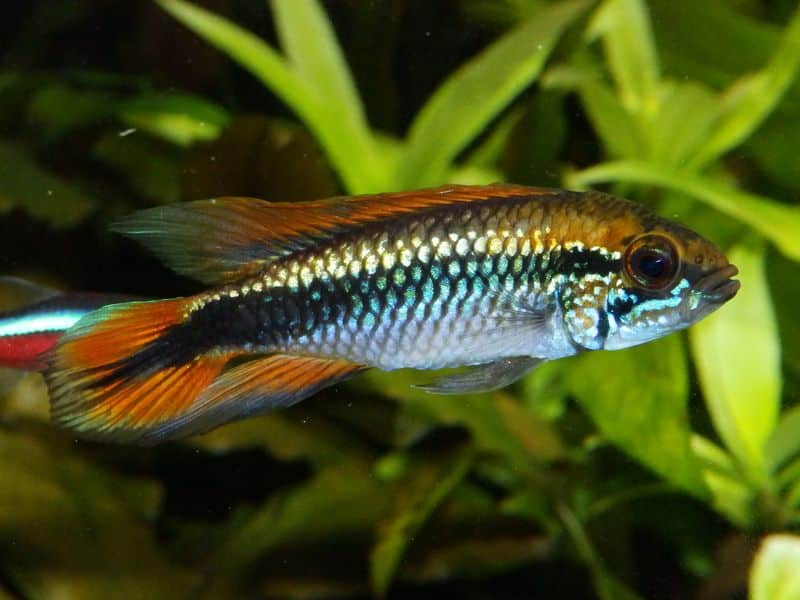
Agassiz’s dwarf cichlid is where a lot of serious apisto keepers got started. That’s not an accident. Apistogramma agassizii gives you everything the genus is known for: vivid color, bold personality, and rewarding breeding behavior in a package that’s more forgiving than most dwarf cichlids. The flame-shaped caudal fin on the males is one of the most distinctive looks in freshwater fishkeeping.
Here’s what the sales pitch usually misses: this fish doesn’t do well as a simple pair. It’s a harem breeder, and keeping just one male with one female almost always ends badly for the female.
Get the setup right and you’ll have one of the most engaging small fish setups in freshwater. Get it wrong and you’ll wonder what everyone is raving about.
When a female A. agassizii decides she’s protecting her fry, she goes from dull olive to electric yellow in a matter of hours. That transformation is one of the most dramatic color changes in the freshwater hobby, and it’s the moment that turns a lot of hobbyists into apisto collectors.
Key Takeaways
- One of the most popular apistos – widely available, offered in multiple color varieties, and well-suited to the hobbyist who wants a first dwarf cichlid
- Males are showstoppers with vivid coloration and a flame-shaped (spade-shaped) caudal fin that makes them look larger than they are
- Harem breeders – one male with 2 to 3 females is the correct social structure; pairs lead to chronic female stress
- Captive-bred specimens are adaptable to a wider range of water conditions than wild-caught fish; soft, near-neutral water works fine
- Ideal for planted tanks – won’t damage plants and thrives in densely planted environments with caves and leaf litter
ASD Difficulty Rating
Moderate | 5/10
Captive-bred A. agassizii is the most accessible entry point into the Apistogramma genus. Water parameter tolerance is better than most dwarf cichlids. The real learning curve is the harem setup, cave structure, and managing breeding aggression – all of which are predictable and manageable once you understand the fish’s social needs.
What People Get Wrong
These are the mistakes that come up again and again with this species, specifically:
- Keeping a pair instead of a harem. A single male with one female means his full attention is on her, constantly. In a small or poorly structured tank, that’s harassment. In an open tank, it can get worse. The harem setup exists for a reason: it distributes the male’s attention and keeps every female more relaxed.
- Assuming captive-bred fish need the same water as wild-caught. Wild A. agassizii come from blackwater habitats with pH values as low as 4 to 5. Captive-bred stock has been acclimated over generations and handles pH 6.5 to 7.0 with reasonable softness just fine. You don’t need a blackwater tank to keep this fish successfully.
- Adding apistos to a new tank. These fish are sensitive to ammonia and nitrite. A “cycled” tank that’s only two weeks old is not the same as an established tank with stable biology. Wait at least a month before introducing apistos, and test water parameters before adding them.
- Writing off males at the store as dull. Fish at the LFS are usually young, stressed, and showing a fraction of their adult color. The same male in a well-maintained tank with the right water chemistry will look like a different animal in three to four months.
- Thinking color variety means different care. Double red, fire red, gold, blue – all the same species, all the same care requirements. Color forms are the result of selective breeding from the same wild stock. Don’t let the marketing confuse you.
Species Overview
| Field | Details |
|---|---|
| Scientific Name | Apistogramma agassizii |
| Common Names | Agassiz’s Dwarf Cichlid, Agassiz Apisto |
| Family | Cichlidae |
| Origin | Amazon River basin (Peru, Brazil) |
| Care Level | Moderate |
| Temperament | Semi-aggressive (territorial when breeding) |
| Diet | Carnivore |
| Tank Level | Bottom to Middle |
| Maximum Size | 3.5 inches (9 cm) males; 2.5 inches (6 cm) females |
| Minimum Tank Size | 20 gallons (76 liters) |
| Temperature | 73 to 84°F (23 to 29°C) |
| pH | 5.0 to 7.0 |
| Hardness | 1 to 10 dGH |
| Lifespan | 3 to 5 years |
| Breeding | Cave spawner (harem breeder) |
| Breeding Difficulty | Moderate |
| Compatibility | Peaceful community with appropriate tank mates |
| OK for Planted Tanks? | Yes – ideal environment |
Classification
| Taxonomic Level | Classification |
|---|---|
| Order | Cichliformes |
| Family | Cichlidae |
| Subfamily | Geophaginae |
| Genus | Apistogramma |
| Species Group | agassizii group (one of three main lineages within the genus) |
| Species | A. agassizii (Steindachner, 1875) |
Apistogramma agassizii was originally described as Geophagus (Mesops) agassizii by Steindachner in 1875. The species name honors Louis Agassiz, the Swiss-American zoologist who inspired the Thayer Expedition to Brazil (1865 to 1866), during which the type specimens were collected. The genus name Apistogramma comes from the Greek for “uncertain line,” referring to the variably developed lateral lines found across species in the genus. A. agassizii is the namesake species of the agassizii group, one of three major lineage groupings within the genus, which includes several closely related species.
Origin & Natural Habitat
Agassiz’s dwarf cichlid has one of the broader distributions within the genus. Its range covers the Amazon River basin from Peru through Brazil, along the main Amazon-Solimoes channel and its tributaries east to the Capim River basin. That wide range explains the considerable color variation between wild populations: fish from clear-water, blackwater, and whitewater habitats have all developed distinct regional color patterns.
In the wild, A. agassizii lives in shallow tributaries with sandy bottoms, dense leaf litter, submerged roots, and overhanging vegetation. Blackwater habitats often have pH values in the 4 to 5 range. The fish stays close to the bottom, using the structure of accumulated leaves and wood as territory and as a hunting ground for small invertebrates. That natural environment is worth replicating in the tank: leaf litter, driftwood, dense planting, and caves aren’t just decoration; they produce noticeably better behavior and lower stress levels in captive fish.
Appearance & Identification
Male Agassiz’s dwarf cichlids are among the most visually distinctive fish in the genus. The body is elongated and laterally compressed, with a dark lateral stripe running from the snout through the eye to the caudal peduncle. The defining feature is the caudal fin: flame-shaped, coming to a pointed tip that visually extends the fish well beyond its actual body length. Full adult males in good condition are genuinely impressive.
Wild-type males show a blue-silver body with yellow-orange on the belly, chest, and fins. Selective breeding has produced several named color forms: “double red” (red in the caudal and dorsal fins), “fire red” (intense body-wide red), “gold” (yellow-gold body), and “blue” (enhanced blue iridescence). Regardless of color form, the body shape and flame-tailed caudal fin are constant. The fins are the identity; the color is the variety.
Females are smaller, less colorful, and easily overlooked in a store tank. That changes completely during breeding. A female guarding eggs or fry transforms from brownish-olive to a bright, almost electric yellow with bold black markings. It’s one of the most dramatic color changes in the freshwater hobby, and it happens fast.
Male vs. Female
Sexing adult A. agassizii is straightforward. The differences are pronounced even in juvenile fish.
| Feature | Male | Female |
|---|---|---|
| Body Size | Up to 3.5 inches (9 cm) | Up to 2.5 inches (6 cm) |
| Caudal Fin | Flame-shaped (spade), elongated point | Rounded, much smaller |
| Dorsal Fin | Elongated, with extended rays | Shorter, rounded |
| Resting Color | Blues, reds, and yellows depending on variety | Brownish-olive |
| Breeding Color | Intensified display colors | Bright yellow with bold black markings |
Average Size & Lifespan
Males reach a maximum of about 3 to 3.5 inches (7 to 9 cm). The flame-shaped caudal fin adds considerable visual length beyond the body measurement. Females are noticeably smaller at 2 to 2.5 inches (5 to 6 cm), which is part of why tank layout matters so much for this species: the size difference makes female harassment a real issue if there’s nowhere for her to go.
Lifespan in captivity is typically 3 to 5 years. It’s a relatively short window, but the fish’s willingness to breed means you can maintain a self-sustaining population indefinitely if that’s your goal. Diet and water quality are the biggest variables. Fish kept on a varied diet with consistent water maintenance reliably hit the higher end of the range.
Care Guide
Tank Size
A 20-gallon (76-liter) tank is the minimum for a harem of one male with 2 to 3 females. Footprint matters more than height here. A 20-gallon long (30 x 12 x 12 inches) gives each female the floor space to establish her own territory. A 20-gallon tall does not. For a community setup with dither fish added above, 30 to 40 gallons is more comfortable and significantly reduces aggression.
The tank needs to be structured around female territories. Each female needs visual separation from the others: dense planting, driftwood, or rock arrangements that create distinct zones. This isn’t optional decoration; it’s how the harem actually functions. Without it, the male chases one female relentlessly, and that fish ends up chronically stressed or dead.
Water Parameters
| Parameter | Recommended Range |
|---|---|
| Temperature | 73 to 84°F (23 to 29°C) |
| pH | 5.0 to 7.0 (captive-bred comfortable at 6.5 to 7.0) |
| General Hardness | 1 to 10 dGH |
| Ammonia | 0 ppm |
| Nitrite | 0 ppm |
| Nitrate | Below 20 ppm |
Wild A. agassizii come from water with pH values as low as 4 to 5. Captive-bred fish are a different story. Generations of tank breeding have produced stock that thrives at pH 6.5 to 7.0 with moderate softness. If your tap water is reasonably soft (GH around 6, KH around 2), you likely don’t need RO water or blackwater additives for everyday keeping. For breeding, dialing the pH down to 6.0 to 6.5 with GH below 5 improves egg viability, but the fish don’t need extreme conditions to survive and be healthy.
Don’t introduce apistos into a new tank. Wait at least a month after cycling before adding them. These fish are sensitive to ammonia and nitrite, and a freshly cycled tank that “reads zero” can still have unstable biology. Let the tank mature first.
Expert Take (Mark Valderrama, AquariumStoreDepot)
After 25 years of working with apistos at the store and retail level, the biggest mistake I see is people keeping A. agassizii as a pair. The male fixates on the one female, and in a small or unstructured tank, she takes a beating. A harem setup is not just “better” – it’s the correct social structure for this species. The other thing worth knowing: wild-caught fish and captive-bred fish are practically different fish in terms of what they need. Wild fish need very soft, acidic water to thrive. Captive-bred stock from a quality supplier will do fine in soft, near-neutral water. Always ask where the fish came from before you build your water chemistry plan around them.
Filtration & Water Flow
Gentle filtration is non-negotiable. A. agassizii comes from slow-moving water and doesn’t appreciate strong current. Sponge filters are ideal for smaller setups: good biological filtration, minimal flow, and no risk of fry being sucked in. In larger tanks, a canister or hang-on-back filter with a pre-filter sponge and diffused output works well. Point the output toward the surface or against the wall to break the current before it hits the bottom.
Weekly water changes of 20 to 25% maintain quality without large parameter swings. Match the temperature and chemistry of the replacement water closely. Sudden temperature drops or large pH shifts stress apistos quickly.
Lighting
Low to moderate lighting is ideal. These fish come from shaded forest streams and display their best color and behavior under subdued conditions. Floating plants are the most effective tool for creating the dim, sheltered environment apistos prefer. Under normal planted-tank lighting, enough shade at the bottom level keeps the fish comfortable and encourages them to stay out in the open rather than hiding.
Plants & Decorations
A densely planted tank is the natural home for this species. Java fern, anubias, cryptocorynes, and floating plants all work well. The fish don’t dig or damage plants, so you can aquascape without restriction. Dense planting creates the visual barriers that make the harem setup function: each female can hold her corner of the tank without constant visual contact with the others.
Driftwood, dried botanicals, and Indian almond leaves on the substrate replicate the leaf-litter habitat and provide foraging opportunities. The tannins released by Indian almond leaves and alder cones naturally soften and acidify the water and have mild antifungal properties useful during breeding.
Hard Rule: One cave per female, minimum. Add extras.
A tank with one male and three females needs at least four caves – preferably six. The female needs to feel like she owns a territory with a spawning site. Without caves, females can’t spawn, can’t retreat, and remain chronically stressed. Coconut shell halves, small terracotta pots, or ceramic caves all work. No caves means the harem system doesn’t function, period.
Substrate
Fine sand is the correct substrate for this species. Agassiz’s apistos spend most of their time at or near the bottom, occasionally sifting sand for food particles. Sand is gentle on their bodies, supports the planted tank aesthetic, and looks natural with the leaf litter and wood that complete this setup. A dark-colored sand enhances the contrast with the fish’s coloration significantly.
Tank Mates
Agassiz’s dwarf cichlid is peaceful toward fish that stay out of its bottom territory. The classic approach pairs apistos with small schooling fish in the upper water column. These “dither fish” reduce skittishness in the apistos: when they see other fish out in the open and relaxed, they’re more likely to come out themselves.
Best Tank Mates
- Cardinal tetras – the classic apisto companion; thrives in the same soft, acidic water
- Rummy-nose tetras – peaceful mid-water schoolers that serve as excellent dither fish
- Pencilfish (Nannostomus spp.) – upper-water dwellers that share soft-water preferences and won’t compete for territory
- Ember tetras – tiny, peaceful, and beautiful in a planted apisto tank
- Hatchetfish – surface dwellers that never enter the apisto’s zone
- Otocinclus – peaceful algae eaters that stay out of bottom-level territorial disputes
- Small corydoras – can work in larger tanks, though watch during breeding when the female becomes territorial even toward bottom fish
Tank Mates to Avoid
- Other bottom-dwelling cichlids in small tanks – rams, other apistos, and kribensis compete for the same territory; only combine in large, heavily structured tanks
- Fin-nippers or boisterous species – tiger barbs, serpae tetras, and similar fish will harass and outcompete apistos
- Large or predatory fish – anything that views a 2 to 3 inch fish as a snack
- Dwarf shrimp – cherry shrimp, neocaridina, and similar small shrimp will be hunted; even larger amano shrimp face real risk in a tank with breeding apistos
Food & Diet
Agassiz’s dwarf cichlids are carnivores. In the wild they hunt small invertebrates and insect larvae near the bottom. In the tank, protein-rich frozen and live foods produce the best color, condition, and breeding behavior. Frozen bloodworms, brine shrimp, daphnia, cyclops, and mysis shrimp are all eagerly accepted. Live foods – baby brine shrimp, blackworms, microworms, grindal worms – are excellent for conditioning fish before breeding.
Captive-bred specimens usually accept high-quality micro pellets and crushed flake food, which makes daily feeding straightforward. That said, a diet built entirely on prepared food produces faded color and reduced vitality over time. Frozen foods should be a consistent part of the rotation, not an occasional treat. Feed small amounts two to three times daily; these fish have small stomachs and do better with frequent modest meals than one large feeding.
Breeding & Reproduction
Breeding Difficulty
Moderate. A. agassizii is one of the more willing Apistogramma species to breed in captivity, particularly tank-raised stock. Sexual maturity typically arrives around 6 months of age. Once water conditions are right and the tank is properly structured, spawning happens without much encouragement.
Spawning Tank Setup
A 20-gallon breeding tank with fine sand, multiple caves, leaf litter, and a sponge filter is the standard setup. Each female needs at least one cave as a potential spawning site; offer two or three options per female so she can choose. Dense planting or dividers create the visual separation between female territories that the harem structure requires. Keep the tank established and well-cycled before adding fish.
Water Conditions for Breeding
Softer, more acidic water improves spawning success and egg viability. Target pH 6.0 to 6.5 with GH around 2 to 5, and temperatures of 79 to 82°F (26 to 28°C). Indian almond leaves and alder cones naturally acidify and soften the water while providing tannins that have mild antifungal properties – useful for protecting eggs. Nitrates should be kept below 10 ppm. Regular small water changes are more effective than infrequent large ones for maintaining stable chemistry during spawning.
Conditioning & Spawning
Condition breeders for one to two weeks on live and frozen foods before attempting to spawn. When the female is ready, she turns bright yellow with bold dark markings and begins actively exploring caves. She’ll display toward the male and lead him toward her chosen site, where she deposits eggs on the cave ceiling or walls. The male enters briefly to fertilize, then the female takes over.
Be aware that breeding brings out real aggression. In small or unstructured tanks, the male and female can seriously injure each other. This is normal apisto breeding behavior – but the tank needs enough cover and escape routes that neither fish has nowhere to go. In very small tanks, be prepared to remove the male once spawning is confirmed. He may not be welcome.
Egg & Fry Care
Eggs hatch within 24 to 72 hours – notably fast compared to most cichlids. The female handles egg care entirely: fanning the eggs, removing any that develop fungus, and defending the site aggressively. The fry become free-swimming within a few days of hatching and are guarded closely. Watching a female A. agassizii herd her fry is one of the better arguments for keeping this species.
First foods for fry: infusoria and naturally occurring microorganisms from a mature, planted tank. Move to freshly hatched baby brine shrimp within the first week. The female’s yellow warning coloration during fry guarding is genuine: she’ll chase off any tank mate that comes near, including the male, and occasionally dither fish larger than herself. Respect the signal.
Should You Get This Fish
Good fit if:
- You have a planted tank with soft, moderately acidic water (pH 6.5 or below preferred)
- You’re ready to set up a proper harem with a structured tank – caves, visual barriers, and enough space for each female
- You want to observe breeding behavior and parental care in a small fish
- You’re stepping up from basic community fish and want your first “specialty” cichlid
- You want a fish where the effort put into tank setup directly shows up in fish behavior and color
Think twice if:
- Your tap water is hard and alkaline (pH above 7.5, GH above 15) and you’re not willing to treat it
- You want to keep dwarf shrimp in the same tank
- You only have space for a pair; without a harem setup the social dynamics don’t work reliably
- You want a fish with minimal setup requirements – the cave structure and parameter management take real attention
- You’re a complete beginner; gain some experience with basic tropical fish first
What It Is Actually Like Living With Agassiz’s Dwarf Cichlid
This is the part no other care guide gives you. Forget water parameters for a minute. Here is what it is actually like to share your tank with this species.
The female’s color transformation is the moment most apisto keepers point to. She spends most of her time as a brownish-olive fish – easily overlooked, honestly forgettable. Then she spawns. Over the course of a few hours she turns a bright, almost electric yellow, with bold black markings appearing on her face and body. She becomes a completely different-looking fish. Once she’s guarding fry, she will charge anything that comes too close – including the male who is twice her size. That combination of transformation and intensity is what makes apisto keepers lose count of their tanks.
The male’s daily routine is its own display reel. The flame-shaped caudal fin is the signature feature in photos, but what you notice in person is how he uses it – spread wide near a female at the cave entrance, fanned out in a challenge display at the territory boundary, briefly tucked while moving across neutral ground. A fully colored adult male in good water quality looks nothing like what you see at the fish store. The first time you see one in peak condition in a well-planted soft-water tank, you understand why this species has the reputation it has.
The social structure of a functioning harem is what makes this fish genuinely interesting over time. Each female holds her corner, her cave, her territory. The male navigates between them – displaying here, courting there, patrolling the boundaries. When multiple females are in breeding condition simultaneously, the male’s behavior intensifies noticeably. Once you’ve watched this play out for a few weeks, a simple community tank feels static by comparison.
Color is the daily feedback. Rich blues and oranges on the male with the flame tail held wide – the water is right, the tank is stable. A pale, washed-out male retreating to the substrate means something is wrong – usually temperature, pH drift, or the wrong tank mates. The female’s electric yellow during breeding condition is the best possible signal that the setup is working exactly as intended. Pay attention to the color and you will become a better keeper faster than with almost any other species.
How the Agassiz’s Dwarf Cichlid Compares to Similar Species
If you are deciding between Agassiz’s and other small cichlids, the choice comes down to your water chemistry and what you want from the keeping experience.
Agassiz’s Dwarf Cichlid vs. Cockatoo Apisto (A. cacatuoides) , Choose the Cockatoo Apisto if your tap water is moderately hard or neutral and you want the most parameter-tolerant entry point into the apisto hobby. The cockatoo handles a wider range of conditions and the distinctive dorsal spines are immediately recognizable. Choose the Agassiz’s Dwarf Cichlid if your water is soft and you want the flame-tailed caudal fin and the more visually elegant adult male – a fully colored A. agassizii in peak condition in a planted soft-water tank is one of the most impressive small cichlids in freshwater.
Agassiz’s Dwarf Cichlid vs. German Blue Ram (Mikrogeophagus ramirezi) , Choose the German Blue Ram if you want the most colorful small cichlid for a high-temperature setup (82 to 86°F / 28 to 30°C) and the broad color range that GBR variants offer – but be aware GBRs typically live only 2 to 3 years and are notably more sensitive to water quality. Choose the Agassiz’s Dwarf Cichlid if you want longevity, behavioral complexity, and the harem social dynamic – including the female’s dramatic breeding transformation – in a more resilient package that will live 3 to 5 years with proper care.
Common Health Issues
Bacterial Infections
Bacterial infections typically show as fin erosion, body sores, cloudy eyes, or lethargy. They’re almost always triggered by poor water quality or stress. Prevention through consistent maintenance is the best approach. When treatment is needed, broad-spectrum antibiotics such as kanamycin or nitrofurazone work well when caught early. Move infected fish to a hospital tank to avoid medicating the main display unnecessarily.
Ich (White Spot Disease)
Ich is common after stress events – temperature swings, new additions, or shipping. Gradually raise the temperature to 82 to 84°F (28 to 29°C) and use a quality ich treatment. Apistos handle standard ich treatments reasonably well at their preferred warmer temperatures. Catch it early; ich progresses faster in warmer water than in cooler community tanks.
Internal Parasites
Stringy white feces and progressive weight loss despite normal appetite are the key signs. More common in wild-caught specimens, but possible in tank-raised fish too. Metronidazole treats protozoan parasites including Hexamita; praziquantel targets intestinal worms. Quarantine all new fish for at least two weeks before adding them to an established tank.
Velvet Disease (Oodinium)
Velvet presents as a fine gold or rust-colored dust on the body, usually accompanied by fin clamping and rapid breathing. It moves faster than ich and can be lethal without quick treatment. Dim the lights (the Oodinium parasite is photosynthetic), raise the temperature, and treat with copper-based medication. Early detection is critical – by the time velvet is obvious on the skin, it’s already progressed significantly.
Common Mistakes to Avoid
- Keeping a pair instead of a harem. The male fixates on one female, who has nowhere to escape in a small tank. In a harem his attention is distributed; in a pair it isn’t. This mistake costs fish their lives.
- Introducing to a newly cycled tank. A tank that cycled two weeks ago is not ready for apistos. Wait a month, keep parameters stable, then add them.
- Skimping on caves. Each female needs at least one dedicated cave. Without them, females can’t spawn, can’t de-stress, and won’t show natural behavior. Add more caves than you think you need.
- Keeping with hard, alkaline water long-term. Captive-bred fish are more tolerant than wild-caught, but very hard water (above 15 dGH) and pH consistently above 7.5 create low-grade chronic stress over time. Soft water is not optional if you’re breeding.
- Feeding only prepared foods. Captive-bred fish accept pellets, but a diet without frozen or live protein leads to faded color and reduced vitality within months. Variety in the diet shows up directly in the fish.
- Underestimating breeding aggression. A female guarding fry can injure the male in a small, unstructured tank. Have a backup plan: dense planting, a divider if needed, or a separate tank for the male.
Where to Buy
Agassiz’s dwarf cichlid is one of the more consistently available Apistogramma species. Local fish stores with decent cichlid sections often carry wild-type or basic color forms. For specific varieties – double red, fire red, gold – specialty retailers are more reliable. Flip Aquatics carries quality dwarf cichlids and is worth checking for current availability. Dan’s Fish is another dependable source for healthy, well-conditioned specimens.
When buying, look for active fish with intact fins, clear eyes, and no visible signs of disease. Males should show at least some color even under store lighting – a completely washed-out male may be stressed beyond normal store-level stress. Buy a proper harem if you can: one male and two or three females. Adults are easy to sex, so selecting a group is straightforward.
Frequently Asked Questions
Is the Agassiz’s dwarf cichlid good for beginners?
It’s a good second or third fish for hobbyists who’ve built some foundation with basic tropicals. Captive-bred A. agassizii is one of the more accessible Apistogramma species – it forgives moderate parameter variation and doesn’t require extreme water chemistry. Complete beginners should develop comfort with water testing, maintenance routines, and tank cycling before adding apistos. Once those basics are solid, this species is a reasonable step up.
Should I keep a pair or a harem?
A harem of one male with two to three females is the correct setup. In a pair, the male’s full attention is on the one female – constant display, constant harassment. With multiple females, his attention distributes naturally. Each female needs her own cave and enough visual separation to feel secure. Plan the tank layout around this before you add the fish.
What are the different color varieties, and do they need different care?
The most common named varieties are double red (red in the caudal and dorsal fins), fire red (intense body-wide red), gold or yellow (golden body tones), and blue (enhanced blue iridescence). Wild-type coloring varies by geographic population. All color forms are the same species and have identical care requirements. The variety you choose is purely aesthetic preference.
What’s the difference between wild-caught and captive-bred?
Wild-caught specimens need very soft, acidic water (pH below 6.0, ideally closer to 5.0 to 5.5) to thrive long-term, and they may carry internal parasites that need treatment on arrival. Captive-bred fish have adapted over generations to tank conditions and handle near-neutral, moderately soft water well. For most hobbyists, captive-bred is the practical choice. Wild-caught makes sense only if you’re specifically working with a particular geographic population for breeding purposes.
Can I keep Agassiz’s apistos with shrimp?
Not with dwarf shrimp. Cherry shrimp, neocaridina, and similar small shrimp will be hunted efficiently. Larger amano shrimp have a better survival rate in a heavily planted tank, but losses are a real possibility – and during breeding, even large shrimp become targets. If shrimp are a priority, keep them in a separate tank.
What kind of caves work best for Agassiz’s apistos?
Coconut shell halves with an entrance hole, small terracotta pots laid on their sides, and commercially available ceramic or clay caves all work well. The entrance size matters: it should be just large enough for the female to enter comfortably but not so large that she can’t defend it. Females are choosy – providing multiple cave styles and sizes lets each female select the site she prefers, which leads to better spawning results.
Closing Thoughts
Agassiz’s dwarf cichlid earns its reputation. It’s not the easiest fish in the hobby, but it’s the right kind of challenge: predictable, manageable, and genuinely rewarding when the setup is correct. The flame-tailed males are among the best-looking small cichlids in freshwater, and the behavioral complexity of a functioning harem – territories, displays, courtship, and the full parental care cycle – is hard to find in a fish that fits a 20-gallon tank.
Get the tank structured right before the fish go in. Caves for every female, visual barriers between territories, fine sand, soft water. Add dither fish to reduce skittishness. Feed a varied diet. Then watch what happens the first time a female turns bright yellow. That’s the moment most apisto keepers point to when they explain why they have six tanks.
References
- Seriously Fish: Apistogramma agassizii species profile. seriouslyfish.com
- FishBase: Apistogramma agassizii (Steindachner, 1875). fishbase.org
- Practical Fishkeeping: Apistogramma agassizii care guide. practicalfishkeeping.co.uk
- Romer, U. (2006). Cichlid Atlas Volume 2. Mergus Publishers, Melle, Germany.
- About the Author
- Latest Posts

I’m Mark Valderrama, founder of Aquarium Store Depot and a fishkeeper with over 25 years of hands-on experience. I started in the hobby at age 11, worked at local fish stores, and have kept freshwater tanks, ponds, and reef tanks ever since. I’ve been featured in two best-selling aquarium books on Amazon and built this site to share practical, experience-based fish keeping knowledge.
Leave a Reply