
Last Updated: June 25, 2026
Thank you for visiting! By the way… any links on this page that lead to products on Amazon and other stores/partners are affiliate links Aquarium Store Depot earns a commission if you make a purchase.
Table of Contents
- Key Takeaways
- What People Get Wrong
- Species Overview
- Classification
- Origin & Natural Habitat
- Appearance & Identification
- Average Size & Lifespan
- Care Guide
- Tank Mates
- Food & Diet
- Breeding & Reproduction
- Should You Get This Fish
- How It Compares
- Common Health Issues
- Common Mistakes to Avoid
- Where to Buy
- Frequently Asked Questions
- Closing Thoughts
- References
The Borellii dwarf cichlid has been in the hobby for over 100 years. That’s not a coincidence – experienced fishkeepers keep coming back to it because it’s genuinely hard to improve on. Apistogramma borellii is the most peaceful apisto commonly kept, one of the few cichlids that thrives without a heater in many home environments, and a fish that rewards a well-set-up tank with elegant behavior and low drama.
In a genus known for sparky personalities and territorial confrontations, the Borellii is the quiet one. That reputation tends to make it a second or third choice for hobbyists who want maximum color and maximum personality. Those people are missing something real. The flowing fin display of a male in full breeding condition, the female turning from dull olive to electric yellow when guarding her cave – none of that is subtle once you’re watching it.
The most common mistake with this species is running the tank too warm. Most hobbyists assume all apistos want tropical temperatures. Borellii is the exception, and it matters more than most care guides acknowledge. Get the temperature right and everything else gets easier.
Key Takeaways
- Most peaceful apisto in common keeping – Borellii has a well-earned reputation as the gentlest species in the genus; far less territorial aggression than most dwarf cichlids
- Cool water tolerance is genuinely unique – thrives at 65 to 79°F (18 to 26°C); one of the only cichlids that can be kept without a heater in many homes
- True dwarf species – males rarely exceed 2.5 inches (6.5 cm); females smaller still; fits comfortably in a 15-gallon long
- Over 100 years in the hobby – described by Regan in 1906; long track record of captive breeding success
- Pair breeding works better than harem – unusual for an Apistogramma species; a bonded pair produces more consistent spawning results than a harem group
A. borellii is the most accessible Apistogramma for hobbyists new to dwarf cichlids. The cool-water tolerance removes the need for precise temperature management, and the peaceful temperament eliminates most aggression problems. The main learning curves are cave structure for breeding and choosing fin-nipper-free tank mates. If you’re new to apistos, this is the right starting point.
What People Get Wrong
These mistakes come up consistently with this specific species:
- Running the tank too warm. Borellii has a documented preference for cooler water. Most hobbyists set their apisto tanks at 78 to 80°F because that’s “tropical.” That temperature range is tolerable for Borellii but not optimal, and keeping it there long-term produces a fish that’s perpetually a little stressed. The target is 72 to 76°F, not 80.
- Assuming peaceful means boring. Low aggression doesn’t mean low personality. Male Borellii spread their elongated fins like a sail during courtship, females turn electric yellow when breeding, and the parental care behavior is just as compelling as in more aggressive species. The drama is just quieter.
- Eliminating the heater entirely without managing stability. Yes, Borellii tolerates cooler water. No, that doesn’t mean temperature swings are fine. A tank that drops from 72°F in summer to 58°F in winter because someone removed the heater is a problem. Stability within the cool range is more important than hitting the cool end of the range.
- Keeping with fin nippers. The flowing dorsal and anal fins on males make them a target. Neon tetras, black skirt tetras, and serpae tetras have all been reported to nip Borellii fins in community setups. This isn’t theoretical – it shows up regularly. Choose tank mates with a proven non-nipping record.
- Not knowing the old names. Fish sold as A. reitzigi or A. rondoni in older stock lists are almost certainly A. borellii. The name wasn’t stabilized until Kullander’s 1983 revision. If you’re sourcing from older breeders or importing from Europe, this matters.
Species Overview
| Field | Details |
|---|---|
| Scientific Name | Apistogramma borellii |
| Common Names | Borellii Dwarf Cichlid, Umbrella Dwarf Cichlid, Yellow Dwarf Cichlid, Umbrella Apisto |
| Family | Cichlidae |
| Origin | Paraguay and lower Parana River basins (Brazil, Paraguay, Argentina, Bolivia) |
| Care Level | Easy to Moderate |
| Temperament | Peaceful (mildly territorial when breeding) |
| Diet | Carnivore (primarily) |
| Tank Level | Bottom to Middle |
| Maximum Size | 2.5 inches (6.5 cm) males; 1.5 inches (4 cm) females |
| Minimum Tank Size | 15 gallons (57 liters) |
| Temperature | 65 to 79°F (18 to 26°C) |
| pH | 5.5 to 7.5 |
| Hardness | 3 to 15 dGH |
| Lifespan | 3 to 5 years |
| Breeding | Cave spawner (pair breeder) |
| Breeding Difficulty | Easy to Moderate |
| OK for Planted Tanks? | Yes – ideal environment |
Classification
| Taxonomic Level | Classification |
|---|---|
| Order | Cichliformes |
| Family | Cichlidae |
| Subfamily | Geophaginae |
| Genus | Apistogramma |
| Species Group | regani group (one of three main lineages within the genus) |
| Species | A. borellii (Regan, 1906) |
Apistogramma borellii was described by British zoologist Charles Tate Regan in 1906, originally placed in the genus Heterogramma as H. borellii. The species name honors Italian zoologist Alfredo Borelli, who collected the type specimens from the Paraguay River basin. This species has a notably complicated synonym history: it has been incorrectly identified and sold in the hobby under the names A. ritensis, A. rondoni, and A. reitzigi at various points over the decades. Kullander’s 1983 revision of the genus established A. borellii as the correct name. Within the genus, it belongs to the regani species group.
Origin & Natural Habitat
Borellii dwarf cichlid comes from the Paraguay River and lower Parana River basins, distributed across southern Brazil, Paraguay, Bolivia, and northern Argentina. This southern distribution is significantly below the equatorial Amazon range of most Apistogramma species, and it directly explains the cool-water tolerance that sets this fish apart. The Paraguay River system experiences seasonal temperature variation that drops well below what central Amazon fish ever encounter.
In the wild, A. borellii occupies a wide range of water types: clear streams, tannin-stained backwaters, slow-moving tributaries, and marshy areas with dense vegetation and sandy substrates. The pH across its range spans from under 5.5 to above 8.0 depending on locality, which explains the species’ unusual parameter flexibility in captivity. Wild fish have been documented in water temperatures as low as 54°F (12°C), though they’re most abundant in the 65 to 75°F range.
The leaf litter and root structures of the natural habitat provide both food sources (small invertebrates, microorganisms) and the shelter that this bottom-oriented species relies on for security and spawning. Replicating that structure in the tank – botanicals, fine sand, caves, and dense planting – produces a noticeably more confident, active fish.
Appearance & Identification
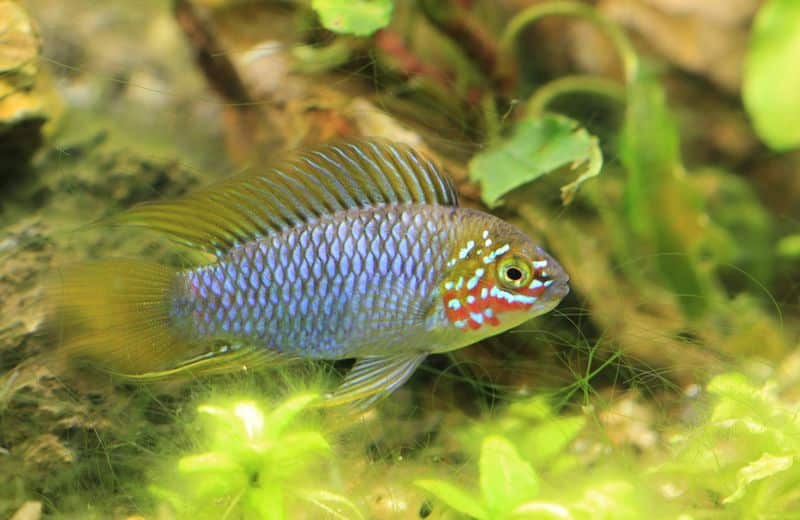
Male Borellii have a measured, elegant look. The body is predominantly blue to blue-gray with iridescent highlights that shift under different lighting angles. The head and cheeks often carry stronger blue-green iridescence, sometimes with a pattern of fine spots or streaks on the gill covers. The fins are the signature: the dorsal, pelvic, and anal fins are significantly elongated in mature males, and when fully spread during display, they create the umbrella-like silhouette that gives the species its common name.
Fin coloration is yellow to golden-yellow, contrasting cleanly with the blue body. The “Opal” variety – the most common form in the trade – adds red speckles across the cheeks and gill covers, extending the color palette further. Full adult males in good condition are genuinely striking, but they take time to develop. Young males in store tanks look nothing like their potential.
Females are smaller and more subdued in resting coloration, but undergo the same dramatic breeding transformation common to the genus: from brownish-olive to a vivid, high-contrast yellow with bold black markings when spawning or guarding fry.
Male vs. Female
Sexing adult Borellii is straightforward. The fin length differences are pronounced, and color differences are clear in adult fish.
| Feature | Male | Female |
|---|---|---|
| Body Size | Up to 2.5 inches (6.5 cm) | Up to 1.5 inches (4 cm) |
| Dorsal Fin | Elongated, umbrella-shaped when spread | Short, rounded |
| Anal and Pelvic Fins | Notably elongated, flowing | Short, compact |
| Resting Color | Blue-gray body with yellow fins; Opal form adds red cheek spots | Brownish-olive |
| Breeding Color | Intensified blue and yellow | Vivid yellow with bold black markings |
Average Size & Lifespan
Males max out around 2 to 2.5 inches (5 to 6.5 cm). Females are noticeably smaller at around 1.5 inches (4 cm). The elongated fins on males create the impression of a larger fish, but the body itself is genuinely compact. This size makes Borellii one of the few dwarf cichlids that works well in a 15-gallon long – a real advantage for hobbyists with limited space.
Lifespan is 3 to 5 years in captivity. As with other Apistogramma species, a breeding pair can sustain a self-renewing colony across many years if conditions are right. The cooler water preference actually works in the fish’s favor here: lower temperatures slow metabolic rate slightly, which can contribute to reaching the higher end of the lifespan range compared to fish kept perpetually at the warm edge of their tolerance.
Care Guide
Tank Size
A 15-gallon (57-liter) tank is a legitimate minimum for a pair or a trio – one male and two females. Footprint matters more than height. A 15-gallon long (24 x 12 x 12 inches) provides enough floor space for each female to hold her own territory. For a community setup with dither fish, 20 to 30 gallons is more comfortable and significantly reduces any territorial pressure.
If you want to keep multiple males, plan for 40+ gallons with dense structure and distinct visual territories for each male. Borellii males are less likely to cause serious injury to each other than more aggressive apisto species, but persistent territorial conflict still stresses all fish involved. Don’t crowd them even if they’re not fighting actively.
Water Parameters
| Parameter | Recommended Range |
|---|---|
| Temperature | 65 to 79°F (18 to 26°C) – target 72 to 76°F for general keeping |
| pH | 5.5 to 7.5 (most captive-bred fish comfortable at 6.5 to 7.2) |
| General Hardness | 3 to 15 dGH |
| Ammonia | 0 ppm |
| Nitrite | 0 ppm |
| Nitrate | Below 20 ppm |
The temperature range is what separates Borellii from almost every other dwarf cichlid. The species genuinely prefers cooler water – 72 to 76°F (22 to 24°C) is the ideal range for everyday keeping. This makes it suitable for temperate room-temperature setups that would be too cool for most tropical fish. The 79°F upper limit is a ceiling, not a target. Sustained temperatures above that don’t kill the fish immediately, but they create ongoing stress and shorten the lifespan.
Water chemistry flexibility is another standout feature. Wild Borellii have been found in water ranging from pH 5.0 to 8.0 across their range, and captive-bred fish are reasonably tolerant of whatever your tap water offers as long as it’s not extremely hard (above 15 dGH) and pH isn’t consistently alkaline above 7.5. Consistency is more important than hitting a specific target. Don’t add apistos to a newly cycled tank regardless of species – wait for stable biology before introducing them.
In 25+ years in the hobby and at the store level, the temperature issue is the single most consistent mistake I see with Borellii. Hobbyists set their tanks to 78 to 80°F because that’s “tropical fish temperature,” then wonder why their Borellii don’t look right or live as long as expected. This species comes from the southern cone of South America – it’s not an Amazon fish. The cool-water tolerance isn’t just a quirk. It’s how this fish is wired. Dial the temperature down to 72 to 74°F and watch what happens. The coloration improves, the behavior becomes more active, and the fish just looks healthier. The other thing worth knowing: captive-bred Borellii are considerably more water-chemistry-flexible than wild-caught. If you’re buying from a reputable breeder, standard soft-neutral tap water is usually sufficient without RO treatment.
Filtration & Water Flow
Gentle filtration is essential. Borellii inhabits slow-moving water and doesn’t tolerate strong current. Sponge filters are ideal for smaller setups: excellent biological filtration, minimal flow, and completely fry-safe. In larger tanks, a hang-on-back filter with a pre-filter sponge or a small canister with a diffused output pointed at the surface works well. Avoid anything that creates significant bottom-level current where the fish spends its time.
Weekly water changes of 20 to 25% maintain quality without parameter swings. Match the temperature of replacement water closely – a sudden cold-water change can be a spawning trigger in small doses, but an unintended large drop stresses the fish. Consistency in maintenance is more important than volume of changes.
Lighting
Low to moderate lighting suits Borellii best. The blue iridescence and yellow fin coloration both show better under subdued, slightly warm lighting than under bright white LEDs. Dense floating plants are the most effective tool for creating the dappled shade at the bottom level where these fish live. Under standard planted-tank lighting, enough floating cover to break up the light reaching the substrate is all that’s needed.
Plants & Decorations
Borellii is a perfect planted tank resident. It doesn’t dig, doesn’t eat plants, and actively benefits from dense planting. Java fern, anubias, cryptocorynes, moss, and floating plants all work well. The density of planting creates the visual barriers that keep each female in her own zone and prevent the male from fixating on any one fish. The more broken the sight lines between territories, the more settled the whole group will be.
Caves are non-negotiable for breeding and basic female security. Each female needs at least one cave, and providing extras gives them choices. Coconut shell halves with a small entrance hole, small terracotta pots, and ceramic apisto caves all work. Driftwood and Indian almond leaves on the substrate complete the natural look and provide tannins that benefit water chemistry and egg protection during breeding.
The sweet spot for long-term Borellii keeping is 72 to 76°F. Running this species at standard tropical temperatures – 78 to 82°F – because that’s what the thermostat is already set to is the most common mistake in Borellii keeping. The fish survive it. They don’t thrive in it. Over years, the difference in lifespan, coloration, and breeding success between a Borellii kept at 74°F versus 80°F is significant.
Substrate
Fine sand is the correct substrate. Borellii spends most of its time at or near the bottom, occasionally sifting through the substrate for small food items. Sand is gentle on the body, natural-looking, and pairs well with the leaf litter and botanicals that complete this setup. A dark-colored sand enhances the contrast with the blue and yellow coloration significantly more than light-colored or white substrates.
Tank Mates
Borellii’s peaceful temperament makes it one of the most community-compatible apisto species. It’s less likely to start territorial conflicts with tank mates than most other dwarf cichlids. The one exception is breeding females, who will actively defend their cave and the surrounding area against any intrusion – but even this is proportionate compared to more aggressive species.
Best Tank Mates
- Rummy-nose tetras – excellent dither fish; peaceful, mid-water, help Borellii feel secure in the open
- Cardinal tetras – classic companion for soft-water dwarf cichlid setups; stay in the upper half of the tank
- Ember tetras – tiny, peaceful, and beautiful in a planted Borellii setup without crowding the bottom
- Pencilfish (Nannostomus spp.) – share soft-water preferences and occupy the upper water column entirely
- Otocinclus – peaceful algae eaters that stay on plant surfaces and glass, not competing for bottom territory
- Pygmy corydoras and habrosus cories – small enough to share bottom space without triggering territorial responses; watch during spawning
- Hatchetfish – surface dwellers that never enter the apisto’s zone
Tank Mates to Avoid
- Fin-nipping tetras – neons, black skirt tetras, and serpae tetras have all been documented nipping the elongated fins of male Borellii; the flowing dorsal and anal fins are targets
- Aggressive cichlids or dominant bottom fish – even other apisto species may bully the relatively passive Borellii in smaller or unstructured tanks
- Dwarf shrimp – cherry shrimp, neocaridina, and similar small shrimp will be hunted; the peaceable reputation does not extend to invertebrates
- Large or boisterous species – anything that dominates the bottom territory, stirs up the water column, or causes consistent stress
Food & Diet
Borellii dwarf cichlids are primarily carnivorous in practice. In the wild they hunt small invertebrates and microorganisms near the bottom. In the tank, a protein-rich diet produces the best color and condition. Frozen bloodworms, brine shrimp, daphnia, cyclops, and mysis shrimp are all accepted readily. Live foods – baby brine shrimp, microworms, grindal worms, blackworms – are excellent for conditioning before breeding and maintaining peak condition year-round.
Captive-bred Borellii accept high-quality micro pellets and crushed flake food reliably, which simplifies daily feeding. That said, a diet built entirely on prepared food produces faded color over time. Frozen foods should rotate in regularly, not as occasional treats. Feed small amounts two to three times daily. In community tanks, make sure food reaches the bottom; mid-water species will often intercept sinking pellets before Borellii gets to them.
Breeding & Reproduction
Breeding Difficulty
Easy to moderate. Borellii is one of the more willing apistos to breed in captivity. Given a well-structured tank with caves, good water quality, and a varied diet, spawning happens without much prompting. This species typically does better in pairs than harems – which is slightly unusual within the Apistogramma genus. A well-bonded pair produces more consistent spawning than a one-male-multiple-females setup with this particular species.
Spawning Tank Setup
A 15 to 20-gallon breeding tank with fine sand, multiple cave options, Indian almond leaf litter, and a sponge filter is ideal. Provide two to three cave choices so the female can select her preferred site. Coconut shell halves with a small entrance hole are reliable spawning sites. Dense planting helps separate the male’s territory from the female’s cave area, which reduces conflict during fry guarding.
Water Conditions for Breeding
Soft, slightly acidic water at slightly cooler temperatures than many apisto species prefer. Target pH 6.0 to 6.5, GH 3 to 6, and 72 to 77°F (22 to 25°C). The cooler temperature preference is genuine – don’t push temperatures into the upper 70s for breeding with this species as you would for agassizii or cacatuoides. Clean water with low nitrates (below 10 ppm) is the most important variable. A small water change with slightly cooler water can trigger spawning behavior in a conditioned pair.
Conditioning & Spawning
Condition the pair on live and frozen foods for one to two weeks before attempting to spawn. When the female is ready, her coloration shifts toward yellow and she begins spending more time exploring caves. She leads the male to her chosen site, deposits 50 to 70 eggs on the cave ceiling or walls, and the male fertilizes them before the female takes over guarding completely.
Borellii males are generally less aggressive during breeding than other apisto species, but in small or unstructured tanks, the female can still turn on the male once eggs are laid. Have a plan to separate them if aggression escalates – dense planting and multiple caves usually resolve this without intervention, but be ready.
Egg & Fry Care
The female guards eggs exclusively, fanning them and removing any that develop fungus. Eggs hatch in 2 to 4 days; fry become free-swimming 5 to 7 days after hatching. The mother continues herding and guarding the free-swimming fry, signaling them back toward the cave when threatened. This is when the female’s bright yellow breeding coloration is at its peak intensity, and it’s genuinely impressive to watch in a well-planted tank.
First foods for fry: infusoria and microorganisms naturally present in a mature planted tank. Move to freshly hatched baby brine shrimp within the first week. The fry are small but grow steadily with frequent feeding and consistent water quality. The female typically guards the fry for two to three weeks before reducing her involvement as they become more independent.
Should You Get This Fish
Good fit if:
- You have a cool-water tank or a room that doesn’t stay above 75°F in winter – Borellii is one of the only cichlids that can be kept without a heater in many temperate home environments
- You want a planted community tank with dwarf cichlid personality and minimal aggression problems
- You’re entering the apisto hobby for the first time and want the most forgiving option
- You value elegant behavior over flashy color – the fin display and breeding behavior are genuinely rewarding even though the fish isn’t the loudest color in the store
- You want a fish with a track record – 100+ years of captive breeding success means well-established care knowledge and quality captive stock
Avoid if:
- You already have fin-nipping fish established in the tank – the flowing fins are a liability in mixed communities
- You want to keep shrimp; dwarf shrimp will be hunted regardless of how peaceful the fish is in other respects
- Your tank runs at 80°F+ for discus or other high-temperature fish – the temperature ranges are incompatible for long-term co-keeping
- You want the most colorful or dramatic-looking apisto on the shelf – the Borellii’s beauty is understated; if you need maximum visual impact at first glance, look elsewhere
How It Compares
Borellii Dwarf Cichlid vs. Agassiz’s Dwarf Cichlid (A. agassizii)
These two are the most beginner-accessible apistos and the most natural comparison. Both are cave spawners with similar planted tank requirements, but the differences in temperament and temperature preferences are meaningful. Agassiz’s is warmer, more colorful, and produces more obvious male visual drama – the flame-shaped caudal fin is one of the best-looking features in the genus. It’s also a harem breeder, requiring more tank structure to work correctly.
Borellii is cooler, calmer, and simpler to run. The pair-breeding behavior reduces the complexity of tank setup, and the cool-water tolerance opens up keeping scenarios that aren’t possible with most dwarf cichlids. If your tank runs in the low-to-mid 70s and you want a simple setup that works, Borellii is the better choice. If you want maximum male coloration and are ready to structure a proper harem tank, choose Agassiz’s dwarf cichlid.
Borellii Dwarf Cichlid vs. Cockatoo Apisto (A. cacatuoides)
The cockatoo apisto is the most recommended beginner apisto for water-chemistry reasons: it handles harder, more neutral water better than most species in the genus. The dramatic raised dorsal spines of the male give it an immediately recognizable profile that Borellii doesn’t have.
The trade is temperature. Cockatoo apistos prefer warmer water in the upper 70s, similar to most tropical community fish. Borellii’s cool-water tolerance is a genuine niche advantage that cockatoo can’t match. For hobbyists with standard tropical community tanks and hard-ish tap water, the cockatoo is probably the more practical starting point. For hobbyists who want to run a cooler tank, prefer less aggression, or have soft water, Borellii wins on all three counts.
Common Health Issues
Bacterial Infections
Fin erosion, body sores, cloudy eyes, and lethargy are the typical signs of bacterial infection, almost always triggered by poor water quality or stress. The elongated fins on male Borellii actually help here: fin rot is visible earlier on long fins than on short ones. Catch it early and treat with broad-spectrum antibiotics – kanamycin or nitrofurazone work well. Move infected fish to a hospital tank before treating.
Ich (White Spot Disease)
Ich typically shows up after stress events – shipping, temperature swings, or new additions. Gradually raise the temperature to around 82°F (28°C) and use a quality ich treatment. Borellii tolerate standard ich treatments well. Because they’re normally kept at the cooler end of the tropical range, watch for ich particularly during seasonal temperature drops in rooms without climate control.
Internal Parasites
White, stringy feces and slow weight loss despite eating normally suggest internal parasites. More common in wild-caught specimens but possible in captive-bred fish too. Metronidazole treats protozoan parasites including Hexamita; praziquantel handles intestinal worms. Quarantine all new fish for at least two weeks before adding them to an established tank.
Fin Damage from Nipping
The elongated fins of male Borellii are a fin-nipping target. Even fish generally considered peaceful – neon tetras are a documented culprit – will nip the flowing dorsal and anal fins in community tanks. Fin damage itself heals in clean water, but chronic nipping creates stress that leads to other problems. Choose tank mates carefully, observe the tank for a few days after any new addition, and be ready to remove known nippers promptly.
Common Mistakes to Avoid
- Running the heater too high. This is the single most common mistake with this species. The target temperature is 72 to 76°F, not 78 to 80°F. Long-term keeping at tropical temperatures shortens lifespan and suppresses the fish’s full potential.
- Removing the heater entirely without managing stability. Cool-water tolerance doesn’t mean temperature swings are acceptable. A heater set to 70 to 72°F provides stability even if you don’t need active heating. Uncontrolled seasonal swings create more stress than consistent cooler water.
- Not providing enough caves. Even this gentle species needs caves for female security and successful spawning. Each female needs at least one cave; more choices produce better results.
- Keeping with fin nippers. The flowing fins are a liability. Watch for nipping from any tank mate, regardless of reputation. Neon tetras nip Borellii fins more than most hobbyists expect.
- Expecting harem dynamics to work the same as with other apistos. Borellii typically breeds more successfully in pairs. The harem setup works in larger tanks but isn’t the default approach it is with agassizii or cacatuoides.
- Neglecting the diet. Captive-bred Borellii accept prepared foods reliably, but a diet without frozen protein produces faded color over time. Variety matters more than volume.
Where to Buy
Borellii dwarf cichlids are available through specialty retailers and online suppliers, though they’re not as universally stocked as cockatoo apistos. The “Opal” variety is the most commonly offered form. Flip Aquatics carries quality dwarf cichlids and is worth checking for availability. Dan’s Fish is another reliable source for healthy, well-conditioned specimens with live arrival guarantees.
When selecting fish, look for active individuals with intact fins, clear eyes, and alert behavior. Males should show at least some blue iridescence even under store lighting. Buy a pair or a small group if the goal is eventual breeding. Sexing adult fish is straightforward from the size and fin length differences alone.
Frequently Asked Questions
Is the Borellii dwarf cichlid good for beginners?
It’s the best apisto for beginners. The cool-water tolerance removes one of the most common points of failure with dwarf cichlids, and the peaceful temperament reduces aggression-related problems dramatically. Some experience with water testing and tank maintenance is still valuable, but compared to other Apistogramma species, Borellii is the most forgiving combination of personality and parameter flexibility in the genus.
Do Borellii dwarf cichlids need a heater?
Possibly not, depending on your home temperature. Borellii thrives at 65 to 79°F (18 to 26°C). If your home consistently stays above 65°F year-round, the fish may not require active heating. That said, a low-wattage heater set to 70 to 72°F is usually worth running for stability: preventing temperature swings matters more than achieving any specific cool temperature. Stability within the cool range is better than fluctuating between cool and warm.
Should I keep pairs or harems?
Pairs are generally more reliable for Borellii. This species is one of the exceptions within Apistogramma where pair breeding produces more consistent results than the harem approach. In larger tanks (40+ gallons) with proper territory structure, harems can work, but the default approach for most setups should be a bonded pair. One male and two females in a 20-gallon long with multiple caves is a workable middle ground if you want to experiment with a small harem.
What color varieties are available?
The most common variety in the trade is the “Opal” form, which adds red facial speckles on the cheeks and gill covers to the blue body and yellow fins. Wild-type Borellii tend toward more uniform blue-gray coloration without the red facial detail. Both forms have identical care requirements. Color intensity in both varieties improves with good water quality, diet variety, and appropriate temperature.
Can I keep Borellii with other Apistogramma species?
It’s possible in larger tanks (40+ gallons) with dense structure and distinct, non-overlapping territories, but not recommended as a default approach. The risks are territorial conflict and hybridization, especially between closely related species. Borellii’s peaceful nature means it may be displaced by more assertive species rather than actively engaging in conflict, which produces its own form of chronic stress. Species-only setups produce better results and cleaner breeding lines.
Why is it called the umbrella dwarf cichlid?
The name comes from the elongated dorsal fin of the male, which when fully spread during display fans out and curves back like an open umbrella. The pelvic and anal fins are also notably longer than in most other apisto species. When a male is in full display mode toward a female or a rival, the entire fin profile creates a flowing, sail-like silhouette that makes the fish look substantially larger than its actual body size.
Closing Thoughts
The Borellii dwarf cichlid doesn’t need to win a color contest to be worth keeping. What it offers is a combination of genuine adaptability, true peaceful temperament, and behavioral depth that most flashier species don’t match. The cool-water tolerance is a real practical advantage for many hobbyists. The pair-breeding behavior is simpler to manage than harem dynamics. And the fish has 100+ years of captive breeding history backing up every care recommendation written about it.
Set up a planted tank with soft water, fine sand, plenty of caves, and the temperature dialed to 72 to 74°F. Add a bonded pair and some upper-water dither fish with a documented non-nipping record. Feed a varied diet with regular frozen protein. What you get is one of the most elegant, low-drama cichlid setups in the hobby, built around a fish that experienced keepers consistently return to – not because they can’t find anything better, but because they’ve learned there isn’t much to improve on.
References
- Seriously Fish: Apistogramma borellii species profile. seriouslyfish.com
- FishBase: Apistogramma borellii (Regan, 1906). fishbase.se
- Practical Fishkeeping: Apistogramma borellii care guide. practicalfishkeeping.co.uk
- The Aquarium Wiki: Apistogramma borellii. theaquariumwiki.com
- About the Author
- Latest Posts

I’m Mark Valderrama, founder of Aquarium Store Depot and a fishkeeper with over 25 years of hands-on experience. I started in the hobby at age 11, worked at local fish stores, and have kept freshwater tanks, ponds, and reef tanks ever since. I’ve been featured in two best-selling aquarium books on Amazon and built this site to share practical, experience-based fish keeping knowledge.
Leave a Reply