
Last Updated: June 25, 2026
Thank you for visiting! By the way… any links on this page that lead to products on Amazon and other stores/partners are affiliate links Aquarium Store Depot earns a commission if you make a purchase.
Table of Contents
- Key Takeaways
- Species Overview
- Classification
- Origin & Natural Habitat
- Appearance & Identification
- Average Size & Lifespan
- Care Guide
- Tank Mates
- Food & Diet
- Breeding & Reproduction
- Common Health Issues
- Common Mistakes to Avoid
- Where to Buy
- Frequently Asked Questions
- What It Is Actually Like Living With Red Head Tapajos
- Closing Thoughts
- References
The red head tapajos is the fish that made people care about eartheaters. Before this species hit the hobby, eartheaters were background fish. Interesting behavior, boring colors. The tapajos changed that. A dominant male with full color is one of the most stunning freshwater fish alive, and it is not even close. But that color does not show up in bad conditions. Stress, poor water quality, or wrong tank mates and you get a washed-out grey fish that looks nothing like the photos that made you buy it. The eartheater that turned sand-sifters from boring to breathtaking.
The red head tapajos does not give you its best. You have to earn it.
The Reality of Keeping Red Head Tapajos
Color takes time. Juvenile red head tapajos are grey with faint markings. The red head develops over months to a year in good conditions. If you buy this fish expecting instant color, you will be disappointed. Patience is the price of admission.
Sand substrate is mandatory. Like all eartheaters, tapajos sift sand through their gills constantly. Gravel damages their feeding apparatus and prevents natural behavior. Fine sand is not a suggestion. It is a requirement.
They need groups. A single tapajos in a tank is a stressed, pale fish. You need at least five, ideally more. In a group, males compete, display, and color up far beyond what a solitary specimen ever achieves. The group dynamic is what makes this species special.
Temperature matters more than you think. Red head tapajos need warm water, 82 to 86F. At lower temperatures their metabolism slows, colors fade, and they become susceptible to disease. This is a tropical fish in the truest sense.
Biggest Mistake New Red Head Tapajos Owners Make
Expecting instant color. New owners buy juvenile tapajos, see grey fish for three months, and assume something is wrong. Nothing is wrong. These fish need time, clean water, warm temperatures, and a group dynamic to develop their signature coloration. The keepers who bail early miss the entire point of this species.
Expert Take (Mark Valderrama, AquariumStoreDepot)
Red Head Tapajos is the cichlid for people who want personality without constant aggression management. Give it space, feed it well, and it becomes the centerpiece of any tank.
What Most Care Guides Get Wrong About Red Head Tapajos
The biggest misconception about Geophagus sp. “Red Head Tapajos” is lumping them in with other eartheaters as if they all have the same care requirements. Tapajos red heads are actually one of the more manageable geophagus species. Smaller, less aggressive, and more adaptable than their larger cousins like G. Altifrons or G. Sveni. The other thing that care guides consistently get wrong is substrate choice. These are earth eaters. They need fine sand substrate, period. I’ve seen keepers try gravel, and the fish either refuse to feed naturally (they sift substrate through their gills) or injure their gills on sharp edges. Fine pool filter sand or play sand is essential, not optional.
What makes this fish even more appealing is that all that beauty comes wrapped in an easygoing temperament. Eartheaters as a group are among the most peaceful cichlids, and the red head tapajos is no exception. They won’t terrorize tank mates, they won’t destroy plants (though they’ll rearrange substrate), and they’re genuinely interesting to watch as they scoop mouthfuls of sand and sift out food particles. In my 25+ years in the hobby, geophagus species like this one have become some of my favorite fish to recommend to keepers who want cichlid personality without cichlid aggression.
Key Takeaways
- Recently described species. Formally named Geophagus pyrocephalus in 2022 after years of being known as Geophagus sp. “Red Head Tapajos”
- Sand substrate is mandatory. As eartheaters, these fish must be able to sift substrate through their gills. Gravel can cause choking and gill damage
- Peaceful for a cichlid and suitable for community tanks with appropriately sized, non-aggressive tank mates
- Best kept in groups of 5 or more in a minimum 55-gallon tank, though 75+ gallons is better for a proper group
- Larvophilic mouthbrooders. Unique breeding behavior where parents pick up newly hatched larvae and brood them in their mouths
Species Overview
| Field | Details |
|---|---|
| Scientific Name | Geophagus pyrocephalus |
| Common Names | Red Head Tapajos, Red Head Eartheater, Tapajos Red Head Geophagus |
| Family | Cichlidae |
| Origin | Rio Tapajós drainage, Brazil |
| Care Level | Moderate |
| Temperament | Peaceful |
| Diet | Omnivore |
| Tank Level | Bottom to Middle |
| Maximum Size | 8 inches (20 cm) |
| Minimum Tank Size | 55 gallons (208 liters) |
| Temperature | 78 to 86°F (26 to 30°C) |
| pH | 5.5 to 7.5 |
| Hardness | 2 to 12 dGH |
| Lifespan | 8 to 10 years |
| Breeding | Larvophilic mouthbrooder |
| Breeding Difficulty | Moderate |
| Compatibility | Community (with medium to large peaceful fish) |
| OK for Planted Tanks? | Yes (with sturdy plants and sand substrate) |
Classification
| Taxonomic Level | Classification |
|---|---|
| Order | Cichliformes |
| Family | Cichlidae |
| Subfamily | Geophaginae |
| Genus | Geophagus |
| Species | G. Pyrocephalus Deprá, Kullander, Manaças & Faria, 2022 |
The red head tapajos has a fascinating taxonomic history. For years, this fish circulated in the hobby under the placeholder name Geophagus sp. “Red Head Tapajos,” recognized by aquarists and exporters as a distinct species but lacking a formal scientific description. The fish was first collected by German aquarists in the early 1990s from the Rio Tapajós drainage and quickly became popular in the trade.
It wasn’t until 2022 that the species was formally described as Geophagus pyrocephalus by Deprá and colleagues. The species name pyrocephalus translates to “fire head” from Greek, perfectly capturing the vivid red-orange head coloration that defines this species. If you see it listed under the old placeholder name or as Geophagus sp. “Red Head Tapajos” in older literature and online stores, it’s the same fish.
Origin & Natural Habitat
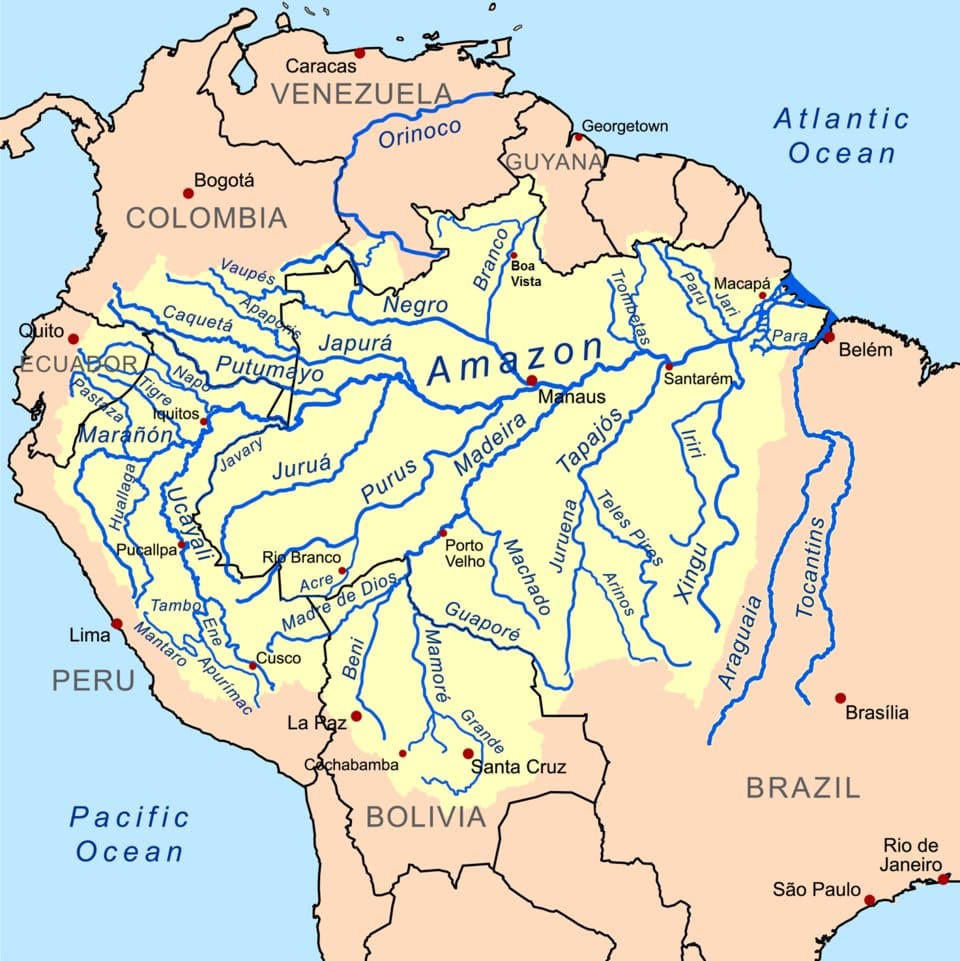
As the common name suggests, this species is native to the Rio Tapajós drainage in central Brazil. The Tapajós is one of the major southern tributaries of the Amazon, a clear-water river that flows through the Brazilian state of Pará before joining the Amazon near the city of Santarém. The Rio Tapajós system is known for its relatively clear water compared to the turbid whitewater of the main Amazon channel.
In their native habitat, red head tapajos inhabit sandy-bottomed areas of rivers and tributaries where they can practice their characteristic earth-eating behavior. They forage by scooping mouthfuls of fine sand from the bottom, sifting it through their gill rakers to extract small invertebrates, organic particles, and algae, then expelling the processed sand through their gills. This feeding strategy is so fundamental to who they are that the genus name Geophagus literally means “earth eater.”
The water in the Tapajós system is warm (78-84°F / 26-29°C), moderately soft, and ranges from slightly acidic to near neutral pH. The substrate is predominantly fine sand and silt, with scattered driftwood, rocks, and submerged vegetation providing structure. These fish are social in the wild, often seen foraging in loose groups across sandy flats.
Appearance & Identification
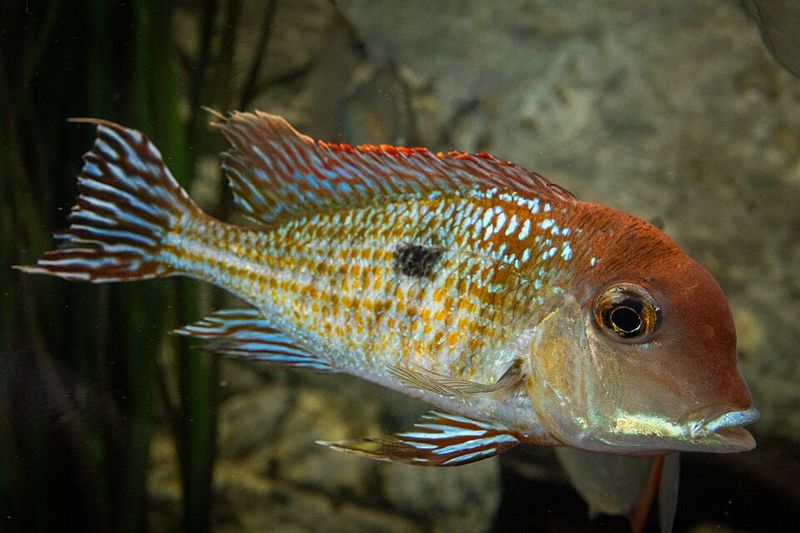
The red head tapajos is a medium-sized, moderately deep-bodied cichlid with a streamlined profile built for cruising along the bottom. The signature feature is the brilliant red-orange coloration on the head, forehead, and face of mature specimens, particularly dominant males. This red extends from the lips up over the forehead and often reaches the upper portion of the gill covers. The intensity of the red coloring varies with mood, dominance status, and diet, but a healthy, dominant male displaying full colors is genuinely breathtaking.
The body is silvery-blue to greenish-blue with iridescent scales that shimmer under aquarium lighting. A dark spot is present on the mid-body, and faint vertical bars may appear when the fish is stressed or displaying. The fins have a subtle blue-green iridescence, and the dorsal and caudal fins may show red or orange highlights that complement the head coloration.
Juveniles are much less colorful, showing primarily silver-gray bodies with faint markings. The red head coloration develops gradually as the fish matures, becoming noticeable around 2-3 inches and intensifying through adulthood. Patience is required when growing out juvenile red head tapajos. The payoff is worth the wait.
Male vs. Female
Sexing red head tapajos becomes easier as the fish mature, though it remains challenging with juveniles and sub-adults.
| Feature | Male | Female |
|---|---|---|
| Body Size | Larger, reaching 7-8 inches | Smaller, 5-6 inches |
| Head Coloration | Intense red-orange, especially when dominant | Less intense, may show subdued red or orange |
| Nuchal Hump | Develops with maturity | Absent or minimal |
| Fin Extensions | Longer, more pointed dorsal and anal fin tips | Shorter, more rounded fins |
| Body Shape | Deeper body, more robust | Slimmer, less deep |
In a group setting, males establish a hierarchy with the dominant male displaying the most vivid coloration. Subdominant males may suppress their coloring, making them harder to distinguish from females. This social dynamic is one reason why keeping them in groups of 5 or more is recommended. It allows natural social structures to develop and gives multiple individuals a chance to display.
Average Size & Lifespan
Red head tapajos reach an adult size of 6-8 inches (15-20 cm), with males larger than females. Growth rate is moderate, with fish reaching about half their adult size within the first year under good conditions. They’re not as fast growing as some cichlids, so don’t expect overnight transformations from juvenile to adult.
With proper care, red head tapajos live 8-10 years in captivity. This is a solid lifespan for a medium-sized cichlid and represents a meaningful commitment. Maintaining excellent water quality and a proper diet throughout their lives is the key to reaching the upper end of this range.
ASD Difficulty Rating: Tier 2 – Intermediate
Red-head tapajos (Geophagus sp. Tapajos) are substrate-sifting eartheaters from the Tapajos River in Brazil. They need fine sand substrate, a 55-gallon minimum, warm soft water, and good filtration. Peaceful for a cichlid, but demanding in setup requirements.
Care Guide
Tank Size
A 55-gallon (208-liter) tank is the minimum for a small group of red head tapajos, but 75-90 gallons is much better. These are social fish that do best in groups of 5-8, and a group of that size needs room to establish territories and display natural behaviors. For a proper community setup with a group of red heads plus tank mates, 90-125 gallons is ideal.
As bottom-dwelling sifters, these fish benefit from a long tank with a generous footprint. A standard 75-gallon (48 x 18 x 21 inches) provides a good balance of floor space and water volume. Avoid tall, narrow tanks that limit the bottom area where these fish spend most of their time.
Water Parameters
| Parameter | Recommended Range |
|---|---|
| Temperature | 78 to 86°F (26 to 30°C) |
| pH | 5.5 to 7.5 |
| General Hardness | 2 to 12 dGH |
| Ammonia | 0 ppm |
| Nitrite | 0 ppm |
| Nitrate | Below 15 ppm |
Red head tapajos are sensitive to deteriorating water quality, particularly elevated nitrates. These eartheaters are constantly sifting substrate, which stirs up detritus and can contribute to water quality issues if maintenance falls behind. Regular water changes of 25-30% weekly are important for keeping nitrate levels low and the fish in peak condition.
They’re adaptable within their parameter range, but like most geophagus, they prefer soft to moderately hard water with a slightly acidic to neutral pH. Most captive-bred specimens do well in a wide range of conditions as long as the water is clean and stable.
Filtration & Water Flow
Moderate filtration with calm areas in the tank is ideal. A quality canister filter rated for your tank size provides the necessary biological and mechanical filtration. Because these fish are constantly sifting sand, good mechanical filtration is especially important for keeping fine particles out of the water column. A filter with a pre-filter sponge helps prevent sand from entering the impeller.
Avoid directing the filter output straight down into the substrate, as this disrupts the sand surface the fish depend on for feeding. A spray bar or deflector aimed along the surface or against the back glass creates circulation without disturbing the bottom.
Lighting
Standard aquarium lighting is fine for red head tapajos. They don’t have strong preferences for light or dark conditions, though their iridescent coloration shows off best under moderate lighting. If you’re keeping live plants, lighting should be chosen based on plant needs. The fish will adapt to whatever light level you provide.
Plants & Decorations
Red head tapajos can coexist with live plants, but there’s a catch: they dig. Constantly. Plants rooted in the substrate will get excavated if they’re in the fish’s sifting path. The solution is to use hardy plants attached to hardscape rather than planted in the substrate. Java fern, anubias, and bolbitis attached to driftwood or rocks work perfectly and won’t be disturbed. Amazon swords and other rooted plants can survive if protected with a ring of larger stones around their base.
Driftwood and smooth rocks provide important visual barriers and territory markers. Open sandy areas should make up the majority of the bottom, giving the fish room for their natural sifting behavior. Some keepers create a mix of planted driftwood “islands” surrounded by open sand, which looks fantastic and gives the fish both structure and foraging space.
Substrate
This is non-negotiable: fine sand is the only appropriate substrate for red head tapajos. As obligate earth eaters, these fish take mouthfuls of substrate, sift it through their gill rakers to extract food, and expel it through their gills. Gravel, coarse sand, or any sharp-edged substrate risks choking, gill damage, and effectively starving the fish by preventing their natural feeding behavior.
Use fine pool filter sand, play sand, or commercially available aquarium sand. Avoid very heavy or coarse products. A depth of 2-3 inches provides enough substrate for the fish to sift comfortably. Over time, you’ll notice the fish rearranging the sand into hills and valleys as they systematically work through it, which is completely normal and fascinating to watch.
Is the Red Head Tapajos Right for You?
Before you commit to this species, here’s an honest assessment of whether it fits your setup and experience level.
- One of the best eartheater species for home aquariums. Smaller and more manageable than most geophagus species.
- Fine sand substrate is mandatory. These fish sift sand through their gills to feed. Gravel will injure them or prevent natural feeding behavior.
- Peaceful and social. Best kept in groups of 5 or more for natural social dynamics and reduced stress.
- Need at least 75 gallons for a group. They’re active swimmers that need space, especially in groups.
- Males develop stunning red-orange head coloration. The intensity develops slowly and peaks in mature, dominant males.
- Fascinating to watch feed. The sand-sifting behavior is unique and endlessly watchable. It’s like having a tiny excavation crew in your tank.
Tank Mates
Red head tapajos are among the most community-friendly cichlids available. Outside of breeding behavior, they rarely show aggression toward other species and coexist peacefully with a wide range of tank mates. The main consideration is choosing fish that are too large to be accidentally swallowed and that won’t bully the geophagus.
Best Tank Mates
- Angelfish. Occupy different tank zones and coexist peacefully. Both species prefer warm, soft water
- Large tetras. Silver dollars, Congo tetras, diamond tetras, and similar mid-sized schooling fish make excellent companions
- Other peaceful geophagus. Can be kept with other eartheater species in sufficiently large tanks
- Corydoras catfish. Peaceful bottom dwellers, though they should be large enough not to be accidentally bothered during sifting
- Bristlenose plecos. Useful algae eaters that stay out of the geophagus’s way
- Severums. Peaceful, similarly sized cichlids that make good companions in large tanks
- Discus. Can work in large setups with matching water parameters
Tank Mates to Avoid
- Aggressive cichlids. Oscars, Jack Dempseys, red devils, and other pugnacious species will bully geophagus
- Very small fish. Tiny tetras, microrasboras, and small shrimp is accidentally consumed
- Mbuna and other African cichlids. Incompatible temperaments and water requirements
- Bottom-dwelling territorial fish. Aggressive plecostomus or large territorial catfish may conflict over floor space
Food & Diet
In the wild, red head tapajos are omnivores that derive a significant portion of their nutrition from sifting substrate for microorganisms, algae, and small invertebrates. In captivity, their diet should reflect this varied approach with an emphasis on both protein and vegetable matter.
A high-quality sinking cichlid pellet makes a good staple, supplemented with frozen foods like bloodworms, brine shrimp, mysis shrimp, and krill. Vegetable matter is important for this species: blanched spinach, spirulina-based flakes or pellets, and algae wafers should be part of the regular rotation. The combination of animal protein and plant matter reflects their natural diet and promotes the best coloration.
Feed 2-3 times daily in moderate amounts. These fish also derive nutrition from their constant substrate sifting, picking up biofilm, algae, and microfauna from the sand. This is another reason why a well-established tank with mature sand substrate benefits these fish. Don’t keep the sand too clean. A certain amount of natural biofilm development provides supplemental nutrition.
Breeding & Reproduction
Breeding Difficulty
Moderate. Red head tapajos will breed in home aquariums with some consistency once a compatible pair forms within a group. The fascinating aspect of their reproduction is the larvophilic mouthbrooding strategy, which differs from both substrate-spawning cichlids and immediate mouthbrooders.
Spawning Tank Setup
A breeding group does best in a spacious tank of 75 gallons or larger with a fine sand substrate and some flat stones or slate pieces as potential spawning surfaces. Keep the group together and let pairs form naturally. Driftwood and visual barriers help subordinate fish escape the attention of dominant individuals during breeding season.
Water Conditions for Breeding
Warmer water in the 82-86°F (28-30°C) range trigger breeding activity. Slightly acidic pH (6.0-6.5) and soft water improve success. Large water changes with slightly cooler water can simulate rainy season conditions and stimulate spawning. Low nitrate levels (below 10 ppm) are important during breeding.
Conditioning & Spawning
Condition breeding groups with high-quality live and frozen foods for several weeks. When ready, a pair will select and clean a flat surface, a rock or piece of slate. The female deposits eggs on the surface and both parents guard them for the first 24-48 hours.
Here’s where the magic happens: once the eggs hatch and the larvae emerge, the parents pick them up in their mouths and begin the larvophilic mouthbrooding phase. The parents hold the wriggling larvae in their buccal cavities, occasionally passing them between each other. This mouthbrooding phase lasts approximately 10-14 days, during which the parents don’t eat (or eat very little). The parents may release the fry to forage briefly, then scoop them back up at any sign of danger.
Egg & Fry Care
Once the fry are released permanently, they’re large enough to accept freshly hatched baby brine shrimp and finely crushed flake food. The parents continue to guard the free-swimming fry for several days to weeks. Growth rate of fry is moderate, and they can take 6-12 months to develop the red head coloration that makes the adults so appealing.
Breeding in a community setting is possible, but fry survival rates are higher in a dedicated breeding tank or when the breeding pair is separated with their brood. Other fish in the tank will readily eat free-swimming fry if the parents can’t defend them effectively.
Common Health Issues
Hole in the Head Disease (HITH)
Like many geophagus and other South American cichlids, red head tapajos are susceptible to hole-in-the-head disease. This condition manifests as pitting and erosion around the head and lateral line, and is strongly linked to poor water quality (especially high nitrates), nutritional deficiencies, and Hexamita infection. Prevention through regular water changes, a varied diet rich in vitamins, and maintaining low nitrate levels is critical. Treatment involves improving water quality and, when parasites are suspected, using metronidazole.
Gill Irritation from Improper Substrate
This is specific to eartheaters. Using gravel or coarse substrate instead of fine sand can cause gill damage, choking, and chronic irritation as the fish attempt their natural sifting behavior with inappropriate material. Affected fish may show rapid breathing, clamped gills, and loss of appetite. The only real fix is switching to fine sand. Prevention is straightforward: always use fine sand with eartheater species.
Ich (White Spot Disease)
Red head tapajos can contract ich, particularly when stressed by poor water quality, temperature fluctuations, or new tank additions. Treatment involves raising the temperature to 86°F (30°C), which is within their comfortable range, and using a commercial ich medication. The higher base temperature these fish prefer actually works in your favor when treating ich, since the parasite’s life cycle accelerates in warmer water.
Bloat
Abdominal swelling, loss of appetite, and lethargy can indicate internal bacterial infection or digestive issues. Bloat in geophagus is often linked to stress, internal parasites, or poor diet. Epsom salt (1 tablespoon per 5 gallons) can provide relief for mild cases. More serious infections requires antibiotic treatment. Feeding a varied diet with adequate vegetable matter helps prevent digestive issues.
Hard Rule
Red-head tapajos require fine sand substrate – they sift mouthfuls of sand continuously while foraging. Gravel prevents this natural feeding behavior entirely and causes long-term digestive stress. Sand is the baseline, not an upgrade.
Common Mistakes to Avoid
- Using gravel instead of sand. This cannot be overstated. Eartheaters need fine sand to feed naturally. Gravel causes gill damage and prevents their primary feeding behavior
- Keeping them alone or in pairs. Red head tapajos are social fish that display their best behavior and coloration in groups of 5 or more. A lone geophagus is a stressed geophagus
- Letting nitrates climb. These fish are more sensitive to nitrate accumulation than many other cichlids. Keep nitrates below 15 ppm with regular water changes
- Mixing with aggressive cichlids. Their peaceful nature makes them easy targets for belligerent tank mates. Choose companions carefully
- Expecting juvenile coloration to match adults. Young red head tapajos are silvery and unremarkable. The stunning red head develops gradually over months. Be patient
- Feeding only protein-heavy foods. While they enjoy frozen and live foods, a significant portion of their diet should include vegetable matter for optimal health and digestion
Where to Buy
Red head tapajos have become increasingly popular and more widely available in the hobby, especially as captive breeding has supplemented wild imports. However, they’re still a specialty fish that you’re unlikely to find at big-box pet stores. Look to specialty online retailers and dedicated cichlid breeders for the best specimens.
Flip Aquatics is a great source for quality South American cichlids including geophagus species, and Dan’s Fish is another trusted retailer where you can find healthy, well-cared-for eartheaters. Both ship with live arrival guarantees.
When buying red head tapajos, don’t be discouraged by juvenile coloration. Buy healthy fish with good body condition, clear eyes, and active behavior, and trust that the colors will develop. If possible, buy a group of 5 or more juveniles rather than trying to select an adult pair. Growing a group together from juvenile stage produces the most natural social dynamics and the best chance of ending up with breeding pairs.
Frequently Asked Questions
Why do red head tapajos need sand substrate?
Red head tapajos are eartheaters. Their primary feeding behavior involves scooping substrate into their mouths and sifting it through their gill rakers to extract food. This behavior is not optional. It’s how they’re built to eat. Using gravel prevents this natural behavior, can damage their gills, and creates a risk of choking on individual stones. Fine sand is the only appropriate substrate for this species.
How many should I keep together?
A minimum group of 5 is recommended, with 6-8 being ideal if your tank size allows. In groups, these fish establish natural social hierarchies, display better coloration (especially the dominant male), and show more interesting behavior. A group of 6 in a 75-gallon tank is a great starting point.
Will they destroy my plants?
They won’t eat plants, but they will dig them up. Any plant rooted in the substrate is likely to be excavated during the fish’s constant sifting. Use plants attached to driftwood or rocks (java fern, anubias, bolbitis) rather than rooted species. If you want rooted plants, surround their base with a ring of smooth stones to protect the roots from digging.
When do they develop the red head?
The characteristic red-orange head coloration begins to appear when the fish reach about 2-3 inches, but full color development takes considerably longer. Males show their best coloration at full maturity (around 5-6 inches), which can take 12-18 months. Diet, water quality, and social dynamics all influence color intensity. Dominant males always display the most vivid red.
Why do some stores still call it Geophagus sp. “Red Head Tapajos”?
Before 2022, this fish didn’t have a formal scientific name and was known in the hobby under the placeholder designation Geophagus sp. “Red Head Tapajos.” The species was formally described as Geophagus pyrocephalus in 2022. Many retailers and databases haven’t updated their listings yet. Both names refer to the same fish.
How the Red Head Tapajos Compares to Similar Species
The severum cichlid is a common South American alternative for keepers with 75+ gallon tanks. Both are peaceful by cichlid standards and work in community setups. Severums are hardier and less demanding on substrate (they don’t need sand), but they lack the fascinating sand-sifting behavior that makes eartheaters so engaging. Severums are also plant eaters, while Red Head Tapajos leave plants alone as long as they have sand to sift. If you want a low-maintenance large cichlid, the severum is simpler. If you want a unique behavioral experience, the Red Head Tapajos delivers something no other commonly kept cichlid offers.
The Bolivian ram is relevant if you like the idea of a South American cichlid that sifts substrate but want something smaller. Bolivian rams are mild-mannered sand sifters that work in 30-gallon tanks. They’re hardier and need less space, but they don’t offer the same group social dynamics that make Tapajos red heads special. If you have the tank space for a group of eartheaters, the Red Head Tapajos is the more rewarding experience.
What It Is Actually Like Living With Red Head Tapajos
Living with red head tapajos is a lesson in delayed gratification. For the first few months, you have a group of grey, unassuming fish sifting sand in a tank. Then one day you notice a hint of orange on the dominant male’s forehead. A week later it is deeper. A month later the entire head is glowing red-orange and the body is shimmering with iridescent blue-green scales. The transformation is gradual enough that it sneaks up on you, but dramatic enough to make you call someone over to see it.
The social dynamics in a tapajos group are endlessly entertaining. Males display to each other with flared gills and intensified colors. Subordinate males stay on the periphery, waiting for their chance. Females browse through the sand in loose clusters. The entire tank has a rhythm to it that feels natural and alive in a way that many fish setups never achieve.
The sand sifting never stops. Your carefully aquascaped substrate becomes a lunar landscape within days. Valleys appear, hills form, and decorations slowly shift position as the fish excavate around them. You either embrace the chaos or you choose a different species. There is no middle ground with eartheaters.
Closing Thoughts
The red head tapajos is one of those fish that genuinely earns the title of must-keep species for anyone interested in South American cichlids. It combines show-stopping coloration with an approachable temperament, fascinating natural behavior, and a care level that, while not beginner-friendly, is well within reach of any dedicated hobbyist willing to provide sand substrate, warm clean water, and a proper group size.
There’s something deeply satisfying about watching a group of eartheaters work their way across a sandy bottom, methodically sifting through substrate the way their species has done for millions of years. Add in the spectacle of a dominant male flashing that fiery red head at a rival or a courting female, and you have a fish that’s both visually stunning and endlessly entertaining. If you’re ready for a mid-sized cichlid that won’t terrorize your tank, the red head tapajos deserves a place on your short list.
This article is part of our South American Cichlids species directory. Explore more South American cichlid care guides.
References
- Deprá, G.C., Kullander, S.O., Manaças, A.P.F. & Faria, T.C. (2022). Description of Geophagus pyrocephalus, a new species from the Rio Tapajós basin. Journal of Fish Biology.
- FishBase. Geophagus genus information. fishbase.se
- Seriously Fish. Geophagus sp. ‘orange head’ species profile. seriouslyfish.com
- Practical Fishkeeping. Geophagus eartheater care guide. practicalfishkeeping.co.uk
- About the Author
- Latest Posts

I’m Mark Valderrama, founder of Aquarium Store Depot and a fishkeeper with over 25 years of hands-on experience. I started in the hobby at age 11, worked at local fish stores, and have kept freshwater tanks, ponds, and reef tanks ever since. I’ve been featured in two best-selling aquarium books on Amazon and built this site to share practical, experience-based fish keeping knowledge.
Leave a Reply