
Last Updated: June 25, 2026
Thank you for visiting! By the way… any links on this page that lead to products on Amazon and other stores/partners are affiliate links Aquarium Store Depot earns a commission if you make a purchase.
Table of Contents
- Key Takeaways
- Species Overview
- Classification
- Origin & Natural Habitat
- Appearance & Identification
- Average Size & Lifespan
- Care Guide
- Tank Mates
- Food & Diet
- Breeding & Reproduction
- Common Health Issues
- What People Get Wrong
- Common Mistakes to Avoid
- Should You Get This Fish
- Threadfin Acara vs. Similar Species
- Where to Buy
- Frequently Asked Questions
- Closing Thoughts
- References
You buy the threadfin acara on faith. The fish you see at the store is not the fish you’ll have in three years.
Acarichthys heckelii is one of the most stunning South American cichlids in the hobby once it reaches full maturity, but maturity takes time. The long, trailing filaments on the dorsal fin that define this species develop over two to three years. Juveniles at the fish store look interesting but not extraordinary. Give them clean water, a proper group, and time, and they transform into something genuinely spectacular. A mature group of threadfin acaras in full display is one of those aquarium moments that stops you mid-sentence.
That patience requirement is also the main filter that determines whether this fish is right for you. Experienced keepers who appreciate the long game will love the threadfin acara. Hobbyists looking for immediate visual impact should probably look elsewhere.
Key Takeaways
- Fin extensions develop over 2-3 years. Juveniles don’t look like the photos. The full adult display takes years of good care to develop.
- Groups of 5-8 minimum. Social and hierarchical, threadfin acaras need enough individuals to distribute dominance interactions and display natural behavior.
- Monotypic genus. Acarichthys heckelii is the only species in its genus, which makes it one of the more taxonomically distinctive cichlids in the hobby.
- Peaceful outside of breeding. Despite reaching 8 inches (20 cm), they rarely show aggression toward other species when not spawning.
- Sensitive to water quality. Susceptible to head and lateral line erosion if nitrates climb. Weekly water changes are non-negotiable.
- Breeding is genuinely difficult. Wild fish excavate complex burrow systems that are nearly impossible to replicate in home aquariums. This is not a casual breeding project.
- Fine sand only. Gravel prevents natural feeding behavior and risks gill damage. No exceptions.
ASD Difficulty Rating
Moderate to Advanced | 6/10
The threadfin acara’s peaceful temperament makes the community keeping side manageable. The challenge is everything else: the long development timeline, the group size requirement, the water quality sensitivity, and the near-impossible breeding behavior. Experienced keepers who have already managed water-quality-sensitive geophagines will find this fish straightforward. First-time cichlid keepers should build some experience before taking this on.
Species Overview
| Field | Details |
|---|---|
| Scientific Name | Acarichthys heckelii |
| Common Names | Threadfin Acara, Heckel’s Thread-finned Acara, Threadfin Cichlid |
| Family | Cichlidae |
| Origin | Northern Amazon basin (Colombia, Peru, Brazil, Guyana) |
| Care Level | Moderate to Advanced |
| Temperament | Peaceful (territorial when breeding) |
| Diet | Omnivore (vegetable-heavy) |
| Tank Level | Bottom to Middle |
| Maximum Size | 8 inches (20 cm) |
| Minimum Tank Size | 90 gallons (341 liters); 125+ preferred for a proper group |
| Temperature | 74 to 82°F (23 to 28°C) |
| pH | 6.0 to 7.0 |
| Hardness | 2 to 10 dGH |
| Lifespan | 8 to 12 years |
| Breeding | Biparental substrate spawner (burrow nesting) |
| Breeding Difficulty | Difficult |
| OK for Planted Tanks? | With caution (may dig near roots; epiphytes on hardscape are safer) |
Classification
| Taxonomic Level | Classification |
|---|---|
| Order | Cichliformes |
| Family | Cichlidae |
| Subfamily | Geophaginae |
| Tribe | Acarichthyini |
| Genus | Acarichthys (monotypic) |
| Species | A. heckelii (Muller & Troschel, 1849) |
Acarichthys heckelii was originally described as Acara heckelii by Muller and Troschel in 1849, based on specimens from Guyana. Eigenmann placed it in the monotypic genus Acarichthys in 1912, where it remains today as the only species. The genus name combines the Tupi word “acara” (cichlid) with the Greek “ichthys” (fish). The species name honors Austrian ichthyologist Johann Jakob Heckel. Within Geophaginae, it’s placed in the tribe Acarichthyini alongside the related genus Guianacara. Its status as the sole species in its genus makes it taxonomically distinctive among commonly kept cichlids.
Origin & Natural Habitat
The threadfin acara has a wide distribution across the northern Amazon basin, from Colombia and Peru through Brazil and into Guyana’s Essequibo drainage. It’s found in the Rio Putumayo, Rio Trombetas, Rio Negro, Rio Xingu, Rio Tocantins, and the Branco River. This wide range produces notable variation between populations in coloration and pattern.
In the wild, threadfin acaras inhabit slow-moving rivers, tributaries, and backwaters with sandy substrates. They congregate in areas with moderate depth near sandy banks or open areas where they can excavate their elaborate breeding burrows. The water is typically soft and slightly acidic, often tannin-stained from decaying vegetation. Unlike dedicated eartheaters, threadfin acaras aren’t strictly bottom-bound and regularly occupy the lower to mid-water column.
Expert Take (Mark Valderrama, AquariumStoreDepot)
In 25+ years in the hobby and time spent managing fish stores, the threadfin acara is one of those fish that I’ve always recommended to experienced keepers who are ready for a long-term project. You’re not buying the fish you see in the store. You’re investing in the fish it’ll become in two to three years. That requires confidence in your ability to maintain water quality consistently over a long period. The payoff is real, but you have to be willing to trust the process while the fins develop. One more thing: the wide geographic range means you’ll see real variation between specimens from different suppliers. Don’t be surprised if fish from two different sources look noticeably different.
Appearance & Identification
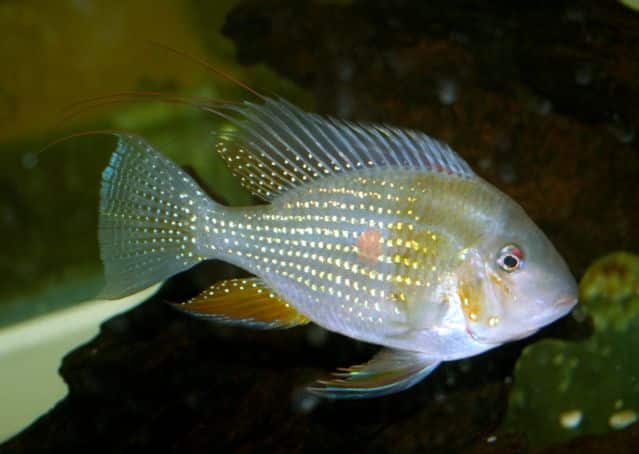
The threadfin acara has a deep, laterally compressed body with a distinctive profile. Base color is golden-yellow to olive, with each scale carrying an iridescent spot that gives the body a gem-like, glittering quality under good lighting. A dark lateral blotch sits roughly at the body’s midpoint, and the head often shows blue-green iridescence around the gill covers.
The fins are the defining feature. Mature threadfin acaras develop long, trailing filaments on the dorsal fin that can extend well beyond the caudal fin. Caudal extensions may also develop, and both dorsal and caudal fins often show reddish coloration in well-conditioned specimens. These extensions develop gradually over the first 2-3 years of the fish’s life. Juveniles show none of it. Full adult display requires time, good nutrition, and clean water.
Male vs. Female
Sexing threadfin acaras is challenging in younger fish. Both sexes develop fin extensions, though males tend to have longer ones. Differences become more apparent as the fish mature and approach breeding condition.
| Feature | Male | Female |
|---|---|---|
| Body Size | Slightly larger, up to 8 inches (20 cm) | Slightly smaller, up to 6 inches (15 cm) |
| Fin Extensions | Longer dorsal and caudal filaments | Shorter filaments (still present) |
| Body Shape | Slightly more streamlined | More robust when mature |
| Coloration | Typically more vivid iridescence | Good color, slightly less intense |
| Breeding Role | Patrols territory perimeter | Guards eggs within nesting chamber |
Average Size & Lifespan
Threadfin acaras reach approximately 7-8 inches (18-20 cm) as adults, making them a medium-sized cichlid. Growth is slow compared to most cichlid species, and it takes 2-3 years to reach full adult size with complete fin development. This slow maturation is worth understanding before you buy. The juvenile you see at the store won’t look like the fish in the care guide photos for a couple of years.
With proper care, threadfin acaras live 8-12 years. Like other geophagines, they’re sensitive to water quality, and chronic exposure to elevated nitrates shortens their lifespan significantly. Well-maintained fish in spacious, clean setups reliably reach the upper end of that range.
Care Guide
Tank Size
A minimum of 90 gallons (341 liters) for a small group, with 125-150 gallons preferred for a proper group of 5-8 adults. These fish need floor space more than water column height. A long, wide tank configuration works better than a tall, narrow one. Every adult reaches 7-8 inches, and the group dynamic requires enough space for individuals to establish positions in the hierarchy without constant conflict.
Don’t understock on group size to compensate for a smaller tank. Keeping 3-4 individuals in a 75-gallon is worse than keeping 6-8 in a 125-gallon. The social structure needs enough members to function.
Water Parameters
| Parameter | Recommended Range |
|---|---|
| Temperature | 74 to 82°F (23 to 28°C) |
| pH | 6.0 to 7.0 |
| General Hardness | 2 to 10 dGH |
| Ammonia | 0 ppm |
| Nitrite | 0 ppm |
| Nitrate | Below 20 ppm |
Soft, slightly acidic water is ideal and mimics the tannin-stained waters of the Amazon tributaries this species comes from. If your tap water is hard and alkaline, blending with RO water or adding peat filtration will help. Driftwood and Indian almond leaves naturally acidify and soften while providing a more natural look.
Hard Rule: Never keep threadfin acaras with fin-nipping species.
The trailing dorsal filaments are a target. Tiger barbs, serpae tetras, and any known fin-nipper will destroy those fins. Regrowth, if it happens, takes months. The fins are the whole point of keeping this fish. Protect them by choosing tank mates carefully from the start.
Filtration & Water Flow
Efficient filtration with moderate, diffused flow. A canister filter rated for the tank volume, with a spray bar distributing output gently across the tank, is ideal. Target 6-8 times the tank volume per hour in filtration turnover. These fish tolerate gentle movement but don’t come from fast-flowing environments.
Weekly water changes of 25-30% are the baseline. Threadfin acaras, like other geophagines, are intolerant of deteriorating water conditions. Consistent maintenance is the foundation everything else depends on.
Lighting
Moderate lighting brings out the body iridescence and fin coloration best. Very bright lighting can make these fish feel exposed and push them into hiding. Floating plants naturally diffuse overhead light and create a more comfortable, natural environment. The golden body spots and reddish fin accents show best under warm-toned, moderate-intensity lighting.
Plants & Decorations
Threadfin acaras will dig in the substrate, particularly near hardscape and when breeding. Plants rooted in sand are at risk of being uprooted. Epiphytic species like anubias and java fern attached to driftwood are the safer choice. Floating plants work well for light diffusion.
Driftwood tangles, rocky formations, and visual barriers serve as territorial markers and help manage hierarchy dynamics. Leave substantial open sandy areas for natural sifting and display behavior. The tank should balance structure for security with open space for natural activity.
Substrate
Fine sand is essential. Threadfin acaras sift through the substrate searching for food, and gravel or coarse substrate damages their mouths and gill filaments over time. Quality aquarium sand or pool filter sand at 2-3 inches (5-7 cm) depth allows for natural sifting and the excavation behavior this species engages in, particularly when breeding conditions are right.
Tank Mates
Threadfin acaras are surprisingly peaceful for a cichlid of their size. Outside of breeding, they rarely show aggression toward other species and won’t predate on even small fish under normal circumstances. The primary constraint is keeping companions that won’t damage their fins.
Best Tank Mates
- Other peaceful eartheaters (demon eartheaters, Biotodoma), shared requirements and temperament
- Larger tetras (Congo tetras, emperor tetras, silver dollars), active mid-water fish that stay out of the way
- Angelfish, compatible water parameters and similar temperament in spacious tanks
- Corydoras catfish, peaceful bottom companions in large setups with adequate sand area
- Bristlenose plecos, unobtrusive algae eaters that coexist peacefully
- Medium rainbowfish, active dither fish that occupy mid-water and encourage natural behavior
Tank Mates to Avoid
- Fin-nipping species, tiger barbs, serpae tetras, and any known nipper will target the trailing filaments immediately
- Aggressive cichlids, territorial species will dominate and stress the peaceful threadfins
- Hard-water species, African cichlids, most livebearers, and similar fish need incompatible chemistry
- Very small or slow-moving fish, at risk during breeding when the pair becomes highly territorial
Food & Diet
Threadfin acaras are omnivores with a more herbivorous slant than most cichlids. High-quality sinking pellets with spirulina or other plant-based ingredients form the staple. Supplement with frozen bloodworms, brine shrimp, and mysis shrimp for protein variety, but don’t let animal protein dominate the diet.
Blanched vegetables, spinach, zucchini, shelled peas, are accepted and provide important fiber and nutrients. Algae wafers work well as a convenient supplement. Feed 2-3 small sinking meals daily. A varied diet isn’t optional with this species: it’s the primary prevention against the nutritional deficiency that leads to HLLE.
Breeding & Reproduction
Breeding Difficulty
Difficult, genuinely one of the more challenging breeding projects in the geophagine family. The threadfin acara’s natural breeding behavior involves excavating elaborate burrow systems in sandy river banks, with a nesting chamber at the center of a territory that can span 6-10 feet (2-3 meters) in diameter. Replicating this in a home aquarium is extremely difficult to do properly.
Spawning Tank Setup
If you’re serious about breeding, a dedicated tank of 150+ gallons with deep sand substrate (4-6 inches) is needed to allow excavation. Some breeders have had success providing pre-formed tunnels or pipe structures that mimic natural burrows. The breeding pair needs isolation from other fish, as they defend an enormous territory and become aggressive toward everything in range during spawning.
Water Conditions for Breeding
Soft, acidic water at pH 5.5-6.5, hardness below 5 dGH, temperature 78-82°F (26-28°C). Pristine water quality with very low nitrates is essential. Large consistent water changes and a high-quality, varied diet are the primary triggers for spawning behavior in established pairs.
Conditioning & Spawning
Condition breeders with high-quality, varied foods for several weeks. When a pair forms, they begin excavating a burrow system in the sand. The courtship ritual is elaborate and may take multiple days. Once committed, the pair defends a large territory centered on the burrow complex. The female deposits eggs deep within the nesting chamber, potentially up to 2,000, and remains in the chamber while the male patrols the outer territory perimeter.
Egg & Fry Care
The female guards eggs within the burrow until they hatch. Once fry are free-swimming, both parents show excellent parental care, signaling young to return to the burrow when danger approaches. This guardianship continues until fry reach approximately half an inch (12 mm). Fry accept baby brine shrimp and finely crushed food immediately. Monitor breeding pairs closely: extreme intraspecific aggression can sometimes develop between mates during or after spawning.
Common Health Issues
Head and Lateral Line Erosion (HLLE)
The primary health concern for threadfin acaras. Pitting and tissue loss around the head and sensory line are directly linked to elevated nitrates and nutritional deficiency. Once damage occurs, it often doesn’t fully reverse even after conditions improve. Prevention through weekly water changes, nitrates kept below 20 ppm, and a varied vitamin-rich diet is the only reliable approach.
Ich (White Spot Disease)
Stress from shipping, water quality changes, or temperature swings triggers ich. Treatment involves gradually raising temperature and using a commercial ich medication. The trailing fin filaments can make ich spots harder to spot initially, inspect closely and regularly.
Stunted Growth
Threadfin acaras raised in undersized tanks or with poor water quality during development may never reach full adult size or develop the complete fin extensions. Since maturation takes 2-3 years, providing proper conditions throughout the entire growth period matters. Stunting from the juvenile phase is largely irreversible.
Fin Damage
The trailing dorsal filaments are vulnerable to fin-nipping tank mates, sharp decorations, and bacterial infections. Damaged filaments can regrow if the underlying tissue is healthy and conditions are good, but regrowth is slow. The best approach is prevention: choose tank mates that won’t nip, remove sharp decorations, and treat any bacterial infection promptly before it progresses along the fin rays.
What People Get Wrong
The threadfin acara gets misunderstood at nearly every stage of ownership:
- “They look dull in the store.” Juveniles have no fin extensions and show none of the adult coloration intensity. The fish you’re looking at in the store tank is going to be a completely different animal in two to three years. This is the fish you need to evaluate when deciding whether to buy, not the juvenile in front of you.
- “A pair is enough.” Two threadfin acaras quickly become unstable. Without enough group members to distribute the social pressure, one individual ends up on the receiving end of every dominant interaction. A group of 5-8 is where the hierarchy stabilizes and the natural social behavior emerges.
- “They’re big enough that fin nippers won’t bother them.” Size doesn’t protect fins. Tiger barbs and serpae tetras will nip a 7-inch threadfin acara’s filaments just as readily as they’d nip any other fish. The fins are the target regardless of body size.
- “I can breed them if I just set up a 55-gallon.” Wild pairs defend territories up to 10 feet (3 meters) across and excavate complex burrow systems. A 55-gallon tank doesn’t have the floor space for the territory, the sand depth for the burrows, or the isolation from other fish that breeding requires. Successful captive breeding needs a dedicated 150+ gallon setup with specifically prepared substrate.
Common Mistakes to Avoid
- Keeping fewer than 5 individuals. Dominant fish focus on too few targets. Hierarchy becomes unstable and the weakest fish are relentlessly harassed.
- Neglecting water quality. Weekly water changes are not optional. HLLE progresses fast once nitrates climb.
- Expecting fast maturation. The full fin extension and adult coloration take 2-3 years. Juvenile appearance is not the finished product.
- Keeping with fin-nippers. The trailing filaments are a target. Tiger barbs, serpae tetras, and similar species will destroy them.
- Using gravel substrate. Prevents natural sifting, damages gill filaments over time.
- Attempting breeding in an inadequate setup. Burrow-nesting behavior requires territory sizes and sand depths that most home aquariums can’t accommodate.
Should You Get This Fish?
The threadfin acara is a genuinely special fish, but it’s not the right fit for everyone.
Good fit if:
- You have 90+ gallons available (125+ preferred) with fine sand and soft water
- You’re an experienced keeper with consistent water quality habits
- You appreciate delayed gratification and a long-term visual payoff
- You can keep a group of 5-8 without space constraints
- You’re willing to build your community around fish that won’t nip fins
- You want a large, peaceful cichlid that can anchor a South American community setup
Think twice if:
- You want colorful, dramatic fish on day one
- You have fin-nipping species in your tank or plan to add them
- Your tank has hard, alkaline tap water and no RO setup
- You’re a first-time cichlid keeper without experience managing water-quality-sensitive species
- You’re planning to breed them without a large dedicated setup
- You have aggressive cichlids in the tank (threadfin acaras are peaceful and will not hold their own)
What It Is Actually Like Living With a Threadfin Acara
This is the part no other care guide gives you. Forget water parameters for a minute. Here is what it is actually like to share your tank with this species.
The juvenile in the fish store gives you almost no information about what you are buying. Young threadfin acaras look like a generic eartheater – pleasant enough, nothing distinctive. The dorsal filaments that make this species remarkable do not develop fully until 2 to 3 years of age. You are committing to a fish you cannot fully see yet. Keepers who do not know this are surprised when the fish they bought looks completely different two years later. Keepers who do know it spend those two years watching something unfold.
When the fins come in, the visual impact is real. A fully mature male in peak condition, fins fully extended, moving through the water column in a dimly lit soft-water tank – the trailing filaments hang and drift with each movement. No other commonly available cichlid in the hobby looks like this. The name “threadfin” is a description, not a marketing term.
The sand sifting is constant and calming to watch. The group works the substrate continuously, taking mouthfuls and releasing clean plumes. The tank bottom is always in motion. Between feeding events, the group drifts through the mid-level in loose formation, relaxed. This is not a fish that patrols or dominates the tank – it inhabits it, which is its own kind of presence.
Color is the daily health check. Rich bronze-gold body with fins extended and active substrate work: the water is right and the fish feels secure. Pale, grayish fish with clamped fins hovering mid-water: something is wrong – usually nitrates or a temperature drift. The threadfin acara is clear about what it needs. Learn to read the color and you will know the tank before you test the water.
Threadfin Acara vs. Similar Species
If you’re deciding between the threadfin acara and other South American cichlids, here’s how they compare on what actually matters for ownership:
Threadfin Acara vs. Demon Eartheater (Satanoperca jurupari)
Both need groups, fine sand, and clean soft water. The demon eartheater is more demanding on water quality (nitrates below 15 ppm vs. 20 ppm for the threadfin) and has more interesting mouthbrooding behavior to observe. The threadfin acara delivers more visual impact once the fin extensions develop fully. Choose demon eartheater if you want active mouthbrooding behavior and a more social group dynamic. Choose threadfin acara if the elegant fin display is the primary draw and you’re patient enough to wait for it.
Threadfin Acara vs. Redhump Eartheater (‘Geophagus’ steindachneri)
The redhump eartheater is more colorful from day one, with vivid breeding coloration and a visible cranial hump that develops in males. It’s also a mouthbrooder with a dramatic harem social structure. The threadfin acara’s appeal is the unique flowing fin display, which has no equivalent in the redhump. Choose redhump if you want immediate visual impact and dramatic spawning behavior. Choose threadfin if the fin extensions are the look you’re after and you’re committed to the development timeline.
Where to Buy
Threadfin acaras are available through specialty retailers and online sellers, though they’re not a regular stock item at most local fish stores. Flip Aquatics and Dan’s Fish are reliable online sources with live arrival guarantees. Since these fish need to be purchased in groups of 5 or more, online sourcing is often the most practical approach.
When selecting threadfin acaras, look for active fish with clear eyes, intact fins, and good body condition. Avoid specimens with sunken bellies, pitting on the head, or clamped fins. Juveniles won’t show adult coloration or fin extensions yet, but they should be alert and actively feeding.
Frequently Asked Questions
When do the threadfin extensions develop?
The dorsal fin filaments begin developing around 12-18 months of age and continue lengthening over the next 1-2 years. Full adult fin development typically takes 2-3 years. Good nutrition, low stress, and clean water conditions promote the best fin growth. Juveniles at the store show very little of this, so don’t judge the species by what you see in the store tank.
How many threadfin acaras should I keep?
A minimum of 5-8. These fish form dominance hierarchies and need enough group members for the social structure to function without one fish absorbing all the aggression. In properly sized groups, hierarchy stabilizes and everyone settles in. Fewer than 5 is consistently problematic.
Can threadfin acaras be bred in home aquariums?
It’s possible but genuinely difficult. Their natural breeding involves excavating complex burrow systems in sandy substrate, requiring deep sand and a very large dedicated tank. Some breeders have used artificial burrow structures with limited success. The extreme pair aggression during spawning adds another layer of complexity. This is not a casual breeding project.
Are threadfin acaras peaceful?
Yes, surprisingly so for a cichlid that reaches 8 inches. Outside of breeding they rarely show aggression toward other species and won’t predate on even small fish under normal conditions. The main aggression is within the species when group size is too small. Breeding pairs become highly territorial and aggressive toward everything in their vicinity.
What should the diet balance be?
More plant-based than most cichlids. Roughly 60% of the diet should be vegetable-based: spirulina-enriched pellets, blanched vegetables, algae wafers. The remaining 40% can be protein: frozen bloodworms, brine shrimp, mysis shrimp. This balance supports long-term health and helps prevent the nutritional deficiency that contributes to HLLE.
Is the threadfin acara the only fish in its genus?
Yes. Acarichthys is a monotypic genus, meaning A. heckelii is the only species currently assigned to it. Its closest relative is Guianacara, a genus of eartheater-type cichlids from the Guiana Shield region.
Can I add a peaceful fish that occasionally nips?
No. There’s no such thing as “only nips occasionally” when it comes to the threadfin acara’s fins. Once a fin-nipper establishes the behavior, it’s persistent. The trailing filaments are too valuable to risk on a maybe. Choose companions with a known clean track record: Congo tetras, silver dollars, angelfish, corydoras.
Closing Thoughts
The threadfin acara is a fish for the patient aquarist. It doesn’t deliver instant gratification. The fin extensions take years to develop, the full coloration emerges gradually, and the social dynamics of a group take time to establish. But for those who appreciate the slow reveal, this is one of the most rewarding South American cichlids in the hobby.
Set up a large tank with fine sand, driftwood, and clean soft water. Stock a proper group. Feed them well and maintain the water consistently. Then watch as these fish transform over months and years into something genuinely impressive. The threadfin acara earns its place not by demanding attention on day one, but by getting more extraordinary every time you look.
References
- Seriously Fish: Acarichthys heckelii species profile. seriouslyfish.com
- FishBase: Acarichthys heckelii (Muller & Troschel, 1849). fishbase.se
- Kullander, S.O. (1986). Cichlid Fishes of the Amazon River Drainage of Peru. Swedish Museum of Natural History, Stockholm.
- Practical Fishkeeping: Threadfin Acara care guide. practicalfishkeeping.co.uk
- About the Author
- Latest Posts

I’m Mark Valderrama, founder of Aquarium Store Depot and a fishkeeper with over 25 years of hands-on experience. I started in the hobby at age 11, worked at local fish stores, and have kept freshwater tanks, ponds, and reef tanks ever since. I’ve been featured in two best-selling aquarium books on Amazon and built this site to share practical, experience-based fish keeping knowledge.
Leave a Reply