
Last Updated: June 25, 2026
Thank you for visiting! By the way… any links on this page that lead to products on Amazon and other stores/partners are affiliate links Aquarium Store Depot earns a commission if you make a purchase.
Table of Contents
- Key Takeaways
- Species Overview
- Classification
- Origin & Natural Habitat
- Appearance & Identification
- Average Size & Lifespan
- Care Guide
- Tank Mates
- Food & Diet
- Breeding & Reproduction
- Common Health Issues
- What People Get Wrong
- Should You Get This Fish
- Demon Eartheater vs. Similar Species
- Where to Buy
- Frequently Asked Questions
- Closing Thoughts
- References
The demon eartheater has the scariest name and the gentlest personality in the cichlid world. The name is a lie. The care commitment is not.
Satanoperca jurupari got its dramatic name from the Tupi word for a malevolent forest spirit, and the genus name literally translates to “Satan’s perch.” In the aquarium, this fish is anything but demonic – it’s a calm, social eartheater that spends its days methodically sifting through fine sand, flashing subtle iridescent colors, and living peacefully alongside a wide range of tank mates. What it actually is, underneath that name, is a Fragile/Precision Fish: one that punishes neglect, has a hard ceiling on nitrate tolerance, and develops hole in the head disease at levels that most other cichlids shrug off. A properly set up group is one of the most natural-looking displays you can create in a large freshwater aquarium – but the “properly set up” part is where most people underestimate the commitment.
That said, “peaceful” doesn’t mean “easy.” The demon eartheater demands clean water, fine sand, plenty of space, and the company of its own kind. Get those things right and this fish will reward you for a decade. Skip one of them and you’ll find out quickly why this species has a reputation for being finicky.
Key Takeaways
- The name is misleading. Despite “demon” in the name, this is one of the most peaceful cichlids you can keep. No aggression toward tank mates outside of spawning.
- Groups only – and I mean it. Minimum 5-8 individuals. In a pair, the dominant fish has no one to redirect aggression toward except the one other fish. That fish will be stressed constantly.
- She holds the fry in her mouth. The female collects fertilized eggs and carries them for about two weeks, then continues offering refuge to the fry for several weeks after release. It’s one of the most compelling things you’ll see in a cichlid tank.
- Water quality will make or break this fish. This species develops HITH at nitrate levels other cichlids ignore completely. Weekly 30-50% water changes aren’t optional – they’re the core of the whole care equation.
- Gets large. Adults reach 8-10 inches (20-25 cm), and a group of six needs 125 gallons (473 liters) or more to thrive long-term.
- Fine sand or don’t bother. Demon eartheaters push substrate through their gill rakers all day. Gravel damages those structures over time and prevents the sifting behavior that keeps them active and healthy.
ASD Difficulty Rating
Moderate to Advanced | 6/10
The care requirements aren’t technically complex, but this species has zero tolerance for water quality lapses, requires a large tank stocked with a proper group, and punishes neglected maintenance with HITH that can progress quickly. Beginners who are ready to be diligent can succeed, but this is not an entry-level cichlid.
Species Overview
| Field | Details |
|---|---|
| Scientific Name | Satanoperca jurupari |
| Common Names | Demon Eartheater, Jurupari Eartheater, Earth Eater |
| Family | Cichlidae |
| Origin | Amazon River basin (Brazil, Peru, French Guiana, Guyana) |
| Care Level | Moderate to Advanced |
| Temperament | Peaceful |
| Diet | Omnivore (substrate sifter) |
| Tank Level | Bottom |
| Maximum Size | 10 inches (25 cm) |
| Minimum Tank Size | 75 gallons (284 liters) for a small group; 125+ gallons preferred |
| Temperature | 78 to 84°F (25 to 29°C) |
| pH | 6.0 to 7.0 |
| Hardness | 5 to 10 dGH |
| Lifespan | 8 to 10 years |
| Breeding | Maternal mouthbrooder |
| Breeding Difficulty | Moderate |
| OK for Planted Tanks? | No (persistent digger, will uproot anything rooted in substrate) |
Classification
| Taxonomic Level | Classification |
|---|---|
| Order | Cichliformes |
| Family | Cichlidae |
| Subfamily | Geophaginae |
| Genus | Satanoperca |
| Species | S. jurupari (Heckel, 1840) |
The demon eartheater was originally described by Johann Jakob Heckel in 1840 as Geophagus jurupari. It was later transferred to the genus Satanoperca, revalidated by Kullander in 1986. The genus name translates from Greek as “Satan’s perch,” while the species name jurupari comes from a Tupi word for a forest demon. The dramatic naming has nothing to do with temperament.
One important note: fish sold as S. jurupari in the trade are frequently S. leucosticta or other members of the jurupari species group. The genus currently contains about 10 recognized species, with several more awaiting formal description. Care requirements are similar across the group, but if species accuracy matters to you for breeding, purchase from a reputable source that can confirm the identification.
Origin & Natural Habitat
The demon eartheater has a wide distribution across the Amazon River basin, ranging from Peru through Brazil and into the Guianas. It’s found in slow-moving rivers, tributaries, floodplain lakes, and backwaters with sandy or muddy substrates. These habitats are warm, soft, and slightly acidic, with gentle currents and abundant organic material on the bottom. Tannins from decaying plant matter color the water brown, lowering pH further and filtering light.
In the wild, demon eartheaters congregate in loose social groups over open sandy areas, constantly sifting the substrate for small invertebrates and organic material. They prefer moderate vegetation overhead but spend most of their time in open water rather than hiding in structure. This behavioral context explains a lot about their care needs: these are open-water social fish that need space, sand, clean water, and companionship to express their natural behavior.
Expert Take (Mark Valderrama, AquariumStoreDepot)
After 25+ years in the hobby and time managing fish stores, the pattern I’ve seen with demon eartheaters is consistent: the fish that fail do so because of water quality, almost every time. They’re not a difficult fish to understand, but they’re completely unforgiving of the kind of maintenance shortcuts that most other cichlids shrug off. The HITH damage starts small and progresses fast – and what I noticed at the stores I managed was that newly arrived specimens that came in stressed were the ones most likely to show early pitting within weeks of sale, even in customer tanks that tested reasonably clean. The cumulative stress of shipping plus any maintenance gap seems to accelerate the onset faster than either factor alone. Weekly changes aren’t optional with this species. Also worth knowing: a significant percentage of fish sold as S. jurupari in the trade are actually S. leucosticta or a related species. It usually doesn’t matter for general care, but if you care about species accuracy, ask the retailer specifically.
Appearance & Identification
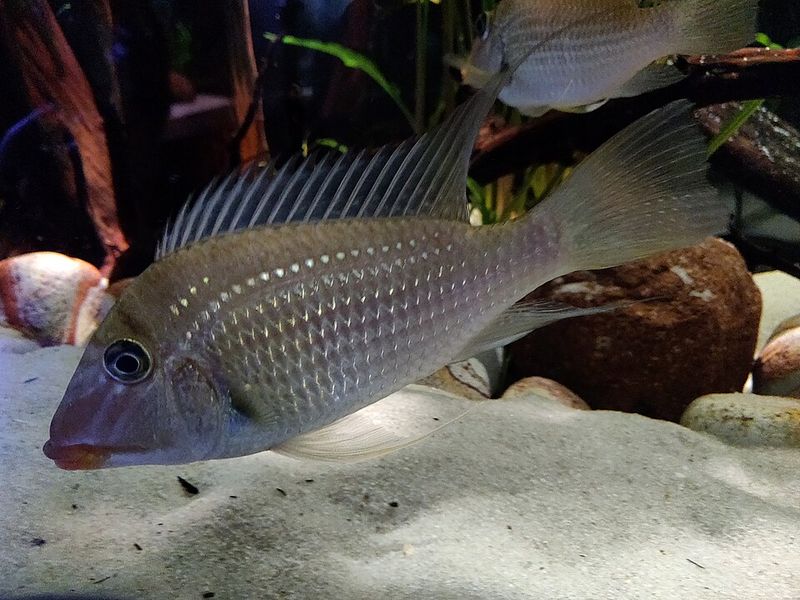
The demon eartheater has an elongated, laterally compressed body with a large, somewhat pointed head. The base color is greenish-yellow to yellow-brown, and each scale carries an iridescent yellow to gold spot that gives the fish a textured, glittering look under good lighting. On the head, these spots often develop a turquoise or blue-green iridescence that becomes more pronounced in prime condition.
Faint vertical bars are visible on the body, especially when the fish is stressed or displaying. A dark spot at the base of the caudal fin is present on most specimens. Fins are largely transparent to slightly yellowish, and mature fish may develop subtle extensions on the dorsal and pelvic fins. This isn’t a fish that screams for attention, but the delicate iridescence and patterning reward close observation.
Under warm-spectrum lighting, a settled fish in a mature tank carries a depth of gold and blue-green that a stressed or newly introduced specimen simply won’t show – it’s the kind of coloration that takes weeks to fully emerge, and once you’ve seen a relaxed group in good condition, a stressed fish looks like a different animal.
Male vs. Female
Sexing demon eartheaters outside of breeding is notoriously difficult. There are no reliable external differences between the sexes when they’re not spawning, which is why most keepers start with a group of juveniles and let pairs form naturally.
| Feature | Male | Female |
|---|---|---|
| Body Size | Slightly larger, up to 10 inches (25 cm) | Slightly smaller, up to 8 inches (20 cm) |
| Head Profile | May develop a slightly more pronounced nuchal hump | Slightly more streamlined |
| Fin Extensions | Marginally longer fin filaments when mature | Slightly shorter fins |
| Coloration | Marginally more vivid iridescence | Slightly less intense coloration |
| Breeding Role | Guards territory near spawning site | Collects and broods eggs in mouth |
Average Size & Lifespan
Demon eartheaters typically reach 8-10 inches (20-25 cm) in home aquariums. Growth is moderate, and it takes two or more years for them to reach full adult size. That slow growth rate actually works in their favor when you’re housing juveniles, since smaller fish can start in a less massive tank before graduating to their permanent large setup.
Lifespan is typically 8-10 years with proper care. Water quality is the single biggest factor in longevity. This species is unforgiving of chronic neglect, and elevated nitrates shorten their lives significantly while also triggering HITH before age becomes a factor.
Care Guide
Tank Size
A minimum of 75 gallons (284 liters) is the floor for a small group, but for a proper group of 5-8 adults, a 125-gallon (473-liter) tank is where you want to be. A long, wide footprint matters more than height. These fish are bottom dwellers that need floor space, not water column depth.
Understocking a demon eartheater tank is never a mistake. Extra water volume provides a larger buffer against nitrate accumulation, which is your primary management concern. If you’re on the fence between tank sizes, go bigger.
Water Parameters
| Parameter | Recommended Range |
|---|---|
| Temperature | 78 to 84°F (25 to 29°C) |
| pH | 6.0 to 7.0 |
| General Hardness | 5 to 10 dGH |
| Ammonia | 0 ppm |
| Nitrite | 0 ppm |
| Nitrate | Below 15 ppm (strict) |
Hard Rule: Nitrates above 20 ppm are not a yellow flag with demon eartheaters. They are a red one.
This species develops hole in the head disease at nitrate levels that most other cichlids tolerate without complaint. Keep nitrates below 15 ppm consistently. That means 30–50% water changes every week, not every two weeks. If your maintenance schedule doesn’t have room for that, choose a more forgiving cichlid.
Soft, slightly acidic water mimics their natural habitat and produces the best coloration. If your tap water is hard and alkaline, RO water or peat filtration may be necessary to hit suitable parameters. Temperature should stay on the warmer side at 78-84°F (25-29°C).
Filtration & Water Flow
Run a large canister filter – bigger is better here – but direct the output through a spray bar or lily pipe. You want high filtration capacity with gentle water delivery. Target 8-10x tank volume per hour. Here’s the thing: the filter is not what’s going to keep your nitrates in check. That’s the water changes. The filter handles biological load and mechanical cleanup. The weekly changes handle nitrates. Both are required.
Large weekly water changes of 30-50% are the real filtration for this species. No filter alone will manage nitrates at the level demon eartheaters require. The combination of their sensitivity and the waste load from a group of large fish demands consistent, substantial maintenance. Factor this into your decision before you buy.
Lighting
Subdued to moderate lighting works best. Demon eartheaters come from tannin-stained, shaded waters and feel most secure under lower light levels. Bright overhead lighting will push them toward the corners and reduce visible activity. Floating plants are an excellent solution, diffusing light at the surface and giving the tank a natural look. The iridescent spots on their body show beautifully under warm-toned, moderate lighting.
Plants & Decorations
Don’t try to build a planted tank around these fish – it won’t survive the week. Demon eartheaters dig constantly, all day, and anything rooted in the substrate is temporary at best. The only plants that survive long-term are epiphytes attached to hardscape: anubias, java fern, and bolbitis. Floating plants are fine and actually help with light diffusion.
Large pieces of driftwood create natural territory markers and visual barriers. Smooth rocks and boulders add structure without sharp edges that could injure the fish during digging. Leave large open areas of sand as the primary habitat feature. These fish spend most of their time working across open substrate, not hiding in structure.
Substrate
Fine sand is mandatory. Demon eartheaters take large mouthfuls of substrate, filter edible particles through their gill rakers, and expel the rest in a stream from their gill openings. This behavior is constant and central to their well-being. Gravel or coarse substrates damage gill filaments, prevent natural feeding, and cause chronic stress. Use fine aquarium sand or pool filter sand at 2-3 inches (5-7 cm) depth.
Tank Mates
Tank mate selection is genuinely easy with this species – in one direction. Demon eartheaters are peaceful to a fault. They won’t pick fights, they won’t bully, they won’t claim half the tank at the expense of everything else. The flip side: they will not defend themselves against an aggressive fish. They will not fight back against a Jack Dempsey. Keep that in mind when you’re choosing companions.
Best Tank Mates
- Silver dollars: Robust, peaceful schoolers that occupy mid-water and share soft-water preferences. Their open-water cruising keeps them well clear of the bottom where the eartheaters work, and their matching need for soft, warm, acidic water means you’re optimizing for one chemistry target instead of two.
- Larger tetras (Congo tetras, emperor tetras): Active mid-water swimmers that are too large to be at risk
- Angelfish: Compatible in water parameters and temperament. They thrive in the same soft, warm water the eartheaters require, and they spend their time in the mid-to-upper column – which means the two species divide the tank vertically and never compete for the same space.
- Corydoras catfish: Peaceful bottom companions in large tanks with ample sand area
- Larger rainbowfish (Boesemani, red rainbowfish): Active dither fish that stay in mid-water
- Bristlenose plecos: Unobtrusive algae eaters that coexist peacefully
Tank Mates to Avoid
- Aggressive cichlids: Red terrors, Jack Dempseys, and similar fish will bully demon eartheaters relentlessly
- Very small fish: Anything under 1.5 inches (4 cm) risks being eaten, especially by larger adults
- Hard-water species: African cichlids, most livebearers, and similar fish need incompatible chemistry
- Territorial bottom dwellers: Any catfish or loach that competes aggressively for substrate territory creates chronic stress
Food & Diet
Demon eartheaters are omnivorous substrate sifters. In the wild they extract small invertebrates, microorganisms, and organic particles from the sand. In captivity, quality sinking pellets and granules form the foundation of the diet. Supplement with frozen bloodworms, mysis shrimp, brine shrimp, and daphnia for protein variety.
Vegetable matter is an important component. Spirulina flakes, blanched greens, and algae wafers provide necessary fiber and nutrients and help prevent the nutritional deficiencies that contribute to HITH. Feed 2-3 small meals per day rather than one large feeding. All food should sink, floating foods will be largely ignored.
Avoid mammalian proteins like beef heart as a staple. Fats from these sources are poorly metabolized by South American cichlids and create long-term health problems. Stick to aquatic-based proteins and plant matter.
Breeding & Reproduction
Breeding Difficulty
Moderate. Demon eartheaters breed in home aquariums, but it requires patience. Sexing is unreliable outside of spawning, so buying a group of juveniles and allowing pairs to form naturally is the standard approach. Sexual maturity takes a year or more.
Spawning Tank Setup
A spacious tank with fine sand substrate and minimal decoration. Flat rocks or slate provide spawning surfaces. The group dynamic is important: demon eartheaters breed more readily in established social groups where natural hierarchy has stabilized. A sponge filter or diffused canister output keeps water moving without disturbing the spawning area.
Water Conditions for Breeding
Soft, slightly acidic water at pH 6.0-6.5, hardness below 8 dGH, temperature around 82°F (28°C). Immaculate water quality with very low nitrates is essential. Large weekly water changes and a varied, protein-rich diet are the primary triggers for spawning in an established group.
Conditioning & Spawning
Heavy up on protein – bloodworms, mysis, varied frozen foods – while keeping the water pristine. No rain simulation or temperature manipulation required. A settled, well-fed group in clean water will get there on its own schedule. Once a female is carrying, watch for the constant jaw movement – that’s her aerating the clutch.
When ready, the female deposits eggs in small batches on a cleaned flat surface, and the male follows to fertilize them. The female immediately collects the fertilized eggs into her mouth. This process repeats until up to 400 eggs have been laid and collected.
Egg & Fry Care
The female incubates eggs in her mouth for approximately 14 days depending on temperature. She eats little to nothing during this period. Free-swimming fry are large enough to take baby brine shrimp and finely crushed food immediately upon release. The female continues offering refuge in her mouth for several more weeks when she senses danger, which is one of the most compelling behaviors you’ll see in cichlid keeping.
Common Health Issues
Hole in the Head (HITH) and Lateral Line Erosion
The number one health concern with demon eartheaters. They’re exceptionally susceptible to HITH and lateral line erosion, which manifests as pitting and tissue loss around the head and along the sensory line. The primary driver is elevated nitrates, reinforced by nutritional deficiency. Once advanced, HITH damage often doesn’t fully reverse even after conditions improve. Prevention is everything. Keep nitrates below 15 ppm and feed a varied, vitamin-rich diet.
Ich (White Spot Disease)
Like all freshwater fish, demon eartheaters can contract ich when stressed or after temperature swings. The elevated temperatures this species prefers work in your favor during treatment: raising the tank to 86°F (30°C) accelerates the ich lifecycle and makes treatment faster. Use a quality ich medication at the full recommended dosage.
Hexamita (Internal Protozoan Parasite)
Hexamita infections are closely associated with HITH and present with similar head pitting along with white, stringy feces and appetite loss. Metronidazole is the standard treatment, administered in food or dissolved in the water column. Maintaining pristine water conditions dramatically reduces the risk.
Stunted Growth
Juveniles raised in poor water quality or inadequate nutrition may fail to reach full adult size. Unlike most health issues, growth stunting from the juvenile period is often permanent. Proper tank size, water quality, and dietary variety from the beginning are the only preventive measures.
What People Get Wrong
- Assuming aggression from the name. First-time buyers see “demon,” expect a fighter, and are either pleasantly surprised or pass on the fish entirely. This species won’t bully your other fish. The name is folklore, not a temperament warning – but it does lead keepers to underestimate the actual challenge, which is water quality, not behavior.
- Buying a pair instead of a group. In pairs, the dominant individual has nowhere to redirect aggression, and the subordinate fish takes it all – constantly. A group of 5-8 stabilizes the social hierarchy and spreads that pressure naturally. Anything smaller is an unstable setup that usually ends with one fish harassed into decline.
- Using gravel instead of fine sand. “It’s smooth enough” is not the same as “it’s fine enough.” Demon eartheaters push substrate through their gill rakers. Gravel particles damage those gill structures over time, prevent the natural sifting behavior that keeps them active and healthy, and create chronic low-grade stress that shortens their lives.
- Applying standard cichlid nitrate tolerance. Many fishkeepers know that cichlids in general can handle 20-40 ppm nitrates without obvious symptoms. That logic does not apply here. Demon eartheaters start showing HITH at levels that Jack Dempseys and convicts ignore completely. If you’re used to less sensitive fish and don’t adjust your maintenance standards, HITH will appear – and once it starts, it doesn’t always reverse fully.
- Feeding a monotonous diet. A single-food diet creates nutritional deficiency that directly accelerates HITH – the same disease their water quality sensitivity triggers. Rotate pellets, frozen foods, and vegetable matter consistently, or you’re fighting the same battle from two directions at once.
Should You Get This Fish?
The demon eartheater is one of the most rewarding large cichlids in the hobby, but it’s not for everyone. Here’s an honest breakdown:
Good fit if:
- You have a 75-gallon minimum ready (125+ gallons strongly preferred for a proper group)
- Your tank has fine sand substrate and open floor space
- You can commit to 30-50% water changes every week without exception
- You want a large, peaceful cichlid that works in a South American community setup
- You’re genuinely interested in behavioral watching, not just colorful fish
- You have some cichlid experience, particularly with water quality management
Think twice if:
- Your tank is under 75 gallons or doesn’t have a sandy bottom
- You have an established planted tank you want to preserve
- You’re planning to keep just a pair or a single specimen
- You want a cichlid that tolerates inconsistent maintenance
- You have aggressive cichlids in the tank (these fish will not hold their own against them)
- You’re a first-time cichlid keeper who isn’t ready to be strict about water quality
Demon Eartheater vs. Similar Species
If you’re deciding between the demon eartheater and other South American cichlids, here’s how they compare on what actually matters for ownership:
Demon Eartheater vs. Redhump Eartheater (‘Geophagus’ steindachneri) : Both are mouthbrooders. The redhump is more colorful with a visible cranial hump and operates in a harem structure (one male to two or three females). The demon eartheater works in a more egalitarian social group where multiple females are involved without the strict hierarchy. The redhump is slightly less demanding on water quality. Choose the redhump if you want more visual drama from your centerpiece. Choose the demon eartheater if you want a more complex social group dynamic and the mesmerizing maternal mouthbrooding behavior.
Demon Eartheater vs. Pearl Cichlid (Geophagus brasiliensis) : The pearl cichlid is the forgiving entry point into eartheater keeping. It tolerates harder water, cooler temperatures (it actually prefers 68-77°F / 20-25°C), and is more tolerant of water quality lapses than the demon eartheater. It’s also a biparental substrate spawner, not a mouthbrooder. Choose the pearl cichlid if you’re newer to the group and want a more flexible, forgiving fish. Choose the demon eartheater if you’re ready for the water quality commitment and want mouthbrooding behavior.
Where to Buy
Demon eartheaters are available through online retailers, though they’re less commonly stocked at local fish stores than some other South American cichlids. Flip Aquatics and Dan’s Fish are good sources to check for availability. Since these fish need to be purchased in groups, online sourcing often makes more sense than hunting down 5-8 individuals at a single local store.
Be aware that fish sold as S. jurupari are frequently misidentified. If accurate species identification matters for your purposes (particularly breeding), buy from a retailer who can confirm the ID rather than relying on the label alone.
Frequently Asked Questions
Are demon eartheaters actually aggressive?
No. The name comes from indigenous folklore and has nothing to do with temperament. Outside of spawning behavior, demon eartheaters are among the most peaceful cichlids available. They won’t bother similarly sized tank mates and coexist comfortably with a wide range of species.
How many demon eartheaters should I keep?
A minimum of 5-8 individuals. These fish form social hierarchies and need enough group members to spread interactions naturally. Fewer fish means the dominant individual focuses aggression on a smaller pool of targets, which leads to one or two fish being relentlessly harassed. In a proper group, the hierarchy stabilizes and everyone settles in.
How do I tell males from females?
You often can’t, reliably, outside of spawning. Males may grow slightly larger and develop marginally longer fin extensions, but these differences are subtle. The practical approach is to buy a group of juveniles and let them grow out together, allowing pairs to form naturally over time.
How often should I do water changes?
Weekly, at 30-50% volume. This species doesn’t tolerate nitrate accumulation the way most other cichlids do. If your tank is heavily stocked, twice-weekly changes may be necessary. Test nitrates regularly and keep them below 15 ppm consistently.
Is my fish really Satanoperca jurupari?
Possibly not. Fish sold under this name are frequently S. leucosticta or other jurupari group members. Exact identification requires examining scale patterns, head markings, and geographic origin. For general care the species in the group are very similar, so misidentification usually doesn’t create practical problems.
Can I keep plants with demon eartheaters?
Only epiphytic plants attached to hardscape (java fern, anubias, bolbitis) and floating plants will survive. Anything rooted in the substrate will be excavated within days. This is a fundamental part of their natural feeding behavior and can’t be trained away.
Can demon eartheaters live with other cichlids?
Yes, with the right species. Other peaceful South American cichlids with similar water chemistry needs work well. Angelfish and larger, non-aggressive species are good options. Avoid aggressive cichlids like Jack Dempseys, red terrors, or green terrors. Demon eartheaters are peaceful and will be bullied without fighting back.
Closing Thoughts
Get a proper group of demon eartheaters into a mature, well-maintained tank, and the daily routine becomes something you actually look forward to watching. The whole group is in near-constant motion across the sand – mouthful after mouthful, plumes of substrate drifting from their gill openings, the dominant fish making unhurried sweeps across their preferred stretch of bottom while subordinates work the edges. There’s a loose social order to it: the alpha claiming the best feeding ground, lower-ranked fish deferring with a slight tilt of the body, occasional slow-motion posturing that never really escalates. It’s not dramatic. It’s just relentlessly interesting, in the way that watching a well-run ecosystem tends to be.
The breeding payoff is something else entirely. When a female is holding, you’ll notice her jaw moving constantly, aerating the clutch, eating nothing, hovering slightly apart from the group. Then the fry release happens – and it’s one of those moments in the hobby that genuinely stops you. She opens her mouth and dozens of fully formed juveniles disperse into the water column, and for the next few weeks she keeps watch, pulling them back in at the first sign of a threat. It doesn’t get more cichlid than that. Build the tank right, keep the nitrates honest, and this fish will give you years of it. The demon is just a name – the eartheater, and the devoted mother beneath that name, is the whole fish.
This guide is part of our complete South American Cichlids: Complete A-Z Species Directory. Visit the hub to explore care guides for every South American cichlid species we cover.
References
- Seriously Fish: Satanoperca jurupari species profile. seriouslyfish.com
- FishBase: Satanoperca jurupari (Heckel, 1840). fishbase.se
- Kullander, S.O. (1986). Cichlid Fishes of the Amazon River Drainage of Peru. Swedish Museum of Natural History.
- The Aquarium Wiki: Satanoperca jurupari. theaquariumwiki.com
- About the Author
- Latest Posts

I’m Mark Valderrama, founder of Aquarium Store Depot and a fishkeeper with over 25 years of hands-on experience. I started in the hobby at age 11, worked at local fish stores, and have kept freshwater tanks, ponds, and reef tanks ever since. I’ve been featured in two best-selling aquarium books on Amazon and built this site to share practical, experience-based fish keeping knowledge.
Leave a Reply