
Last Updated: June 25, 2026
Thank you for visiting! By the way… any links on this page that lead to products on Amazon and other stores/partners are affiliate links Aquarium Store Depot earns a commission if you make a purchase.
What It Is Actually Like Living With a Redhump Eartheater
This is the part the care guides skip. Here is what actually happens when you keep this species long-term.
The sand never stops moving. Redhump eartheaters sift sand constantly throughout the day. They take a mouthful, filter it through their gills, spit out the sand, and move on. In a tank with fine sand, this is mesmerizing to watch. In a tank with gravel, this doesn’t happen – and the fish look stressed because they can’t express a behavior that is hardwired into them. The substrate is not optional.
The nuchal hump is a live health dashboard. A dominant male in good condition has a pronounced, vividly red hump. When water quality drops, when the male is stressed, or when tank conditions slip, that hump fades and flattens within days. You don’t need a test kit to know something is wrong – you look at the hump. Experienced redhump keepers check the hump the way other keepers check nitrate readings.
The mouthbrooding female is the most compelling fish in the tank for three weeks at a time. During the brooding period she refuses food, holds her mouth slightly open and extended, and becomes more visibly protective than at any other point in her life. When she finally releases the fry, the event happens fast and the fry are large and capable. Watching a redhump female release 40 to 60 fully-formed fry and immediately herd them as a group is one of the more memorable things you can observe in a South American cichlid tank.
The social hierarchy is constant and visible. In a proper harem setup – one male, two or three females – the male courts continuously, the females establish a pecking order, and the interactions are never random. Once you know what you’re watching, the tank reads like a story with recurring characters. This is the behavioral complexity that makes the redhump eartheater worth the extra maintenance effort.
Redhump vs. Other South American Cichlids
If you are deciding between South American cichlids for a medium-sized setup, here is how the redhump eartheater compares on what actually matters for ownership.
Redhump Eartheater vs. Pearl Cichlid (Geophagus brasiliensis): Choose the Pearl Cichlid if you want a larger, more forgiving eartheater that tolerates cooler temperatures and less frequent water changes – the pearl cichlid is more beginner-accessible and doesn’t require a harem structure. Choose the Redhump Eartheater if you specifically want the mouthbrooding behavior, the active social dynamics of a harem group, and the dramatic nuchal hump visual indicator – the keeping experience is fundamentally different from a substrate-spawning eartheater.
Redhump Eartheater vs. Blue Acara (Andinoacara pulcher): Choose the Blue Acara if you want a more community-compatible, colorful cichlid that doesn’t require sand-sifting substrate or strict harem management – the blue acara is more forgiving of water quality variation and works in a wider range of setups. Choose the Redhump Eartheater if you want the eartheater sand-sifting behavior and the mouthbrooding theater that the blue acara simply does not offer – these are completely different behavioral experiences despite similar size ranges.
Expert Take (Mark Valderrama, AquariumStoreDepot)
After 25+ years in this hobby, the redhump eartheater is one of the species I consistently see capture people who think eartheaters are complicated. The mouthbrooding behavior is the hook – once someone watches a female release fry for the first time, they’re invested in this fish in a different way. The water quality requirement is real and non-negotiable for this species, but it’s not complicated. Weekly water changes and good filtration. Nail those two things and the redhump eartheater rewards you with one of the more engaging behavioral displays in South American cichlid keeping. The nuchal hump on a dominant male in prime condition is something you really have to see in person. Photos don’t do it justice.
Where to Buy
Redhump eartheaters are available through online retailers and specialty cichlid shops, though they’re not a staple at every local fish store. For the healthiest stock, check Flip Aquatics or Dan’s Fish. Online specialty retailers consistently ship better-conditioned fish than chain pet stores for eartheater species.
When buying, look for active fish with good body condition and vibrant coloration. Males should show at least the beginnings of the red forehead hump if they’re subadult or larger. Avoid fish with sunken bellies, clamped fins, or visible pitting on the head. Purchasing a small group of juveniles and letting them grow up together is the best way to end up with a compatible, naturally established harem.
Frequently Asked Questions
When do males develop the red hump?
The nuchal hump typically becomes noticeable as males reach 3 to 4 inches (7 to 10 cm), but it continues to grow and intensify throughout the fish’s life. Dominant males kept in good conditions with a proper diet develop the most impressive humps. A subordinate male or one under stress may have a smaller, less colorful hump — watch for changes in hump size and color as a health indicator.
How can I tell if my female is holding eggs?
A mouthbrooding female has a visibly distended throat and lower jaw area. She stops eating entirely and makes subtle chewing or turning motions with her mouth. She becomes more reclusive, retreating to quiet areas of the tank away from other fish. This is all completely normal. Don’t separate her or try to intervene — just give her space and let the process complete.
What’s the best male-to-female ratio?
One male to 2 to 3 females is the ideal ratio. This species is polygamous, and a single male will court multiple females. Keeping only one female with a male results in excessive harassment. In larger tanks (125+ gallons), two males with 5 to 6 females can work if the tank has clearly separated territorial zones with visual barriers.
Is this a true Geophagus?
Technically, not quite. G. steindachneri belongs to a lineage that shares some features with true Geophagus but differs in significant ways, especially its immediate mouthbrooding reproductive strategy. Taxonomists generally agree it will eventually be moved to a different genus. In scientific literature, you’ll see the genus name in quotes: ‘Geophagus‘ steindachneri. For hobbyist purposes, it’s sold and kept as a Geophagus eartheater and the care is treated accordingly.
Can redhump eartheaters live in a community tank?
Yes, as long as tank mates are chosen carefully. Avoid very small fish that will be eaten and very aggressive cichlids that will dominate the eartheaters. Medium-sized, peaceful to semi-aggressive fish from similar South American habitats make the best companions. The tank needs to be large enough that breeding behavior and territorial displays don’t disrupt the entire community.
Closing Thoughts
The redhump eartheater offers something genuinely rare in the eartheater world: mouthbrooding behavior combined with manageable size and accessible care requirements. Watching a male display his growing red hump to court females, and then observing a female carry her brood for weeks until tiny, fully formed fry emerge ready to sift the sand — that’s fishkeeping at its most engaging. This isn’t a fish you just observe. It’s a fish you follow.
Give them clean water with consistent weekly changes, a sandy bottom, the right harem social structure, and a varied diet. In return, you’ll get one of the most behaviorally fascinating South American cichlids in regular availability — with a lifespan long enough to become a real anchor in your fishroom.
This article is part of our complete South American Cichlids: Complete A-Z Species Directory. Explore care guides for every South American cichlid species we profile.
References
- Seriously Fish – ‘Geophagus’ steindachneri species profile. seriouslyfish.com
- FishBase – Geophagus steindachneri Eigenmann & Hildebrand, 1922. fishbase.se
- The Aquarium Wiki – Geophagus steindachneri. theaquariumwiki.com
- Practical Fishkeeping – Redhump Eartheater care guide. practicalfishkeeping.co.uk
Table of Contents
- Key Takeaways
- Species Overview
- Classification
- Origin & Natural Habitat
- Appearance & Identification
- Average Size & Lifespan
- Care Guide
- What People Get Wrong
- Tank Mates
- Food & Diet
- Reality of Keeping
- Breeding & Reproduction
- Common Health Issues
- Common Mistakes to Avoid
- Should You Get This Fish
- Redhump vs. Other South American Cichlids
- Where to Buy
- Frequently Asked Questions
- Closing Thoughts
- References
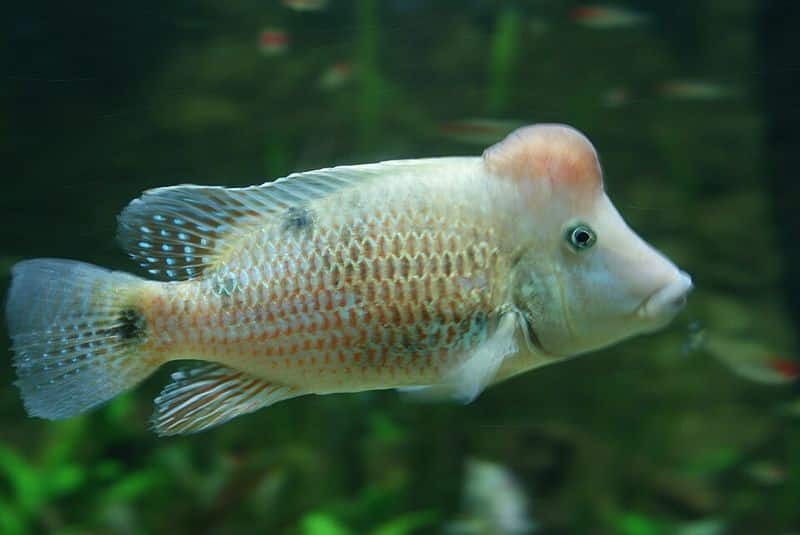
The redhump eartheater isn’t the flashiest fish on the shelf at the store. Give it a few months in a proper setup, though, and the transformation is notable. Males develop a prominent red nuchal hump, vivid red coloration around the mouth and gill area, and an iridescence across the body that makes them genuinely impressive. The red hump doesn’t lie — a dominant male in good condition is one of the more visually striking medium cichlids you can keep.
You don’t just watch the redhump eartheater. You follow the story.
What sets Geophagus steindachneri apart from most eartheaters is the mouthbrooding behavior. This is a maternal mouthbrooder in a genus better known for substrate spawners and delayed mouthbrooders. Watching a female pick up her eggs immediately after spawning and carry them in her mouth for two to three weeks — refusing food the entire time — is one of the more compelling behaviors you’ll observe in South American cichlid keeping. In 25+ years in this hobby, the redhump eartheater is one of the few fish that I consistently see capture the attention of people who think cichlids are too complicated. The behavior sells itself.
Key Takeaways
- Maternal mouthbrooder: unlike most eartheaters, the female immediately picks up eggs after spawning and broods them in her mouth for 15 to 20 days
- Males develop a prominent red nuchal hump that intensifies with maturity, dominance, and breeding readiness — a genuine visual indicator of fish health and condition
- Moderate adult size (6 inches / 15 cm for males): manageable in a 50-gallon with the right social structure
- Harem setup is the right social structure: one male with 2 to 3 females reduces harassment and supports natural behavior
- More sensitive to water quality than pearl cichlid: weekly 25 to 30% water changes are not optional for this species
- Taxonomic note: scientists place this species’ genus name in quotes (‘Geophagus’) due to its distinct lineage — a reclassification is likely in coming years
ASD Difficulty Rating
Moderate | 5/10
The redhump eartheater rewards consistent water maintenance. The mouthbrooding behavior is accessible and the social dynamics are fascinating. The challenge is water quality sensitivity – this species does not tolerate chronic high nitrates the way a pearl cichlid or blue acara might. Get the maintenance routine right and keep the harem structure correct, and this fish is manageable for intermediate cichlid keepers.
Species Overview
| Field | Details |
|---|---|
| Scientific Name | ‘Geophagus’ steindachneri |
| Common Names | Redhump Eartheater, Red Hump Geophagus, Redhump Geo |
| Family | Cichlidae |
| Origin | Colombia (Magdalena, Cauca, Sinu River basins) and Venezuela (Maracaibo basin) |
| Care Level | Moderate |
| Temperament | Semi-aggressive (territorial when breeding) |
| Diet | Omnivore |
| Tank Level | Bottom to Middle |
| Maximum Size | 6 inches (15 cm) males; 5 inches (13 cm) females |
| Minimum Tank Size | 50 gallons (189 liters) |
| Temperature | 73 to 81°F (23 to 27°C) |
| pH | 6.0 to 7.0 |
| Hardness | 5 to 15 dGH |
| Lifespan | 10 to 12 years |
| Breeding | Substrate-spawning mouthbrooder (maternal) |
| Breeding Difficulty | Easy to Moderate |
| Compatibility | Community with similar-sized fish |
| OK for Planted Tanks? | With caution (will dig and uproot rooted plants) |
Classification
| Taxonomic Level | Classification |
|---|---|
| Order | Cichliformes |
| Family | Cichlidae |
| Subfamily | Geophaginae |
| Genus | ‘Geophagus’ (placement pending reclassification) |
| Species | G. steindachneri Eigenmann & Hildebrand, 1922 |
Geophagus steindachneri was described by Eigenmann and Hildebrand in 1922, with the species name honoring Austrian zoologist Franz Steindachner. Despite its current placement in Geophagus, this species doesn’t share all the diagnostic features of true eartheaters in that genus. Taxonomists have long noted that the ‘Geophagus’ steindachneri group represents a distinct lineage — its mouthbrooding behavior alone sets it apart from most of the genus. A comprehensive genus-level revision will likely move this fish to a different genus. In scientific literature, you’ll often see the genus name in quotes as ‘Geophagus‘ steindachneri to flag this uncertainty.
Origin & Natural Habitat
The redhump eartheater is native to northwestern South America: specifically the Rio Magdalena, Rio Cauca, and Rio Sinu drainages in Colombia, and tributaries of the Lake Maracaibo basin in Venezuela. This is a relatively restricted range compared to many other eartheater species. The Rio Magdalena is Colombia’s primary river system, flowing northward through a broad valley before reaching the Caribbean.
In the wild, G. steindachneri inhabits forested streams, tributaries, and backwaters with sandy substrates. These are typically clear to slightly turbid waterways shaded by overhanging vegetation. Like other eartheaters, they spend most of their time at the bottom, sifting through sand for small invertebrates, insect larvae, and organic material. Water in their native range tends to be soft and slightly acidic with moderate, stable temperatures.
Appearance & Identification
The redhump eartheater has a compact, oval body with iridescent scales that shimmer in greens, golds, and blues under aquarium lighting. The base color is silvery-green to olive, becoming more intense in older, dominant fish. The most distinctive feature is the bright red coloration that develops around the mouth, lower jaw, and throat area, intensifying in dominant males and during breeding displays.
The namesake red nuchal hump is the feature that separates mature males from every other eartheater in common availability. This fatty deposit on the forehead becomes prominent in dominant, well-fed males and can grow quite large relative to the fish’s head size. The hump is typically red to reddish-orange. It serves as a signal of dominance and breeding fitness — and a quick health indicator for experienced keepers. A flat, pale hump on a male that used to have a full one is worth investigating.
Male vs. Female
Sexing adult redhump eartheaters is straightforward once the fish mature. Males develop several unmistakable features.
| Feature | Male | Female |
|---|---|---|
| Body Size | Up to 6 inches (15 cm) | Up to 5 inches (13 cm) |
| Nuchal Hump | Large, prominent red hump on forehead | Absent or very small |
| Coloration | More vivid, especially red around mouth and gill area | Less intense coloration |
| Fins | Longer, more pointed dorsal and anal fins | Shorter, more rounded fins |
| Body Shape | Deeper bodied, more robust | Slightly smaller and more streamlined |
Average Size & Lifespan
Males typically reach 5 to 6 inches (13 to 15 cm) in home aquariums, with females slightly smaller at 4 to 5 inches (10 to 13 cm). Wild specimens can reportedly grow somewhat larger, but aquarium-raised fish rarely exceed 6 inches. Growth is moderate, with fish reaching sexual maturity at around 3 inches (7 cm) — at which point the males will begin showing the first signs of the nuchal hump.
With good care, redhump eartheaters live 10 to 12 years in captivity. Water quality is the biggest variable in longevity. Fish kept with chronic high nitrates or inconsistent water changes will have notably shorter lives. Get the maintenance routine right and this is a fish that becomes a long-term fixture.
Care Guide
Tank Size
A 50-gallon (189 liter) tank is the minimum for a single male with a small group of females. For a community setup with other species, 75 gallons (284 liters) or more provides the space needed to manage territorial behavior during breeding. The tank needs a minimum footprint of 48 x 18 inches (120 x 45 cm) to give bottom-dwelling fish adequate territory. If you’re keeping multiple males, plan for 125 gallons (473 liters) minimum — and only with plenty of visual barriers that create genuinely separate territories.
Water Parameters
| Parameter | Recommended Range |
|---|---|
| Temperature | 73 to 81°F (23 to 27°C) |
| pH | 6.0 to 7.0 |
| General Hardness | 5 to 15 dGH |
| Ammonia | 0 ppm |
| Nitrite | 0 ppm |
| Nitrate | Below 20 ppm |
The redhump eartheater is more sensitive to water quality than many other eartheaters. Chronic high nitrate levels are the most common cause of hole in the head disease in this species. Weekly 25 to 30% water changes are the baseline — not a recommendation, a requirement. In heavily stocked setups, twice-weekly changes may be necessary. Consistency matters more than hitting a specific chemistry number. Focus on stable parameters through regular maintenance.
Slightly acidic to neutral pH is preferred, matching the soft, slightly acidic streams of their native Colombian and Venezuelan range. Avoid hard alkaline water long-term. Soft to moderately hard water works well.
Hard Rule: One male per tank. The subordinate always loses.
One male per tank unless the setup is 125+ gallons with clearly separated territories. Keeping two males in a 50 or 75-gallon tank is asking for a dead or chronically stressed subordinate fish. Redhump males fight. The subordinate loses – every time.
Filtration & Water Flow
Efficient filtration is non-negotiable for this species. A quality canister filter is the best choice, providing strong biological, mechanical, and chemical filtration. Target a turnover rate of at least 6 to 8 times the tank volume per hour. The constant sand-sifting behavior kicks up particulate matter, so good mechanical filtration with fine filter floss or polishing pads keeps the water clear and reduces the organic load that drives nitrate accumulation.
Water flow should be moderate with calmer areas available. Distribute the filter output evenly using a spray bar rather than directing a single strong current across the tank. Provide resting spots away from the highest flow areas.
Lighting
Moderate lighting shows off this species well. The iridescent scales look best under moderate, slightly warm-toned lighting. Very bright overhead lights stress these fish and wash out their coloration. Standard plant-growth lighting works well if you’re running a planted tank. Adding floating plants that diffuse surface light provides natural shading and helps the fish feel secure.
Plants & Decorations
Like all eartheaters, redhump eartheaters dig. Plants rooted directly in the substrate are at high risk of being uprooted. Your best options are epiphytic plants (anubias, java fern) attached firmly to driftwood or rocks. These stay in place regardless of how much the fish rearranges the sand bed below.
Provide driftwood tangles, rocky caves, and clear visual barriers. These create the territorial zones that manage aggression, especially in a harem setup with multiple females. Smooth stones and flat slate pieces serve as territorial markers and can function as spawning surfaces. Leave open sandy areas for natural sifting behavior. Open sand is functional habitat for this fish, not empty space.
Substrate
Fine sand is essential. Redhump eartheaters are dedicated substrate sifters that pick up mouthfuls of sand, extract edible particles, and expel the rest through their gills. Gravel or coarse substrates prevent this natural behavior and can damage gill rakers over time. Pool filter sand or fine aquarium sand provides the ideal texture for healthy sifting behavior.
What People Get Wrong
“Keep a pair.” This is the most common mistake with redhump eartheaters. A single male with a single female creates a situation where the male’s courtship behavior becomes harassment. With only one female, the male’s attention is entirely focused on her, which is relentless and stressful. One male with 2 to 3 females distributes that attention and is the correct social structure. If you can only keep a pair, provide more hiding spots than you think are necessary and watch closely for stress.
“The hump is just a physical feature.” The nuchal hump is a live health indicator. A dominant male in good condition with a full, vivid red hump is one thing. A male whose hump is shrinking or losing color is a sign something is wrong — water quality, stress from a rival, or illness. If you keep this species, learn to read the hump. It tells you a lot.
“Water quality is like any other cichlid.” Redhump eartheaters are specifically sensitive to nitrate accumulation. More sensitive than pearl cichlids or blue acaras. Hobbyists who do water changes every two or three weeks for their other cichlids often find that schedule is not sufficient for this species. Weekly changes are the minimum. Chronic high nitrates lead directly to hole in the head disease in this fish.
“The brooding female needs intervention.” A female holding eggs will stop eating for up to three weeks. This is completely normal. Her throat and lower jaw will look swollen. She’ll be reclusive and refuse food. Don’t try to force-feed her, separate her unnecessarily, or strip the eggs. Trust the behavior. Interfering with mouthbrooding females is a common way to lose a spawn.
Tank Mates
Redhump eartheaters are generally peaceful outside of breeding periods but can become territorial when a male is courting or a female is holding eggs. Tank mate selection should focus on species robust enough to handle occasional cichlid aggression without being so aggressive they stress the eartheaters.
Best Tank Mates
- Blue acaras: similar size and temperament, a natural pairing in a South American community
- Larger tetras (silver dollars, Buenos Aires tetras): too big to eat and fast enough to avoid trouble
- Bristlenose and medium-sized plecos: armored bottom dwellers that hold their own
- Large corydoras or Brochis species: peaceful bottom companions in spacious setups
- Rainbowfish: active mid-water swimmers that add movement without causing territorial conflicts at the substrate level
Tank Mates to Avoid
- Small fish: neon tetras, rasboras, and similar species will be eaten
- Highly aggressive cichlids: red devils, Jack Dempseys, and similar species will dominate and stress the eartheaters
- Multiple redhump males in small tanks: only in 125+ gallons with clearly separated territories
- Delicate or slow-moving species: discus, fancy guppies, and similar sensitive fish are poor matches for any active cichlid community
Food & Diet
Redhump eartheaters are omnivorous and accept a wide variety of foods in captivity. A quality sinking pellet or granule should serve as the staple, since these are primarily bottom feeders and won’t readily compete for floating food. Supplement regularly with frozen bloodworms, brine shrimp, mysis shrimp, and daphnia for protein variety.
Vegetable matter is important for long-term health and helps prevent nutritional deficiency that contributes to hole in the head disease. Blanched spinach, shelled peas, zucchini slices, and spirulina-based foods provide essential fiber and trace nutrients. Feed 2 to 3 times daily in amounts the fish can consume within a few minutes. Sinking foods ensure the bottom-dwelling eartheaters actually get fed, rather than losing food to midwater species.
Reality of Keeping
The daily social dynamics in a redhump eartheater harem are genuinely interesting to observe. The dominant male is constantly signaling, displaying, and positioning himself relative to the females. You’ll see him open his mouth and shake his jaw in courtship displays — a behavior that looks dramatic and almost aggressive but is actually ritualized courtship. The females assess, respond, or retreat. The social hierarchy is active and visible in a way that most fish simply aren’t.
The mouthbrooding is the main event. When a female is holding, she retreats to quieter areas of the tank with a visibly swollen lower jaw. She makes subtle chewing motions as she rotates the eggs. She refuses food for 15 to 20 days. The fry emerging from her mouth for the first time — small, fully formed, immediately beginning to sift the sand — is one of those fishkeeping moments that stays with you. It’s immediate, visible, and genuinely compelling in a way that substrate spawning often isn’t.
The sand-sifting behavior is constant and satisfying to watch. The fish methodically work the substrate, picking up mouthfuls and expelling clean sand through their gill plates. Your tank will be rearranged regularly. Sand gets pushed into mounds near driftwood, hollows get excavated near flat rocks. Design the tank to accommodate this behavior from the start rather than fighting it.
The water change discipline is the real daily reality. More than with most medium cichlids, this species requires consistent weekly maintenance. If your schedule is monthly water changes, this is not your fish. If you can commit to weekly 25 to 30% changes and keep nitrates below 20 ppm, you’ll have healthy, active fish that display consistently and breed regularly.
Breeding & Reproduction
Breeding Difficulty
Easy to moderate. G. steindachneri breeds readily in captivity once you have a healthy male with receptive females and consistent water quality. The mouthbrooding behavior is one of the most rewarding aspects of keeping this species. Sexual maturity is reached at around 3 inches (7 cm).
Spawning Tank Setup
A 50-gallon (189 liter) tank works for a breeding setup with one male and 2 to 3 females. Provide sand substrate, flat rocks as spawning surfaces, and driftwood for visual barriers. Having a separate tank available for brooding females is ideal, since males can become aggressive toward females immediately after spawning. A sponge filter provides gentle filtration that won’t endanger fry.
Water Conditions for Breeding
Slightly soft, acidic water (pH 6.0 to 6.5, 5 to 10 dGH) at 77 to 80°F (25 to 27°C) creates ideal breeding conditions. Clean water with minimal nitrates is critical. Regular water changes frequently trigger spawning behavior. The species doesn’t require extreme soft-water conditions to breed, but soft, clean water improves egg viability and brooding success.
Conditioning & Spawning
Condition breeders with a varied, protein-rich diet for 1 to 2 weeks before attempting to trigger spawning. When ready, the male’s nuchal hump becomes more vivid and he begins elaborate courtship displays, opening his mouth and shaking his jaw at receptive females. The courtship can last several hours. The female deposits 30 to 150 bright yellow eggs on a cleaned stone, then immediately scoops them into her mouth along with the male’s milt for fertilization. The pickup happens fast — blink and you miss it.
Egg & Fry Care
The female mouthbroods the eggs for 15 to 20 days, during which she refuses food. This is normal and expected. Her lower jaw will appear swollen and she’ll make subtle chewing motions as she rotates the developing eggs. The eggs hatch within about 2 days, but the fry remain in the mother’s mouth until free-swimming at around 7 days post-hatch.
After release, feed the fry with finely crushed flake food and freshly hatched baby brine shrimp. Growth is rapid with generous feedings and frequent water changes in the rearing tank. By three weeks, young fish begin showing characteristic earth-eating sifting behavior. Sexual dimorphism becomes visible at around 14 weeks.
Common Health Issues
Hole in the Head (HITH)
Eartheaters are specifically prone to HITH, and redhump eartheaters are among the most susceptible in the genus. The condition causes pitting and erosion around the head and lateral line and is directly linked to chronic high nitrate levels and nutritional deficiency. Prevention is straightforward: regular large water changes, a varied diet including vegetable matter, and keeping nitrates consistently below 20 ppm. Once HITH develops, improving water quality and diet can halt progression, but existing pitting may not fully heal. Don’t let it develop in the first place.
Ich (White Spot Disease)
Stress from temperature fluctuations or poor water quality can trigger ich outbreaks. The small white spots are easy to identify. Gradually raise the temperature to 84°F (29°C) and treat with a commercial ich medication. Redhump eartheaters handle most standard treatments well, though avoid copper-based medications at full strength with sensitive fish.
Lateral Line Erosion
Related to HITH but affecting the lateral line system along the body, this condition manifests as small pits or grooves along the fish’s sides. It’s almost always a water quality issue. Keeping nitrates consistently below 20 ppm, maintaining a varied diet, and ensuring adequate mineral content in the water are the best preventive measures.
Bloat
Abdominal swelling can indicate bloat from internal parasites or bacterial infection. This is a serious condition requiring prompt treatment. Metronidazole is the standard medication for cichlid bloat. Avoid overfeeding protein-heavy foods and ensure the diet includes adequate fiber from vegetable matter. Don’t confuse a brooding female’s swollen throat with bloat — they look different and the location is different.
Common Mistakes to Avoid
- Keeping only a pair: one male with one female leads to relentless harassment. The correct social structure is one male with 2 to 3 females.
- Neglecting water changes: this species is more sensitive to nitrate accumulation than many other cichlids. Weekly 25 to 30% changes are the minimum.
- Using gravel substrate: fine sand is essential for natural eartheater feeding behavior. Gravel prevents sifting and risks gill raker damage.
- Intervening during mouthbrooding: the female refusing food for 2 to 3 weeks is completely normal. Don’t separate her, strip eggs, or attempt to force-feed. Trust the behavior.
- Not providing enough hiding spots: brooding females need retreat options away from the male. Multiple caves and visual barriers reduce stress significantly.
- Feeding only one type of food: dietary variety directly prevents HITH and keeps the fish in peak condition. Rotate pellets, frozen foods, and vegetable matter regularly.
Should You Get This Fish
Good fit if:
- You want an eartheater with genuinely fascinating breeding behavior (mouthbrooding) rather than typical substrate spawning
- You can commit to weekly 25 to 30% water changes
- You have a 50-gallon (189 liter) or larger tank with sand substrate
- You’re prepared to keep the proper harem social structure (1 male, 2 to 3 females)
- You want a fish that gives you something to watch every day through its social behavior
Think twice if:
- Your water change schedule is biweekly or monthly — this fish demands weekly maintenance
- You can only keep a single pair (harassment risk)
- Your tank is under 50 gallons
- You’re keeping small fish that will be eaten
- You want a more forgiving, lower-maintenance cichlid — choose the pearl cichlid instead
What It Is Actually Like Living With a Redhump Eartheater
This is the part the care guides skip. Here is what actually happens when you keep this species long-term.
The sand never stops moving. Redhump eartheaters sift sand constantly throughout the day. They take a mouthful, filter it through their gills, spit out the sand, and move on. In a tank with fine sand, this is mesmerizing to watch. In a tank with gravel, this doesn’t happen – and the fish look stressed because they can’t express a behavior that is hardwired into them. The substrate is not optional.
The nuchal hump is a live health dashboard. A dominant male in good condition has a pronounced, vividly red hump. When water quality drops, when the male is stressed, or when tank conditions slip, that hump fades and flattens within days. You don’t need a test kit to know something is wrong – you look at the hump. Experienced redhump keepers check the hump the way other keepers check nitrate readings.
The mouthbrooding female is the most compelling fish in the tank for three weeks at a time. During the brooding period she refuses food, holds her mouth slightly open and extended, and becomes more visibly protective than at any other point in her life. When she finally releases the fry, the event happens fast and the fry are large and capable. Watching a redhump female release 40 to 60 fully-formed fry and immediately herd them as a group is one of the more memorable things you can observe in a South American cichlid tank.
The social hierarchy is constant and visible. In a proper harem setup – one male, two or three females – the male courts continuously, the females establish a pecking order, and the interactions are never random. Once you know what you’re watching, the tank reads like a story with recurring characters. This is the behavioral complexity that makes the redhump eartheater worth the extra maintenance effort.
Redhump vs. Other South American Cichlids
If you are deciding between South American cichlids for a medium-sized setup, here is how the redhump eartheater compares on what actually matters for ownership.
Redhump Eartheater vs. Pearl Cichlid (Geophagus brasiliensis): Choose the Pearl Cichlid if you want a larger, more forgiving eartheater that tolerates cooler temperatures and less frequent water changes – the pearl cichlid is more beginner-accessible and doesn’t require a harem structure. Choose the Redhump Eartheater if you specifically want the mouthbrooding behavior, the active social dynamics of a harem group, and the dramatic nuchal hump visual indicator – the keeping experience is fundamentally different from a substrate-spawning eartheater.
Redhump Eartheater vs. Blue Acara (Andinoacara pulcher): Choose the Blue Acara if you want a more community-compatible, colorful cichlid that doesn’t require sand-sifting substrate or strict harem management – the blue acara is more forgiving of water quality variation and works in a wider range of setups. Choose the Redhump Eartheater if you want the eartheater sand-sifting behavior and the mouthbrooding theater that the blue acara simply does not offer – these are completely different behavioral experiences despite similar size ranges.
Expert Take (Mark Valderrama, AquariumStoreDepot)
After 25+ years in this hobby, the redhump eartheater is one of the species I consistently see capture people who think eartheaters are complicated. The mouthbrooding behavior is the hook – once someone watches a female release fry for the first time, they’re invested in this fish in a different way. The water quality requirement is real and non-negotiable for this species, but it’s not complicated. Weekly water changes and good filtration. Nail those two things and the redhump eartheater rewards you with one of the more engaging behavioral displays in South American cichlid keeping. The nuchal hump on a dominant male in prime condition is something you really have to see in person. Photos don’t do it justice.
Where to Buy
Redhump eartheaters are available through online retailers and specialty cichlid shops, though they’re not a staple at every local fish store. For the healthiest stock, check Flip Aquatics or Dan’s Fish. Online specialty retailers consistently ship better-conditioned fish than chain pet stores for eartheater species.
When buying, look for active fish with good body condition and vibrant coloration. Males should show at least the beginnings of the red forehead hump if they’re subadult or larger. Avoid fish with sunken bellies, clamped fins, or visible pitting on the head. Purchasing a small group of juveniles and letting them grow up together is the best way to end up with a compatible, naturally established harem.
Frequently Asked Questions
When do males develop the red hump?
The nuchal hump typically becomes noticeable as males reach 3 to 4 inches (7 to 10 cm), but it continues to grow and intensify throughout the fish’s life. Dominant males kept in good conditions with a proper diet develop the most impressive humps. A subordinate male or one under stress may have a smaller, less colorful hump — watch for changes in hump size and color as a health indicator.
How can I tell if my female is holding eggs?
A mouthbrooding female has a visibly distended throat and lower jaw area. She stops eating entirely and makes subtle chewing or turning motions with her mouth. She becomes more reclusive, retreating to quiet areas of the tank away from other fish. This is all completely normal. Don’t separate her or try to intervene — just give her space and let the process complete.
What’s the best male-to-female ratio?
One male to 2 to 3 females is the ideal ratio. This species is polygamous, and a single male will court multiple females. Keeping only one female with a male results in excessive harassment. In larger tanks (125+ gallons), two males with 5 to 6 females can work if the tank has clearly separated territorial zones with visual barriers.
Is this a true Geophagus?
Technically, not quite. G. steindachneri belongs to a lineage that shares some features with true Geophagus but differs in significant ways, especially its immediate mouthbrooding reproductive strategy. Taxonomists generally agree it will eventually be moved to a different genus. In scientific literature, you’ll see the genus name in quotes: ‘Geophagus‘ steindachneri. For hobbyist purposes, it’s sold and kept as a Geophagus eartheater and the care is treated accordingly.
Can redhump eartheaters live in a community tank?
Yes, as long as tank mates are chosen carefully. Avoid very small fish that will be eaten and very aggressive cichlids that will dominate the eartheaters. Medium-sized, peaceful to semi-aggressive fish from similar South American habitats make the best companions. The tank needs to be large enough that breeding behavior and territorial displays don’t disrupt the entire community.
Closing Thoughts
The redhump eartheater offers something genuinely rare in the eartheater world: mouthbrooding behavior combined with manageable size and accessible care requirements. Watching a male display his growing red hump to court females, and then observing a female carry her brood for weeks until tiny, fully formed fry emerge ready to sift the sand — that’s fishkeeping at its most engaging. This isn’t a fish you just observe. It’s a fish you follow.
Give them clean water with consistent weekly changes, a sandy bottom, the right harem social structure, and a varied diet. In return, you’ll get one of the most behaviorally fascinating South American cichlids in regular availability — with a lifespan long enough to become a real anchor in your fishroom.
This article is part of our complete South American Cichlids: Complete A-Z Species Directory. Explore care guides for every South American cichlid species we profile.
References
- Seriously Fish – ‘Geophagus’ steindachneri species profile. seriouslyfish.com
- FishBase – Geophagus steindachneri Eigenmann & Hildebrand, 1922. fishbase.se
- The Aquarium Wiki – Geophagus steindachneri. theaquariumwiki.com
- Practical Fishkeeping – Redhump Eartheater care guide. practicalfishkeeping.co.uk
- About the Author
- Latest Posts

I’m Mark Valderrama, founder of Aquarium Store Depot and a fishkeeper with over 25 years of hands-on experience. I started in the hobby at age 11, worked at local fish stores, and have kept freshwater tanks, ponds, and reef tanks ever since. I’ve been featured in two best-selling aquarium books on Amazon and built this site to share practical, experience-based fish keeping knowledge.
Leave a Reply