
Last Updated: June 25, 2026
Thank you for visiting! By the way… any links on this page that lead to products on Amazon and other stores/partners are affiliate links Aquarium Store Depot earns a commission if you make a purchase.
Table of Contents
- What Care Guides Get Wrong
- The Reality of Keeping Chinese Hillstream Loach
- Key Takeaways
- Species Overview
- Classification
- Origin & Natural Habitat
- Appearance & Identification
- Average Size & Lifespan
- Care Guide
- Is It Right for You?
- Tank Mates
- Food & Diet
- Breeding & Reproduction
- Common Health Issues
- Common Mistakes to Avoid
- Where to Buy
- Frequently Asked Questions
- Species Comparison
- Closing Thoughts
- Recommended Video
- References
The Chinese hillstream loach needs cooler water, high flow, and high oxygen levels. Put it in a standard heated tropical tank at 78F with low flow and it will slowly decline. Most of the deaths with this species come from people treating it like a regular tropical fish. It is not. It is a coolwater species that evolved in fast-moving, oxygen-rich streams.
Get the setup right and it is a fascinating algae grazer that clings to rocks and glass, barely looks like a fish, and keeps surfaces clean better than most plecos. This guide focuses on what actually kills them and how to avoid it, because the care is not hard once you understand that this fish needs different conditions than everything else in a typical community tank.
A hillstream loach in a standard tropical tank is not thriving. It is slowly overheating. That is the number one mistake people make with this species.
The Reality of Keeping Chinese Hillstream Loach
The Chinese hillstream loach needs the same high-flow, coolwater setup as the standard hillstream loach. Temperatures between 65 and 75F, strong current from a powerhead or river manifold, and mature rocks covered in biofilm and algae. Standard tropical community tank parameters will stress and eventually kill this fish.
Added to warm, slow-flow tanks as an algae eater, it stops feeding, loses grip on surfaces, and slowly starves in oxygen-poor water.
If your tank water looks calm, it’s not a hillstream loach tank.
It is smaller and more commonly available than the Sewellia species, which makes it more tempting as a community tank addition. Resist that temptation. Just because it is common does not mean it fits in a standard setup. The temperature and flow requirements are non-negotiable.
Biofilm is the primary food source. A new tank with clean rocks and no algae growth does not support a hillstream loach. The tank needs to be mature with established biofilm before adding this species.
Biggest Mistake New Owners Make
Treating it as a regular community fish because it is small and commonly available. The Chinese hillstream loach has the same specialized requirements as any hillstream species. Cool water, strong flow, biofilm-covered surfaces. Size and availability do not change the care requirements.
Chinese hillstream loaches (Sewellia lineolata) are specialized fish adapted to fast-flowing, highly oxygenated water. They need strong flow, high oxygen, and smooth rocks to graze on – not a standard community setup.
Expert Take (Mark Valderrama, AquariumStoreDepot)
The Chinese hillstream loach is the most accessible entry point to hillstream fishkeeping. It is more affordable and more available than Sewellia species, and it thrives in the same setup. A 20-gallon long with a powerhead, smooth river rocks, temperatures around 70F, and established biofilm growth is a simple but specialized setup that works perfectly for this species.
Key Takeaways
- High flow is non-negotiable. This species needs water turnover of 10 to 15 times per hour and well-oxygenated, cool water between 61 and 75°F (16 to 24°C)
- Not a typical tropical fish. They prefer cooler temperatures than most community species, which limits compatible tank mates
- Algae grazers by nature, spending most of their time suctioned to rocks and glass surfaces scraping biofilm and microorganisms
- Keep in groups of 6 or more to reduce territorial behavior and encourage natural social interactions
- Breeding in captivity is extremely rare. There are virtually no confirmed reports of successful aquarium spawning
- Cover your tank. These loaches have been known to climb out of the water
Species Overview
| Field | Details |
|---|---|
| Scientific Name | Beaufortia kweichowensis |
| Common Names | Chinese Hillstream Loach, Butterfly Loach, Butterfly Pleco, Hong Kong Pleco |
| Family | Gastromyzontidae |
| Origin | Southern China |
| Care Level | Moderate |
| Temperament | Peaceful (semi-territorial with own species) |
| Diet | Omnivore (primarily herbivore) |
| Tank Level | Bottom |
| Maximum Size | 3 inches (7 to 8 cm) |
| Minimum Tank Size | 20 gallons (76 liters) |
| Temperature | 61 to 75°F (16 to 24°C) |
| pH | 6.5 to 7.5 |
| Hardness | 2 to 15 dGH |
| Lifespan | 3 to 6 years |
| Breeding | Egg layer (extremely rare in captivity) |
| Breeding Difficulty | Very Difficult |
| Compatibility | Cool water community |
| OK for Planted Tanks? | Yes (with hardy plants) |
Classification
| Taxonomic Level | Classification |
|---|---|
| Order | Cypriniformes |
| Family | Gastromyzontidae (Hillstream loaches) |
| Subfamily | . |
| Genus | Beaufortia |
| Species | B. Kweichowensis (Fang, 1931) |
This species was originally described by P.W. Fang in 1931. Despite the common name “butterfly pleco” or “Hong Kong pleco,” this fish is not a plecostomus and isn’t even closely related to catfish. It’s a cypriniform. More closely related to barbs and danios than to any pleco you’ve ever kept. The genus Beaufortia contains several hillstream loach species from southern China and northern Vietnam, but B. Kweichowensis is by far the most commonly available in the trade.
Origin & Natural Habitat
The Chinese hillstream loach is native to shallow, fast-flowing headwater streams in southern China, primarily in the Guizhou and Guangxi provinces. The species name “kweichowensis” references Kweichow (now Guizhou), the province where it was first collected.
In the wild, these loaches inhabit rocky mountain streams where the water is cool, clear, and highly oxygenated. The substrate is almost entirely smooth rocks and boulders coated in biofilm and algae. There’s very little aquatic vegetation because the current is simply too strong for most plants. Water depth is typically shallow, sometimes just a few inches, with strong flow over flat rock surfaces. The key takeaway for aquarists is that this fish evolved in an environment with constant motion, pristine water quality, and cool temperatures. Treating it like a stagnant jungle stream fish is the fastest way to lose it.
Appearance & Identification
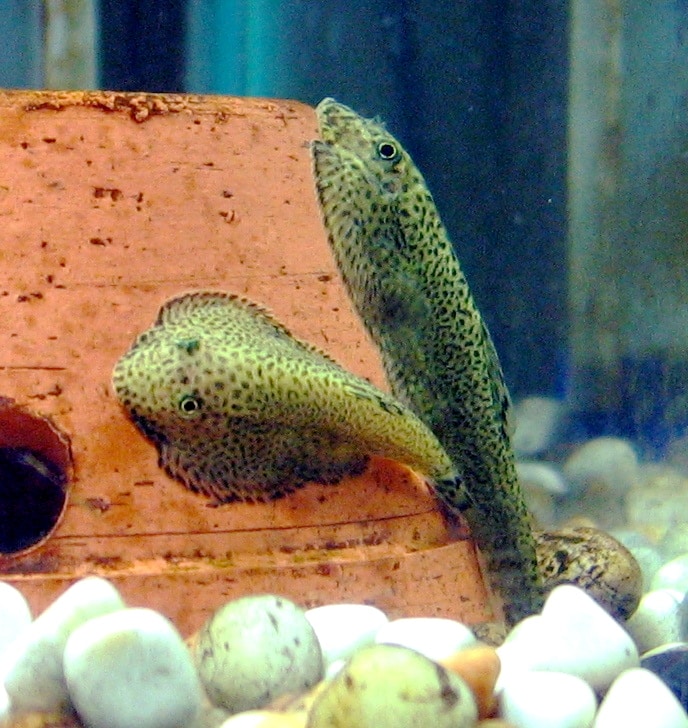
The Chinese hillstream loach has one of the most distinctive body shapes in the freshwater hobby. Viewed from above, it looks almost like a small stingray or butterfly, with a broadly flattened body and pectoral and pelvic fins that spread out horizontally to form a wide, disc-like shape. This isn’t just for show. Those fused fins create a suction cup effect that allows the fish to anchor itself to rocks in powerful currents that would sweep other fish downstream.
The body coloration is typically olive-brown to yellowish-brown with darker spots and mottling across the dorsal surface, mimicking algae-covered rocks. The underside is pale cream or white, and the tail fin is slightly forked with the same spotted patterning. They also have a specialized downward-facing mouth that forms a sucker disc, working with their flattened body to grip surfaces. You’ll often see them plastered to the glass or anchored to a rock, methodically scraping away at biofilm. Overall, they’re subtle rather than flashy. The appeal is in the body shape and behavior, not vivid colors.
Male vs. Female
| Feature | Male | Female |
|---|---|---|
| Body Shape | Slimmer, more streamlined | Broader and heavier-bodied |
| Head/Snout | Squarer, more angular snout | More rounded snout |
| Size | Slightly smaller | Slightly larger when mature |
| Behavior | More territorial and bolder | Less aggressive, more reclusive |
| Coloration | May show slightly more vivid markings | Subdued, especially when gravid |
Sexing Chinese hillstream loaches is genuinely difficult, especially in juveniles. The differences listed above become more apparent in mature adults, but even then, it takes a trained eye to reliably tell them apart. The most consistent indicator is body shape when viewed from above. Females carrying eggs will appear noticeably wider through the midsection.
Average Size & Lifespan
Chinese hillstream loaches reach a maximum size of about 3 inches (7 to 8 cm) in total length, though most specimens in the aquarium trade stay closer to 2.5 inches (6 cm). They grow slowly, so don’t expect a recently purchased juvenile to reach full size anytime soon.
With proper care, these loaches can live 3 to 6 years in captivity. The biggest factors affecting lifespan are water temperature and oxygen levels. Fish kept in water that’s too warm or without adequate flow will have significantly shorter lifespans. Those kept in optimized setups with cool, well-oxygenated water and a consistent food supply will reach the upper end of that range.
Care Guide
Tank Size
A 20-gallon (76-liter) tank is the minimum for a small group of Chinese hillstream loaches. That said, a longer tank is far more useful than a tall one. These fish live their entire lives on horizontal surfaces, so what matters most is floor space and surface area for grazing. A standard 20-gallon long (30 x 12 inches / 76 x 30 cm footprint) works well as a starting point for a group of 4 to 6.
If you plan to keep a larger group or want to house them with other species, step up to a 30 or 40-gallon (114 to 151-liter) tank. More surface area means more grazing territory, which reduces territorial disputes between males. It also gives you more room to create varied flow zones, which becomes important when setting up the filtration.
Water Parameters
| Parameter | Ideal Range |
|---|---|
| Temperature | 61 to 75°F (16 to 24°C) |
| pH | 6.5 to 7.5 |
| General Hardness (GH) | 2 to 15 dGH |
| KH | 2 to 10 dKH |
| Ammonia | 0 ppm |
| Nitrite | 0 ppm |
| Nitrate | Below 20 ppm |
Temperature is the single most critical parameter for this species. The Chinese hillstream loach is a cool water fish, not a tropical one. Keeping them above 75°F (24°C) for extended periods stresses the fish and reduces dissolved oxygen levels, both of which lead to health problems and shortened lifespans. In warmer climates, you need to use a fan or chiller to keep the tank cool during summer months.
Water quality needs to be pristine. These fish come from clean mountain streams, and they have zero tolerance for ammonia, nitrite, or elevated nitrate. Weekly water changes of 25 to 30% are the minimum. Many successful keepers go higher. The tank should be fully cycled and mature before adding hillstream loaches, as they also need established biofilm to graze on.
Filtration & Water Flow
This is where keeping Chinese hillstream loaches gets unique. Standard filtration isn’t enough. You need serious water movement. The general recommendation is a filter turnover rate of 10 to 15 times the tank volume per hour. For a 20-gallon tank, that means a filter or pump combination rated at 200 to 300 gallons per hour.
A canister filter paired with an additional powerhead or wavemaker is a common approach. The goal is strong, unidirectional flow across flat rock surfaces. Additional airstones can help boost dissolved oxygen levels, which is just as important as the flow itself. That said, create some calmer zones using strategic rock placement so the loaches can rest and food won’t immediately get swept away.
Lighting
Moderate to strong lighting is actually beneficial for Chinese hillstream loaches. Not for the fish directly, but because it encourages algae and biofilm growth on rock surfaces. This natural grazing material is a crucial part of their diet. A standard LED fixture on a 10 to 12 hour photoperiod works well. If your tank isn’t growing much biofilm, you can extend the light cycle slightly or use a warmer-spectrum light to promote growth.
Plants & Decorations
In their natural habitat, aquatic plants are scarce due to the extreme current. However, several hardy plant species can work in a hillstream loach setup. Anubias attached to rocks, java fern, and various mosses like java moss or Christmas moss are excellent choices. These plants tolerate high flow, attach to hardscape rather than needing substrate, and their surfaces provide additional grazing area for the loaches.
Rocks are the most important decoration. Smooth river stones, flat slate pieces, and cobbles should make up the majority of the hardscape. Stack them to create crevices and overhangs where the loaches can shelter. Driftwood is fine to include but shouldn’t dominate the layout. These fish need open, current-swept rock surfaces more than anything else.
Substrate
Fine gravel or sand works well as a base substrate, but the focus should really be on the rocks above it. Chinese hillstream loaches spend the vast majority of their time attached to vertical and horizontal hard surfaces, not on the substrate itself. A thin layer of fine gravel or sand beneath your rock arrangements is all you need.
Avoid sharp or jagged substrates that could injure the loach’s delicate ventral surface. If you go with sand, choose a neutral-colored variety that won’t compact too tightly and restrict flow through the substrate bed.
Is the Chinese Hillstream Loach Right for You?
Before you buy, run through this honest checklist. The Chinese Hillstream Loach is a great fish for the right keeper, but it is not for everyone.
- You can maintain temperatures of 65-75°F. This is not a standard tropical fish
- Your tank has strong water flow from a powerhead or high-output filter
- You have smooth rocks and surfaces where biofilm can establish
- You want a fascinating fish that clings to glass and rocks like a suction cup
- You are willing to set up a tank around this species rather than adding it as an afterthought
- You enjoy watching natural grazing behavior that looks unlike any other freshwater fish
Tank Mates
Choosing tank mates for the Chinese hillstream loach comes down to one unavoidable requirement: temperature compatibility. Since these loaches need cool water between 61 and 75°F (16 to 24°C), you’re immediately ruling out most tropical species that prefer 76 to 82°F. The sweet spot for a hillstream loach community tank is around 68 to 72°F (20 to 22°C), which opens up a decent selection of compatible species.
Best Tank Mates
- White Cloud Mountain minnows. One of the best matches, thriving in the same cool, well-oxygenated conditions
- Zebra danios. Active, hardy, and comfortable in cooler water with strong flow
- Gold ring danios. Another subtropical danio that pairs well with hillstream setups
- Rosy barbs. Tolerant of cooler temperatures and active enough to handle the current
- Dojo loaches (weather loaches). Peaceful bottom dwellers that prefer similar cool water conditions
- Stiphodon gobies. Share similar habitat requirements with high flow and algae grazing
- Rhinogobius species. Small stream-dwelling gobies that occupy similar ecological niches
- Garra species. Another group of algae-grazing fish from fast-flowing Asian streams
- Amano shrimp. Tough enough to handle the current and won’t bother the loaches
- Nerite snails. Great algae cleanup crew that thrives in the same well-oxygenated water
Tank Mates to Avoid
- Tropical fish requiring 78°F+. Discus, angelfish, rams, cardinal tetras, and most South American species won’t tolerate the cool water these loaches need
- Large or aggressive cichlids. These will harass or eat hillstream loaches
- Slow-moving fish with long fins. Bettas and fancy goldfish can’t handle the high flow and may get stressed
- Plecos (most species). Aside from temperature incompatibility, larger plecos can be territorial over grazing surfaces
- Large catfish. Anything big enough to swallow a 3-inch loach is a risk
Food & Diet
In the wild, Chinese hillstream loaches are primarily grazers. They spend their days methodically scraping biofilm, diatoms, green algae, and microorganisms off rock surfaces. This constant grazing behavior is essential to understand. You’re not dealing with a fish that eats a meal and walks away. These loaches are built to eat small amounts continuously throughout the day.
In the aquarium, a mature tank with algae-covered rocks is the single best food source. Strong lighting and the right conditions will naturally produce the biofilm these loaches crave. But natural algae growth alone usually isn’t enough to sustain a group, especially in a clean, well-maintained tank. Supplement with:
- Algae wafers. The staple supplemental food for most keepers
- Blanched vegetables. Zucchini, cucumber, and spinach are all accepted
- Sinking pellets. High-quality herbivore or bottom-feeder formulas
- Spirulina-based foods. Tablets or wafers with a high plant-matter content
- Frozen or live foods (occasionally). Bloodworms, daphnia, and brine shrimp provide protein variety
Feed once or twice daily in amounts the fish can consume within a few hours. Drop algae wafers near their preferred grazing spots in the evening, as they are more active during lower-light periods. If you notice your loaches looking thin or lethargic, the first thing to evaluate is whether they’re getting enough to eat. Insufficient food is one of the most common problems keepers run into with this species.
Breeding & Reproduction
Breeding Difficulty
Breeding the Chinese hillstream loach in captivity is extremely difficult, and there are virtually no confirmed, well-documented cases of successful aquarium spawning. Most specimens in the trade are wild-caught. This is one of those species where even experienced breeders are still figuring out the triggers, and the odds of accidental breeding in a home aquarium are close to zero.
Spawning Tank Setup
If you want to attempt breeding, the setup should closely replicate natural conditions: a mature tank with very strong flow, an abundance of smooth rocks and cobbles, and excellent water quality. A dedicated breeding tank of at least 20 gallons (76 liters) with a long, shallow footprint is ideal. The tank should be well-established with plenty of biofilm on surfaces, as this provides food for both adults and any potential fry.
Water Conditions for Breeding
Based on what little information exists, seasonal changes are likely a key trigger. In the wild, breeding probably coincides with the rainy season when water temperatures drop and flow increases. Gradually lowering the temperature to 61 to 64°F (16 to 18°C) and simultaneously increasing the flow rate may help simulate these natural cues. Large water changes with slightly cooler water can also be tried as a trigger.
Conditioning & Spawning
Condition adults with a varied, high-quality diet including plenty of protein-rich foods alongside their normal algae-based fare. Bloodworms, daphnia, and high-protein sinking pellets can help bring females into breeding condition. Gravid females will appear noticeably wider when viewed from above.
The actual spawning behavior in Beaufortia species is poorly documented. Based on observations of related hillstream loach genera, eggs are likely deposited on the undersides of flat rocks or in crevices where they’re protected from the current. Males may guard the eggs, though this is speculative for this particular species.
Egg & Fry Care
Because so few aquarium spawnings have been documented, specific information on egg incubation time and fry development is limited. In related species, eggs typically hatch within several days at cooler temperatures. Fry would be extremely small and likely require microscopic foods such as infusoria or biofilm before transitioning to powdered algae-based foods. Maintaining pristine water quality and gentle flow would be critical during the early stages, while still providing enough oxygenation for the developing fry.
Common Health Issues
Oxygen Deprivation
This is the number one killer of Chinese hillstream loaches in captivity. These fish have a higher oxygen requirement than most freshwater species, and they come from environments where dissolved oxygen levels are consistently high. In a poorly oxygenated tank, you’ll see the loaches become lethargic, lose color, and begin gasping or resting near the surface. Inadequate flow, warm water temperatures, and overstocking all reduce available oxygen. The fix is straightforward. Increase flow, add airstones, lower the water temperature, and reduce the bioload.
Starvation
Chinese hillstream loaches are constant grazers, and they slowly waste away if they don’t have enough to eat. This is especially common in newer tanks that haven’t developed sufficient biofilm, or in setups where the loaches are outcompeted for food by faster tank mates. Symptoms include a sunken belly and increasingly thin, gaunt appearance. Ensure the tank is mature with established algae growth, supplement regularly with algae wafers, and make sure food is reaching the bottom where these loaches feed.
Ich (White Spot Disease)
Like all freshwater fish, Chinese hillstream loaches are susceptible to ich, particularly when stressed by poor water quality or temperature fluctuations. The white salt-grain-sized spots are easy to identify. Treatment is complicated by the fact that many ich medications can be harsh on scaleless or thin-skinned fish. Use half-dose treatments and slowly raise the temperature to the upper end of their range. Around 75°F (24°C). To speed up the parasite’s life cycle. Increased salt concentration (1 tablespoon per 5 gallons) is sometimes used, but this species doesn’t tolerate salt well, so proceed with caution.
Bacterial Infections
Redness on the ventral surface, fin erosion, or cloudy patches on the skin can indicate bacterial infections. These typically result from poor water quality. High nitrates, insufficient water changes, or inadequate filtration. Improving water conditions is the first line of defense. In more severe cases, a broad-spectrum antibacterial treatment may be necessary. Always quarantine new additions to prevent introducing pathogens to an established tank.
Common Mistakes to Avoid
- Keeping them in tropical temperatures. This is the most common and most damaging mistake. Water above 78°F (26°C) is a death sentence for hillstream loaches. They need cool water, period.
- Insufficient water flow. A standard hang-on-back filter doesn’t cut it. You need powerheads, strong canister filters, or purpose-built river-tank setups to provide the flow these fish require.
- Adding them to new tanks. A newly cycled tank with bare, clean surfaces means there’s nothing for the loaches to eat. Wait until the tank is mature and biofilm has established on rock surfaces before adding them.
- Not covering the tank. These loaches can and will climb above the waterline and out of the tank. A tight-fitting lid is essential.
- Keeping them alone. While they can be semi-territorial, they do better in groups of 6 or more where aggression is spread out and natural behaviors are more visible.
- Relying solely on tank algae for food. Even in a well-established tank, natural algae growth usually isn’t sufficient. Supplement with algae wafers and blanched vegetables regularly.
- Choosing incompatible tank mates. Pairing them with tropical species that need 78°F+ means someone’s going to be in the wrong temperature range. Plan the community around the loach’s needs, not the other way around.
Where to Buy
Chinese hillstream loaches are moderately available in the aquarium trade, though they can be harder to find than more common loach species. Most specimens are wild-caught, so availability can be seasonal. Here are two reputable online sources:
- Flip Aquatics. A well-regarded online retailer with a strong reputation for healthy, well-acclimated fish. Check their stock regularly, as specialty species like hillstream loaches sell out quickly.
- Dan’s Fish. Another excellent source for freshwater fish, known for quality livestock and careful shipping practices. They frequently carry loach species that are harder to find at local stores.
When purchasing online or in-store, look for active individuals that are firmly attached to surfaces. Avoid any fish that appear thin, lethargic, or have discolored patches on their body. Since most are wild-caught, quarantining new arrivals for at least two weeks is strongly recommended before introducing them to your main tank.
Frequently Asked Questions
Are Chinese hillstream loaches the same as regular hillstream loaches?
Not exactly. “Hillstream loach” is a broad term that covers dozens of species across several genera in the family Gastromyzontidae. The Chinese hillstream loach specifically refers to Beaufortia kweichowensis. Other commonly sold hillstream loaches include Sewellia lineolata (the reticulated hillstream loach) and Gastromyzon species. They share similar care requirements, but they are different fish from different parts of Asia.
Can I keep a Chinese hillstream loach in a tropical community tank?
Not if the tank stays above 75°F (24°C). These are cool water fish that need temperatures between 61 and 75°F (16 to 24°C). Keeping them in warm tropical conditions reduces dissolved oxygen, increases stress, and shortens their lifespan significantly. They need to be housed with species that share their preference for cooler water.
Do Chinese hillstream loaches eat algae?
Yes, they are natural algae grazers and spend most of their time scraping biofilm and algae off hard surfaces. However, they shouldn’t be thought of as an “algae cleanup crew” for your tank. They eat what they need for nutrition, not to keep your glass spotless. They’re fish with dietary needs, not cleaning tools.
How many Chinese hillstream loaches should I keep together?
A group of 6 or more is ideal. While males can be territorial and compete for prime grazing spots, keeping a larger group spreads out this aggression so no single individual gets bullied. A solo loach will survive, but you’ll miss out on their natural social interactions. Make sure the tank has enough surface area to support the group. Roughly 3 to 4 gallons of tank space per loach as a minimum.
Why does my Chinese hillstream loach keep climbing out of the water?
This is a known behavior in hillstream loaches. In the wild, they sometimes move between pools by climbing over wet rocks. In the aquarium, they may climb above the waterline or even out of the tank entirely if given the chance. This is why a secure, tight-fitting lid is absolutely essential. If you notice frequent attempts to leave the water, it could also be a sign that something is wrong with the water quality. Test your parameters and make sure oxygen levels are adequate.
Can Chinese hillstream loaches live with shrimp?
Yes, they’re generally safe with most freshwater shrimp. Amano shrimp are particularly good companions since they’re large enough not to be bothered and enjoy similar water conditions. Smaller shrimp like cherry shrimp can also work, though very tiny shrimplets will be eaten. The cool water requirement is the main limiting factor. Most Neocaridina and Caridina shrimp species are fine in the 65 to 72°F (18 to 22°C) range that suits these loaches.
How the Chinese Hillstream Loach Compares to Similar Species
Chinese Hillstream Loach vs. Panda Loach
The Panda Loach is rarer, more expensive, and more demanding, but has showpiece-level coloring. The Chinese Hillstream Loach is the practical entry point into hillstream keeping. More available, more affordable, and slightly more forgiving. If you have never kept hillstream fish, start here.
Chinese Hillstream Loach vs. Reticulated Hillstream Loach
Both are hillstream loaches with similar care needs. The Reticulated Hillstream Loach has more intricate patterning, while the Chinese Hillstream Loach is more widely available and typically less expensive. Care requirements are nearly identical, so your choice comes down to aesthetics and budget.
What It Is Actually Like Living With Chinese Hillstream Loach
Chinese hillstream loaches are grazing machines. They move across rock surfaces methodically, rasping biofilm with their specialized mouthparts. The clean trails they leave on algae-covered surfaces are visible proof that the fish is feeding properly.
They suction to glass. Watching a hillstream loach climb the front glass against strong current is mesmerizing. The suction-cup body design allows them to hold position on smooth surfaces that other fish would slide off immediately.
Temperature monitoring becomes a daily habit with this species. Summer heat waves are the biggest threat. A tank that creeps above 78F needs immediate intervention. Fans, chillers, or floating frozen water bottles in an emergency. Hillstream keepers learn to think about temperature in a way that tropical fishkeepers do not.
Closing Thoughts
The Chinese hillstream loach is one of the most unique freshwater fish you can keep. But only if you’re willing to build a setup around its needs. This isn’t a fish that adapts to your tank. You adapt the tank to the fish. Cool water, powerful flow, high oxygen, and established biofilm are the non-negotiables, and cutting corners on any of them leads to a short-lived, stressed-out loach.
If you’re the kind of fishkeeper who enjoys a challenge and the idea of a dedicated river-style biotope sounds exciting rather than intimidating, this species is absolutely worth the effort. Watching a group of hillstream loaches navigate a current-swept rockscape, suctioning from surface to surface and methodically grazing, is unlike anything else in the hobby. Just do the homework, set up the tank right, and these fascinating little fish will reward you with years of enjoyment.
Recommended Video
Check out our video on hillstream loach care and what makes these incredible fish so unique in the freshwater hobby:
References
- Seriously Fish. Beaufortia kweichowensis species profile. seriouslyfish.com
- FishBase. Beaufortia kweichowensis (Fang, 1931). fishbase.org
- The Aquarium Wiki. Beaufortia kweichowensis. theaquariumwiki.com
- Fang, P.W. (1931). “A study on the loaches (Cobitidae) of Kwichow Province and its vicinity.” Sinensia, 1(12): 169. 184.
- About the Author
- Latest Posts

I’m Mark Valderrama, founder of Aquarium Store Depot and a fishkeeper with over 25 years of hands-on experience. I started in the hobby at age 11, worked at local fish stores, and have kept freshwater tanks, ponds, and reef tanks ever since. I’ve been featured in two best-selling aquarium books on Amazon and built this site to share practical, experience-based fish keeping knowledge.
Leave a Reply