
Last Updated: June 25, 2026
Thank you for visiting! By the way… any links on this page that lead to products on Amazon and other stores/partners are affiliate links Aquarium Store Depot earns a commission if you make a purchase.
Table of Contents
- What Care Guides Get Wrong
- The Reality of Keeping Pearl Cichlid
- Key Takeaways
- Species Overview
- Classification
- Origin & Natural Habitat
- Appearance & Identification
- Average Size & Lifespan
- Care Guide
- Is It Right for You?
- Tank Mates
- Food & Diet
- Breeding & Reproduction
- Common Health Issues
- Common Mistakes to Avoid
- Where to Buy
- Frequently Asked Questions
- What It Is Actually Like Living With Pearl Cichlid
- Species Comparison
- Closing Thoughts
- References
Pearl cichlids are one of the hardiest cichlids in the hobby and one of the few that thrive in cooler water. That hardiness makes people underestimate them. They still get big, still get territorial, and still need a proper tank. I have kept geophagus brasiliensis for years and the biggest mistake is treating them as a low maintenance fish you can ignore. They are tolerant of conditions that would kill other cichlids, but tolerant is not the same as thriving. The cichlid that prefers your room temperature to your heater.
The cichlid that prefers your room temperature to your heater.
What Most Care Guides Get Wrong About the Pearl Cichlid
The Pearl Cichlid (Geophagus brasiliensis) is one of the most underrated South American cichlids, and the biggest misconception is about its temperature needs. This is one of the few cichlids that genuinely thrives in cool water, handling temperatures down to 60F without issue. Most guides list it as a standard tropical species needing 76 to 82F, which is misleading. It actually does better in the 65 to 75F range. The other misconception is about aggression. People hear ‘cichlid’ and assume monster aggression. The Pearl Cichlid is moderately aggressive at best, and in the right setup with proper space, it is surprisingly manageable.
What sets this fish apart from many other eartheaters is its adaptability. While some Geophagus species demand warm, soft, acidic water and fall apart at the first sign of trouble, the pearl cichlid thrives across a surprisingly wide range of conditions. It’s found in everything from rivers to coastal lagoons in the wild, and that toughness translates directly to the home aquarium. If you’re looking for a substantial cichlid with personality and serious visual appeal, this is a species worth considering.
The Reality of Keeping Pearl Cichlid
Pearl cichlids are one of the hardiest cichlids you can keep, and one of the few that actually thrives in cooler water.
They handle cold water. Pearl cichlids tolerate temperatures down to 60F. That makes them one of the few cichlids suitable for unheated tanks and outdoor ponds in mild climates.
They get bigger than expected. Reaching 10 to 11 inches, pearl cichlids outgrow most setups that beginners plan for. A 75-gallon is the realistic minimum for adults.
Aggression increases with age. Juveniles are relatively peaceful. Adults become territorial and will bully smaller tank mates. Plan your stocking for the adult temperament, not the juvenile behavior.
They are substrate sifters. Pearl cichlids constantly rework the substrate. Fine sand is the best choice. Gravel gets moved around and can damage their gill rakers.
Biggest Mistake New Pearl Cichlid Owners Make
Keeping them in a tropical community tank at 78F with small fish. Pearl cichlids prefer cooler water and will eat anything they can fit in their mouth once they reach adult size.
Expert Take (Mark Valderrama, AquariumStoreDepot)
After 25+ years in the hobby and time managing fish stores, the pearl cichlid is the eartheater I’ve consistently recommended to people who want something substantial but aren’t ready for the precision water management that other Geophagus species demand. The temperature flexibility is real – no heater required in many homes, and outdoor pond potential in mild climates. The sand-sifting behavior is genuinely entertaining to watch long-term. And that breeding color change – from olive-brown to dark blue-purple in hours – is one of the more dramatic visual events in South American cichlid keeping. Give this fish the tank size it needs, the right temperature, and sand to work with, and you’ll have one of the most rewarding medium-large cichlids in the freshwater hobby.
ASD Difficulty Rating
Easy to Moderate | 3/10
The pearl cichlid is one of the most beginner-accessible medium-large cichlids in the hobby. It tolerates a wide range of water conditions, eats almost anything, and does not require tropical temperatures. The barriers are tank size (75 gallons minimum for a pair), substrate (fine sand only – no gravel), and the understanding that this fish grows to 10 inches and lives 10 to 15 years. Get those three things right and the pearl cichlid handles almost everything else.
Key Takeaways
- Hardy and beginner-friendly. One of the most adaptable South American cichlids, tolerating a wide range of water conditions
- Stunning iridescent scales give this fish its common name, with colors shifting from green to blue to gold depending on the light
- Gets to a decent size. Males can reach 10 inches (25 cm), so plan for at least a 75-gallon tank for a pair
- Excellent parents. Both parents guard eggs and fry, making breeding straightforward and rewarding to observe
- Semi-aggressive when breeding. Peaceful enough most of the time, but a spawning pair will defend their territory aggressively
Species Overview
| Field | Details |
|---|---|
| Scientific Name | Geophagus brasiliensis |
| Common Names | Pearl Cichlid, Pearl Eartheater, Brazilian Eartheater, Mother of Pearl Eartheater |
| Family | Cichlidae |
| Origin | Southeastern Brazil, Uruguay, northeastern Argentina, Paraguay |
| Care Level | Easy |
| Temperament | Semi-aggressive (territorial when breeding) |
| Diet | Omnivore |
| Tank Level | Bottom to Middle |
| Maximum Size | 10 inches (25 cm) males; 6 inches (15 cm) females |
| Minimum Tank Size | 75 gallons (284 liters) |
| Temperature | 68 to 77°F (20 to 25°C) |
| pH | 6.5 to 7.5 |
| Hardness | 5 to 15 dGH |
| Lifespan | 10 to 15 years |
| Breeding | Substrate spawner (biparental) |
| Breeding Difficulty | Easy |
| Compatibility | Community with similar-sized fish |
| OK for Planted Tanks? | With caution (will dig and may uproot plants) |
Classification
| Taxonomic Level | Classification |
|---|---|
| Order | Cichliformes |
| Family | Cichlidae |
| Subfamily | Geophaginae |
| Genus | Geophagus |
| Species | G. Brasiliensis (Quoy & Gaimard, 1824) |
The pearl cichlid was originally described as Chromis brasiliensis by Quoy and Gaimard in 1824, based on specimens from Rio de Janeiro Bay in Brazil. It was later moved to the genus Geophagus, which means “earth eater” in Greek, referring to the characteristic sand-sifting feeding behavior of the group. Recent molecular studies suggest that G. Brasiliensis is actually part of a species complex, with several genetically distinct populations across its wide range that may eventually be described as separate species.
Origin & Natural Habitat
The pearl cichlid has one of the broadest distributions of any South American cichlid. It ranges from coastal river basins in Bahia state in northeastern Brazil all the way south through southeastern Brazil to Uruguay and northeastern Argentina. Some populations also extend into the Paraguay River basin. This is a fish that naturally occurs across a wide variety of climates, which explains its remarkable adaptability in captivity.
In the wild, pearl cichlids inhabit slow-moving rivers, streams, lakes, and even coastal lagoons with slightly brackish conditions. They’re found over sandy or muddy substrates where they can engage in their characteristic earth-eating behavior, picking up mouthfuls of sediment, sifting out edible material like invertebrates and detritus, and expelling the rest through their gills. Unlike many tropical cichlids, the pearl cichlid experiences seasonal temperature variation in parts of its range, with water temperatures occasionally dropping below 65°F (18°C) during cooler months.
The habitats where pearl cichlids are found often have moderate vegetation, rocky areas, and submerged wood. These structures provide territorial boundaries and spawning sites that are critical to the fish’s natural behavior.
Appearance & Identification
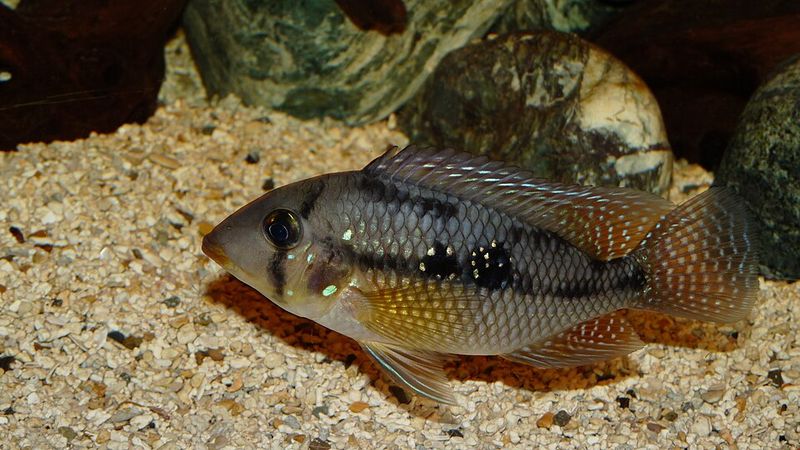
The pearl cichlid lives up to its name. Each scale on the body has an iridescent, pearlescent spot that catches the light and creates a shimmering effect across the entire fish. The base color ranges from olive-green to golden-brown, with the iridescent spots creating patterns of blue, green, and gold depending on the lighting angle. A prominent dark spot sits on the mid-body, and a second may appear at the base of the caudal fin.
One of the most fascinating aspects of this species is its ability to dramatically change coloration. During breeding, the body can shift from its typical light olive-brown to an intense dark blue or near-purple, with the iridescent spots becoming even more vivid against the darker background. Outside of breeding, the coloration is more subdued but still attractive. The fins often show red, blue, and green highlights, particularly in mature males.
Male vs. Female
Sexing pearl cichlids becomes easier as they mature. Males grow significantly larger and develop more pronounced features.
| Feature | Male | Female |
|---|---|---|
| Body Size | Up to 10 inches (25 cm) | Up to 6 inches (15 cm) |
| Nuchal Hump | Develops a noticeable forehead hump with maturity | No hump or minimal development |
| Fin Extensions | Longer, more pointed dorsal and anal fins | Shorter, more rounded fins |
| Coloration | More vivid iridescence, stronger fin coloration | Slightly more subdued, but still iridescent |
| Body Shape | Deeper bodied, more robust overall | Smaller, more streamlined |
Average Size & Lifespan
Males can reach up to 10 inches (25 cm) in length, though 7-8 inches (18-20 cm) is more common in home aquariums. Females stay considerably smaller, maxing out around 6 inches (15 cm). Growth is steady during the first year or two and slows as they reach maturity. This isn’t a fish you’ll outgrow quickly, though. Pearl cichlids grow at a moderate pace compared to some of the faster-growing Central American cichlids.
With proper care, pearl cichlids can live 10-15 years in captivity. That’s a serious commitment and one of the advantages of keeping this species. You get a long-lived companion that develops more personality and better coloration as it matures. Longevity depends heavily on water quality, diet, and stress levels. Fish kept in overcrowded or poorly maintained tanks will have significantly shorter lifespans.
Care Guide
Tank Size
A single pearl cichlid is housed in a 40-gallon (151-liter) tank, but for a pair, you’ll want at least 75 gallons (284 liters). If you’re planning a community setup with other medium-sized cichlids, 125 gallons (473 liters) or larger is the way to go. These fish are active swimmers that need horizontal space, so a standard rectangular tank is preferable to a tall, narrow design.
Pearl cichlids are substrate sifters and diggers. They’ll rearrange your tank regularly, pushing sand around and excavating areas near rocks and driftwood. The larger the tank, the less disruptive this behavior feels and the more territory is available to minimize aggression.
Water Parameters
| Parameter | Recommended Range |
|---|---|
| Temperature | 68 to 77°F (20 to 25°C) |
| pH | 6.5 to 7.5 |
| General Hardness | 5 to 15 dGH |
| Ammonia | 0 ppm |
| Nitrite | 0 ppm |
| Nitrate | Below 20 ppm |
One of the pearl cichlid’s biggest selling points is its temperature tolerance. Unlike most South American cichlids that need water in the upper 70s to low 80s, this species actually prefers cooler conditions, thriving in the 68-77°F (20-25°C) range. In parts of its natural range, it experiences seasonal temperatures well below what most tropical fish can handle. This makes it an excellent choice for unheated tanks in moderate climates or for fishkeepers who prefer not to run a heater year-round.
Water chemistry is similarly flexible. While slightly acidic to neutral pH is ideal, pearl cichlids tolerate a broader range than most eartheaters. Moderate hardness is fine, and they’ve even been documented in slightly brackish conditions in the wild. Just keep the water clean and consistent, and this fish will reward you.
Hard Rule: Pearl cichlids are not hot-water fish. No exceptions.
Do not run this species above 78°F (26°C) long-term. If you’re used to running your tank at 80°F for discus or other South American cichlids, the pearl cichlid needs a different setup or a different tank. Sustained high temperatures stress this species chronically, and the decline is gradual enough that many keepers never realize the temperature is the cause.
Filtration & Water Flow
Strong, efficient filtration is essential for pearl cichlids. These are messy fish. Between their constant sand-sifting and their solid appetite, they produce more waste than a similarly-sized non-cichlid. A canister filter rated for at least 1.5 times your tank volume is a good starting point. If you’re running a large community tank, consider doubling up on filtration.
Water flow should be gentle to moderate. Pearl cichlids come from slow-moving water in the wild and don’t appreciate being blasted by strong currents. Use spray bars or flow diffusers to spread the output across the tank rather than creating a single strong current. Weekly water changes of 25-30% keep nitrates in check and maintain the water quality these fish need to thrive.
Lighting
Moderate lighting works best for pearl cichlids. They’re not particularly light-sensitive, but the iridescent scales look most impressive under moderate to slightly subdued lighting. Very bright overhead lights can wash out the colors. If you’re running a planted tank, standard plant-growth lighting is perfectly fine. Adding some floating plants to diffuse the light brings out the best in this species while also providing some cover.
Plants & Decorations
Here’s where pearl cichlids get tricky. They love to dig. Anything planted directly in the substrate is at risk of being uprooted during their constant excavation. Your best options are epiphytic plants like java fern, anubias, and bolbitis attached to rocks or driftwood. These are completely safe from the digging behavior. If you want rooted plants, place them in pots buried in the substrate, which provides some protection.
Large rocks, driftwood, and smooth stones create the territorial boundaries that pearl cichlids need. Flat stones are particularly important as they serve as preferred spawning sites. Create several distinct territories with visual barriers so that if you’re keeping a pair, both fish can find their own space when not spawning. Leave plenty of open sand area for natural sifting behavior.
Substrate
Fine sand is the only appropriate substrate for pearl cichlids. Their entire feeding strategy in the wild revolves around picking up mouthfuls of sand, filtering out edible particles, and expelling the rest through their gills. Gravel or coarse substrates can damage the delicate gill filaments and prevent natural feeding behavior. A medium-grain pool filter sand or aquarium sand in a neutral color works perfectly and allows you to watch one of the most entertaining feeding behaviors in the cichlid world.
Is the Pearl Cichlid Right for You?
Before you buy, here is the honest breakdown. The pearl cichlid is one of the most accessible medium-large cichlids in the hobby – but it still has requirements that eliminate it for some setups.
Good fit if:
- You have a 75-gallon minimum for a pair, with fine sand substrate for natural sifting behavior
- You want a cichlid that tolerates cooler water – no heater required in many homes, outdoor pond potential in mild climates
- You can pair it with robust, similarly-sized tank mates: blue acara, angelfish, silver dollars, large plecos
- You want a long-term fish – 10 to 15 years with proper care, with dramatic breeding color changes as a bonus
- You want a cichlid with genuine personality that responds to your presence at the glass
Think twice if:
- Your tank runs above 78°F – this is a hard limit for this species; sustained heat stress leads to gradual decline
- Your tank is under 55 gallons – a single adult male reaches 10 inches and needs meaningful horizontal space
- You have a planted aquascape with rooted plants – pearl cichlids are committed diggers and will rearrange the substrate indefinitely
- You keep small fish under 2 inches – anything that fits in the mouth eventually gets eaten, especially as adults
- You run gravel substrate – this is not negotiable; sand only, fine-grained, for gill health and natural feeding behavior
Tank Mates
Pearl cichlids are manageable in a community setting as long as you choose tank mates wisely. Outside of breeding, they’re peaceful toward fish of similar size. The trouble comes when a pair decides to spawn, at which point they becomes highly territorial and drive everything else in the tank into the opposite corner. A larger tank with plenty of visual barriers minimizes the impact of this behavior.
Best Tank Mates
- Blue acara (Andinoacara pulcher). Similar size and temperament, a classic pairing with eartheaters
- Angelfish. Occupy mid-water and won’t compete directly for bottom territory
- Silver dollars. Robust, fast-moving schooling fish that hold their own
- Larger tetras (Buenos Aires tetras, Congo tetras). Big enough to avoid predation and fast enough to escape territorial displays
- Bristlenose plecos. Bottom-dwelling but armored enough to coexist with moderate cichlid aggression
- Large corydoras (Brochis or Corydoras species). Can share the bottom as long as the tank is spacious
Tank Mates to Avoid
- Small fish. Anything small enough to fit in the pearl cichlid’s mouth will eventually end up there
- Aggressive Central American cichlids. Jack Dempseys, red devils, and similar species will bully pearl cichlids
- Multiple male pearl cichlids. Unless the tank is very large (150+ gallons), keeping more than one male leads to constant fighting
- Dwarf cichlids. Apistos and rams are too small and will be harassed or eaten
- Slow-moving, long-finned species. Fancy guppies, bettas, and similar delicate fish are poor choices
Food & Diet
Pearl cichlids are true omnivores with enthusiastic appetites. In the wild, they sift sand for invertebrates, insect larvae, plant material, and detritus. In captivity, they’ll eat just about anything you offer them. A high-quality cichlid pellet should form the foundation of the diet, supplemented with frozen or live foods for variety and nutrition.
Frozen bloodworms, brine shrimp, mysis shrimp, and chopped earthworms are all eagerly accepted. Vegetable matter is also important for long-term health. Blanched spinach, peas, zucchini slices, and spirulina-based foods round out a balanced diet. Feed 2-3 times daily in moderate amounts. Pearl cichlids will overeat if given the opportunity, so keep portions reasonable.
Avoid mammalian meats like beef heart or chicken. The fats in these foods are not suited to a fish’s digestive system and can cause organ damage over time. Stick to aquatic-based proteins and plant matter for the healthiest fish.
Breeding & Reproduction
Breeding Difficulty
Easy. Pearl cichlids are among the most straightforward South American cichlids to breed. They’re biparental substrate spawners, meaning both parents participate in egg and fry care. If you have a compatible pair and reasonable water conditions, spawning is almost inevitable.
Spawning Tank Setup
A dedicated breeding tank of 55-75 gallons works well for a pair. Keep the setup simple: sand substrate, a few flat rocks or smooth slate pieces as potential spawning sites, and some driftwood for territory markers. A sponge filter provides biological filtration without creating currents that could disturb eggs or fry. Dim lighting encourages natural spawning behavior.
Water Conditions for Breeding
Pearl cichlids aren’t fussy about breeding conditions. Slightly warmer water in the 75-77°F (24-25°C) range, neutral pH around 7.0, and moderate hardness should trigger spawning in a well-conditioned pair. A large water change with slightly cooler water will sometimes jumpstart the process. Clean water with low nitrates is the single most important factor.
Conditioning & Spawning
The best approach is to raise a group of 6-8 juveniles together and let them pair off naturally as they reach 3-4 inches (7-10 cm). Forced pairings can work but carry more risk of aggression. Condition the pair with high-protein foods for a couple of weeks before attempting to trigger spawning.
When ready, both fish clean a flat stone or smooth surface. The female deposits 150-200 eggs in neat rows, and the male fertilizes them. During this process, both fish undergo the dramatic color change the species is known for, shifting to dark blue or purple tones that make the iridescent spots stand out even more intensely.
Egg & Fry Care
Both parents guard the eggs and fan them to keep water flowing over the developing embryos. Eggs hatch in 3-4 days, and the fry become free-swimming 5-6 days later. The parents continue to guard the fry, herding them around the tank and aggressively defending them from any perceived threat. First foods for the fry include freshly hatched baby brine shrimp and finely crushed flake food. The parental care in pearl cichlids is impressive and one of the most enjoyable aspects of breeding this species.
Common Health Issues
Hole in the Head (HITH)
Like many eartheaters, pearl cichlids are susceptible to hole in the head disease, which presents as pitting and erosion around the head and lateral line. This is linked to poor water quality, high nitrate levels, and nutritional deficiency (particularly a lack of vitamin C and trace minerals). Prevention is straightforward: keep the water clean, feed a varied diet, and avoid overreliance on a single food source.
Ich (White Spot Disease)
Ich can strike any freshwater fish, and pearl cichlids are no exception. The characteristic white spots appear after stress events like temperature fluctuations, new tank introductions, or shipping. Treatment involves gradually raising the temperature to 82-84°F (28-29°C) and using a quality ich medication. Pearl cichlids tolerate standard ich treatments well due to their overall hardiness.
Bacterial Infections
Fin rot, body sores, and cloudy eyes can result from bacterial infections, triggered by stress or injuries from tank mate aggression. Good water quality is the best prevention. If infections develop, broad-spectrum antibiotics like kanamycin or erythromycin are effective treatments. Isolate affected fish in a hospital tank when possible.
Internal Parasites
White, stringy feces and gradual weight loss despite normal feeding are signs of internal parasites. This is more common in wild-caught specimens but can occur in tank-raised fish too. Metronidazole treats protozoan parasites effectively, while praziquantel targets intestinal worms. Quarantine all new fish for at least two weeks before adding them to an established tank.
Common Mistakes to Avoid
- Using gravel instead of sand. Pearl cichlids are sand sifters. Gravel prevents natural feeding behavior and can damage their gills. Always use fine sand
- Keeping the water too warm. Unlike most South American cichlids, pearl cichlids actually prefer cooler temperatures in the 68-77°F range. Running a heater at 80°F+ stresses them over time
- Underestimating their adult size. Juveniles at the fish store look manageable, but males approaching 10 inches need serious tank space. Plan for the adult size, not the purchase size
- Pairing with small fish. Pearl cichlids will eat anything they can fit in their mouth. Neon tetras, guppies, and other small species are snacks, not tank mates
- Ignoring digging behavior. These fish will rearrange your aquascape. Use epiphytic plants on hardscape rather than rooted plants in the substrate, or accept that your layout will change regularly
- Keeping multiple males in a small tank. One dominant male will constantly harass subordinates unless the tank is large enough (150+ gallons) to provide separate territories
Where to Buy
Pearl cichlids are reasonably common in the hobby, though they may not be a staple at every local fish store. Specialty cichlid shops and online retailers are your best bet for healthy, well-conditioned specimens. Flip Aquatics is worth checking for availability, and Dan’s Fish is another reliable source for quality freshwater fish with live arrival guarantees.
When selecting pearl cichlids, look for active fish with intact fins, clear eyes, and good iridescence on the scales. Avoid any fish with sunken bellies, clamped fins, or visible lesions. If buying a pair, try to get a male and female that have already been housed together, as pre-established pairs have a much smoother transition into a new tank.
Frequently Asked Questions
Are pearl cichlids good for beginners?
Yes, they’re one of the best medium-sized cichlids for beginners. Their hardiness, temperature tolerance, and willingness to eat a wide variety of foods make them very forgiving. The main requirement is providing a tank large enough for their adult size. If you can handle a 75-gallon setup, a pearl cichlid is an excellent first cichlid.
Can I keep a pearl cichlid in a 55-gallon tank?
A single pearl cichlid can work in a 55-gallon tank, but it’s tight for a pair, especially if they breed. Males can reach 10 inches, and a breeding pair needs enough space to establish a territory without stressing other fish. A 75-gallon is the recommended minimum for a pair, and larger is always better with this species.
Do pearl cichlids need a heater?
It depends on your room temperature. Pearl cichlids thrive in cooler water (68-77°F) than most tropical fish. If your home stays above 68°F year-round, you may not need a heater at all. In cooler climates or homes with significant temperature drops at night, a heater set to around 72-74°F provides stability without overheating.
Are pearl cichlids aggressive?
They’re semi-aggressive. Day to day, they’re fairly peaceful toward similar-sized fish. The aggression ramps up significantly during breeding, when the pair becomes highly territorial. Keeping them with robust tank mates and providing plenty of space and visual barriers keeps aggression manageable.
Can I keep pearl cichlids in a planted tank?
You can, but with limitations. Pearl cichlids are committed diggers that will uproot rooted plants. Stick to epiphytic species like java fern, anubias, and bolbitis attached to rocks and driftwood. Floating plants also work well and are completely safe from digging. If you want rooted plants, use pots to protect the root systems.
Why does my pearl cichlid change color?
Color change is completely normal for this species. Pearl cichlids can shift from light olive-brown to dark blue or purple, especially during breeding, territorial displays, or when stressed. The dramatic darkening during spawning is one of the most visually striking behaviors in the species. If color changes are accompanied by other symptoms like loss of appetite or lethargy, check your water parameters.
What It Is Actually Like Living With a Pearl Cichlid
This is the part the care sheets skip. Here is what actually happens when you keep this species long-term.
Your substrate will not stay the way you arranged it. Pearl cichlids rework the sand constantly. Areas near rocks and driftwood get excavated. Sand piles up in corners. This is not a malfunction – it is their entire feeding strategy. Accept it or don’t get this fish.
Breeding color change is one of the more dramatic events in freshwater fishkeeping. When a pair is ready to spawn, the fish can shift from olive-brown to dark blue-purple in a matter of hours. The iridescent spots become vivid against the dark background. You’ll notice something is different before you even check the tank. That’s your fish telling you they’re spawning.
The size difference between male and female is striking. A mature male at 9 to 10 inches next to a female at 5 to 6 inches – in the same tank, often bonded – is dramatic. People who bought two juveniles of similar size are often surprised when one fish doubles the other in length by adulthood.
Parental behavior is active and visible. When fry are present, both parents herd, guard, and move the school. The female fans the eggs. The male patrols the perimeter. Tank mates that wander too close get driven off decisively. Watching a pearl cichlid pair parent fry is one of the more engaging things you can observe in a freshwater aquarium.
How the Pearl Cichlid Compares to Similar Species
Pearl Cichlid vs. Green Terror
Both have dramatic iridescent coloring and a semi-aggressive temperament, but these are very different fish to live with. The Green Terror runs warm (76 to 82°F), grows more aggressive with age, and is harder to house in a community setting. The pearl cichlid runs cool, stays manageable in the right community setup, and is significantly more beginner-accessible. Choose the pearl cichlid if you want visual impact without committing to a single-species aggressive setup. Choose the Green Terror if you specifically want a dominant fish that defines the tank on its own terms.
Pearl Cichlid vs. Bolivian Ram
Both tolerate cooler water, which puts them in a similar niche for keepers who don’t want tropical temperatures. The Bolivian Ram stays small (3 to 4 inches), works in a 30-gallon community tank, and is peaceful enough for most setups. The pearl cichlid is a completely different scale commitment – 10-inch adults, 75-gallon minimum, moderate cichlid aggression during breeding. Choose the Bolivian Ram if you have a smaller tank or want a true community fish. Choose the pearl cichlid if you want a large, visually dominant centerpiece fish with the same cool-water advantage.
Closing Thoughts
Pearl cichlids survive almost anything. But surviving is not the same as thriving.
The pearl cichlid is one of the unsung heroes of the South American cichlid world. It doesn’t get the hype of discus or the cult following of apistos, but it delivers something those fish often can’t: reliability. This is a fish that looks incredible, displays fascinating parental behavior, tolerates a wide range of conditions, and can live well over a decade in your care.
Set up a 75-gallon or larger tank with a sand substrate, some smooth rocks and driftwood, and a few epiphytic plants. Add a pair of pearl cichlids and some robust mid-water companions. Keep the water clean, the diet varied, and the temperature on the cooler side. You’ll be watching one of the most rewarding South American cichlids in the hobby, and you’ll have years to enjoy it.
This article is part of our South American Cichlids: Complete A-Z Species Directory. Visit the hub page to explore care guides for all 32 South American cichlid species we cover.
References
- Seriously Fish. Geophagus brasiliensis species profile. seriouslyfish.com
- FishBase. Geophagus brasiliensis (Quoy & Gaimard, 1824). fishbase.se
- Practical Fishkeeping. Pearl Cichlid care guide. practicalfishkeeping.co.uk
- The Aquarium Wiki. Geophagus brasiliensis. theaquariumwiki.com
- About the Author
- Latest Posts

I’m Mark Valderrama, founder of Aquarium Store Depot and a fishkeeper with over 25 years of hands-on experience. I started in the hobby at age 11, worked at local fish stores, and have kept freshwater tanks, ponds, and reef tanks ever since. I’ve been featured in two best-selling aquarium books on Amazon and built this site to share practical, experience-based fish keeping knowledge.
Leave a Reply