
Last Updated: June 25, 2026
Thank you for visiting! By the way… any links on this page that lead to products on Amazon and other stores/partners are affiliate links Aquarium Store Depot earns a commission if you make a purchase.
Table of Contents
- What Care Guides Get Wrong
- The Reality of Keeping Arulius Barb
- Key Takeaways
- Species Overview
- Classification
- Origin & Natural Habitat
- Appearance & Identification
- Average Size & Lifespan
- Care Guide
- Is It Right for You?
- Tank Mates
- Food & Diet
- Breeding & Reproduction
- Common Health Issues
- Common Mistakes to Avoid
- Where to Buy
- Frequently Asked Questions
- Species Comparison
- Closing Thoughts
- Recommended Video
- References
The arulius barb develops dramatic dorsal fin extensions and bold blue-black markings that make it one of the most attractive barbs in the hobby. It reaches about 5 inches, needs a school, and thrives in a large planted tank with moderate flow. The problem is finding it. This species is rarely stocked in pet stores, and most hobbyists have never even seen one in person.
For keepers who manage to source a group, the arulius barb is a rewarding, active fish with genuine visual impact. This guide covers everything you need to know, because the arulius barb is one of the best-looking barbs in the hobby and one of the hardest to find. That is the only reason it is not everywhere.
If you can find arulius barbs for sale, buy them. You will not see them again for a while.
If your tank doesn’t have a tight lid and excellent water quality, you’ll never see what this barb is supposed to look like.
The Reality of Keeping Arulius Barb
The arulius barb develops extended dorsal rays similar to the filament barb, giving mature males a distinctive feathered appearance. At 4 to 5 inches, it needs a 40-gallon minimum.
It is a relatively uncommon species in the trade, making it a collector’s choice for keepers who want something different from the standard barb selection.
Males need competition to develop the extended dorsal features and peak coloration. A group with multiple males is essential.
Biggest Mistake New Owners Make
Buying a single specimen. The arulius barb’s best features, the extended dorsals and breeding color, only develop in groups with male competition. One arulius barb is an ordinary fish. A group of six with competing males is a display.
Arulius barbs (Dawkinsia arulius) are a large, colorful barb reaching 4 inches (10 cm). They are hardy and active, but their size means they need a minimum 55-gallon tank and bold, fast-moving tank mates.
Expert Take (Mark Valderrama, AquariumStoreDepot)
The arulius barb is the affordable alternative to the filament barb with similar fin extensions and less demanding space requirements. A group of six in a 40-gallon with moderate planting produces an elegant display that most hobbyists have never seen.
Key Takeaways
- Males develop stunning extended dorsal fin rays that trail behind the body, earning this fish the alternate name “Longfin Barb”
- Active, semi-aggressive schooling fish that should be kept in groups of at least 6 to spread out any chasing behavior
- Needs a 55-gallon (208-liter) tank minimum due to its size, speed, and swimming requirements. Length matters more than height
- Prefers cooler subtropical water between 66 and 77°F (19 and 25°C), making it a great candidate for unheated or mildly heated tanks
- Often confused with Dawkinsia arulius, a closely related species. True D. Tambraparniei is endemic to the Tamiraparani River basin in southern India
- Moderate care level. Not a beginner fish, but manageable for anyone with some experience maintaining stable water quality
Species Overview
| Field | Details |
|---|---|
| Scientific Name | Dawkinsia tambraparniei (Silas, 1954) |
| Common Names | Arulius Barb, Longfin Barb, Tamiraparani Barb |
| Family | Cyprinidae |
| Origin | India (Southern Western Ghats, Tamil Nadu. Tamiraparani River system) |
| Care Level | Moderate |
| Temperament | Semi-aggressive |
| Diet | Omnivore |
| Tank Level | Middle |
| Maximum Size | 4 inches (10 cm) |
| Minimum Tank Size | 55 gallons (208 liters) |
| Temperature | 66 to 77°F (19 to 25°C) |
| pH | 6.0 to 7.5 |
| Hardness | 5 to 15 dGH |
| Lifespan | 5 to 8 years |
| Breeding | Egg scatterer |
| Breeding Difficulty | Moderate |
| Compatibility | Community (with similarly sized, active fish) |
| OK for Planted Tanks? | Yes (may nibble soft plants) |
Classification
| Taxonomic Level | Classification |
|---|---|
| Order | Cypriniformes |
| Family | Cyprinidae |
| Subfamily | Barbinae |
| Genus | Dawkinsia |
| Species | D. Tambraparniei (Silas, 1954) |
The Arulius Barb was originally described by E.G. Silas in 1954 as Barbus tambraparniei, named after the Tamiraparani River. For decades, it was lumped under the catch-all genus Puntius as Puntius arulius. In 2012, the genus Dawkinsia was established for large-bodied South Indian barbs, and this species was moved accordingly. Here’s the important part: what was traditionally sold as the “Arulius Barb” in the hobby was often Dawkinsia arulius (from the Cauvery basin) rather than the true Dawkinsia tambraparniei (from the Tamiraparani basin). The two look very similar but come from different river systems, so if you see this fish in a store, it may be listed under any combination of old and new names.
Origin & Natural Habitat
Dawkinsia tambraparniei is endemic to the Tamiraparani River system in the southern Western Ghats of Tamil Nadu, India. The Western Ghats are one of the world’s biodiversity hotspots, and the rivers that flow from these mountains support an incredible array of endemic freshwater fish found nowhere else on Earth.
In its natural habitat, the Arulius Barb lives in clear, moderately flowing hill streams and river pools with rocky and sandy substrates. Overhanging vegetation provides shade, and leaf litter contributes to slightly acidic, relatively soft water. The riverbeds feature a mix of boulders, cobbles, gravel, and sand, with patches of marginal vegetation along the banks.
Water temperatures in these hill streams vary seasonally, which explains why Arulius Barbs are comfortable across a wider temperature range than many strictly tropical fish. The current ranges from moderate to strong, especially during the monsoon, so these are fish accustomed to flowing water rather than still conditions.
Appearance & Identification
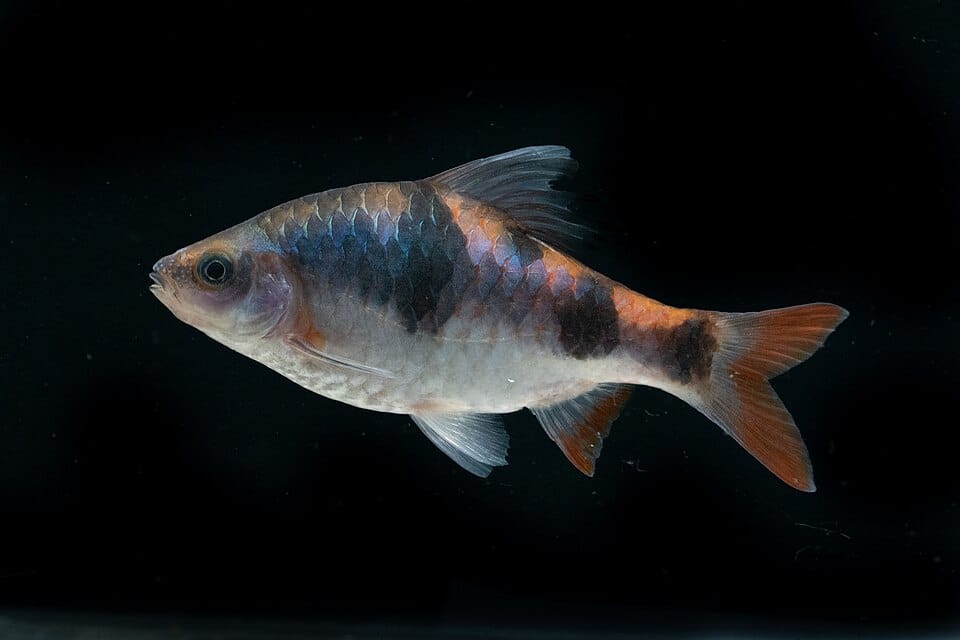
The Arulius Barb has a streamlined, laterally compressed body built for active swimming. The base color is silver to golden-olive, overlaid with bold dark horizontal striping along the flanks. These bars give the fish a striking, high-contrast appearance, especially under good lighting against a darker substrate.
The fins are clear to yellowish, and mature specimens often develop a reddish or orange tint on the caudal and anal fins. But the real show-stopper is the dorsal fin on mature males. As they reach full size, the dorsal fin rays extend well beyond the fin membrane, creating long, filamentous trailing extensions that flutter as the fish swims. This is where the common name “Longfin Barb” comes from, and it’s genuinely impressive when you see a dominant male displaying at full extension. Overall, these aren’t dainty fish. A school of adults in a well-maintained tank has real visual impact.
Male vs. Female
Sexing Arulius Barbs becomes easier as the fish mature, thanks to some clear differences between males and females:
- Dorsal fin: Males develop the signature extended dorsal fin rays that trail behind the body. Females retain a standard-length dorsal fin without the filamentous extensions.
- Body shape: Females are deeper-bodied and rounder, especially when carrying eggs. Males are more streamlined and slightly slimmer.
- Coloration: Males typically show more intense colors overall, with bolder striping and more pronounced reddish tints on the fins, particularly when in breeding condition.
- Size: Males and females reach roughly the same total length, but females appear bulkier due to their fuller body shape.
In juvenile fish, these differences are much harder to spot. The dorsal fin extensions usually don’t begin developing until the fish are approaching 2.5 to 3 inches (6 to 8 cm) in length.
Average Size & Lifespan
Arulius Barbs reach about 4 inches (10 cm) in aquarium conditions. They’re medium-sized barbs. Big enough to hold their own in a community tank but not so large they require a monster setup. With proper care, they live 5 to 8 years. Consistent water quality, a varied diet, appropriate tank size, and a proper school are the keys to hitting the upper end of that range.
Care Guide
Tank Size
A 55-gallon (208-liter) tank is the minimum for a group of Arulius Barbs. These are active, fast-swimming fish that use horizontal space constantly, so tank length matters far more than height. Look for a tank that’s at least 48 inches (120 cm) long to give them adequate swimming room.
If you’re planning to keep a larger school of 8 to 10 individuals (which I’d recommend for the best behavior and display), step up to a 75-gallon (284-liter) tank or larger. When these fish have room to swim, they’re far less likely to redirect their semi-aggressive tendencies toward tank mates, and the schooling behavior is noticeably better in spacious setups.
Water Parameters
| Temperature | 66 to 77°F (19 to 25°C) |
| pH | 6.0 to 7.5 |
| Hardness | 5 to 15 dGH |
| Ammonia/Nitrite | 0 ppm |
| Nitrate | Below 20 ppm |
Arulius Barbs are subtropical fish, not strict tropicals. A sweet spot around 72 to 75°F (22 to 24°C) works well for most setups. In a climate-controlled home, you may not even need a heater. Keeping them consistently above 78°F (26°C) will stress them over time and shorten their lifespan, so don’t force these fish into the upper end of their tolerance for the sake of tank mates that need warmer water.
Filtration & Water Flow
Coming from flowing hill streams, Arulius Barbs appreciate moderate to strong water movement in the aquarium. A canister filter rated for your tank size (or slightly above it) is ideal. Aim for a turnover rate of about 4 times your tank volume per hour. You can supplement the main filter with a powerhead or wavemaker to create directional flow along the length of the tank.
These fish enjoy swimming into the current, and you’ll see more natural behavior when the water isn’t stagnant. Strong biological filtration is also essential. Arulius Barbs are active fish that produce a fair amount of waste and are sensitive to ammonia and nitrite spikes.
Lighting
Standard aquarium lighting works fine for Arulius Barbs. They come from partially shaded streams, so they don’t require intense light and may actually show better coloration under moderate lighting. If you’re running a planted tank, adjust your lighting to suit the plants rather than the fish. Providing some shaded areas through floating plants or tall background plants gives the fish options and helps reduce stress.
Plants & Decorations
Use hardy plants like Java Fern, Anubias, Vallisneria, and Amazon Swords. These tolerate moderate current and won’t be uprooted by active swimmers. Softer stem plants may get nibbled. Arrange rocks, driftwood, and plants around the back and sides, leaving a generous open swimming corridor through the center. Driftwood provides visual barriers that help break up line-of-sight, which is useful for managing chasing behavior within the school.
Substrate
Sand or fine gravel works best for Arulius Barbs, matching the sandy and pebbly substrates of their native rivers. A darker substrate will make their silver bodies and dark striping pop visually. Avoid sharp-edged substrates, as these active fish sometimes dart toward the bottom when startled. A natural-looking mix of sand and smooth gravel with scattered river rocks creates an authentic, functional setup.
Is the Arulius Barb Right for You?
Before you buy, run through this honest checklist. The Arulius Barb is a great fish for the right keeper, but it is not for everyone.
- You have a 40-gallon or larger tank for a school of medium-sized barbs
- You are patient enough to wait for juveniles to develop their adult coloring
- You enjoy watching active, schooling fish with complex social behavior
- Your tank has good flow and open swimming space
- You want a barb species that looks dramatically different as an adult than as a juvenile
- You keep other robust, active community fish that can match the Arulius Barb’s energy
Tank Mates
Arulius Barbs are semi-aggressive. Not outright bullies, but boisterous, fast, and potentially nippy toward slow-moving or long-finned fish. The key is pairing them with similarly active, robust species. Keeping them in a large school (6 or more, ideally 8 to 10) is the single most important thing you can do to manage their behavior. In proper-sized groups, the chasing stays within the school, and tank mates are largely left alone.
Best Tank Mates
- Other medium-sized barbs (Tiger Barbs, Rosy Barbs, Odessa Barbs, Denison Barbs)
- Larger tetras (Congo Tetras, Buenos Aires Tetras, Colombian Tetras)
- Rainbowfish (Boesemani, Turquoise, Australian)
- Danios (Giant Danios, Zebra Danios, Pearl Danios)
- Loaches (Yoyo Loaches, Zebra Loaches, Clown Loaches)
- Corydoras catfish (Sterbai, Bronze, Peppered. In larger groups)
- Plecos (Bristlenose, Rubber Lip)
- White Cloud Mountain Minnows (good temperature overlap)
Tank Mates to Avoid
- Slow-moving, long-finned fish (Bettas, fancy Guppies, Angelfish). The barbs will likely nip at trailing fins
- Very small fish (Neon Tetras, Ember Tetras, Celestial Pearl Danios). These can be stressed or outcompeted for food by the barbs’ speed and activity level
- Aggressive cichlids. Territorial fish like Jack Dempseys or aggressive Mbuna will cause constant conflict
- Strictly warm-water species (Discus, German Blue Rams). Their temperature requirements are too high for Arulius Barbs
- Dwarf shrimp (Cherry Shrimp, Crystal Red Shrimp). These will likely become expensive snacks
Food & Diet
Arulius Barbs are omnivores with hearty appetites. In the wild, they feed on algae, aquatic insects, small invertebrates, and plant matter. In the aquarium, they accept just about anything, making feeding straightforward.
Use a high-quality flake or pellet food as the daily staple. Supplement with frozen or live foods like bloodworms, brine shrimp, daphnia, and mosquito larvae 2 to 3 times per week. The protein boost promotes healthy growth, intensifies coloration, and encourages the development of the males’ extended dorsal fin rays.
Don’t neglect the vegetable component. Blanched spinach, zucchini medallions, shelled peas, and spirulina-based foods round out their nutrition and reduce any tendency to nibble on live plants. Feed once or twice daily in amounts the group can finish within 2 to 3 minutes. These are greedy eaters, and excess food degrades water quality quickly.
Breeding & Reproduction
Breeding Arulius Barbs in the home aquarium is possible but takes some effort. Like most barbs, they’re egg scatterers with no parental care. Adults will eat their own eggs if given the chance. Success depends on proper conditioning, the right setup, and quick removal of adults after spawning.
Breeding Difficulty
I’d rate Arulius Barb breeding as moderate. They’re not as easy to breed as Cherry Barbs or Rosy Barbs, but they’re not impossible either. The main challenges are triggering spawning behavior and protecting the eggs afterward. Hobbyists who have bred them successfully report that simulating seasonal changes in water temperature and chemistry is the key trigger.
Spawning Tank Setup
Set up a separate breeding tank of 20 to 30 gallons (76 to 114 liters) with the following:
- Fine-leaved plants like Java Moss, Cabomba, or spawning mops to catch the scattered eggs
- A mesh or grid at the bottom of the tank (raised about half an inch above the substrate) to allow eggs to fall through and prevent adults from eating them
- A gentle sponge filter for aeration without strong current that could scatter the eggs
- Dim lighting to create a calm, low-stress environment
Water Conditions for Breeding
Adjust the breeding tank water to slightly softer and more acidic conditions than the main tank:
- Temperature: 75 to 77°F (24 to 25°C). The warmer end of their range
- pH: 6.0 to 6.5
- Hardness: 5 to 8 dGH
Simulating the onset of the rainy season can help trigger spawning. Gradually raising the temperature by a couple of degrees, softening the water with RO water, and performing larger-than-usual water changes with slightly cooler water can all serve as spawning cues.
Conditioning & Spawning
Condition a well-colored male and a plump female with high-protein live and frozen foods (bloodworms, brine shrimp, daphnia) for 1 to 2 weeks before introducing them to the breeding tank. The female should be noticeably rounder when ready.
Spawning typically occurs in the morning. The male will chase and display, showing off his extended dorsal fin rays. When the female is receptive, the pair scatters eggs among the plants or spawning mops. A single spawning can produce 100 to 200 eggs depending on the female’s size and condition.
Egg & Fry Care
Remove the adults immediately after spawning. The small, adhesive eggs typically hatch within 24 to 36 hours. Fry absorb their yolk sacs over 2 to 3 days before becoming free-swimming.
Feed free-swimming fry infusoria or liquid fry food initially, then transition to freshly hatched baby brine shrimp. Keep the water clean with small, frequent water changes using aged water at the same temperature. The fry will begin showing adult coloration within a few weeks.
Common Health Issues
Arulius Barbs are reasonably hardy when kept in proper conditions, but they’re not immune to the common diseases that affect freshwater fish. Most health problems come back to water quality, so consistent maintenance is your best preventive measure.
Ich (White Spot Disease)
Ich is the most common freshwater fish disease, and Arulius Barbs are susceptible after stressful events like shipping or sudden temperature swings. Watch for small white spots, flashing behavior (rubbing against objects), and rapid gill movement. Treat with a malachite green or copper-based medication and gradually raise the temperature to 82°F (28°C) to speed up the parasite’s life cycle.
Bacterial Infections
Fin rot, body sores, and cloudy eyes are signs of bacterial infections brought on by poor water quality or injury. These are secondary infections. The immune system was compromised first. Large water changes, parameter correction, and broad-spectrum antibiotic treatment resolve most cases if caught early.
Columnaris
This bacterial infection presents as white or grayish patches on the body, often around the mouth or along the lateral line. It’s sometimes confused with a fungal infection but progresses faster and can be fatal if left untreated. Columnaris thrives in warmer, stagnant water. Another reason to keep temperatures moderate and maintain good water flow. Treat with antibiotics specifically targeting gram-negative bacteria.
Stress-Related Issues
Fish kept in groups that are too small, tanks that are too cramped, or water that’s too warm will exhibit chronic stress. Symptoms include faded colors, clamped fins, reduced appetite, hiding, and increased vulnerability to disease. The fix is always environmental: increase the group size, provide more space, and dial in the water parameters. Once the underlying stressor is removed, recovery is usually quick.
Common Mistakes to Avoid
- Keeping too few. A pair or trio of Arulius Barbs will be stressed and will redirect their semi-aggressive behavior toward other tank mates. Keep at least 6, and 8 to 10 is better for spreading out the pecking order.
- Tank too small. These are 4-inch (10 cm) active swimmers that cover a lot of horizontal ground. A 30 or 40-gallon tank won’t give them the space they need. Start at 55 gallons (208 liters) minimum.
- Water too warm. Don’t treat them like tropical fish. Keeping Arulius Barbs consistently above 78°F (26°C) will shorten their lifespan and reduce their overall health. Aim for the low to mid-70s.
- Pairing with slow or long-finned fish. Bettas, fancy Guppies, and Angelfish will have their fins nipped. Choose active, robust tank mates that can match the barbs’ energy level.
- Inconsistent water quality. These fish are sensitive to ammonia spikes and organic waste buildup. Stay on a regular maintenance schedule with weekly 25 to 30% water changes.
- Skipping the quarantine. As with any new fish, quarantine Arulius Barbs for 2 to 4 weeks before adding them to your main tank. This protects your existing fish from potential diseases the new arrivals might carry.
Where to Buy
Arulius Barbs aren’t as commonly stocked as Tiger Barbs or Cherry Barbs, but they’re available through specialty retailers. Look for active fish with clear eyes, intact fins, and bold striping. If possible, buy the entire school at once. Fish from the same batch school together more smoothly. Here are two trusted online sources I recommend:
- Flip Aquatics. Known for healthy, well-quarantined fish and excellent customer service. They carry a wide selection of barb species and ship nationwide.
- Dan’s Fish. Another reliable source with a strong reputation for quality freshwater fish. Great selection and solid shipping practices.
Because of the taxonomic confusion between D. Tambraparniei and D. Arulius, you may see this fish sold under different names. Either species requires the same general care, so the confusion is more of an identification curiosity than a practical issue.
Frequently Asked Questions
How many Arulius Barbs should I keep together?
Keep at least 6, though 8 to 10 is ideal. Larger groups distribute any chasing behavior across more individuals, which reduces stress and prevents single fish from being targeted. In small groups, they become noticeably more aggressive toward each other and toward tank mates.
Are Arulius Barbs aggressive?
They’re best described as semi-aggressive. They chase and spar within the school, which is normal. In a properly sized group and tank, this rarely affects other species. Issues arise when they’re kept in small groups, cramped tanks, or with slow-moving, long-finned tank mates.
Do Arulius Barbs need a heater?
Not necessarily. They prefer water between 66 and 77°F (19 and 25°C), which is cooler than most tropical fish. If your home stays around 68 to 74°F year-round, you can keep them without a heater. A heater set to 72°F (22°C) can serve as a safety net during cold snaps, but overheating is a bigger concern than being too cool.
What is the difference between Dawkinsia tambraparniei and Dawkinsia arulius?
D. Tambraparniei is from the Tamiraparani River in Tamil Nadu, while D. Arulius comes from the Cauvery River basin farther north. They look very similar and were long considered the same species. Both are sold as “Arulius Barbs,” and their care requirements are virtually identical.
Can Arulius Barbs live in a planted tank?
Yes, they do well in planted tanks. However, they may nibble on soft-leaved plants, so stick with hardier species like Java Fern, Anubias, and Vallisneria. Plants provide visual barriers, natural cover, and help maintain water quality. All of which benefit these fish. Just make sure there’s enough open swimming space in the center of the tank.
How fast do Arulius Barbs grow?
Under good conditions, juveniles reach about 2 inches (5 cm) within 3 to 4 months and their full size of 4 inches (10 cm) within 8 to 12 months. Males begin developing extended dorsal fin rays as they approach maturity.
Why are my Arulius Barbs chasing each other?
Some chasing is completely normal. Males spar to establish a pecking order, especially when displaying for females. This is harmless and indicates healthy, confident fish. If it becomes relentless or causes physical damage, the group is likely too small or the tank too cramped. Adding more fish or upgrading the tank typically solves the problem.
What It Is Actually Like Living With Arulius Barb
Arulius barbs are mid-tempo swimmers. Not frantic, not lazy. They patrol the tank with a consistent rhythm that adds reliable motion.
The dorsal extensions develop gradually, giving you something to watch for over the first year. Each month, the fins grow slightly longer.
They are plant-safe with hardy species. Java fern, anubias, and bolbitis are untouched. Softer plants may get occasional nibbles.
Closing Thoughts
The Arulius Barb doesn’t get the attention it deserves. It’s not as flashy as a Denison Barb or as ubiquitous as a Tiger Barb, but a school of mature adults. Males flaring those extended dorsal fins as they cruise through a well-scaped tank. Is a genuinely rewarding sight. Give them space, clean cooler water, a proper school, and wisely chosen tank mates, and they’ll reward you with years of dynamic, engaging behavior.
Recommended Video
For a closer look at barbs and how they rank in the hobby, check out this video:
References
- Froese, R. And D. Pauly, Editors. “Dawkinsia tambraparniei.” FishBase. https://www.fishbase.se/summary/Dawkinsia-tambraparniei.html
- “Dawkinsia tambraparniei.” Seriously Fish. https://www.seriouslyfish.com/species/dawkinsia-tambraparniei/
- Pethiyagoda, R., Meegaskumbura, M. & Maduwage, K. “A synopsis of the South Asian fishes referred to Puntius (Pisces: Cyprinidae).” Ichthyological Exploration of Freshwaters, 23(1): 69-95. 2012.
- Silas, E.G. “New fishes of the Western Ghats, with notes on Puntius arulius.” Records of the Indian Museum, 52: 27-40. 1954.
- About the Author
- Latest Posts

I’m Mark Valderrama, founder of Aquarium Store Depot and a fishkeeper with over 25 years of hands-on experience. I started in the hobby at age 11, worked at local fish stores, and have kept freshwater tanks, ponds, and reef tanks ever since. I’ve been featured in two best-selling aquarium books on Amazon and built this site to share practical, experience-based fish keeping knowledge.
Leave a Reply