
Last Updated: June 25, 2026
Thank you for visiting! By the way… any links on this page that lead to products on Amazon and other stores/partners are affiliate links Aquarium Store Depot earns a commission if you make a purchase.
Table of Contents
- Key Takeaways
- Species Overview
- Classification
- Origin & Natural Habitat
- Appearance & Identification
- Average Size & Lifespan
- Care Guide
- Tank Mates
- Food & Diet
- Breeding & Reproduction
- Common Health Issues
- Common Mistakes to Avoid
- Where to Buy
- Frequently Asked Questions
- What It Is Actually Like Living With Niger Tetra
- Closing Thoughts
- Recommended Video
- References
The niger tetra is a large, tough African tetra that thrives in conditions most tetras cannot handle. It tolerates harder water, higher pH, and temperature swings without missing a beat. The red eye gives it a distinctive look, and the schooling behavior in groups of 8+ is impressive for a fish this size.
The niger tetra does not care about your water parameters. It thrives in almost anything.
The Reality of Keeping Niger Tetra
Group size is not a suggestion. The minimum school size for niger tetra is not just a guideline. In small groups, these fish lose color, become stressed, and display abnormal behavior. A proper group of 6 to 8+ is where you start to see natural schooling behavior, full color expression, and the confidence that makes them worth keeping.
Tank mate selection requires thought. The niger tetra is not aggressive in the traditional sense, but it is assertive enough to cause problems with the wrong companions. Slow-moving, long-finned species are targets. Fast, short-finned fish of similar size are fine. Plan your community around this reality.
Hardy does not mean indestructible. The niger tetra tolerates a range of conditions, but it still needs basic care. Ammonia spikes, dramatic temperature swings, and neglected water changes will catch up to even the toughest species. The difference is margin of error, not immunity.
Store appearance is not home appearance. Fish in store tanks are stressed, crowded, and under inappropriate lighting. The niger tetra almost always looks better in a properly set up home aquarium than it does at the store. Dark substrate, live plants, and appropriate lighting bring out colors and behaviors you will never see in a retail environment.
Biggest Mistake New Owners Make
Keeping them with fish small enough to eat. This is a predator. It will eat anything it can fit in its mouth. If you stock smaller fish with a niger tetra, you are feeding it expensive live food.
Expert Take (Mark Valderrama, AquariumStoreDepot)
In my 25+ years in the hobby, West African tetras are consistently underrepresented in the freshwater hobby. The niger tetra is one of the most active and visually dynamic schooling fish you can keep – just give them the group size and swimming space they need and they will reward you for it.
Key Takeaways
- African species from Nigeria, not South America like most tetras in the hobby
- Grows to 3-4 inches, making it one of the larger tetras commonly available
- Needs a 55-gallon tank minimum with a tight-fitting lid (notorious jumpers)
- Group of 10 or more recommended for best behavior and coloration
- IUCN Endangered, making captive-bred specimens especially important for conservation
Species Overview
| Field | Details |
|---|---|
| Scientific Name | Arnoldichthys spilopterus |
| Common Names | Niger Tetra, African Red-Eye Tetra, Large-Scaled African Characin |
| Family | Alestidae |
| Origin | Lower Niger and Ogun rivers, Nigeria |
| Care Level | Moderate |
| Temperament | Peaceful but active |
| Diet | Omnivore |
| Tank Level | Mid to Top |
| Maximum Size | 3.5 inches (9 cm) |
| Minimum Tank Size | 55 gallons (208 liters) |
| Temperature | 75-82°F (24-28°C) |
| pH | 6.0-7.5 |
| Hardness | 5-19 dGH |
| Lifespan | 5-8 years in captivity |
| Breeding | Egg scatterer |
| Breeding Difficulty | Moderate |
| Compatibility | Community (with similarly sized fish) |
| OK for Planted Tanks? | Yes |
Classification
| Taxonomic Level | Classification |
|---|---|
| Order | Characiformes |
| Family | Alestidae |
| Genus | Arnoldichthys |
| Species | A. spilopterus (Boulenger, 1909) |
The genus Arnoldichthys is monotypic, meaning the niger tetra is the only species it contains. The genus was named in honor of Johann Paul Arnold (1869-1952), a German aquarist and naturalist who was instrumental in establishing the tropical fish hobby in Europe.
The family Alestidae contains African characins and is distinct from the Neotropical family Characidae. While the 2024 Melo et al. phylogenomic study reorganized the South American Characidae into four families, it did not affect the classification of Alestidae, which has been recognized as a separate family for African characins. Some databases may list this species under Lepidarchidae, reflecting ongoing refinements in African characin taxonomy.
Origin & Natural Habitat
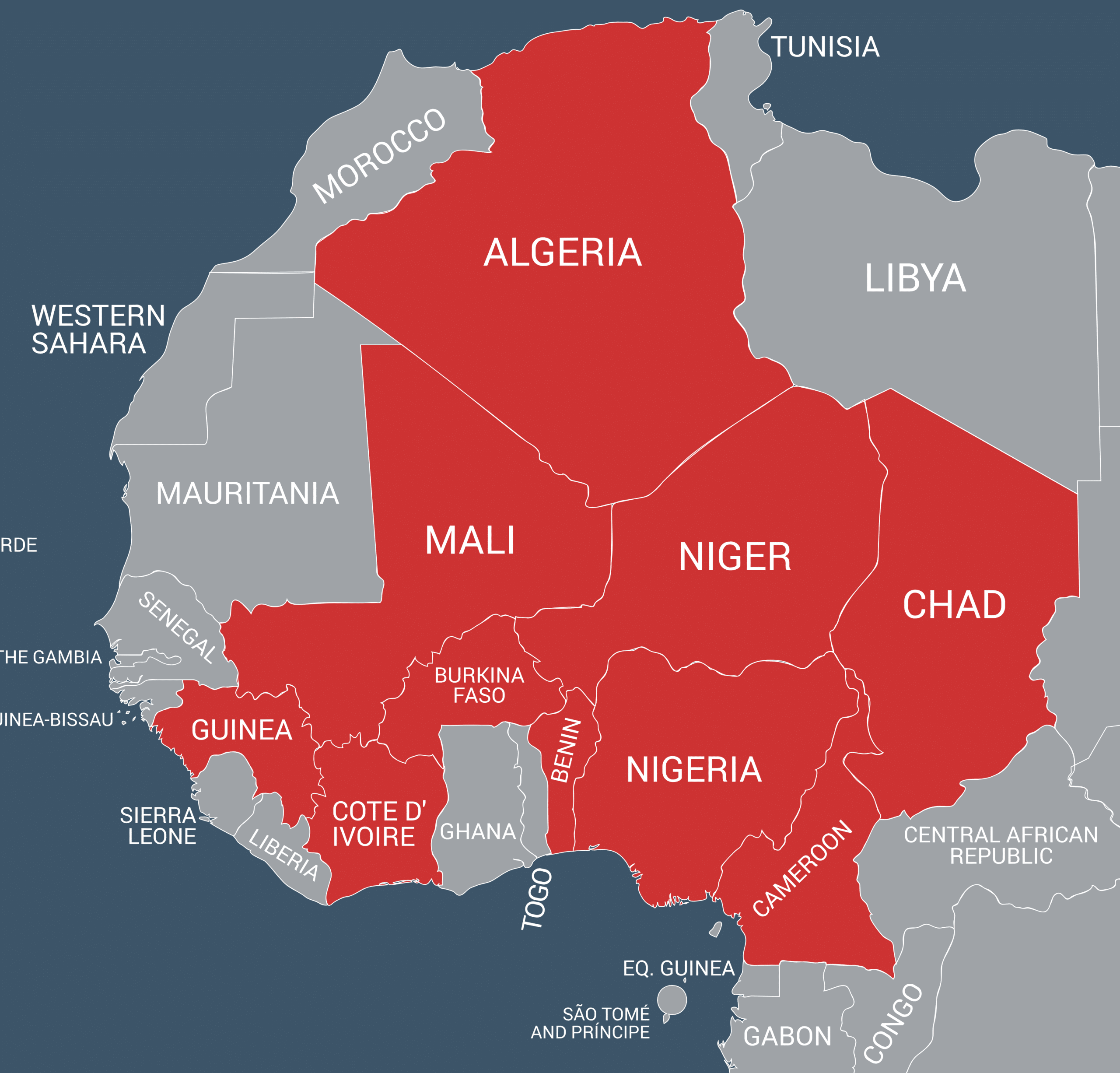
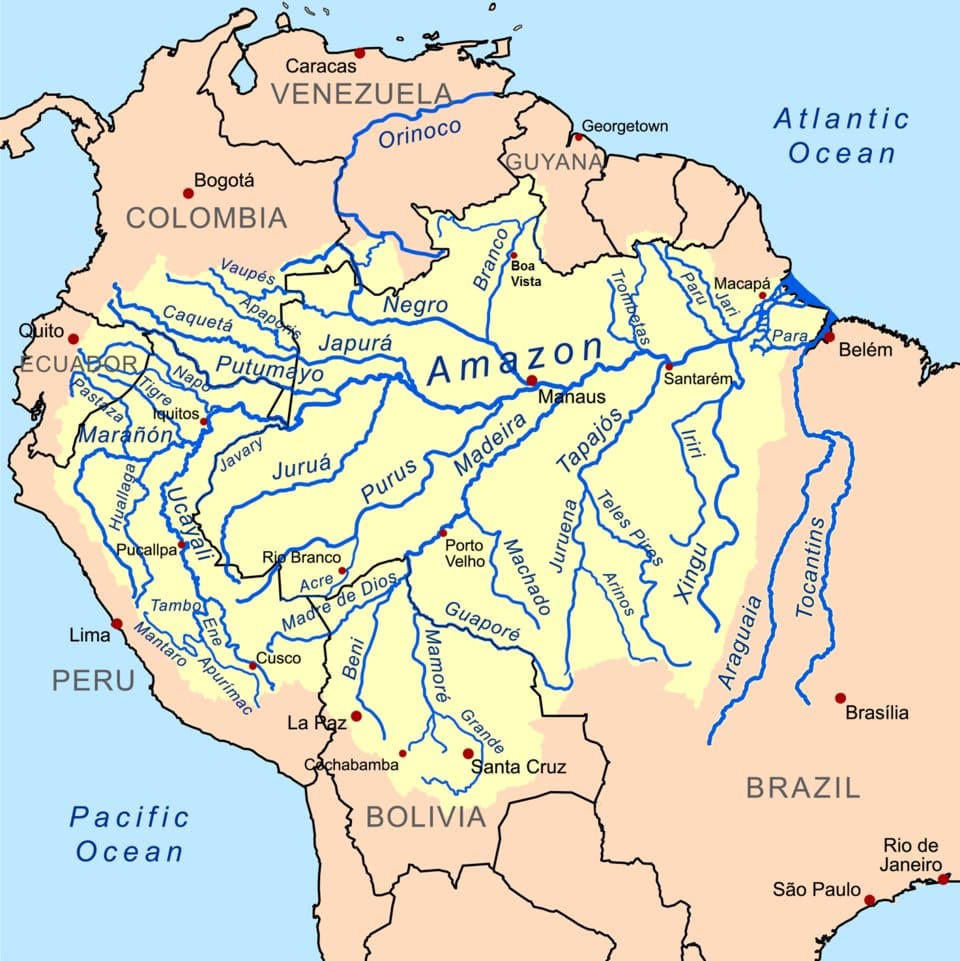
Unlike the vast majority of tetras in the aquarium hobby, the niger tetra comes from West Africa, not South America. It’s endemic to Nigeria, specifically the lower Niger River and the Ogun River systems. This makes it one of a relatively small number of African characins available to hobbyists.
In the wild, niger tetras inhabit rivers and streams with moderate flow. The water is typically slightly acidic to neutral, often stained with tannins from surrounding vegetation. They’re pelagic fish, spending most of their time in open water rather than hiding along the bottom or in vegetation.
It’s worth noting that this species is classified as Endangered by the IUCN. Habitat degradation and pollution in its native range are the primary threats. This makes responsibly sourced captive-bred specimens all the more valuable, both for hobbyists and for the long-term survival of the species.
Appearance & Identification
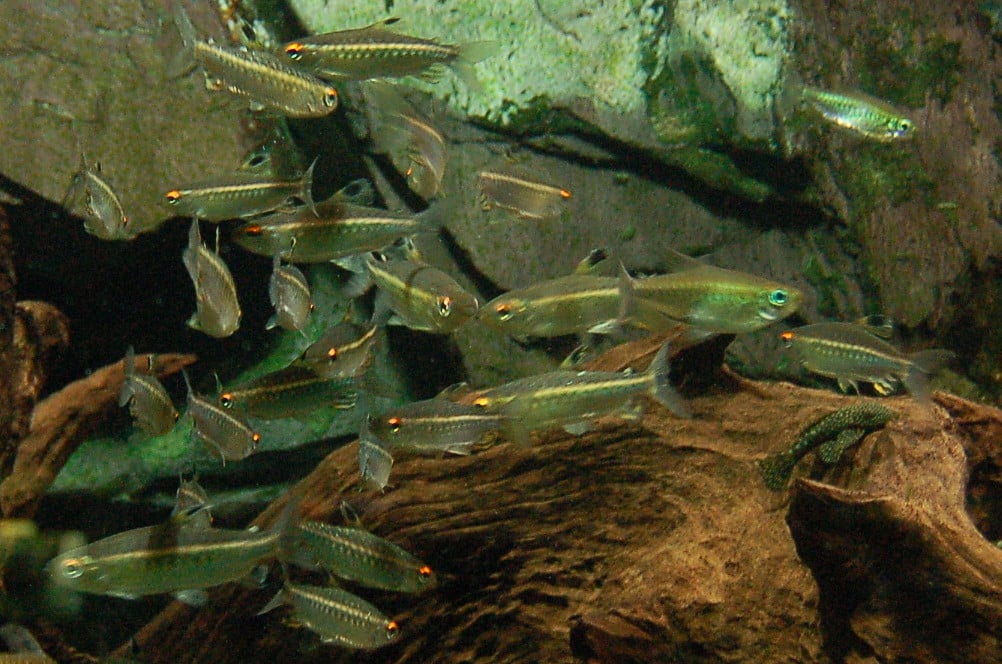
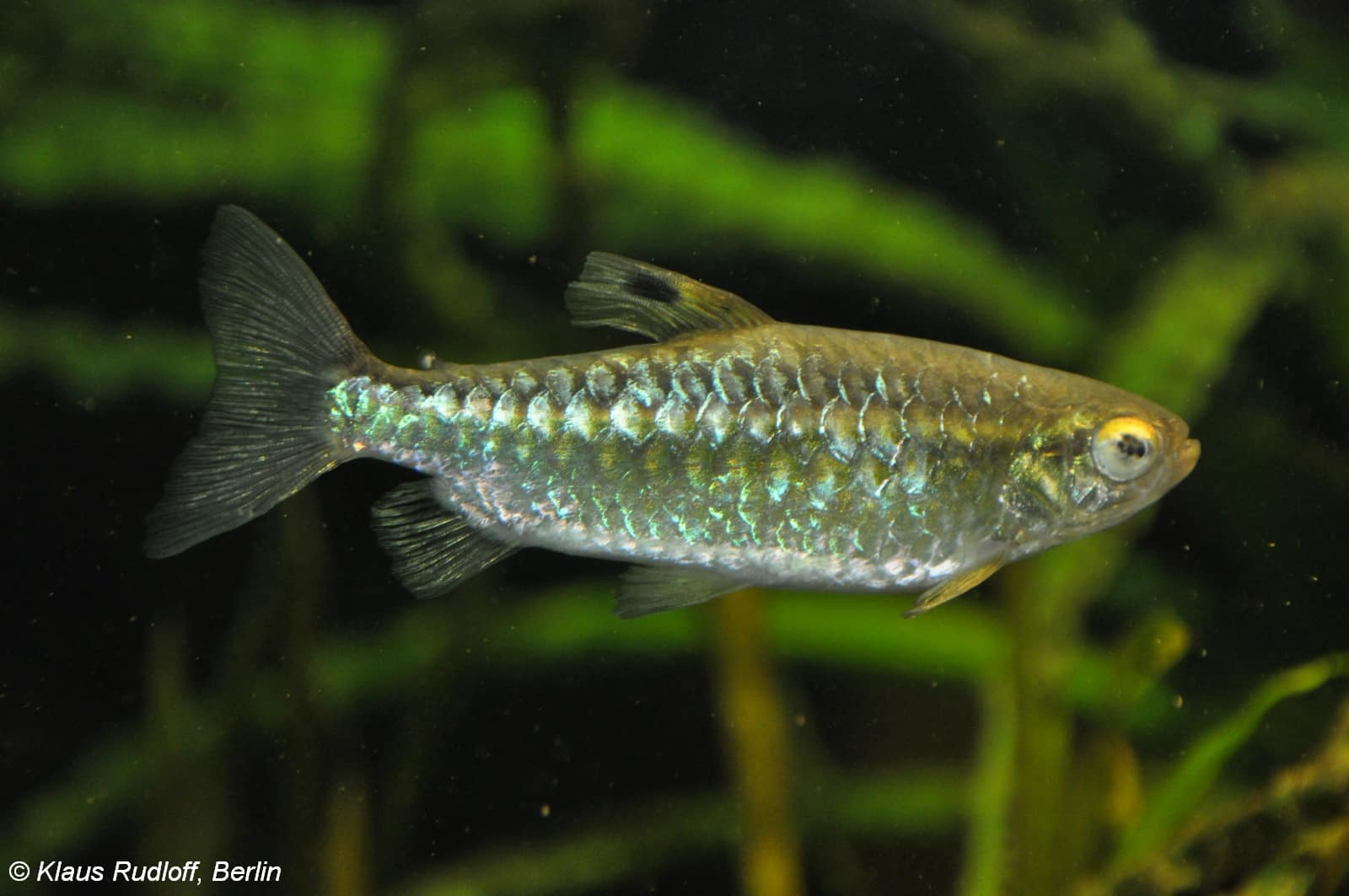
The niger tetra is a genuinely striking fish when kept in proper conditions. The body is elongated and laterally compressed, covered in large, prominently visible scales that give it a distinctive armored look compared to most small tetras. Each scale catches the light individually, creating an iridescent display that shifts between green, gold, and blue depending on the angle.
The most immediately recognizable feature is the bright red upper half of the eye, which gives the fish its alternative common name, the “African red-eye tetra.” The body color ranges from olive-green to golden, with a subtle horizontal stripe running along the midline.
Sexual dimorphism is noticeable in this species. Males are more colorful overall, with brighter iridescence and more vivid fin coloration. The anal fin of males often shows distinct red, yellow, and dark banding that’s less pronounced in females. Females are rounder-bodied, especially when full of eggs.
Average Size & Lifespan
Niger tetras are larger than most popular tetra species. They reach 3 to 3.5 inches (7.5 to 9 cm) in standard length, with some specimens pushing closer to 4 inches. That’s significantly bigger than a neon tetra or cardinal tetra, and it’s the main reason they need a larger tank.
With proper care, expect a lifespan of 5 to 8 years. They’re fairly hardy once established and can live for many years in a well-maintained aquarium.
ASD Difficulty Rating: Moderate
Moderate. An underappreciated West African community fish that deserves far more attention. Active, personable, and visually striking in a large school. The main demand is adequate swimming space and a group large enough to trigger natural schooling behavior.
Care Guide
Tank Size
A 55-gallon tank is the minimum for a group of niger tetras. They’re active, open-water swimmers that need plenty of horizontal swimming space. A 4-foot long tank (48 inches) is the minimum length. For a larger group of 10 or more, consider 75 gallons or bigger.
A tight-fitting lid is absolutely essential. Niger tetras are notorious jumpers. They will launch themselves out of any gap in the cover, especially when startled or during feeding. This isn’t optional. If your tank has an open top, this is not the fish for you.
Water Parameters
| Parameter | Ideal Range |
|---|---|
| Temperature | 75-82°F (24-28°C) |
| pH | 6.0-7.5 |
| General Hardness | 5-19 dGH |
| KH | 3-10 dKH |
| Ammonia / Nitrite | 0 ppm |
| Nitrate | Below 40 ppm |
Niger tetras are fairly adaptable regarding water chemistry. They do well across a broad pH range and handle moderately hard water without issues. The key is consistency. Avoid sudden parameter swings, and maintain a regular water change schedule of 25 to 30 percent weekly.
A filter that turns over the water 4 to 5 times per hour is recommended. They come from rivers with moderate flow, so a good canister or HOB filter works well. Adding peat filtration or driftwood helps replicate the tannin-stained waters of their natural habitat.
Tank Setup
The ideal setup provides a balance of open swimming space and structure. Use driftwood, branches, and roots to create some visual interest and hiding spots, but leave the center of the tank open for schooling. Plants is arranged around the perimeter, with floating plants helping to diffuse the lighting.
Sand or fine gravel substrate works well. Moderate lighting brings out the best iridescence in their scales without making them skittish. These are naturally open-water fish, so don’t overcrowd the tank with decorations.
Tank Mates
Niger tetras are peaceful despite their size. They is kept in community setups with similarly sized or slightly smaller fish. However, their active swimming style means they shouldn’t be housed with shy, slow-moving species that is stressed by the constant movement.
Good Tank Mates
- Other African tetras (Congo tetras are an excellent pairing)
- Medium-sized West African cichlids (kribensis, other Pelvicachromis)
- Synodontis catfish (smaller species)
- Larger tetras from South America (emperor tetras, bleeding heart tetras)
- Rainbowfish
- Medium-sized barbs
- Larger Corydoras species
- Bristlenose plecos
Tank Mates to Avoid
- Very small fish (neon tetras, microrasboras) that is intimidated or outcompeted for food
- Slow-moving, shy species that may be stressed by the active swimming
- Large aggressive cichlids
- Fin nippers
Food & Diet
Niger tetras are omnivores with a preference for meaty foods. In the wild, their diet consists mainly of insects, small invertebrates, and plant matter. In the aquarium, they’re not picky eaters, but variety is important for health and color.
- Staple: High-quality flakes or pellets (appropriately sized for their larger mouths)
- Frozen foods: Bloodworms, brine shrimp, mysis shrimp, daphnia
- Live foods: Brine shrimp, daphnia, small insects
- Supplements: Spirulina flakes, blanched vegetables
Feed two to three times daily. Live and frozen foods are particularly important for bringing out the best coloration. Niger tetras are active feeders and will eagerly come to the surface at feeding time.
Breeding & Reproduction
Breeding niger tetras is achievable and reportedly not especially difficult once you get the conditions right, though it’s rarely attempted in the hobby.
Breeding Setup
- Breeding tank: 20 to 30 gallons
- Water: Soft, slightly acidic (pH 6.0 to 6.5)
- Temperature: 79 to 82°F (26 to 28°C)
- Decor: Fine-leaved plants or spawning mops
- Lighting: Subdued
- Filtration: Gentle sponge filter
Condition breeding pairs with high-quality live and frozen foods. Females can produce up to 1,000 eggs in a single spawning event, which is impressive for a tetra. Remove the parents after spawning, as they will eat eggs.
Eggs hatch in 24 to 36 hours. Fry are small and should be fed infusoria or commercially available liquid fry food, then graduated to baby brine shrimp as they grow.
Common Health Issues
Niger tetras are hardy once acclimated and not prone to any species-specific diseases. The standard freshwater ailments apply:
- Ich (white spot disease): Usually stress-related, common after shipping or tank changes. Raise temp to 86°F and treat accordingly.
- Bacterial infections: Typically follow injuries from jumping or aggression.
- Fin rot: Water quality issue. Address with water changes and antibacterial treatment if needed.
- Jumping injuries: The most common “health issue” is death from jumping. A secure lid prevents this entirely.
Quarantine all new arrivals for 2 to 4 weeks. Maintain stable water conditions and good filtration, and these fish will typically be trouble-free for years.
Hard Rule
Keep niger tetras in groups of at least 8 to 10. In smaller numbers they school loosely, stay stressed, and never display the coordinated group behavior that makes this species worth keeping.
Common Mistakes to Avoid
- No lid: This is the number one killer of niger tetras in home aquariums. They jump. A lot. Cover every gap.
- Tank too small: They need at least a 4-foot tank. A 20-gallon won’t work for this species.
- Group too small: Keeping 3 or 4 results in shy, stressed fish. Get 10 or more.
- Pairing with tiny fish: While not predatory, their size and activity level can stress very small tankmates.
- Ignoring their endangered status: Try to source captive-bred specimens when possible. Wild-caught fish put additional pressure on an already threatened population.
Where to Buy
Niger tetras aren’t as commonly stocked as South American species, but they’re available through specialty retailers. Check these trusted sources:
When ordering, buy a group of at least 10 at once. They settle in faster and display better schooling behavior when introduced together.
Frequently Asked Questions
Are niger tetras aggressive?
No. They’re peaceful fish that do well in community setups. They’re active swimmers, which can seem boisterous, but they’re not aggressive or fin-nipping.
How big do niger tetras get?
They typically reach 3 to 3.5 inches (7.5 to 9 cm), making them one of the larger tetra species commonly available in the hobby.
Do niger tetras jump?
Yes, they’re notorious jumpers. A tight-fitting lid with no gaps is absolutely essential. This is one of the most common causes of death with this species in home aquariums.
Can I keep niger tetras with neon tetras?
It’s not the best combination. While niger tetras won’t actively hunt neons, the significant size difference and the niger tetra’s active swimming style can stress smaller fish. Pair them with medium-sized species instead.
Are niger tetras endangered?
Yes. Arnoldichthys spilopterus is listed as Endangered by the IUCN due to habitat degradation in Nigeria. When possible, look for captive-bred specimens to support conservation efforts.
What It Is Actually Like Living With Niger Tetra
In a proper school, niger tetra display natural movement patterns that are genuinely engaging to watch. The fish interact with each other, establish subtle hierarchies, and move through the tank with purpose.
They spend most of their time near the surface, which fills a level of the tank that many other species ignore. This makes them excellent complements to mid-water and bottom-dwelling fish.
Feeding time is when their personality comes out. They learn your routine quickly and will anticipate feeding before you even open the lid.
Their color and behavior improve over time as they settle into a stable environment. Fish that have been in the same tank for months look noticeably better than recently added stock.
They coexist peacefully with virtually every other appropriately-sized community fish. This compatibility makes tank planning straightforward.
Closing Thoughts
The niger tetra is one of those species that deserves way more recognition in the hobby. It offers everything you’d want in a community tetra: beautiful coloration, active schooling behavior, and a peaceful temperament. The fact that it comes from Africa rather than South America just makes it more interesting.
Yes, they need a bigger tank than your average tetra, and yes, you absolutely need a secure lid. But if you can meet those two requirements, you’ll be rewarded with a school of genuinely impressive fish that will be a centerpiece of your tank for years. And given their endangered status in the wild, every well-maintained captive population helps ensure this species sticks around for future generations of fishkeepers to enjoy.
Recommended Video
Check out our Tetra Tier List video where we rank popular tetra species for the home aquarium:
References
- Froese, R. and D. Pauly, Eds. FishBase. Arnoldichthys spilopterus. Accessed 2025.
- SeriouslyFish. Arnoldichthys spilopterus species profile. Accessed 2025.
- IUCN Red List. Arnoldichthys spilopterus. Assessed 2019. Status: Endangered.
Explore More Tetras
The niger tetra is just one of dozens of tetra species we cover in our complete species directory. From peaceful community favorites to unusual African species like this one, our guide has you covered.
👉 Tetras: Complete A-Z Species Directory
- About the Author
- Latest Posts

I’m Mark Valderrama, founder of Aquarium Store Depot and a fishkeeper with over 25 years of hands-on experience. I started in the hobby at age 11, worked at local fish stores, and have kept freshwater tanks, ponds, and reef tanks ever since. I’ve been featured in two best-selling aquarium books on Amazon and built this site to share practical, experience-based fish keeping knowledge.
Leave a Reply