
Last Updated: June 25, 2026
Thank you for visiting! By the way… any links on this page that lead to products on Amazon and other stores/partners are affiliate links Aquarium Store Depot earns a commission if you make a purchase.
Table of Contents
- What Care Guides Get Wrong
- The Reality of Keeping Black Kuhli Loach
- Key Takeaways
- Species Overview
- Classification
- Origin & Natural Habitat
- Appearance & Identification
- Average Size & Lifespan
- Care Guide
- Is It Right for You?
- Tank Mates
- Food & Diet
- Breeding & Reproduction
- Common Health Issues
- Common Mistakes to Avoid
- Where to Buy
- FAQ
- Species Comparison
- Closing Thoughts
- Recommended Video
- References
The black kuhli loach has the same care requirements as the standard kuhli loach, and people get them wrong just as often. Sand substrate, a group of six or more, and plenty of hiding spots are non-negotiable. The only real difference is the solid dark coloration, which ironically makes them even harder to spot in a planted tank. You will spend more time wondering where they went than watching them.
If you already know kuhli loach care, you know this fish. If you do not, this guide covers everything that matters, because the black kuhli loach is not a different fish. It is the same ghost that hides behind your filter, just harder to spot when it does come out.
Everything that applies to the standard kuhli loach applies here. Do not let the color variant fool you into thinking the care is different.
The Reality of Keeping Black Kuhli Loach
The black kuhli loach is essentially a darker version of the standard kuhli loach with identical care requirements. The solid dark brown to black coloration makes it harder to spot in tanks with dark substrate, which is both a feature and a frustration depending on your expectations.
Everything that applies to kuhli loaches applies here. Scaleless, medication-sensitive, nocturnal unless kept in large groups, and an escape artist that will find any gap in your tank lid. The only real difference is the coloring.
Group size matters just as much as with standard kuhlis. Six is the minimum, ten is better. A group of ten black kuhli loaches in a tank with light-colored sand actually makes their dark coloration more visible and dramatic. This is one of the few cases where lighter substrate works better for a loach.
Biggest Mistake New Owners Make
Putting them on dark substrate where they become completely invisible. The entire point of the black kuhli is the solid dark coloration, and it only works visually when contrasted against lighter sand. Dark substrate makes them disappear. Light sand makes them striking.
Black kuhli loaches are eel-like bottom-dwellers that are nocturnal and spend much of the day hidden. They need soft substrate, hiding spots, and a group to feel secure enough to emerge regularly.
Expert Take (Mark Valderrama, AquariumStoreDepot)
The black kuhli loach on light sand is the visual inverse of a standard kuhli on dark substrate, and it works beautifully. A group of ten on fine white or cream-colored sand with green plants creates a dramatic contrast that standard kuhlis cannot replicate. Same care requirements, same behavior, same medication sensitivity. The only difference is picking your substrate color to complement the fish rather than match it.
Key Takeaways
- Keep them in groups of 5-6 or more. Black Kuhli Loaches are social fish that feel more secure and are more active when kept with their own kind
- Sand substrate is non-negotiable. These loaches spend a lot of time burrowing and sifting through the substrate, and rough gravel can damage their sensitive skin and barbels
- Medication sensitivity. Like all Kuhli Loaches, they have small, widely spaced scales that leave much of their skin exposed, so always dose medications at half strength
- Peaceful and community-friendly. They get along with virtually any non-aggressive tank mate and are ideal for planted community setups
- Secure your lid. Black Kuhli Loaches are known escape artists, especially when first introduced to a new tank or during barometric pressure changes
Species Overview
| Property | Details |
|---|---|
| Scientific Name | Pangio oblonga (Valenciennes, 1846) |
| Common Names | Black Kuhli Loach, Java Loach, Chocolate Kuhli Loach |
| Family | Cobitidae |
| Origin | Southeast Asia (Java, Sumatra, Borneo, Peninsular Malaysia, Thailand) |
| Care Level | Easy to Moderate |
| Temperament | Peaceful |
| Diet | Omnivore (micropredator) |
| Tank Level | Bottom |
| Maximum Size | 3.2 inches (8 cm) |
| Minimum Tank Size | 20 gallons (76 liters) |
| Temperature | 70. 79°F (21. 26°C) |
| pH | 5.5. 7.0 |
| Hardness | 0. 8 dGH |
| Lifespan | 8. 12 years |
| Breeding | Egg scatterer |
| Breeding Difficulty | Difficult |
| Compatibility | Peaceful community fish |
| OK for Planted Tanks? | Yes |
Classification
| Rank | Name |
|---|---|
| Order | Cypriniformes |
| Family | Cobitidae |
| Subfamily | Cobitinae |
| Genus | Pangio |
| Species | P. Oblonga (Valenciennes, 1846) |
The Black Kuhli Loach was originally described by Achille Valenciennes in 1846. It is closely related to the more commonly seen Kuhli Loach (Pangio kuhlii) and shares the same genus. The key difference is that P. Oblonga lacks the distinctive banding pattern. Instead displaying a uniform dark brown to black coloration. In the aquarium trade, it is sometimes sold simply as “Black Kuhli” or confused with juvenile Pangio kuhlii that have not yet developed full banding. True P. Oblonga never develops bands regardless of age.
Origin & Natural Habitat
Black Kuhli Loaches are found across a wide range of Southeast Asia, including Java, Sumatra, Borneo, Peninsular Malaysia, and Thailand. Their range also extend into Vietnam, Laos, and Cambodia. They inhabit shallow, slow-moving sections of forest streams and calm habitats like peat swamps, where the water is typically stained dark with tannins from decomposing leaf litter.
The substrate in these habitats is typically soft mud, peat, or fine sand. Thick layers of fallen leaves and submerged wood provide both shelter and a food source in the form of insect larvae, small crustaceans, and biofilm. The water is warm, soft, and acidic. Often with a pH well below 6.0 and minimal mineral content. Light penetration is low thanks to the dense forest canopy overhead and the tannin-stained water.
In the wild, Black Kuhli Loaches are found in aggregations and are primarily nocturnal. They spend the day buried in the substrate or hidden among leaf litter, emerging at dusk to forage along the bottom. Understanding this natural behavior is the key to keeping them successfully in the aquarium. They need soft substrate, plenty of cover, and subdued lighting to feel at home.

Appearance & Identification
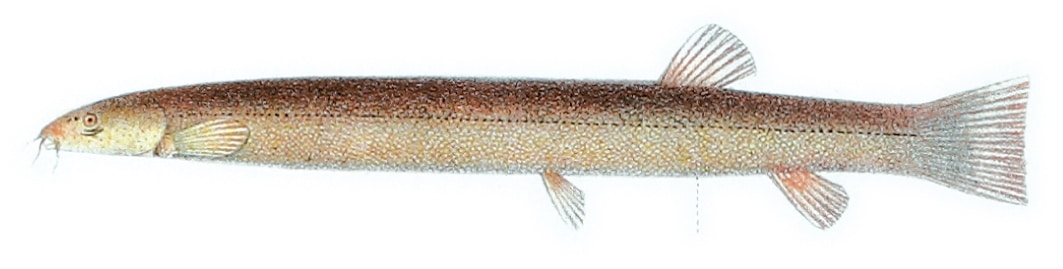
The Black Kuhli Loach has the same elongated, eel-like body shape as other Pangio species. What sets it apart is its coloration. A uniform dark brown to nearly black body without any banding or stripes. The belly may be slightly lighter, ranging from dark tan to grayish, but the overall impression is of a solid dark fish. This plain coloration is actually what gives it an alternative common name, the “Chocolate Kuhli Loach.”
Like all Kuhli Loaches, P. Oblonga has four pairs of barbels around the mouth that it uses to probe the substrate for food. A small suborbital spine sits just below each eye and can become erect when the fish feels threatened. Be careful when netting these fish, as the spine can snag in fine mesh. Better to scoop them with a cup or container instead.
Their scales are small and widely spaced, leaving much of the skin exposed. This is not the same as being “scaleless,” but the practical effect is similar. They absorb chemicals and medications more readily than fully scaled fish. Their eyes are small and covered by a transparent layer of skin, which is typical of the genus.
Male vs. Female
Sexing Black Kuhli Loaches is difficult, especially in younger fish. The differences become more visible in mature adults, but even then it takes a trained eye.
| Feature | Male | Female |
|---|---|---|
| Body Shape | Slimmer and more streamlined | Heavier-bodied with rounder abdomen |
| Size | Slightly smaller | Slightly larger overall |
| Pectoral Fins | First pectoral-fin ray is thickened and branched | Normal, unmodified pectoral-fin rays |
| When Gravid | No visible change | Abdomen noticeably swollen; greenish eggs may be visible through the skin |
Average Size & Lifespan
Black Kuhli Loaches typically reach about 3 inches (7. 8 cm) in the aquarium, though some specimens may grow slightly larger. FishBase records a maximum total length of 3.2 inches (8 cm). They are slow growers and may take over a year to reach their full adult size.
With proper care, Black Kuhli Loaches can live 8. 12 years in captivity. Hobbyists report even longer lifespans. Their longevity makes them a long-term commitment, so it pays to set up their tank correctly from the start. These are fish that reward patience. They become more bold and active the longer they are established in an aquarium.
Care Guide
Tank Size
A 20-gallon (76-liter) tank is the minimum for a group of Black Kuhli Loaches. Since you should be keeping at least 5. 6 together, you need enough floor space for them to set up hiding spots and forage without feeling crowded. A longer, more horizontal tank is always better than a tall one for these strictly bottom-dwelling fish. If you want a larger group of 8. 10 (which is even better), step up to a 30-gallon (114-liter) or larger.
Water Parameters
| Parameter | Recommended Range |
|---|---|
| Temperature | 70. 79°F (21. 26°C) |
| pH | 5.5. 7.0 |
| Hardness | 0. 8 dGH |
| Ammonia | 0 ppm |
| Nitrite | 0 ppm |
| Nitrate | <20 ppm |
Black Kuhli Loaches come from soft, acidic water and will do best when you replicate those conditions. They are more tolerant of neutral pH than some sources suggest, but they will not thrive in hard, alkaline water. Stability matters more than hitting an exact number. Sudden swings in temperature or pH cause far more problems than water that is slightly outside the ideal range. Perform weekly water changes of 25. 30% to keep nitrates low and water quality high.
Filtration & Water Flow
Choose a filter rated at 4. 5 times the tank volume per hour. Black Kuhli Loaches come from slow-moving waters and do not appreciate strong currents. A sponge filter is an excellent choice. It provides gentle flow, good biological filtration, and eliminates the risk of these slender fish getting sucked into an intake. If you are using a hang-on-back or canister filter, always cover the intake with a pre-filter sponge. This is not optional. These fish are thin enough to get pulled into standard intakes, especially younger or smaller specimens.
Lighting
Dim lighting is preferred. Black Kuhli Loaches are naturally nocturnal, and bright lighting will keep them hidden for most of the day. If you are running a planted tank that requires moderate to high light, add floating plants like Amazon Frogbit, Salvinia, or Red Root Floaters to create shaded areas along the bottom. You will see your loaches out and about far more often when the lighting is subdued or broken up by plant cover.
Plants & Decorations
Plenty of hiding places are essential. Black Kuhli Loaches will spend most of their time tucked into crevices, caves, driftwood tangles, and dense plant growth. Coconut caves, PVC pipe sections, rock formations, and driftwood with lots of nooks and crannies all work great. Low-light plants like Java Fern, Anubias, Java Moss, and Cryptocorynes create naturalistic cover that mimics their forest stream habitat.
Adding dried leaf litter. Indian almond leaves or dried oak leaves. Is one of the best things you can do for these fish. The leaves replicate their natural environment, provide surfaces for biofilm growth that the loaches graze on, and release tannins that naturally soften the water and lower pH. Do not be surprised when you find your entire group of Black Kuhli Loaches piled into a single hiding spot. They are communal fish and genuinely seem to prefer stacking up together.
Substrate
Sand substrate is the single most important element of a Black Kuhli Loach setup. These fish love to burrow. They will partially or completely bury themselves in the substrate. They also use their sensitive barbels to sift through the bottom looking for food. Rough gravel will damage their barbels and exposed skin over time, leading to infections and stress. Fine sand like pool filter sand or aquarium-specific sand is ideal. If you are using a nutrient-rich planted substrate, cap it with a layer of fine sand in the areas where your loaches spend the most time.
Is the Black Kuhli Loach Right for You?
Before you buy, run through this honest checklist. The Black Kuhli Loach is a great fish for the right keeper, but it is not for everyone.
- You have a tank with fine sand substrate. Gravel is a deal-breaker for this species
- You can keep a group of at least 6 for them to feel secure and come out of hiding
- You want a unique eel-shaped fish that adds interest to the bottom of your tank
- Your tank has plenty of hiding spots. Driftwood, plant roots, PVC pipes
- You do not expect a fish that is always visible. They are most active at dusk and dawn
- You have a peaceful community without aggressive or large bottom dwellers
Tank Mates
Black Kuhli Loaches are among the most peaceful bottom dwellers you will find. They completely ignore other fish and are too small and docile to cause trouble. The only real concern is making sure their tank mates will not harass, outcompete, or eat them.
Best Tank Mates
- Small tetras. Neon Tetras, Ember Tetras, Cardinal Tetras, Rummy-Nose Tetras
- Rasboras. Harlequin Rasboras, Chili Rasboras, Lambchop Rasboras
- Small gouramis. Honey Gouramis, Sparkling Gouramis
- Corydoras catfish. Another peaceful bottom dweller that coexists perfectly with Kuhli Loaches
- Otocinclus catfish. Gentle algae eaters with the same peaceful temperament
- Guppies and Endlers
- Dwarf shrimp. Cherry Shrimp, Amano Shrimp (Kuhlis may eat very small shrimplets)
- Snails. Nerite Snails, Mystery Snails
Tank Mates to Avoid
- Cichlids. Most cichlids are too aggressive or territorial for these gentle loaches
- Large catfish. Pictus Catfish, large Plecos, or Raphael Catfish may prey on or intimidate them
- Aggressive barbs. Tiger Barbs and similar nippy species will harass slow-moving loaches
- Bettas (with caution). Some Bettas coexist fine, but aggressive individuals may target loaches on the bottom
- Large predatory fish. Anything big enough to eat a slender, eel-shaped fish should be avoided
- Crayfish. They will catch and eat Kuhli Loaches, especially at night when both are active
Food & Diet
In the wild, Black Kuhli Loaches are primarily micropredators, feeding on insect larvae, small crustaceans, and other tiny invertebrates they find in the substrate. In the aquarium, they are easy to feed as long as you make sure food is actually reaching the bottom.
Sinking pellets and wafers should be the staple of their diet. High-quality sinking foods designed for bottom feeders work well. Supplement with frozen or live foods like bloodworms, brine shrimp, daphnia, tubifex worms, micro worms, and grindal worms. These protein-rich foods help keep them in good condition and encourage more active behavior.
Feed after the lights go out or at least during the dimmer evening hours. Since Black Kuhli Loaches are nocturnal, they are most active at night, and feeding at this time ensures they actually get to the food before more aggressive daytime feeders clean it up. A varied diet with a mix of sinking pellets, frozen foods, and the occasional live food will keep them healthy and well-nourished.
Breeding & Reproduction
Breeding Difficulty
Breeding Black Kuhli Loaches in captivity is considered difficult. There are very few documented accounts of successful breeding in home aquariums, and most Black Kuhli Loaches available in the trade are wild-caught. When breeding does occur, it is often accidental rather than intentional. Hobbyists discover fry in a well-established tank without ever observing spawning behavior.
Spawning Tank Setup
If you want to attempt breeding, set up a dedicated spawning tank of at least 20 gallons (76 liters) with very dim lighting. Use a mature sponge filter to avoid trapping eggs or fry. Provide dense clumps of Java Moss or spawning mops that can catch scattered eggs. The substrate should be fine sand, and the tank should have plenty of cover. Driftwood, leaf litter, and low-light plants to make the adults feel secure.
Water Conditions for Breeding
Breeding is most likely to occur in soft, acidic water. Aim for a pH of 5.5. 6.5, hardness below 3 dGH, and a temperature around 77. 79°F (25. 26°C). Adding Indian almond leaves or peat filtration to darken the water and lower pH can help simulate the rainy season conditions that are believed to trigger spawning in the wild. A partial water change with slightly cooler, softer water also act as a spawning trigger.
Conditioning & Spawning
Condition breeding adults with a high-protein diet of live or frozen foods for several weeks before attempting to breed. Bloodworms, daphnia, and brine shrimp are all excellent conditioning foods. Females in breeding condition will appear noticeably plumper, and you may be able to see greenish eggs through their translucent belly skin.
Spawning behavior in Pangio species is rarely observed. In the few documented cases, eggs were found scattered among the substrate and plant matter without the hobbyist witnessing the actual spawning event. It is believed that spawning may occur during the night and that the adults may release eggs near the water surface, allowing them to sink and settle into the substrate or plant cover below.
Egg & Fry Care
If you are fortunate enough to find eggs, remove the adults to prevent them from eating the eggs. The small, greenish eggs typically hatch within 24. 48 hours. Newly hatched fry are tiny and will initially feed on their yolk sac before transitioning to infusoria and other microscopic foods. After a few days, you can introduce micro worms and baby brine shrimp (Artemia nauplii). Keep the water very clean with gentle filtration and minimal water movement. Fry are extremely small and fragile, and survival rates in captivity are low.
Common Health Issues
Black Kuhli Loaches are reasonably hardy once established, but their reduced scalation makes them more vulnerable to certain diseases and particularly sensitive to medications. Here are the most common health issues to watch for.
Ich (White Spot Disease)
Ich is one of the most common diseases in freshwater fish, and Black Kuhli Loaches are particularly susceptible because of their exposed skin. You will see small white spots on the body and fins, along with flashing (rubbing against objects). The critical thing to remember is that you should dose ich medications at half the recommended strength for these fish. Their reduced scalation means they absorb chemicals much faster than fully scaled species. Alternatively, raising the temperature gradually to 86°F (30°C) and adding aquarium salt at very low doses can treat ich without harsh medications.
Skinny Disease (Wasting)
This is common in newly imported Black Kuhli Loaches. The fish appears thin and does not gain weight despite eating. Internal parasites are usually the cause, picked up during collection or transport. A veterinary-grade dewormer containing praziquantel or levamisole, dosed carefully at reduced strength, can treat this effectively. Quarantine new arrivals and watch for signs of wasting during the first few weeks.
Bacterial Infections
Damaged barbels or skin abrasions from rough substrate are the most common entry point for bacterial infections in Black Kuhli Loaches. Symptoms include redness, ulcers, frayed fins, or a fuzzy appearance on the skin. Prevention is the best approach. Use fine sand substrate, maintain excellent water quality, and avoid overcrowding. If treatment is needed, broad-spectrum antibacterial medications dosed at half strength are the safest option.
Stress-Related Issues
Black Kuhli Loaches are sensitive to stress from poor water quality, lack of hiding places, or being kept alone. Stressed loaches will stay hidden constantly, refuse to eat, and become more susceptible to disease. The best prevention is proper husbandry. Keep them in groups, provide plenty of cover, maintain stable water parameters, and avoid housing them with aggressive tank mates.
Common Mistakes to Avoid
- Using gravel substrate. This is the single most common mistake. Rough gravel damages their barbels and skin, leading to infections. Always use fine sand.
- Keeping them alone or in pairs. Black Kuhli Loaches need a group of at least 5. 6 to feel secure. A lone Kuhli will hide constantly and you may never see it.
- Not covering filter intakes. Their slender body allows them to get pulled into unprotected filter intakes. Always use a pre-filter sponge.
- Dosing medications at full strength. Their reduced scalation means they absorb medications faster. Always use half-dose or less when treating these fish.
- No lid or gaps in the lid. Black Kuhli Loaches can and will escape through surprisingly small openings, especially when new to a tank.
- Adding them to an uncycled tank. These fish are sensitive to ammonia and nitrite spikes. Only add them to a fully cycled, mature aquarium.
- Not feeding at night. If you only feed during the day, your faster daytime fish will eat everything before the nocturnal loaches even come out. Drop sinking foods in after lights-out.
Where to Buy
Black Kuhli Loaches are moderately available in the aquarium trade, though they are less commonly stocked than the standard banded Kuhli Loach. Your best bet for healthy, well-acclimated specimens is to order from a reputable online retailer that specializes in freshwater fish.
Two sources I recommend are Flip Aquatics and Dan’s Fish. Both are well-known in the hobby for shipping healthy fish with good packaging and customer support. Check their current stock, as loach availability can vary seasonally since most are wild-caught.
When buying, look for specimens that are active (for a loach. Meaning they respond to disturbance and are not lethargic), have no visible sores or lesions, and are not abnormally thin. Buying in a group of 5. 6 at once is ideal so they can be quarantined and acclimated together.
FAQ
What is the difference between a Black Kuhli Loach and a regular Kuhli Loach?
The main difference is coloration. The standard Kuhli Loach (Pangio kuhlii) has alternating dark brown and yellowish-orange bands, while the Black Kuhli Loach (Pangio oblonga) has a uniform dark brown to black body without any banding. They are different species, not color variants. Care requirements are essentially the same, and they can be kept together without any issues.
How many Black Kuhli Loaches should I keep together?
Keep a minimum of 5. 6 Black Kuhli Loaches together. They are social fish that feel more secure in groups and will be significantly more active and visible when kept in appropriate numbers. A single Kuhli Loach will hide constantly and you will rarely see it. Groups of 8. 10 or more are even better if your tank can support them.
Can Black Kuhli Loaches live with shrimp?
Yes, Black Kuhli Loaches can coexist with most dwarf shrimp species like Cherry Shrimp and Amano Shrimp. However, they may eat very small shrimplets if they come across them while foraging. Adult shrimp are safe. If you are breeding shrimp, provide plenty of moss and dense plant cover where shrimplets can hide.
Are Black Kuhli Loaches nocturnal?
Yes, they are naturally nocturnal. In the wild, they spend the day buried in substrate or hidden under leaf litter and come out at dusk to forage. In the aquarium, they can be trained to come out during the day for feeding, especially if the lighting is subdued and they feel secure in a large group with plenty of hiding places. Over time, established groups become bolder and more visible during daytime hours.
Do Black Kuhli Loaches eat snails?
Black Kuhli Loaches are not effective snail predators. While they will eat a very small snail or snail egg that they encounter while sifting through the substrate, they should not be relied on for snail control. If you have a pest snail problem, look at Assassin Snails or manual removal instead.
Why is my Black Kuhli Loach always hiding?
Constant hiding is usually caused by one of three things. The group is too small (fewer than 5), the tank lacks sufficient cover (which paradoxically makes them hide more, not less), or the lighting is too bright. Adding more loaches, more hiding places, and floating plants to diffuse light will typically bring them out. New Black Kuhli Loaches also take several weeks to settle in before they feel comfortable enough to explore openly.
How the Black Kuhli Loach Compares to Similar Species
Black Kuhli Loach vs. Java Loach
The Java Loach is a close relative but is more robust and forgiving. It has visible banding rather than the solid dark coloring of the Black Kuhli. For beginners, the Java Loach is the easier keeper. The Black Kuhli Loach has more visual impact with its jet-black body.
Black Kuhli Loach vs. Horseface Loach
Both love sand substrates, but they use it differently. The Horseface Loach buries itself completely, while the Black Kuhli Loach wedges under and between decorations. The Horseface Loach grows much larger and needs more tank space. The Black Kuhli is better for smaller community setups.
What It Is Actually Like Living With Black Kuhli Loach
Black kuhli loaches behave identically to standard kuhlis. The noodle piles, the nocturnal emergence, the escape artistry. The only difference is aesthetic. On the right substrate, they look like living pieces of calligraphy against a blank page.
Feeding is the same after-dark routine. Lights off, food in, wait. Within minutes, dark shapes emerge from everywhere and converge on the food. It is eerie and beautiful in dim lighting.
The substrate choice decision is the single most important aesthetic call you make with this species. Light sand turns them into a showpiece. Dark substrate turns them into ghosts. Choose accordingly.
Closing Thoughts
Put black kuhli loaches on black substrate and you have paid for fish you will never see. Light sand turns them into the most dramatic loach in your tank.
Black Kuhli Loaches are one of those fish that quietly wins you over. They are not flashy, they are not always visible, and they will not be the centerpiece of your tank. But once you see a pile of them emerge from the sand at feeding time or catch them weaving through driftwood in the evening, you will understand why so many hobbyists are hooked on them. They bring a different kind of life to the bottom of the tank. One that feels natural and endlessly entertaining.
Get the basics right. Sand substrate, a group of at least 5. 6, stable soft water, and plenty of hiding places. And these loaches will reward you with years of quirky behavior and reliable bottom-dwelling cleanup. They are not demanding fish. They just need the right foundation to thrive.
Recommended Video
Check out this video for more on Kuhli Loach care and what makes these loaches such a great addition to community tanks:
References
- Seriously Fish. Pangio oblonga species profile. seriouslyfish.com
- FishBase. Pangio oblonga (Valenciennes, 1846). fishbase.se
- Practical Fishkeeping. Kuhli Loach care and species guide. practicalfishkeeping.co.uk
- Kottelat, M. & Widjanarti, E. (2005). The fishes of Danau Sentarum National Park and the Kapuas Lakes area, Kalimantan Barat, Indonesia. Raffles Bulletin of Zoology, Supplement 13: 139-173.
- About the Author
- Latest Posts

I’m Mark Valderrama, founder of Aquarium Store Depot and a fishkeeper with over 25 years of hands-on experience. I started in the hobby at age 11, worked at local fish stores, and have kept freshwater tanks, ponds, and reef tanks ever since. I’ve been featured in two best-selling aquarium books on Amazon and built this site to share practical, experience-based fish keeping knowledge.
Leave a Reply