
Last Updated: June 25, 2026
Thank you for visiting! By the way… any links on this page that lead to products on Amazon and other stores/partners are affiliate links Aquarium Store Depot earns a commission if you make a purchase.
Table of Contents
- Key Takeaways
- Species Overview
- Classification
- Origin & Natural Habitat
- Appearance & Identification
- Average Size & Lifespan
- Care Guide
- Tank Mates
- Food & Diet
- Breeding & Reproduction
- Common Health Issues
- What People Get Wrong
- Common Mistakes to Avoid
- Should You Get This Fish
- Kelberi Peacock Bass vs. Similar Species
- Where to Buy
- Frequently Asked Questions
- Closing Thoughts
- References
This fish will define the tank. Everything else either fits around it or becomes lunch.
The Kelberi peacock bass (Cichla kelberi) is widely considered the most aquarium-suitable species in the Cichla genus. It’s the smallest of the peacock bass family, the most peaceful relative to other members of the group, and develops a stunning golden coloration that earned it the “24K” nickname in the hobby. If you’ve ever wanted a fish that looks like it belongs on a sport fishing magazine cover but lives in your living room, this is the species.
Let me be straight with you: this is not a casual fish. Even as the most manageable peacock bass, the Kelberi still grows to over a foot long, demands pristine water conditions, eats a high-protein predatory diet, and needs a tank that most hobbyists simply don’t have. This is a monster fish keeper’s species. If you’ve got the space, the filtration, and the commitment, a Kelberi peacock bass is one of the most impressive freshwater fish you can keep. If you’re not ready for that level of investment, there are better options out there.
Key Takeaways
- The most aquarium-friendly peacock bass. Smaller and more peaceful than other Cichla species, but still a large, demanding predator.
- Needs a massive tank. 180 gallons minimum for adults. This is the floor, not a target.
- Extremely nitrate-sensitive. Water quality demands are among the highest of any commonly kept freshwater fish. Keep nitrates below 10 ppm. That means twice-weekly water changes.
- Piscivore. Will eat anything it can swallow. And it can swallow a lot.
- Fast grower. Juveniles add 1-1.5 inches per month. Plan for the adult size from day one.
- 10-15 year commitment. This fish will outlive most furniture in the room.
ASD Difficulty Rating: Advanced | 8/10
The care itself isn’t technically complex, but the resource requirements are extreme: 180-gallon minimum tank, twice-weekly large water changes, strict nitrate management, a dietary transition away from live foods, and a decade-plus commitment. This is a specialist fish. Intermediate keepers can succeed with proper infrastructure, but this is not a casual purchase.
Species Overview
| Field | Details |
|---|---|
| Scientific Name | Cichla kelberi |
| Common Names | Kelberi Peacock Bass, 24K Peacock Bass, Peacock Bass |
| Family | Cichlidae |
| Origin | Rio Araguaia and lower Rio Tocantins drainages, Brazil |
| Care Level | Advanced |
| Temperament | Predatory piscivore (semi-aggressive toward similarly sized fish) |
| Diet | Carnivore (piscivore) |
| Tank Level | Middle to Top |
| Maximum Size | 18 inches (45 cm) wild; typically 10-12 inches (25-30 cm) in aquariums |
| Minimum Tank Size | 180 gallons (681 liters) |
| Temperature | 78 to 84°F (26 to 29°C) |
| pH | 6.0 to 7.0 |
| Hardness | 5 to 15 dGH |
| Lifespan | 10 to 15 years |
| Breeding | Biparental substrate spawner |
| Breeding Difficulty | Difficult |
| OK for Planted Tanks? | No (uproots plants, needs open swimming space) |
Classification
| Taxonomic Level | Classification |
|---|---|
| Order | Cichliformes |
| Family | Cichlidae |
| Subfamily | Cichlinae |
| Genus | Cichla |
| Species | C. kelberi Kullander & Ferreira, 2006 |
Cichla kelberi was formally described by Kullander and Ferreira in 2006 as part of a major taxonomic revision that recognized nine new species within the Cichla genus. Before that revision, it was grouped with C. monoculus. The species name honors Dieter Kelber, a sport fisherman who contributed field information during the revision. The Kelberi is distinguished from other peacock bass species by small light spots on the pelvic, anal, and lower caudal fins in adults. The 2006 revision is the authoritative species framework still in use today.
Origin & Natural Habitat
The Kelberi peacock bass is native to the Rio Araguaia and lower Rio Tocantins drainages in Brazil. These are large, warm, clear to slightly turbid rivers with moderate to strong current. Peacock bass are apex predators in their native environment, inhabiting areas near structure, fallen trees, rocky outcrops, flooded vegetation, where they can ambush prey fish in open water.
Water in their natural habitat is warm (77-84°F), soft to moderately hard, and slightly acidic to neutral, with high dissolved oxygen levels and pristine water quality. This is the critical context for understanding why peacock bass are so nitrate-sensitive. They evolved in large, open-flowing river systems with essentially no nitrate accumulation. A static aquarium is a fundamentally different environment, and managing the difference is the core challenge of keeping this species.
C. kelberi has been extensively introduced outside its native range as a sport fish. It’s now established in many Brazilian reservoirs and river systems beyond its original distribution, as well as parts of Southeast Asia. This invasive track record speaks to how effective a predator it is in new environments.
Expert Take (Mark Valderrama, AquariumStoreDepot)
In 25+ years in the hobby and time managing fish stores, peacock bass are the fish I see fail most often due to tank size expectations. People hear “smallest peacock bass” and assume something manageable. A 10-12 inch predatory cichlid with the bioload of a small dog requires infrastructure most home aquariums don’t have. The Kelberi is the best entry point into the genus, but “best entry point” still means 180 gallons minimum, twice-weekly water changes, and a decade-plus commitment. The fish is worth it if you can build around it. If you’re trying to fit it into an existing moderate setup, you’re setting yourself up for a bad outcome.
Appearance & Identification
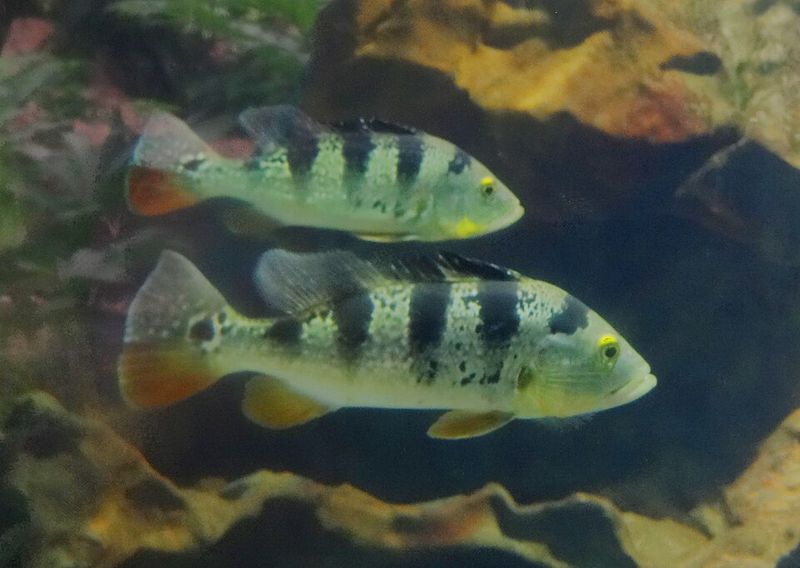
The Kelberi peacock bass has the classic Cichla body: streamlined, powerful, built for speed. The body is elongated with a large terminal mouth, strong jaw, and a muscular tail designed for explosive bursts of acceleration. Base coloration is golden-yellow to olive-green, with three dark vertical bars that become more or less visible depending on mood and condition.
What sets the Kelberi apart from other peacock bass is the presence of small light spots on the pelvic and anal fins and on the lower lobe of the caudal fin. The golden coloration intensifies with age and good care, which is where the “24K” trade name comes from. A large, mature Kelberi in peak condition is a genuinely golden fish. All peacock bass have the signature ocellus (eye spot) at the base of the caudal fin, which serves as a false eye to confuse predators and is the source of the “peacock” common name.
Male vs. Female
Outside of breeding condition, sexing Kelberi peacock bass is difficult. Both sexes look very similar through most of the year.
| Feature | Male | Female |
|---|---|---|
| Body Size | Slightly larger at maturity | Slightly smaller |
| Nuchal Hump | Develops a pronounced hump during breeding season | No hump or minimal development |
| Coloration | May show slightly more vivid golden tones in breeding condition | Similar coloration |
| Vent | Pointed genital papilla when breeding | Rounded, wider papilla when breeding |
Average Size & Lifespan
In the wild, Kelberi peacock bass reach up to 18 inches (45 cm) and close to 11 pounds (5 kg). In home aquariums, 10-12 inches (25-30 cm) is the common adult size, though exceptional specimens in very large, well-managed tanks can approach the wild maximum. Growth is fast in the first year: juveniles add 1-1.5 inches per month under optimal conditions. A 3-inch juvenile can be 8-10 inches within its first year. Plan for this trajectory when sizing the tank.
Lifespan is 10-15 years with proper care. These are long-lived animals that represent a serious long-term commitment. Water quality and diet quality are the primary drivers of longevity. Fish kept in undersized tanks with poor water quality live significantly shorter lives and never reach their growth potential.
Care Guide
Tank Size
A minimum of 180 gallons (681 liters) for a single adult or a compatible pair. For a community of large fish, 300+ gallons is where you want to be. The tank should be at least 6 feet (180 cm) long and 2 feet (60 cm) wide. Peacock bass are fast, active swimmers, the footprint matters more than the height.
Juveniles can start in smaller tanks (75-90 gallons) but will outgrow them within months. If you don’t have the permanent large tank ready or concretely planned, don’t buy the fish. Growth cannot be stunted without serious health consequences, and understocking a growing predatory fish in a tank it’s outgrown is a welfare issue.
Water Parameters
| Parameter | Recommended Range |
|---|---|
| Temperature | 78 to 84°F (26 to 29°C) |
| pH | 6.0 to 7.0 |
| General Hardness | 5 to 15 dGH |
| Ammonia | 0 ppm |
| Nitrite | 0 ppm |
| Nitrate | Below 10 ppm (ideally below 5 ppm) |
Hard Rule: Twice-weekly water changes at 30-50% are the minimum standard for peacock bass keeping.
This isn’t a recommendation, it’s a requirement. Nitrates above 10-15 ppm will show in the fish’s health over time: fading color, reduced appetite, increased disease susceptibility. Most freshwater fish tolerate 30-40 ppm without obvious problems. Peacock bass start declining at a fraction of that. If a rigorous water change schedule isn’t sustainable for you, choose a different species.
Filtration & Water Flow
Filtration for a peacock bass tank needs to be industrial-grade. Large canister filters, sump systems, or wet/dry filters are the norm. Target a turnover rate of at least 10 times the tank volume per hour. Strong mechanical, biological, and chemical filtration are all essential given the heavy bioload these fish produce.
Water movement should be moderate to strong, replicating the riverine conditions this species comes from. Peacock bass are accustomed to well-oxygenated water with active current. A powerhead or air pump providing supplemental aeration is recommended, especially in warmer tanks where dissolved oxygen naturally decreases.
Lighting
Standard aquarium lighting works fine. Peacock bass aren’t light-sensitive and display well under a range of conditions. Moderate, slightly warm-toned LED lighting brings out the golden coloration most effectively. Very bright lighting won’t harm them but won’t add anything either.
Plants & Decorations
Peacock bass tanks are typically minimalist by necessity. Large, fast-moving fish need open swimming lanes above all else. A few large pieces of driftwood, rounded boulders, or PVC pipe structures provide visual interest and possible territory anchors without restricting movement.
Live plants are generally impractical. The fish’s activity will destroy rooted plants, and the tank layout should prioritize open space over aesthetics. Some keepers run bare-bottom tanks for easier waste removal, which is a legitimate approach given the maintenance demands.
Substrate
Sand or fine gravel both work. Peacock bass aren’t sand sifters, so substrate choice is less critical here than with eartheaters. Bare-bottom tanks are a valid option for easier waste management. If using substrate, a thin layer of sand is a good compromise between aesthetics and practicality. Keep it easy to vacuum.
Tank Mates
Tank mate selection for a peacock bass is simple in theory and demanding in practice: if it fits in the mouth, it’s food. A full-grown Kelberi has a surprisingly large mouth. Only fish that are genuinely too large to swallow are safe companions. The Kelberi is the most peaceful Cichla species, which means it’s less likely to attack fish it can’t eat, but the instinct to chase and test is always present.
Best Tank Mates
- Large cichlids (Oscars, severums, large Geophagus), can coexist in very large tanks with adequate space
- Large catfish (large plecostomus, Synodontis), robust enough to hold their own
- Silver dollars and large characins, fast, deep-bodied schooling fish too wide to swallow
- Bichirs, armored bottom dwellers that generally don’t compete with peacock bass
- Arowana, only in extremely large systems (500+ gallons) with compatible temperament
Tank Mates to Avoid
- Any fish under 5-6 inches, will be consumed. Period.
- Slow-moving or shy fish, will be stressed and eventually hunted regardless of size
- Highly aggressive tank mates, while the Kelberi holds its own, constant aggression from tank mates creates unnecessary stress
- Invertebrates, shrimp, crayfish, and snails are food items
Food & Diet
Kelberi peacock bass are dedicated carnivores. The goal in captivity is to wean them onto high-quality prepared foods rather than relying on live feeders, which carry disease risk and poor nutrition.
High-quality carnivore pellets and sticks (Hikari Massivore, Northfin Carnivore, and similar products) should form the staple diet once the fish is weaned. Supplement with frozen whole silversides, smelt, shrimp, and krill. Live earthworms are excellent treats. Avoid using live feeder fish as a regular food source, they carry parasites and are high in thiaminase, which depletes vitamin B1 over time.
Juveniles need 2-3 feedings daily to support rapid growth. Adults can be fed once daily or every other day, depending on food type and portion. Never feed mammalian meats or fatty foods.
Breeding & Reproduction
Breeding Difficulty
Difficult. Breeding peacock bass in home aquariums requires extremely large tanks, exceptional water quality, and a compatible bonded pair. It’s rarely achieved by hobbyists because the space requirements alone eliminate most setups.
Spawning Tank Setup
A dedicated breeding tank of at least 300 gallons (1,136 liters) with minimal decoration. Provide a large, flat piece of slate or smooth stone as a spawning surface. The breeding pair needs isolation from other fish, they defend an enormous territory during spawning and will stress any other occupants. Bare-bottom or thin sand substrate makes maintenance easier during the intensive care period.
Water Conditions for Breeding
Pristine water is the primary requirement. Temperature around 80-82°F (27-28°C), pH 6.0-6.5, nitrates near zero. Large frequent water changes maintain the conditions these fish require for spawning. Conditioning with a high-protein diet of whole fish and shrimp triggers breeding behavior in established pairs.
Conditioning & Spawning
The best approach is to raise a group of 6+ juveniles together and allow natural pair formation. Forced pairings rarely work. When a pair forms and is ready, they select and clean a spawning surface. The male may develop a pronounced nuchal hump during breeding condition. The female deposits eggs on the cleaned surface in rows, and the male fertilizes them immediately after. Spawning typically occurs in warmer months.
Egg & Fry Care
Both parents guard eggs and fry. The female tends the eggs directly while the male patrols the wider territory. Eggs hatch in 3-4 days, and fry become free-swimming within a week. Fry can be fed baby brine shrimp initially, progressing to chopped frozen foods as they grow. Fry growth is rapid with proper feeding and water quality. The parents’ size and aggression during the breeding period can make routine tank maintenance difficult, be careful.
Common Health Issues
Nitrate Sensitivity
The defining health concern with peacock bass. Symptoms of nitrate stress include appetite loss, lethargy, color fading, and increased susceptibility to secondary infections. Most freshwater fish tolerate nitrates up to 40 ppm without obvious problems. Peacock bass begin declining at a fraction of that level. Prevention through massive, frequent water changes is the only answer. Test weekly.
Hole in the Head (HITH)
Like many large cichlids, peacock bass are susceptible to HITH, particularly when water quality slips or the diet lacks variety. The pitting erosion around the head is directly linked to high nitrates and nutritional deficiency. Given this species’ extreme nitrate sensitivity, HITH can develop faster than in hardier cichlids. Maintaining very low nitrates and feeding a varied, vitamin-rich diet are the preventive measures.
Parasites from Live Feeders
Peacock bass fed regularly on live feeder fish are at high risk for internal and external parasites. Feeder goldfish and rosy reds are notorious carriers of parasites and bacteria. Weaning onto prepared foods and frozen whole fish eliminates this risk entirely. If live food is used during the weaning process, quarantine feeders for at least two weeks and treat prophylactically.
Ich (White Spot Disease)
Peacock bass can contract ich after shipping stress, temperature fluctuations, or water quality lapses. Their warm water preference helps during treatment: raising the temperature to 86°F (30°C) accelerates the parasite’s lifecycle and makes treatment faster. Use a quality ich medication at the full recommended dose. These fish are generally resilient to treatment when the issue is caught early.
What People Get Wrong
The “most manageable peacock bass” framing creates predictable misconceptions:
- “The Kelberi is small enough for a 75-gallon.” A 75-gallon is a temporary grow-out tank at best, and confining a growing predator in a tank it’s outgrown is a welfare problem. At 10-12 inches in the aquarium, this fish needs 180 gallons as a permanent minimum. There’s no size range where a 75-gallon is appropriate long-term.
- “Live feeders are the natural food source, so they must be fine.” Wild peacock bass eat wild prey fish. Feeder goldfish are farm-raised disease vectors high in thiaminase. This is not what the fish evolved eating. The risk of parasites and nutritional deficiency from regular feeder use is real and well-documented.
- “Nitrate tolerance is nitrate tolerance.” Most cichlid keepers know that 20-30 ppm nitrates are acceptable for species like Jack Dempseys or convicts. That logic doesn’t apply here. Peacock bass show stress at nitrate levels that robust cichlids shrug off entirely. Managing this species requires a fundamentally different approach to water changes than most fishkeepers are used to.
- “The Kelberi is peaceful.” Relative to a 36-inch Cichla temensis, yes. Relative to a community aquarium, absolutely not. Any fish that fits in the mouth will be eaten. “Peaceful” means it won’t actively attack fish it can’t consume, not that it’s a community fish in any traditional sense.
Common Mistakes to Avoid
- Buying without the tank ready. A juvenile Kelberi will outgrow a 75-gallon in months. Have the 180+ gallon setup ready before purchasing.
- Underestimating water change requirements. Twice-weekly 30-50% water changes are standard. If that sounds excessive, this isn’t the right fish.
- Using live feeder fish as a staple. Live feeders carry parasites and poor nutrition. Wean onto prepared foods as quickly as possible.
- Keeping with undersized tank mates. If it fits in the mouth, it will eventually be eaten. Don’t test this with expensive or irreplaceable fish.
- Undersized filtration. The bioload from a large predatory fish is substantial. Overfilter, never underfilter.
- Ignoring nitrate testing. Test weekly. Keep nitrates below 10 ppm. This species does not tolerate the nitrate levels that most freshwater fish handle without issues.
Should You Get This Fish?
The Kelberi peacock bass is one of the most impressive freshwater fish you can keep. It’s also one of the most demanding. Here’s the honest assessment:
Good fit if:
- You have 180 gallons available now and can realistically upgrade to 300+ as the fish grows
- You can commit to twice-weekly 30-50% water changes for the next 10-15 years
- You already keep large predatory fish and understand the infrastructure requirements
- You want a showpiece specimen that defines the room it’s in
- You have the patience to wean a piscivore off live foods
- You’re ready for a long-term, singular fish relationship rather than a community tank experience
Avoid if:
- Your largest available tank is under 180 gallons
- You can only realistically manage once-weekly water changes
- You have smaller fish in the tank that you’re not willing to lose
- You’ve never kept large predatory cichlids before
- The 10-15 year commitment gives you pause, it should be something you’re actively excited about, not just accepting
Kelberi Peacock Bass vs. Similar Species
If you’re deciding between the Kelberi and other large cichlid options, here’s how they compare on what matters for ownership:
Kelberi Peacock Bass vs. Oscar (Astronotus ocellatus)
The Oscar is far more beginner-accessible: it works in a 75-gallon, tolerates a wider range of water chemistry, is more social and interactive, and is available at virtually every local fish store. The Oscar’s charm is its personality and responsiveness to its owner. The Kelberi’s appeal is the visual power of a large predatory fish in full golden color. Choose Oscar if you want a large, intelligent centerpiece in a standard-sized tank with room for error. Choose Kelberi if you specifically want the peacock bass aesthetic and the monster fish experience, and can fully meet the infrastructure requirements.
Kelberi vs. Other Cichla Species
The Kelberi is the appropriate entry point into the genus. The Temensis (Cichla temensis), for example, can reach 24-36 inches and is significantly more aggressive. Azul, Monoculus, and Orinocensis all fall in a similar range of size and aggression above the Kelberi baseline. If you’ve kept a Kelberi successfully and want to scale up, those are the next conversations to have with the monster fish community. For most aquarists, the Kelberi is the only peacock bass that’s remotely feasible long-term.
Where to Buy
Kelberi peacock bass are available through specialty monster fish retailers and some online fish stores. They’re not commonly found at typical local fish stores due to their specialized requirements. Flip Aquatics carries a range of unique species and is worth checking regularly, and Dan’s Fish is another reliable source for less common South American cichlids.
Juveniles are typically sold at 2-3 inches and are relatively affordable. Look for active, alert fish with clear eyes, good coloration, and a strong feeding response. Ask the seller what the fish has been eating, this directly affects how easy the weaning process will be.
Frequently Asked Questions
How big does a Kelberi peacock bass really get?
In home aquariums, expect 10-12 inches (25-30 cm) as a typical adult size. Wild specimens and those in very large, well-managed setups can reach 18 inches (45 cm). Even at the smaller end, this is a substantial fish. Don’t plan around the minimum, plan around the realistic maximum for your setup and upgrade the tank before the fish outgrows it.
Can I feed my peacock bass goldfish?
You shouldn’t. Feeder goldfish are nutritionally poor and carry a high risk of parasites and bacterial infections. They’re also high in thiaminase, which causes vitamin B1 deficiency over time. Wean your peacock bass onto quality carnivore pellets and frozen whole silversides, smelt, and shrimp instead. Live earthworms are a much safer option if you want to provide live prey occasionally.
How fast do peacock bass grow?
Fast. Under optimal conditions, juveniles grow 1-1.5 inches per month. A 3-inch juvenile can reach 8-10 inches within the first year. Growth slows after the first year but continues steadily. Plan tank upgrades well in advance of when the fish will need them.
How does the Kelberi compare to other peacock bass species?
The Kelberi is the most aquarium-suitable Cichla species: one of the smallest in the genus, more peaceful than species like the Temensis or Azul, and it develops attractive golden coloration. Other peacock bass species can reach 24-36 inches and are significantly more aggressive, making them impractical for all but the largest custom setups.
Can peacock bass tolerate cooler water?
No. Peacock bass are strictly tropical and need 78-84°F (26-29°C) consistently. They’re very intolerant of temperature drops and develop health problems if temperatures fall below 75°F (24°C) for extended periods. Use a reliable heater, and for tanks 180 gallons and larger, consider running two heaters for redundancy, a single heater failure in a large tank can crash temperatures before you notice.
What size fish is safe with a peacock bass?
As a rough guide, fish under 5-6 inches are at serious risk. Even then, a determined peacock bass can swallow fish you’d consider too large. Deep-bodied fish like silver dollars are safer than slender fish of the same length because the girth prevents easy swallowing. When in doubt, err on the side of larger tank mates. Replacing a fish that gets eaten is expensive and stressful.
Closing Thoughts
The Kelberi peacock bass is the quintessential monster fish. Beautiful, powerful, intelligent, and genuinely impressive in a way that smaller fish simply cannot replicate. Watching a full-grown Kelberi cruise through a large aquarium, golden scales catching the light, is one of the peak experiences in freshwater fishkeeping.
This fish isn’t for everyone, and it shouldn’t be. The tank size, water quality demands, dietary requirements, and long-term commitment required to keep a peacock bass properly are beyond what most hobbyists can provide. If you can meet those demands, you’ll be rewarded with one of the most striking and engaging freshwater fish in the world. If you’re not sure, there’s no shame in admiring them from afar and focusing on species that better match your current setup and experience level.
This guide is part of our complete South American Cichlids: Complete A-Z Species Directory. Visit the hub to explore care guides for every South American cichlid species we cover.
References
- Kullander, S.O. & Ferreira, E.J.G. (2006). A review of the South American cichlid genus Cichla, with descriptions of nine new species. Ichthyological Exploration of Freshwaters, 17(4), 289-398.
- FishBase: Cichla kelberi Kullander & Ferreira, 2006. fishbase.se
- Seriously Fish: Cichla kelberi species profile. seriouslyfish.com
- Practical Fishkeeping: Peacock Bass care guide. practicalfishkeeping.co.uk
- About the Author
- Latest Posts

I’m Mark Valderrama, founder of Aquarium Store Depot and a fishkeeper with over 25 years of hands-on experience. I started in the hobby at age 11, worked at local fish stores, and have kept freshwater tanks, ponds, and reef tanks ever since. I’ve been featured in two best-selling aquarium books on Amazon and built this site to share practical, experience-based fish keeping knowledge.
Leave a Reply