

Last Updated: March 26, 2026
Thank you for visiting! By the way… any links on this page that lead to products on Amazon and other stores/partners are affiliate links Aquarium Store Depot earns a commission if you make a purchase.
Flowerhorns are the most aggressively territorial freshwater fish most hobbyists will ever keep. They do not tolerate tank mates. They rearrange your tank daily. They will bite your hand during water changes and mean it. A flowerhorn demands a tank built entirely around its existence, and if you try to compromise on that, something in your tank is going to die. I have seen experienced keepers underestimate these fish, and the result is always the same.
A flowerhorn does not share a tank. It allows you to share its tank.
What Most Care Guides Get Wrong About Flowerhorn Cichlid
The most persistent myth about flowerhorns is that bigger is always better when it comes to their nuchal hump (the kok). I’ve seen keepers pump their fish full of questionable supplements and hormones trying to grow the biggest head possible, and it often shortens the fish’s life. A healthy flowerhorn with a moderate hump will outlive an overfed, hormone-treated one every time. The other misconception is that flowerhorns are impossible to keep with other fish. While they’re aggressive, I’ve seen experienced keepers maintain them successfully with large, tough tank mates in 150+ gallon setups. It’s not easy, but it’s not impossible either.
What It Is Actually Like Living With Flowerhorn Cichlid Care
Flowerhorn Cichlid Care watches you. When you walk past the tank, it tracks your movement. This is not a passive decoration. It is an aware, reactive animal.
Feeding time is intense. Flowerhorn Cichlid Care strikes hard and fast. Smaller foods disappear in one motion.
Tank maintenance takes longer than with community fish. The waste output is significant, and skipping a water change shows within days.
Other fish in the tank exist on Flowerhorn Cichlid Care’s terms. If it decides a tank mate is in the wrong spot, that tank mate moves or gets hit.
Table of Contents
- Species Overview
- Classification
- Origins
- What Do Flowerhorn Cichlids Look Like?
- How Big Can They Get?
- How Long Do They Live?
- What Do They Eat?
- Their Temperament and Behavior
- Tank Mates
- Care
- Tank Requirements
- Water Quality and Filtration
- Breeding
- Health And Disease
- Where to Buy
- FAQS
- Closing Thoughts
Flowerhorns are the most aggressive cichlid most hobbyists will ever encounter. They will kill tank mates, rearrange your tank daily, and demand a setup built entirely around them. This is not a community fish. This is not even a fish you keep with other cichlids. A flowerhorn gets its own tank, period. If that is not what you signed up for, walk away now. This is not a fish you own. It is a fish that owns the tank.
The Reality of Keeping Flowerhorn Cichlid
Flowerhorns are interactive, intelligent, and visually spectacular. They are also the most destructive freshwater fish you will keep. Here is the reality.
Solo tank only. This is not a suggestion. Flowerhorns will attack and kill virtually any tank mate you put with them. Some experienced keepers have success with large, tough companions in 150+ gallon tanks, but the default should always be a species-only setup. One fish, one tank.
They destroy everything. Heaters get knocked off. Decorations get moved. Plants get shredded. Substrate gets rearranged into hills and valleys. You will learn to use heavy, stable equipment and accept that your aquascape belongs to the flowerhorn, not to you.
The kok is not everything. The nuchal hump size is partly genetic, partly diet, partly water quality. Supplements and hormones marketed to grow bigger koks often shorten the fish’s life. A healthy flowerhorn with moderate head growth will outlive an overfed, hormone-treated one every time. Do not chase the kok at the expense of the fish.
They bond with their owner. Flowerhorns learn to recognize the person who feeds them. They follow you across the room, beg for food, and display aggression toward strangers. This is a fish with a genuine relationship with its keeper, and that bond is a big part of why people keep them despite the aggression.
Biggest Mistake New Flowerhorn Cichlid Owners Make
Trying to keep them with other fish. It does not matter how big your tank is or how tough you think your other fish are. The default outcome of adding tank mates to a flowerhorn tank is injuries and death. Some people get lucky for a while, but eventually the flowerhorn decides it wants the other fish gone, and it has the size and aggression to make that happen. Accept the solo lifestyle or do not get a flowerhorn.
Expert Take
Flowerhorns are the most interactive freshwater fish in the hobby. Nothing else comes close to the bond between a flowerhorn and its keeper. They greet you, they beg, they display, they have genuine moods. The trade-off is that they need their own tank, heavy-duty equipment, and an owner who respects their aggression instead of trying to work around it. If you want a pet fish in the truest sense of the word, this is it.
The Reality of Keeping Flowerhorn Cichlid Care
Size is the first reality check. Flowerhorn Cichlid Care grows fast and grows large. A tank that fits today will not fit in six months.
Aggression is not optional. This fish is territorial by nature. Tank mates are selected around this fact or they become food.
Filtration needs are extreme. Large predatory cichlids produce massive waste loads. Underfilter this tank and water quality crashes fast.
Biggest Mistake New Flowerhorn Cichlid Care Owners Make
Putting Flowerhorn Cichlid Care in a tank that is too small. This fish grows fast and gets aggressive in tight spaces. Start with the final tank size from day one or do not start at all.
Expert Take
Flowerhorn Cichlid Care is a commitment fish. Start with a 75 gallon minimum, run heavy filtration, and stock only tank mates that hold their own. Half measures do not work with predatory cichlids.
Species Overview
| Scientific Name | Unknown – Hybrid |
| Common Names | Flowerhorn Cichlid, Flowerhorn fish, Flowerhorn, Luohans |
| Family | Cichlidae |
| Origin | Variable – Manmade fish |
| Diet | Omnivore |
| Care Level | Intermediate |
| Activity | Moderate |
| Lifespan | 10-12 years |
| Temperament | Aggressive |
| Tank Level | All levels |
| Minimum Tank Size | 75 gallon |
| Temperature Range | 75°-86°F (24°-30°C) |
| Water Hardness | 161-358ppm (9-20 dGH) |
| pH Range | 6.5 – 8.0 |
| Filtration/Water Flow | Moderate to high |
| Water Type | Freshwater |
| Breeding | Egg-layer |
| Difficulty to Breed | Difficult to breed |
| Compatibility | Limited, Species-only tank |
| OK, for Planted Tanks? | Yes, known to dig up plants |
Classification
| Taxonomic Rank | Classification |
|---|---|
| Common Name | Flowerhorn Cichlid |
| Scientific Name | Hybrid (no single species) |
| Order | Cichliformes |
| Family | Cichlidae |
| Genus | Hybrid |
| Species | Hybrid |
Origins
Flowerhorn Cichlids (video source) are manmade freshwater fish that were first bred by fish keepers in Thailand, Malaysia, and Taiwan. That means this aquatic animal does not naturally occur in the wild. The closest wild relatives to this hybrid fish, are African Cichlids.
They first appeared in the market in 1996 and have been rising in popularity since. These large Cichlids also have quite an impressive lifespan adding to their popularity.
Unfortunately, some Flowerhorns have been illegally released into the wild. They can now be found in a few wild habitats around the world where they’ve become an invasive species.
Flowerhorn fish is a result of selectively breeding different African Cichlid species. The idea of breeding these fish was based on the earliest manmade fish called the Blood Parrot.
Interbreeding Cichlids gives them the same unique head and body shape as the parent species. Fortunately, this process is fairly simple since Cichlids will spawn with just about any fish of the opposite sex as long as it’s another Cichlid species.
A few of the naturally occurring species that were used to create Flowerhorn strains are Red Devil (Amphilophus labiatus), Redheaded Cichlid (Paraneetroplus synspilus), Midas Cichlid (Amphilophus citrinellus), Red Terror (Cichlasoma festae), and Trimac (Cichlasoma trimaculatum). Parrot fish also played a role, but nobody seems to know (or aren’t telling us) exactly to what degree any of these species were involved.
There were originally only five strains of Flowerhorns. These were referred to as Luohans. These strains include the golden-based group such as Faders and Golden Trimax as well as the Golden Monkey, Kamfa, and Zhen Zhu varieties. These are sometimes referred to as Cichlid fish breeds, but in reality, they are only hybrids and not full breeds.
Other strains have also since been developed. Some of the most popular Flowerhorns are currently Golden Monkey, Red Dragon Flowerhorn, and Thai Silk.
What Do Flowerhorn Cichlids Look Like?
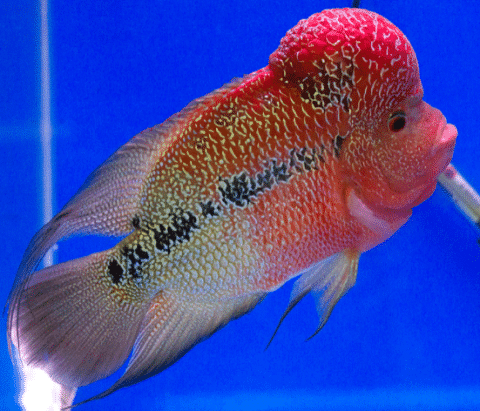
A Flowerhorn Cichlid is a large fish with a unique body shape and nuchal hump also called a Kok. The nuchal hump is the large protrusion on top of your fish’s head that gives them an easily recognizable silhouette. The size can vary from massive nuchal humps on males to nonexistent on females. The size can also change depending on the situation the fish finds itself in.
Both the dorsal and anal fins start about two-thirds of the way back on the body and stretch all the way to the base of the tail. The dorsal fin matches the bulk of the anal fin and ends in a fleshy, braid-like protrusion. The dorsal and anal fins also dwarf the caudal fin.
The tail fin, on the other hand, is round and much thinner than the other fins but the shape may vary. The pectoral fins are quite short and often almost see-through.
Flowerhorns also have quite a lumpy ‘chin’ area that extends right to the ventral fins. This feature is much more prominent in males.
Male Flowerhorns also have more brightly colored, pearlized scales. The female Flowerhorn will be an inch or two smaller than the male.
The unusual patterns of Flowerhorns evolve and change as the juvenile fish grow into adulthood. Once this critter reaches mature size, the patterns are set. This means that you may not know what you’re getting if you choose a juvenile fish. Most will end up with horizontal black stripes, however.
The eyes of these aquatic pets are quite prominent. The King Kamfa variety have white or yellow eyes.
How Big Can They Get?
Flowerhorn Cichlids are a large fish species. These aquarium fish can grow to about 12 to 16 inches (30.4-40.6cm) depending on the variant. It’s important to know the average size of your adult. The size will affect everything from Flowerhorn Cichlid care, tank mates, and even the aquarium setup.
How Long Do They Live?
Flowerhorns can live around 10 to 12 years. For this reason, it is quite important that you’re ready for a long-term commitment. The lifespan of your fish can drastically vary depending on the care you provide.
If your fish is constantly exposed to poor water quality or set up in an unsuitable aquarium, you can expect a sickly, short-lived fish.
What Do They Eat?
Flowerhorn Cichlids are omnivorous. This means that you’ll need to feed meaty treats like brine shrimp, bloodworms, mosquito larvae, as well as some greens to keep your fish healthy. The best way to do this is to feed a healthy pellet-based diet for omnivorous fish with some added treats.
Feeding a Flowerhorn Cichlid is fairly easy as long as you get the balance right. Due to these fish being so large, they have quite a big apatite. These freshwater fish will quite happily feed on just about anything that ends up in the tank.
If you’re unsure which meaty treats your fish can eat, consider adding the following foods:
- Brine shrimp
- Shrimp
- Bloodworms
- Mosquito larvae
- Earthworms
- Other aquatic worms
- Fish fillet
- Dried crickets
- Dried grasshoppers
- Krill
What you feed will depend on the size of your fish. Small treats like brine shrimps are for small fish. Bigger fish can have bigger snacks like earthworms.
For greens, you can consider adding the following vegetables:
- Boiled peas (No shells)
- Zucchini
- Shredded lettuce
- Cucumber
Give Them Live Foods
To keep your fish in tip-top shape, it is best to feed both live and frozen foods. Live foods, like mosquito larvae, will provide your fish with some entertainment. Hunting these creatures will also appeal to the foraging instincts of your Flowerhorn Cichlid.
How Much and How Often to Feed Them
It is best to feed your Flowerhorn Cichlid just enough to finish the food within five minutes after feeding. If you notice any food left at the end of five minutes, consider reducing the amount fed.
Any food that is allowed to settle to the bottom of the tank will just stay there to rot. This reduces your water quality and will lead to ammonia spikes if you’re not careful.
On the other hand, if your fish isn’t fed enough, it will start to dig up plants, chew on the leaves and break the stems. To reduce this destructive behavior, make sure to feed your fish regularly.
Adult fish need to be fed around two to three times a day. Young fish need five to 10 feedings to help them grow. If your fish aren’t interested in every feeding, reduce the number of feeding per day.
Their Temperament and Behavior
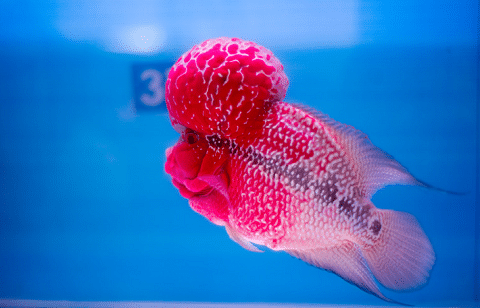
Flowerhorn Cichlids have a reputation for being quite aggressive. For this reason, they don’t do so well in community tanks with other fish. If you keep these fish with other species, you can expect fights to break out quite often. Even when kept in tanks with others of their kind, their aggressive nature will often lead to fighting.
Funny enough, Flowerhorns do prefer to swim in pairs. Keeping a male and female together in the tank will often reduce aggression and lower the stress levels in the aquarium.
It is possible to add in a few tank mates for your Flowerhorns if you do some careful planning. It’s an idea to keep them with peaceful fish of a similar size.
These Cichlids also won’t just stay in one layer of the tank. You can expect to see your fish moving up and down the water column as they, please. They will also claim territories in the aquarium which can lead to fighting. This is why it is very important to have enough space if you’re planning on having more than one Flowerhorn Cichlid in the tank.
If you’re planning a planted aquarium, you’ll also need to do some planning. These fish aren’t the best when it comes to living plants. They will often dig up the plants and even eat them. To avoid this, make sure to feed your fish correctly and plant unpalatable specimens that don’t require the substrate to thrive in your tank.
Tank Mates
Flowerhorn Cichlid tank mates aren’t easy to find. , these fish don’t do so well in a tank set up with other aquarium fish. Their aggressive nature and territorial tendencies will get in the way.
Fortunately, there are a few suitable tank mates out there. It will also help to select a large tank to reduce possible aggressive behavior. Before you select tank mates, keep the following guidelines in mind:
- Avoid other species of aggressive fish. Choosing fish with peaceful dispositions is best.
- Avoid slow-moving fish. Any species that gets selected must be able to escape any conflict.
- Avoid shrimp and snails, they will definitely only serve as a great snack for your fish.
- Avoid fish that are significantly smaller than your Flowerhorns. They will end up as snacks and targets for aggression rather than Flowerhorn tank mates.
- Any tank mate you select must be big enough to hold its own and be fast enough to swim away when the need arises.
If you’re still considering getting some friends for your fish, keep the lists below in mind.
Best Tank Mates for Them
It can get quite frustrating to select some fishy friends for your giant terrors. To make it a bit easier, consider the following species:
- Another Flowerhorn Cichlid (Best choice)
- Sailfin Plecos
- Leopard Plecos
- Bichir (Go big to avoid problems)
- Silver Arowana
- Bristlenose Plecos
- Jaguar Cichlids
- Common Plecos
- Clown Plecos
- Giant Gourami
- Lowland Cichlids
- Spotted Hope
- Armored Catfish
- Oscar Cichlids
Least Compatible Fish for Them
- Any aggressive fish species besides other Cichlids
- Very small fish like Rasboras
- Shrimps of any kind
- Snails of any kind
- Danios
- Tetras
- Livebearers
- Betta fish
- Loaches
- Red-Tailed Sharks
- Rainbow Sharks
- Iridescent Sharks
- Goldfish
- Koi
- Bala Sharks
- Angelfish
Care
Despite being a manmade fish, the Flowerhorn Cichlid is quite hardy and fairly easy to care for. If keeping fish is new to you, you shouldn’t have any problems, but having some experience is better. New fish keepers are often put off by the required tank size as well.
Flowerhorns are big fish. They are also quite aggressive and messy. This can complicate things when it comes to keeping other fish with your Flowerhorn. You’ll also need to do regular maintenance to keep the tank clean and the water conditions perfect.
Tank Requirements
Flowerhorns need quite big aquariums to satisfy their territorial needs. You will also need some decorations in your tank setup to keep them out of trouble.
Unfortunately, it’s impossible to know exactly what these fish prefer in terms of habitat since they were bred in captivity. In other fish species, you may set up the aquarium with plants or lots of rocks to mimic the natural habitat of that specific freshwater fish. In this case, your guess is as good as mine when it comes to tank decorations.
Despite not having a natural habitat, you can still create a stunning home for your pet. Here’s what you need to know.
Tank Size
To keep your fish healthy and stress-free, you will need at least a 75-gallon tank. These are very messy fish so if you can go bigger, go for it. Bigger tanks will prevent sudden changes in water parameters due to rotting fish waste and uneaten food.
If you’re thinking of keeping a breeding pair in the same tank, make sure to allocate at least 150 gallons to these fish. The bigger the tank, the less likely it will be for them to show aggression due to territorial battles. If you want a tank with different Cichlid species or other fish in it, make sure to give them a tank with a minimum volume of 215 gallons to prevent aggression.
Tank Setup
Setting up a Flowerhorn tank is really quite simple. After you’ve selected the tank you want, you will need to add a few things to create a suitable environment for your fish. Here are a few decor ideas to think about.
Plants
A Flowerhorn Cichlid does well in a tank with some added plants. Unfortunately, they do will dig up plants from the substrate. It’s best to keep them in tanks with plants that prefer to grow on other objects like driftwood and rocks with their roots exposed.
If possible, also select plants that aren’t the most palatable. Flowerhorns are omnivores and will nibble on your plants from time to time. A few live plants you can consider are Anubias Nana and Java Fern. Be prepared for some casualties, however, since these big fish will damage some of your plants.
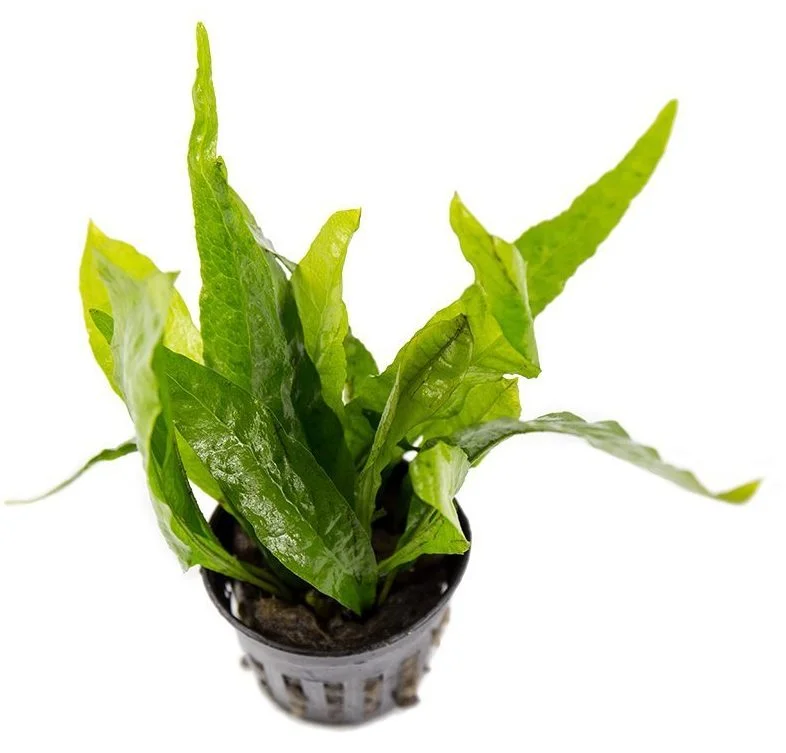
Editor’s Choice
Hardy, easy to care for, and requires only basic lighting to grow. This is the perfect aquarium plant for beginners!
Substrate
By now you probably noticed that Flowerhorns love to dig around in the substrate. For this reason, it is very important to choose something safe to put at the bottom of your tank.
The best substrate will be sand or large tiles without any sharp edges. Sand allows the fish to dig to its heart’s content without the risk of injury. Avoid coarse gravel. The substrate is often ingested during digging which may lead to impaction if the grains are too large.
Some aquarium enthusiasts prefer to have a bare bottom tank. Bare tanks are very easy to clean and also completely remove the likelihood of impaction due to substrate ingestion.
Decor
To create a bit more structure in the tank, you can add large heavy rocks or driftwood to your tank. Just make sure that the items you add are large and heavy enough to not be knocked over by your fish. If you can, secure any decorations to the bottom of the tank.
Water Quality and Filtration
Flowerhorns prefer clean water in their tanks. They are quite sensitive to pollutants which means regular water changes are necessary to keep them healthy. It is also best to have a moderate flow in the tank to circulate oxygen and remove toxins.
Filtration
Flowerhorns are very messy. For this reason, they need a strong filtration system to help maintain the correct water parameters. Your filter should produce a moderate flow to circulate water around the aquarium.
A canister filter is an excellent choice when it comes to these Cichlids. It will create the correct flow while removing any solids from the water. It will also help to remove toxins by allowing beneficial bacteria to grow in the filter media. The Fluval FX Series is designed for large fish like Flowerhorns.

High flow, large filtration capacity, and quality plumbing – The FX series is designed for monster fish keepers
Water Parameters
Despite being quite hardy fish, you will still need to keep an eye on the water conditions to keep them healthy. Here’s a quick breakdown of the parameters for Flowerhorn Cichlids:
- Water Temperature: 75-86°F (24-30°c)
- pH: 6.5-7.8
- GH: 161-358ppm (9-20 dGH)
- kH: 54-107ppm (3-6 dKH)
- Ammonia (NH3): 0 ppm
- Nitrite (NO2-): 0 ppm
- Nitrate (NO3-): <20 ppm
Aquarium Maintenance
Since Flowerhorns are such slobs, it is very important to do regular aquarium maintenance. You should do weekly water changes and replace at least 20% of the aquarium water. On top of that, you can do monthly water changes of up to 70% of the total volume of water.
Doing these water changes will remove solid waste and excess nitrates in the water. Nitrates may not be dangerous in small quantities, but they will become toxic in large amounts.
Testing Tank Conditions
To keep your fish health excellent, make sure to do weekly water tests. To achieve this you will need a water test kit. The ideal kit will test all the water parameters except for the temperature in your tank. For that, you will need a thermometer.
Breeding
Breeding these fish is very difficult. Fertile specimens are extremely rare in this hybrid breed. A fish keeper also needs to wait for around 8-10 months or even longer before they can test breed their male and up to 2 years for a female. For this reason, it becomes very frustrating trying to breed these Cichlids.
If you still insist on breeding them, you’ll need a breeding tank and some knowledge.
Sexing
Male and female Flowerhorns are quite easy to tell apart. Males are around one to two inches bigger than females. They are also more brightly colored.
You can also expect a V-shaped vent on the male where the female has a U-shaped vent. The most prominent difference is the nuchal hump. Males will have massive nuchal humps while a female has no hump or just a very small protrusion.
It is difficult to sex juveniles so make sure to buy from an experienced breeder to be sure.
Getting Your Fish Ready to Breed
You don’t need to do anything special to prepare your fish for breeding. Simply place them in a breeding tank with a similar size to their normal tank. If the male is too aggressive, use a divider that allows water flow between the male and female. This should encourage breeding as soon as the divider is removed.
Your breeding tank will function as both a spawning tank as well as a fry tank.
The Breeding Process
During the breeding process (video source), the female Flowerhorn will lay around 900 eggs on a smooth surface somewhere in the tank. The male will then swim over and fertilize the eggs.
Once fertilization has taken place you can remove the female. The male Flowerhorn will care for the eggs until they hatch. Once the fry hatched, you can also remove the male.
Caring For Fry
Caring for the fry is quite simple. It is best to feed the fry with live food like brine shrimps to help them grow. You will need to do this 5 to 10 times per day to keep up with their ferocious appetite and nutrient needs.
Once they turn 6 months old, you should be able to sex your offspring and separate them into different grow-out tanks.
Health And Disease
You’ll be happy to know that Flowerhorns aren’t susceptible to any particular disease. Unfortunately, there are still a few things you should be aware of. Let’s take a look at your Cichlid’s health.
Evaluating Their Health
It’s very important to keep an eye on these amazing creatures. Fortunately, it’s quite obvious when your pet isn’t feeling so well. Look out for the following red flags:
- Reduced apatite
- Obvious sores on the body
- Reduced activity level
- Change in normal behavior
Common Health Issues
These Cichlids are amazingly healthy pets. This doesn’t mean they are completely immune against diseases, however. Here are a few health issues you should be aware of:
- Mechanical health issues
Due to these fish being so aggressive, you can expect a few injuries every now and then. These shouldn’t be a huge problem unless they affect the fish’s ability to swim. Injuries can also happen during the exploration of the tank and while digging through the substrate.
Avoid these issues by checking the tank for any sharp objects and providing a large enough aquarium to avoid conflict.
- Ich
Ich shows up as white spots on the body and gills of your aquatic pet. Make sure to treat this disease immediately to prevent serious complications. To understand ich better, take a look at this article.
- Hole-in-the-head disease
This disease looks like holes in the nuchal hump of your fish. Fortunately, it is curable, but some scarring will remain. Treat this problem by doing daily water changes and removing any activated carbon in your tank until the water conditions improve.
Where to Buy
Flowerhorn Cichlids are quite popular. They is found in almost any aquarium shop around the world. Unfortunately, these hybrid species are not cheap to obtain. The average price they go for is around $35 for just one fish. To get the best of the best, you will need to venture to an online fish store, connect with breeders locally, or at tradeshows.
FAQS
How much do they cost?
On average, the Flowerhorn costs around $35 per fish. If you buy a juvenile, the costs is slightly lower.
How big do they get?
Flowerhorns can grow to around 12 to 16 inches (30.4-40.6cm) depending on the strain.
When do they get their hump?
Flowerhorns only grow humps under the right conditions. Most juveniles should start to develop their characteristic appearance at around 6 months old.
Can they live with African Cichlids?
Yes, but there is always the risk of conflict. Make sure the tank is big enough if you want to attempt this.
Is the Flowerhorn Cichlid Right for You?
Before you commit to this species, here’s an honest assessment of whether it fits your setup and experience level.
- Perfect if you want a pet fish, not just an aquarium. Flowerhorns recognize their owners, beg for food, and develop distinct personalities that rival any pet.
- Not for small tank keepers. You need 75 gallons minimum for a single flowerhorn, and bigger is always better with these fish.
- Great if you enjoy a species-only setup. Most flowerhorns do best as the sole fish in their tank, so if you like the idea of one showpiece fish, this is your species.
- Skip if you’re on a tight budget. Between the large tank, heavy filtration, and high-protein diet, flowerhorns are expensive to maintain compared to most freshwater fish.
- Ideal for keepers who want interaction. These fish will play with you through the glass, follow you around the room, and learn feeding routines within days.
- Not suitable for community setups. Unless you have 150+ gallons and experience managing aggressive cichlids, plan on keeping them alone.
How the Flowerhorn Cichlid Compares to Similar Species
Flowerhorns are often compared to oscars, and it’s an understandable comparison. Both are large, personable cichlids that become genuine pets. But they’re different fish in practice. Oscars are messy eaters that need excellent filtration but are less aggressive toward tank mates of similar size. Flowerhorns take aggression to another level. An oscar will chase a tank mate; a flowerhorn will kill one. Oscars also grow slightly larger (up to 14 inches vs. 12 for most flowerhorns) and are less expensive to acquire. If you want a big, interactive pet fish and plan to keep it with other large cichlids, the oscar is the safer choice. If you want a single showpiece fish with maximum visual impact and don’t mind a solo setup, the flowerhorn is hard to beat.
The red devil cichlid is one of the parent species used in flowerhorn breeding, so the comparison is natural. Red devils are pure species with their own charm. They’re slightly less flashy but arguably more authentic. They share the flowerhorn’s aggression and need for space, but they lack the exaggerated nuchal hump that makes flowerhorns so distinctive. Red devils can also be kept in pairs for breeding, which is something flowerhorns (as hybrids) can’t do as reliably.
What It Is Actually Like Living With Flowerhorn Cichlid
Living with a flowerhorn is the closest thing to keeping a pet that also wants to fight you. You walk into the room and the fish follows you, pressing against the glass, flaring, displaying. You put your finger near the tank and it charges. You reach in for maintenance and it bites you. Not a nip. A bite with intent. You learn to respect the fish, and in return, it gives you a level of interaction that no other freshwater species can match.
The tank will never look the way you set it up. Substrate gets piled into mounds. Decorations get shoved into corners. Heaters get knocked sideways. You stop fighting it and start securing equipment with suction cups rated for industrial use. The flowerhorn wins every decorating argument. Every single time.
Feeding is a performance. The fish sees the food container and goes into a frenzy. It slams into the surface, grabs pellets with force, and makes a mess. Visitors are either fascinated or slightly alarmed. The flowerhorn does not care either way. It is the undisputed center of attention in whatever room it occupies, and it knows it.
Closing Thoughts
A flowerhorn does not coexist. It dominates or it destroys.
Flowerhorn fish is very popular in the aquarium trade. They are fairly easy to keep as long as you do regular tank maintenance to keep the water quality pristine. It is also important to monitor the water temperature to keep them healthy.
If you have any questions, please comment below.
- About the Author
- Latest Posts

I’m Mark Valderrama, founder of Aquarium Store Depot and a fishkeeper with over 25 years of hands-on experience. I started in the hobby at age 11, worked at local fish stores, and have kept freshwater tanks, ponds, and reef tanks ever since. I’ve been featured in two best-selling aquarium books on Amazon and built this site to share practical, experience-based fish keeping knowledge.

Leave a Reply