Last Updated: June 25, 2026
Thank you for visiting! By the way… any links on this page that lead to products on Amazon and other stores/partners are affiliate links Aquarium Store Depot earns a commission if you make a purchase.
Table of Contents
- Key Takeaways
- Species Overview
- Classification
- Origin & Natural Habitat
- Appearance & Identification
- Average Size & Lifespan
- Care Guide
- Tank Mates
- Food & Diet
- Breeding & Reproduction
- Common Health Issues
- Common Mistakes to Avoid
- Where to Buy
- Frequently Asked Questions
- Closing Thoughts
- References
Oscars will outgrow your tank, eat your other fish, and produce enough waste to crash your water quality in days if your filtration is not up to the task. I have watched more people fail with this fish than succeed over my 25+ years in the hobby. Most of them walked into a pet store, saw a cute 2 inch juvenile, and had no clue they just committed to a 12 inch, 15 year predator that will rearrange their entire setup.
But if you go in prepared, an oscar is hands down one of the best fish you will ever keep. No other freshwater fish comes close to the personality, the intelligence, or the bond you build with one. This guide is what I wish someone had handed me before my first oscar. Not the watered down version. The real one. Because this is not a fish you add to a tank. It becomes the tank.
If you treat an oscar like a community fish, you will fail. Full stop.
Once you commit to an oscar, you are committing to a large tank, heavy filtration, and weekly maintenance for the next decade. There is no scaling back once they hit full size.
What Most Care Guides Get Wrong About Oscar Fish
The most damaging misconception about oscars is that baby oscars can grow into their tank. They can’t – or rather, they will, but their health suffers dramatically. I’ve seen too many oscars stunted in 30 or 40-gallon tanks, developing hole-in-the-head disease and shortened lifespans because their owners planned to “upgrade later.” Later rarely comes. Buy the big tank first – 75 gallons absolute minimum, 125 gallons preferred. The other myth is that oscars are aggressive. They’re really not, compared to actual aggressive cichlids. Oscars are more accurately described as predatory – they’ll eat anything that fits in their mouth, but they’re not territorial bruisers like red devils or green terrors.
But here’s the thing most pet stores won’t tell you when you’re staring at that adorable 2-inch baby oscar in the display tank: this fish is going to get big. Really big. And it’s going to get there fast. Oscars routinely reach 12 to 14 inches in captivity, they need a minimum of 75 gallons, and they produce more waste than almost any other aquarium fish their size. If you’re not ready for that commitment, you’re going to have problems. This guide covers everything you need to know before you buy one, and everything you need to do right once you bring one home.
The Reality of Keeping Oscar Fish
I am going to be blunt. Oscars are not a beginner fish no matter what the pet store employee tells you. They are often one of the most misrepresented fish in the hobby, sold as hardy and easy when the reality is they require serious commitment. Here is what that actually looks like.
They outgrow tanks fast. That 2 inch juvenile you brought home will be 6 inches in four months and pushing 10 inches within a year. A 75 gallon tank is the absolute minimum for a single oscar. Never keep an oscar in anything smaller long term. There is no debate on this., and honestly, I would start with a 125 if you plan on keeping one long term.
The bioload is no joke. Oscars produce more waste than almost any other common aquarium fish. You need heavy duty filtration, ideally a canister filter rated for at least twice your tank volume, and you will be doing 30 to 50 percent water changes every single week.
They destroy decorations. Plants get uprooted. Gravel gets moved. Heaters get knocked off suction cups. In my experience, the best oscar setups are simple. Sand substrate, a few large rocks too heavy to move, and a solid heater guard. That is the setup I always come back to.
They live a long time. A healthy oscar can live 10 to 15 years. I have personally known keepers who had theirs for over a decade. That is not a fish you keep for a season. It is a commitment closer to a dog than a goldfish.
Biggest Mistake New Oscar Owners Make
They buy the fish small, put it in a 30 or 40 gallon tank, and tell themselves they will upgrade later. They almost never do. By the time the oscar is 8 inches and the tank is crashing from ammonia, they are either rehoming the fish or watching it suffer. If you are not ready to start with a 75 gallon minimum on day one, do not buy the fish.
Expert Take (Mark Valderrama, AquariumStoreDepot)
A 75 gallon tank is the minimum for a single oscar. In practice, I recommend starting with a 125 gallon if you want to keep one long term. The difference in water stability, swimming space, and overall fish health between a 75 and a 125 is night and day. Do not cheap out on the tank. It is the single most important decision you will make.
Key Takeaways
- Plan for adult size from day one. Oscars grow to 12-14 inches (30-35 cm) and need a minimum 75-gallon tank, though 125 gallons is better for long-term housing
- Extremely messy eaters that require heavy-duty filtration and frequent water changes to maintain water quality
- One of the most intelligent aquarium fish, capable of recognizing their owner and learning feeding routines within days
- Not community-friendly in most setups. Oscars will eat anything that fits in their mouth and may bully fish that don’t
- Long-lived commitment. Healthy oscars can live 10-20 years with proper care
Species Overview
| Field | Details |
|---|---|
| Scientific Name | Astronotus ocellatus |
| Common Names | Oscar, Oscar Cichlid, Tiger Oscar, Velvet Cichlid, Marble Cichlid |
| Family | Cichlidae |
| Origin | Amazon and Orinoco River basins, South America |
| Care Level | Moderate |
| Temperament | Aggressive |
| Diet | Omnivore (primarily carnivorous) |
| Tank Level | All levels |
| Maximum Size | 14 inches (35 cm) |
| Minimum Tank Size | 75 gallons (284 liters) |
| Temperature | 74 to 81°F (23 to 27°C) |
| pH | 6.0 to 8.0 |
| Hardness | 5 to 20 dGH |
| Lifespan | 10 to 20 years |
| Breeding | Substrate spawner |
| Breeding Difficulty | Moderate |
| Compatibility | Large fish only |
| OK for Planted Tanks? | No (will uproot plants) |
Classification
| Taxonomic Level | Classification |
|---|---|
| Order | Cichliformes |
| Family | Cichlidae |
| Subfamily | Astronotinae |
| Genus | Astronotus |
| Species | A. ocellatus (Agassiz, 1831) |
The oscar was first described by Louis Agassiz in 1831 and has been a fixture of the aquarium hobby since at least the 1930s. The genus name Astronotus translates roughly to “star back,” referring to the star-like markings on the body, while ocellatus means “eye-like spot,” pointing to the distinctive ocellus (eyespot) typically found at the base of the tail fin. This eyespot is thought to confuse predators by mimicking a larger fish’s eye.
There is one other recognized species in the genus, Astronotus crassipinnis, which is occasionally imported but rarely seen in the hobby compared to the common oscar.
Origin & Natural Habitat
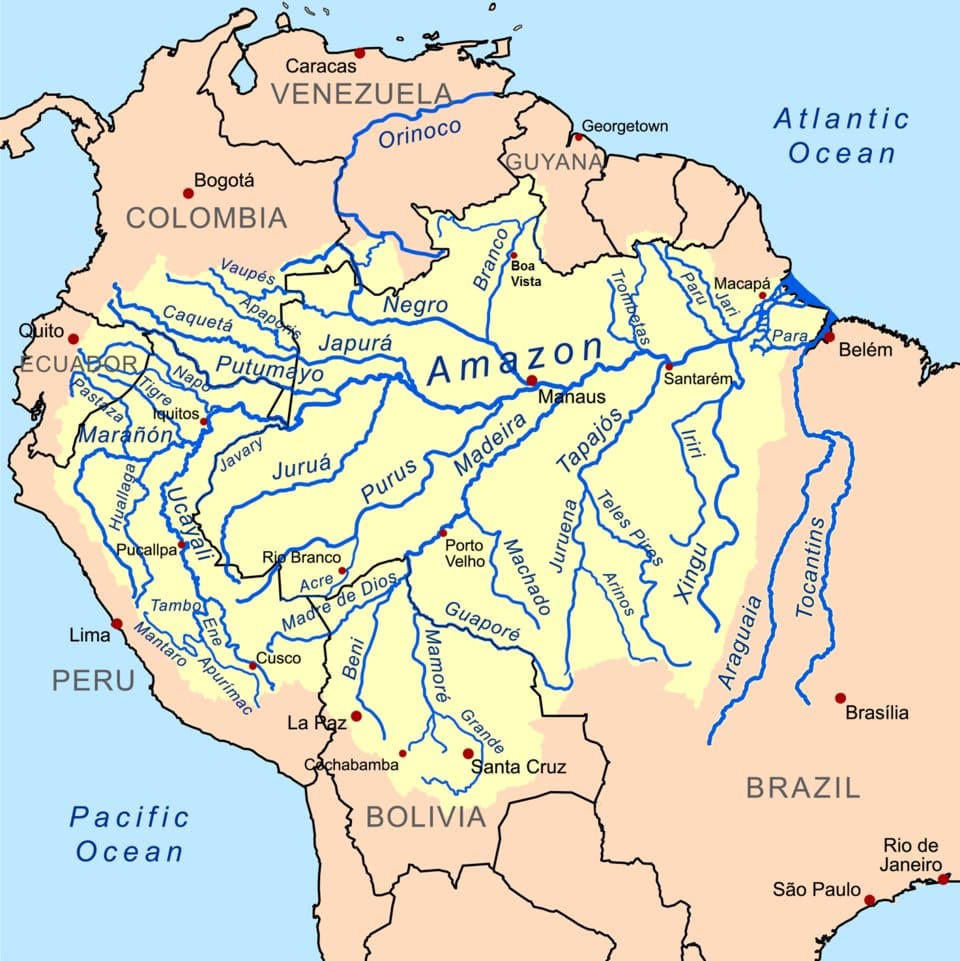
Oscars are native to a wide swath of South America, occurring throughout the Amazon and Orinoco River basins across Colombia, Venezuela, Peru, Brazil, Ecuador, Bolivia, Paraguay, and Argentina. Their natural range is enormous, which partly explains their adaptability in captivity. They’ve also been introduced to waterways in Florida, Hawaii, and several other tropical and subtropical regions where they’ve established breeding populations.
In the wild, oscars tend to inhabit slow-moving or still waters, favoring forested areas where submerged tree roots, fallen branches, and overhanging vegetation provide cover. They’re typically found in silt-laden white water systems rather than clear or blackwater environments, though they can tolerate a range of conditions. The substrate in their natural habitat is usually soft sand or mud.
Wild oscars are ambush predators that stake out territories around structure and wait for smaller fish, crayfish, and insects to venture too close. This hunting strategy carries over into aquarium behavior. Your oscar isn’t just swimming around aimlessly. It’s constantly watching, evaluating, and waiting for something interesting to happen. Understanding this natural behavior helps explain why oscars need space, structure, and a varied diet to truly thrive.
Appearance & Identification
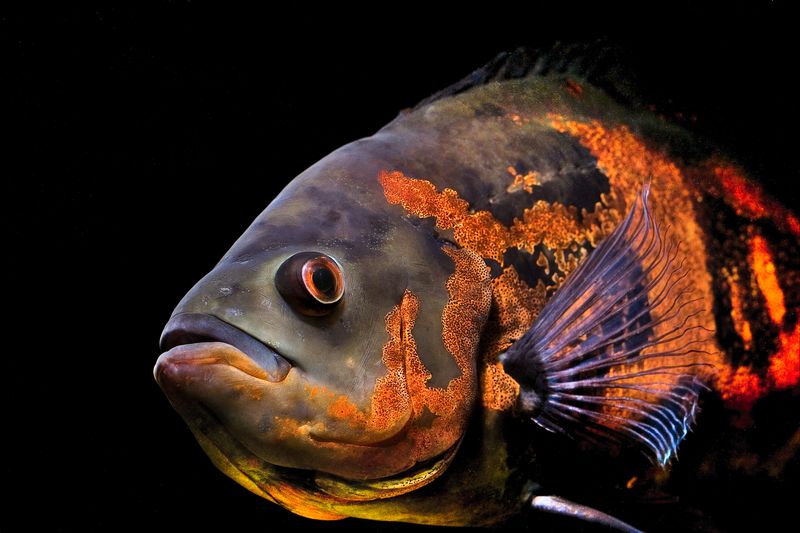
Wild-type oscars have an olive-green to dark brown base coloration with irregular orange-red markings scattered across the body and fins. The signature feature is the ocellus, a black spot ringed with orange at the base of the caudal fin, which serves as a false eye to deter predators. They have large, thick-lipped mouths and a robust, oval-shaped body built for power rather than speed.
Decades of selective breeding have produced several popular color variants including tiger oscars (bold orange and black patterning), red oscars (predominantly deep red coloration), albino oscars (white or yellow body with red eyes), and lemon oscars (bright yellow). Regardless of the color form, all oscars share the same basic body shape, size potential, and behavioral traits.
Juveniles look nothing like adults. Baby oscars are dark with white and orange barred patterning that serves as camouflage. As they grow, their adult coloration gradually develops over several months. This transformation is one of the most rewarding aspects of raising an oscar from a juvenile.
Male vs. Female
Sexing oscars is notoriously difficult outside of breeding condition. There are no reliable external differences in color, fin shape, or body proportions between males and females. The only definitive way to determine sex is during spawning, when the female’s ovipositor (egg tube) becomes visible. It is shorter, broader, and more blunt than the male’s narrower, pointed breeding tube.
| Feature | Male | Female |
|---|---|---|
| Body Size | Slightly larger on average | Slightly smaller on average |
| Body Shape | No reliable difference | No reliable difference |
| Coloration | No reliable difference | No reliable difference |
| Fins | No reliable difference | No reliable difference |
| Breeding Tube | Narrow and pointed | Shorter, broader, and blunt |
Many keepers rely on behavioral cues during pair formation. Established pairs often swim together, lip-lock during courtship, and jointly clean spawning sites before breeding. If you want a breeding pair, the most reliable approach is to raise a group of 4-6 juveniles together and let them pair off naturally.
Average Size & Lifespan
Oscars typically reach 12 to 14 inches (30-35 cm) in captivity, though exceptional specimens in very large tanks can push toward 16 inches (40 cm). They grow fast, too. A juvenile oscar can easily put on an inch per month during its first year, reaching 8-10 inches within 12 months under good conditions. This rapid growth catches many new keepers off guard.
With proper care, oscars routinely live 10-15 years in aquariums, and well-maintained specimens have been reported to reach 20 years. This is a genuine long-term commitment. Before bringing an oscar home, consider whether you’ll still have room for a 75+ gallon tank a decade from now. Too many oscars end up rehomed because their owners didn’t plan ahead.
ASD Difficulty Rating: Tier 3 – Advanced
Oscar fish are large, messy predators that grow to 12 inches (30 cm) and produce an enormous bioload. They need 75+ gallon tanks, canister filtration, and consistent water maintenance. This is not a community fish – they will eat anything that fits in their mouth.
Care Guide
Tank Size
The absolute minimum for a single adult oscar is 75 gallons (284 liters), and honestly, bigger is always better with this species. A 125-gallon (473-liter) tank gives a single oscar much more room to move and creates a more stable water chemistry environment. For a pair of oscars, 125 gallons should be considered the starting point, and 150+ gallons is preferable.
Tank footprint matters more than height. A standard 75-gallon tank (48 x 18 x 21 inches) provides reasonable swimming room, but the wider 18-inch depth helps the oscar turn comfortably. Tall, narrow tanks are a poor choice regardless of total volume.
Water Parameters
| Parameter | Recommended Range |
|---|---|
| Temperature | 74 to 81°F (23 to 27°C) |
| pH | 6.0 to 8.0 |
| General Hardness | 5 to 20 dGH |
| Ammonia | 0 ppm |
| Nitrite | 0 ppm |
| Nitrate | Below 20 ppm |
Oscars are fairly adaptable when it comes to water chemistry. Most captive-bred oscars do fine in a wide pH range, and they aren’t particularly sensitive to hardness. What they absolutely cannot tolerate is poor water quality. High ammonia, nitrite, or nitrate levels will show up as hole-in-the-head disease, fin erosion, and loss of appetite long before they become lethal. Consistent water parameters matter far more than hitting a specific number.
Filtration & Water Flow
Filtration is the single most important piece of equipment in an oscar tank. These fish are messy eaters and heavy waste producers. You need a filter (or combination of filters) that turns over the tank volume at least 4-5 times per hour. A canister filter rated for a tank significantly larger than yours is a good starting point. Many oscar keepers run two filters for redundancy and to handle the bioload.
Oscars don’t need strong current. Moderate flow is fine, and they actually prefer calmer areas in the tank. Direct the filter output along the back wall or use a spray bar to diffuse the flow. Even with heavy filtration, weekly water changes of 25-40% are non-negotiable with oscars. This species does not do well in stale water.
Lighting
Standard aquarium lighting is fine for oscars. They don’t have any special lighting requirements and actually tend to prefer subdued light over bright illumination. If you’re not growing live plants (and you probably won’t be in an oscar tank), a simple LED fixture on a timer with 8-10 hours of light per day is all you need.
Plants & Decorations
Let me be blunt: oscars destroy planted tanks. They dig, they uproot, they rearrange. If you put delicate stem plants in an oscar tank, you’ll find them floating at the surface within hours. The only live plants that sometimes survive oscar treatment are tough species like java fern or anubias attached to heavy driftwood, and even those aren’t guaranteed.
For décor, think heavy and simple. Large pieces of driftwood, smooth river rocks, and sturdy ceramic or clay decorations work well. Avoid anything with sharp edges or small openings where a large oscar could injure itself. Many experienced oscar keepers go with a minimalist setup: sand substrate, a couple of large driftwood pieces, and open swimming space. The oscar becomes the decoration.
Substrate
Fine to medium sand is the best substrate for oscars. It’s easy to clean, safe when ingested (oscars frequently pick up and spit out substrate), and allows for their natural digging behavior. Gravel works but makes cleaning more difficult since food debris settles between the pieces. Some keepers opt for a bare bottom tank, which makes maintenance easier but looks less natural.
Is the Oscar Fish Right for You?
Before you commit to this species, here’s an honest assessment of whether it fits your setup and experience level.
- The ultimate pet fish. Oscars recognize their owners, beg for food, and develop personalities that are genuinely comparable to dogs.
- Plan for adult size from day one. A 2-inch baby at the store will be 12+ inches within a year. Buy the 75-125 gallon tank before you buy the fish.
- Extremely messy eaters. Budget for heavy-duty filtration and commit to regular water changes – this is non-negotiable.
- Not truly aggressive, but definitely predatory. They’ll eat anything that fits in their mouth without hesitation.
- Long-lived commitment. 15-20 years with proper care. Make sure you’re ready for that before you bring one home.
- Should be kept with similar-sized, tough tank mates. Severums, large plecos, and silver dollars often work well in 125+ gallon setups.
Tank Mates
Choosing tank mates for oscars is all about one simple rule: if it fits in the oscar’s mouth, it will eventually end up there. Oscars are opportunistic predators with surprisingly large mouths for their body size. Any fish under 4-5 inches is basically a snack waiting to happen.
Best Tank Mates
- Silver dollars. Fast, deep-bodied, and too large to eat. One of the most popular oscar companions
- Large plecostomus. Common plecos, sailfin plecos, and other armored catfish over 6 inches. Their tough armor and bottom-dwelling nature keeps them out of trouble
- Bichirs. Tough, armored, and large enough to coexist. Senegal bichirs and similar species can work well
- Jack Dempseys. Another robust cichlid that can hold its own (only in tanks 125 gallons and larger)
- Firemouth cichlids. Can work in larger setups where they have room to retreat
- Large severums. Similar temperament and size range, generally compatible
- Flagtail prochilodus. Large, active characin that’s too fast and deep-bodied to be prey
Tank Mates to Avoid
- Any small fish. Tetras, guppies, danios, rasboras, and small barbs are all oscar food
- Highly aggressive cichlids. Red devils, jaguar cichlids, and similar ultra-aggressive species can seriously injure or kill oscars
- Slow-moving small fish. Corydoras, small loaches, and similar species won’t last a week
- Shrimp and snails. Expensive oscar snacks
- African cichlids. Different water requirements and incompatible aggression styles
Food & Diet
Oscars are not picky eaters. In fact, one of the biggest challenges with oscar feeding is preventing overfeeding rather than getting them to eat. A high-quality cichlid pellet should form the base of the diet, making up about 60-70% of what they eat. Look for pellets with whole fish or shrimp as the first ingredient and avoid fillers like wheat and soy.
Supplement the staple pellets with a rotation of frozen foods like shrimp, krill, silversides, and bloodworms. Live earthworms are an exceptional treat that oscars go absolutely crazy for. Crickets and mealworms can also be offered occasionally. The variety keeps things interesting for the fish and ensures a well-rounded nutritional profile.
A few feeding rules to live by: feed adult oscars once or twice daily, only as much as they can consume in 2-3 minutes. Avoid feeder fish entirely. They offer poor nutrition, they introduce parasites and diseases, and they teach oscars to be more aggressive. The old practice of dumping dozens of feeder goldfish into an oscar tank is bad husbandry. Quality pellets and frozen foods are better in every way.
Breeding & Reproduction
Breeding Difficulty
Moderate. Getting oscars to spawn isn’t particularly difficult once you have an established pair. The hard part is getting that pair in the first place, since you can’t reliably sex them visually. Most breeders raise a group of 4-6 juveniles together and wait for natural pair formation, then separate the bonded pair into their own tank.
Spawning Tank Setup
A dedicated breeding tank of at least 100 gallons works best. Provide flat rocks, slate tiles, or smooth stone surfaces as potential spawning sites. The pair will choose and meticulously clean their preferred surface before spawning. Keep décor minimal so the parents don’t feel cramped and stress isn’t a factor.
Water Conditions for Breeding
Breeding oscars generally prefer slightly warmer water (78-82°F / 26-28°C) with a pH around 6.5-7.0. A large water change with slightly cooler water can sometimes trigger spawning, simulating the onset of the rainy season in their natural habitat. Excellent water quality is essential, with nitrates kept below 10 ppm.
Conditioning & Spawning
Condition the pair with high-protein foods like earthworms, shrimp, and quality pellets for 2-3 weeks before attempting to trigger spawning. When ready, the pair will begin cleaning a flat surface together, often lip-locking as part of their courtship ritual. The female deposits eggs in neat rows on the cleaned surface, and the male follows behind to fertilize them. A single spawning can produce 1,000-2,000 eggs.
Egg & Fry Care
Both parents guard the eggs aggressively, fanning them to maintain water circulation and removing any that turn white (infertile). Eggs hatch in approximately 3-4 days at 80°F (27°C). The fry become free-swimming about 5-7 days after hatching. First-time parents may eat their eggs or fry, which is frustrating but normal. It often takes 2-3 spawning attempts before the pair successfully raises a brood.
Once free-swimming, fry can be fed freshly hatched baby brine shrimp, crushed flake food, or commercial fry food. Growth is rapid with proper feeding and clean water. Frequent small water changes (10-15% daily) help maintain water quality in the fry tank.
Common Health Issues
Hole in the Head Disease (HITH)
This is the number one health problem in oscars, and it’s almost always caused by poor water quality, nutritional deficiency (particularly lack of vitamins and minerals), or a combination of both. Symptoms begin as small pits around the head and lateral line that gradually enlarge into open lesions. Treatment involves improving water quality, supplementing the diet with vitamin-enriched foods, and in severe cases, antiparasitic medication targeting Hexamita (the protozoan often associated with the condition). Prevention is straightforward: maintain excellent water quality and feed a varied, high-quality diet.
Ich (White Spot Disease)
Oscars are susceptible to Ichthyophthirius multifiliis, particularly when stressed by temperature fluctuations or poor water quality. White spots appear on the body and fins, and the fish may flash against objects. Treatment involves raising the temperature to 86°F (30°C) and adding aquarium salt (1 tablespoon per 5 gallons) or using a commercial ich medication. Oscars generally respond well to treatment if caught early.
Fin Rot
Bacterial fin rot shows up as fraying, discoloration, or progressive erosion of the fins. It’s almost always a secondary infection triggered by poor water quality or physical injury. Clean water is the first line of defense. Mild cases often resolve with water changes alone. More advanced cases need antibacterial treatment with medications like kanamycin or nitrofurazone.
Bloat
Abdominal swelling, loss of appetite, and lethargy can indicate internal bacterial infection or digestive issues. Bloat in oscars is often linked to poor diet (especially feeder fish), stress, or internal parasites. Epsom salt baths (1 tablespoon per 5 gallons) can help with mild cases. Severe bloat may require antibiotic treatment. Preventing bloat starts with a clean, varied diet and avoiding live feeder fish.
Hard Rule
Oscars need a 75-gallon minimum, and 125 gallons if you plan long-term. Their bioload is enormous – standard HOB filters will not keep up. Canister filtration with high turnover is not optional. Get the big tank and the right filter before you bring one home.
Common Mistakes to Avoid
- Starting with too small a tank. A 20 or 30 gallon tank is not acceptable even for a juvenile oscar if you don’t have an upgrade plan in place. These fish grow an inch a month in their first year
- Using feeder fish as a primary diet. Feeder goldfish and minnows are nutritionally poor, carry parasites, and increase aggression. Quality pellets and frozen foods are superior in every way
- Underestimating waste production. Oscars produce enormous amounts of waste. Skipping water changes or using undersized filtration leads directly to hole-in-the-head disease
- Keeping oscars with small tank mates. That neon tetra or cory catfish will become an expensive snack. Only house oscars with fish too large to be eaten
- Impulse buying baby oscars. Those cute 2-inch babies at the pet store will be over a foot long within 18 months. Plan ahead
- Neglecting tank covers. Oscars are powerful jumpers, especially when startled. A heavy, secure lid is essential
Where to Buy
Oscars are one of the most widely available freshwater fish in the hobby. You can find them at nearly every local fish store and big-box pet retailer. However, if you want healthy specimens from reputable sources, I recommend checking out online specialty retailers who take better care of their stock.
Flip Aquatics is a great option for quality freshwater fish, and Dan’s Fish is another trusted source where you can find healthy, well-cared-for oscars. Both ship directly to your door with live arrival guarantees. Buying from reputable sources reduces the risk of bringing home a fish carrying diseases or parasites.
When selecting an oscar, look for clear eyes, intact fins, no visible lesions or holes around the head, and active, alert behavior. Avoid any fish that is hiding in a corner, breathing rapidly, or showing signs of disease in its tank.
Frequently Asked Questions
What size tank does an oscar need?
A single adult oscar needs a minimum of 75 gallons (284 liters), though 125 gallons is strongly recommended. For a pair, 125 gallons is the bare minimum. The tank should have at least a 48-inch length and 18-inch width to allow the fish to turn comfortably.
How fast do oscars grow?
Very fast. Oscars can grow approximately 1 inch per month during their first year, reaching 8-10 inches by 12 months old. Growth slows after the first year but continues until they reach their full adult size of 12-14 inches. This rapid growth is why planning for adult size from day one is so important.
Can I keep just one oscar?
Absolutely. A single oscar does perfectly fine on its own and will often bond closely with its owner. Many experienced oscar keepers actually prefer keeping a single specimen, as it eliminates aggression issues and reduces the tank size requirement. A solo oscar in a well-maintained 75+ gallon tank is a perfectly valid setup.
Should I feed my oscar feeder fish?
No. Feeder fish (particularly feeder goldfish) are nutritionally poor, commonly carry parasites and diseases, and can encourage excessive aggression. High-quality cichlid pellets supplemented with frozen shrimp, krill, earthworms, and other varied foods provide better nutrition and are far safer.
Do oscars really recognize their owners?
Yes. Oscars are among the most intelligent freshwater aquarium fish. They quickly learn to recognize the person who feeds them and will often come to the front of the tank, follow your movements, and even accept food from your hand. They can also distinguish between familiar people and strangers, often hiding or acting cautiously around unfamiliar faces.
Can I keep live plants with an oscar?
In most cases, no. Oscars are notorious diggers and will uproot virtually any planted substrate. Your best bet is tough, epiphytic plants like java fern or anubias attached to heavy driftwood, but even these may be damaged. Most oscar keepers embrace the minimalist look with sand, driftwood, and rocks instead.
What It Is Actually Like Living With an Oscar Fish
This is the part no other care guide gives you. Forget water parameters for a minute. Here is what it is actually like to share your house with an oscar.
They beg like dogs. The second you walk into the room, your oscar is at the glass. Staring. Following you. Some of them splash water out of the tank when they think it is feeding time. You will start changing your route through the house just to avoid the guilt trip. And yes, they will absolutely train you to overfeed them if you let them.
They recognize individual people. Your oscar knows who you are. It will come to the front for you and hide when a stranger walks in. I have had guests not believe me until they see it happen in real time. This is not internet folklore. It is one of the things that makes oscars feel less like a fish and more like a pet with actual awareness.
They rearrange everything. Sand, gravel, rocks, decorations. If an oscar can move it, it will. I have woken up to find an entire tank rearranged overnight, heater suction cups popped off, and gravel piled into corners like they were remodeling. They are not being destructive. They genuinely have opinions about their setup.
Feeding gets expensive. A full grown oscar eats a lot. Quality pellets, occasional frozen food, and the sheer volume they consume adds up. Most people do not realize how much a full grown oscar eats until they are buying pellets every two weeks.
They are dramatic. Oscars will sometimes lay on their side at the bottom of the tank and look completely dead. Then you panic, tap the glass, and they swim off like nothing happened. It is just something they do. First time it happens you will nearly have a heart attack. By the fifth time you will barely look up from your phone.
How the Oscar Fish Compares to Similar Species
If you are deciding between an oscar and another large cichlid, here is how I would break it down based on what I have seen over the years.
Oscar vs Flowerhorn
Flowerhorns are more aggressive, more colorful, and even more destructive than oscars. If you want a fish with maximum visual impact and you are comfortable with a species only tank, go with a flowerhorn. If you want a fish with more personality and the option to keep a tank mate or two, the oscar is the better choice. In my experience, oscars are also significantly easier to keep healthy long term.
Oscar vs Jack Dempsey
Jack Dempseys stay smaller, need less space, and are generally less demanding on filtration. If you want the large cichlid experience but do not have room for a 75 gallon or larger tank, a Jack Dempsey is the more practical option. But if personality and intelligence are what you are after, the oscar wins and it is not even close.
Oscar vs Green Terror
Green terrors are stunning fish, but they are significantly more aggressive than oscars in my experience. If you want a showpiece cichlid in a mixed large cichlid tank, an oscar is usually the safer bet. Green terrors tend to dominate everything around them once they mature.
Closing Thoughts
Oscars aren’t for everyone, and that’s okay. They need big tanks, heavy filtration, frequent water changes, and a long-term commitment that most fishkeepers aren’t prepared to make. But for those who are willing to put in the work, an oscar rewards you with something you won’t get from most aquarium fish: a genuine relationship with a creature that knows who you are and gets excited to see you.
If you’ve read through this guide and you’re still excited about keeping an oscar, you’re probably the right kind of person for the job. Just remember: plan for the adult, not the baby. Get the big tank first, invest in proper filtration, feed a quality diet, and stay on top of water changes. Do those things right, and your oscar could be with you for the next 15-20 years.
References
- Seriously Fish. Astronotus ocellatus species profile. seriouslyfish.com
- FishBase. Astronotus ocellatus (Agassiz, 1831). fishbase.se
- Kullander, S.O. (2003). Family Cichlidae. In: Reis, R.E., Kullander, S.O. & Ferraris, C.J. (eds.) Check List of the Freshwater Fishes of South and Central America. Porto Alegre: EDIPUCRS.
- Practical Fishkeeping. Oscar care guide. practicalfishkeeping.co.uk
- About the Author
- Latest Posts

I’m Mark Valderrama, founder of Aquarium Store Depot and a fishkeeper with over 25 years of hands-on experience. I started in the hobby at age 11, worked at local fish stores, and have kept freshwater tanks, ponds, and reef tanks ever since. I’ve been featured in two best-selling aquarium books on Amazon and built this site to share practical, experience-based fish keeping knowledge.
Leave a Reply