
Last Updated: June 25, 2026
Thank you for visiting! By the way… any links on this page that lead to products on Amazon and other stores/partners are affiliate links Aquarium Store Depot earns a commission if you make a purchase.
Table of Contents
- Key Takeaways
- Species Overview
- Classification
- Origin & Natural Habitat
- Appearance & Identification
- Average Size & Lifespan
- Care Guide
- What People Get Wrong
- Tank Mates
- Food & Diet
- Breeding & Reproduction
- Reality of Keeping
- Common Health Issues
- Common Mistakes to Avoid
- Should You Get This Fish?
- Red Zebra Cichlid vs. Similar Species
- Where to Buy
- FAQ
- Closing Thoughts
- Recommended Video
- References
The Red Zebra Cichlid is one of the most popular, and ironically named, fish in the Lake Malawi hobby. Despite the name, these fish aren’t always red, and they rarely display zebra stripes. What Metriaclima estherae does deliver is bold, vibrant color that lights up any African cichlid tank. From bright orange females to blue-hued males, this is a polymorphic species that keeps things interesting.
Mbuna tanks look impossible at first glance, constant movement, territorial posturing, fish that seem to never stop chasing each other. The Red Zebra is your entry point into that world. It’s the most forgiving mbuna you can start with, but “forgiving” doesn’t mean “easy.” Get the formula wrong and you’ll lose fish. Get it right and you’ve got one of the most dynamic displays in freshwater fishkeeping.
Red Zebras are a mainstay mbuna for good reason, they’re hardy, colorful, and breed readily in captivity. They’re also one of the more accessible mbuna for hobbyists new to African cichlids, offering a real introduction to Lake Malawi without the extreme aggression of species like the Auratus. That said, they’re still mbuna. They defend their turf, and they don’t apologize for it.
In this guide, I’ll cover everything you need to know about keeping Red Zebra Cichlids, from the right tank setup and water parameters to diet, tank mates, and breeding. Let’s get into it.
Key Takeaways
- Polymorphic species, Color varies widely; females are typically orange/red, males are often blue or blue-orange
- Hardy and beginner-friendly, One of the more forgiving mbuna species for newcomers to African cichlids
- Semi-aggressive temperament, Territorial but manageable with proper stocking and rockwork
- 55-gallon minimum, Grows to 4–5 inches (10–13 cm) and needs horizontal swimming space
- Primarily herbivorous, Spirulina-based foods are essential; high-protein foods cause Malawi Bloat, which kills within 48–72 hours
- Maternal mouthbrooder, Easy to breed; females carry eggs for 12–18 days
- 1 male : 3+ females is non-negotiable, Too many males concentrates aggression and females cannot recover
🔵 ASD Difficulty Rating: Easy to Intermediate
The Red Zebra itself is one of the hardiest mbuna you can keep. The challenge isn’t the fish, it’s managing the system. The 1 male : 3+ female ratio isn’t a guideline, it’s a structural requirement. A spirulina-based diet isn’t a preference, it’s what prevents a fatal disease. And overstocking isn’t a mistake, it’s actually part of the strategy. A properly loaded mbuna tank spreads aggression across enough fish that no single individual gets targeted. Understanding these counterintuitive rules is what separates successful mbuna keepers from frustrated ones.
Species Overview
| Common Name | Red Zebra Cichlid, Orange Zebra, Estherae |
| Scientific Name | Metriaclima estherae (syn. Maylandia estherae) |
| Care Level | Easy to Intermediate |
| Temperament | Semi-Aggressive |
| Max Size | 4–5 inches (10–13 cm) |
| Min Tank Size | 55 gallons (208 liters) |
| Diet | Primarily Herbivore |
| Lifespan | 5–10 years |
| Water Temp | 76–82°F (24–28°C) |
| pH | 7.8–8.6 |
| Origin | Lake Malawi, Africa |
Classification
| Rank | Classification |
|---|---|
| Kingdom | Animalia |
| Phylum | Chordata |
| Class | Actinopterygii |
| Order | Cichliformes |
| Family | Cichlidae |
| Genus | Metriaclima |
| Species | M. estherae (Konings, 1995) |
Origin & Natural Habitat
The Red Zebra Cichlid is endemic to Lake Malawi in East Africa. They’re found along the rocky shorelines on both sides of the lake, with notable populations around Minos Reef, Chilucha Reef, and several other rocky habitats. Like all mbuna, they’re rock dwellers that spend their lives among the boulders and rubble of the shallow littoral zone.
In their natural habitat, Red Zebras typically inhabit depths of 3 to 30 feet (1–10 meters), grazing on aufwuchs, the biofilm of algae and microorganisms that coats the rocky surfaces. The water in these zones is clear, warm, and highly alkaline, with very stable parameters year-round. Males establish territories among the rocks while females and juveniles roam in loose groups.
One interesting note: the common name “Red Zebra” is somewhat misleading. The species was named for the occasional faint barring seen on some individuals, but most Red Zebras in the hobby display solid coloration without stripes. The “red” part is more accurately “orange” in many cases, though the name has stuck.
Appearance & Identification
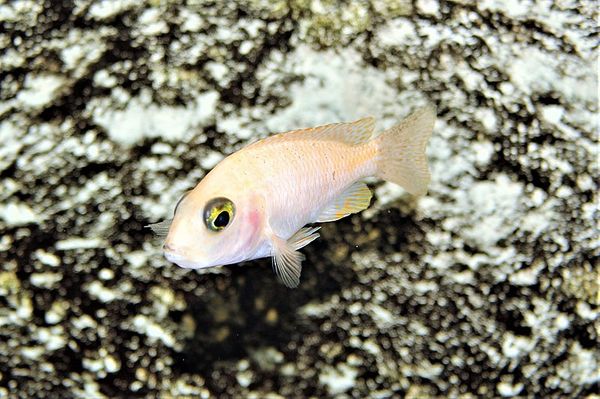
Red Zebras are a polymorphic species, which means they come in a surprisingly wide range of colors. This isn’t variation from breeding, it’s natural. In the wild and in captivity, you’ll see individuals ranging from bright orange and red to yellow, pink, and even blue. This variety is one of the things that makes them so popular.
Their body shape is typical mbuna, stocky, laterally compressed, and built for maneuvering through rocky terrain. They have a rounded head, strong jaw, and the trademark slightly turned-down mouth common to aufwuchs grazers. Under good lighting, their coloration really pops, especially the bright orange females that most people picture when they hear “Red Zebra.” When a male is actively displaying, that color transformation is dramatic. Blue deepens, the egg spots on the anal fin pop, and the whole fish looks like it’s lit from the inside.
Male vs. Female
Red Zebras are one of the easier mbuna to sex, thanks to distinct sexual dimorphism in coloration. This makes them a great choice for keepers who want to ensure the right male-to-female ratio.
| Feature | Male | Female |
|---|---|---|
| Body Color | Blue to blue-gray (sometimes with faint barring) | Bright orange to red-orange |
| Size | Up to 5 inches (13 cm) | Up to 4 inches (10 cm) |
| Egg Spots | Prominent on anal fin | Fewer or absent |
| Body Shape | Slightly larger and more robust | Rounder, especially when gravid |
| Behavior | Territorial, displays to females | Less aggressive, schools with other females |
Keep in mind that color morphs can sometimes complicate things, there are blue females and orange males in some populations. But in the most common form available in the hobby, the blue male/orange female pairing is standard.
Average Size & Lifespan
Red Zebra Cichlids are a medium-sized mbuna, reaching 4–5 inches (10–13 cm) in captivity. Some reports suggest they can reach 6 inches under ideal conditions, but 5 inches is more typical. Males are the larger sex; females stay an inch or so smaller.
With proper care, Red Zebras live 5–10 years in a home aquarium. Reaching the upper end of that range requires consistent water quality, a balanced diet, and a well-managed tank. Their hardiness is one of their best traits, they’re more forgiving than many mbuna species, which is exactly why they make such a good entry point into this side of the hobby.
Care Guide
Tank Size
A 55-gallon (208-liter) tank is the minimum for a small group of Red Zebras. I’d recommend 75 gallons (284 liters) or more for a mixed mbuna community. The tank needs to be at least 48 inches (120 cm) long, horizontal swimming space is critical for reducing aggression and giving each fish room to establish territory.
If you’re planning a larger group or mixing with other mbuna species, 100–125 gallons (379–473 liters) gives you much better options for stocking and aggression management. More space also means more rockwork, and more rockwork means more stable territories.
Water Parameters
| Temperature | 76–82°F (24–28°C) |
| pH | 7.8–8.6 |
| General Hardness (dGH) | 10–20 dGH |
| Carbonate Hardness (dKH) | 10–15 dKH |
| Ammonia | 0 ppm |
| Nitrite | 0 ppm |
| Nitrate | <20 ppm |
Red Zebras are tolerant of minor parameter variations, but stability matters more than hitting exact numbers. Use aragonite sand or crushed coral to naturally buffer pH to the alkaline levels Lake Malawi cichlids require. Consistent water chemistry goes a long way toward keeping these fish healthy and colorful.
💬 Expert Take (Mark Valderrama, AquariumStoreDepot)
After 25 years in this hobby and time managing fish stores, the number one way I watched customers kill their mbuna was the diet. Beef heart was the big one. People would come back in two days later saying their fish were bloating and dying, and nine times out of ten it was the beef heart they’d just started feeding. That’s not what these fish evolved to eat. Lake Malawi mbuna are aufwuchs grazers, algae, biofilm, plant matter. When you load them up with mammalian protein, their digestive system can’t handle it and Malawi Bloat sets in fast.
The other thing I noticed in store setups: a slightly overstocked mbuna tank actually runs better than an understocked one. Sounds backwards, but it works because aggression gets spread across more fish. No single fish becomes the target. When you only have four or five mbuna in a tank that could hold twelve, the dominant male picks two or three fish and doesn’t stop. We saw it constantly. A properly loaded tank, not overcrowded, but fully stocked, is more stable than a sparse one.
Filtration & Water Flow
A canister filter rated for 1.5–2 times your tank volume is ideal. Mbuna tanks tend to be heavily stocked, so robust filtration is essential. Consider adding a powerhead for supplemental water movement, it keeps the water well-oxygenated and replicates the moderate currents of their natural habitat.
Weekly water changes of 25–40% are recommended. In heavily stocked setups, twice-weekly changes may be necessary to keep nitrates in check. Regular gravel vacuuming helps remove accumulated waste from under and between rocks.
Lighting
Standard aquarium LED lighting works perfectly for Red Zebras. They display their best colors under moderate lighting, and a photoperiod of 8–10 hours is ideal. If you want to encourage natural algae growth on rocks, which provides supplemental grazing, slightly longer photoperiods help.
Plants & Decorations
Lots of rock formations are essential. Create caves, overhangs, and passages using limestone, lava rock, or ocean rock. Each male needs a territory to call his own, and subordinate fish need places to retreat. Build your rockwork from the substrate to near the water surface, creating multiple layers of hiding spots.
Red Zebras dig and rearrange their surroundings, so most rooted plants won’t survive. Anubias attached to rocks and Java Fern tied to hardscape are your best bets if you want any greenery. Make sure rock structures are stable and won’t collapse if the fish dig around the base, a toppled rock pile can trap and kill fish overnight.
Substrate
Fine sand is the way to go, aragonite sand or pool filter sand both work great. Aragonite provides natural pH buffering, which is a real bonus for Malawi cichlid tanks. Red Zebras enjoy digging and sifting through sand, so a sand substrate supports natural behavior and is easier to keep clean than gravel.
What People Get Wrong
The Protein Diet Mistake
This is the one that kills fish, and it kills them fast. Malawi Bloat is a metabolic and digestive disease triggered primarily by high-protein foods in herbivorous cichlids. When mbuna are fed bloodworms, beef heart, or other protein-heavy foods regularly, their gut flora shifts, harmful bacteria proliferate, and the intestinal lining becomes inflamed. What follows is abdominal swelling, white stringy feces, loss of appetite, and labored breathing near the surface.
Here’s the brutal part: most keepers don’t realize what’s happening until the fish is already dying. The disease progresses quickly, you can go from a normal-looking fish at night to a fish hovering at the surface by morning. Once bloat is advanced, treatment with Metronidazole in a hospital tank is your only option, and it’s not guaranteed. Prevention is the only reliable strategy. That starts with never making protein foods a staple, and understanding that Red Zebras are herbivores, not opportunistic feeders who’ll thrive on whatever you drop in the tank.
The Male Ratio Mistake
People hear “keep one male to three females” and treat it like a suggestion. It’s not. Here’s why it matters structurally: a dominant male’s entire behavioral drive is to spawn and defend territory. He will chase females relentlessly. With three or more females available, that attention is distributed, each female gets chased, rests, recovers, and gets chased again. The cycle is manageable.
Drop that to one male and two females, or one male and one female, and the math breaks badly. Each female is chased constantly with no recovery time. Breeding females holding eggs are still harassed. Females stop eating, become stressed and emaciated, and eventually die, not from injury, but from exhaustion and immune compromise. A single extra male in the wrong setup creates the same problem from the other direction: two males competing means double the aggression load on every female in the tank. In larger tanks with extensive rockwork and clear visual barriers, two males can work, but that’s an advanced setup, not a starting point.
Tank Mates
Best Tank Mates
Red Zebras work well with a variety of other mbuna. Choose species with different coloration to minimize territorial conflicts, similar-colored fish trigger more aggression. Some solid choices:
- Yellow Lab (Labidochromis caeruleus), Classic pairing; contrasting colors, relatively peaceful for a mbuna
- Demasoni (Pseudotropheus demasoni), Different color pattern; both species do well in groups
- Acei Cichlid (Pseudotropheus acei), Occupies different areas of the tank
- Cobalt Blue Zebra (Metriaclima callainos), Similar care needs, contrasting color
- Synodontis catfish, Bottom dwellers that complement any mbuna setup
- Bristlenose Pleco, Hardy enough to coexist with mbuna
Tank Mates to Avoid
- Peacock cichlids (Aulonocara spp.), Too peaceful for a mbuna tank; will be bullied relentlessly
- Other orange/red mbuna, Similar coloration triggers concentrated territorial aggression
- Auratus (Melanochromis auratus), Too aggressive; will dominate the entire tank
- Small community fish, Tetras, rasboras, and similar fish will be eaten or harassed
- Long-finned species, Red Zebras will nip flowing fins without hesitation
Food & Diet
🔴 Hard Rule: Spirulina-based diet is non-negotiable. Beef heart, bloodworms as staples, and excessive protein are a direct path to Malawi Bloat. This disease kills within 48–72 hours and has no guaranteed cure. Feed it like an herbivore because it IS one.
Red Zebra Cichlids are primarily herbivorous, spending most of their time in the wild grazing on algae and plant material. Your staple food is a high-quality spirulina flake or cichlid pellet designed for herbivorous African cichlids. Algae wafers make a great supplemental option.
Blanched vegetables, zucchini, spinach, shelled peas, and romaine lettuce, add variety and nutrition. You can offer occasional protein treats like brine shrimp or daphnia, but keep these to once or twice a week at most. Bloodworms and beef heart don’t belong in a regular rotation for this species. Period.
Feed small amounts 2–3 times daily. Red Zebras are enthusiastic eaters and will happily overeat if given the chance, which leads to obesity and water quality problems. Only offer what they can consume within a few minutes.
Breeding & Reproduction
Red Zebras are maternal mouthbrooders and one of the easier mbuna species to breed in captivity. With the right setup, a dominant male, multiple females, and good water quality, spawning happens regularly without much intervention.
Spawning Behavior
When ready to breed, the male intensifies his coloration and begins displaying near his territory. He clears a spawning site, usually a flat rock or depression in the substrate, and courts passing females with vigorous body shaking and fin displays. The receptive female follows him to the site, deposits eggs a few at a time, and immediately scoops them into her mouth.
The male flashes his anal fin egg spots, and the female attempts to collect these “eggs,” inadvertently picking up the male’s milt to fertilize the eggs already in her mouth. A typical clutch ranges from 20–60 eggs depending on the female’s size and experience.
Mouthbrooding & Fry Care
The female carries the eggs for 12–18 days, during which she fasts. You’ll see her jaw distended and her behavior become more secretive. Once fry are released, they’re free-swimming and ready to eat crushed flake food, spirulina powder, or newly hatched brine shrimp.
For the best survival rates, isolate the holding female in a separate tank about a week before release. Fry left in the main tank with adults face significant predation risk. Keep the breeding ratio at 1 male to 3+ females to prevent male harassment from exhausting any single female, this matters especially during the holding period, when females are vulnerable and less able to flee.
Reality of Keeping
A Red Zebra tank isn’t a display tank. It’s a managed ecosystem where the rules are clear and the consequences for ignoring them are immediate.
Here’s what a healthy mbuna tank actually looks like day-to-day: constant movement. Males displaying with fins spread, color cranked up. Females being chased, ducking into rockwork, emerging again. The occasional short burst of real aggression, a chase, a lock-up, then back to the steady background activity. It’s dynamic in a way that most community tanks aren’t. Some people love it. Others find it stressful to watch.
Spawning happens constantly in a well-run setup. You’ll notice a female with a distended jaw and you’ll know she’s holding. A few weeks later, tiny fish appear from between the rocks. In a properly stocked tank, this is almost automatic, you’re not engineering it, you’re just not getting in the way of it.
The aggression is manageable when the tank is right. When it’s wrong, too few fish, wrong ratio, not enough rock, it’s relentless. That’s the thing about mbuna that catches people off guard. The solution to aggression is often more fish, not fewer. You have to genuinely shift your mindset coming from community fishkeeping. In a community tank, overcrowding is a mistake. In a mbuna tank, a slightly loaded stock list is part of the design. Aggression gets diluted across enough individuals that no single fish takes the full brunt of it.
The other thing worth knowing: the color transformation when a male is actively displaying is genuinely impressive. What looks like a solid blue fish in a holding tank comes alive in a proper setup, the blue deepens, the egg spots pop, and the whole animal looks different. That’s what you’re getting with Red Zebras. Not just a colorful fish, but a fish that performs.
Common Health Issues
Malawi Bloat
The most serious health concern for Red Zebras and all herbivorous mbuna. Malawi Bloat is triggered by stress, poor diet (excess protein), or deteriorating water quality. Symptoms include a swollen belly, white stringy feces, loss of appetite, and labored breathing. It kills within 24–72 hours if untreated. Prevention through proper diet and water maintenance is the only reliable defense. If caught early, Metronidazole treatment in a hospital tank can be effective, but there’s no guarantee.
Ich (White Spot Disease)
Stress-related ich is common after transport or during water quality issues. Watch for white salt-like spots on the body and fins. Raise the temperature gradually to 82°F (28°C) and treat with a quality ich medication. Red Zebras are hardy and typically respond well to treatment when caught early.
Obesity
Red Zebras love to eat and will become overweight if overfed. Obesity reduces lifespan, impairs breeding, and stresses internal organs. Stick to the 2–3 small feedings per day rule and resist the urge to drop extra food in the tank. A weekly fasting day helps keep them lean.
Common Mistakes to Avoid
- Overfeeding, Red Zebras eat everything you give them. Stick to small, controlled portions
- Mixing with Peacocks, A classic mistake. Peacocks are too docile for a Red Zebra tank and will be harassed to death
- Insufficient rockwork, Without caves and visual barriers, aggression becomes unmanageable fast
- Keeping too many males, One male to 3+ females is a structural requirement, not a suggestion
- Ignoring water changes, Mbuna tanks produce a lot of waste. Stay on top of weekly water changes or nitrates spike fast
- Feeding a high-protein diet, Spirulina and veggies are the staple. Protein is an occasional treat, not a rotation
- Understocking, A sparse mbuna tank concentrates aggression. Don’t confuse “fewer fish” with “less aggression”
Should You Get This Fish?
The Red Zebra is the right entry point into mbuna, but it’s still mbuna. Be honest with yourself before you buy.
Good Fit If:
- You want a dynamic, active tank that’s genuinely interesting to watch
- You have at least 55 gallons (208 liters) with a 48-inch (120 cm) footprint
- You’re willing to commit to a spirulina-forward diet, no shortcuts
- You want to observe natural breeding behavior without complicated intervention
- You’re new to African cichlids and want a forgiving species to learn the mbuna system
- You like bold, vibrant color and don’t need a peaceful tank to get it
Avoid If:
- You want a peaceful community tank, this isn’t it
- You want live plants, Red Zebras will uproot and destroy most of them
- You’re not willing to research and maintain a strictly herbivorous diet
- You have a tank under 55 gallons (208 liters), don’t try to make it work
- You want fish that ignore each other, constant interaction is part of the deal
- You already have Peacocks or other docile cichlids in the tank, adding Red Zebras will end badly for the Peacocks
Red Zebra Cichlid vs. Similar Species
Red Zebra vs. Yellow Lab (Labidochromis caeruleus)
The Yellow Lab is the gentlest, most beginner-friendly mbuna in the hobby, and that’s the key difference. Yellow Labs are significantly less territorial than Red Zebras, more tolerant of tank mates, and less likely to harass females relentlessly. They’re also one of the most compatible mbuna to mix with Red Zebras, since the color contrast (yellow vs. blue-orange) reduces the visual triggers for aggression.
Choose the Yellow Lab if you want the mbuna aesthetic without the intensity. Choose the Red Zebra if you want more personality and behavioral complexity, and you’re comfortable managing the aggression that comes with it.
Red Zebra vs. Auratus (Melanochromis auratus)
The Auratus is not a beginner fish. It’s significantly more aggressive than the Red Zebra, not just territorial, but actively dominant in a way that restructures the social dynamic of the entire tank. An Auratus male will claim the tank, suppress other males, and harass fish that most mbuna would ignore. In a mixed mbuna setup, Auratus often graduates from tankmate to warden.
The Red Zebra is the entry point. The Auratus is the advanced course. If you’re new to mbuna, get the Red Zebra right first. If you’ve run a successful mbuna tank and you’re ready to raise the stakes, the Auratus delivers, but it demands a tank designed around its aggression level, not just adapted to it.
Red Zebra vs. Kenyi Cichlid (Metriaclima lombardoi)
Kenyi Cichlids are a close comparison, similar size, similar care requirements, and similarly polymorphic coloration (Kenyi females are blue, males turn yellow as they mature, the reverse of most mbuna expectations). The difference is aggression: Kenyi males are notably more aggressive than Red Zebra males, particularly toward each other and toward similar-colored fish.
Both species work well in a mbuna community, but if you’re building your first Lake Malawi tank and choosing between the two, go with the Red Zebra. The care requirements are nearly identical, and the slightly lower aggression ceiling gives you more margin for error while you’re learning the system. Once you’re comfortable, Kenyi is a natural next step.
Where to Buy
Red Zebra Cichlids are one of the most commonly available mbuna species. Most local fish stores that carry African cichlids will have them, and they’re usually quite affordable at $4–$10 per fish. For the best selection and healthiest stock, consider these online retailers:
- Flip Aquatics, Reliable source for quality African cichlids with excellent shipping practices
- Dan’s Fish, Trusted retailer that regularly stocks Red Zebras and other popular mbuna
When purchasing, try to get a group of at least 6 with a clear female majority. Since Red Zebras are relatively easy to sex by color, you can usually request specific male-to-female ratios from the seller.
FAQ
Why is my Red Zebra orange and not red?
That’s completely normal. Despite the name “Red Zebra,” most specimens in the hobby display a bright orange rather than true red coloration. The species is highly polymorphic, individuals range from yellow and orange to pink and even brownish. Color intensity also varies with diet, mood, and water quality. A high-quality spirulina diet helps bring out the best color.
Can Red Zebras live with Peacock cichlids?
Not recommended. Red Zebras are more aggressive and active than most Peacock species (Aulonocara), which are more docile and slower-moving. In most mixed setups, the Red Zebras stress, outcompete, and bully the Peacocks. Stick to other mbuna or similarly robust species.
How many Red Zebras should I keep?
A group of 6–8 with a ratio of 1 male to 3+ females works well in a 55–75 gallon (208–284 liter) tank. The female-heavy ratio distributes the male’s attention and reduces harassment. In larger tanks (100+ gallons / 379+ liters), you can keep a larger group, but avoid multiple males unless the tank has extensive rockwork and clear visual barriers throughout.
Are Red Zebra Cichlids good for beginners?
They’re one of the better mbuna for beginners. Red Zebras are hardy, easy to sex, and more forgiving of minor mistakes than many other mbuna species. If you have basic aquarium experience and understand the fundamentals of African cichlid care, alkaline water, plant-based diet, proper stocking ratios, they’re a solid first mbuna. Just don’t skip the diet rules.
Why is my Red Zebra digging?
Digging is perfectly normal behavior. Males especially rearrange substrate, move sand away from rocks, and create pits as part of territory establishment and breeding preparation. It’s healthy and natural, just make sure your rockwork is secure so excavation doesn’t topple any structures.
What is Malawi Bloat and how do I prevent it?
Malawi Bloat is a serious digestive disease that affects herbivorous cichlids fed too much protein. Symptoms include abdominal swelling, white stringy feces, loss of appetite, and labored breathing. It progresses fast, fish can appear normal one evening and be in critical condition the next morning. Prevention is the only reliable strategy: feed a spirulina-based diet, avoid bloodworms and beef heart as regular foods, and maintain consistent water quality. If you catch it early, Metronidazole in a hospital tank is the standard treatment.
Can I keep more than one male Red Zebra?
In a large tank with extensive rockwork, think 100+ gallons (379+ liters) with dense rock formations that create multiple visual barriers, two males can coexist. In most standard setups, a second male creates a level of competition that’s hard to manage and stresses every fish in the tank. Start with one male and get that right before experimenting with multiple males.
Closing Thoughts
The Red Zebra Cichlid is a fantastic all-around mbuna, colorful, hardy, and genuinely engaging to watch. Whether you’re setting up your first African cichlid tank or adding to an existing mbuna community, Metriaclima estherae delivers consistent color and personality without requiring expert-level experience. The sexual dimorphism makes sexing straightforward, and their willingness to breed means you get to observe the full lifecycle in your own tank.
Keep the fundamentals in check, proper tank size, plenty of rockwork, a spirulina-forward diet, the right male-to-female ratio, and consistent water quality, and your Red Zebras will run themselves. Get any one of those wrong and you’ll know about it quickly. That’s the mbuna deal. The Red Zebra just gives you the most margin to figure it out.
This article is part of our Lake Malawi Cichlid Species Directory: Complete A-Z Care Guide List. Visit the hub page to explore care guides for all 28 Lake Malawi cichlid species we cover.
Recommended Video
References
- Seriously Fish. (n.d.). Metriaclima estherae. https://www.seriouslyfish.com/species/metriaclima-estherae/
- FishBase. (n.d.). Maylandia estherae, Red Zebra Cichlid. https://www.fishbase.se/summary/Maylandia-estherae.html
- Practical Fishkeeping. (n.d.). Red Zebra Cichlid species profile. https://www.practicalfishkeeping.co.uk
- The Aquarium Wiki. (n.d.). Maylandia estherae. https://www.theaquariumwiki.com/wiki/Maylandia_estherae
- About the Author
- Latest Posts

I’m Mark Valderrama, founder of Aquarium Store Depot and a fishkeeper with over 25 years of hands-on experience. I started in the hobby at age 11, worked at local fish stores, and have kept freshwater tanks, ponds, and reef tanks ever since. I’ve been featured in two best-selling aquarium books on Amazon and built this site to share practical, experience-based fish keeping knowledge.
Leave a Reply