
Last Updated: June 25, 2026
Thank you for visiting! By the way… any links on this page that lead to products on Amazon and other stores/partners are affiliate links Aquarium Store Depot earns a commission if you make a purchase.
Table of Contents
- Key Takeaways
- Species Overview
- Classification
- Origin & Natural Habitat
- Appearance & Identification
- Average Size & Lifespan
- What People Get Wrong
- Reality of Keeping
- Care Guide
- Tank Mates
- Food & Diet
- Breeding & Reproduction
- Common Health Issues
- Common Mistakes to Avoid
- Should You Get This Fish?
- Where to Buy
- Comparison: Rusty Cichlid vs. Similar Species
- FAQ
- Closing Thoughts
- Recommended Video
- References
In a hobby dominated by electric blues and fiery reds, the Rusty Cichlid takes a different approach. Iodotropheus sprengerae brings a warm, understated combination of rusty orange and lavender-purple that’s completely unique among mbuna. It won’t scream at you from across the room, but give it a second look and you’ll realize it’s one of the most beautiful cichlids Lake Malawi has to offer.
The real selling point isn’t the looks, though. It’s the temperament. The Rusty Cichlid is the most peaceful mbuna available, full stop. Where most mbuna are measured in degrees of aggression, the Rusty is measured by how well it plays with others. It’s the fish I recommend to anyone who wants their first taste of the mbuna world without getting burned.
The Rusty is the mbuna that lets you enjoy the look without managing the chaos.
Formally described by Oliver and Loiselle in 1972 and named after California aquarist Kappy Sprenger, who played a key role in collecting and identifying the species, the Rusty has been a classic in the hobby for over 50 years. Here’s everything you need to keep them right.
ASD Difficulty Rating: Easy
The Rusty Cichlid is the most forgiving mbuna available. Hardy, adaptable, and genuinely peaceful by African cichlid standards. Suitable for hobbyists stepping up from community tanks, no prior cichlid experience required, provided tank mates are chosen carefully.
Key Takeaways
- Most peaceful mbuna, The least aggressive species in the entire mbuna group; the gateway fish for Lake Malawi
- Unique coloration, Rusty orange body with lavender-purple hues; nothing else in the mbuna world looks like it
- Small and manageable, Reaches 3–4 inches (7.6–10 cm); a 40-gallon breeder works for a species-only group
- Plant-compatible, One of the only mbuna that won’t destroy a planted tank
- Peacock-compatible, Mild enough to coexist with Aulonocara spp., opening up showpiece stocking options
- Easy breeder, Reaches sexual maturity at 1.5 inches (3.8 cm); maternal mouthbrooder; fry are easy to raise
Species Overview
| Common Name | Rusty Cichlid, Lavender Mbuna, Iodotropheus |
| Scientific Name | Iodotropheus sprengerae |
| Family | Cichlidae |
| Origin | Lake Malawi, East Africa (Chinyamwezi & Chinyankwazi reefs) |
| Care Level | Easy |
| Temperament | Peaceful (for a mbuna) |
| Diet | Omnivore, primarily herbivorous |
| Tank Level | Middle to Bottom |
| Max Size | 3–4 inches (7.6–10 cm) |
| Min Tank Size | 40 gallons (151 liters) species-only; 55+ gallons (208+ liters) community |
| Temperature | 76–82°F (24–28°C) |
| pH | 7.8–8.6 |
| Hardness | 10–20 dGH |
| Lifespan | 5–8 years |
Classification
| Order | Cichliformes |
| Family | Cichlidae |
| Subfamily | Pseudocrenilabrinae |
| Genus | Iodotropheus |
| Species | I. sprengerae Oliver & Loiselle, 1972 |
Iodotropheus is a monotypic genus, meaning the Rusty Cichlid is its only species. The genus name derives from the Greek iodo (violet/iodine-colored) and tropheus (feeder), referencing both the distinctive coloration and the aufwuchs-grazing feeding behavior characteristic of mbuna. The species epithet sprengerae honors Kappy Sprenger, the California aquarist who collected the original specimens.
Origin & Natural Habitat
The Rusty Cichlid is endemic to Lake Malawi in East Africa, specifically found at the Chinyamwezi and Chinyankwazi reef complexes near Boadzulu Island. Their range is unusually restricted even by mbuna standards; most mbuna occupy wider stretches of coastline, while the Rusty is concentrated in a relatively compact area of rocky shoreline.
Like all mbuna, Rusties are rock dwellers. The word “mbuna” itself means “rockfish” in the local Tonga language, and it fits, these fish spend their entire lives among boulders and rubble, grazing on the aufwuchs (the biofilm of algae, bacteria, and microorganisms that coats rocky surfaces). They inhabit relatively shallow depths in the surge zone, where wave action keeps oxygen levels high and water parameters stable.
What sets the Rusty apart ecologically is its temperament in the wild, even among the competitive mbuna assemblages at these reefs, Iodotropheus sprengerae is notably less aggressive than its neighbors. That natural disposition carries directly into aquarium life.
Appearance & Identification
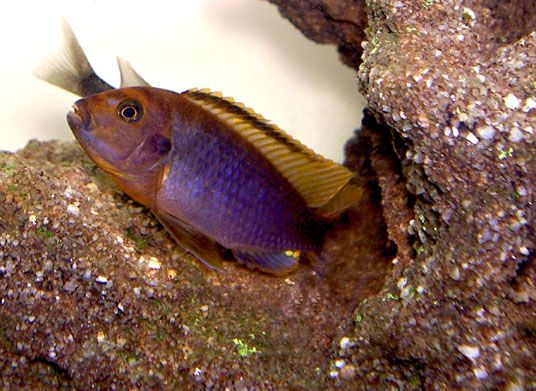
The Rusty Cichlid’s coloration is genuinely unique among mbuna. While most species in the group feature bold blues, yellows, and blacks, the Rusty displays a warm palette of rusty orange and lavender-purple that stands apart from everything else in the Lake Malawi hobby. The rust-colored body carries a violet to purple sheen, most pronounced on the midsection of males, and the fins are bright orange. Under good aquarium lighting, the interplay between orange and purple tones is subtle but captivating.
They have the typical mbuna body shape: elongated, laterally compressed, slightly torpedo-shaped. They’re on the slender side for a mbuna, not as stocky as some of the Pseudotropheus species, which gives them a sleeker, more streamlined appearance.
One practical note: Rusty Cichlids look significantly more vibrant over dark substrate. On white coral sand, the warm tones wash out. On dark sand, the orange and purple genuinely pop. Substrate choice matters more with this species than most.
Male vs. Female
Sexing Rusty Cichlids is moderately difficult, both sexes share similar coloration, and the differences are subtle. With practice, they’re identifiable.
| Feature | Male | Female |
|---|---|---|
| Color | More purple hue on midsection, brighter orange fins | More uniform rust coloration throughout |
| Egg Spots | More numerous on anal fin | Fewer egg spots |
| Size | Slightly larger, up to 4 inches (10 cm) | Slightly smaller, around 3 inches (7.6 cm) |
| Anal Fin | Slightly pointed or elongated | More rounded |
| Behavior | Slightly more assertive during breeding season | Calmer; groups with other females |
Because sexing is difficult, buy a group of 8–10 juveniles rather than trying to hand-select pairs. A larger group statistically gives you a workable male-to-female ratio, and the affordable price point makes this easy.
Average Size & Lifespan
Rusty Cichlids are one of the smaller mbuna, typically reaching 3–4 inches (7.6–10 cm) in captivity. This compact size is a genuine advantage, it means a 40-gallon breeder can house a species-only group, and they’re less physically intimidating to other tank inhabitants than the larger mbuna species.
With proper care, expect 5–8 years. Because they’re peaceful and experience less chronic fighting stress than most cichlids, they often trend toward the longer end of that range. Some keepers have reported individuals reaching 10 years under pristine conditions.
What People Get Wrong
“Peaceful” doesn’t mean it can handle any mbuna tank. This is the mistake I see most often. Someone hears “the peaceful mbuna” and immediately drops Rusties into a tank with Auratus, Kenyi, or Demasoni, because they figure the Rusty’s mellow personality will smooth things over. It won’t. The Rusty is peaceful by mbuna standards. Against truly aggressive species, it loses every time: outcompeted for food, bullied from territory, and stressed into slow decline.
The second mistake is assuming the orange color is always going to pop. Rusty Cichlids kept over white or light substrate look pale and unimpressive, completely different from the same fish over dark sand. Substrate choice isn’t optional for this species; it’s part of the care.
The third mistake is diet. Because Rusties are so easygoing, keepers get casual about feeding and start loading in protein, frozen bloodworms, beef heart, meaty pellets. That’s how you trigger Malawi Bloat. This fish needs a primarily plant-based diet. The peaceful personality doesn’t exempt it from mbuna digestive physiology.
Reality of Keeping
The Rusty Cichlid is a grazer. That’s its whole personality. You’ll see it methodically working the rock faces, picking at biofilm and aufwuchs, calm, deliberate, systematic. It’s not the fish that charges around the tank establishing dominance. It’s the fish that quietly goes about its business and leaves the drama to others.
What surprises most new keepers is how well the orange-purple coloration develops once the tank is dialed in. A young Rusty in a dealer’s tank over bright gravel looks underwhelming. The same fish in your tank, over dark sand, under warm-toned LED lighting, with six months of proper diet, it’s a completely different animal. The purple sheen on males deepens noticeably when they’re healthy and in optimal conditions.
The plant compatibility is genuinely unusual for an mbuna. You can actually run Vallisneria, Anubias, and Java Fern in a Rusty Cichlid tank and have them survive, even thrive. That’s not possible with most other mbuna. If you’ve always wanted a planted Lake Malawi tank, the Rusty is your best option.
The Peacock compatibility opens another door. A 75-gallon tank with Rusty Cichlids, Yellow Labs, Aulonocara Peacocks, and a couple of Synodontis catfish is one of the most visually stunning, low-conflict African cichlid setups you can build. That combination is nearly impossible with any other mbuna. The Rusty makes it work.
Care Guide
Tank Size
A 40-gallon breeder (36 inches long) is the minimum for a species-only group of 6–8 Rusty Cichlids. This is one of the few mbuna where that’s genuinely feasible due to their small size and peaceful temperament. For a mixed Lake Malawi community with Peacocks or other mbuna, use at least 55–75 gallons (208–284 liters). Always prioritize tank length over volume, a long, horizontal footprint matters more than depth for these rock-dwelling fish.
Water Parameters
| Temperature | 76–82°F (24–28°C) |
| pH | 7.8–8.6 |
| General Hardness (dGH) | 10–20 dGH |
| Carbonate Hardness (dKH) | 10–15 dKH |
| Ammonia | 0 ppm |
| Nitrite | 0 ppm |
| Nitrate | <20 ppm |
Standard Lake Malawi parameters. Use aragonite sand or crushed coral substrate to buffer pH upward. If you’re mixing substrates for color (darker sand for coloration), top-dress with aragonite or use a layer underneath to maintain buffering capacity.
Filtration & Water Flow
A quality external canister filter sized for the tank is the baseline. Add a powerhead for supplemental circulation, Rusty Cichlids come from the wave-swept rocky shallows of Lake Malawi, where oxygen levels are consistently high. Good surface agitation and water movement matter. Perform 25–30% water changes weekly. Even a hardy species suffers when nitrates creep up in hard, alkaline water.
Lighting
Moderate lighting with a slightly warm color temperature (around 4,000–5,000K) brings out the orange tones in Rusty Cichlids far better than cool white or blue-heavy LEDs. Run an 8–10 hour photoperiod. If you’re keeping live plants, adjust to their requirements, the Rusty adapts to whatever lighting the plants need.
Plants & Decorations
One of the most pleasant surprises with Rusty Cichlids: they’re actually plant-friendly. Unlike virtually every other mbuna, they don’t shred, uproot, or eat plants with any consistency. Hard water-tolerant species, Vallisneria, Anubias, Java Fern, can thrive in a Rusty Cichlid tank. This is genuinely unique in the mbuna world.
That said, still provide substantial rockwork. Build stacked formations with plenty of crevices, caves, and sight breaks from substrate to mid-tank height. Even peaceful mbuna feel exposed without rock structure, and having defined cave territories reduces the little competitive tension that does exist between individuals.
Substrate
Fine sand is ideal. Aragonite sand provides pH buffering, but consider mixing in a portion of darker pool filter sand or black sand for aesthetics, Rusty Cichlids display their richest orange and purple coloration over dark substrate, and the difference is dramatic. A 50/50 mix of aragonite and dark sand gives you buffering capacity plus color enhancement. Pure white coral sand is the worst choice for this species: it washes out the coloration and makes a beautiful fish look ordinary.
Tank Mates
Expert Take (Mark Valderrama, AquariumStoreDepot)
At every fish store I managed, when a customer came in asking “what’s a good beginner mbuna?” the Rusty Cichlid was the answer. Every time. We’d routinely display them with Yellow Labs and Synodontis in the same tank, and they were always the most trouble-free African cichlid combination we ran. The thing is, their peaceable nature means they actually get along with fish that other mbuna would bully or outright kill, and that opens up some genuinely beautiful stocking combinations that aren’t possible otherwise. The compatibility with Peacocks in particular is something most keepers don’t take advantage of until they’ve kept Rusties for a while. Once they figure it out, they don’t want any other mbuna.
Best Tank Mates
- Yellow Lab (Labidochromis caeruleus), The classic peaceful mbuna pairing; their bright yellow contrasts beautifully with the Rusty’s orange-purple
- Acei Cichlid (Pseudotropheus acei), Equally peaceful, occupies different tank zones (open water vs. rock), excellent combination
- Peacock Cichlids (Aulonocara spp.), Rusties are one of the only mbuna mild enough not to bully Peacocks; enables stunning mixed Malawi displays
- Powder Blue Cichlid (Pseudotropheus socolofi), Another mild mbuna; good size match
- Saulosi Cichlid (Chindongo saulosi), Manageable temperament, excellent size compatibility
- Synodontis Catfish, The ideal bottom-dwelling companion for any African cichlid tank; occupies a different niche entirely
- Some Tanganyikan species, Rusties can coexist with select peaceful Tanganyikans, though water parameter overlap must be confirmed
Tank Mates to Avoid
- Auratus (Melanochromis auratus), Dominant, aggressive, will terrorize Rusties
- Kenyi (Maylandia lombardoi), Too boisterous and aggressive; Rusties can’t compete
- Demasoni (Pseudotropheus demasoni), Relentless aggression; incompatible with any mild mbuna
- Any large, dominant mbuna, Rusties get outcompeted for food and territory; chronic stress leads to disease and early death
- Predatory species, Rusties are small enough to be threatened by larger aggressive fish in the same tank
Food & Diet
Rusty Cichlids are primarily herbivorous grazers. Their diet in the wild is aufwuchs, the biofilm of algae, bacteria, and microorganisms that coats rocky surfaces. In captivity, replicate that with high-quality spirulina flakes or pellets as the dietary foundation.
Supplement with blanched spinach, nori sheets on a veggie clip, algae wafers, and zucchini. Small amounts of high-quality protein, frozen brine shrimp, daphnia, occasional bloodworms, are fine 1–2 times per week. The emphasis is on “small amounts.” The digestive system of mbuna is built for plant matter. Overload it with protein and you’re creating a bloat case.
Feed 2–3 small meals per day and only what the fish consume in 2–3 minutes. Uneaten food in an alkaline, hard water tank degrades water quality fast.
Hard Rule: Spirulina-based diet. Non-negotiable.
No beef heart. No high-protein pellets. No routine bloodworm feeding. Malawi Bloat, a fatal digestive and systemic infection, is directly linked to protein overload in mbuna. It kills within 48–72 hours of symptom onset. The Rusty Cichlid’s peaceful temperament does not exempt it from mbuna digestive physiology. Keep protein treats to once or twice a week, maximum.
Breeding & Reproduction
Rusty Cichlids are polygamous maternal mouthbrooders and among the easiest mbuna to breed. They reach sexual maturity at a surprisingly small size, sometimes as little as 1.5 inches (3.8 cm), which means breeding can happen even in juvenile tanks before you’ve finished setting up.
Breeding Difficulty
Easy. Rusty Cichlids are prolific and undemanding breeders. In a properly maintained tank with appropriate male-to-female ratios, spawning occurs without deliberate intervention. The main task is managing the holding female and fry after the fact.
Spawning Behavior
The male establishes a spawning territory on a flat rock or open substrate area. He courts females with intensified coloration and circling displays. The pair performs the classic mbuna egg-dummy spawning sequence: the female deposits eggs, collects them in her buccal cavity, and is drawn to the egg spots on the male’s anal fin, picking up milt in the process, fertilizing the eggs already in her mouth.
Maintain a 1:2 male-to-female ratio minimum. Even at mbuna’s most peaceful, males will over-pursue females in equal or male-heavy ratios, stressing females and disrupting breeding cycles.
Mouthbrooding & Fry Care
The female holds developing eggs for 2–3 weeks. She fasts during this period and should be minimally disturbed. If she’s being actively harassed, move her to an isolation container, a mesh breeding box inside the display tank is preferable to a separate tank, as it avoids the shock of complete parameter change. Wait as long as possible before intervening; premature spitting or egg-eating results from stress, not aggression.
Released fry are large enough to accept brine shrimp nauplii, crushed spirulina flake, and microworms immediately. They grow quickly with clean water and consistent feeding. Rusty Cichlid fry are among the easiest mbuna fry to raise, they’re robust, they eat well, and the parents don’t pose much danger to them in a properly arranged tank.
Common Health Issues
Malawi Bloat
The primary killer of mbuna. Malawi Bloat is a systemic infection, believed to involve Hexamita and opportunistic bacteria, triggered by protein-heavy diet, poor water quality, or chronic stress. Symptoms: abdominal swelling, loss of appetite, white or stringy feces, rapid breathing, hovering near the surface. Onset to death can occur in 48–72 hours. Treat immediately with Metronidazole (Flagyl), 250mg per 10 gallons, every other day for three treatments. Prevention is the only reliable strategy: keep the diet plant-based and water quality high.
Ich (White Spot Disease)
Stress from transport, temperature swings, or new tank introductions triggers ich outbreaks. Look for white salt-grain-sized spots on the body and fins, flashing behavior, and clamped fins. Raise temperature gradually to 82°F (28°C) and treat with a malachite green-based ich medication. Rusty Cichlids recover well from ich when caught early.
Stress from Aggressive Tank Mates
This is the most specific health risk for Rusty Cichlids. Because they don’t fight back effectively against dominant mbuna, chronic bullying creates persistent low-level stress that suppresses the immune system. The fish pale out, stop eating, and become susceptible to every pathogen in the tank. The fix is removing the aggressor, not medicating the victim. Choose tank mates carefully up front, retrofitting a problematic stocking list is harder than building it right the first time.
Common Mistakes to Avoid
- Housing with aggressive mbuna, Auratus, Kenyi, and Demasoni will dominate and stress Rusties without exception
- Overfeeding protein, mbuna digestive systems are not built for high-protein diets; this is how Malawi Bloat starts
- Using bright substrate, White coral sand washes out the orange-purple coloration; dark sand is essential for the best display
- Skipping water changes, Even hardy fish suffer in dirty hard water; weekly 25–30% changes are non-negotiable
- Wrong sex ratio, Keep 1:2 male-to-female at minimum; equal ratios stress females even in a peaceful species
- Buying too few, Groups of fewer than 6 concentrate male attention on too few females; buy 8–10 to start
- Wrong lighting spectrum, Cool or blue-heavy LEDs suppress the orange tones; warm-spectrum lighting makes this fish look dramatically better
Should You Get This Fish?
The Rusty Cichlid earns a strong recommendation, but it’s the right fish for specific situations, not a universal answer.
Good fit if:
- You want your first mbuna and aren’t ready for full cichlid chaos
- You already have a Peacock tank and want to add mbuna color without aggression problems
- You want a planted Lake Malawi tank, nearly impossible with other mbuna, actually achievable with Rusties
- You have a 40-gallon breeder and want to breed African cichlids without a species-dedicated setup
- You prefer calm, grazing behavior over the chasing and territorial standoffs of typical mbuna
Avoid if:
- Your tank already has Auratus, Kenyi, Demasoni, or other dominant mbuna, the Rusty will be outcompeted and stressed
- You want bold mbuna display behavior, the charging, territorial standoffs, and color wars aren’t what Rusties do
- You can’t maintain stable pH above 7.8, hard, alkaline water is a non-negotiable requirement
- You want the most visually dramatic African cichlid in the tank, the Rusty is beautiful but subtle; for electric impact, look at Yellow Labs or Peacocks
Where to Buy
Rusty Cichlids are widely available and affordable, typically $3–$8 per fish at most LFS that carry African cichlids. For the best selection and quality:
- Flip Aquatics, Quality African cichlids with reliable shipping and excellent customer support
- Dan’s Fish, Trusted source for healthy mbuna including Rusty Cichlids
Buy a group of 8–10 juveniles. Their affordable price makes it easy to start with a proper-sized colony, and the larger group ensures a workable sex ratio without needing to hand-select. Since sexing juveniles is nearly impossible, numbers are your best strategy.
Comparison: Rusty Cichlid vs. Similar Species
If you’re deciding between the Rusty and other beginner-friendly cichlids, here’s how to choose:
Rusty Cichlid vs. Yellow Lab (Labidochromis caeruleus)
These are the two most common “peaceful mbuna” recommendations, and they actually pair beautifully. The Yellow Lab is slightly more widely available, easier to sex (males are brighter yellow), and slightly bolder in behavior. The Rusty has more unusual coloration and greater plant tolerance. Choose Yellow Lab if you want a single-species easier-to-sex colony. Choose Rusty if you want unique coloration and the possibility of a planted tank. Better yet, combine them, they’re one of the most compatible mbuna pairings available.
Rusty Cichlid vs. Red Zebra Cichlid (Metriaclima estherae)
The Red Zebra is one step up in aggression, more territorial, more assertive, more traditionally “mbuna” in behavior. Both are manageable beginner fish, but Red Zebra requires more attention to sex ratios and tank mate selection. The Red Zebra’s orange-red coloration is bolder and more saturated; the Rusty’s orange-purple is subtler and more unusual. Choose Red Zebra if you want classic mbuna energy and bold color impact. Choose Rusty if you want the most peaceful possible mbuna entry point or need compatibility with Peacocks.
Rusty Cichlid vs. Acei Cichlid (Pseudotropheus acei)
The Acei is another genuinely peaceful mbuna, slightly larger at 4–5 inches (10–12.7 cm) and with a distinctive blue-purple body and yellow fins. Both are beginner-appropriate. Acei occupies more open water zones; Rusties are more rock-bound. Choose Acei if you want more size, bolder color contrast, and open-water behavior. Choose Rusty if you want a smaller, rock-grazing fish with more unusual coloration. Or keep both, they complement each other well in a 75-gallon Lake Malawi community.
FAQ
Are Rusty Cichlids good for beginners?
They’re the best beginner mbuna available. Their peaceful temperament, small size, hardiness, and dietary flexibility make them the most forgiving entry point into Lake Malawi cichlids. If you’ve kept community fish and want to step up to African cichlids, start with Rusties.
Can Rusty Cichlids live with Peacocks?
Yes, and this is one of the best arguments for keeping them. Rusty Cichlids are one of the only mbuna mild enough not to bully Aulonocara Peacocks. A mixed Peacock/Rusty tank with Synodontis catfish is one of the most beautiful, low-conflict Lake Malawi setups you can build. Most other mbuna rule out this combination.
Can I keep Rusty Cichlids in a planted tank?
More than any other mbuna, yes. Rusty Cichlids are notably less destructive to plants. Vallisneria, Anubias, and Java Fern thrive in a Rusty tank. This is nearly impossible with other mbuna species, which shred or uproot plants as a matter of course. If a planted Lake Malawi tank is your goal, the Rusty is your fish.
Why is my Rusty Cichlid pale?
Two likely causes: substrate and stress. Rusty Cichlids kept over white or light substrate look significantly washed out, dark sand dramatically improves color saturation. The second cause is tank mate aggression. If a dominant fish is bullying the Rusty, even subtly, the stress shows up as color loss before any other symptom. Check both before assuming a health issue.
How many Rusty Cichlids should I keep together?
Minimum 6, ideally 8–10. Groups smaller than 6 concentrate male attention on too few females, creating stress even in this peaceful species. A larger group distributes any minor aggression across more individuals and ensures a workable male-to-female ratio since juveniles are difficult to sex.
How big do Rusty Cichlids get?
Rusty Cichlids max out at 3–4 inches (7.6–10 cm), making them one of the smaller mbuna. This compact size means a 40-gallon breeder is viable for a species-only group, something that isn’t true of most other mbuna.
Do Rusty Cichlids eat plants?
Rarely, and not with the same destructive intent as most mbuna. They graze on aufwuchs (biofilm on rock surfaces) in the wild, not macroalgae or aquatic plants. In captivity, they show very little interest in destroying or eating live plants, a trait that’s genuinely unusual among mbuna and opens up planted tank possibilities that most other African cichlids rule out.
Closing Thoughts
The Rusty Cichlid is the gentle soul of the mbuna world, and that’s not a limitation. That’s its entire value proposition. Its warm, earthy coloration sets it apart from every other mbuna. Its peaceful temperament opens up stocking combinations that simply aren’t possible with the rest of the group. And its adaptability means first-time African cichlid keepers can actually succeed with it without learning hard lessons at the fish’s expense.
Give them clean water, a dark substrate, a plant-based diet, and tank mates matched to their temperament, and they’ll reward you with years of easy, beautiful keeping. In a family defined by aggression, the Rusty Cichlid is the fish that plays by different rules. And it’s better for it.
This article is part of our Lake Malawi Cichlid Species Directory: Complete A-Z Care Guide List. Visit the hub page to explore care guides for all 28 Lake Malawi cichlid species we cover.
Recommended Video
References
- Oliver, M.K. & Loiselle, P.V. (1972). A new genus and species of cichlid of the mbuna group from Lake Malawi. Revue de Zoologie et de Botanique Africaines, 85(3-4), 309–320.
- Seriously Fish. (n.d.). Iodotropheus sprengerae. https://www.seriouslyfish.com/species/iodotropheus-sprengerae/
- FishBase. (n.d.). Iodotropheus sprengerae Oliver & Loiselle, 1972. https://www.fishbase.se/summary/Iodotropheus-sprengerae.html
- Konings, A. (2016). Malawi Cichlids in Their Natural Habitat (5th ed.). Cichlid Press.
- Practical Fishkeeping. (n.d.). Rusty Cichlid species profile. https://www.practicalfishkeeping.co.uk
- About the Author
- Latest Posts

I’m Mark Valderrama, founder of Aquarium Store Depot and a fishkeeper with over 25 years of hands-on experience. I started in the hobby at age 11, worked at local fish stores, and have kept freshwater tanks, ponds, and reef tanks ever since. I’ve been featured in two best-selling aquarium books on Amazon and built this site to share practical, experience-based fish keeping knowledge.
Leave a Reply