
Last Updated: June 25, 2026
Thank you for visiting! By the way… any links on this page that lead to products on Amazon and other stores/partners are affiliate links Aquarium Store Depot earns a commission if you make a purchase.
Table of Contents
- Key Takeaways
- Species Overview
- Classification
- Origin & Natural Habitat
- Appearance & Identification
- Average Size & Lifespan
- Care Guide
- Tank Mates
- Food & Diet
- Breeding & Reproduction
- Common Health Issues
- What People Get Wrong
- Common Mistakes to Avoid
- Should You Get This Fish
- Dwarf Pike Cichlid vs. Similar Species
- Where to Buy
- Frequently Asked Questions
- Closing Thoughts
- References
Pike cichlid personality. 30-gallon budget.
Crenicichla regani is the exception that breaks every assumption people have about the pike cichlid genus. The genus Crenicichla has a reputation for aggression, size, and demanding setups. The dwarf pike cichlid challenges all three. Staying at just 3-4 inches (7-10 cm), remaining peaceful enough for a well-planned community tank, and thriving in a planted aquarium, it offers all the predatory charisma and torpedo-body elegance of a pike cichlid without the 100-gallon commitment that usually comes with it.
This is a fish for keepers who want something different. Not a beginner fish, the live food requirement and water quality standards rule that out, but not an expert-only species either. Get the setup right and the dwarf pike cichlid will be one of the most interesting, most watchable fish you’ve ever kept.
Key Takeaways
- The most peaceful pike cichlid. Crenicichla regani is the gentle outlier in a genus known for aggression. Community-compatible with appropriately sized fish.
- True dwarf species. Males reach only 3-4 inches (7-10 cm), making it one of the smallest pike cichlids in the hobby.
- Plant-safe. Unlike most cichlids, dwarf pikes don’t dig or destroy plants. A planted tank is actually the ideal setup for this species.
- Strict carnivore. Requires a diet of live and frozen meaty foods. Many individuals refuse prepared foods entirely.
- Expert jumper. A tight-fitting, gap-free lid is the single most important piece of equipment for this fish. Non-negotiable.
- Cave spawner. Breeds readily in captivity given proper conditions and is one of the easier pike cichlids to spawn.
ASD Difficulty Rating
Moderate | 5/10
The 30-gallon minimum and community-compatible temperament make the dwarf pike cichlid more accessible than most predatory cichlids. What pushes it past beginner territory is the requirement for live and frozen foods, the water quality needs, and the absolute lid requirement. Intermediate keepers with experience keeping soft-water fish and feeding frozen foods will find this species manageable and extremely rewarding.
Species Overview
| Field | Details |
|---|---|
| Scientific Name | Crenicichla regani |
| Common Names | Dwarf Pike Cichlid, Regani Pike Cichlid, Regan’s Pike Cichlid |
| Family | Cichlidae |
| Origin | Amazon River basin, Brazil (Rio Trombetas) |
| Care Level | Moderate |
| Temperament | Semi-aggressive (mildly territorial; peaceful toward non-prey tank mates) |
| Diet | Carnivore (live and frozen meaty foods) |
| Tank Level | Bottom to Middle |
| Maximum Size | 4 inches (10 cm) males; 3 inches (7 cm) females |
| Minimum Tank Size | 30 gallons (114 liters) |
| Temperature | 76 to 82°F (24 to 28°C) |
| pH | 5.5 to 7.0 |
| Hardness | 3 to 10 dGH |
| Lifespan | 4 to 6 years |
| Breeding | Cave spawner (biparental) |
| Breeding Difficulty | Moderate |
| OK for Planted Tanks? | Yes, excellent choice for planted setups |
Classification
| Taxonomic Level | Classification |
|---|---|
| Order | Cichliformes |
| Family | Cichlidae |
| Subfamily | Cichlinae |
| Tribe | Crenicichlini |
| Genus | Crenicichla |
| Species | C. regani Ploeg, 1989 |
Crenicichla regani was described by Alex Ploeg in 1989. The genus Crenicichla is one of the most species-rich cichlid genera, with over 100 described species ranging from dwarf fish like C. regani to large predators exceeding 12 inches. The common name “pike cichlid” comes from the elongated body shape that resembles the unrelated northern pike (family Esocidae). Recent molecular studies place the genus in the tribe Crenicichlini within subfamily Cichlinae. C. regani belongs to the “regani group” of smaller, more docile Crenicichla species that are more suitable for aquarium keeping than the larger members of the genus.
Origin & Natural Habitat
The dwarf pike cichlid is documented from the Amazon River basin in Brazil, specifically from the Rio Trombetas at Cachoeira Porteira. It inhabits clearwater rivers and streams near shorelines where rocks, roots, and submerged vegetation provide dense cover. Water in these habitats is warm, soft, and slightly acidic, typical of Amazonian blackwater tributaries.
In the wild, C. regani is a secretive ambush predator. It lives among rock crevices, root tangles, and dense vegetation near the riverbank, waiting in cover and darting out to capture small invertebrates and tiny fish that move within striking distance. This behavioral context explains the care requirements: these fish need structure, plenty of hiding places, and a sense of security to express their natural behavior and leave cover regularly.
Expert Take (Mark Valderrama, AquariumStoreDepot)
After 25+ years in the hobby, I’ve watched a lot of fishkeepers pass on dwarf pike cichlids because of the Crenicichla reputation. Understandable, the genus has some real terrors. But C. regani is the exception. It’s the pike cichlid that actually works in a community setup with the right companions. What surprises most people is how well it does in a planted tank. It won’t dig up your aquascape or eat your plants, which puts it ahead of most cichlids for planted setups. The lid requirement isn’t optional though. I’ve heard too many stories about losing these fish to overnight jumps before a proper cover was in place. Sort out the lid first, then add the fish.
Appearance & Identification
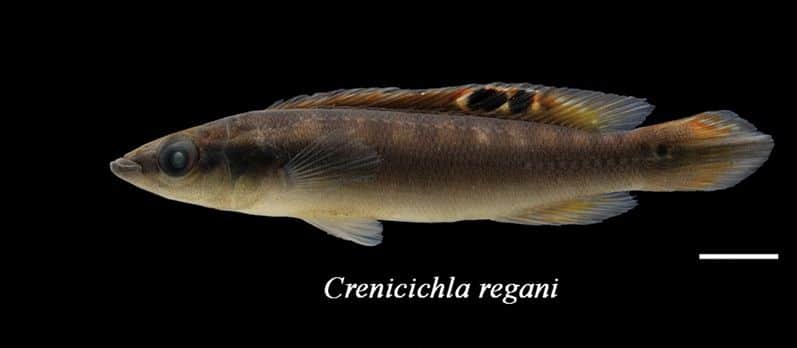
The dwarf pike cichlid has the characteristic elongated, torpedo-shaped body of the Crenicichla genus: large head, upturned mouth, and streamlined profile built for ambush hunting. Base coloration is brownish to olive-green with a dark lateral stripe running from the snout through the eye to the caudal peduncle. Multiple dark vertical bars appear along the body, varying in intensity with mood and condition.
Under good conditions, the body develops subtle iridescent highlights, and the fins may show reddish or yellowish tones in well-conditioned specimens. A dark ocellus is typically present on the upper portion of the caudal peduncle. The overall appearance is subtle rather than flashy, but the predatory body shape and the watchful, alert energy this fish carries give it a charisma that raw color can’t replicate.
Male vs. Female
C. regani is one of the easier pike cichlids to sex. The female’s dorsal fin has distinct black spots that are absent in males, this difference is visible in captive-bred specimens as early as three months of age.
| Feature | Male | Female |
|---|---|---|
| Body Size | Up to 4 inches (10 cm) | Up to 3 inches (7 cm) |
| Dorsal Fin | No spots | Distinct black spots (key sexing indicator) |
| Belly Color | More uniform | May show reddish tones, especially in breeding condition |
| Body Shape | Slightly more elongated | Slightly deeper-bodied when mature |
Average Size & Lifespan
Males in aquariums typically reach 3-4 inches (7-10 cm). Females stay smaller at 2-3 inches (5-7 cm). Growth is rapid, sexual maturity can be reached as early as 3-4 months in captive-bred fish, which makes this species one of the faster-developing cichlids in the hobby relative to its adult size.
Lifespan is typically 4-6 years with proper care. Some sources suggest C. regani may have a naturally shorter lifespan in the wild compared to many other cichlid species. In aquarium conditions with consistent feeding, clean water, and stable parameters, they reliably reach the upper end of that range.
Care Guide
Tank Size
A 30-gallon (114-liter) tank is the minimum for a pair. For a small group or a community setup, 40-55 gallons gives more room for territory establishment and reduces the chance of aggressive encounters. The tank should be at least 36 inches (90 cm) long and 18 inches (45 cm) wide. Footprint matters more than height for these bottom-oriented fish.
In larger groups of 10 or more, a 75-gallon or larger tank with dense structure allows the social hierarchy to stabilize and individual territories to become less rigidly defended. Groups work better than pairs in setups with adequate space and hiding spots.
Water Parameters
| Parameter | Recommended Range |
|---|---|
| Temperature | 76 to 82°F (24 to 28°C) |
| pH | 5.5 to 7.0 |
| General Hardness | 3 to 10 dGH |
| Ammonia | 0 ppm |
| Nitrite | 0 ppm |
| Nitrate | Below 20 ppm |
Hard Rule: Your lid needs to be escape-proof before this fish enters the tank.
Not “a lid with a small gap.” Not “covered except for the feeding hole.” Every gap is an exit. Dwarf pike cichlids are expert jumpers that locate openings other fish ignore entirely. A pike cichlid on the floor doesn’t usually survive. The lid goes on before the fish go in, and it stays on.
Soft, slightly acidic water mimics their natural Amazonian habitat and brings out the best behavior. If your tap water is hard and alkaline, blending with RO water or using peat filtration helps achieve suitable parameters. Driftwood and Indian almond leaves naturally acidify while providing a more natural environment.
Filtration & Water Flow
Strong biological filtration with gentle output. A quality canister or hang-on-back filter provides the necessary biological capacity. Water flow should be gentle to moderate, these fish inhabit calm shoreline areas in the wild and don’t appreciate strong current. Use a spray bar or pre-filter sponge on the output to diffuse flow across the tank. Regular 25-30% weekly water changes maintain the water quality this species needs.
Lighting
Low to moderate lighting. Bright, exposed conditions make dwarf pike cichlids shy and reluctant to leave cover. Floating plants naturally reduce overhead light and create shaded zones that encourage the fish to come out and be visible. This pairs perfectly with the planted tank approach that works so well for this species.
Plants & Decorations
This is where dwarf pike cichlids genuinely surprise people. They don’t dig. They don’t eat plants. They don’t rearrange your aquascape. A densely planted tank with java fern, anubias, cryptocorynes, and stem plants is the ideal environment for C. regani, providing the structured, cover-rich habitat these fish thrive in.
Driftwood tangles, rocky crevices, and small caves are essential alongside the plants. These ambush predators need spots to retreat to, hide in, and hunt from. Coconut shells, small terracotta pots, and stacked rock formations all provide the hideaways dwarf pikes favor. Each territory needs at least one sheltered area the fish can claim as its own.
Substrate
Fine sand is preferred for the natural look and the gentle bottom surface, but it’s not as critical as it is for eartheater species since dwarf pikes don’t sift substrate for food. Fine gravel also works. The key is providing a smooth substrate that won’t abrade the fish’s body, since pike cichlids spend time resting near the bottom.
Tank Mates
C. regani is the most peaceful pike cichlid, but it’s still a small predator. Fish small enough to fit in its mouth will eventually be eaten, though at 3-4 inches, the mouth is small, which limits the at-risk list considerably. Many common community fish are too large to be prey.
Best Tank Mates
- Angelfish, compatible temperament and water parameters; too large to be prey
- Keyhole cichlids, peaceful, similarly sized cichlids with shared soft-water preferences
- Medium-sized tetras (bleeding heart, Colombian, emperor), large enough to avoid predation
- Small corydoras, coexist well in structured tanks with adequate hiding spots
- Other dwarf pike cichlids, groups work in larger tanks with dense structure
Tank Mates to Avoid
- Very small fish, neon tetras, ember tetras, small rasboras, and similar nano fish are potential prey
- Aggressive cichlids, larger territorial cichlids will bully and stress dwarf pikes
- Dwarf shrimp, will be hunted and eaten
- Large, boisterous fish, active, pushy species intimidate these relatively shy predators and reduce visibility
Food & Diet
Dwarf pike cichlids are strict carnivores. Frozen foods should form the foundation of their diet: bloodworms, white mosquito larvae, vitamin-enriched brine shrimp, daphnia, and mysis shrimp are all eagerly accepted. Live blackworms, daphnia, and baby brine shrimp bring out the best hunting behavior and help maintain condition. These are exactly the foods that make this species most active and interesting to watch.
Getting dwarf pikes to accept prepared pellets can be challenging and is not reliable across individuals. Some fish will learn to take sinking pellets or granules, but many won’t. Even those that accept prepared foods need frozen and live supplements. If you’re not willing to feed frozen bloodworms regularly, this isn’t the right fish for your setup.
Feed small amounts 2-3 times daily. These fish have small stomachs and do better with frequent, modest meals. Use sinking foods that reach the bottom where they feed, or target-feed directly to the territory. Upper-water feeders can intercept food before it reaches the pike’s level.
Breeding & Reproduction
Breeding Difficulty
Moderate. C. regani is one of the easier pike cichlids to spawn and has been bred regularly in home aquariums. Sexual maturity arrives quickly in captive-bred fish, sometimes as young as 3-4 months of age, which makes breeding attempts realistic in a well-managed setup.
Spawning Tank Setup
A 20-30 gallon breeding tank works well. Provide fine sand substrate, small caves with tight openings (barely large enough for the fish to enter), and some driftwood or plants for cover. The caves are critical, these are cave spawners, and the female needs an appropriate site to deposit eggs. Coconut shells, small terracotta pots, and commercially available cichlid caves all work well.
Water Conditions for Breeding
Soft, acidic water at pH 5.0-6.0, hardness below 5 dGH, temperature 79-84°F (26-29°C). Slightly decreasing pH and hardness while raising temperature and adding tannins through botanicals (Indian almond leaves, catappa bark) often stimulates breeding activity. Pristine water quality with frequent changes is essential.
Conditioning & Spawning
Condition breeders with generous portions of live food. Live blackworms, daphnia, and brine shrimp are excellent conditioning foods. When ready, the female selects a cave and deposits eggs on the ceiling or walls of the cavity. Both parents guard the territory, with the female providing primary egg care inside the cave. Spawning can occur at 3-4 months of age in aquarium-bred specimens, making this one of the faster-breeding cichlid species in the hobby.
Egg & Fry Care
The female guards eggs inside the cave, fanning them and removing any that develop fungus. Eggs hatch in approximately 3-4 days depending on temperature. Free-swimming fry are relatively large and accept baby brine shrimp as a first food immediately. Growth is rapid with frequent feeding and clean water. Separate fry by size as they develop to prevent cannibalism from larger siblings.
Common Health Issues
Bacterial Infections
Bacterial infections occur when water quality slips or the fish sustains injuries from territorial disputes or sharp decorations. Symptoms include fin erosion, cloudy eyes, and body sores. Good water quality is the primary prevention. Broad-spectrum antibiotics are generally effective when treatment begins early.
Ich (White Spot Disease)
Stress from shipping, new tank introductions, or temperature swings can trigger ich. Gradually raise the temperature to 84-86°F (29-30°C) and treat with a quality ich medication. The warm water preferences of this species work in your favor during treatment.
Internal Parasites
Wild-caught specimens carry a higher parasite risk than tank-raised fish, but aquarium-bred individuals can still be affected. White, stringy feces and unexplained weight loss are warning signs. Metronidazole treats protozoan parasites; praziquantel targets worms. Quarantine all new fish, especially wild-caught specimens, before introduction to an established tank.
Jumping Injuries
Dwarf pike cichlids jump, and they’re good at finding openings. Fish that make it to the floor may survive if found immediately, but often sustain injuries to fins, scales, or internal organs. Prevention is the only reliable approach: a tight-fitting lid with no gaps, every time, from day one. Coverslide glass, acrylic lids, and mesh covers all work as long as they’re truly secure with no openings the fish can exploit.
What People Get Wrong
The Crenicichla genus reputation creates specific, predictable misconceptions about this species:
- “It’s a pike cichlid, so it must be aggressive.” The genus contains some genuinely problematic species, but C. regani is the gentle outlier. It’s specifically the mellow member of an aggressive family. The name creates expectations this particular species consistently contradicts.
- “It’ll destroy my planted tank.” Most cichlids dig and uproot plants. This one doesn’t. A well-planted tank is the ideal environment for C. regani, better than most non-cichlid community fish, because the plants and caves together create exactly the structured habitat this ambush predator needs.
- “I can feed it pellets and supplement occasionally with frozen.” This is backwards. Frozen foods and live foods are the diet, with pellets as the occasional supplement if the fish accepts them at all. Many individuals never take prepared foods. If frozen bloodworms aren’t already part of your routine, address that before getting this species.
- “I’ll get the lid sorted later.” The lid goes on before the fish go in. Not after. Not “tomorrow.” Dwarf pike cichlids are not like most fish where a loose lid is a minor risk. They actively locate and exploit gaps. The tank is not ready for this fish until the lid is escape-proof.
Common Mistakes to Avoid
- Not covering the tank properly. The single most important requirement. Tight-fitting lid, no gaps, before the fish arrives.
- Feeding only prepared foods. Dwarf pikes need frozen and live foods. Prepared foods alone won’t sustain them long-term.
- Keeping with tiny fish. Even with this peaceful species, anything small enough to swallow will eventually be eaten.
- Bright, open lighting without shade. Makes dwarf pikes shy and stressed. Provide floating plants and subdued conditions.
- Insufficient hiding spots. Without caves and structure, these fish feel permanently exposed. More cover means bolder, more visible fish.
- Keeping only a pair without escape routes. If the pair becomes aggressive with each other, the subordinate fish needs somewhere to go. Dense structure with multiple hiding areas is essential.
Should You Get This Fish?
The dwarf pike cichlid is a rewarding, unusual fish that fits a specific keeper profile. Here’s the honest breakdown:
Good fit if:
- You have a 30-gallon or larger with soft, slightly acidic water
- You already feed frozen foods or are willing to start
- You have a tight-fitting, gap-free lid or can build one
- You want a predatory fish with a planted tank aesthetic
- You have some experience keeping soft-water tropical fish
- You’re drawn to the ambush predator personality and torpedo body shape
Think twice if:
- You want a fish that lives primarily on pellets
- You have nano fish (neons, embers, small rasboras) you want to protect
- Your tank has gaps in the lid or you’re not able to add a proper cover
- You’ve never kept carnivorous fish before and aren’t sure about the feeding commitment
- You have dwarf shrimp you want to keep
What It Is Actually Like Living With a Dwarf Pike Cichlid
This is the part the care guides skip. Here is what actually happens when you keep this species long-term.
It does not look like a predator until the moment it eats. The dwarf pike cichlid spends most of its time motionless or drifting near cover, which reads as peaceful until you watch it ambush a small fish. The speed of the strike is the first thing that surprises new keepers. The second is how fast a fish that fits in its mouth disappears. This is a predator that uses patience as its hunting strategy – everything before the strike looks like calm.
The camouflage behavior is constant and deliberate. Dwarf pike cichlids orient to match background elements – driftwood, plant stems, substrate edges. In a well-planted tank with natural decor, you will regularly lose track of this fish. In a bare or sparsely decorated tank, it will look exposed and stressed, and the behavior shifts from confident ambush predator to a fish that cannot settle. The decoration is not optional – it is what turns this fish on.
Personality develops over months. Fish that arrive shy and reclusive become progressively bolder as they map the tank and recognize the keeper. After a few months, a well-settled dwarf pike will emerge at feeding time and track movement at the glass. It will not beg the way an oscar does, but it registers your presence. The transition from hiding fish to confident predator is one of the more satisfying things to watch in a cichlid tank.
Color is the readout. A settled, healthy dwarf pike in the right conditions shows rich patterning with the lateral stripe sharp and the body color fully saturated. Stress, poor water quality, or temperature drift produce a washed-out fish that holds position near the bottom and barely moves. If your dwarf pike looks faded and inactive, something is wrong – check water parameters before anything else.
Dwarf Pike Cichlid vs. Similar Species
If you’re deciding between the dwarf pike cichlid and other small South American cichlids, here’s what actually matters for ownership:
Dwarf Pike Cichlid vs. Apistogramma (Dwarf Cichlids)
Apistos are more colorful, more widely available, and more forgiving on diet (most accept pellets readily). They’re the beginner-accessible entry point into small South American cichlids. The dwarf pike offers what apistos don’t: the predatory body shape, the ambush hunting behavior, and the torpedo silhouette that makes watching these fish genuinely different. Choose an apisto if color and breeding behavior are the priority. Choose the dwarf pike if you want the predator experience in a planted tank.
Dwarf Pike Cichlid vs. Keyhole Cichlid (Cleithracara maronii)
The keyhole cichlid is one of the most peaceful cichlids in the hobby and is genuinely beginner-accessible. It accepts pellets, is compatible with a wide range of tank mates, and has almost no aggression. The keyhole has personality without the predatory edge. Choose keyhole if you want maximum community compatibility and ease of care. Choose dwarf pike if you want the hunting behavior, the ambush personality, and the torpedo shape of a true predatory cichlid in a manageable size.
Where to Buy
Dwarf pike cichlids are a specialty item not commonly found at typical local fish stores. Online retailers and specialty cichlid dealers are the most reliable sources. Flip Aquatics carries unique South American species and is worth checking, and Dan’s Fish is another reliable source for less common cichlids.
When purchasing, look for active, alert fish with good body condition and intact fins. Ask what the fish has been eating, knowing their current food preferences directly affects how easy the transition to your tank will be. Note that fish sold as “dwarf pike cichlid” may include several Crenicichla species from the regani group; confirm the species identification if possible, particularly if you plan to breed.
Frequently Asked Questions
Are dwarf pike cichlids good for beginners?
Intermediate keepers with some experience, not true beginners. The feeding requirements, regular live and frozen foods, and water quality standards put this fish above entry level. If you’ve successfully kept soft-water community fish and already feed frozen foods regularly, C. regani is approachable. If this would be your first foray into carnivorous fish, build that experience first.
Can dwarf pikes live in a community tank?
Yes, with the right companions. Fish too large to swallow and that don’t crowd the bottom territory are safe. Angelfish, keyhole cichlids, and medium-sized tetras all work. The critical factor is providing enough structure and hiding spots so the pike feels secure and doesn’t become stressed by tank mates.
Will dwarf pikes eat pellets?
Some individuals accept sinking pellets and granules, but many don’t, and you can’t count on it. Even fish that take prepared foods need frozen and live foods as a regular part of their diet. If you’re not prepared to provide frozen bloodworms and similar foods consistently, this is the wrong species for your setup. The diet requirement is not negotiable.
Can I keep dwarf pikes in a planted tank?
Yes, and a planted tank is actually the ideal setup. Unlike most cichlids, dwarf pikes don’t dig or eat plants. Dense planting with java fern, anubias, cryptocorynes, and stem plants creates exactly the structured, cover-rich habitat these fish thrive in. A planted setup with driftwood and caves is far superior to a sparse tank.
How do I sex dwarf pike cichlids?
Look at the dorsal fin. Females have distinct black spots on the dorsal; males don’t. This is visible in captive-bred fish as early as three months of age, making it one of the easier dwarf cichlids to sex. Males are also slightly larger and may show less belly color variation than females.
Why is the lid such a big deal with this species?
Dwarf pike cichlids are exceptionally good at finding and exploiting gaps in aquarium covers. They’re jumpers by nature, and unlike some fish where a loose lid is a minor hazard, a pike cichlid that gets out typically doesn’t survive. This isn’t theoretical, it’s a commonly reported experience among keepers who underestimated the lid requirement. Sort the lid before the fish arrive, not after.
Closing Thoughts
The dwarf pike cichlid offers something rare in the aquarium hobby: the predatory edge and torpedo elegance of a pike cichlid in a package that actually fits in a standard home aquarium. C. regani proves that you don’t need 100 gallons to enjoy the hunting behavior, the alert intelligence, and the distinctive body shape that make pike cichlids so compelling.
Set up a planted tank with soft water, plenty of caves and driftwood, and a secure lid. Feed a carnivorous diet heavy on frozen and live foods. Add a pair or small group and let them settle in. You’ll have a fish that combines the predatory personality of a pike cichlid with a size and temperament that opens it up to a whole range of keepers who’ve been on the wrong side of the genus reputation for too long.
References
- FishBase: Crenicichla regani Ploeg, 1989. fishbase.in
- TFH Magazine: “It’s Dwarf Crenicichla Time!” tfhmagazine.com
- Cichlid Room Companion: Crenicichla regani, the gentle pike. cichlidae.com
- The Aquarium Wiki: Crenicichla regani. theaquariumwiki.com
- About the Author
- Latest Posts

I’m Mark Valderrama, founder of Aquarium Store Depot and a fishkeeper with over 25 years of hands-on experience. I started in the hobby at age 11, worked at local fish stores, and have kept freshwater tanks, ponds, and reef tanks ever since. I’ve been featured in two best-selling aquarium books on Amazon and built this site to share practical, experience-based fish keeping knowledge.
Leave a Reply