Last Updated: June 25, 2026
Thank you for visiting! By the way… any links on this page that lead to products on Amazon and other stores/partners are affiliate links Aquarium Store Depot earns a commission if you make a purchase.
Table of Contents
- What Most Care Guides Get Wrong
- The Reality of Keeping
- Key Takeaways
- Species Overview
- Classification
- Origin & Natural Habitat
- Appearance & Identification
- Average Size & Lifespan
- Care Guide
- Tank Mates
- Food & Diet
- Is the Checkerboard Cichlid Right for You?
- Breeding & Reproduction
- Common Health Issues
- Common Mistakes to Avoid
- Where to Buy
- FAQ
- What It Is Actually Like
- Species Comparison
- Closing Thoughts
- References
Checkerboard cichlids are among the most delicate freshwater fish in the hobby. They need soft, acidic water, pristine conditions, and a stress free environment. One parameter swing and they stop eating. Ammonia above zero and they are dead within days. I have lost checkerboards in tanks that every other fish thrived in because their tolerance for error is essentially zero. This is not a beginner fish. This is not even an intermediate fish. This is an expert level cichlid in a tiny package. The dwarf cichlid that treats your water quality as a pass/fail exam.
The dwarf cichlid that treats your water quality as a pass/fail exam.
What Most Care Guides Get Wrong About Checkerboard Cichlid
The biggest misconception about Checkerboard Cichlids is that “soft water” means Indian almond leaves and a pH around 6.5. It doesn’t, for this species. Checkerboard cichlids need pH 4.5 to 5.5 and near-zero hardness – not soft-ish, not close, not pH 6.8 with tannins added. In my 25 plus years in the hobby, I’ve watched people set up what they thought was a soft-water tank and lose every checkerboard within a month. The tank looked right. The fish seemed fine for the first week. Then the fade started. The water was never where it needed to be, and with this species, close is not close enough.
The Reality of Keeping Checkerboard Cichlid
Checkerboard cichlids are among the most delicate freshwater fish in the hobby. Beautiful, yes. Forgiving, absolutely not.
Water chemistry is make or break. pH 4.5 to 6.5, extremely soft water. These fish come from blackwater habitats and need conditions that match. Hard, alkaline water kills them.
Stress kills faster than disease. Aggressive tank mates, bright lighting, bare tanks. Any of these will stress checkerboards to death before disease has a chance.
They need a mature tank. Do not add checkerboard cichlids to a new setup. The tank needs to be fully cycled and stable for months before they go in.
Sand sifting is their signature behavior. Watching checkerboards methodically sift through sand is mesmerizing. Fine sand substrate is not optional.
Biggest Mistake New Checkerboard Cichlid Owners Make
Adding them to a new tank with the wrong water chemistry. Checkerboard cichlids need an established, mature tank with very soft, acidic water. Skipping either requirement means losing the fish within weeks.
Expert Take (Mark Valderrama, AquariumStoreDepot)
At the stores I managed, I declined to stock Dicrossus filamentosus for general sale most of the time. Not because it is hard to source, but because I did not want to be responsible for selling a fish that would die in most buyers’ tap water within three weeks. The customers who succeeded with checkerboard cichlids – and I have seen a handful – already had RO systems, already understood blackwater chemistry, and had already kept other demanding soft-water species successfully. Everyone else asked what went wrong when the fish died, and the answer was always the same: the water. This species is not advanced because it is aggressive, territorial, or hard to feed. It is advanced because the margin for error on water chemistry is essentially zero. The fish that rewards you with one of the most beautiful fin structures in freshwater fishkeeping asks one thing in return: get the water right, and never let it slip.
Key Takeaways
- Demands very soft, acidic water: This is not a species for standard tap water setups. A pH of 4.5 to 6.0 and very low hardness (under 2 dGH) are necessary for long-term health and any chance at breeding success.
- Males display spectacular lyretail finnage: The elongated, filamentous caudal fin extensions on mature males are among the most beautiful features found on any dwarf cichlid.
- Peaceful temperament: Checkerboard Cichlids are genuinely peaceful fish that struggle against more aggressive tank mates. Choose companions carefully.
- Breeding requires extreme conditions: Eggs reportedly won’t hatch above pH 5.8, making this one of the most demanding dwarf cichlids to breed in captivity.
- Not for beginners: This is an advanced-level species that demands precise water chemistry, high-quality foods, and meticulous tank maintenance. Experience with soft-water setups is essential.
Species Overview
| Property | Details |
|---|---|
| Scientific Name | Dicrossus filamentosus |
| Common Names | Checkerboard Cichlid, Lyretail Checkerboard Cichlid, Chessboard Cichlid |
| Family | Cichlidae |
| Origin | Colombia, Venezuela, Brazil (Amazon and Orinoco basins) |
| Care Level | Advanced |
| Temperament | Peaceful |
| Diet | Carnivore (primarily) |
| Tank Level | Bottom to middle |
| Maximum Size | 3.5 inches (9 cm) males; 2.5 inches (6 cm) females |
| Minimum Tank Size | 20 gallons (75 liters) |
| Temperature | 75 – 84°F (24 – 29°C) |
| pH | 4.0 – 6.5 |
| Hardness | 0 – 3 dGH |
| Lifespan | 3 – 5 years |
| Breeding | Substrate spawner |
| Breeding Difficulty | Difficult |
| Compatibility | Peaceful community (soft water species only) |
| OK for Planted Tanks? | Yes (highly recommended) |
Classification
| Taxonomic Rank | Classification |
|---|---|
| Order | Cichliformes |
| Family | Cichlidae |
| Subfamily | Geophaginae |
| Genus | Dicrossus |
| Species | D. Filamentosus (Ladiges, 1958) |
Dicrossus filamentosus was described by Werner Ladiges in 1958. The genus name Dicrossus comes from the Greek “di” (two) and “krossoi” (tassels or fringes), referring to the distinctive filamentous extensions on the caudal fin of mature males. The genus contains only a handful of species, with D. Maculatus (Spadetail Checkerboard Cichlid) being the other commonly seen species in the hobby. Despite their common name, Dicrossus species are not closely related to the African chess-pattern cichlids and belong firmly within the South American Geophaginae subfamily.
Origin & Natural Habitat
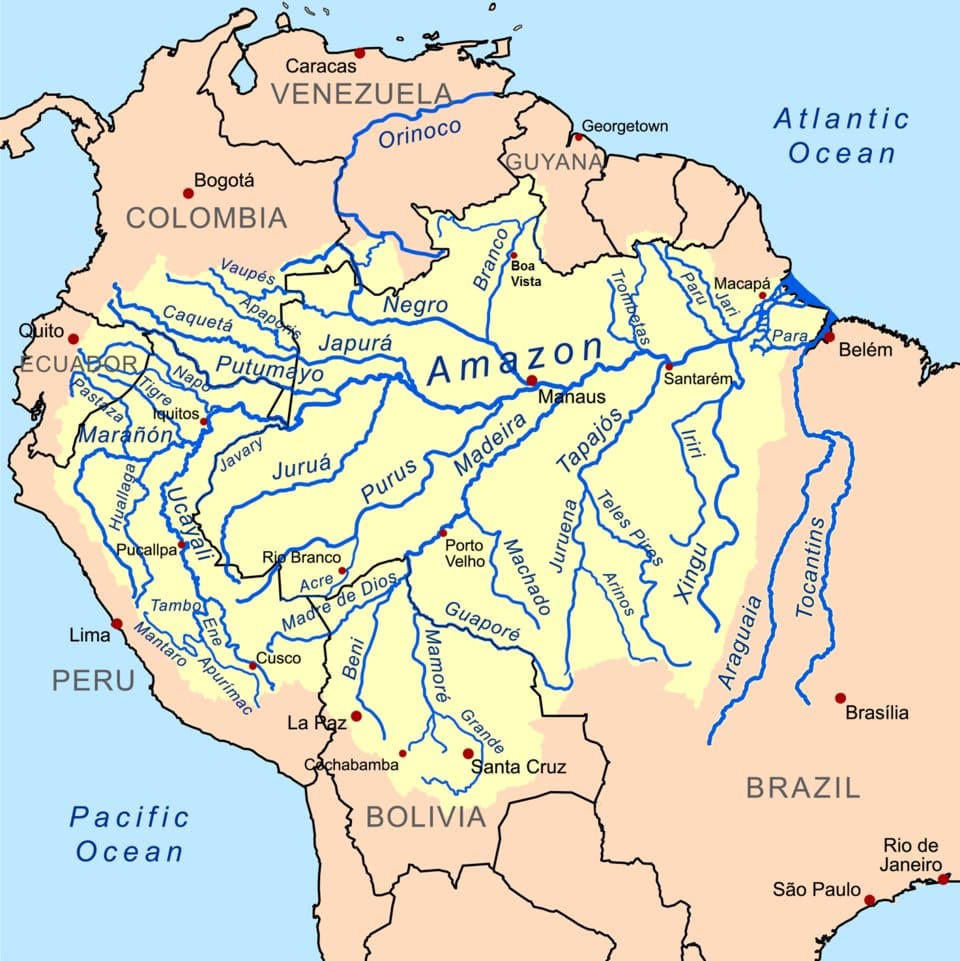
The Checkerboard Cichlid is found across a wide range in northern South America, including the Rio Negro drainage in Brazil, the Rio Inírida system in Colombia, and sections of the Orinoco basin in Venezuela. This distribution spans some of the most extreme blackwater habitats on the planet, and understanding these conditions is absolutely critical for keeping this species successfully in captivity.
In the wild, D. Filamentosus inhabits dark, tannin-stained blackwater streams and tributaries where the water is extremely soft, highly acidic (often pH 4.0 to 5.5), and warm. The water in these habitats is so mineral-poor and acidic that very few organisms can thrive in it, which is both a challenge and a benefit: the extreme conditions reduce competition and disease pressure. The substrate is fine white sand covered in deep layers of fallen leaves, and the water is stained dark brown to nearly black by humic acids leached from decomposing organic matter. Dense root systems, fallen branches, and overhanging vegetation provide shade and shelter. Light levels are extremely low, filtered through both forest canopy and the dark-tinted water. This is one of the most specialized aquatic habitats in the world, and the Checkerboard Cichlid has evolved to thrive in it.
Appearance & Identification
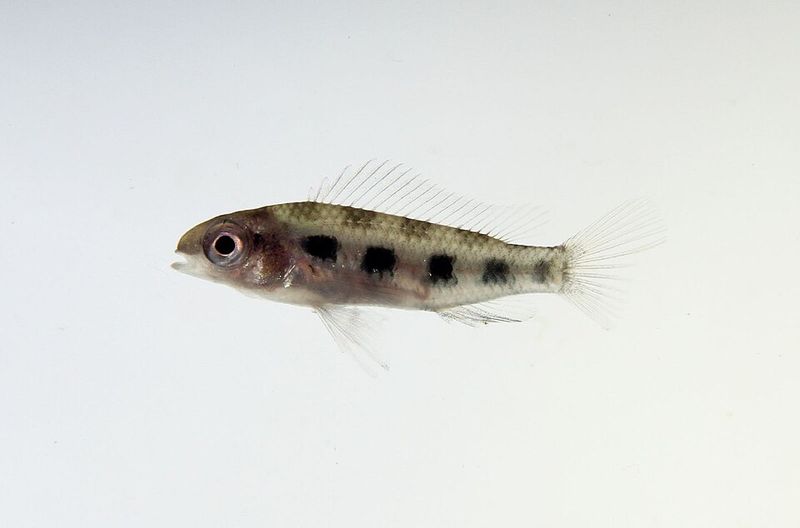
The Checkerboard Cichlid’s most distinctive feature is the pattern that gives it its common name. Two rows of dark, roughly square blotches run along each side of the body, creating a checkerboard effect that’s unique among freshwater aquarium fish. The base color is a warm cream to silvery-olive, and depending on mood and conditions, the dark squares can intensify dramatically or fade to near-invisible. A dark stripe runs from the snout through the eye, and the face often shows iridescent blue-green markings.
But the real showpiece is the male’s caudal fin. In mature males, the caudal fin develops a pronounced lyretail shape with long, filamentous extensions on the upper and lower rays that can extend well beyond the body length. These trailing filaments, combined with red and blue markings in the fin, create an extraordinarily elegant appearance as the fish moves through the water. The dorsal and anal fins also develop attractive coloration, with red, blue, and yellow elements that vary between individual fish and populations.
Females are smaller and lack the dramatic lyretail. Their caudal fin is rounded, and their overall coloration is more subdued, though they still display the characteristic checkerboard patterning. During breeding, females may develop slightly more vivid coloration and darker markings.
Male vs. Female
| Feature | Male | Female |
|---|---|---|
| Size | Up to 3.5 inches (9 cm) including fin extensions | Up to 2.5 inches (6 cm) |
| Caudal Fin | Lyretail with long filamentous extensions | Rounded, no extensions |
| Coloration | More vivid, with red and blue fin markings | Subtler coloration, less fin color |
| Body Shape | Slimmer, more elongated | Rounder, especially when gravid |
| Checkerboard Pattern | Present, may be less distinct when displaying | Usually more consistently visible |
Sexing Checkerboard Cichlids becomes quite straightforward once the males begin developing their lyretail extensions, which starts around 1.5 to 2 inches (4 to 5 cm). Before this stage, the differences are subtle, with males tending to be slightly slimmer and showing the earliest hints of fin extension. Juveniles of both sexes display the checkerboard pattern equally.
Average Size & Lifespan
Males reach about 3 to 3.5 inches (7.5 to 9 cm) in the aquarium, including their caudal fin extensions. The body itself is more like 2.5 to 3 inches (6 to 7.5 cm). Females are noticeably smaller, maxing out at about 2 to 2.5 inches (5 to 6 cm). FishBase records a standard length of about 1.5 inches (3.8 cm), but total length including fins is considerably larger.
With proper care in appropriate water conditions, Checkerboard Cichlids live 3 to 5 years. However, fish kept in water that’s too hard, too alkaline, or too cold will have significantly shortened lifespans. This is a species where getting the environment right directly translates to longevity.
ASD Difficulty Rating
Advanced | 8/10
Blackwater specialists requiring pH 4.5–5.5 and near-zero hardness. They do not adapt to standard tap water. An RO system is not optional. Experience with soft-water setups is required before attempting this species – not recommended as a first dwarf cichlid.
Care Guide
Tank Size
A 20-gallon (75-liter) tank with a minimum footprint of 24 by 12 inches (60 by 30 cm) is appropriate for a pair or small group. These are not heavily territorial fish, so space requirements are more about maintaining stable water chemistry than providing territory. A larger tank of 30 gallons (115 liters) or more is actually easier to manage because it provides more water volume to buffer against parameter swings, which is critically important with this sensitive species.
Water Parameters
| Parameter | Recommended Range |
|---|---|
| Temperature | 75 – 84°F (24 – 29°C) |
| pH | 4.0 – 6.5 |
| General Hardness (GH) | 0 – 3 dGH |
| KH | 0 – 1 dKH |
| Ammonia | 0 ppm |
| Nitrite | 0 ppm |
| Nitrate | < 10 ppm |
This is the section that determines whether the Checkerboard Cichlid is right for you. These fish come from some of the softest, most acidic water on Earth, and while captive-bred specimens can tolerate conditions up to pH 6.5 and slightly higher hardness, they never truly thrive outside of very soft, acidic parameters. An RO (reverse osmosis) system is essentially mandatory unless your tap water is naturally very soft.
The ideal setup uses pure RO water reconstituted with a minimal amount of remineralizer, with pH lowered through the addition of Indian almond leaves, alder cones, and peat filtration. Target a pH of 5.0 to 6.0 for general keeping, lower for breeding. Keep nitrates as low as possible, ideally under 10 ppm, as this species is more sensitive to dissolved waste than many commonly kept dwarf cichlids. Small, frequent water changes of 10 to 15 percent twice weekly are preferable to larger, less frequent changes that could swing parameters.
Filtration & Water Flow
Gentle filtration is essential. These fish come from very slow-moving water and don’t tolerate strong currents. A quality sponge filter is ideal, providing biological filtration without creating flow. For slightly larger setups, a small canister filter with the output heavily diffused through a spray bar or lily pipe works well. Adding peat to the filter media can help maintain the acidic conditions this species needs, though it requires monitoring to avoid pH crashes.
Lighting
Very subdued lighting is strongly preferred. In nature, Checkerboard Cichlids live in extremely dim conditions, with light filtered through dense canopy and dark tannin-stained water. Bright lighting makes them stressed, pale, and skittish. Dense floating plant cover is essential, and heavily tannin-tinted water both reduces light penetration and creates the warm amber ambiance that makes this species feel at home. Under these conditions, the checkerboard pattern and the male’s lyretail fin markings display beautifully.
Plants & Decorations
Create a blackwater biotope-inspired setup for the best results. Fine white sand as the substrate, topped with a thick layer of Indian almond leaves, forms the base. Add driftwood roots, branches, and twigs to create a complex, sheltered environment. Live plants should be species that tolerate very soft, acidic water and low light. Java Fern, Anubias, Java Moss, and Cryptocoryne are all workable options, though some plants struggle at pH values below 5.5. Floating plants like Amazon Frogbit, Salvinia, or Water Lettuce are essential for shade.
The leaf litter layer is not just decorative; it’s functional. The decomposing leaves release tannins that maintain acidity, support microbial communities, and foster the growth of infusoria and other microfauna that fry can feed on. Replace leaves every few weeks as they break down.
Substrate
Fine, light-colored sand is traditional and recommended for Checkerboard Cichlids. White or pale sand mimics the natural habitat and creates an attractive contrast with the dark leaf litter layer and tannin-stained water. Avoid substrates that buffer pH upward (like crushed coral or aragonite), as these work against the acidic conditions this species requires.
Tank Mates
Best Tank Mates
Tank mate selection is limited by two factors: the Checkerboard Cichlid’s peaceful nature and its extreme water requirements. Only fish that thrive in very soft, acidic water should be considered. Good options include:
- Cardinal Tetras. The classic blackwater companion, naturally found in similar habitats
- Green Neon Tetras. Tiny, peaceful, and love extreme blackwater conditions
- Pencilfish (Nannostomus species). Ideal dither fish for acidic setups
- Hatchetfish. Surface dwellers that thrive in soft, acidic water
- Pygmy Corydoras. Small, peaceful bottom dwellers for the same pH range
- Chocolate Gouramis. Another species that demands very soft, acidic conditions
- Small Rasboras (Boraras species). Tiny, peaceful, and tolerant of extreme blackwater
Tank Mates to Avoid
- Any aggressive or semi-aggressive species. Checkerboard Cichlids are too peaceful and delicate to withstand bullying
- Fish requiring hard, alkaline water. Livebearers, African cichlids, and similar species are fundamentally incompatible
- Fast, boisterous species. Hyperactive fish stress these calm, slow-moving cichlids
- Larger cichlids. Even other dwarf cichlids may be too aggressive for Checkerboard Cichlids
- Bottom-dwelling competitors. Large Plecos and loaches compete for space and may be too rough
Food & Diet
Checkerboard Cichlids are carnivorous feeders that do best on a varied diet of high-quality frozen and live foods. Frozen bloodworms, daphnia, brine shrimp, cyclops, and mysis shrimp should be offered regularly. Live foods are especially valuable and include baby brine shrimp, grindal worms, microworms, and daphnia cultures. The latter is particularly recommended as a conditioning food for breeding pairs.
Most specimens will accept high-quality sinking pellets as a supplementary food source, and spirulina-based flakes can provide some vegetable matter for variety. However, this species’ diet should be heavily weighted toward frozen and live foods for the best health and coloration. Feed small amounts two to three times daily. These fish have small mouths, so ensure food particles are appropriately sized. Clean up any uneaten food promptly, as water quality is critical in the extremely soft, acidic conditions this species requires.
Is the Checkerboard Cichlid Right for You?
Before you commit. The checkerboard cichlid is one of the most rewarding dwarf cichlids in the hobby – and one of the most likely to die quickly in the wrong setup. Here is the honest breakdown.
Good fit if:
- You have an RO (reverse osmosis) system or naturally very soft, acidic tap water – this is the hard prerequisite, not a nice-to-have
- You have successfully kept other demanding soft-water species (cardinal tetras in true blackwater, chocolate gouramis, soft-water Apistos) and understand parameter management
- You have a mature, established tank that has been stable for at least 6 months – new tanks are death sentences for this species
- You want to build a dedicated blackwater biotope – this is the showpiece centerpiece for that setup
- You want to observe the male’s lyretail fin display, which is unlike anything else in freshwater fishkeeping at this size
- You want a genuine advanced challenge – breeding at pH below 5.8 is one of the most demanding projects in the dwarf cichlid hobby
Think twice if:
- Your tap water is hard or moderately hard and you don’t have an RO system – without soft water, this fish will not survive long-term
- You are new to dwarf cichlids – start with Apistogramma cacatuoides (Cockatoo Apisto) or A. borellii, which tolerate a much wider range of water conditions
- You want to add them to a general community tank – the water requirements eliminate most community fish as tank mates
- You want a forgiving fish that tolerates occasional maintenance lapses – there is no margin for error with this species
- You are drawn to the checkerboard pattern but are not prepared for the blackwater commitment – the pattern alone is not worth the specialized care requirement if you are not already running a soft-water setup
Breeding & Reproduction
Breeding Difficulty
Difficult. Breeding Checkerboard Cichlids is one of the more challenging projects in the dwarf cichlid world, not because the fish are reluctant spawners, but because the water conditions required for successful egg development are extreme. The eggs reportedly require a pH below 5.8 to develop properly and hatch, and most hobbyists’ setups don’t reach these levels. This is a breeding project for experienced keepers with RO systems and a solid understanding of water chemistry management.
Spawning Tank Setup
A dedicated breeding tank of 15 to 20 gallons (55 to 75 liters) is recommended. Unlike cave-spawning Apistogramma, Checkerboard Cichlids are open substrate spawners that deposit their eggs on flat surfaces such as smooth rocks, broad leaves, or the top surface of driftwood. Provide several potential spawning surfaces along with dense planting and leaf litter. A sponge filter provides the gentle, fry-safe filtration needed.
Water Conditions for Breeding
This is where the challenge lies. Target a pH of 4.5 to 5.5, temperature around 80 to 82°F (27 to 28°C), and essentially zero hardness. Pure RO water with minimal reconstitution is necessary, with pH maintained through heavy tannin supplementation (Indian almond leaves, peat filtration, alder cones). The water should be deeply stained and extremely soft. Some breeders use pure peat-filtered RO water to achieve these conditions. Stability is critical; even small upward swings in pH can prevent eggs from developing.
Conditioning & Spawning
Condition the pair with heavy feedings of live foods, particularly daphnia and brine shrimp, for two to three weeks. The female will clean a chosen spawning surface and display increased coloration. Spawning occurs on the prepared surface, with the female depositing eggs in rows while the male follows to fertilize them. Clutch sizes are 50 to 100 eggs.
Both parents participate in brood care, taking turns fanning the eggs and guarding the spawning site. Their defensive behavior is mild compared to many cichlids, which is both charming and a potential problem if aggressive tank mates are present. The parents’ protection won’t hold up against determined predators.
Egg & Fry Care
Eggs hatch in approximately 2 to 3 days at breeding temperatures, provided the pH is low enough for development. The wrigglers are moved by the parents to a pit in the substrate, where they remain for another 4 to 5 days while absorbing their yolk sacs. Free-swimming fry are tiny and require extremely small first foods. Infusoria, paramecium cultures, or commercial liquid fry food are necessary for the first several days, followed by freshly hatched baby brine shrimp once the fry are large enough to consume them. Growth is slow compared to many dwarf cichlids, and the fry remain very small for several weeks.
Common Health Issues
Sensitivity to Water Chemistry
The single biggest health risk for Checkerboard Cichlids is inappropriate water chemistry. Fish kept in water that’s too hard, too alkaline, or with elevated nitrate levels often develop chronic stress that manifests as pale coloration, reduced appetite, susceptibility to secondary infections, and shortened lifespan. This isn’t a disease per se, but it’s the most common cause of problems with this species. The solution is getting the water right from the start and maintaining it consistently.
Ich (White Spot Disease)
Ich can affect any freshwater fish, including Checkerboard Cichlids. The standard white spots, flashing, and clamped fins are the indicators. Heat treatment (raising to 86°F / 30°C) is effective, and this warm-water species tolerates the elevated temperatures well. Use medications at reduced doses, as the soft, acidic water these fish live in can increase the toxicity of some treatments. Be very careful with copper-based medications in extremely soft water.
Velvet Disease
Velvet (Piscinoodinium) is a particular risk in warm, soft-water tanks, which unfortunately describes the ideal Checkerboard Cichlid setup perfectly. It presents as a fine, gold-dusted appearance on the skin, rapid gill movement, and lethargy. It’s easy to miss in early stages because the gold dusting is subtle. Dimming the lights (the parasite is photosynthetic) and treating with medications at reduced doses is the standard approach. Quarantining new fish before adding them to the display tank is the best prevention.
Internal Parasites
Wild-caught Checkerboard Cichlids frequently carry internal parasites. Symptoms include weight loss despite eating, hollow belly, and white stringy feces. Prophylactic deworming during a quarantine period is strongly recommended for wild-caught specimens. Even captive-bred fish should be quarantined and observed for at least two weeks before introduction to your display tank.
Bacterial Infections
Stress from inappropriate water conditions or aggressive tank mates weakens the immune system and opens the door to bacterial infections. Fin rot, skin ulceration, and septicemia can all occur in chronically stressed Checkerboard Cichlids. Addressing the underlying cause (water chemistry, tank mate aggression, etc.) is always the first priority, followed by appropriate antibacterial treatment if needed.
Hard Rule: True blackwater only. RO water is not optional for this species.
pH 4.5–5.5, GH 0–3 – not soft-ish water, not “close to neutral.” Standard tap water at neutral pH is a slow-kill environment for this species. The fish will not die immediately, but it will never thrive, and you will spend months watching it fade before you find out why. RO water with blackwater extract is the baseline. Not an enhancement. The baseline.
Common Mistakes to Avoid
- Keeping them in hard, alkaline water: This is the fatal mistake. Checkerboard Cichlids cannot thrive in water above pH 7.0 or with hardness above 5 dGH. If you can’t provide very soft, acidic water, this is not the species for you. Full stop.
- Housing them with aggressive tank mates: These are gentle, peaceful fish that cannot hold their own against bullies. Even moderately territorial dwarf cichlids may be too much for them. Choose only truly peaceful companions.
- Using medications at full dose: In very soft, acidic water, the bioavailability and toxicity of many medications increases. Always use reduced doses and monitor the fish closely during treatment. Copper-based products are particularly risky in extremely soft water.
- Neglecting live and frozen foods: A diet of only dry foods is insufficient for this species. They need regular access to high-quality frozen and live foods for health, coloration, and any hope of breeding success.
- Large water changes: In extreme blackwater setups, large water changes can cause dangerous parameter swings. Small, frequent changes of 10 to 15 percent are much safer than 50 percent weekly changes. Always ensure replacement water matches the tank’s chemistry closely.
- Bright lighting without floating plants: These fish come from extremely dim environments. Harsh, direct lighting causes chronic stress. Always provide substantial floating plant cover.
Where to Buy
Checkerboard Cichlids are a specialty species that requires sourcing from dedicated retailers rather than big-box pet stores. Availability is sporadic, as demand is limited to experienced hobbyists. Check these trusted sources:
- Flip Aquatics. A quality source for dwarf cichlids and specialty fish with careful shipping practices. Check their inventory regularly, as Dicrossus species come in periodically.
- Dan’s Fish. Another reliable retailer for hard-to-find freshwater species. Their stock changes frequently, so monitor for availability.
When purchasing, ask whether the fish are wild-caught or captive-bred and what water conditions they’ve been maintained in. Wild-caught specimens are more demanding about water chemistry, while captive-bred fish may show slightly more tolerance. Either way, be prepared to provide very soft, acidic conditions from day one. Don’t buy Checkerboard Cichlids unless you already have the appropriate water chemistry set up and stable.
FAQ
Do Checkerboard Cichlids really need such extreme water conditions?
Yes. While captive-bred specimens can survive in slightly less extreme conditions (pH up to 6.5, GH up to 3), they don’t truly thrive outside of very soft, acidic water. Fish kept in harder, more alkaline conditions show washed-out coloration, reduced activity, and shortened lifespans. For breeding, the conditions need to be even more extreme, with pH below 5.8 being reportedly necessary for egg development.
What’s the difference between Dicrossus filamentosus and Dicrossus maculatus?
D. Filamentosus (Lyretail Checkerboard) and D. Maculatus (Spadetail Checkerboard) are the two commonly seen species in the hobby. The most obvious difference is the caudal fin shape in males: D. Filamentosus develops a lyretail with filamentous extensions, while D. Maculatus develops a spade-shaped tail. D. Maculatus is widely recognized as slightly less demanding regarding water chemistry, though both species need soft, acidic conditions.
Can I keep Checkerboard Cichlids in a community tank?
Yes, but only with other peaceful species that share the same extreme water requirements. Cardinal Tetras, pencilfish, and other blackwater-adapted fish make excellent companions. The limiting factor is finding fish that thrive at pH 5.0 to 6.0 with near-zero hardness. Most standard community fish won’t do well in these conditions.
Do I need an RO system for Checkerboard Cichlids?
Yes. Unless your tap water is naturally very soft and acidic (which is uncommon in most of North America and Europe), you’ll need an RO system to produce the mineral-poor water base this species requires. The investment in an RO unit is essentially a prerequisite for keeping this species successfully long-term.
Why are my Checkerboard Cichlid’s colors fading?
Faded coloration in Checkerboard Cichlids is almost always a sign of environmental stress. Check your water parameters first: pH, hardness, temperature, and nitrate levels. Water that’s too hard, too alkaline, or with elevated nitrates causes chronic stress that directly impacts coloration. Poor diet, aggressive tank mates, and excessively bright lighting are also common culprits. Address the underlying stressor, and colors should return within days to weeks.
What It Is Actually Like Living With Checkerboard Cichlids
Here is what the parameter tables do not tell you.
The sand-sifting is hypnotic. Checkerboard cichlids methodically work the substrate, taking mouthfuls of sand and ejecting them to the side as they search for food. In a tank with fine white sand and deep leaf litter, they dig small depressions as they forage, rearranging the surface in patterns that look intentional. It is one of the most satisfying behaviors to watch in any dwarf cichlid – slow, deliberate, and unmistakably theirs.
The male’s lyretail display is the reason serious hobbyists keep this species. When a male sees a female or senses a rival, he extends everything – dorsal, anal, and the trailing lyretail filaments fanned to full extension. The caudal filaments can be nearly as long as the body itself. Against tannin-amber water with backlit leaves, it looks like nothing else in freshwater. That display is what you are actually buying when you buy a checkerboard cichlid. The care requirements are the price of admission.
Color tells you everything before any symptom appears. A checkerboard in correct water and good health has vivid, saturated checker pattern, iridescent markings on the face, and clean, clearly colored fins. The same fish in water that is slightly too hard or slightly too alkaline goes muted – pattern fades, fins lose their color definition, the fish retreats from the front of the tank. You will see the color change before the fish stops eating. Learn your fish’s baseline so you know what “off” looks like. You will always have advance warning with this species if you are paying attention.
The tank itself becomes part of the experience. A properly set up checkerboard cichlid tank – amber water, leaf litter carpet, driftwood roots, soft lighting – is one of the most aesthetically complete setups in the hobby. The fish and the environment are inseparable. You are not just keeping a fish; you are maintaining a piece of one of the most extreme aquatic habitats on Earth, and doing it successfully.
How the Checkerboard Cichlid Compares to Similar Species
Checkerboard Cichlid vs. Spadetail Checkerboard Cichlid (Dicrossus maculatus)
These are sibling species within the same genus, and they get compared constantly. The visual difference is the caudal fin: D. filamentosus males develop a lyretail with long filamentous extensions; D. maculatus males develop a spade-shaped tail without the trailing filaments. Care requirements are similar – both need soft, acidic blackwater conditions and will not thrive in standard tap water. The practical difference is that D. maculatus is widely recognized as slightly less demanding about water chemistry at the extreme end, with slightly better tolerance for pH values approaching 6.5 to 7.0. Choose D. filamentosus if you want the most spectacular fin display in the genus and are committed to running a true blackwater setup. Choose D. maculatus if you are stepping into the Dicrossus genus for the first time and want a slightly more forgiving starting point with a similar behavioral profile.
Checkerboard Cichlid vs. Apistogramma
For most hobbyists considering a dwarf cichlid, an Apistogramma is the practical comparison. The key difference is water chemistry tolerance. Most Apistogramma species – cacatuoides, borellii, macmasteri – tolerate pH 6.0 to 7.5 and moderate hardness, making them accessible to hobbyists with standard tap water. The checkerboard cichlid does not have that tolerance. The tradeoff is visual: no Apistogramma male develops the filamentous lyretail of a mature D. filamentosus. Choose an Apistogramma if you are new to dwarf cichlids, have moderate or hard tap water, or want a hardy species you can keep in a general community. Choose the Checkerboard Cichlid if you already run a soft-water or blackwater setup and want the most elegant fin structure in the dwarf cichlid world – with the understanding that you are trading water chemistry flexibility for an appearance nothing else replicates.
Closing Thoughts
Checkerboard cichlids do not tolerate mistakes. Not small ones. Not brief ones. None.
The Checkerboard Cichlid is not a fish for everyone, and there’s no shame in admitting that its requirements are beyond your current setup or experience level. But for hobbyists who are ready for the challenge, who have an RO system and the patience to maintain extreme blackwater conditions, Dicrossus filamentosus offers something truly special. A mature male with his filamentous lyretail trailing through amber-tinted water, his checkerboard pattern shimmering against a backdrop of leaf litter and driftwood, is a sight that stays with you. It’s the kind of fish that reminds you why the advanced end of the hobby exists.
If you’re considering this species, be honest about whether you can provide what it needs. The water chemistry requirements are non-negotiable, and cutting corners leads to disappointment. But if you’re ready to commit, the Checkerboard Cichlid rewards that commitment with beauty, elegance, and the quiet satisfaction of keeping one of the hobby’s most demanding and rewarding dwarf cichlids.
This article is part of our South American Cichlids species directory. Explore more South American cichlid care guides.
References
- Seriously Fish. (n.d.). Dicrossus filamentosus. Retrieved from https://www.seriouslyfish.com/species/dicrossus-filamentosus/
- Froese, R. & Pauly, D. (Eds.). (2024). Dicrossus filamentosus in FishBase. Retrieved from https://www.fishbase.se/summary/Dicrossus-filamentosus.html
- Ladiges, W. (1958). Crenicara filamentosa n. Sp., ein neuer Zwergbuntbarsch aus Kolumbien. Die Aquarien- und Terrarien-Zeitschrift, 11, 208-210.
- Römer, U. (2006). Cichlid Atlas Volume 2: Natural History of South American Dwarf Cichlids. Mergus Publishers.
- About the Author
- Latest Posts

I’m Mark Valderrama, founder of Aquarium Store Depot and a fishkeeper with over 25 years of hands-on experience. I started in the hobby at age 11, worked at local fish stores, and have kept freshwater tanks, ponds, and reef tanks ever since. I’ve been featured in two best-selling aquarium books on Amazon and built this site to share practical, experience-based fish keeping knowledge.
Leave a Reply