
Last Updated: June 25, 2026
Thank you for visiting! By the way… any links on this page that lead to products on Amazon and other stores/partners are affiliate links Aquarium Store Depot earns a commission if you make a purchase.
Table of Contents
- The Reality of Keeping Three-Stripe Apisto
- Key Takeaways
- Species Overview
- Classification
- Origin & Natural Habitat
- Appearance & Identification
- Average Size & Lifespan
- Care Guide
- Tank Mates
- Food & Diet
- Breeding & Reproduction
- Common Health Issues
- Common Mistakes to Avoid
- Where to Buy
- FAQ
- Closing Thoughts
- References
- What Most Care Guides Get Wrong
- Is the Three-Stripe Apisto Right for You?
- What It Is Actually Like Living With Three-Stripe Apisto
- Species Comparison
Three-Stripe Apistos are the hardy dwarf cichlid that beginners should start with, and the species that experienced keepers keep coming back to. They tolerate a wider range of water conditions than most apistos, breed readily, and the males develop impressive finnage and blue iridescence that photographs do not capture. Coming from southern Brazil, Paraguay, and Argentina, they handle cooler temperatures that would stress tropical apistos, making them one of the most adaptable species in the genus. The apisto that survives what kills the others.
The Three-Stripe Apisto is the gateway drug of dwarf cichlid keeping. One pair and you are hooked.
This species lives 3 to 5 years. Hardy enough that most keepers actually see the full lifespan.
What makes the Three-Stripe Apisto particularly interesting is its wide distribution across South America, spanning from the Guaporé drainage in Brazil through the Paraguay system and into northern Argentina. This broad range has produced numerous geographic color variants, each with its own distinct look. In my 25+ years in the hobby, I’ve come to appreciate how these regional differences give collectors something to hunt for, and give breeders something to work with. Whether you’re drawn to the species for its beauty, its breeding behavior, or simply because you want a dwarf cichlid with real attitude, A. Trifasciata has a lot to offer. Let’s get into the details.
What Most Care Guides Get Wrong About Three-Stripe Apisto
The biggest misconception about Three-Stripe Apistos is that standard apisto temperature – 78 to 80°F – is fine for this species because it looks like every other apisto. It isn’t. The Three-Stripe needs 68 to 77°F, and the damage from keeping it too warm is slow enough that most people never make the connection. In my 25 plus years in the hobby, I’ve watched these fish kept at 80°F look acceptable for six months and then just gradually stop breeding, lose color saturation, and shorten lifespan by years. The fish doesn’t crash. It fades. That’s what makes this mistake so common – nothing dramatic happens until you’ve already cost the fish most of its best years.
The Reality of Keeping Three-Stripe Apisto
Three-Stripe Apistos are the most forgiving apistogramma species, but forgiving is not the same as bulletproof.
They handle cooler water. Temperature range of 68 to 77F makes them compatible with species that would cook most apistos. This is a genuine advantage for unheated fishrooms.
Water chemistry is flexible but not unlimited. pH 5.0 to 7.0 and soft water is ideal, but they tolerate neutral water better than species like panduro or baenschi.
Males are prolific breeders. A healthy pair will spawn repeatedly. If you do not want fry, keep only males or be prepared to deal with regular batches.
They still need territory. Caves, driftwood, and plants. A bare tank with nowhere to hide stresses even this hardy species.
Biggest Mistake New Three-Stripe Apisto Owners Make
Treating them like a tropical fish that needs 80F water. Three-Stripe Apistos do better in the low to mid 70s. Keeping them too warm shortens their lifespan and stresses them unnecessarily.
Expert Take (Mark Valderrama, AquariumStoreDepot)
After 25+ years in the hobby, the Three-Stripe Apisto is the fish I point people to when they have a naturally cool room and are tired of running heaters. Most dwarf cichlids need 78 to 80°F and complain when the temperature drops. This species is from the southernmost range of any commercially kept Apistogramma – Brazil, Paraguay, northern Argentina – and it shows. The optimal window is 68 to 77°F. Where this trips people up is the default aquarium mindset: most keepers set a heater to 78 to 80°F because that’s what everything else in the store needs. Do that with a Three-Stripe and you’re running it at the top of its range or above it. The fish won’t die immediately – it just slowly shows stress over months: faded color, reduced breeding activity, shortened lifespan. Get the temperature right – ideally in the low 70s if you can manage it – and this species rewards you with behavior and color that puts harder apistos to shame.
Key Takeaways
- One of the smallest Apistogramma species: Males top out around 2.5 inches (6 cm), making this a true nano-compatible dwarf cichlid. Females are even smaller.
- Wide distribution with multiple color forms: Geographic variants from Brazil, Paraguay, and Argentina each display distinct color patterns, adding collector appeal.
- Haremic breeder: Males maintain territories with multiple females, each guarding her own cave and brood. Provide enough caves and space for this social structure.
- Prefers cooler temperatures: This species does best at temperatures in the low-to-mid 70s°F, cooler than many tropical fish. Tank mate selection should account for this.
- Semi-aggressive but manageable: Males are territorial and will defend their area vigorously, but in a properly decorated tank with appropriate tank mates, aggression is contained.
Species Overview
| Property | Details |
|---|---|
| Scientific Name | Apistogramma trifasciata |
| Common Names | Three-Stripe Apisto, Three-Striped Dwarf Cichlid, Blue Apistogramma |
| Family | Cichlidae |
| Origin | Brazil, Paraguay, Argentina (Guaporé, Paraguay, and Paraná drainages) |
| Care Level | Intermediate |
| Temperament | Semi-aggressive |
| Diet | Carnivore (primarily) |
| Tank Level | Bottom to middle |
| Maximum Size | 2.5 inches (6 cm) |
| Minimum Tank Size | 20 gallons (75 liters) |
| Temperature | 68 – 77°F (20 – 25°C) |
| pH | 5.0 – 7.0 |
| Hardness | 1 – 8 dGH |
| Lifespan | 3 – 5 years |
| Breeding | Cave spawner (haremic) |
| Breeding Difficulty | Moderate |
| Compatibility | Peaceful community with caution during breeding |
| OK for Planted Tanks? | Yes (highly recommended) |
Classification
| Taxonomic Rank | Classification |
|---|---|
| Order | Cichliformes |
| Family | Cichlidae |
| Subfamily | Geophaginae |
| Genus | Apistogramma |
| Species | A. Trifasciata (Eigenmann & Kennedy, 1903) |
Apistogramma trifasciata was described by Eigenmann and Kennedy in 1903, making it one of the earliest described species in the genus. The name “trifasciata” translates to “three-striped,” referring to the three dark lateral bands visible on the body. The species has a complex taxonomic history, with several formerly recognized subspecies now treated as geographic variants or color forms rather than distinct taxa. Its wide distribution across multiple river basins in southern South America has resulted in significant variation between populations, which keeps taxonomists and hobbyists alike interested in this small but charismatic fish.
Origin & Natural Habitat
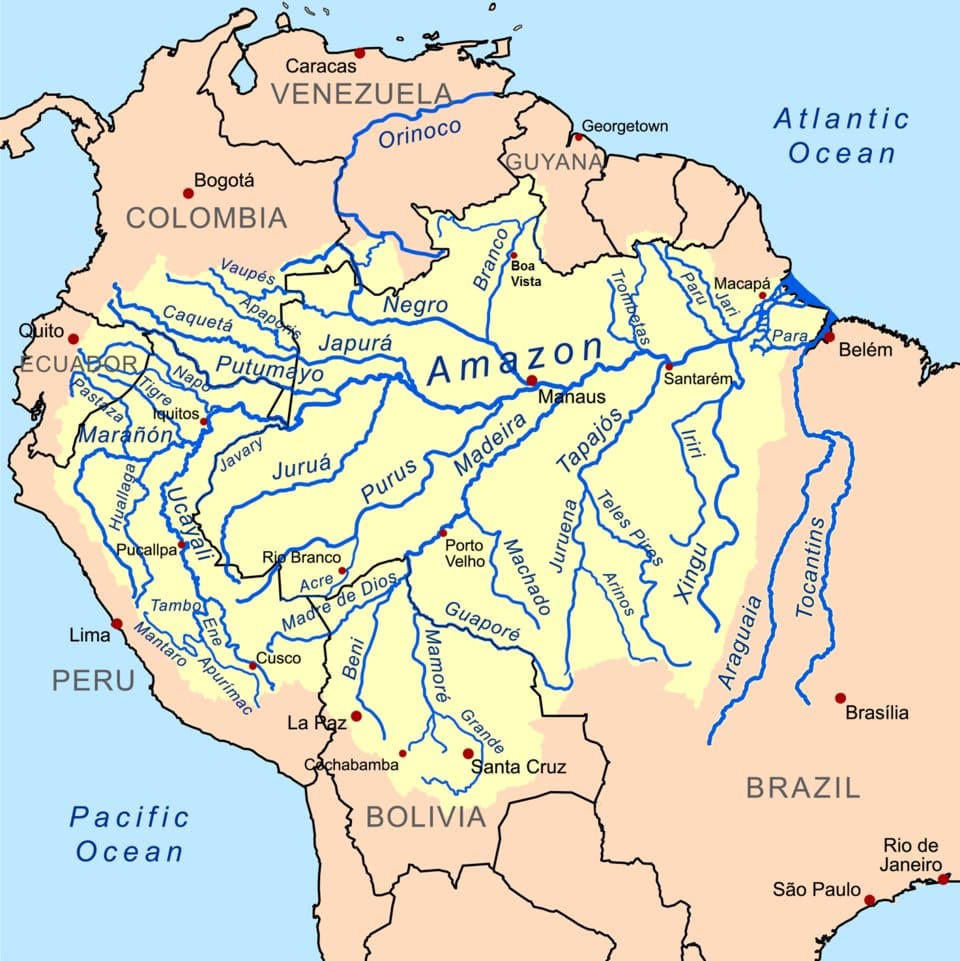
The Three-Stripe Apisto has one of the widest distributions of any Apistogramma species. It’s found from the Rio Guaporé drainage in western Brazil through the Rio Paraguay watershed in Brazil and Paraguay, and south into the middle Paraná basin in northern Argentina. This enormous range means the species encounters a wide variety of habitats and conditions, which has led to the development of numerous distinct color forms that collectors prize.
In the wild, A. Trifasciata inhabits sluggish creeks, backwater areas, and flooded forest margins where leaf litter accumulates. The substrate is fine sand or mud covered in decomposing leaves, and the water is soft and acidic, often tannin-stained from organic matter. Dense vegetation and submerged woody debris provide cover and define territories. Water temperatures in many of this species’ habitats are notably cooler than what most hobbyists associate with tropical fish, particularly in the southern parts of its range where seasonal temperature drops are significant. This cooler-water preference is an important consideration for captive care.
Appearance & Identification
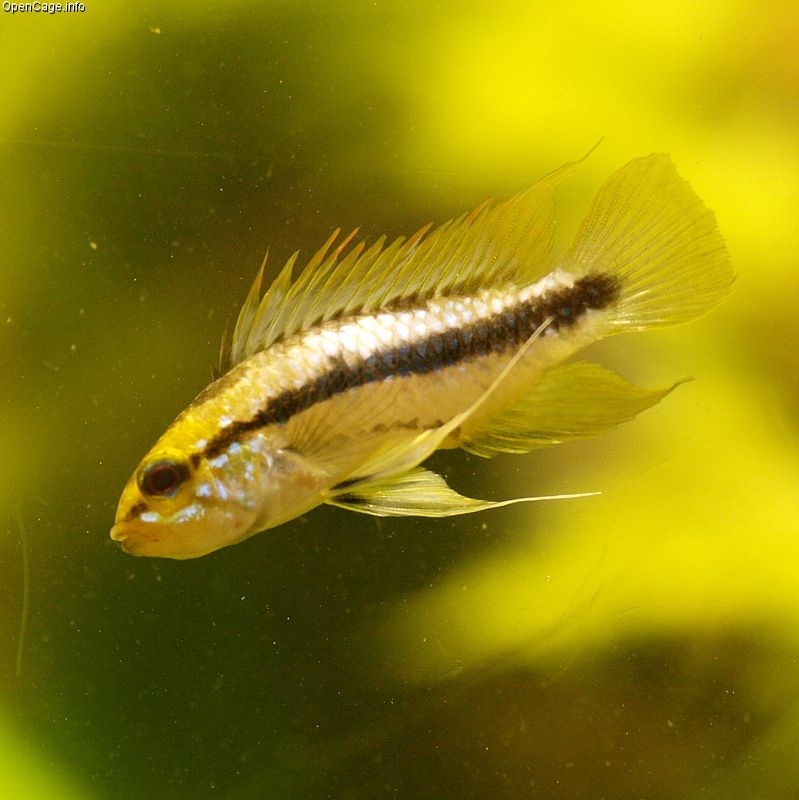
Male Three-Stripe Apistos are vividly colorful little fish. The body displays a metallic blue-green base with iridescent scales that catch the light from every angle. The species gets its common name from three dark horizontal bands: one running along the dorsal ridge, one through the midline from the snout through the eye to the caudal peduncle, and a third along the ventral area. Depending on the geographic variant, males may show intense red coloration on the belly, yellow-orange in the dorsal fin, and blue markings throughout the fins. The dorsal fin is tall and pointed, often with extended rays, and the caudal fin may show a lyrate or spade-shaped profile in mature males.
Females are considerably smaller and less colorful, displaying a yellowish to olive body with a more prominent dark lateral stripe. During breeding, females turn a vivid lemon-yellow with bold dark markings, particularly the lateral band and vertical bars. The fins remain short and rounded compared to the males’ elaborate extensions. The degree of color variation between geographic populations is remarkable, with some variants displaying predominantly blue males while others feature more red or yellow tones.
Male vs. Female
| Feature | Male | Female |
|---|---|---|
| Size | Up to 2.5 inches (6 cm) | Up to 1.6 inches (4 cm) |
| Coloration | Metallic blue-green with red and yellow accents | Yellowish-olive, bright yellow when breeding |
| Fins | Tall dorsal with extended rays, lyrate caudal | Short, rounded fins |
| Body Shape | Slimmer, elongated | Compact, rounder when gravid |
| Markings | Three distinct lateral bands, iridescent scales | Prominent single lateral stripe, vertical bars when breeding |
Sexing Three-Stripe Apistos becomes reliable at about 1 to 1.5 inches (2.5 to 4 cm). Males begin developing their metallic coloration and extended finnage well before reaching full size. The size difference between the sexes is quite pronounced in this species, with mature males dwarfing the females by a noticeable margin.
Average Size & Lifespan
Males reach about 2 to 2.5 inches (5 to 6 cm) in captivity, while females max out around 1.5 to 1.6 inches (3.5 to 4 cm). This makes the Three-Stripe Apisto one of the more compact Apistogramma species, and it’s genuinely small enough to consider for a 20-gallon planted tank without feeling like you’re cramping the fish.
With proper care, Three-Stripe Apistos live 3 to 5 years. Their preference for cooler water may actually contribute to a slightly longer lifespan compared to warm-water species, as lower metabolic rates are associated with longevity in many fish. As always, consistent water quality and a protein-rich diet are the foundations of a long, healthy life.
ASD Difficulty Rating
Intermediate | 5/10
One of the more forgiving Apistogramma species, but not beginner-proof. A Three-Stripe harem needs a minimum of three caves per female with visual breaks between territories, soft acidic water, and cool temperatures – none of which a default aquarium provides automatically. The forgiving part: once the setup is correct, these fish are genuinely hardy and tolerate keeper mistakes in a way the German Blue Ram does not. Start with this one if you want to get into apistos and can meet the water and temperature conditions.
Care Guide
Tank Size
A 20-gallon (75-liter) tank is appropriate for a single male with two to three females. Despite their small size, these fish establish distinct territories that need to be respected. Each female maintains her own space around a cave or sheltered area, and the male patrols a larger territory that overlaps with the females’. A 20-gallon long provides better horizontal space than a standard 20-gallon, which is always preferable for bottom-dwelling species.
Water Parameters
| Parameter | Recommended Range |
|---|---|
| Temperature | 68 – 77°F (20 – 25°C) |
| pH | 5.0 – 7.0 |
| General Hardness (GH) | 1 – 8 dGH |
| KH | 1 – 5 dKH |
| Ammonia | 0 ppm |
| Nitrite | 0 ppm |
| Nitrate | < 20 ppm |
The cooler temperature preference is one of the most important details to get right with this species. Three-Stripe Apistos come from habitats that are significantly cooler than the typical 78 to 80°F (26 to 27°C) that most hobbyists set their tropical tanks to. Keeping them at room temperature (around 72 to 74°F / 22 to 23°C) is often ideal, and many keepers find they don’t even need a heater in a climate-controlled room. Consistently warm temperatures above 78°F can stress these fish and shorten their lifespan.
Captive-bred specimens tolerate a wider range of water hardness than wild-caught fish, but soft, slightly acidic water still brings out the best coloration and breeding behavior. If your tap water is moderately soft and near neutral, these fish will do well without modifications.
Filtration & Water Flow
Low-flow filtration is important. These fish inhabit sluggish backwaters in nature and don’t appreciate strong currents. A sponge filter or air-driven sponge filter is ideal, providing excellent biological filtration with minimal water movement. For community tanks, a gentle hang-on-back filter with a pre-filter sponge works well. Keep the flow rate moderate at around 3 to 4 times tank volume per hour.
Lighting
Subdued lighting is strongly preferred. Three-Stripe Apistos are naturally found in shaded environments, and they show their best coloration and most confident behavior under moderate to low light. Floating plants are excellent for creating dappled shade, and tannin-stained water from leaf litter further softens the light. Under these conditions, the males’ metallic blue and red colors stand out beautifully.
Plants & Decorations
Dense decoration with multiple caves and hiding spots is essential for the haremic social structure of this species. Provide at least one cave per female, plus extras for the male to claim and for territorial buffers. Driftwood, roots, and branches create natural territory boundaries. Live plants like Java Fern, Anubias, Cryptocoryne, and various mosses all work well in the subdued lighting and soft water these fish prefer.
Leaf litter is highly recommended and serves multiple purposes. Dried Indian almond leaves or oak leaves release tannins, provide cover for fry, and foster microfauna growth. They also make the tank look incredibly natural, which is always a bonus.
Substrate
Fine sand is the only appropriate substrate choice. These small fish sift through the substrate as part of their foraging behavior, and anything coarser risks injuring their delicate mouths. A light, natural-colored sand creates an attractive base for the leaf-litter biotope setup that suits this species so well.
Tank Mates
Best Tank Mates
Select small, peaceful species that tolerate the cooler temperature range this species prefers. Not all tropical fish will thrive at 68 to 75°F, so compatibility goes beyond just temperament. Good options include:
- Pencilfish (Nannostomus species). Excellent dither fish for Apistogramma setups
- Ember Tetras. Adaptable to cooler temperatures and very peaceful
- Cardinal Tetras. Tolerate the lower end of the temperature range and prefer soft water
- Hatchetfish. Surface-dwelling species that stay completely out of bottom territory
- Pygmy Corydoras. Small enough to coexist peacefully at cooler temperatures
- Otocinclus. Gentle, unobtrusive algae grazers
- Small Rasboras. Species like Boraras are peaceful and tolerate cooler conditions
Tank Mates to Avoid
- Other Apistogramma species. Territorial conflicts in standard tank sizes
- Warm-water species. Fish requiring 80°F+ temperatures are incompatible with this cooler-water species
- Aggressive or boisterous species. Will stress and intimidate these small cichlids
- Fin nippers. The male’s extended fins are an easy target
- Large bottom dwellers. Compete for territory and can damage eggs
Food & Diet
Three-Stripe Apistos are carnivorous, feeding on small benthic invertebrates in nature. In captivity, they thrive on a diet of frozen and live foods. Frozen bloodworms, daphnia, brine shrimp, cyclops, and moina are all eagerly accepted. Live baby brine shrimp, grindal worms, and microworms are excellent for conditioning breeders and maintaining peak health.
Most captive-bred fish will accept high-quality sinking pellets, and these can serve as a supplementary food source. However, the bulk of the diet should come from frozen and live foods for the best coloration and breeding success. Feed small amounts twice daily, sized appropriately for these small-mouthed fish. Crushed flakes and micro pellets work better than large pellets that these tiny fish can’t easily consume.
Is the Three-Stripe Apisto Right for You?
Honest assessment before you buy. The Three-Stripe Apisto is one of the more forgiving apistos in the hobby – but it still has real requirements that are not negotiable if you want the fish to thrive long-term.
- Good fit if: Your tank runs cool – 68 to 77°F (20 to 25°C). If you have a naturally cool room or don’t use a heater in spring and fall, the Three-Stripe Apisto is one of the few dwarf cichlids that actually prefers your setup over a heated tropical tank.
- Good fit if: You want to experience haremic cichlid dynamics. One male with two or three females produces some of the most complex territorial behavior in the dwarf cichlid world – female-to-female cave competition, active brood care, and a male running an entire social structure from a single 20-gallon.
- Good fit if: You want color form collecting options. The Three-Stripe’s wide South American distribution means genuine color variation between locality variants – blue-dominant forms, red-accent forms, yellow populations. Sourcing specific geographic variants is part of the hobby with this species.
- Think twice if: Your tank consistently runs above 77°F (25°C) and you can’t cool it down. This species declines slowly at warm tropical temperatures – you’ll see it in reduced coloration and shortened lifespan before you realize the temperature is the problem.
- Think twice if: This is your first Apistogramma. Start with A. cacatuoides (Cockatoo Apisto), which tolerates a wider range of conditions. Return to the Three-Stripe once you’ve built your soft-water and cave-setup experience.
- Think twice if: You can only provide one or two caves and a small tank. Haremic setups require space and multiple territories – a pair in a 10-gallon without adequate cover will result in female harassment and injury.
Breeding & Reproduction
Breeding Difficulty
Moderate. Three-Stripe Apistos are haremic breeders that spawn readily once conditions are appropriate. The main challenges are maintaining the cooler water temperatures they prefer and managing the social dynamics of a harem group. This species is considered a reasonable breeding project for intermediate hobbyists.
Spawning Tank Setup
A 15 to 20-gallon (55 to 75-liter) tank works well for a breeding group of one male with two or three females. Each female needs her own cave site within a defined territory. Provide at least four to five potential caves so the females have options. Coconut shell halves, small clay pots, and PVC pipe sections all work. Dense plantings and driftwood create the visual barriers needed to keep peace among the females. A mature sponge filter is the safest filtration choice for protecting fry.
Water Conditions for Breeding
Target a pH of 5.5 to 6.5, temperature around 72 to 75°F (22 to 24°C), and general hardness below 5 dGH. The cooler temperature is actually important for this species, as warmer water can disrupt their natural breeding rhythms. Soft, slightly acidic conditions improve egg viability and hatch rates. Indian almond leaves and alder cones help maintain appropriate chemistry.
Conditioning & Spawning
Condition breeders with two to three weeks of heavy feeding on live and frozen foods. The male establishes a territory that overlaps with multiple female territories and courts each female individually. When ready, each female spawns independently in her chosen cave, depositing up to 100 eggs on the ceiling. The male moves between females’ territories, fertilizing eggs and patrolling his domain.
After spawning, each female takes charge of guarding her own clutch. In this haremic arrangement, the male helps defend the overall territory while the females focus on their individual broods. Both sexes becomes aggressive toward non-breeding tank mates during this period.
Egg & Fry Care
Eggs hatch in approximately 36 to 72 hours depending on temperature. The wrigglers remain attached to the cave ceiling for 4 to 5 days while absorbing their yolk sacs. Free-swimming fry are led around by the mother, who defends them vigorously. First foods should be infusoria, paramecium, or liquid fry food, quickly transitioning to freshly hatched baby brine shrimp within a few days. The fry are tiny, so ensure food particles are small enough for them to consume. Growth is steady with consistent feeding, and young fish begin developing color at around 6 to 10 weeks.
Common Health Issues
Ich (White Spot Disease)
Ich is a common parasite that strikes after temperature fluctuations or stress from new introductions. The distinctive white spots, clamped fins, and flashing behavior are the classic indicators. Heat treatment is effective but requires careful management with this cooler-water species, as raising the temperature to 86°F (30°C) represents a much larger jump from their preferred range. A gradual temperature increase over 2 to 3 days is essential, and half-dose medication may be a gentler alternative for this sensitive species.
Hole-in-the-Head Disease
HITH presents as pitting or erosion on the head and lateral line. It’s linked to poor water quality, elevated nitrates, and nutritional deficiencies. Prevention through regular water changes, a varied diet, and low nitrate levels is far more effective than treatment. Metronidazole can help in early-stage cases when combined with improved conditions.
Columnaris
This bacterial infection presents as white or grayish patches, often around the mouth or on the fins. It can progress rapidly and is often triggered by stress or poor water quality. Prompt treatment with antibacterial medications and immediate water quality improvements are essential. Maintaining a mature, well-filtered aquarium with consistent parameters is the best prevention.
Internal Parasites
Wild-caught Three-Stripe Apistos may carry internal parasites causing wasting, loss of appetite, and white stringy feces. Quarantine all new fish for a minimum of two weeks and consider prophylactic anti-parasitic treatment for wild-caught specimens. Even captive-bred fish benefit from a quarantine period to monitor for illness before introduction to an established tank.
Hard Rule: Never understock caves in a Three-Stripe harem.
Three-stripe apistos need 3 or more caves per female and multiple sightline breaks in any breeding setup. Males defend large territories – without enough hiding options, females cannot escape male pursuit and will be harassed until they die.
Common Mistakes to Avoid
- Keeping them too warm: This is a cooler-water species that prefers the low-to-mid 70s°F. Running the tank at typical tropical temperatures (78 to 82°F) stresses these fish and can shorten their lifespan significantly.
- Not providing enough caves: In a haremic setup, each female needs her own cave. Insufficient spawning sites lead to intense fighting among females that can cause serious injury.
- Choosing incompatible tank mates: The cooler temperature preference limits your tank mate options. Don’t pair these fish with species that require warm water.
- Overfeeding: These are small fish with tiny stomachs. Feed small portions that can be consumed within a minute or two, twice daily. Excess food degrades water quality quickly in these small, soft-water setups.
- Neglecting leaf litter: While not strictly required, leaf litter dramatically improves the quality of life for this species. It provides shelter, fosters natural behavior, supports microfauna for fry, and helps maintain acidic conditions.
Where to Buy
Three-Stripe Apistos are moderately available through specialty fish retailers. Different geographic color forms may be available at different times, so specific variants require patience to source. Check these trusted retailers:
- Flip Aquatics. A reliable source for dwarf cichlids with quality livestock and dependable shipping. They regularly stock Apistogramma species and can be a good source for specific color forms.
- Dan’s Fish. Another trusted retailer with a solid selection of dwarf cichlids. Their inventory changes frequently, so check back regularly for availability.
When purchasing, ask about the geographic origin or color form of the fish if that matters to you. Some variants are significantly more colorful than others, and knowing what you’re getting helps set expectations.
FAQ
Why is it called the Three-Stripe Apisto?
The common name refers to three dark horizontal bands (stripes) visible on the body. These run along the dorsal ridge, through the midline from the snout to the caudal peduncle, and along the lower body. The visibility of these stripes varies with the fish’s mood and coloration, but they’re most apparent in stressed or subdominant individuals.
Do Three-Stripe Apistos need a heater?
In many homes, no. If your room temperature stays in the 68 to 74°F (20 to 23°C) range consistently, these fish will be perfectly comfortable without a heater. If your home gets colder than 65°F at night or during winter, a low-wattage heater set to around 70 to 72°F provides a safety net without pushing temperatures too high.
Can I keep Three-Stripe Apistos with Discus?
No. Discus require water temperatures in the 82 to 86°F range, which is far too warm for Three-Stripe Apistos. The temperature requirements of these two species are fundamentally incompatible. Choose tank mates that share the cooler temperature preference.
How many females should I keep per male?
Two to three females per male is the standard recommendation. This species naturally forms harem structures where one male maintains a territory overlapping with several female territories. A single pair can work, but the haremic arrangement produces more natural behavior and distributes any breeding-related aggression.
Are there different color forms of Three-Stripe Apistos?
Yes, numerous geographic color variants exist due to the species’ wide distribution across South America. Some populations produce males with predominantly blue coloration, while others lean more toward red or yellow accents. If you’re interested in a specific variant, ask your seller about the geographic origin of the fish. Collectors and breeders often identify variants by their collection locality.
What It Is Actually Like Living With Three-Stripe Apisto
This is the part no other care guide gives you. Forget water parameters for a minute. Here is what it is actually like to share your tank with this species.
The first thing that surprises people is the female-to-female competition. Most keepers expect to manage male aggression – and there is plenty of that. What catches them off guard is how intensely the females compete for cave territories among themselves. Each female needs her own cave, her own corner of the tank, and visual breaks from the other females. A properly decorated harem tank turns that competition into natural territorial displays. An underdeveloped setup turns it into attrition – you lose females one at a time without ever seeing a dramatic fight.
One of the genuinely satisfying things about this species is the unheated tank option. If your fishroom naturally sits at 70 to 74°F (21 to 23°C) in spring and fall, you’ve accidentally built the ideal Three-Stripe environment. Most dwarf cichlids need a heater running year-round. The Three-Stripe is comfortable where other fish would be sluggish and stressed. Keepers who run cool rooms consistently get better color and longer lifespans from this species than those keeping it at warm tropical temperatures.
The male’s display is the centerpiece behavior. When he extends his dorsal fin – at the cave entrance, near a receptive female, or marking his territory boundary – the combination of metallic blue-green iridescence and the fully spread fin is one of the better visual moments in dwarf cichlid keeping. In a harem tank this happens often, not just occasionally. You get to watch real social behavior play out: the male managing multiple females, each female managing her own brood cycle.
Color is the daily report card. Vivid metallic scales and active territory patrols mean the setup is right. Faded horizontal stripe, pale body, female that won’t leave her cave – something is off, usually temperature creeping up or pH drifting. The Three-Stripe tells you what it needs before you even test the water. Pay attention to the color and you’ll catch problems early.
How the Three-Stripe Apisto Compares to Similar Species
If you are deciding between Apistogramma species, the choice comes down to your water temperature, tank setup, and what you want from the social dynamic.
Three-Stripe Apisto vs. Hongsloi Apisto (A. hongsloi) : Choose the Hongsloi Apisto if you want a male-focused display fish with warmer temperature tolerance – the Hongsloi runs well at 75 to 80°F, making it easier to mix with standard tropical fish without adjusting your whole setup. Choose the Three-Stripe Apisto if your tank runs cool – under 77°F – and you want the full haremic social structure plus geographic color form collecting options. The Three-Stripe’s wide distribution gives it color variety the Hongsloi does not match.
Three-Stripe Apisto vs. Borellii Dwarf Cichlid (A. borellii) : Choose the Borellii Dwarf Cichlid if you want the most parameter-tolerant, beginner-friendly Apistogramma available. Borellii handles pH 6.0 to 7.5 and temperatures from 68 to 82°F – the widest tolerance range in the genus – making it a reliable starter species for first-time apisto keepers. Choose the Three-Stripe Apisto if you want the haremic social behavior and regional color form collecting, and can commit to the cooler temperature and softer water the Three-Stripe genuinely prefers. It is slightly more demanding but offers a social complexity and color range the Borellii does not match.
Closing Thoughts
The Three-Stripe Apisto is the apisto that runs in the cool room where the AC stays on and your other tropicals can’t go. One male, two or three females, enough caves, soft water – that’s the entire formula. Keep the temperature in the 68 to 77°F range and the color tells you everything you need to know about whether it’s working. Color up means the tank is right. Color flat means something is off. It’s that simple, and that direct a feedback loop is rare in this hobby.
If you’ve been circling dwarf cichlids and want a species that forgives beginner mistakes while still rewarding the keeper who gets the details right, this is the one. It earns the gateway drug reputation every time.
This article is part of our South American Cichlids species directory. Explore more South American cichlid care guides.
References
- Seriously Fish. (n.d.). Apistogramma trifasciata. Retrieved from https://www.seriouslyfish.com/species/apistogramma-trifasciata/
- Froese, R. & Pauly, D. (Eds.). (2024). Apistogramma trifasciata in FishBase. Retrieved from https://www.fishbase.se/summary/Apistogramma-trifasciata.html
- Eigenmann, C.H. & Kennedy, C.H. (1903). On a collection of fishes from Paraguay, with a synopsis of the American genera of cichlids. Proceedings of the Academy of Natural Sciences of Philadelphia, 55, 497-537.
- Römer, U. (2006). Cichlid Atlas Volume 2: Natural History of South American Dwarf Cichlids. Mergus Publishers.
- About the Author
- Latest Posts

I’m Mark Valderrama, founder of Aquarium Store Depot and a fishkeeper with over 25 years of hands-on experience. I started in the hobby at age 11, worked at local fish stores, and have kept freshwater tanks, ponds, and reef tanks ever since. I’ve been featured in two best-selling aquarium books on Amazon and built this site to share practical, experience-based fish keeping knowledge.
Leave a Reply