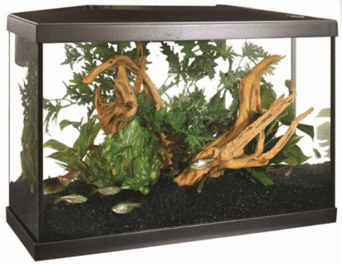
Choosing a betta tank is where most new betta keepers go wrong before they even bring the fish home. The “betta bowl” and tiny desktop vases you see in stores are transport containers, not homes. They’re too small to maintain stable water parameters, can’t accommodate a heater, and stress the fish from day one. A betta in a bowl doesn’t thrive. It just slowly declines. After 25 years in the hobby and selling hundreds of betta setups in the stores I managed, my recommendation hasn’t changed: minimum 5 gallons, a heater, low-flow filtration, and a secure lid. Period. Every tank on this list meets those requirements. The top picks exceed them.
With over 25 years of experience in the aquarium hobby, I’ve assisted countless clients, hobbyists, and readers like you in overcoming their aquarium selection axiety. I’ve personally tested or used these products in real world scenarios to determine the best betta fish tank on the market.
Mark’s Expert Take
Bettas are sold in tiny cups and people see that and think small is fine. It’s not. That cup is a transport container, not a home. At the store I managed, every betta that came back sick was living in an unheated, unfiltered bowl. Every single one. A betta needs at least 5 gallons, a heater dialed to 78-80 degrees F, a low-flow filter, and a lid. Those are not optional upgrades. That speech went out with every single betta we sold. The fish that got those four things thrived. The ones that didn’t came back within months.
Let’s start with my top picks. To summarize, the Fluval Spec V is the best fish tank for your betta that you can buy today. It really has it all. It has the perfect filtration unit. The dimensions of the tank are ideal. The LED lightning that comes out of the box works for beginner plants. The tank also looks amazing in person. I recommend the Fluval Spec V for anyone starting up a Betta fish tank.
The Marina is a great value choice for those who want to spend a bit less but still want good features in an aquarium kit. It is cheaper than the Spec V aquarium kit and the LED lighting will still support low light plants. The LifeWithPets dividers are a great money saving option for those who want to make an Betta tank with multiple males.
The Candidates – A Quick Overview
I reviewed 7 tanks in this round up. Below is the list of the best betta fish tanks on the market today. I put the preferred choices at the top for ease of selection for you. I’ll go into more detail about each further down in the blog.
Now that you know the products we are reviewing, let find out why each tank made the list. Here is a video from our YouTube Channel. Subscribe if you enjoy our content!
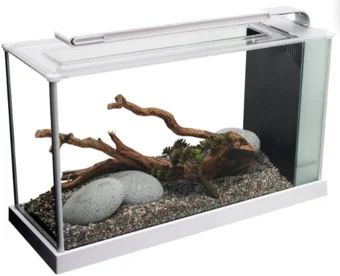
Let’s start off the list with the very best of the bunch. The Fluval Spec V has everything you need. Let’s start off with the size of the aquarium. It is an ideal 5-gallon aquarium tank kit and is designed horizontally. Horizontal dimensions are better for fish like Betta because it gives them more space to swim around side by side. The peninsula style with aluminum trim design gives you a full view of the tank in 3 sizes. This makes it perfect to use on a countertop or cabinet as the plugs and filtration are hidden from view.
The filtration system is top-notch on the Fluval Spec V aquarium kit. It comes with complete 3 stage filtration system foam as mechanical, carbon for chemical, and ceramic bio max media for biological. The filter components come out easily with a basket lifter. With the large filter chambers, you heat the tank’s water temperature without seeing the aquarium heater. The filter flow can also be modified by either using a sponge at the end or installing a rain bar kit.
The light is built for freshwater planted tanks. Its led light has enough output for many beginner freshwater plants. The newest generation led lighting on the Fluval Spec Vs are 20% brighter than the previous generation. Your betta will look noticeably more colorful and vibrant under these lights.
The best comes with a price. The Spec V aquarium kit is one of the most expensive aquariums on this list. You get what you pay for with this aquarium and more. The light itself in my mind is cheaper in the long run than purchasing a similar output separately. The pump is also powerful for these types of fish. You will want to dampen the output with a sponge on the outlet. This is a beautiful-looking tank that will give our fish the size and space it needs. Well deserving of the Editor’s Choice badge.
Pros & Cons
Pros
Best filtration unit
Best LED light
Looks amazing
Cons
Powerful pump
Expensive
Mark’s Top Pick
Fluval Spec V. The filtration is the best on any 5-gallon kit I’ve tested. The 3-stage chamber is large enough to hide a heater, the LED is strong enough for low-light plants, and the build quality is excellent. The flow is strong out of the box, but a sponge on the outlet or a rain bar kit fixes that immediately. Nothing else at this size competes on package quality.
Marina is a value brand of Hagen. Hagen as you might already know is a high-quality manufacturer of aquarium products in business since 1955. They are known for creating well-priced start kit aquariums. This Marina aquarium kit from Hagen screams value. Like the Fluval Spec V, it has everything you need, but at a lower price.
Let’s start off with the starter kit packager itself. It comes with not only a tank, light, and filter but other essentials to get you started. The aquarium kit comes with fish food, a water conditioner, a fish net, a thermometer, and biological supplements to get you started. All these together would cost you a fair amount of money. Given the price, I feel like Marina is practically giving this away.
The LED lighting that comes with this kit is powerful enough to house low-light aquarium plants. The LED light fits within the canopy giving this aquarium a clean look. The lid is fully enclosed preventing evaporation issues.
What’s there not to like? The biggest thing is the power filter. While it comes with a sponge that will actually protect your fish from getting sucked in, it can be an eyesore in the tank. The motor of the filter is housed with the intake, which allows you to hold more media in the filter. In a small tank like this, motor can be easily seen. Placing a heater can be tough to do with this as there isn’t a spot to place one. You will need to place the heater within the tank.
Still, this 5-gallon tank is an incredible value and worthy of my best value tag.
Pros & Cons
Pros
Great value
Good LED light
Comes with other essentials
Cons
Powerful filter
Heater placement
3. LifeWithPets Dividers – Great Budget Option For Multiple
Small aquariums go on sale all the time at chain pet stores. When these sales happen, you can purchase a great 5 gallon or 10 gallon tank for a Betta fish. When you get these deals, you can build a custom DIY aquarium with multiple Bettas with these tank dividers from LifeWithPets.
I love these dividers. These are my go-to when it comes to multiple Bettas in an aquarium. They are well-designed and sturdy. Designed from PVC, these dividers will last a lifetime in your tank. Because this is a DIY aquarium kit, you are free to divide up your tank any way you desire.
The kit I linked to is for a 10 gallon tank kit, which will allow you to house 2 male bettas comfortably. The picture above is using a 20 gallon long tank divider. This allows you to house 3 male Bettas!
Because of their holed design, The male Bettas will see each other and display their male aggression. This results in fin flashing and other desirable behaviors that show off your Bettas’ fins and color while also keeping your males safe from each other. Your Bettas will get their space and will remain active with the other males around.
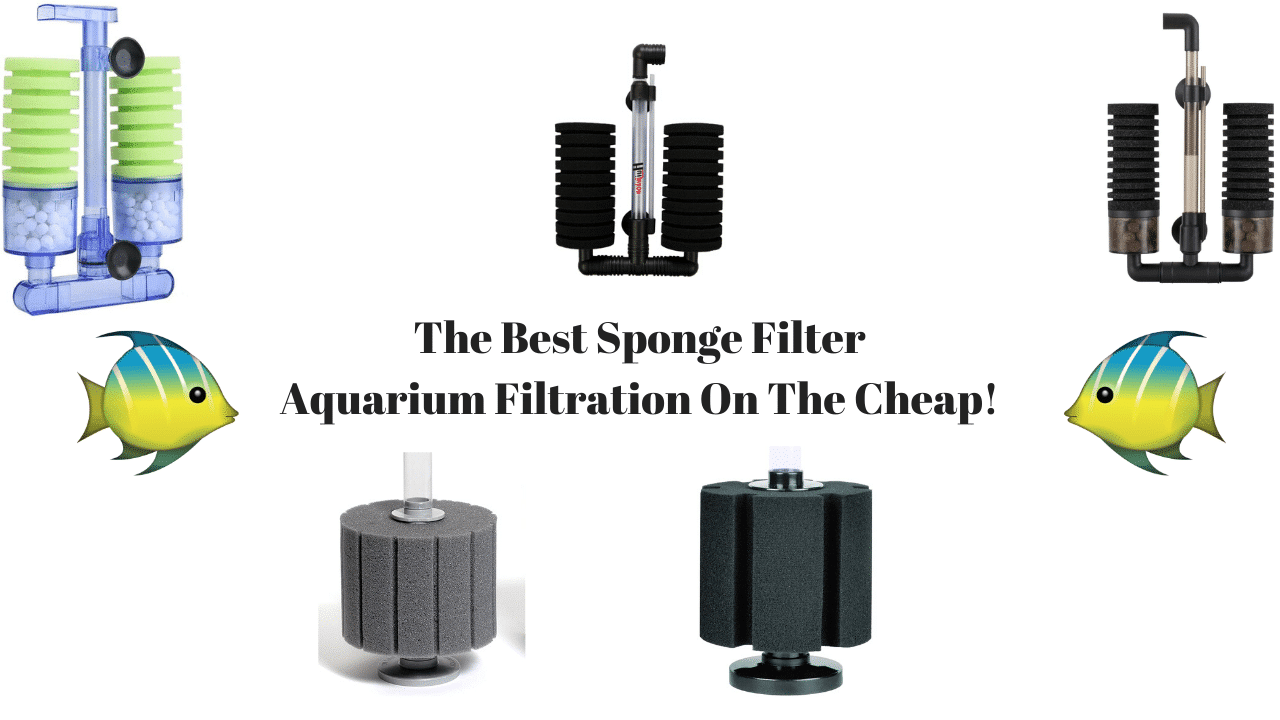
What’s not to like about these dividers? The dividers are designed for Aquaeon glass tanks only. Other glass tank brands will likely have too tight of a fit and could risk cracking. Because of the design, it is recommended you place a filter in each section. I feel the cost of multiple filters can be mitigated by utilizing sponge filters. Check out our Best Sponge Filter blog post for the best ones to buy.
Pros & Cons
Pros
Well designed
Cheap DIY
Houses multiple Betta
Cons
Only works with Aqueon
Requires more filtration
4. Marineland Contour Glass Aquarium – A Great CheapChoice
The Marineland Contour Glass Aquariumkit is a great valued priced Betta tank. The price for what it comes with is amazing. Marineland is a well known manufacturer of aquariums so you can purchase their tanks with confidence that they will last a lifetime. This is similar to Marineland portrait aquarium kit, but this won out because I like the lighting system on this over the portrait aquarium.
The main attraction of this tank is its presentation. The rail-mounted LED light kit give this Betta tank a wonderful touch. It looks amazing with nothing in it in the person sitting on a desktop. LED lighting is powerful enough to work with low-light plants like Java Fern. I like the blue LED lights for the moonlight look as well.
The filtration system on this 5 gallon tank is a 3 stage unit using Marineland’s famous Rite-Size cartridges. These cartridges have to bother mechanical and chemical in the same package and are easy to remove for maintenance. The tank comes with a lid that is easy to move out of the way when feeding or cleaning.
This cube design aquarium kit is a great package with a great price. My biggest gripe about the Marineland Portrait Glass LED Aquarium Kit is that you cannot place the heater in the filtration chamber. It’s recommended that you do not according to Marineland. I want to hide my heater with an all-in-one chamber so this is a big disappointment for me. The curved glass can look odd at certain angles, but not a deal breaker. The main money gripe here is the Rite-Size cartridge. It doesn’t use foam, which is reusable. The cartridges get thrown away after the carbon is exhausted, which means you need to continue to buy replacements. Long-term, that will add to your cost.
Pros & Cons
Pros
Good price
Looks great
3 stage filter
Cons
Heater placement
Rite-Size cartridges
5. Fluval Chi – Zen-like Aquarium In A Small Package
Are you looking for a jaw dropping aquarium? If so, the Fluval Chi is easily the best looking aquarium kit on this list. The Fluval Chi is elegantly designed and inspired by Feng Shui. It starts with it’s clean horizontal design and its water flow.
The water flow is made by a specially design filtration unit. This unit filters from the bottom of the unit then filters down with a fountain like stream down to your aquarium. This creates a therapeutic setting. It does an amazing job of creating calm and accenting counter tops and even has a centerpiece on a piece of furniture. The water flow is so calm that it requires no modification for to use as a Betta tank.
So why isn’t this aquarium at the top of the list? It sounds amazing so far. Well, the LED lightning is not that great. I would not even recommend low light aquarium plants with the LED light it comes with. The filtration system is built into the light, which means if either the light or filter fails you have to buy an entire unit.
The price to replace the light/filter combo is nearly as much as the aquarium kit itself! The final con is the dimensions. Bettas prefer more horizontal space to swim around. You can mitigate horizontal dimensions with a mirror or a multiple betta divider, but for a single Betta fish I would prefer a long tank.
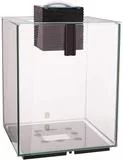
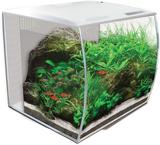
The Hagen HG Fluval Flex Aquarium kit debuts on this list as the largest aquarium. Weighing in at 9 gallons in volume, this tank will provide plenty of swimming space for your prized Betta and maybe a couple of peaceful tank mates. The Fluval Flex aquarium kit uses the exact same filtration system as the Flex Spec V. This true 3 stage filtration unit is top notch and the all-in-one chambers are large enough to fit a heater in the return section.
The aquarium has some really nice touches to it. It has a feeding opening that you can use to feed your Betta and the return comes with a multi-directional output so you are able to spread out the current. The aluminum trim on the cover is very appealing and fits flush on the aquarium.
The LED lighting on this aquarium kit has some interesting features to it. The LED lights have the ability to change colors so you can do various color blends to bring out the best coloration out of your Betta fish. This is great for a fish only tank, however if you are going to add plants to the tank I would recommend keeping the stock settings. LED is part of the lid that fully encloses the tank preventing evaporation issues.
Speaking of plants, this light can handle low light aquarium plants. This saves you on having to purchase a separate Planted Aquarium LED. The white version of this tank pictured above is actually excellent for aquascaping. Many freshwater aquascapes prefer a white or frost background to bring out the max coloration of your plants.
This is a great aquarium kit with a few flaws. The price is up there near the price of the Fluval Spec V, but the Spec V overall is a better package. The glass has been known to crack easily due to it’s curved design. I am also not a fan of the honeycomb design at the top of the tank. I know it’s done to hide the waterline, it just looks odd to me, especially if you go with plants.
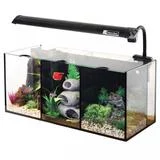
The Aqua One Trio is a great concept. It is an all in one aquarium kit that is specifically designed to house multiple male Betta fish. This is what every Betta fish enthusiast wants. It also has a hefty filtration system to handle three full growth males. At 8.8 gallons, it has one of the largest volumes on this list. It comes with a glass lid that is easy to remove when feeding and maintenance. It looks like the perfect Betta tank on paper.
So what’s the issue with this tank? Where does it fall short? It is a great concept and a dream design. It looks slick too. My biggest issue is the divider design. The divider holes are not designed that well. With the powerful pump equipped on this unit, it is possible for your Betta fish to get stuck on the divider flow holes. The dividers also do not allow for even flow, meaning the chamber where the return is will have a heavy stream of water over the others.
As you may already know, Bettas need calm waters. I can see how the male betta housed near the return chamber would be stressed from the flow. The LED lighting is okay not great. The Fluval LED lighting is superior in my mind.
Great concept and potential for a betta tank that needs refinement in my mind.
Pros & Cons
Pros
Houses multiple bettas
Great concept
Large size
Cons
Divider design
Light
How We Ranked These Tanks
These tanks were evaluated on the criteria that actually affect betta health and longevity. Here’s what I looked at:
Size (5-gallon minimum). Anything under 5 gallons is too small for stable water parameters. The 5-gallon threshold is not arbitrary. It’s the point where a proper nitrogen cycle can establish and temperature holds reasonably well.
Adjustable flow filter included. Bettas come from slow-moving water. High-flow filters stress them and can shred their fins. An adjustable or low-flow filter is not a nice-to-have. It’s a requirement.
Heater included and appropriately sized. Bettas are tropical fish. They need 78-80 degrees F consistently. Without a heater, a betta in a room-temperature tank is chronically stressed and immunocompromised.
Lid security. Bettas jump. This is not a rare event. A secure lid is the difference between finding your fish in the tank and finding it on the floor.
Visibility and viewing angle. Bettas have personality. A tank that lets you actually see your fish from multiple angles is worth paying for.
Ease of water changes. Frequent water changes are non-negotiable in a small tank. If access is awkward or the design makes maintenance annoying, it won’t get done.
What Betta Bowls and Small Vases Miss
The pet industry markets betta bowls, desktop vases, and 1-gallon “starter” kits as legitimate housing. They’re not. Here’s what they consistently fail to provide:
No biological filtration. Ammonia builds up in any container where a fish lives. Without a cycled filter, that ammonia has nowhere to go. In a small bowl, ammonia reaches toxic levels within days. The fish doesn’t die suddenly. It deteriorates slowly, which is worse.
Temperature instability. Room temperature swings throughout the day and season. A betta without a heater lives in chronic thermal stress. Their immune system operates at 78-80 degrees F. Below that, they get sick. It’s that simple.
No room for a heater. Most bowls and vases under 3 gallons can’t safely accommodate a heater even if the owner wants to add one. The tank itself is the constraint.
Shortened lifespan. A betta in a proper 5-gallon heated, filtered setup lives 3 to 5 years. A betta in a bowl lives 6 to 12 months and is stressed the entire time.
Should You Get a Betta Tank?
Buy If
You want a proper setup for one betta from day one
You’re willing to do weekly 25% water changes
You want a fish that actually interacts with you
You’re looking for a desktop display tank with personality
Skip If
You’re considering anything marketed as a “betta bowl”
Budget is driving you to unheated or unfiltered options
You want a low-maintenance fish (bettas require consistent care)
The tank is under 3 gallons (don’t do it)
The honest recommendation: Skip anything under 3 gallons entirely. A betta in the right tank is a genuinely rewarding pet with a real personality. A betta in a bowl suffers quietly for months and then dies. The tanks on this list are the ones worth building around.
Our Criteria
I searched and reviewed a ton of aquariums for your Beta Fish. There are hundreds of fish tanks available to purchase online. How did we decide what was best? It came down to the following criteria.
Aquarium Size
Through my research and experience in fish keeping (over 25 years and counting), the best aquarium size for a Betta is a 5-gallon tank. Anything smaller will be too little space and detrimental to the long-term health and lifespan of your Betta. Anything larger is too much space for a single Betta. Our focus in this review is ideal aquariums for a single Betta. An aquarium kit will also be preferred.
Filtration
I want a complete aquarium kit. Ideally, one that comes with a filter unit built in. This makes maintenance easy to do.
Lighting
Ideally, I can find an aquarium with light that is suitable for beginner aquarium plants. Having plants in our aquarium will make things not only more comfortable for our Betta but also healthier as plants will filter the nutrients in our water. These days led lighting is the way to go. If the light is part of a lid that’s a bonus for me.
Aesthetics
I want our tank to look sharp. I don’t want equipment to be showing everywhere in the tank. I want this aquarium to look nice on a desktop, cabinet, or countertop. I would prefer a lid to avoid evaporation issues.
Price
I don’t want this tank to break your bank. It must have a good price, but at the same time, it needs to be value priced. If it’s cheap and offers me junky equipment, I’m not putting it on this list!
How To Care For Them
So you got an awesome tank for your Siamese Fighting Fish. Great job! Now you might be wondering how to take care of a Betta fish. I’m right here for you! In fact, I wrote up a lengthy guide on Betta Fish Care. In this article I go over:
The great thing is I started you off on the right foot with the top 3 choices of this post. Want to learn more? Check out my article.
Additional Tips And Tricks
Here are some additional tips and tricks for you to keep your Siamese Fighting Fish in the best shape possible
Selection
Purchase your Betta from a reliable vendor. Betta is readily available at all pet stores including chain stores. Make sure you purchase a quality Betta that is not sick. Look for obvious signs like damaged fins, white spots, cloudy eyes, and red sores. Always ask the place you buy your Betta fish from to feed it and observe it eating. If it is near other males, look for signs of aggression. A healthy male Betta should display aggression to other males.
Maintenance
Change your water at least biweekly to start after your aquarium has cycled. Always observe your water quality parameters with a proper Aquarium Test Kit. Once you get in the habit of testing and see consistency in your numbers, you can water change according to your water quality parameters. If you have gravel clean it out with a gravel vacuum. Clean your filtration media once a month with your tank water.
Aquascaping
You can build a fantastic-looking aquascape with a Betta Fish Tank. These are super easy to maintain and set up. All it requires is some Driftwood for Aquarium and some Beginner Freshwater Plants. You can look at those links for additional selections on driftwood and plants. Most of the LED lights that come with the aquariums on this list will support plants. I’ve already took care of the guesswork for you ?.
I know likely are in a hurry to go get your aquarium, so here is this quick video from Regis Aquatics showing a natural aquascape style using a Betta Fish for inspiration. Enjoy!
FAQS
What type of aquarium is right for you?
The best type of tank for a single Betta fish would be a 5 gallon fish tank. A 5 gallon fish tank offers enough space and filtration to keep a betta happy and healthy. In order to keep more fish, however, you will need to increase the tank size. For multiple fish, you can consider a 10-gallon or even a 20-gallon tank.
Do They Prefer Long or Tall?
Like many fish, Bettas prefer to have longer tanks than tall. This is because they are used to shallow waters in the wild. As such, they tend to have wide territories. Many other fish are more comfortable with long and shallow versus tall tanks. Tall tanks tend to be better for the fish tank owner, who prefers horizontal space for viewing, aquascaping, and aesthetics.
What Do They Like In Their Environment?
Bettas are partial to live plants. In particular, large leaf plants like Anubias and floating plants are preferred. Bettas love to lounge and rest on leaves and hide within driftwood while perching. You also play with them with toys like a ping ball!
Can it Be Too Big?
Absolutely not. In a larger tank, Bettas will establish their territory and generally stick to their general area. They won’t get lost in a large tank and they will get along better with schooling fish with the extra space. If anything, more space curbs their aggression. In fact, there are documented cases where even male bettas can coexist in large tanks with plenty of floating and live plants for both to establish their own space!
Aussie aquatics is the most documented influencer in our space who has successfully kept multiple male bettas in a tank without a divider. You can check out his video here.
Do They Get Lonely?
It’s not really a matter of them getting lonely, but them getting bored. Betta fish are actually one of the more intelligent fish you can purchase in the freshwater hobby. They can be taught tricks and make a great solo pet fish to keep when housed in an appropriate-sized aquarium.
When kept in bowls and other small containers under 5 gallons, a betta fish can get bored due to lack of stimulation. Try to make your environment healthy for your betta by offering it a good amount of space, decorations, and interaction. If you purchase a larger aquarium, you can purchase tank mates who will get along with them and stimulate them more.
Closing Thoughts
A betta in the right tank lives 3 to 5 years and has real personality. They recognize their owners. They patrol their territory. They flare at their reflection and beg for food. That fish in a properly set up 5-gallon is genuinely interesting to keep. A betta in a bowl lives 6 months and suffers the whole time. The Fluval Spec V is the tank I recommend to anyone starting from scratch. It’s the right size, it has the right filtration, and it’s built to last. Get it set up, cycle it before you add the fish, dial the flow down with a sponge, and your betta will thrive.
📘 Want to learn more? This article is part of our complete Betta Fish Guide. your ultimate resource for betta care, types, tank setup, feeding, tank mates, and more.
Sponge filters are one of the most underappreciated tools in the hobby. simple, cheap, and brutally effective for biological filtration. I use them religiously in my quarantine tanks because they’re gentle on fish, easy to seed with beneficial bacteria from an established tank, and nearly impossible to break. They’re also my top recommendation for betta tanks and shrimp tanks where strong flow from a HOB can be a problem. After testing many brands over the years, there’s a clear difference in sponge density, fit, and airflow efficiency between the best and the rest.
With over 25 years of experience in the aquarium hobby, I’ve assisted countless clients, hobbyists, and readers like you in setting up successful aquariums. I’ve personally tested these products in real world scenarios to determine the best sponge filter on the market.
Expert Take
Mark Valderrama, AquariumStoreDepot
Sponge filters are the unsung hero of this hobby. I ran quarantine systems in every store I managed, and a seeded sponge filter was always in the tank before the fish arrived. You can pull a sponge from an established tank, drop it into a new setup, and have a cycled filter running in minutes. No canister startup ritual, no priming, no media cartridge to buy next month. The sponge IS the media. That biological colony lives in the foam permanently. For breeding tanks, fry tanks, shrimp tanks, and betta tanks, nothing beats it. The gentle flow won’t stress delicate fish or pull fry into an intake. Air-driven biological filtration is genuinely underrated by hobbyists who default to HOBs out of habit.
Let’s get straight to the point and talk about my top picks among the crowd of sponge filters available. So, among all the sponge filters I reviewed, the Hikari Bacto Surge is the clear top pick. It has the best song material and is of the highest quality. The Qanvee offers chemical filtration and a dual sponge setup at a great price. The Uxcell Biochemical is a clone of the Bacto Surge at a much cheaper price (though the sponge material isn’t the same quality. is which one is the best sponge filter? We have several category winners in this review.
Mark’s Top Pick
Hikari Bacto Surge for most hobbyists. The sponge quality is genuinely better, the double-sponge design lets you seed new tanks instantly by splitting, and Hikari’s foam holds a bacterial colony that cheap generics can’t match. If you’re running a breeding setup or a dedicated shrimp tank, this is the filter I’d put in every single time. If budget is the hard constraint, the Uxcell is the closest clone, but the foam density isn’t the same. You’ll notice the difference in how it maintains a cycle.
Sponge Filter: Buy It or Skip It?
BUY IF YOU HAVE:
A breeding or fry tank
A shrimp colony (cherry, neocaridina, caridina)
A betta tank or nano setup
A quarantine or hospital tank
A lightly stocked tank under 20 gallons
A need to seed a new tank fast
SKIP IF YOU HAVE:
A heavily stocked display tank (needs real mechanical filtration)
A large cichlid or goldfish setup with heavy waste
An aquascape where aesthetics matter
Messy eaters that produce a high particle load
The Candidates – A Quick Overview
Below is a list of the best sponge filters you can purchase today. I will discuss the pros and cons of each filter below.
Now that you know the 7 I considered and the top choices, let’s look at each one in detail to see what makes these products stand out. Starting with our top choice from Hikari! Check out the video from our YouTube Channel below.
1. Hikari Bacto Surge – High Quality Name Brand Product
The Hikari Bacto Surge Sponge Filter is the name brand sponge filter on this list. Hikari is a highly quality name brand in the industry. They did not cheap out on this filter. The bacto surge filter uses a highly porous sponge filter that maximizes biological filtration for beneficial bacteria that is better than most filters on this list. Because of their construction, it is easy to modify these filters to make them more silent by inserting an air stone inside them.
Like the Aquarium Technology filter, the Bacto Surge is more expensive than most on this list. Unlike the aquarium technology filter though, this one is more readily available in fish stores.
Why the Hikari Bacto Surge Is Ranked #1
It comes down to sponge density and pore size. The Bacto Surge foam has a finer, more consistent cell structure than any budget clone on this list. That translates directly to surface area, and surface area is where your beneficial bacteria live. More surface area means a larger, more stable bacterial colony. The Hikari is also a double-sponge design, which matters more than people realize: you can split the sponge when seeding a new tank by dropping one half into the new setup while the other half keeps your original tank cycled. No waiting. No bottled bacteria needed. That one feature alone makes it worth the price premium.
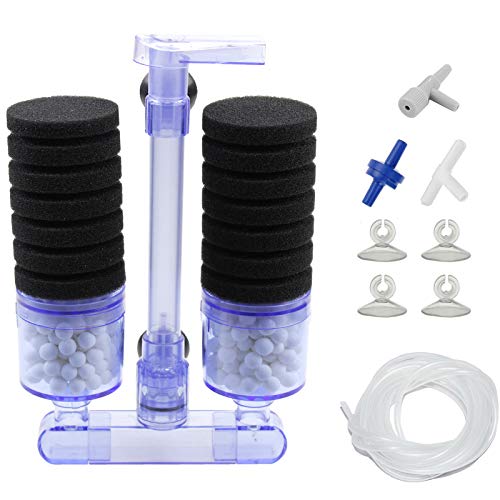
This style of sponge filter has really grown on me. This double sponge filter from Qanvee has a lot of great features. It has a media chamber that comes with surprisingly good ceramic media. This allows you to use the sponges as a mechanical and the ceramic media as your biological. You can also replace it with carbon and have a 3 stage filter. The telescoping lift tube allows you to quiet down the filter a little. That very welcome considering that you cannot modify these with an airstone. The color is more naturally being dark.
Overall, this is one of the better buys for a sponge filter.
Hikari and Aquarium Technology sponge filters are well constructed and great filtration units. However, they are pricey. What if you could get a similar unit for less? This is where Uxcellcomes in with their sponge filter. This is among the cheapest sponge filters on our list and it is well made. It starts off with its superior foam, easily the best among all the value priced brands on our list. You get the advantages of modification with this filter. Dropping in an air stone in the bull eye makes them very quiet
The downfalls with this sponge filter? It doesn’t offer an option for chemical filtration and the weighted base is on the cheap.
Aquarium Technology Hydro-Sponge Filters are one of the best sponge filters available on the market. Founded in 1991 , this Atlanta based company has continued to make high quality sponge filters that can work on small aquariums, large aquariums, and even ponds. It all starts with the patented foam and superior construction. The foam is unique to Aquarium Technologies with a ideal density for both mechanical and biological filtration. This density provides maximum surface area for beneficial bacteria. The construction is american made and expertly engineered with a free standing heavy base that locks securely in place. The base is also easy to take apart so you can accommodate in other spots.
This construction allows for great flexibility on how you implement filtration. You can modify the install by inserting an air stone to make it extra quiet. If want to increase the flow on the sponge filter, you can power it with an aquarium powerhead instead of an air pump.
This well constructed product made by a family based business only has one downfall I can think of. It’s expensive compared to other sponge filters here.
Why the Hikari Bacto Surge Is Ranked #1
It comes down to sponge density and pore size. The Bacto Surge foam has a finer, more consistent cell structure than any budget clone on this list. That translates directly to surface area, and surface area is where your beneficial bacteria live. More surface area means a larger, more stable bacterial colony. The Hikari is also a double-sponge design, which matters more than people realize: you can split the sponge when seeding a new tank by dropping one half into the new setup while the other half keeps your original tank cycled. No waiting. No bottled bacteria needed. That one feature alone makes it worth the price premium.
AquaNet’s Sponge Filter is a unique design as it features a dual media design. It comes with biomedia for these media chambers, but you can switch those out with chemical media and have a full 3 stage filtration unit. The lift tube can be turned 360 degrees as well.
The suction cups are not the best quality. Several users complained that the unit tends to fall down. They also can’t be modified to be made quieter.
The Huijukon Air Driven Sponge Filter is a great value price sponge filter to consider. The dual sponge filter construction allows you to clean one sponge instead of both which keeps your bacterial losses less during maintenance. I also like the telescoping lift tube that gives you an extra 4 inches. It is small enough to fit in smaller tanks and provides a good amount of filtration.
Because of its construction, it cannot be modified with an airstone to be made more silent. It also lacks chemical filtration. I’ve seen this sponge filter used a lot in quarantine and breeder tanks. It’s a great sponge filter to consider.
Sponge filters are cheap, but somethings getting the air pump is also an added cost that can price you out. Fortunately Huijukon has a great package that addresses this. This combo kit includes an air pump, airline hose and air stone to get you start. To top it off, the sponge filter has a media chamber that allows you to convert the filter to a 3 stage unit.
Like all suction cup style sponge filters, this cannot be modified. The air pump is also a dual outlet. Given the output of the air pump, I feel it was more appropriate for it to be a single outlet. I do like that it comes with all the accessories though. This is a well priced and competent package.
Pros
Air Pump Included
Sponge filter can hold chemical media
Dual sponge filter
Cons
Can’t be modified
Air pump should be single outlet
What Is It?
A sponge filter is super simple. It literally is a piece of foam that filters your entire fish tank. Some people are taken aback that that really is all there is too. It’s simplicity has to do with it’s foam filter that doubles up as a mechanical and biological filtration unit. A well made sponge filter will be made of the following components.
1. Foam
The better the quality sponge filter, the better the foam. This matters a ton in your selection process! The sponge will house the beneficial bacteria that becomes your biological filtration. The best sponge will have more surface area and will have superior biological filtration capacity.
2. Weighted Base
This keeps your sponge filter from floating away or getting dragged around by your fish and current. The base can be anchored against gravel or aquarium rocks. Some aquarium sponge filters utilize a suction cup mount instead of a weighted base. Suction cup mounts can come in handy in bare bottom setups.
3. Strainer and Bulls Eye
The strainer keeps out detritus and food particles from filtering out of your sponge filter. The bulls eye allows you to connect your airline tubing directly to your sponge filter from your air pump. Some value priced sponge filters will not have this feature. They will have an airline hose connector that sticks out eternally from the filter for you to connect.
4. Lift Tube
This moves the water out of the sponge filter to the rest of your fish tank. On higher quality and larger sponge filters, you can use this tube to connect the sponge filter to an aquarium power head. This allows you to have a quieter and more powerful filter. Other sponge filters will have a lift tube that will extend higher so the bubbles made by your air pump will be less disruptive.
What Are The Benefits Of Having One?
Sponge filters have a lot going for them that make them super attractive for fish tank keepers.
1. Easy To Use Biological Filtration
Nothing is easier than a sponge filter. It just works. If you purchase a high quality sponge filter, you can filter large tanks. In fact, there are many local fish stores that use large high quality sponge filters to save on costs! Imagine that!
2. Two In One Design
A sponge filter can handle both mechanical and biological filtration. Any foam will do a great job at mechanically filtering your tank. A good foam will stand out in its biological filtration capacity. They are also very easy to adjust with an air pump.
3. They Are Gentle
If you have fish tank setup with inhabitants that require low current, these are great filters to use. You won’t have to worry about a sponge filter sucking up your baby fish, small fish, aquatic amphibians like axolotls or ornamental shrimp like the Cherry Shrimp.
4. Very Quick to Cycle
Because of the flexibility of the foam filter it is very easy to always have a spare foam handy to cycle another tank in an emergency. I’ve also done quick cycles by soaking the sponge in bacteria in a bottle solutions Fritz Turbo Start and got other tanks running.
5. They are CHEAP!
Ya I know that should have probably been the 1st reason. I just feel that shouldn’t be your ONLY reason for getting them ?.
What HOBs and Canisters Get Wrong
High-flow HOBs and canisters are great filters for the right tank. But there are three things they consistently get wrong for sensitive setups, and sponge filters get them right every time.
1. They’re not gentle enough for fry or shrimp. HOB intakes are powerful enough to pull in baby fish, shrimplets, and juvenile shrimp. Even with a pre-filter sponge on the intake, you’re adding a workaround to fix a problem that sponge filters never had in the first place.
2. They destabilize during medication. Canister media and HOB cartridges absorb medications, reducing treatment effectiveness or wiping out your biological colony when you do a cartridge change mid-treatment. A sponge filter doesn’t care. No chemical media, no interference. You treat the tank, the sponge keeps cycling.
3. They create a cartridge replacement cycle you don’t need. HOB manufacturers sell replacement cartridges because it’s a business model, not because the media needs replacing. A quality sponge filter breaks that cycle. The sponge is permanent. Rinse it in old tank water monthly and it keeps running. No upsell, no subscription, no planned obsolescence.
What Are The Disadvantages?
So we know why they are great. Let’s see where aquarium sponge filters fall short.
1. They are Big and Ugly
If you are setting up a simple fish tank or breeder tank looks won’t matter too much. However, these sponge filters are not going to look great if you are doing a grand aquascape or driftwood setup. They are also very large and difficult to hide.
2. No Chemical Filtration
This is a big no go for me. I like having the ability to use chemical media in a pinch whenever it is needed. Not having that in a fish tank is a major issue for me. You can mitigate chemical filtration with lots of quality live plants, but then you will still have #1 to deal with above.
3. Some Fish Will Try To Eat It
Because a sponge filter is meant to be placed inside your fish tank, your fish are around it all day. It also traps food particles because it acts as a mechanical filter. If you have a fish like a Pleco or a large hungry aggressive fish they may decide to snack on your sponge filter thinking it would make a niece meal.
4. They A Loud And Splash Water Everywhere
I’m demand a quiet display tank when I setup a fish tank. I don’t want noisy equipment and I quietly don’t want my significant other or hear about my client’s significant other complaining about how the noise the fish tank makes keeps them up at night. Quiet and media are the main reasons I go for high quality filters like canister filters. You will also need to factor in the noise level of the air pump you purchase.
With their uplift tubes, many sponge filters will splash water everywhere at the top of your aquarium. Water droplets will get all over your aquarium canopy and the back of your walls. Again, I want quiet and clean in a display tank.
What Are The Ideal Uses?
I hit you with a number of disadvantages of using a sponge filter. While they may not be the best choice for a display tank, let’s talk about what types of fish tank they are excellent choices for.
1. Breeder Tanks
One of the best applications for a sponge filter is for a breeder fish tank. Because sponger filters are gentle they do an amazing job filtering in a breeder tank. You won’t have to worry about losing your small fish fry to your aquarium filter intake. They deliver great piece of mind in these setups.
2. Quarantine/Hospital Tanks
Because sponge filters can be setup and cycled so quick and easy, they are great to use in a quarantine tank. A cycled sponge can provide all the beneficial bacteria and biological filtration capacity for a quarantine tank. Since they do not use chemical filtration you are free to use whatever medication you need without worrying about your media removing or absorbing the medication. The sponge filter is also gentle to your inhabitant keeping stress levels down.
3. Freshwater Shrimp Tanks
Sponge filters are amazing in a Freshwater Shrimp Tank. Because of their makeup, you don’t have to worry about the filter sucking up your shrimp and their babies. Sponge filters will also grow biofilm on the surface of the foam making it food producing resource for your shrimp. It’s no wonder sponge filters are used so much in shrimp tanks!
4. Betta Fish Tanks
Betta Fish need calm waters. They also have long fins that can be sucked up by more powerful filters. Betta fish prefer light currents and will usually be housed in smaller tanks. This makes a sponge filter an attractive filtration choice for them.
5. Small Fish Tanks
Any aquarium 20 gallons and under is ideal for a sponge filter. This makes maintainance and filteration easy. A good quality sponge filter will have plently of surface area to support the small fish appropriate for a smaller fish tank.
How To Make It Quieter
So I kept mentioning that sponge filters can be modified to be made quieter. This is true for models with weighted bases like the Uxcell, Aquarium Technologies, and Hikari sponge filters. All you need to do is take it apart and insert an air stone in the bull eye. This video by BairCichlids shows you how to make the modification. Once done, your sponge filter will be more quiet and more effective in oxygen delivery.
Maintenance (How To Clean)
Sponge filters are super easy to maintain. Because the main piece of the filtration unit is the sponge itself, it is a permanent media. This ends up saving you media on disposable media and mechanical filtration cartridge that you might spend otherwise with an Aquarium Power Filter. The main thing you have to maintain is the sponge. Every month, take it out of of your fish tank and wash it in your aquarium water. DO NOT use tap water when cleaning a sponge filter. Doing so will kill the beneficial bacteria on the sponge.
The main thing you have to be careful of when removing your sponge is all the particles trapped in the sponge getting released. It is a great idea to take our your sponge when doing a water change so you can get what escapes out of the sponge cleaned out. I would recommend that you get a cover on the sponge when pulling it out. You can use a fish bag or a zip-lock bag when doing this.
Once you have your sponge and some of your aquarium water in a separate container put the sponge that and squeeze it several times. This will release all the particles out of the sponge. Replace the water in the container several times only you have fairly clear water after squeezing the sponge.
Tips and Tricks
Here are some more tips and tricks regarding sponge filters.
Your Aquarium Air Pump Matters A Lot!
Aquarium air pumps are a huge deal when it comes to the effectiveness of your sponge filter. An air pump is the engine of your sponge filter. You do not want to cheap out on a low quality air pump. Check out our Best Aquarium Air Pump post for details on the best out there. For a value priced air pump, I would recommend the Tetra Whisper. Tetra is best known for their air pump models and the Whisper is a great buy to get your going.
Consider One For Power Back Up Purposes
Aquarium power outages suck. They are the #2 tank killer in our hobby. A sponge filter and battery powered air pump can save your livestock in a pitch. If you aren’t in the market for a sponge filter as your main aquarium filter, consider it for your power outage plan. Just have a sponge cycled and ready to go.
The Material Matters
The better the sponge material the better the surface area for your beneficial bacteria. All the sponge filters here were selected for a reason.
FAQS
What Type Should I Buy?
The best type of sponge filter is one that has a lot of surface area to house beneficial bacteria. The HHikari Bacto Surge excels by having more surface area than cheaper generic sponge filters available in the hobby.
Are They Worth It?
Yes – sponge filters are worth it when they are used in the right conditions. They are best utilized in freshwater shrimp tanks, for raising fry, and for small fish tanks. They also work great in quarantine tanks. While they can be used in display tanks, the general practice is that they are not as there are better filtration units available such as power filters and canisters filters.
How Often Should You Change It?
Hopefully never. Sponge filters are meant to be used indefinitely as the sponge houses your bacteria. If you threw away the sponge, you would lose all the bacteria housed in it. It’s best to wash your sponge filter in your aquarium water when it needs to be cleaned, but you should avoid replacing it so you don’t disrupt your aquarium’s biological ecosystem.
Do They Provide Oxygen?
Yes, sponge filters provide oxygen in aquariums. In fact, they are one of the best filters to do this because they are hooked to air pumps and change a lot of surface agitation. They can also still provide oxygen during power outages as they can be run with battery powered air pumps when other filters would be offline.
Closing Thoughts
Sponge filters are cheap aquarium filters, get the job done, and are very easy to use. It’s not wonder they are one of the most popular filtration units on the market. I hope today’s post helped you make an informed decision on what sponge filter to buy. If you have any questions, please leave them in the comment below. Thanks for reading!
The best filter for a breeding tank, a shrimp colony, or a quarantine setup isn’t the one with the most features. It’s the one that does the job without getting in the way. That’s always been the sponge filter.
🔧 Want to learn more? This article is part of our complete Aquarium Equipment & Gear Guide. your ultimate resource for filters, heaters, lights, pumps, tanks, and more.
Most hobbyists pick aquarium decorations based on how they look. That’s backwards. After 25 years in this hobby and managing fish stores, I’ve watched fish pace, hide compulsively, and fight constantly in tanks that looked great on Instagram but were functionally empty. Decorations aren’t just aesthetics. They’re behavioral infrastructure. The right decoration reduces stress, establishes territory, enables breeding behavior, and gives your fish something to actually do. The wrong ones just take up swimming space.
A bare tank is stressful for fish, but an overcrowded one is worse.
EXPERT TAKE | MARK VALDERRAMA
In my tanks, driftwood, rocks, and caves always come before novelty decorations. I’ve set up hundreds of tanks over the years and the pattern is consistent: fish with proper hiding spots are less skittish, eat better, and show more natural behavior. Caves matter for cichlids and bettas especially. I’ve seen male bettas display properly only after a cave or dense plant cover gave them a home base to defend. The plastic castle might look fun, but if it has sharp molding seams and no functional hiding chamber, it’s doing nothing for the fish. What I actually put in most of my tanks: driftwood or cork bark for structure, a cave or terracotta pot for territory, and soft plants (live or silk) for cover. That combination works for almost every community setup I’ve built.
What People Get Wrong About Aquarium Decorations
The number one mistake I see in customer tanks: decorations chosen entirely for looks, with zero thought given to what the fish actually needs. Plastic castles and skull ornaments show up constantly. They photograph well. But many have sharp molding seams along the interior edges that tear fins on bettas and other slow-moving fish. I’ve pulled decorations out of customer tanks and found shredded fins within a week of installation. If you run your finger along the inside of a decoration and feel resistance or roughness, so does your fish.
The second mistake: overcrowding. A tank stuffed with decorations leaves no open swimming lanes. Fish that need to swim in groups, like tetras and danios, get compressed into corners. Territorial fish have nowhere to establish boundaries, so aggression escalates. My rule for every new hobbyist: fill no more than 40% of your tank volume with hardscape and decorations. The other 60% belongs to the fish.
Third mistake: buying painted decorations from unknown brands. Cheap painted resin leaches dye into the water, especially as the paint fades from light exposure. Fish-safe resin is cured and non-leaching. If the product listing doesn’t specifically say “fish safe” or “aquarium grade resin,” skip it.
The Biggest Mistake Decoration Buyers Make
Prioritizing appearance over function. I’ve seen it hundreds of times: someone spends $80 decorating their tank with colorful novelty pieces and the fish are stressed and hiding constantly because there are no real territories, no hiding spots fish actually want to use, and no visual breaks in the open water. The fish needs the decoration more than you need the visual. When you finally add one good cave or a piece of real structure and watch a territorial fish calm down immediately, claim it, and start acting normal, the lesson hits. Decorations that look good but don’t function are a waste of space and money.
WHY THIS RANKING
I ranked these on five factors: (1) functional value for fish behavior, (2) fish safety with no sharp edges or toxic materials, (3) visual quality that looks natural or high-quality, (4) durability without fading or leaching, and (5) value relative to behavioral and visual benefit. Aesthetic appeal alone is not a ranking criterion. These decorations earn their spot because fish actually benefit from them.
BUY OR SKIP?
Good fit if: You want decorations that actually benefit your fish, not just your photos. You keep territorial species (cichlids, bettas, gobies) that need caves and boundary markers. You want a natural-looking scape without the chemistry complications of real driftwood.
Skip the novelty items if: You keep schooling fish that need open water, you have delicate-finned fish like bettas or angelfish that can’t afford sharp edges, or you’re building a serious biotope where authenticity matters. In those cases, invest in real hardscape, live plants, or species-specific decor rather than novelty ornaments.
Finding Great Aquarium Decorations
Below is a table of the candidates. I’ve looked at both artificial and natural aquarium decorations. This list focuses primarily on artificial decorations. If you’re looking for real aquarium stones, plants, or driftwood, check the links below:
This is the decoration I recommend most often for hobbyists who want a natural-looking scape without the headaches of real driftwood. The Black Manzanita is 100% artificial but looks so convincing that it works in planted tanks and display setups where you’d normally use real wood. The branching structure gives fish actual navigation space: they swim through, around, and behind it, which is what you want from any piece of hardscape.
The real advantage over actual driftwood comes in water chemistry. This piece releases zero tannins, doesn’t affect pH, and doesn’t require a week of soaking before use. That makes it the right choice for African cichlid tanks or any setup where you need higher pH or harder water. Real driftwood would tank your chemistry. This one won’t.
Current USA built this line consulting with aquascapers and provides templates and videos to help you design with it. Ready to go out of the box. No soaking. No floating. No chemistry effects.
Pros and Cons
Unique, natural-looking structure with real navigational value for fish
No tannins, no water chemistry effects
Works in high-pH setups where real driftwood can’t go
I used to be a strong advocate for natural stones over artificial. Then Current USA’s Seiryu Stones changed my mind. These artificial rocks have the same exotic porous look that makes real Seiryu stone popular in aquascaping and bonsai displays. The resemblance is good enough that you can’t tell them apart in a tank photo. The real win is weight: real Seiryu stone is heavy enough to crack aquarium glass if it falls. These won’t.
Pre-washed and ready to go. No alteration to water chemistry. If you want to put Seiryu stones in an African cichlid tank where real rock would raise your pH, now you can. The aquascaping bundles from Current USA make it easy for beginners to get a coherent scape without guessing at layout.
The only real limitation is variety. Real rocks come in unpredictable, interesting shapes. These are templated. For beginners that’s actually a benefit, since templated pieces make layout easier. For advanced aquascapers who want the organic randomness of real stone, you might want both.
Most artificial plants look obviously fake. Current USA solved this problem. Their Fountain Grass line looks like taller background plants such as Vallisneria, without requiring any of the maintenance. No trimming. No fertilizer. No CO2. For hobbyists who want background plant coverage without a planted tank setup, this is the answer.
Affordable, non-toxic, made in the USA. The catch: artificial plants provide cover but don’t compete with algae the way live plants do. If algae control is a priority, live plants or a dedicated algae management approach is still necessary. But for pure visual impact and fish cover at a budget price, these are hard to beat.
Pros and Cons
Life-like appearance unlike most artificial plants
This one is for the kids’ tanks and the aquarists who want something fun. It’s officially licensed, made from 100% water-safe resin, and actually functions as a shelter with multiple openings for fish to explore. At 5 inches tall, it fits without overwhelming smaller tanks. The door opening is large enough for most small-to-medium fish.
The word of caution: check the interior edges when it arrives. Some edges can be sharp, and that matters for bettas and fancy goldfish. Run your finger through the opening before it goes in the tank. If you feel roughness, give it a light sanding. Otherwise, this is a solid novelty ornament that also provides actual hiding value for small fish.
These are the decoration I recommend for anyone keeping cichlids or bettas who need structured territory. The hollow ceramic chambers give territorial fish a real home to claim and defend. That matters more than most people realize: cichlids without territory escalate aggression toward tankmates. A fish with a cave it has claimed is a calmer fish.
Made from natural treated ceramic with a pre-coated gravel base so they don’t slide around. Lightweight enough that they won’t crack your glass if repositioned. Each set comes with both small and large stones. Not every species will use them immediately, but for the fish that need this kind of structure, they make a visible difference in behavior within days of introduction.
Pros and Cons
Functional caves that territorial fish actually use
A classic novelty castle ornament done right. The SLOCME castle is made from 100% water-safe, eco-friendly resin that won’t fade or leach into the water over time. At 8″ x 3″ x 5.8″, it provides multiple openings for fish to explore. The detailing is solid, with precision-etched stonework that looks genuinely decorative rather than cheap.
The bottom edge can have some sharp spots, so check it before installation. It works best in tanks 20 gallons and larger where it won’t dominate the space. For a kids’ tank or a family aquarium where fun aesthetic is the goal alongside fish wellbeing, this gets the job done without compromising safety.
Real driftwood is the best structural decoration available for most freshwater tanks, and Malaysian driftwood from Estes is the budget-accessible entry point. The natural brown coloring works in any community or biotope setup, and it comes in small, medium, and large sizes so you can match it to your tank properly.
This wood releases tannins that lower pH and tint the water a natural tea-brown color. For soft-water fish like tetras, discus, and South American dwarf cichlids, that chemistry shift is actually beneficial. For hard-water fish or pristine display tanks where water clarity is a priority, use the artificial options instead.
Soak it thoroughly in warm water before adding to the tank to remove surface dust. Individual pieces vary in shape from product photos, which is the nature of real wood. If you need predictable shapes, use the artificial options. If you want genuine biological and behavioral value for your fish, real driftwood delivers.
Pros and Cons
Natural wood that fish genuinely interact with
Tannins benefit soft-water species
Available in multiple sizes
Tints water brown (a deal-breaker for some setups)
Marimo Moss Balls are one of the most underrated decorations in the hobby. They’re technically live plants (a type of algae), but they require no special Planted Tank Light, no Aquarium Fertilizer, and no CO2 System to thrive. Drop them in any freshwater tank and they work. They absorb nitrogen and phosphates from the water, provide grazing for shrimp and snails, and add a natural, calming visual element that works with almost any aquascape style.
They grow slowly and can live for years. You can roll them around periodically to maintain their round shape. The main issues are quality control from some sellers and the potential for moss fragments to clog filters. Get them from a reputable source and give them a quick rinse before adding to the tank.
Pros and Cons
No special lighting, fertilizer, or CO2 needed
Absorbs nitrogen and phosphates from the water
Food source for shrimp and snails
Quality varies by seller
Moss fragments can clog filters
My Recommendation
MARK’S TOP PICK
The Current USA Black Manzanita is my top recommendation for most freshwater setups. I’ve used it in multiple display tanks and it holds up better than real wood in one specific situation: tanks that need higher pH or harder water, like African cichlid setups, where real driftwood would tank your chemistry. It’s also ready to go out of the box with no soaking, no tannin leach, and no floating issues. For the average hobbyist who wants the look of a natural scape without the hassle, this is the one I’d buy first.
Most decoration reviews skip the safety check entirely. Before any new decoration goes in your tank, run your finger along the interior edges. If you feel roughness or resistance, so does your fish’s fin tissue. Cheap painted resin is another overlooked hazard: the paint can leach color into the water as it fades under aquarium lighting, especially in tanks with strong UV output. Always verify the product specifically says “aquarium safe resin” or “fish safe.” And watch scale: a decoration that photographs well at 8 inches may overwhelm a 20-gallon or disappear completely in a 75-gallon. Measure before you buy.
Buying Guide
Aquarium decorations come in all shapes, sizes, and materials. When you’re shopping, keep these factors in mind.
Tank Size
Cramming too many decorations into a small tank looks cluttered and robs your fish of swimming space. Fish need room to move. My rule: no more than 40% of tank volume occupied by hardscape and decorations. For a small tank (10-20 gallons), one or two meaningful pieces is enough. Spread decoration evenly rather than clustering everything in one area.
For height balance: aim for a rough 2:3 ratio of tall to mid-height structures. Two tall structures balanced with two or three medium pieces keeps the scape from feeling top-heavy or unnatural.
Natural vs Non-natural
Natural decorations (real driftwood, stones, live plants) serve double duty as fish habitat. They look more credible in a display tank and often benefit water chemistry or fish behavior directly. Non-natural decorations (novelty ornaments, bright plastic plants) are easier to maintain and can be fine in kids’ tanks or setups where function is already covered by other hardscape.
The choice doesn’t have to be either/or. Many great tanks mix natural structure with one novelty piece for personality. What you’re avoiding is a tank built entirely of novelty items with nothing that actually serves the fish.
Plants
Live plants are the best decoration for most freshwater setups. They oxygenate the water, remove ammonia, compete with algae, and give fish cover that feels natural to them. The tradeoff is maintenance: trimming, fertilizing, light management. Artificial plants skip the maintenance but lose those biological benefits. Silk plants are the best compromise: soft enough to be safe for fin-delicate fish, look better than plastic, and require nothing from you. Avoid stiff plastic plants with hard or pointed leaf edges, especially in betta tanks.
Lighting
Aquarium lighting affects how your decorations look and how your tank functions. Match your light spectrum to your fish and plants. Most freshwater setups do well with a 6,500K “daylight” spectrum. Deeper saltwater setups use higher Kelvin ratings to simulate depth. LED technology has made this easier than ever: most quality aquarium LEDs let you adjust spectrum and intensity. Don’t overpower the tank with light intensity. Too much light drives algae growth and stresses fish that prefer dimmer conditions.
FAQ
Can I use any rock in my tank?
No. The right rock depends on your water chemistry goals. For freshwater, shale, slate, basalt, quartz, and lava rocks are safe choices. Avoid calcium-rich rocks like limestone: they harden the water and raise pH, which is wrong for most soft-water species. For saltwater tanks, reef rock or man-made “Real Reef Rock” is the standard. Whatever you use, wash it thoroughly before adding to the tank.
Is resin safe for fish tanks?
Fully cured aquarium-grade resin is safe. It won’t leach chemicals or toxins into the water. The key word is “aquarium grade” or “fish safe.” Generic or cheaply painted resin products are a different story: if the product listing doesn’t specifically confirm fish-safe materials, skip it. Painted decorations from unknown brands can leach dye as the paint fades under aquarium lighting over months.
Can you put any wood in a fish tank?
No. Untreated wood rots in water, degrades water chemistry, and can harm fish. Only use wood that is prepared specifically for aquarium use. Driftwood is the standard choice. Malaysian driftwood, spiderwood, and mopani are all commonly used and safe. If you collect wood from outside, it needs extensive drying, cleaning, and boiling before it goes anywhere near your tank.
How can I make tank decorations at home?
You can use clay, ceramics, and certain food-safe plastics. Nothing painted, nothing with chemical coatings, nothing that hasn’t been thoroughly cleaned. Terra cotta pots are one of the best DIY options: cheap, widely available, safe, and loved by cave-dwelling fish like cichlids and bettas. Clean everything thoroughly before adding it to the tank.
Can you put regular toys in a fish tank?
Sometimes. Non-toxic, food-safe plastics are generally safe in aquariums. Avoid anything painted, adhesive-covered, or made of degradable materials. Legos are a common example of something that works fine. When in doubt, coat with aquarium-safe silicone before adding to the tank. And run your finger over any toy before adding it: if you feel sharp edges, your fish will too.
How can I make my fish tank look better?
Start with function. A tank that gives your fish proper hiding spots, territory, and cover looks natural because it is natural. The best-looking aquariums I’ve built in 25 years are the most functionally designed ones. Get the structure right first: a piece of driftwood or hardscape, some plant cover, a cave if you have territorial species. The aesthetics follow from the function.
Closing Thoughts
Here’s the truth about aquarium decorations that most reviews skip: function comes before form. Every piece of hardscape, every cave, every plant should earn its place in the tank by doing something for the fish. Hiding spots reduce stress. Territory markers reduce aggression. Open swimming lanes let schooling fish behave naturally. A decoration that doesn’t do at least one of those things is visual noise that’s taking up space your fish need.
That doesn’t mean your tank can’t look great. It absolutely can. The best-looking tanks I’ve built over 25 years are also the most functionally designed ones. Natural hardscape that also functions as territory, cover, and behavioral enrichment. That’s the goal.
A decoration that looks great but stresses your fish isn’t a decoration. It’s a liability.
The Current USA Manzanita and Seiryu Stone line are my go-to picks because they nail both sides of that equation. Beautiful enough for a display tank, functional enough to benefit the fish. Underwater Galleries Cichlid Stones are the best choice for territorial species that need structured hiding spots. And if you’re just starting out, a simple piece of driftwood and a few silk plants will do more for your fish’s wellbeing than a shelf full of novelty ornaments.
When you’re ready to add quality fish to a well-decorated tank, check out Flip Aquatics (flipaquatics.com) and Dan’s Fish (dansfish.com). Two sources I trust for healthy livestock. Start with function. The aesthetics will follow.
🔧 Want to learn more? This article is part of our complete Aquarium Equipment & Gear Guide, your ultimate resource for filters, heaters, lights, pumps, tanks, and more.
Canister filters are my go-to recommendation for anyone running a larger tank or a heavily stocked system. they offer more biological and mechanical filtration capacity than hang-on-back filters, and when set up correctly they run quietly and efficiently for years. I’ve personally tested 11 canister filter models over 25 years, and this is exactly what I found: which ones actually hold up, which ones disappoint, and which one I’d put on my own tank today. This guide covers the best canister filters I’ve used and what actually separates the good from the great.
✍ Expert Take | Mark Valderrama, AquariumStoreDepot
After 25 years running aquarium stores and keeping everything from nano planted tanks to 300-gallon (1,136 L) predator builds, I’ve run nearly every canister filter brand on the market. The difference between a good canister and a great one isn’t the GPH rating on the box. It’s how the filter performs after 6 months of real use: noise floor, priming reliability, and whether your biological media survives your cleaning routine. Budget filters can move water. Premium filters move water consistently, quietly, and without punishing you every time you open the canister. That gap matters more than most buyers realize until they’ve already made the wrong call.
🔬 How I Tested
Each filter was run empty of media in a 30-gallon (114 L) watering trough for a minimum of 72 hours before noise measurements were taken; that eliminates break-in vibration as a variable. For decibel readings I used the Decibel X app on my iPhone 14, phone flat on the surface, right next to the filter housing, same distance every time. I also ran the top six units on stocked tanks in my fishroom, ranging from a lightly loaded 55-gallon (208 L) community setup to a heavily stocked 125-gallon (473 L) South American cichlid tank, for at least 60 days each to catch real-world flow drop and maintenance friction that a short bench test won’t reveal.
Let’s look at my top 3 picks for those in a hurry. There is no doubt in my mind that the OASE Biomaster Thermo is the best canister filter you can buy today. It’s German-designed with an integrated heater. It is the easiest filter to maintain due to its quick release mechanical filtration section. The Fluval canister filter continues to be the best value buy with its solid name brand and reputation. For budgets, the SunSun offers a great price with a UV sterilizer that will combat green water in freshwater aquariums.
The Candidates – A Quick Comparison
I narrowed this list down from 20+ units I’ve run over the years. Some got cut for noise issues. Some for build quality failures I caught in the field. A few are here because they genuinely surprised me. Canister filters are not a fun purchase to repeat, so the goal here is to help you get it right the first time.
Below is my list of the best canister filters in the industry:
Product
Average Score
Noise
Engineering Quality
Brand
Features
Price
OASE Biomaster
9.1
9.5
10.0
9.0
10.0
7.0
Fluval
8.6
7.0
10.0
10.0
8.0
8.0
Sun Sun UV
5.8
2.0
5.0
5.0
7.0
10.0
Fzone Canister
5.4
3.0
5.0
5.0
8.0
6.0
SICCE Whale
8.2
10.0
10.0
9.0
6.0
6.0
Eheim Classic
7.6
6.0
10.0
10.0
5.0
7.0
Eheim Pro
7.5
7.0
10.0
10.0
7.0
5.0
Fluval FX
7.8
7.0
10.0
10.0
8.0
4.0
UNS Delta
6.4
4.0
7.0
7.0
7.0
7.0
Marineland Mangiflow
6.8
4.0
9.0
8.0
6.0
7.0
Penn Plex Cascade
7.0
5.0
8.0
7.0
6.0
9.0
What People Get Wrong About Canister Filters
The number one mistake I see is buying a canister filter based on the advertised GPH rating. That number is measured with the filter sitting on a flat surface, pumping water horizontally in a lab. The moment you put that filter under your stand and ask it to push water up 36 inches (91 cm) to your tank rim, that GPH drops, sometimes by 30 to 40 percent. Every foot of head height costs you flow. A filter rated at 400 GPH at zero head height might be delivering 260 GPH by the time the water reaches your tank. Always check the manufacturer’s head pressure curve, not the headline number. If they don’t publish one, that’s already a red flag.
The second mistake is sizing the filter to match your tank exactly. I’ve heard the “10x turnover” rule repeated so many times I’ve stopped counting, and it’s a starting point at best. For a lightly stocked, heavily planted tank it might be fine. For a cichlid tank, a goldfish setup, or anything with messy eaters, you want more headroom, not less. I always recommend going one size up from what the packaging says is rated for your tank volume. The cost difference between filter sizes is usually $20 to $40. The cost of a crashed tank from under-filtration is a lot higher than that.
The third mistake, and honestly it still gets me, is watching people nuke their bio media during a cleaning. I’ve had customers come in panicked because their tank crashed out of nowhere, and when I walked them back through what they did, it was always the same thing: they pulled out the ceramic rings, rinsed them under the tap, put everything back, and called it good. Tap water. That’s all it takes to wipe out the colony you spent months building. If you’re going to clean your bio media at all (most of the time you shouldn’t), do it in a bucket of water you just pulled from the tank during a water change. Gentle agitation only. The mechanical stuff you swap out on a schedule. The biological stuff you mostly leave alone and trust.
Are you simply looking for the best canister filter for your hard-earned money? If so, OASE Indoor Aquatics canister filter is the very best you can find today, end of the story, full stop. Just go buy it now and stop reading…
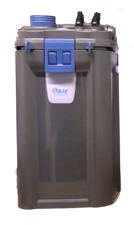
OASE Indoor Aquatics is a brand that has been quietly getting buzz among planted tank hobbyists. It is a very high quality canister filter that is made by German Engineering. OASE itself has been around since 1949, but they haven’t been in the US that long, debuting in 1994. This is a high end canister filter with a unique feature as it is the only canister filter that can hold a heater inside the canister.
The pre-filter is the feature I keep coming back to. It pulls out clean, no mess, no water dripping on your cabinet floor. It’s foam-based, so you’re rinsing and reusing it instead of buying disposable pads every month. There’s a flow regulator on the unit so you can dial back output for a planted tank without swapping hardware. And priming is dead simple. Push a button, done. No siphoning by mouth, no wrestling with a hand pump.
The staging works exactly right: mechanical first, then biological, no shortcuts. That matters more than it sounds. Filters that let water bypass stages are the ones where you end up with detritus sitting on your bio media, and your biological colony suffers for it. The Biomaster gets this right every time.
There is a standard BioMaster canister filter, but I feel that the Thermo model really stands out with its integrated heater. The heater fits right into the filter. This keeps your heater out of your display tank. This takes that ugly heater out of your display and keeps you with a proven heater technology versus an inline that can be hit or miss. The heaters themselves are of excellent quality and backed by 3 year warranties.
The product we tested was the OASE Biomaster 250. In our testing, it ended up being the second most silent canister filter that we tested. The pre-filter option is one of a kind and stands out among all others reviewed and tested. The media capacity is above average. Not amazing like the FX of Eheim pros, but still at the higher end. The specs of their entire line-up is in the table below:
Specs
BioMaster Thermo 250
BioMaster Thermo 350
BioMaster Thermo 600
BioMaster Thermo 850
Dimensions (in.)
9.4 x 9.4 x 14.6
9.4 x 9.4 x 16.7
9.4 x 9.4 x 19
9.4 x 9.4 x 22
Dimensions (mm)
240 x 240 x 370
240 x 240 x 425
240 x 240 x 480
240 x 240 x 560
Rated voltage
120V / 60 Hz
Power consumption, filter
15 watts
16 watts
23 watts
25 watts
Power cord length
6 ft. (1.8 m)
Net weight
9 lbs. (4 kg)
10 lbs. (4.5 kg)
11 lbs. (5 kg)
12 lbs. (5.4 kg)
Maximum flow rate
250 gph (900 l/h)
300 gph (1100 l/h)
350 gph (1250 l/h)
400 gph (1500 l/h)
Maximum Head Height
5.6 ft. (1.7 m)
5.9 ft. (1.8 m)
6.6 ft. (2 m)
7.4 ft. (2.3 m)
Connection fits
5/8″ ID (16 mm)
Tubing
5/8 in. ID x 13 ft. (16/22 mm x 4 m)
Filter Volume
1.2 gal (4.4 L)
1.5 gal (5.6 L)
1.8 gal (6.8 L)
2.1 gal (6.8 L)
Pre-filter Volume
0.11 gal (0.4 L)
0.13 gal (0.5 L)
0.16 gal (0.6 L)
Suitable for aquariums up to max.
66 gal (250 L)
90 gal (350 L)
160 gal (600 L)
225 gal (850 L)
It costs more than a Fluval or Eheim. That’s real money, and I’m not going to pretend otherwise. But after years of running both, the OASE wins on convenience, and convenience is what keeps you on a maintenance schedule. You won’t find it at a local fish store; order it online. The availability issue is frustrating but not a dealbreaker.
I’ll be straight with you: the OASE Biomaster is what I personally run on my own tanks. I’ve used Fluvals for years and still think they’re excellent filters, and Eheim builds some of the most reliable canisters ever made. But the Biomaster wins on convenience. The pre-filter basket pops off without shutting down the whole unit, which means a quick mechanical media rinse takes two minutes instead of twenty. After 25 years of maintaining tanks, that time difference adds up fast. For anyone who actually wants to stay on top of maintenance rather than dreading it, that convenience factor is what puts the OASE over the top for me.
Verdict: Buy if you want the quietest canister on the market with the best maintenance design. Skip if budget is the primary constraint and your tank is under 50 gallons (189 L).
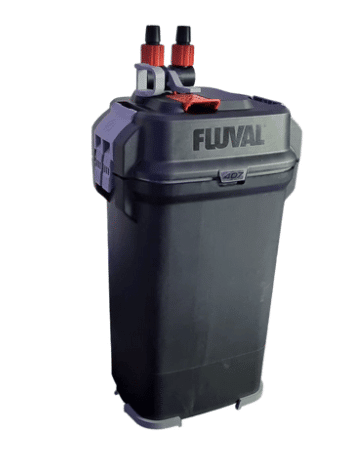
Top name brand, Italian made, and updated design. The next gen Fluval Canisters are a best buy!
If you’ve been in this hobby more than a few years, you’ve had the Eheim vs. Fluval argument at least once. Both brands have earned that debate. They’ve been making reliable canisters longer than most of the people reading this have been in the hobby.
The Fluval Canister Filters are quality Italian made units. I really wish I would hear more about Italian and German made equipment in the Reefing side of the hobby with all the Chinese manufactured equipment, but I guess the freshwater community gets all the good names. The Fluval series has the best quality for the price among all others on this list.
This was also the most well liked brand from our YouTube subscribers. Check out the results of the poll I took on my channel. Fluval is the clear brand favorite!
The Fluval Canister Filter steps up with this new design that now comes with flex ribbed tubing versus the cheap vinyl you are used to seeing with canister filters. It brings water down into the chambers of the filter to ensure the first chamber filters first as it should and it has a nice check valve feature on the drain preventing a flood in the event of a power outage or motor failure.
Like all the other high end external canister filters, the Fluval has great filter media capacity. The instant prime system allows for a quick start-up and the lift-lock clamps make it easy to access. All the 7 series models are shown below for reference:
MODEL Item #
107 A440
207 A443
307 A446
407 A449
Aquarium Capacity*
10-30 US Gal (40-130 L)
20-45 US Gal (60-220 L)
40-70 US Gal (90-330 L)
50-100 US Gal (150-500 L)
Pump Performance
145 US Gal/h (550 L/h)
206 US Gal/h (780 L/h)
303 US Gal/h (1150 L/h)
383 US Gal/h (1450 L/h)
Vertical Pre-filter
514 cm2
803 cm2
803 cm2
1074 cm2
Basket Volume
1.2 L
1.8 L
3.1 L
4.2 L
Total Chamber Volume
2.0 L
3.1 L
4.5 L
6.0 L
Canister Volume
3.9 L
5.3 L
7.3 L
9.2 L
Filter Circulation**
95 US Gal/h (360 L/h)
121 US Gal/h (460 L/h)
206 US Gal/h (780 L/h)
245 US Gal/h (930 L/h)
Max Water Column Height
1.45 m
1.45 m
1.75 m
2.25 m
Wattage (120V/60 Hz)
10 W
10 W
16 W
23 W
Wattage (230-240V/50Hz)
10 W
10 W
15 W
20 W
Filter Dimensions (L x W x H)
7.5 x 7 x 13.7” (19 x 18 x 35 cm)
7.5 x 7 x 16.5” (19 x 18 x 42 cm)
9.5 x 7 x 16.5” (24 x 18 x 42 cm)
9.5 x 7 x 19.3” (24 x 18 x 49 cm)
The Fluval has more canister volume on paper, but the module tray system eats into usable media space. In practice, net media volume is closer to the OASE than the specs suggest. Fluval uses a module system to separate out their filtration stages. This results in actually having less media volume than the OASE. It is also louder at 49 decibels over 43 for the OASE.
The main downfall I see with this unit is that it does not have valves so you cannot adjust the flow rate or easily drain it when maintaining. The flex hosing also keeps you from installing an inline heater unless you modify the plumbing. Fluval also debuted a new 407 Model in late 2019 so you can pick that model if you want the latest and greatest.
Pros
3 year warranty
Italian engineering and quality
All black design makes it easier to hide pipes in the aquarium
Uses flex tubing instead of cheap vinyl
Cons
More on the pricey side
Flex hosing while high quality can be a pain to deal with
Verdict: Buy if you want proven Italian-engineered reliability with a large media volume and easy priming. Skip if noise is a concern and your tank is in a bedroom or living room where 49 dB will be noticeable at night.
⚠ Hard Rule
Never size a canister filter to match your tank. Size it for the livestock you’re actually keeping. A 75-gallon (284 L) cichlid tank needs a filter rated for 100 to 125 gallons (379 to 473 L), full stop. The tank size on the box is a marketing number. Your fish’s bioload is the real number, and it’s almost always higher than the rating assumes.
Cheap, yet effective filtration unit. Equipped with a UV Sterilizer for added water clarity. Its price is hard to beat!
If you are looking for a budget canister filter, the SunSun Pro Canister Filters are just what you are looking for. This canister filter provides a lot of generous features for the money. The main feature is the UV sterilizer that is included with the unit. This provides additional water clarity, algae control, and some parasite and bacterial control for your aquarium. It has your standard 3 stage filtration and the gallons per hour rating on these filters is surprisingly high compared to canister filters on this list.
The SunSun comes in two models rated at 265, 370, 525, and 793 gallons per hour. The product we tested at the 370 GPH model, which we felt was the most equivalent to the OASE 250 that was tested. On the sound test, it posted a 57 – the highest of all the filters tested.
The main thing we do not like with the sunsun pro canister filter is the build quality. The included canister filter media is pretty cheap and almost suspect on a more demanding system. The canister filter does not have a stage separating feature so you will have water going through the stages, and some users have reported issues with the motors. We also feel that the UV is underpowered, but we believe the purpose of it was really water clarity from the manufacturer.
One thing I’ll say from experience with budget canisters in this class: plan on the impeller wearing noticeably by the 18-month mark. I clocked a measurable flow drop on a comparable SunSun unit after about a year and a half of continuous running on a 75-gallon (284 L) tank, not catastrophic, but enough that a flow meter would catch it. The impeller housing on these is tighter-tolerance plastic rather than ceramic-sleeved, and it shows over time. Not a dealbreaker at this price point, but exactly the kind of thing that doesn’t show up in a 30-day review.
Despite everything I just said, the SunSun is cheap. Really cheap. And for a beginner tank, a quarantine setup, or a second filter on a lightly stocked system, cheap and functional is all you need. That’s why it’s still on this list.
An ADA Canister Filter clone without the ADA price! And amazing filter to consider for high en planted tanks. Extremely professional looking
Verdict: Buy if you’re on a hard budget and stocking a community tank with forgiving fish. Skip if you’re keeping sensitive species, a planted display, or anything where long-term motor reliability matters.
Replacing the Aqueon quietflow canister for this year, the Fzone’s new Stainless Steel Canister Filters give us a clone of ADA’s famous Super Jet stainless steel filters. If you have ever seen planted tank systems in Japan, you may have seen ADA Super Jets in action. These filters are very popular over there, but they command an extremely high price tag, more than doubling the price of the most expensive external canister filters on this list.
Fortunately, Fzone has created a clone of the SuperJet, and it’s a fraction of the price. I find it pretty genius of them to offer this same style of canister filter at a lower price point. Its price puts it in direct competition of the Fluvals, Eheims, and OASEs of the world.
There are a number of reasons why this canister filter stands out among all the others on the list. The main reason is the external water pump. It is powered by a DC pump and since it’s external, you can replace the pump without having to replace the entire unit or wait on shipping from the manufacturer to get another. Fzone allows you to select any DC pump of your choice, or you can go with one of theirs.
The next factor is these units are made of 304 stainless steel. Stainless steel is the look for professional aquascapes. It provides a professional look in your cabinet. The steel also makes the unit more durable than others. You should expect the body of the unit to last a lifetime.
This canister filter offers a good mix of features and value. Because the pump is mounted on the top, it gives the unit the maximum amount of filtration media capacity possible. Because you can select your own DC pump, the gallons per hour you can run through this filter are way higher than other canister filters you can purchase. Do you want an 800-gallon per hour canister filter? Easily done by mounting the right return pump. You’ll need to buy the larger units to achieve this due to the inlet pipe.
This filter has the highest potential when it comes to the media capacity of all the units tested. Only the Fluval FX comes close to it. Same with its gallons per hour, it’s the highest you can buy. We tested the 10L model and hooked up FZone’s recommended DC800 pump. We tested 55 Decibels on our sound app.
With the FJ Canister Canister, you have to purchase your quick disconnect valves if you want them. It’s literally an empty canister that gives you ultimate flexibility. It won’t have a self priming / push-button primer feature or a fancy heater compartment like the Biomaster. As a result, there is more DIY involved with it. While it is a completely beginner-friendly unit, the filter media capacity offered is second to none and it is extremely quiet.
If you are really set on an ADA style, this is the canister filter to buy. It’s not as functional or feature-rich as the Biomaster, but it looks amazing and it is very quiet to use. Oh yeah, it is also the only aquarium filter on this list where the filter body is backed by a lifetime warranty!
Pros
ADA style external canister filter without the price
External pump
Largest filter media capacity
Cons
Need to buy and cut all your filter media
Pump is not included – which makes this filter more expensive
I was super excited when SICCE announced it was entering the canister filter game. After all, most SICCE products have been reviewed very well on this site. The Whale is a very competent first attempt by SICCE. It doesn’t check all the boxes for me, but it’s a good sign that SICCE is figuring it out.
What sets the SICCE Whale apart is the intake design. Water comes in at the top and drops down to the bottom of the canister, then filters upward through the stages. That bottom-to-top flow path is what keeps the filtration stages properly separated. You’re not getting stage bleed where fine debris bypasses mechanical and loads up your bio media. It’s a smarter flow path than most filters at this price range.
The filter is designed for ease of use. The fittings are designed to suction or pressure fit. You also get Sicce’s filter media with the unit, which is actually pretty good. While most canister filters you would want to replace the filtration media with better, the media offered here is serviceable which can save you some money over other choices on this list.
For testing, the 350 model was used. We oversized a bit on this test compared to the OASE, yet despite that it scored the lowest sound rating at 39 decibels. This is the quiestest canister filter you can buy today!
These filters have competitive prices and are backed with SICCE’s long warranties (3 years). The priming system is also mounted on the intake, which makes it more accessible than other canister filters. It’s a great choice as a canister filter, just keep in mind that SICCE is running through some first-generation issues with their quality control.
Eheims are known for their incredible reliability. The classic model offers great features at a reasonable price
Verdict: Buy if you need Italian-engineered reliability in a compact form factor for a mid-size tank. Skip if you’re looking for the widest media customization options or have a tank above 100 gallons (379 L).
The Eheim Classic Canister filter is a throwback to the original canister designs. It is an old, but proven design and with a brand name that backs it. Eheim is best known for its canister filters and pumps. Their quality engineering, design, and durability are unmatched in the industry.
The Eheim Classic Canister filters offer a lower-priced option while getting the quality Eheim name. The Eheim Classic canister filter pumps are extra silent and extra energy-efficient, so much so that it is possible to run even the 600 model off a simple UPS for several hours during a power outage. That means you can run your entire filtration unit during a power outage – that’s a pretty stellar feature!
For this test, we used the 250 model and scored 50 decibels, this puts its noise level at average compared to all the other filters compared.
The main downfall with the Eheim Classic canister filter units is the design. It just looks ancient and ugly. It hasn’t been updated in years and the tubing is an algae green color. It doesn’t exactly hide well inside your aquarium. It screams classic canister filter. It also only comes with the mechanical and biological media, meaning you have to purchase the chemical filtration media separately.
Pros
Canister filters are what Eheim is known for incredible durability
For those looking at a higher end upgrade to the Eheim Classic canister filter, the Eheim Pro Canister Filters answer the call. This square model provides extra media capacity and is suitable for larger aquariums.
Verdict: Buy if you want a filter that will outlast multiple tanks and run without complaint for a decade. Skip if you want modern conveniences like tool-free priming or a pre-filter stage, because the Classic keeps it old-school by design.
The pro units come with a self-priming feature which allows for the unit to quickly and easily start. The also has the ability to control flow rate with its Xtender control function and also has the ability to redirect water flow from different chambers to extend media life.
For testing, we used the 350 model, which is rated for 50-95 gallon tanks. It’s larger than our benchmark Oase, but still scored well in noise at 48 decibels. It’s not a bad filter and actually cheaper than the OASE 250!
Because of the high-quality bearings and ceramic axles on the pump, this is one of the quiet and durable canister filters. Eheims have withstood the test of time, with many hobbyists reporting Eheim canister filters operating 10+ years with no setbacks. They come with a price tag, but it is as one and done as you get with a filtration solution. You will not be disappointed in choosing Eheim!
The Fluval FX Series canister filters are a top-of-the-line canister filtration system for those with aquariums with high demands. The external canister filter is built to last with its Italian made design, external pump design, and high quality parts.
The FX Series filters are well known for their high flow rate, with the FX4 model having a water flow rate of over 700 gallons per hour while the FX6 pulls 925 gallons per hour. This power makes it ideal for larger fish that produce a ton of waste in the aquarium. The filteration media baskets and tray design give the FX the greatest capacity of all the aquarium canister filters on this list.
The canister filter also comes with a multi-functional utility valve drain that makes it possible to empty the canister for maintenance and also to drain water out of the aquarium seamlessly without having to bust out your siphon. It also has a gravel vac accessory so you can vacuum through the filter.
The largest model, the Fluval FX6, is rated up to 400 Gallons making this ideal for folks who keep large fish tanks. The twin output nozzles allow for customized flow rate and prevent surface scum from building at the top of the aquarium. Fluval really has thought of everything with this design.
Testing was tough with the FX. Because the smallest model is the FX4, it’s really comparing apples to oranges. Still, it posted a 48 decibel sound score, making it one of the quieter filters on the list! It has the second-highest media capacity of the bunch with only the FZone filter being able to best it.
The main drawback with this wonderful filter is the price tag. It is easily the most expensive canister filter on the list, but rightly so given the features and performance. I also do not like that provides carbon filter pads instead of actual activated carbon. The flex hosing also makes it more difficult to incorporate an inline heater (though in full disclosure you would need multiple heaters for a large tank anyway). The industrial-like design makes it time-consuming to maintain.
Pros
Built for larger systems – larger model goes up to 400 gallons
Second highest GPH
Second best media capacity
Italian built with external pump design – 3 year warranty
Flush valve and adjustable valves
Cons
Expensive
Annoying to take apart for maintenance
They are massive – won’t fit in a tight aquarium setup
UNS is a new entry to our list, replacing the now-defunct Hydor canister filters. This is the only canister that can actually be mounted on the back of an aquarium (for the smaller models). The larger models are designed with planted tanks and aquascapes in mind.
The fact that you can hang this on the back gives you a lot of options if you are running a smaller tank. Not everyone wants to have a canister at the bottom of their cabinet or make not have room. This gives you the option of having the filter media capacity of a canister filter without the hassle of storing it. It is like owning the old Marineland Magnum HOBs, but the Delta is far superior with its filter media capacity and flexibility.
UNS offers a nice video to show you how to mount this unit on the back of your aquarium. Check it out below:
For our testing, we used the UNS 90 model rated up to 66 gallons. It posted a disappointing 52 decibels on the sound meter. This was sad given it has a higher media capacity than the OASE – thought not built as efficiently with their chambers as our German-built favorite.
If you are looking for a high quality canister filter for a smaller tank, this is a great pick up. It can mount on the back of the aquarium and the white parts blend very well in a planted tank. For the larger models, however, I feel the other options from manufacturers like OASE and Fluval are better options.
The Marineland Maniflow Canister Filters are the successor to the Magnum 350. For those of you who weren’t in the hobby before the Magnums were around, the Magnum was considered one of the more versatile canister filters. The main downfall of the old magnum was the lack of media space options with its limited filter media space.
The new Marineland Magniflows addresses the media space issue with this very well built external filter. The new magniflow have a stack and flow filter tray feature which keeps water flow from moving into the various stages prematurely. The canister lid is a quick latch on and off function with a better seal then the old mangums. What I really like is the quick release function which immediately shuts down water flow and separates the motor for quicker and less messy cleaning.
For our testing, we used the Magniflow 220 model. It scored a 55 on the decibel app, putting it below average on noise. Marineland does not post their filter capacity on their specs, but from what we could tell looking at the model in person, it holds less than the Fluval 7 series, and OASE.
Marineland also does a great job with the starting media that comes with it. They use foam for mechanical filtration, which is reusable and the bio-balls are a good mid-tier filtration media. The water polishing media is sizable and cheap to replace, but I would have liked it after the mechanical filtration to keep our chemical and biological media chambers cleaner.
Another thing I really miss is the diatom feature of the old magnum filters. The diatom filter option was great for water polishing, ich management, and removing dinoflagellates. That’s what made the Magnums so unique and it’s really an underrated filter feature. It’s a shame it could not be included.
Pros
3 year warranty
Auto shut down feature makes for quick cleaning
Quiet and clean operation
Cons
I REALLYmiss the diatom filter option on the old Magnum 350 filters
The Penn Plax Cascade is a competent and capable filter. Penn Plax is a family owned business. A great purchase option for those wanting to support an American business
ThePenn Plax Cascade Canister Filter is a filter with a lot of features with a great price attached to it. While I can talk about what the filter has, the big draw to me is the story of the Company itself.
Penn Plax is a family owned business operating since the 1950’s. Started up by an engineer turned pet store owner, he brought his family into the business who still operate the Company to this day. Their main product was fabricating their own mold plastics to create a business making plastic pet products. If you are familiar with licensed pet products from Disney, Penn Plax’s name is all over them. They are masters of licensed pet products. The story itself is very much in the spirit of American entrepreneurship and being part of a family of entrepreneurs they hold a special place in my heart.
Going back to the Penn Plax Cascade filter, you get a number of higher end features like flow rate control valves, hose clamps, and a nice rubber feet base to make the canister study and quiet. The Penn Plax Cascade canister uses simple filters like sponges, which cuts down on costs and provides flexible space to put whatever you want in there. The price for these units is very attractive and worth consideration.
For our test, we used the Cascade 1000 model which produces 250 gallons per hour. It scored a 51 decibel rating, which put it at the average for noise. Like the Marineland, Penn-Plax does not post their filter volume specs. Looking at these in person, they hold significantly less than the OASE and Fluval filters we rated at the top.
Pros
Family owned business
Price
Features
Cons
Cheap looking design
Filter media is not as readily available as bigger brands
Score
Noise Level – 51 Decibels – 5/10
Manufacturer of Origin – 8/10
Brand Name – 7/10
Features – 6/10
Price – 9/10
Average Score – 7.0
Which Aquarium Filter is Best for Me?
You may be thinking about getting started on an aquarium and wonder to yourself what filtration system you need. This blog post is mostly going to cover the freshwater side of things as saltwater tanks have totally different criteria (though in the canister filter’s defense canister filters do make good filters for a fish-only saltwater tank).
Determining the best aquarium filter for you comes down to several factors:
What fish are you planning to keep?
How concerned are you about noise and aesthetics?
How large is your tank
What is your budget?
Canister filters are the best all-around filtration option for most freshwater tanks. Superior mechanical, chemical, and biological filtration in one sealed unit. They also work well in terrariums and turtle tanks because the intake tube reaches lower than a HOB ever could.
Benefits of Using this Type
Here’s why canister filters win over hang-on-backs for most serious setups.
High Water Flow Rate
Depending on the canister filter you select, there are some models that have higher water flow rates than others, which make them great for tanks that need a lot of filtration flow like African Cichlid tanks.
Some also come equipped with spray bars or outlet tubing that you can run on the surface of the water, which eliminates surface scum and aerate your tank. This can eliminate the need for a noisy air pump1.
Flexible Filter Media Selection
Superior canister filters hold a large amount of filter media space. You have the freedom to add multiple types of filter media in a canister filter. Most people will go for carbon, but there are other media such as additional biological filtration media, Chemi-pure, phosphate removers, and ammonia remover. These are just several examples of chemical filtration media you can add to a canister filter!
Easy Setup Process and Cleaner Setup
Canister filters are pretty easy to set up and go into your aquarium cabinet making them easier to access when needing to maintain them. A well-designed canister filter system will have auto-off or drain options that allow the unit to be cleaned without causing a giant mess.
Cleaning used to be the Achilles heel of canister filters of old, but as you will see, many of the top-performing canister filters I have listed here have features that make cleaning and regular filter maintenance painless and easy to prime again (some you don’t even need to prime!).
Long Lasting
The High-quality canister filters offer long warranties and are expertly built in countries like Germany and Italy. Both countries are very well known for building quality and durable aquarium equipment that has stood the test of time with 1,000s of successful field results.
We do have a budget-built system listed that is made in China, but they were included because several hobbyists have reported good results and not everyone is on a bigger budget.
Quiet Operation
This is the big separator between hang on the back power filters and aquarium canister filters. The top-tier canister filters are very quiet and you avoid that annoying vibration noise from a hang on the back filter. If you need a quiet area or sleep light, a canister filter should be on the top of your list for consideration.
Clean Aquarium Presentation
Most people who keep aquariums, especially in high traffic areas like living rooms, restaurants, and family rooms don’t want filtration parts sticking out like a sore thumb. A canister filter hides your major piece of filtration in your cabinet and you can work in an inline heater system to heat the tank without putting a submersible heater in the tank. You also have the option of not having to run an air pump with the aeration a canister filter provides. There really isn’t anything much better in regards to hiding equipment aside from using an overflow and sump, which is a whole other topic and level of filtration spend/budget.
What We Looked For
I’ve tested over 20 canisters across a dozen brands. Here’s the exact criteria I used to separate the ones worth buying from the ones worth avoiding.
Manufacturer of Origin
This is my #1 criteria. Call me judgemental, but I’ve been in the aquarium industry for over 25 years. I know the best equipment on the planet is going to be made and designed in Germany, Italy, or Japan. I’m trying to keep you away from cheap Chinese-made products that might save you money, but will not last. A good canister will last beyond the life of the tank.
Brand Name
Canister filters are made by the best of the best and the longest standing in the industry. In the fish hobby, these would be brands like Fluval, OASE, and Eheim. Eheim filters have been known to last over 20 years. I’ve seen several operating in fish shops and they rarely redesign their models. Why fix something that isn’t broken?
Noise Level
Noise sucks. Noise and media capacity are the two main reasons why people will buy an aquarium canister filter over a hang-on-back filter. To test sound, we ran the units through a watering trough with media empty. It’s almost unfair to run these units with media in because all these units come with different stock media. I also know filters can get louder over time as the filters build up gunk. It’s best to measure with no media to get the best reading from the motors themselves. Scores were all rounded up to the nearest whole number.
App Used
To measure, we use Decibel X from the apple app store. You can download it yourself if you want to test out the noise levels of your equipment and tank. It comes in real handy! Here is how each model tested fared.
Features
Some canisters offer high gallons per hour, others are designed for their media capacity, and some are easier to maintain. I look at all the features to see what stands out
Price
Let’s face it, an aquarium canister filter is expensive. You want a quality aquarium filter, but you don’t want to spend an arm and leg
The OASE Biomaster is a great premium canister filter and earns our top pick. With a heater compartment, you can keep your heater outside of your tank. The easy to remove mechanical filtration section makes maintenance simple. It’s a staple in every planted tank we setup.
We have listed a number of good canister filters to choose from. Now the question is which one would be right for you? Let’s talk about decision-making factors.
Size of Aquarium and Space
The size of your aquarium is a major factor in your decision. If you have a larger aquarium over 100 gallons, the Fluval FX and Eheim Pro series are strong considerations or even a multiple canister filter setup. You will want to measure the space you have in your aquarium cabinet to see if you can fit these inside.
Motor Adaptability and Durability
The motor is everything to a canister filter. If the motor breaks early, you are out of a filter. To us, the motor quality is the biggest factor in our purchase, which is why we lean on Italian and German built motors. You run the risk of getting a faulty motor purchasing a Chinese made pump and manufacturers who do not have a multi-year warranty on their canister filters should be seen as suspect. We believe the OASE, Eheim, Fluval, and Marineland, and Cobalt canister filters offer the most well built pumps of the bunch and they are all backed with 3 year warranties.
The next factor is adaptability. We want our canister filter to have the ability to adjust its flow with a ball valve. Some units on this list do not have ball valves and that does limit the ability to adjust your flow and quickly shut off your canister filter drain.
Your Aquarium Budget
Everyone has a budget and what they are willing to spend. You should take all the factors we mentioned in this post to determine the best budget canister filter to buy. If you simply want the cheapest canister filter out there, the SunSun’s would be the best to go with while the OASE BioMasters are the best canister filters to go if you are operating on a higher end budget.
⭐ Mark’s Pick
I pick the OASE Biomaster over the Fluval and Eheim for one reason that shows up every single maintenance session: the pre-filter canister. Being able to clean the mechanical stage without cracking open the main canister (without stopping flow, without disturbing the bio media) is not a gimmick. It’s a design philosophy that extends biological colony stability between full cleanings. At 43 dB in my testing it’s also the quietest filter I’ve measured, which matters if your tank is in a living space. Fluval is excellent and Eheim is bulletproof, but the OASE is the filter I’d buy with my own money for any display tank above 75 gallons (284 L).
FAQ
Here are the questions I get most from readers and customers.
Which one works best for saltwater aquariums?
All of these filters can work in a saltwater aquarium, but we feel that canister filters are best in a fish only setup. This is for multiple reasons:
1) Live rock and Dry rock are far superior biological media providers in saltwater aquariums than a canister filter can provide and is natural.
2) In a reef aquarium, a canister filter’s biological media could lead to excessive nitrate production, which would result in more required water changes and non-idea parameters needed for corals.
3) Many saltwater aquariums are built off a reef ready system or a sump, which does not really fit well with a canister filter
There are other uses a canister would be great for in a saltwater tank, however. Using them as a filter media reactor or to feed water into a UV sterilizer from the display or additional flow would all be good uses for a canister filter.
Is the OASE BioMaster worth the price premium over Fluval?
For most hobbyists, yes, and here’s the honest math. The OASE BioMaster runs quieter than any Fluval in this roundup (43 dB versus Fluval’s 49 dB in my testing), it primes itself with a button instead of a hand pump, and the integrated pre-filter basket means you’re rinsing a small cartridge every few weeks instead of cracking the full canister every month. Over two or three years of ownership, that convenience adds up. If you’re running a high-bio-load tank or you just hate maintenance days, the OASE justifies every dollar of the gap. If you’re on a tighter budget and disciplined about a monthly maintenance schedule, the Fluval is still a legitimate filter. You’re just trading convenience for cost savings.
How often should you clean them?
It does depend on your bioload and the type of fish you have, but you will want to replace or clean your mechanical and chemical filtration media at least once per month. And don’t clean all the media at once. You will want to clean the canister and motor at least every 3-6 months to keep it running well.
We do have a preference of running foam/sponges over consumable mechanical media like filter floss to save on monthly expenses and to hold more beneficial bacteria.
How Long Do They Last?
Canister filters are the most durable filtration system available. I have seen Eheim Canister filters operation with zero issues for 20 years. Your canister filter will last depending on the quality and how often you maintain it. German and Italian made canister filters like Fluval, OASE, and Eheim has passed the test of time. They are the best brands when looking for a filter that will last a lifetime!
Does the pre-filter canister design actually make maintenance easier?
It does, but only if you use it the way it’s designed. The pre-filter on the OASE BioMaster catches the bulk of the mechanical debris (uneaten food, fish waste, fine particulate) before it ever reaches the main media chamber. In practice, that means I’m rinsing the pre-filter basket every two to three weeks and only fully servicing the main canister every six to eight weeks instead of monthly. The catch is that some hobbyists ignore the pre-filter until it’s so clogged it’s strangling flow to the main unit, at which point you’ve defeated the whole purpose. Stay on top of the pre-filter, and yes, it genuinely reduces how often you’re elbow-deep in the full canister.
Is A Sump Better?
Yes – a sump is considered the ultimate in flexibility and capacity for any aquarium. However, they aren’t always practical, especially for freshwater tanks. Freshwater fish tanks typically do not have a need for dosing pumps, auto top-off systems, and or the need for space for denitrifying fauna and scavengers. A Canister filter offers everything you need in a comprehensive package for a freshwater fish tank and many are very reliable.
So for freshwater, unless the fish tank is very large a canister filter is actually better than a sump. In saltwater, a sump is far and above better than a canister filter. Canister filters can become a nitrate-producing factory in an established reef tank.
ASD Canister Filter Scorecard
After 25+ years of running canister filters across freshwater planted tanks, reef systems, and everything in between, here’s how I score the top contenders on the dimensions that actually matter when you’re maintaining real tanks:
OASE Biomaster 350: Filtration 9/10 | Maintenance Ease 10/10 | Value 8/10 | Noise 9/10 | ASD Overall: 9.0/10 🏆 My personal pick. Pre-filter basket changes without shutting down the system. Time saved over a year is significant.
Eheim Classic 350: Filtration 9/10 | Maintenance Ease 7/10 | Value 9/10 | Noise 10/10 | ASD Overall: 8.8/10 Most reliable filter I’ve ever run. Bulletproof build, dead-silent, but priming can be frustrating. It scores this high on a maintenance-weighted scale because a filter that never fails, never needs a prime, and runs for a decade earns its keep even without a pre-filter or push-prime button. Simplicity done right is its own feature.
Fluval 307: Filtration 8/10 | Maintenance Ease 8/10 | Value 8/10 | Noise 8/10 | ASD Overall: 8.0/10 Excellent all-rounder, great for beginners moving up from HOBs. Aquastop valve is genuinely useful.
Marineland Magniflow 360: Filtration 7/10 | Maintenance Ease 9/10 | Value 9/10 | Noise 7/10 | ASD Overall: 8.0/10 Budget pick that punches above its price. Wide basket is easy to service.
Fluval FX6: Filtration 10/10 | Maintenance Ease 7/10 | Value 7/10 | Noise 7/10 | ASD Overall: 7.8/10 Best raw filtration capacity on this list. Built for big tanks (150+ gal). Overkill for anything smaller.
ASD scoring note: Maintenance Ease is weighted heavily because consistency matters more than peak performance. The best filter is the one you’ll actually service on schedule.
Conclusion
Budget filters can move water. Premium filters move water consistently, quietly, and without punishing you every time you open the canister. That’s the real difference, and after 25 years of running everything from entry-level Aquaclears to high-end OASE units, I’d tell you the same thing I’d tell a customer standing in front of the filter wall at a fish store: buy the best filter your budget genuinely allows, because you feel the quality difference on every maintenance day for the next five years.
Every filter on this list made the cut for a reason. The right one depends on your tank, your budget, and how much maintenance friction you can live with. Get that match right and you won’t think about your filter again for years. Get it wrong and you’ll be replacing it sooner than you should.
Got a question about a specific setup? Drop it in the comments. I check them and respond. If you want to see these filters in action, the YouTube channel has full testing videos, tank builds, and maintenance walkthroughs.
The Isolation and Study of Nitrifying Bacteria”, W. Gibbs, 1919
Why Trust Us?
Aquarium Store Depot is dedicated to assisting aquarium enthusiasts of all expertise levels in finding the best products to enhance their aquarium care and maintenance. Our approach to reviewing aquarium equipment, accessories, and nutritional products is thorough and holistic, ensuring that we recommend only products that we personally use or have rigorously tested. You can read more about our product testing process here. To learn more about our team and mission, visit our ‘About Us‘ page.
Over 200 hands on product reviews
Authentic photos and videos demonstrating the use of aquarium products
A detailed 5-point rating system for evaluating aquarium products
Emphasis on manufacturers specializing in aquarium related goods.
More than 25 years of experience in the field of aquarium keeping and aquatic life care.
🔧 Want to learn more? This article is part of our complete Aquarium Equipment & Gear Guide. your ultimate resource for filters, heaters, lights, pumps, tanks, and more.
UNS (Ultum Nature Systems) tanks have become the go-to choice for serious planted tank enthusiasts, and I understand why. The ultra-clear glass, the precise rimless construction, the thoughtful dimensions. these tanks are built for aquascapers who care about the details. I’ve had the opportunity to look closely at several UNS setups and here’s my honest assessment of whether the price premium is justified.
Are you looking for the finest ultra clear rimless aquariums you can find today? If so you have come to the right place as I do a comprehensive UNS Aquarium Review. Ultum Nature Systems or UNS is at the pinnacle of quality and craftsmanship in the planted tank community. As you may have seen in our Best Rimless Tank round up, they were given my editor’s choice badge for best the best at what they do – making a pure rimless aquarium. I didn’t have as much space as I wanted to talk about their aquariums, so I’ll go in-depth here.
Ultum Nature Systems (AKA UNS) are considered the premium rimless aquarium brand in our industry. They are heavily favored when it comes to planted tanks. The main selling point is their extremely precise design.
Glass Construction
The glass on the Ultum Nature Systems have 45 degree mitered edges. They use high-grade german silicone to not only secure the tank but to have a quality view without obstruction. All aquariums come with a black leveling mat. They are made of low iron 91 clarity Diamant glass.
The use of 91 clarity Diamant glass is another level of quality when it comes to aquariums. It is not your ordinary low iron glass.
Diamant is typically used in commercial office windows, interior design, furniture, and display cabinets. This type of glass isn’t used in aquariums because of its price. UNS doesn’t skip anything on quality and materials to get the highest clarity glass you can find on the market. They are well known with their UNS Systems brand logo laser etched on the right bottom side of every tank they construct.
Cabinets
One of the biggest benefits of purchasing a UNS aquarium is have access to their cabinets. The UNS cabinets are one of the most modern and clean looking stands you will find today. They are made of natural wood materials and come fully assembled out of the box. They are far superior to any stand you can buy standard from a pet store.
They are designed to house Canister filters and there is a 45 degree mitered cut at the top of the cabinet door to allow for a grip when opening the doors. All the cabinets fit with UNS aquariums.
Craftsmanship
Ultum Nature Systems craftsmanship is the pinnacle of the planted tank community. Their glass construction and materials are top notch and unique in the industry. Few if any manufacturers use a commercial grade Diamant glass to save on materials costs. Each glass tank is laser etched with their trademark UNS brand and the aquariums are designed for clean lines and maximum clarity.
On the cabinet side, the cabinets are some of the most modern looking and elegant aquarium stands you will find in the industry. They have leveling knobs and are designed to last and look amazing. Everything fits seamlessly and the tanks look like a work on art on top of the cabinet. The black leveling mat is nonexistent when installed correctly.
Together both the aquariums and cabinets make a high-end design that will make you the envy of all your aquarium friends and be a conversation piece in the living room or office.
Value for the Money
Ultum Nature Systems Aquariums come in a variety of sizes designed with the aquascaper in mind. All models have a cabinet available that fits with the tank and made with their low iron diamant glass. I feel the value for the money is great given the quality of these aquariums and the cabinets available for them. UNS has the following model lines for their aquariums:
Rimless Cube Glass Aquariums
Standard Ultra Clear Rimless Glass Aquariums
Shallow Rimless Aquariums
All-In-One Aquarium Tanks
Cube Glass Tanks
UNS Cube Aquariums are nano square shaped tanks. They can be great for tighter spaces. The small aquariums are perfect for shrimp tanks, betta fish tanks, and stunning mini aquascapes.
Model
16C
20C
25C
30C
40C
Picture
Price
$
$
$
$
$$
Dimensins (LxWxH)
6.29 x 6.29 x 6.29
7.87 x 7.87 x 7.78
9.84 x 9.84 x 9.84
11.81 x 11.81 x 11.81
15.75 x 15.75 x 15.75
Aquarium Volume (Gallons)
1
2.1
4.1
7.1
16.9
Link
Standard Glass Tanks
These are the most popular styles of aquariums of UNS going from small to over 100 gallons. These are the gold standard for ultra clear glass rimless aquariums for the planted community
Model
60U
75P
90P
90U
120P
120U
180U
Picture
Price
$$
$$$
$$$$
$$$$
$$$$$
$$$$$
$$$$$$
Dimensins (LxWxH)
23.62 x 14.17 x 14.17
29.52 x 17.72 x 17.72
35.43 x 17.72 x 17.71
35.43 x 22.04 x 22.04
47.24 x 19.69 x 19.69
47.24 x 23.62 x 23.62
70.86 x 23.62 x 23.62
Aquarium Volume (Gallons)
19
36
44
68
78
114.58
156
Link
Shallow Rimless Tanks
The shallow rimless line provides longer aquascaping scape as well as swimming space for fish. These are ideal for aquarists looking to maximum tank length and swimming space for their fish while still having a great backdrop for a planted space. They all come with the ultra clear glass that UNS is known for.
Model
25S
45S
60S
75S
120S
Picture
Price
$
$
$$
$$$
$$$$
Dimensins (LxWxH)
9.84 x 9.84 x 4.92
17.71 x 11.02 x 7.09
23.62 x 14.17 x 7.09
29.52 x 17.72 x 11.81
47.24 x 23.62 x 14.17
Aquarium Volume (Gallons)
2
5
10
26
68
Link
Ease Of Use
The aquarium itself is super simple. It’s a clean rimless aquarium that comes with a leveling mat. It’s the cabinets that are the big selling point when you purchase these aquariums. The cabinets come already assembled. This is a big difference between other brands like Red Sea or WaterBox who will have the cabinet come in a kit where you would need to assemble it yourself. This saves you time and risk of error.
Product Support
This is a major knock on Ultum Nature Systems. They do not have much in the way of product support. They really rely on their retailers to provide guidance and support for claims. The claims will then run through the retailer. This is why you must purchase these aquariums from an authorized dealer. Most dealers are local fish stores, but a premier online seller of UNS aquariums exists online. That would be BucePlant, who is the go to for advanced freshwater equipment and plants. I would recommend if you are going to purchase a UNS Aquarium aquarium online that you purchase it from BucePlant.
Price
UNS due to their unique to the industry leading glass, construction process, and brand name are one of the more expensive pure rimless tanks on the market. There certainty are cheaper brands out there if they are out of your budget range, but the UNS’s premier construction, glass, and brand name really stand out.
Among cabinets, they are one of the finest cabinets you can purchase outside of getting one custom made. The price for them is worth it. Together as a package, they are an excellent value for a high end aquarium.
Closing Thoughts
Ultum Nature Systems aquariums offer a great package for those aquascapers lookers for a high end looking setup. The rimless aquarium is one of the highest quality out there with a unique commercial grade glass type. The cabinets are great looking and designed for planted tanks. If you are looking for a show stopping setup to compliment your home or office, UNS Aquariums are the way to go!
The Red Sea Reefer genuinely changed how people think about hobby reef tanks. Before it, a clean rimless system with a quality sump took real effort to piece together. the Reefer packaged that experience into something turnkey. I don’t take sponsorships, so I can tell you honestly: the Reefer is worth the price premium for reefers who value clean aesthetics and a well-engineered sump from day one, but it’s not the only path. Here’s my full review so you can decide if it’s the right fit for your setup and budget.
The Red Sea Reefer is loaded with many features. It’s so much more than a glass box. It all starts with the construction.
GlassConstruction
Red Sea has one of the most transparent manufacturing processes on the market. The only aquarium manufacture that comes close is Elos. Here is the quality and care you will get from every Red Sea Reefer that is created for you:
Ultra clear front and side glass. All glass is beveled edge glass
All cut glass edges are ground down to size and polished on all all 4 sides
Each piece of glass that is cut is inspected for blemishes
Aquariums are assembled in batches of 20 units per model
They are then stored for 3 to 6 days to allow for the silicone to cure
All aquariums and sumps are then water tested for 24 hours to ensure they do not leak
They are then hand-cleaned and polished
A final QC inspection is done before the system is boxed for shipment
You can see the full video of their manufacturing process process of their display tanks, sumps, and cabinets. It’s quite impressive!
Overflow System and Plumbing
The overflow box and system on the Red Sea Reefer is based on the bean animal design. The bean animal is considered the best practice for reef tank plumbing to day and creates a silent down flow system. Many cheaper systems still use an old style durso system, which can be loud and not as fail-safe as the bean animal. Due to using the bean animal design, the Reefer overflow is very quiet. The main thing is adjusting the drain valve.
The Reefer comes with a standard control knob showed below. You just turn the knob clockwise to raise the weir water system and counter clockwise to lower it. You slowly adjust until your overflow becomes quiet. Just make sure you adjust slightly and give it a few minutes for your aquarium system to adjust. Once you have the level right, it’s a set it and forgot it design. The box itself is easy to take apart and clean out.
Below you can see the plumbing on an installed system. The Reefer comes with all the plumbing parts ready to go so you don’t have to worry about cutting pipes or going to the hardware store to get pipes. My one critique is the lack of unions. I do know that some aquarists upgrade the system by adding unions and replacing the knob with a Spears gate valve. It’s really up to you. I’d go with unions myself, but it’s not needed.
Sump
The sump on the older Reefer systems used to be it’s biggest weak point. Since the V3 redesign, the sump is more on par with other competitors like WaterBox. The main upgrades from the V3 design is a better cup system that supports media cups, a separate refugium section, adjustable baffles, and the ATO reservoir housing itself on top of the sump.
Image Courtesy of Marine Depot
The refugium wall is also removable if you do not want to use it. This gives you the flexibility of either having a 2 stage or 3 stage sump.
Below is the outline of the Reefer 425 sump so you can see the different configurations available. The height on the skimmer chamber can also be adjusted to suit multiple protein skimmers without having to purchase a skimmer stand. There are multiple holders for media cups, filter bags, and filter socks. There shouldn’t be any issues with air bubbles given the baffle design. They really put a lot of design work in the redesign to give you the most options possible.
The water management system sits at the top of the sump. Because of how it sits now, you get a lot more space to house all your equipment controllers and plugs. I really like how everything fits on one side. They put a wall between the sump and all your equipment. You do not have to worry about salt creep getting into your outlets and have the room to really design your control panel on your reef system. There have been a crazy amount of cool designs and inspirations you can find online from other Reefer owners. The options are endless!
Red Sea Reefer 425 Sump Installed
Cabinets
As we saw in Red Sea’s manufacturing process, the cabinet has as much quality in the construction process as the aquarium itself. Every board is hand-finished and cleaned in the construction. The Reefer cabinets are constructed from MDF. The top of the line Reefer Concept models are made of plywood with adjustable feet. Because the cabinet is built for the aquarium, it seamlessly follows the contour of the glass and gives a very modern look
The cabinets are available in either black or white finishes. I’m partial to the white finish. The cabinets are a far superior than what you would normally get at a chain pet store and you would have to be put quite a bit of effort to construct one of similar quality yourself.
Craftsmanship
Red Sea has been the pioneer in our industry when it comes to creating the first ever ready to run reef aquarium system. There have been attempts in the past with reef ready systems, but you still had to do the plumbing yourself and build or get a sump. Red Sea has taken all the guess work and skill out. It is a well designed and carefully engineered product line.
The plumbing is now colored and no gluing is required. The overflow is clean and top notch. They go with a simple approach to plumbing because they are targeting the masses versus the hard core reefers who want every toy in their system.
They have even gone so far as to create their own line of skimmers, LED lights, and wavemakers in order to make your decision easier when you can literally just buy everything Red Sea to get yourself started. The only thing Red Sea hasn’t made of their own line is their return pump – which I’m happy with. Just mate this system with a Sicce pump and never worry about it failing again!
Value For Money
Red Sea Reefers seem expensive at first, but you need to account for everything you get out of the system when you purchase it. They are also available in a variety of models and lines for multiple budgets. The Reefer line is separated into the following lines
Reefer
XL
Peninsula
XXL and 3XL
The Original Model
The Reefer series is the original model. This is the line that made ready to run aquariums mainstream. All other ready to run manufacturers are judged against this line. It is one of the best reef aquariums available on the market today. They start at 21 gallons and go up to a 4 foot long 73 gallon system.
Model
Nano
170
250
350
Picture
Price
$
$$
$$$
$$$$
Dimensions (LxWxH)
18″ x 18″ x 52″
24.5″ x 20″ x 54″
35.5″ x 20″ x 55″
47″ x 20″ x 55″
Aquarium Volume (Gallons)
21
34
54
73
Sump Volume (Gallons)
7
9
11
18
ATO Reservoir Volume (Gallons)
1.2
1.5
2.1
2.8
Total System Volume
28
43
65
91
Link
The XL
The Reefer XL models takes the Reefer concept, but works on maximizing aquascaping space. These models all have 22.6″ wide and 22″ high dimensions. They stay as close to the ideal 24″ wide and high dimensions that aquascapers love. These cabinets are also upgraded with plywood versus MDF.
Model
XL 200
XL 300
XL 425
XL 525
Picture
Price
$$
$$$
$$$$
$$$$$
Dimensions (LxWxH)
24″ x 22.6″ x 55″
36″ x 22.6″ x 56″
47″ x 22.6″ x 56″
59″ x 22.6″ x 56″
Aquarium Volume (Gallons)
42
54
90
116
Sump Volume (Gallons)
11
15
24
31
ATO Reservoir Volume (Gallons)
1.8
3.2
5.5
5.5
Total System Volume
53
80
112
139
Link
Peninsula
The Reefer Peninsula are a top of line model that are see through from 3 sides. They are great to place as a room divider or in an office. The cabinets have additional features here like a ventilated compartment for chiller and control systems.
Model
Peninsula 500
Peninsula 650
Picture
Price
$$$$$
$$$$$$
Dimensions (LxWxH)
49.2″ x 23.6″ x 63″
63″ x 25.2″ x 63″
Aquarium Volume (Gallons)
105
140
Sump Volume (Gallons)
27
35
ATO Reservoir Volume (Gallons)
6
7.5
Total System Volume
132
175
Link
The XXL and 3XL
These are the beast systems. The are some of the largest ready to run reef aquariums you can buy today. No expense is spared here. Super clear and super thick low iron glass is used. On The largest system, you get a split sump system and a dual return setup so you have redundancy on the returns.
Model
625 XXL
750 XXL
3XL 900
Picture
Price
$$$$$$
$$$$$$$
$$$$$$$$
Dimensions (LxWxH)
59″ x 23.6″ x 58.3″
71″ x 23.6″ x 58.3″
79″ x 25.6″ x 60″
Aquarium Volume (Gallons)
133
160
192
Sump Volume (Gallons)
32
40
48
ATO Reservoir Volume (Gallons)
7.5
7.5
Not Included
Total System Volume
165
200
240
Link
Ease of Use
Red Sea Reefers are easy to put together and well constructed. Below are two sample images of their instruction booklet. The first is the cabinet assembly instructions. I feel that the cabinet install is fairly straight forward. The instructions aren’t as clear as Waterbox, but the components are easy to identify.
The next photo is the plumbing install. The images aren’t as clear, but there are so many pictures and videos online of folks who have put together these systems that it shouldn’t be too difficult even for a beginner to put everything together. RedSea lacks a video of the actual install, which I feel is a downer.
Product Support
The product support isn’t really from Red Sea themselves, but from the community. When you purchase the Red Sea Reefer, you enter into an exclusive club of Reefer owners. There is even a private Facebook group for owners that Red Sea promotes where you can connect with other owners and share tips.
Other forums like Reef2Reef even have their own Reefer trends and some of the big marine clubs have their own little Reefer cliques. It’s pretty cool how the community of owners are super passionate and work together to make other hobbyists successful. You will find the community of Reefer owners as one of the most passion hobbyists out there and are very open about sharing their successes and failures in the hobby with you.
Outside of the community. Red Sea now offers a 3 year warranty for 2020 models and beyond. This was a response to other competitors like Waterbox taking market share away from them. I’m glad to see competition pushing Red Sea to push for a better warranty. The days of lifetime warranties from manufacturers like Aqueon seem to be fading away these days.
Price
The Red Sea, while it executes simplicity and quality at a very high level, has also received criticism for being expensive. On the surface, Reefer prices seem very expensive, but we have to look at the value their bring by having everything in a kit in an easy to assemble package. To build similar you would need to:
Get an overflow box and possibility drill the tank to install it.
Purchase an aquarium cabinet or get one made of similar quality
Most people will go with a standard rimmed tank to save money. This will not present as well aesthetically as the Reefer. Also, many reefers tend to purchase the best available for their budgets. As a result, they often go overbudget. It’s not uncommon for a full set purchase to be near the cost of a set package like a Reefer. Other times the time cost of money of DIY’ing a solution is a major consideration.
So in my mind, I feel that the Red Sea offers great value for someone looking to build a high quality setup. Most reef owners tend to go high end because they want the best for their coral reef systems and aquatic animals. To me the upfront investment is worth it.
Comparision: The Waterbox
The biggest consideration for someone looking at these systems is which is better – Red Sea or Waterbox. There are a number of differences and I can list them here. Overall, they both have their strength and personally I feel the Waterbox is a better buy if you are trying to future proof or get a white cabinet:
Waterbox’s plumbing has a manifold, Red Sea’s does not
Waterbox has unions. Red Sea uses elbows for a simpler install
The overflow on the Waterbox is 100% glass while the Red Sea overflow is acrylic on the teeth. Waterbox’s overflow will be more resistant to scratches long-term
White finishes are cheaper for Waterbox models then Red Sea white finishes
The cabinet quality on the Red Sea overall is superior. The higher end models of the Reefer have leveling feet
The community I feel is superior on the Red Sea. Red’s community is older and more broad. Waterbox is still developing theirs
The Red Sea brand name is strong and has greater resale value
Red Sea warranty is better
Neither system includes a return pump. I would highly recommend you purchase a Sicce AC or DC Pump to complete your aquarium.
Closing Thoughts
Red Sea Reefers offer great value for aquarists who want a how quality build without having to go through the headache of picking all the parts separately. It’s a ready made solution and Red Sea has only components in their system like proteins skimmers that integrate with the aquarium. They were the pioneers when they debuted the first generation models and today they continue to set the bar for quality.
An auto top off system is one of those pieces of equipment that seems optional until you realize how much salinity swings can stress your livestock. In a reef tank, evaporation can drop salinity noticeably within a day or two. especially in warm climates. I’ve run ATO systems on my 125-gallon reef for years and the stability difference is real. Once you set one up, you won’t go back to manual top-offs.
Mark’s Expert Take
An ATO is the piece of equipment most reef keepers wish they had bought sooner. Salinity swings from evaporation are slow and invisible until they are not. On a hot summer day a small reef can lose a gallon to evaporation. A manual top-off that is two days late is a 0.5 salinity point swing, and corals notice before you do. I made ATO a requirement on every store reef display I ran, and I give the same advice to every customer who asks. Get one before you need it, not after something crashes.
Aquarium automation is becoming more and more of a reality to the modern aquarist these days. One of the most common applications of tank automation are auto top of systems (AKA ATOs). They are many out there, but which one is the best auto top off system? Today’s post is all about figuring that out
These systems work to add freshwater to your aquarium as water evaporates. In saltwater tanks, they are extremely valuable in maintaining stable salinity levels as salinity can swing as water evaporates and does not get replaced. In freshwater tanks, this will keep your water level stable so your filtration can run optimally and so your tank doesn’t completely dry out.
Replacing evaporated water is a real pain, especially for those with larger aquariums. Auto top off systems make things easy for you to manage without carrying a bucket of water everyday. However, you have to be very diligent about the system you choose. Auto top off systems are finicky and selecting one of poor quality ones can lead to a tank disaster and possibly an expensive home repair bill!
This is the reason for this post today. Auto top off systems are great tools for making your life easier, but not all auto top off systems are created equal. I’ve used or have experience with most of these top off systems I will go over today. Before we get started, let’s talk about why a top off system is so great and what features you should be looking for.
Why Do You Need An Auto Top Off System?
Anyone with a large amount of money invested in an complete aquarium system wants to protect their investment. An auto top off system is an automation tool that maintains stability in your aquarium. With saltwater aquariums it does more than just keep your salinity levels stable, but also to add supplements to your reef tank via Kalkwasser. In freshwater systems, it will keep your levels stable for equipment to run correctly.
The main thing with an auto top off system is that you need a reservoir of water to pull from. You can use a sample 5 gallon bucket, brute trash can, or a glass/acrylic top of container designed for aquarium usage. The reservoir will usually last 5-7 days before needing to be filled up again saving you the time from having to fill up water manually. Auto top off systems are essential if you are out of town or frequently away and can’t regularly maintain the tank’s water level.
Choosing An Auto Top Off System (What To Look For)
Auto top off systems are widely available in the hobby and there are several cheaper options like a DIY systems, however we have to outline the major critical features that are required in a quality system. Below are the main things we want when selecting a proper top off system for our aquariums:
Redundancy (Fail Safes)
This is the most important feature to look for. Auto top off failure is pretty common, especially with systems that use a manual float switch. If the switch fails, the top off system will fail to turn off, which causes too much water to be added. Ideally, we need dual sensors with our auto top off system. We also desire both a manual and digital sensor.
For a manual sensor we want a float switch (pictured above). The float switch has a switch that floats with the water level in your aquarium. As the water level rises the switch triggers and turns off the top off system. This the most common type of top off switch and something you may be familiar with if you have seen the float switches on your toilets. They are fairly reliable, but since it has moving parts they are prone to getting clogged with salt creep, getting jammed with critters like inverts, getting interrupted by waves, or breaking.
For a digital sensor (pictured above), we want an electronic eye sensor. This sensor monitors the water level in the aquarium and turns off the top off system electronically when the eye senses water above where it’s set. It is reliable, but prone to getting clogged up by water impurities over time. Most top off manufactures like to market these sensors as “not having moving parts” knowing that manual switches can fail, but don’t really like to mention the faults of a digital switch.
This is why we want to have a system with both manual and digital sensors. We can live with a dual manual or digital sensor, but the best of both worlds is a combo of digital and manual as both sensors can fail for different reasons.
Timers
Another critical feature we are going to want is a auto top off system with an auto shut off timer. In the event of a switch failing, an auto top off system with a shut off timer will shut off the pump before a major water disaster can occur. One of the biggest concerns with a DIY ATO solution is that there is no auto shut off timer.
This means that water will continue to fill in your aquarium if your switches fail. This can be disastrous not only to your aquarium, but also to your home as well! You would have to add some type of auto shut off feature on a DIY system or consider an aquarium controller, both of which will add costs to the system.
Value For Your Money
Now that we know what we are looking for. Let’s look at the best auto top off systems available on the market.
Why #1 Ranked: What Actually Separates a Good ATO from a Bad One
Sensor type – Optical sensors beat float valves. Optical has no moving parts to jam with salt creep or get blocked by a stray snail. The Tunze Osmolator wins here by combining both.
Fail-safe mechanism – If a sensor fails, does the pump keep running? The Tunze has a timed shut-off that kills the pump automatically. Most budget units do not. That difference is a flooded sump vs. a saved tank.
Pump reliability – A bundled pump matters. Units that ship without a pump leave you guessing on flow rate and compatibility. The Tunze and IceCap include tested, right-sized pumps.
Reservoir size compatibility – The pump needs to reach the bottom of whatever container you use. Verify tubing length before you commit to a 5-gallon bucket vs. a dedicated ATO reservoir.
Alarm system – Low reservoir alert and high-water alert are both non-negotiable on a reef. Without them, you learn the reservoir is empty by watching your salinity climb.
The Tunze Osmolator is without a doubt the gold standard for auto top off systems in the industry. It has everything that I listed earlier that we are looking for in an ATO system. It has dual sensors – one float switch and one digital sensor that work together to manage your water level. It has an auto shut off feature so you won’t have to worry about the pump running too long or your house flooding if the switches fail. It has an audible alarm if the water level gets too high and comes with a quality pump from Tunze.
The Tunze brand is well known for building lasting equipment and the reputation of this auto top off system is well known. They last for years and rarely fail with the pump usually failing first and being easy to replace. This is the ATO of choice for anyone building a quality display tank. You may have noticed there is a nano osmolator available from Tunze – but it’s simply not the same as it only has one sensor and I only list dual sensor ATOs for a reason on this post.
It comes with a high price though. It’s the most expensive auto top off system for a reason. You get what you pay for with this system.
The XP Aqua Duetto ATO system is an ATO that has been designed with all-in-on aquariums in mind. It is designed for this purpose so well that Waterbox Aquariums often sells this ATO as an add on to their reef ready system. It is marketed as the “world’s smallest dual-sensor aquarium top-off system” and you can see by the sensors and pump how small it really is. It can achieve this small footprint by not using moving parts, opting for a digital sensor setup.
The pump is a DC pump, which draws less power and allows it to be smaller in size. So small that it can easily fit in all-in-one chambers and operate effectively. It uses dual digital sensors that will work in complete darkness. Because the sensors mount magnetically without a sensor mount, they can be placed just about anywhere in the aquarium or sump chamber and can be hidden easily.
For those aquarists who want a compact version of an osmolator, XP offers an ultimate version with 4 sensors that competes with the Osmolator 3155
The JBJ Auto Top Off system is one of the main time tested entry level auto top off systems on the market. This system is different than the others before it on this list as it features two manual float switches that will trigger as your water level rises. There are no of digital sensors on this auto top of system. I actually don’t mind the dual float sensors and with the two types of setups you can do with this ATO system, you can have a pretty full proof and redundant system.
Another great feature is this system is easy to customize. You can modify the auto shut off timer by upping the time on the controller and tuning the shut off with a screw driver and you can also turn on an alarm when the ATO turns on. That’s a really great feature for control and to prevent any flooding in the event the float switches fail.
The controller features an audible alarm if the max float switch triggers and both float switches are reversible if you need to do that. It really offers a lot for its price point.
The things I don’t like with this system is you have to purchase a pump and the mount options aren’t that great. There is a suction cup mount option, which I would not recommend, and the bracket mount options just don’t look very pleasing to the eye and may mount weird if you have a rimless tank or sump. Not having a pump included usually brothers me with auto top off systems. I tend to lean on systems that comes with pumps as it takes out any guesswork I need to do.
Pros
Reasonable price
Easily modifiable and customized
Auto shut off feature
Cons
Suction cup mounts (Use brackets instead!)
No pump included
4) Hydor Smart Level Controller – Dual Sensor ATO For A Reasonable Price
The Hydor Smart Level Controller is an ATO system that uses a dual sensor to manage your aquarium’s water level. The sensors are included on a single plug making it easy to install. It is a sump based ATO systems, so I would not recommend it for using it in tank as the alarm level is set very high if used in an aquarium. It features a dual alarm system with both lights and sound. The sensors are not affected by waves in the tank.
What I don’t like about this auto top off system is that it does not come with a pump. You have to purchase that separately so the price may not be as great as it seems if you pick up a more expensive pump. The switch holder is also a hybrid suction/magnet. I would prefer a true magnet mount.
The IceCap ATO is a comprehensive top off system that includes dual digital sensors. These dual digital sensors read your water level and provide a min and max sensor. This provides a dual sensor back up for the auto top off unit. CoralVue advertises this unit as one without moving parts. It is a bit of marketing fluff to do this, but overall it is a competent unit for the price.
The pump that is included is of good quality and it is mounted with magnets, which I feel is a better and more secure mount than the Hydor system. The alarm has a nice feature that lets you when your reservoir is low, which helps when you don’t look at the ATO container. CoralVue is a brand is also known for quality customer service so that’s another thing that gives this system a leg up.
It has a decent price for what it offers. It lacks a manual switch and a shut off feature but overall it is a good package for the price.
The EPPTECH ATO is a good value and has a small footprint. This is a clone of the smart ATO system. The smart ATO system was actually excluded from our list because of availability and price compared to others that made the cut. This does not have a float switch, but a single digital senor. As a result, it has a very small footprint and will fit anywhere in an aquarium.
My biggest gripe is the quality control on this unit. There are several reviews on the product where it fails. The sensor fails or the magnetic optical part corrodes in the tank. These are all no go’s in my book. As such, I would not recommend this unit and stick to the others I mentioned prior.
Pros
Good value
Small footprint
Cons
Only uses one sensor
Quality Control
Our Recommendation
If you want the best quality and most reliable auto top off system, my recommendation is very simple. It would be the Tunze Osmolator 3155. It’s ironclad reliable, will service your tank for years, and is built very well. If that is not in your budget, I would recommend the XP Aqua Duetto Auto or JBJ Auto Top Off depending on if you have a pump available or not. The XP Aqua offers a good price and includes the pump and is reliable. The JBJ is cheap if you have a pump and has adjustable features when you access the inside of the controller.
I Don’t Have A Sump. Which ATO should I use?
There is one auto top off system that is designed for people without sumps. That would be the XP Aqua Sumpless ATO System. If you are running your ATO directly out of your display aquarium, this is the best ATO to get for your needs.
What Manual Top-Off and Cheap Float-Valve ATOs Miss
Float valves can stick. Salt creep, debris, or a curious snail jamming the mechanism means the valve does not close. The pump keeps running. Your sump overflows or your salinity crashes below 1.020 before you notice.
No fail-safe means no safety net. A cheap single-sensor ATO has one point of failure. When that sensor fouls or fails, freshwater addition does not stop. A 5-gallon reservoir of fresh water dumped into a 40-gallon reef is a livestock emergency.
No reservoir alarm. Manual top-off means you remember, or you do not. Miss two days and salinity climbs. Miss four days and you are doing an emergency water change. Most cheap ATOs have no alert for an empty reservoir either, so you get the same problem with extra steps.
Inconsistent dosing interval. Manual top-off adds water in large batches. A proper ATO adds small amounts continuously, keeping salinity within 0.001 of target. That consistency is what corals and invertebrates actually need.
How to Setup
ATOs are actually really easy to install. They are probably one of the easiest tank automation tools to maintain and install on an aquarium. This video below shows how to install an XP Aqua Ultimate on a sump system. The install would be very similar installing an ATO in the display tank or all in one aquarium.
For the reservoir you will want to use a food grade bucket or trash can or an acrylic or glass ATO container. If you are running a saltwater tank, you will want to use RODI water from an RODI System. Make sure to fill up the reservoir and put the pump in the container before you turn on the system so the pump does not run dry.
Conclusion
Final Thought
On a reef, stability is everything. Temperature, salinity, alkalinity – the animals you are keeping evolved in one of the most chemically stable environments on the planet. An ATO is what makes stability possible without babysitting the tank every day. It is a one-time purchase that quietly protects everything else in the system. Get the right one, set it up correctly, and it becomes the last thing you think about – which is exactly the point.
🔧 Want to learn more? This article is part of our complete Aquarium Equipment & Gear Guide. your ultimate resource for filters, heaters, lights, pumps, tanks, and more.
Mark’s Top Pick
Tunze Osmolator 3155. I used these on every display reef at the stores I managed, and I use one on my personal 125-gallon reef. The combination of an optical sensor, a float valve backup, and the timed shut-off is the reason it earns top spot. Every other unit on this list makes a compromise somewhere. The Tunze does not. If you can only afford one piece of automation on your reef, this is the one.
Buy or Skip? Straight Verdict
Buy if:
You are running any saltwater tank. Full stop. This is not optional equipment for a reef.
You travel, work long hours, or go more than 48 hours between maintenance sessions.
Your tank is in a warm room or runs warm – evaporation accelerates fast above 80°F (27°C).
You are keeping SPS corals or other animals sensitive to salinity swings of even 0.2 points.
Skip if:
You have a freshwater tank and check water level daily – manual top-off is fine for most freshwater setups.
You run a small planted freshwater tank where slight level drops between weekly water changes are a non-issue.
Freshwater keepers: an ATO is a convenience upgrade, not a necessity. Saltwater keepers: it is a necessity dressed up as a convenience.
Nyos skimmers have developed a loyal following in the reef community, and after evaluating them alongside the more established brands, I can see why. The needle wheel design and build quality stand out immediately. I approach every equipment review the same way I’ve approached gear for 25 years in this hobby. what does it actually do in a real tank, and is it worth what you’re paying?
Looking for the very best Protein Skimmer available for your saltwater aquarium today? If so, you have come to the right place. Today, I go in-depth with a Nyos Skimmer review!
As you may have read in my Best Protein Skimmer round up article, Protein skimmers have become a staple piece of equipment for many reef tanks. It all started with the Berlin method that became popular when I started up reefing back in the early 90s. Everyone swears by their protein skimmer, and we can see why with so many successful reef tanks running them. So what makes the Nyos Quantum so unique? Let’s find out shall we?
My reviews are fairly structured. I’m going to be reviewing the following with the categories with this protein skimmer line:
The Nyos skimmer prides itself by it’s extreme performance. This is a result of the massive amount of air and water it drives through it’s skimming chamber. This is achieved by their Nyos Twister technology. The twister is an additional blade that is added to the usual bubble plate you will see in most protein skimmers. This blade gives the bubbles an additional cycle within the bubble vortex. What this does is create additional contact time for the air bubbles in the water column.
A protein skimmer lives and dies off the contact time. The more contact time the better for a skimmer. This is why recirculating skimmers are popular at the high-end of the hobby. Nyos achieves a recirculating effect all within a small footprint.
The next feature to speak of is the quiet operation of the skimmer. I’ve worked with skimmers that do a great job, but are very loud. Given that the Nyos is a premium level skimmer, I would expect it to be dead quiet. I purchase a skimmer like this for the performance and it’s silent operation. Not only is it one of the quietest skimmers on the market, it is also energy efficient even without using a DC pump!
The pump is built off what Nyos calls the Nyos Hybrid Wheel. This is a specialty designed impeller that combines the advantages of a needle wheel and lattice wheel. It is an AC pump, which I personally love because I know AC pumps are generally more reliable than DC pumps. The pump is placed in a clear view reactor. This is a clear impeller cover that lets you see the function of the skimmer. This allows you to visually inspect the protein skimmer to see if there are any obstructions that need to be cleaned out. The pump will operation best in a water level of 8 – 10 inches on all Quantum models
Craftsmanship
The Nyos has nothing cheap built into it. When you pull it out of the box, the first thing you will notice is the weight of skimmer. There are no cheap plastic and thick high quality acrylic. It comes with titanium screws so you do not have to worry about your screws rusting out. Below is a image of the Nyos Twister blade.
Image Courtesy of Marine Depot
The Nyos is built to be compact and does not use externally mounted or large bulky pumps. This not only allows it to fit in smaller aquarium sumps, but also makes it quiet and easy to maintain. The Nyos skimmer is designed and built in Germany. There is are no corners cut with its design and it shows not only in its parts, but its looks. It looks cool just sitting in your sump. For those of you who like to make aesthetically pleasing sump setups, this skimmer is a great additions for its looks and it’s performance.
Ease Of Use (Installation)
The Nyos built to be plug in play. In my experience, this is the quickest skimmer to break in among all the skimmers I have worked with. Many lower end skimmers will take several weeks to break in until they start performing the way they should. The Nyos gets off running. They usually break in after a day or so.
They are built to be simple to use. It has two adjustment values for the air intake and the chamber level. The collection cup is also generous in size and goes a while before needing to be replaced. The cup comes off easily by twisting off.
While the instruction manual does not have pictures illustrating install, EcoTech Marine does provide a video showing how to assemble and install the skimmer. I have supplied the video below for your reference so you can view it when you purchase it.
Value For Money
The Nyos Skimmer from first look seems like a very expensive skimmer. When you look at the quality of construction and features that this skimmer has, you can see how it stands out from many of the its competitors in the marketplace. A Nyos has been known to be too good at its job and has to be dialed back in order to control nutrient levels. This to me is a hallmark for a skimmer. A good unit should be able to run on its own without added equipment.
A quality skimmer should be able to run with just this unit and the biological filtration coming from the rock in the aquarium and the micro fauna that is breeding in the refugium. The Nyos can achieve this balance in a heavily stocked tank without missing a beat.
Models
The Nyos Quantum comes in 4 different models that can handle from 40 gallons all the way up to 1000 gallons. The 160 is the most popular of the entire lineup.
Model
Nyos Quantum 120
Nyos Quantum 160
Nyos Quantum 220
Nyos Quantum 300
Picture
Price
$$$
$$$$
$$$$$
$$$$$$
Gallon Recommendation
40-125 Gallons
100 – 250 Gallons
125 – 500 Gallons
250-1000 Gallons
Air Max (Liters Per Hour)
500 l/h
1500 l/h
2200 l/h
2200 l/h
Power Consumption
8 Watts
18 Watts
22 Watts
2 x 22 Watts
Dimensions (LxWxH) in Inches
5.91 x 8.27 x 18.31
7.29 x 9.85 x 20.87
12.2 x 9.25 x 23.8
13.4 x 16.4 x 26
Water Level
8-10 “
8 – 10″
8 – 10″
8 – 10″
Link
Product Support
Nyos Skimmers are distributed in the US by EcoTech Marine. EcoTech marine is well known in the reefing hobby for producing high-end equipment and having excellent customer server. EcoTech marine provides the support for Nyos. They are typically fast to respond to phone or email inquires.
The main downfall with the Nyos protein skimmers are their warranty. You only get a 1 year warranty. This is disappointing given the Germany quality engineering and the fact that the pump runs of AC power. However, looking at other brands like Reef Octopus and Deltec, you will see similar short warranty periods. The longest warranty I’ve seen for a distributed protein skimmer has been Simplicity which offers a 3 year warranty.
The Nyos website it linked back to Germany or something, but they’re actually distributed in the USA by Ecotech Marine. Most people already know Ecotech’s reputation for being a well-established exceptional company. They respond to inquiries extremely fast via both phone and email.
One issue we ran into when it came to contacting them was we were informed that during some warranty issues a credit card actually gets held to ensure everything runs smoothly. The next was for price point. The prices on them for a skimmer with a 1-year warranty we think is a little high. But, there is room for a slight margin of error. When we called the company we got 5 different answers. 3 people told us that the warranty in the USA is only 1-year, but 2-years in the UK and Germany. 2 people told us the warranty is 2-years no matter where the skimmer is sold.
Either way, no one seemed to really know. They should be ranked #1, but we couldn’t seem to get solid answers about how long the warranty actually is or how the warranty issues are actually handled. The only thing for sure when it comes to Nyos skimmers is they perform exceptionally well and are backed by one of the best companies in the USA.
Price
The price for this skimmer may seem very high at first. We have to compare apples to apples though. The Nyos is one of the few German made skimmers out on the market. A fair comparison would be to compare these to the Daltec and Bubble King brands of the hobby. A bubble king is typically going to be 50% more expensive than the Nyos while the Daltecs are going to be slightly more expensive, but less feature rich.
Compared to an equivalent German made protein skimmer they actually are an economical option. Knowing that however, the Nyos does not perform economically. It is an elite performing protein skimmer with stellar support from their EcoTech distributor.
Closing Thoughts
The Nyos Quantum skimmer represents the best of the best when it comes to protein skimmers. It is the best mix of simple to operation and elite performance. The German engineer and quality really make this skimmer stand out for all others on the market. With EcoTech backing support for US distribution, you have great customer service behind the product. If you are looking for the absolute best skimmer on the market today, the Nyos my choice for any top-end reef setup.
You can see the ratings below from me and my editor’s choice badge that these skimmers receive. Since I’m open to all reviews, you can leave your own reviews below. I’m all about being an unfiltered source of reviews for our reefing community. If you have any questions, please leave them in the comments below. Thanks for reading!
🔧 Want to learn more? This article is part of our complete Aquarium Equipment & Gear Guide. your ultimate resource for filters, heaters, lights, pumps, tanks, and more.
The original Gyre wavemaker was a genuine innovation when it launched. the crossflow design eliminated dead spots in a way that traditional powerheads just can’t, and I thought the first-gen IceCap Gyre was one of the best values in reef flow equipment at the time. The 2K and 4K second-generation models pushed performance further, but also pushed the price. I don’t accept sponsorships, so here’s my honest take on whether the upgrade is worth it and how the Gyre 2K stacks up against the competition for reef tanks in the 100. 200 gallon range.
The 1st generation of IceCap’s Gyres was in my opinion the best value in aquarium wavemakers on the market. Today, I look at IceCap’s latest Gyre 2K and 4K 2nd generation models and see if they still continue to deliver value.
My reviews are fairly structured. I’m going to be reviewing the following with the categories with these kits:
The IceCap 2K Gyre has a number of improvement over the last generation 1K models. The output has been upgraded to 2,000 gallons per hour and it now can be controlled via wifi.
The new wifi app is called CoralVue Hydros. It’s the same mobile app that is used on the Hydros WaveEngine controller. The new app also you to program the Gyre on your phone using presents and triggers. Modes are always available like a feed mode that shuts down the pump. Below is a screenshot of the app. It is a simple to use app that CoralVue has a number of videos available that explain how to use the app.
One observation with the WiFi is that it only runs off 2.4 ghz. It does not run off the modern 5 ghz band. Make sure you have a router that runs 2.4 and 5 ghz bands. Most wifi routers do have dual bands so it’s likely not going to be an issue for most users.
The new controller that runs the Gyre 2K and 4K can actually run up to two pumps. This is an improvement to the prior generation model that had to have a controller for each pump. You can even run two pumps off a single power supply. This reduces clutter in your aquarium cabinet. It’s an added plus feature with this newest generation.
The design of the 2nd generation Gyres look similar to the prior models, with exception to the impeller blades. In the prior models, they were black. In the 2K and 4K models they are a orange color. IceCap does include black impellers that you can switch out though. I would encourage you to switch to the black ones as the orange ones can look odd in the tank when the pump isn’t running. The magnet can work on aquariums up to 1/2″ thick in glass.
IceCap Gyre Craftsmanship
The craftsmanship on the IceCap Gyre is solid just like the last generation. It’s licensed technology from MaxSpect. Maxspect was the original designer of the Gyre technology. It is a cheaper version of the MaxSpect gyre, but I don’t feel any significant cost cutting measures were taken. The impeller design is simple and easy to take apart.
Thepower outlet comes from the top. The Gyre, like all other Wavemakers not named EcoTech has the power outlet on the wet side of the aquarium. Since Gyres are places near the top of an aquarium, I don’t feel it takes away from the look of the tank. It some display tanks, it may blends into the backgrounds and look like part of the return.
Ease Of Use (Installation)
This is where the IceCap Gyre really stands out. CoralVue has done a stellar job of producing video content on how to setup and use the Gyre. I’m going to list them all here so you have a quick guide when you purchase the unit.
Installation and Operation
This video will walk you through the Gyre parts and the setup to install in your aquarium
Pump Controller Setup
This video walks you through the install setup of the Hydros mobile app
Controller Configuration
This video walks you through flow configurations available off the Hydros app and how to program your Gyre.
https://youtu.be/WExf_POvVt4
Value For Money
There are three comparisons I need to make on the Gyre. The first is comparing it to the MaxSpec XF Gyres. The IceCap 2K and 4K Gyres are superior value in comparison to the MaxSpect. In my opinion, there isn’t much to justify the additional price tag of the XF. This is specifically true now with the CoralVue Hydros app.
The next comparision is against the high end wavemakers on the market. Comparing to the EcoTech MP, the IceCap Gyre 2K and 4K are a superior value. A IceCap 2K Gyre can easily power a 3 foot long tank with no dead spots. The equivalent setup for an MP would require two units. This makes a Gyre a much cheaper alternative for a wavemaker in a reef tank
The last comparison is against the prior IceCap 1K and 3K models. There has been a significant price increase over the 1K and 3K due to the controller. The 1K Gyre used to be an incredible value. It’s a shame that the 2K model has a much higher price tag. However, the controller is a significant improvement and if you run a tank that needs to run 2 gyres like a 6 foot long tank, The IceCap will be a great value for you.
Models
Below are the available IceCap Gyre models available today. The 2K will work for up to 3 foot long tanks. The 4K is a more powerful version that is recommended for higher flow demand environments such as an SPS tank.
Model
IceCap Gyre 2K
IceCap Gyre 4K
Picture
Price
$$
$$$
Gallon Recommendation
20 – 90+ Gallons
25 – 150+ Gallons
Gallons Per Hour (Max)
2,000
4,000
Gallons Per Hour (Min)
739
1,286
Power Consumption
8-25 Watts
13-45 Watts
Dimensions (LxWxH) in Inches
8.78 x 2.83 x 1.5
12 x 3.15 x 1.7
Tank Thickness
Up to 1/2″ thick
Up to 5/8″ thick
Link
Product Support
IceCap is sold by CoralVue. They have been a manufacture of OEM parts for major years in the industry and are the exclusive distributor or brands such as IceCap. One thing that really stands out with CoralVue is their customer support. They go the extra mile to reach out to you and are regularly involved in hobbyist forums. As you also saw, they have been getting into video content more which has been helpful in understanding how to use the products you purchase.
The cons with Gyres in general are their warranties. You only get a 1 year warranty on them. That is a vast different from the old AC wave makers that would offer multi-year warranties. I still feel they serve great value even with their shorter warranty.
Price
Price is the biggest change with this newest generation Gyre from IceCap. The prior generation was a bargain at the price it was sold at. This new generation has had a significant price increasedue to the wifi enabled controller. While it can be more expensive for a tank that only requires one Gyre, the price becomes more reasonable when you are running 2 or me Gyres. This is because the controller can operate 2 gyres so you can save a good bit of money just buying the pump only for the 2nd Gyre.
While overall it is more expensive than the last generation, it is still cheaper than the higher end wavemakers on the market. I feel it’s still a great value for reef tank owners looking for a wavemaker that is set and forget and not complicated to use.
Closing Thoughts
The IceCap Gyre 2K and 4K are great value for what they offer to a reef tank owner. It is one of the more comprehensive wavemaker solutions that won’t break the bank. The new wifi feature on the controller is a great update from the prior generation and worth the added cost. CoralVue as a distributor has a solid reputation for customer service. I feel that you cannot go wrong with a CoralVue distributed product. This is an excellent wavemaker overall.
You can see the ratings below from me and my best value badge that these series of aquariums receive. Since I’m open to all reviews, you can leave your own reviews below. This provides the community with an unfiltered source of reviews. If you have any questions, please leave them in the comments below. Thanks for reading!
Waterbox aquariums have become a serious competitor in the all-in-one reef tank market, and after spending time evaluating them, I understand the appeal. The cabinetry, the rimless glass quality, and the integrated filtration compartment are all clearly designed by people who actually keep reef tanks. I approach every review the same way. no sponsorships, no paid placements, just an honest look at whether the product is worth your money.
Looking for a reef ready system that that delivers on quality and simplicity? If so, you have come to the right place as today I do a comprehensive Waterbox Aquarium Review. Waterbox has taken it to Red Sea with highly quality reef ready systems that are approachable even for a beginner saltwater aquarium owner. As you may have read in my Best Rimless Tank round up article, the Waterbox Aquariums systems are a great way to get started in the saltwater hobby.
They got my best value award for having such great features at a fair price, however, I didn’t have the space in the article to talk about their entire line and go in depth on all their features. This post, I will dive in so you can see what makes WaterBox Aquariums stand out so much in an industry I feel at times can be seen as overly complex to beginners.
The WaterBox tanks are loaded with features. It’s more than just a box of glass.
GlassConstruction
The WaterBox Aquarium is built to be a run to run system. It starts off with the aquarium itself which is made of Ultra Clear Starphire glass. This glass is made of low iron. Due to the low iron make up, it has better clarity than a traditional glass tank. It’s clarity rivals an acrylic tank – the gold standard of clarity when it comes to aquariums. Ultra Clear Starphire really comes into it’s own when you are looking at larger tanks. Given that most of the tanks that WaterBox sells are going to be over 100 gallons, Starphire makes a lot of sense for those looking for high quality display tanks.
The entire construction of the glass is put together with straight edged black silicon. The edges are put together with a straight-edging technique that not only gives the aquarium great strength, but a clean look. There are budget rimless tanks that will show poor quality seems where you still see the silicone stick out. Waterbox’s silicone technique is top notch and clean.
Overflow System and Plumbing
Now let’s talk about the overflow system. Waterbox uses a full glass overflow. This is very different than other reef ready systems that use an acrylic overflow. An acrylic overflow have serious drawback in that they scratch over time. The glass overflow has etched teeth and are far easier to clean off than an acylic overflow. What I always loved about glass is you can just take a blade to it to pull off coralline algae. It’s more difficult with acrylic. Your best bet with acrylic is a credit card or a special plastic scrapper. I always felt the glass scrapers were superior.
The overflow system takes use to the plumbing work. This is where Waterbox shines. They use a manifold system with hard colored PVC plumbing. They also come with quick disconnect unions and a gate valve. The drains are a bean animal style1 – the current industry best practice. You can see a video below from the manufacturer that goes over the plumbing system. There wasn’t a plumbing system like this when Waterbox came to the scene. It is still the main feature that wins me over with them.
Sump
These are the best sumps included in a ready to run aquarium system that I have seen. It’s a rimless glass sump that has it clean separate chambers. The sump below is the Reef 130.4 Sump.
You can see this is a true mult-stage sump with a sock chamber, skimmer reactor, pump and ATO section. The ATO section is a great feature. While the Reef models only have a skimmer chamber, the larger Reef Pro models have a skimmer and refugium section. I love the rimless design as there are no braces in the way. The skimmer reactor chamber is also very generous, allowing for oversized skimmers.
Cabinets
The Waterbox cabinets for the Reef, Pro and Peninsula series are made of hardwood and are heavy duty UV coated. This is a step above the standard MDF that you will see from budget cabinet manufacturers – and much better than what you would you would purchase at a typical pet store. They are available in either black or white finishes. Personally, I’m partial to the white finish.
Another great touch are the soft close doors. The hinges are PVC coated. This is another great feature by Waterbox as standard hinges are known for rusting out over time. The doors operate via push open which means you don’t need to have door handles installed. I like this touch as well. It makes the cabinet look clean and modern.
The cabinet is designed with a brace off center. This is down so you have full access to the tank without an annoying middle brace in the way of everything. You will see the same feature on their larger 5 and 6 foot tanks. I like this touch and on the larger systems it really allows you to be creature and design a control command center.
WaterBox Craftsmanship
I love the engineering though and fit and finish of these systems. The plumbing is colored and no gluing is required. The overflow is professional designed. The manifold system makes your system future proof. The cabinets are excellent. And that’s all without mentioning the aquarium itself which is well put together.
Value For The Money
Waterbox Aqariums seem expensive at first, but you have to take into account what you are getting. They are also available in a number of sizes folks of all budget prices and purchase them. Let’s talk about their main series of models, the Reef Series.
Reef Series
The reef series offers a full reef ready system with a bean animal overflow and drain, manifold, cabinet, and sump. Waterbox aquariums are easy to understands with their models. The first number is a rounded up total volume of the system. The number after the period is the length of the tank. An an example, the Reef 130.4 would be 130 gallons of total volume and 4 feet long. Below are all the reef aquarium series models:
Model
Reef 70.2
Reef 100.3
Reef 130.4
Reef Pro 180.5
Reef Pro 220.6
Picture
Price
$$
$$$
$$$
$$$$
$$$$$
Dimensions (LxWxH)
24″ x 24″ x 58″
36″ x 24″ x 58″
48″ x 24″ x 58″
60″ x 25″ x 60″
72″ x 25″ x 60″
Aquarium Volume(Gallons)
47.2
71.7
96.3
140.7
167
Sump Volume(Gallons)
22
25.4
30.6
45.3
37.1
ATO Reservoir Volume(Gallons)
3.6
4.7
5.5
5.8
17.2
Total System Volume
69.1
97.2
126.9
180.8
221.3
Link
Peninsula Series
The peninsula are the top of the line models for Waterbox. These have the overflow on the left side of the tank giving you a full 3 sided view of the display tank. All sumps have an optional fuge baffle you can install for a true 3 stage sump. Below on the Peninsula models available:
Model
Peninsula 6025
Peninsula 7225
Picture
Price
$$$$$
$$$$$$
Dimensions (LxWxH)
60″ x 25″ x 60″
72″ x 24″ x 60″
Aquarium Volume(Gallons)
140.7
168.9
Sump Volume(Gallons)
41.8
41.8
ATO Reservoir Volume(Gallons)
5.8
18.7
Total System Volume
183
228
Link
Ease of Use
Waterbox Aquariums are very easy to put together. Below is an excerpt from their instruction manual. They label all their parts and take you through each step in detail. The cabinet includes leveling feet included and the hinges can be adjusted.
The cabinet construction is probably the most difficult piece of the set to put together. If you ever put together a piece of furniture from IKEA together, this will be no different for you.
The plumbing system would be the next area of the install. Waterbox posts a great video walking you through the plumbing system and the entire install. It’s much easier to see the video and for me to type it all up in the post. Check out the video for the walk through when you go instal the plumbing.
Product Support
The Waterbox team fully supports their product with excellent customer support and instruction videos to guide you along the way. They also have been getting into content discussing best practices in aquarium keeping.
The aquariums are backed by a 2 year warranty. For a set compared to Red Sea, this is better. However, from the old school manufacturers like Aqueon or brands you can only purchase from a local fish store like Planet – this is a subpar warranty. I understand that Waterbox is putting a warranty on the entire set. I just feel their customers would feel a bit more reassured if the aquariums came with a 3 or even 5 year warranty instead of 2.
Price
Price is a sensitive topic when it comes to ready to run aquariums. Many buyers are initially shocked at the stick price because they seem very expensive from the on set. Let’s talk about what you are getting and go from there. These aquariums come with:
A rimless low iron glass tank
Colored plumbing section with unions, gate valve, and manifold assembly
A rimless 3 stage sump with ATO chamber
Bean animal overflow system
Stylish modern cabinet that is UV coated
Colored background
Waterboxs often get unfairly compared to the classic DIY cheap pet store rimmed tank build. Let’s think about what we would need to do to build a system like this:
Purchase a Rimless tank
Paint it
Drill it
Get an external bean-animal style overflow
Purchase all the colored plumbing, unions, gate values, etc
Cut and glue all our piping together — and pray it doesn’t leak when you test it
Build a cabinet of similar quality and paint
Build a DIY custom sump or purchase a sump
Most people will go with a standard rimmed tank to save money, which won’t look as nice as a Waterbox. With all the labor involved and research to build a DIY setup, you can see the value in these tanks. At the end of the day, the price difference is not that material when comparing making a build of similar quality and look.
So my assessment is they seem expensive, but not as expensive as you think when you factor in the time, research, and money involved in building your own setup of similar quality.
Closing Thoughts
Waterbox Aquariums have great value for what they offer. It would be challenging to build a similar quality aquarium setup without DIY knowledge and even then the amount of labor and time involved many not be worth for some. Waterbox offers a ready to go product that is of superior quality. You can see the ratings below from me and my best value badge that these series of aquariums receive. Since I’m open to all reviews, you can leave your own reviews below. This provides the community with an unfiltered source of reviews. If you have any questions, please leave them in the comments below. Thanks for reading!
Planted tank lighting is one of those areas where the wrong choice sets you back months of growth and algae frustration. I’ve evaluated a lot of LED fixtures over the years for planted setups, and Twinstar has carved out a strong reputation in the high-end segment. particularly for tanks that need both excellent PAR and a natural spectrum. Here’s my in-depth look at whether it lives up to that reputation.
Looking for the very best planted tank LED available for your aquarium today? If so, you have come to the right place. Today, I go in-depth and do a Twinstar LED review. I’ll go through what’s new, their features, and what makes them so superior compared to all other planted tank led systems on the market.
As you may have read in my Best Planted Tank LED round up article, LEDs have become the technology to use for growing plants. The energy efficiently and programmability of the units have created easy to use lights. Twinstar’s focus on their lights is performance and aesthics. What you will see in this review is that not all LED are created equal. Twinstar nails full spectrum and spread like no other planted LED maker on the market. among the various players out there.
My reviews are fairly structured. I’m going to be reviewing the following with Twinstar LED light series:
The Twinstar prides itself as the a true full spectrum aquarium light system. When it comes to assessing the fit of an LED fixture for aquarium usages we look at the following factors
PAR Strength (Intensity)
Spectrum
Spread
PAR1 strength is something that many LED fixture will easily meet. LEDs in general are very intense so this isn’t the sole metric we should focus on in assessing a planted tank LED. However, it is something that is readily available from Twinstar. Below are the values of the 600E series. The PAR values below here are good enough to light up the vast majority of plants in a planted aquarium.
Having a true full spectrum is the big difference factor between a cheap light and a high quality light. Very few LEDs on the market can really bring out the reds of red plants. The benchmark for planted tank LEDs are the ADA Solar RGBs. The problem is the Solar RGB is not only hard to find, but also very expensive. The Twinstar LED light is considered a copy of the ADA Solar RGB spectrum. It’s the gold standard in planted LEDs, without the extreme price of the ADA. The Twinstar LED light also does not have fans, which make them excellent for quiet rooms
Let’s talk about another factor in these lights. These lights come with a diffuser built in. Look at the photo below. You can see the diffuser in action. A diffuser is a must in the planted tank world. If you are growing an aquascape of mostly tall plants like a Dutch Aquascape, shadowing becomes a major deal. The diffuser eliminates the problem. You won’t see this feature in many planted tank LEDs and I’m puzzled why it’s excluded is many other fixtures on the market.
The Twinstar is feature heavy on the core function of the light – PAR, full spectrum, and spread. Regarding controllability that’s where this fixture falls short. There is no fancy controller or app that runs on wifi and you can’t mess with the spectrum through a tuner. I rather like it that way. It makes it simple to use and less prone to electronic failure.
Craftsmanship
Twinstar’s craftsmanship is top notch. The thing I love about this light is there are no fans. That makes the light ideal for quiet rooms. The light is not made in China, and it shows. It’s sleek smooth, and looks very clean presented on a tank. They can either come in aluminum brackets or acrylic ones. I personally prefer the acrylic bracket
Ease of Use
This is by far one of the easiest planted tank LEDs for advanced hobbyists. The light comes with brackets that hold up the light at the ideal height for proper spread and PAR output. Because the LED is designed for the best full spectrum not the highest PAR, it is not necessary to use a PAR meter to adjust the intensity. It’s a plug and play system. All you need is a mechanical timer or smart timer. It’s completely dummy proof. Excellent marks overall by Twinstar!
Value For Money
The Twinstar LED family of lights actually come in multiple flavors that fit every budget and need. Twinstar has a model for all budgets starting from their budget friendly CA series to their premium S series. Their most popular model is the E series. The E series can handle the vast majority of planted tank needs and grow plants efficiency. I would say their E and S series have the most value of all their models. The CA series will have other competitors that may be a better value.
Models For Everyone!
Below is a table showing the main Twinstar LED light models
Feature
Twinstar CA
Twinstar E
Twinstar S
Picture
Price
$
$$
$$$
Output
Low-Light
Mid to High Light
All
Models
300C , 600C
300E, 360E, 450E, 600E, 900E
600S, 900S
BucePlant Link
Amazon Link
Product Support
Product support scores the lowest in my review. Twinstar as a whole doesn’t have much in the way of product support. They have a few videos and their distributor sites are not very helpful. The main source of support you will find is from hobby forums and other aquascapers who use the light to get success. That’s a big difference compared to say Fluval that actually does a number of videos and support behind them.
One way to migrate the lack of support is to purchase the fixture from a high quality seller like BucePlant. Buce has been around for a number of years and their know planted tanks well. Their customer service is excellent and I would prefer to purchase the fixture there over Amazon for that very reason!
Regarding warranty, Twinstar offers a 2 year warranty on all their lights. That is higher than most lower quality aquarium light makers that offer only 1 year, but lower than the 3 year warranty offered by Fluval. I have not heard of many Twinstar lights failing prematurely however. Many last for years due to their simple electronics design.
Price
For many of you looking at this point, the Twinstar will likely be the most expensive light fixture you are researching. There are more expensive units like the Kessil and ADA out there, but most will be comparing these to Fluval, Finnex, and cheap aquarium light alternatives on Amazon. The Twinstar offers the best spectrum and design of all these brands and models. From a spectrum and spread prospective, it’s not even close.
Closing Thoughts
This is the best planted tank LED on the market you can buy today. Best full spectrum, best spread, best value for money. You can see the ratings below from me and my editor’s choice badge that Twinstar earns. Since I’m open to all reviews, you can leave your own reviews below. This provides the community with an unfiltered source of reviews. If you have any questions, please leave them in the comments below. Thanks for reading!
The EcoTech Radion sits at the top of the reef LED market, and it earns that position. I run a 125-gallon reef and I’ve watched the LED lighting space evolve considerably. the gap between a premium fixture like the Radion and mid-tier alternatives has narrowed over the years, but EcoTech still leads in spectrum tuning, app integration, and long-term reliability. The honest conversation for most reefers isn’t “is the Radion G5 good?”. it clearly is. It’s whether your coral goals and tank size justify the price over capable competitors. Here’s my full breakdown to help you decide.
As you may have read in my Best Reef LED round up article. LEDs are the it technology when it comes to coral growing. They have become the tech toys of our hobby and also have become very energy efficient over time. LEDs can be tricky however, as too many features can overwhelm a newcomer and the spectrum of the LED are not created equal among the various players out there.
EcoTech has prided themselves with spending the R&D time and listening to the hardcore Reef community about what is wanted from a proper Reef LED. This new G5 answers a lot of the asks our community has been wanting. Let’s dive in and see what’s new and what means this newest generation the best ever!
My reviews are fairly structured. I’m going to be reviewing the following with this Radion G5:
The EcoTech Radion G5 is a huge improvement over the Generation 4. It starts with the HEI lenses that are the most sophisticated lens design available in the industry for LEDs. The new design cluster and optices cuts hot-spot PAR by 30% while also providing a 35% increase in total PAR output from the prior generation. This means you get a better spread and higher output then ever before.
The new generation 5s come in either a Pro version or a Blue version. For this product review, I’m going to concentrate on the Blue version. The reason why is because I feel that the Blue version is the way to go. Anyone who runs a hardcore reef tank knows the value of blues when it comes to coral growth. The blue version is also designed on the EcoTech’s well known AB+ spectrum setting. The model is completely optimized for this spectrum. This makes the new generation 5 the most plug and play friendly Radion ever. Below are the array outlines of the XR15 and XR 30 models for both the Blue and Pro models.
Just look at that array and see the difference between this LED and many others out there. The number of blues on the Blue model are amazing. What you end up is getting a spectrum that is very close to the gold standard ATI Blue Plus.
The generation 5 has 8 controllable channels. Aside from the new array and lens, the other major difference with the Radion Gen 5 is the new Mobius app. The App makes things so much easier to manage and it comes with the package. You no longer need Reeflink in order to connect your light to your phone. The spectrum and intensity is easily adjusted through the mobile app
The Mobius app also has a user friendly timer setting that allows you to set your light timing and your ramp up and down times. I love the ease of use for this app. I know some of our more hardcore reefers want more out of the app. I’m all about simplicity. EcoTech is really listening to the reef community by making everything so accessible for this Generation 5 model.
Did I mention that the Mobius app has the AB+ as a template within the app? This makes it super easy to set up your Radion to the most popular setting that the reefing community uses.
The blue model makes things so easy for the reef community. I love the new features, the app, and the ease of setup with the new blue model. Excellent job EcoTech!
Craftsmanship
The newest generation design is sleek and modern. It’s what we come to expect with the EcoTech Radion lights. Below is a photo of the external overview of the Radion G5
Regarding the mount options, unfortunately the mounting options from the prior generation can’t be used on the G5 Radion. However, the new design actually gives you more options to hang the unit from a DIY perspective. The mounting arm is raised more than the prior generation, which means you can mount your unit on a rail.
It’s a great design and well engineered. There isn’t much out there in the market today that comes close to the craftsmanship and aesthetics of the Radion. The coolness factor of these lights cannot be denied.
Ease Of Use
The ease of of use of the EcoTech Radion G5 has been vastly improved over the last generation. With the Blue model, all you will need to do is tune down the intensity of the unit in order to get the PAR down to where you need it for your specific corals. The Mobius app makes this so easy compared to last generations. Below is the Mobius program overview video from EcoTech. By looking over this video, you should have what you need to get it started. This is the easiest to setup Radion I’ve ever worked with.
There is a fairly easy way to setup your Radion. Here is a quick guide. I would recommend that you rent a PAR meter from your local hobby club or an LFS so that you can ensure you have the proper PAR levels
Set height to 8″ for the best distribution of PAR
Set all channels on the Blue model to 100% and only adjust intensity for PAR
Photo period – 9 hour peak photo period with 30 minute ramp up and ramp down for a total of 10 hours total
LPS PAR Range – 75-150
SPS PAR Range – 200-350
Value For Money
Many retailers will recommend that you use a single XR30 for a 24 x 24 tank space. If you are using an XR30 for a 24 x 24 space, I would say your value for the Money definitely diminishes for this light. However, I firmly believe you can achieve ideal coverage for a 24 x 24 space, still get your ideal PAR coverage, and get way better value for your money by going with a single XR 15.
How is this possible? It is possible with the new Radion G5 diffusers. I would recommend that you purchase a single XR15 and the G5 Diffuser. This will achieve full coverage of the space and PAR spread for the vast majority of tank setups. Below is a video that discusses the new diffuser.
I actually think the diffuser should come with every G5 light. It was a neccessary item with the last generation for those with SPS tanks. With the new lenses, EcoTech claims that you do not need the diffuser to achieve proper PAR spread. The reason why I recommend it is so you can save money and go with a single XR15 instead of purchasing an XR30. If you are running an all out Acro tank, I would just recommend getting XR15s and mounting it to a hybrid fixture over the XR30.
Product Support
The main selling point for me when it comes to EcoTech is the large amount of reefers who use the Radion LEDs. It’s very easy to get advice on proper spectrum settings. This was a major deal with the prior generation models before AB+ became mainstream.
The biggest issue that always bothered me about EcoTech was their warranty. You only get a 1 year warranty with their LEDs. While this is pretty standard when it comes to lights (Giesemann and GHL are the only high end lighting manufacturer where you will see warranties beyond a year), I just expect if you going to spend the amount of money for this light that you get longer than a one year warranty.
Price
This is an expensive light. There is no way around it. It is one of the most expensive reef LEDs on the market and you truly get what you pay for with this Generation 5 model.
I will also point out that the Kessil 360X is more expensive that than the XR15 – and the XR15 is a superior light in my opinion when it comes to performance for coral growth. The XR15 is marginally more expensive than the Hydra 32 and Red Sea 90. The Hydra used to have a huge advantage with their smartphone app, but EcoTech has gained a ton of ground with the new Mobius app.
I do not feel that this generation of Radions are overpriced anymore. I felt that way with the G2, G3, and even the G4. The G5 has really changed my opinion. As other manufacturers come out with newer models, they pushed their prices up while EcoTech kept their prices with this newest generation. Good on EcoTech, and this light is worth every dollar.
Closing Thoughts
This is the best Reef LED light you can buy today. The newest generation is such a gigantic improvement over the G4. It raises the benchmark for all other LEDs on the market. With competitors looking to mimic what EcoTech does, their prices continue to go up which increases the value of the EcoTech Radion even more.
You can see the ratings below from me. The G5 Radion gets my editor’s choice rating and is now the light of choice for my high end setups. Since I’m open to all reviews, you can leave your own reviews below. This provides the community with an unfiltered source of reviews. If you have any questions, please leave them in the comments below. Thanks for reading!