
Last Updated: June 25, 2026
Thank you for visiting! By the way… any links on this page that lead to products on Amazon and other stores/partners are affiliate links Aquarium Store Depot earns a commission if you make a purchase.
Table of Contents
- Key Takeaways
- Species Overview
- Classification
- Origin & Natural Habitat
- Appearance & Identification
- Average Size & Lifespan
- Care Guide
- Tank Mates
- Food & Diet
- Breeding & Reproduction
- Common Health Issues
- Common Mistakes to Avoid
- Where to Buy
- Frequently Asked Questions
- Closing Thoughts
- Recommended Video
- References
- What Most Care Guides Get Wrong
- Is the White Cloud Mountain Minnow Right for You?
- Species Comparison
The white cloud mountain minnow is one of the most beginner-friendly fish in the entire hobby, and yet it gets overlooked constantly. Walk into most fish stores and you’ll find them tucked in a corner tank, priced at a dollar or two, and completely ignored in favor of flashier species. That’s a real shame, because Tanichthys albonubes is genuinely one of the best small community fish you can keep, especially if you don’t want to deal with a heater.
That’s right. This is one of the very few fish you’ll find in a “tropical” fish store that actually prefers cooler water. White clouds thrive in temperatures that would stress most tropical species, making them perfect for unheated indoor tanks, office setups, and even outdoor mini ponds during the warmer months. They’re hardy, peaceful, colorful, and easy to breed. If you’re new to fishkeeping or just want a low-maintenance species that looks great in a planted tank, this is a fish that deserves a serious look.
What Most Care Guides Get Wrong About White Cloud Mountain Minnow
The biggest misconception about White Cloud Mountain Minnows is that they belong in a standard tropical community tank. They don’t. These are cold-mountain-stream fish that prefer 62 to 72°F – not the 76 to 80°F that most community tanks run. In my 25 plus years in the hobby, I’ve watched white clouds slowly fade at tropical temperatures – coloration washes out, lifespan drops from five years to two or three, and the fish never reaches peak color. It survives the warm tank. It just never shows you what it actually looks like.
Key Takeaways
- True cold-water fish that prefers temperatures of 57 to 72°F (14 to 22°C), one of the few “tropical store” fish that does best without a heater
- Extremely hardy and beginner-friendly, tolerating a wide range of water conditions including pH from 6.0 to 8.0 and hardness from 5 to 20 dGH
- Keep in groups of 6 or more in at least a 10-gallon tank. They’re a schooling species that looks best and behaves most naturally in larger groups
- Several popular variants exist, including the golden white cloud, longfin, and the meteor minnow (a longfin golden combination)
- Excellent outdoor mini pond fish for summer months, as long as water temperatures stay within their preferred range
- Nearly extinct in the wild due to habitat destruction near Guangzhou, China, but thriving in captivity thanks to decades of hobbyist breeding
Species Overview
| Field | Details |
|---|---|
| Scientific Name | Tanichthys albonubes (Lin, 1932) |
| Common Names | White Cloud Mountain Minnow, White Cloud, Canton Minnow, Chinese Danio, Poor Man’s Neon |
| Family | Danionidae (some sources: Tanichthyidae) |
| Origin | White Cloud Mountain (Baiyun Mountain) near Guangzhou, China |
| Care Level | Easy |
| Temperament | Peaceful |
| Diet | Omnivore |
| Tank Level | Middle to Top |
| Maximum Size | 1.5 inches (4 cm) |
| Minimum Tank Size | 10 gallons (38 liters) |
| Temperature | 57 to 72°F (14 to 22°C) |
| pH | 6.0 to 8.0 |
| Hardness | 5 to 20 dGH |
| Lifespan | 3 to 5 years |
| Breeding | Egg scatterer |
| Breeding Difficulty | Easy |
| Compatibility | Community (cold-water compatible) |
| OK for Planted Tanks? | Yes |
Classification
| Taxonomic Level | Classification |
|---|---|
| Order | Cypriniformes |
| Family | Danionidae (some sources place it in Tanichthyidae) |
| Subfamily | Danioninae |
| Genus | Tanichthys |
| Species | T. albonubes (Lin, 1932) |
The white cloud mountain minnow was first described by a Chinese boy scout leader named Tan Kam Fei in 1932, which is how the genus got its name, Tanichthys literally means “Tan’s fish.” The species name albonubes translates to “white clouds,” a reference to White Cloud Mountain (Baiyun Shan) where the fish was first discovered near Guangzhou in southern China.
The taxonomic placement of this species has been debated over the years. It’s most commonly placed in the family Danionidae alongside danios and some rasboras, which is the classification used by FishBase and most modern references. However, some taxonomists have placed it in its own family, Tanichthyidae, based on certain morphological differences. For practical purposes, the care requirements are similar to small danio species, and either classification you encounter is considered valid depending on the source.
Origin & Natural Habitat
The white cloud mountain minnow is native to a very limited range in southern China, originally found in the streams and springs of White Cloud Mountain (Baiyun Shan) on the outskirts of Guangzhou (formerly Canton) in Guangdong Province. The habitat consists of clear, cool, slow-moving mountain streams with rocky and sandy substrates, surrounded by dense vegetation and shaded by forest canopy.
Here’s where the story gets sobering. By the late 20th century, wild populations of white cloud mountain minnows were believed to be completely extinct. Urbanization and development around Guangzhou destroyed much of their original stream habitat. The species was not seen in the wild for over two decades, and for a long time, the only white clouds in existence were the millions living in aquariums around the world.
In 2007, a small wild population was rediscovered in a remote area of Guangdong Province, and a few additional populations have since been found in nearby regions of China and on Hainan Island. These remaining wild populations are tiny and fragmented, and the species is still considered critically threatened in its natural habitat. Conservation efforts are ongoing, but the reality is that aquarium-bred white clouds far outnumber their wild counterparts. This is one species where the hobby has genuinely helped preserve a fish that might otherwise have disappeared entirely.
In their natural habitat, white clouds experience seasonal temperature fluctuations, with cooler water during winter and warmer temperatures in summer, but rarely reaching the tropical range that most aquarium fish prefer. The streams they inhabit are well-oxygenated with moderate flow, and the water tends to be slightly acidic to neutral with low to moderate hardness.
Appearance & Identification
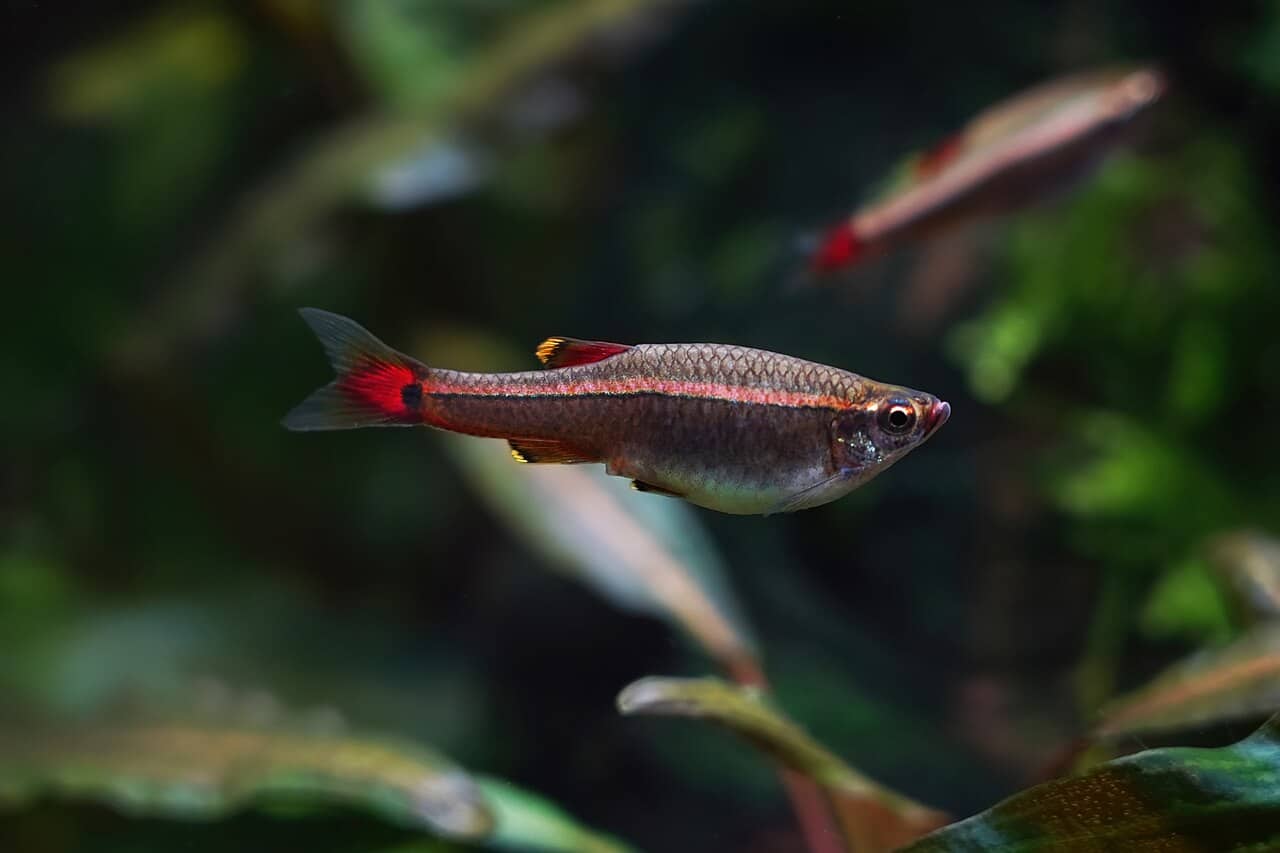
The standard wild-type white cloud mountain minnow is a small, slender fish with a streamlined body built for active swimming. The base body color is a bronzy-olive on the back, fading to a silvery-white belly. Running along each flank is a distinctive iridescent stripe that shifts between blue and green depending on the lighting, this stripe is bordered above by a thin line of gold or copper. The dorsal and caudal fins show red and white edges, and the overall effect in a well-maintained aquarium is surprisingly colorful for such a small, inexpensive fish.
Juveniles are even more striking in some ways. Young white clouds display a bright neon-blue lateral stripe that’s reminiscent of a neon tetra, which is how they earned the nickname “poor man’s neon.” This brilliant blue stripe fades somewhat as they mature, transitioning to the more muted blue-green iridescence of adults.
Several selectively bred variants are popular in the hobby, and all share the same care requirements as the wild-type form:
Golden White Cloud
The golden variant replaces the dark olive-bronze body coloring with a warm, creamy gold tone. The iridescent lateral stripe and red fin markings are still present, often appearing even more vivid against the lighter body color. Golden white clouds are widely available and are just as hardy as the standard form. In a planted tank with dark substrate, the golden variety really pops.
Longfin White Cloud
The longfin variety features extended dorsal, anal, and caudal fins that trail elegantly as the fish swims. The body coloring remains the same as the wild type. Longfin white clouds are beautiful but slightly less common in stores. The extended finnage can make them marginally slower swimmers, so keep them with peaceful tank mates that won’t nip at those flowing fins.
Meteor Minnow (Longfin Golden)
The meteor minnow combines both traits, the golden body color and the extended finnage, into one variant. These are arguably the most visually striking form, with flowing gold-tinted fins and bright lateral coloring. Meteor minnows are less commonly stocked than the standard or golden varieties, so you may need to seek them out from specialty retailers or online breeders. Same care, same hardiness, just a more dramatic look.
Male vs. Female
Sexing white cloud mountain minnows isn’t too difficult once they’re mature. Males tend to be slimmer and more brightly colored, with more vivid red fin markings and a more intense lateral stripe. They’ll also display more actively, spreading their fins to impress females and rival males. Females are slightly rounder and fuller-bodied, especially when carrying eggs. The color difference is most noticeable when the fish are in good condition and well-fed, in drab store lighting, both sexes can look equally washed out.
Average Size & Lifespan
White cloud mountain minnows reach a maximum size of about 1.5 inches (4 cm), with most individuals in aquariums staying closer to 1.2 to 1.4 inches (3 to 3.5 cm). They’re a true nano-sized species, which is part of their appeal for smaller tanks and desktop setups.
With good care, expect a lifespan of 3 to 5 years. Some hobbyists report specimens living even longer in well-maintained, cool-water environments. Keeping them at the lower end of their temperature range tends to slow their metabolism and can contribute to a longer life, fish kept consistently at 72°F (22°C) or above may have a slightly shortened lifespan compared to those kept in the mid-60s°F (18 to 20°C).
White cloud mountain minnows are one of the hardiest aquarium fish in the hobby. They tolerate cold water (60-72°F/15-22°C), adapt to a wide pH range, and are excellent for beginners and unheated tanks.
Care Guide
Tank Size
A 10-gallon (38-liter) tank is the recommended minimum for a group of white cloud mountain minnows. While you’ll sometimes see people keeping them in smaller setups, these fish are active swimmers that use the full length of the tank. A 10-gallon gives a group of 8 to 10 fish enough horizontal swimming space to school naturally and display their best behavior.
If you want a larger group, and honestly, white clouds look their absolute best in groups of 12 or more, consider a 20-gallon long. The extra length makes a real difference for schooling fish, and a big group of white clouds weaving through a planted tank is a genuinely beautiful sight.
Water Parameters
| Parameter | Recommended Range |
|---|---|
| Temperature | 57 to 72°F (14 to 22°C) |
| pH | 6.0 to 8.0 |
| Hardness (dGH) | 5 to 20 |
| Ammonia | 0 ppm |
| Nitrite | 0 ppm |
| Nitrate | Below 20 ppm |
This is where white clouds really stand apart from most fish you’ll find in a typical fish store. They prefer cooler water, ideally in the low to mid-60s°F (17 to 20°C), and do not need a heater in most indoor environments. Room temperature water in the average home sits right in their comfort zone. In fact, keeping them at sustained temperatures above 72°F (22°C) can shorten their lifespan and make them more susceptible to disease.
They’re also remarkably flexible on pH and hardness. Whether your tap water is soft and slightly acidic or hard and alkaline, white clouds will adapt without issues. Stability matters more than hitting an exact number. Keep up with regular water changes (25% weekly), keep ammonia and nitrite at zero, and these fish will reward you with vibrant color and active behavior.
Filtration & Water Flow
A standard hang-on-back filter or sponge filter works perfectly for white cloud minnows. They come from streams with gentle to moderate flow, so you don’t need a powerhead or strong current, just enough turnover to keep the water clean and well-oxygenated. Sponge filters are a particularly good choice if you plan to breed these fish, since they won’t suck up fry.
Good oxygenation is important. White clouds are accustomed to well-aerated mountain streams, and they appreciate clean, oxygen-rich water. If your tank runs on the warmer side during summer, consider adding an air stone to maintain oxygen levels, since warmer water holds less dissolved oxygen.
Lighting
White clouds don’t have specific lighting requirements, but moderate lighting that supports plant growth will show off their colors best. Their iridescent lateral stripe really shines under standard LED aquarium lights. Avoid extremely bright, unshaded lighting with no plant cover, like most small fish, they’ll feel more secure and display better colors when there are some shaded areas to retreat to.
Plants & Decorations
White cloud mountain minnows look absolutely stunning in a planted tank, and plants serve the added purpose of providing shelter, breaking up sight lines, and giving fry a chance at survival if breeding occurs. Good plant choices include java moss, java fern, anubias, hornwort, and vallisneria, all of which tolerate the cooler temperatures that white clouds prefer.
Leave plenty of open swimming space in the middle and front of the tank. White clouds are active mid-water swimmers, and they’ll use that open space to school together. Plant the sides and back, add some driftwood or smooth stones, and you’ll have a setup that looks natural and gives the fish everything they need.
Substrate
White clouds aren’t picky about substrate. Fine gravel, sand, or planted tank substrate all work well. A darker substrate will help bring out their colors, the iridescent blue-green stripe and red fin markings look significantly better against a dark background compared to a light or bare bottom. If you’re going with live plants, a nutrient-rich planted substrate is ideal for growing the lush greenery that makes white cloud tanks look their best.
Tank Mates
Choosing tank mates for white cloud mountain minnows requires one important consideration that most people overlook: temperature compatibility. Most popular “tropical” fish need water in the upper 70s°F, which is too warm for white clouds to thrive long-term. You need tank mates that share their preference for cooler water.
Best Tank Mates
- Other white cloud mountain minnows: always keep them in groups of 6+, and bigger groups are better
- Zebra danios: tolerate the same cool temperature range and match the active energy level
- Rosy barbs: another cold-water species that does well in the same conditions
- Hillstream loaches: appreciate cooler, well-oxygenated water
- Dojo loaches (weather loaches): classic cold-water companions
- Bristlenose plecos: tolerate a range of temperatures and stay peaceful
- Cherry shrimp: do well in the same temperature range and add cleanup crew benefits
- Nerite snails: temperature-flexible and excellent algae eaters
- Paradise fish: a cold-tolerant gourami that can work in larger setups, though watch for aggression from territorial males
- Corydoras paleatus (peppered cory): one of the more cold-tolerant cory species
Tank Mates to Avoid
- Most tropical fish requiring 76°F+: species like neon tetras, angelfish, discus, rams, and most gouramis need warmer water that will stress white clouds over time
- Large or aggressive fish: anything big enough to eat a 1.5-inch fish is obviously a bad match
- Fin nippers: especially important if you’re keeping longfin or meteor minnow varieties, which have extended fins that attract nippers
- Goldfish (in most cases): while temperature-compatible, goldfish grow much larger and will eventually eat white clouds. The only exception would be a very large pond setup where the minnows can stay well out of reach
Food & Diet
White cloud mountain minnows are easy to feed and will accept virtually anything you offer. In the wild, they feed on small insects, insect larvae, zooplankton, and algae. In the aquarium, a varied diet keeps them in their best condition.
A high-quality micro pellet or crushed flake food should form the staple of their diet. Supplement with frozen or live foods like daphnia, baby brine shrimp, cyclops, and micro worms. These small live foods are especially valuable for conditioning adults for breeding and for growing out fry. White clouds will also pick at biofilm and microalgae growing on surfaces in the tank.
Feed once or twice daily, offering only what they can consume in about two minutes. Their mouths are small, so make sure food particles are appropriately sized. Crushed flake or micro-sized pellets work much better than large pellets or whole wafers.
Is the White Cloud Mountain Minnow Right for You?
Before you add a White Cloud Mountain Minnow to your tank, here is an honest assessment of what you’re signing up for. I’d rather you know exactly what to expect now than find out the hard way after you’ve already bought one.
- Experience level: White Cloud Mountain Minnows are best suited for intermediate to advanced keepers. They have specific requirements that can overwhelm beginners.
- Tank size commitment: You’ll need at least 10 gallons, though bigger is always better. Make sure you have room for the tank before buying.
- Tank mate planning: White Cloud Mountain Minnows can be territorial, so plan your community carefully. Not every fish will work as a tank mate.
- Maintenance demands: Expect regular water testing and consistent water changes. White Cloud Mountain Minnows are sensitive to parameter fluctuations.
- Cost to keep: White Cloud Mountain Minnows are reasonably affordable. Standard equipment and quality food cover most needs.
- Time investment: Beyond daily feeding and weekly maintenance, regular observation is the best way to catch health issues early.
- Long-term commitment: With proper care, White Cloud Mountain Minnows can live up to 5 years. Make sure you’re ready for years of consistent care.
Breeding & Reproduction
White cloud mountain minnows are one of the easiest egg-laying fish to breed in captivity. Unlike many small cyprinids, they’re relatively restrained when it comes to eating their own eggs, which means you can sometimes get fry even in a community tank if there’s enough plant cover. That said, setting up a dedicated breeding tank will dramatically increase your success rate.
Breeding Difficulty
Easy. White clouds are among the most beginner-friendly egg layers in the hobby. If you have a healthy group in good condition, breeding will happen almost on its own.
Spawning Tank Setup
A 5 to 10-gallon tank works well for breeding. Add plenty of fine-leaved plants like java moss, spawning mops, or clumps of hornwort. These give the fish surfaces to scatter their eggs on and provide some protection for the eggs after spawning. A bare bottom or thin layer of marbles can also be used, eggs fall between the marbles where adults can’t reach them.
Use a sponge filter for gentle filtration without risking fry getting sucked in. Keep the tank well-lit and at a temperature around 64 to 68°F (18 to 20°C).
Water Conditions for Breeding
White clouds aren’t demanding about breeding water conditions. A temperature in the mid-60s°F (18 to 20°C), neutral to slightly acidic pH (6.5 to 7.5), and moderate hardness will work fine. Slightly cooler water with a gradual warm-up of a few degrees can help trigger spawning behavior, mimicking the transition from winter to spring in their natural habitat.
Conditioning & Spawning
Condition breeding adults with plenty of high-quality live or frozen foods, baby brine shrimp, daphnia, and micro worms are all excellent choices. Well-fed females will visibly plump up with eggs over a period of one to two weeks.
Spawning typically occurs in the morning hours. Males will intensify their colors and display actively in front of females, spreading their fins and darting around the planting. The female scatters small, adhesive eggs among fine-leaved plants or across the spawning medium. A single female can produce 100 to 200 eggs per spawning event, though smaller clutches are common in younger fish.
Egg & Fry Care
While white clouds are less aggressive egg-eaters than many other species, it’s still a good idea to remove the adults after spawning to maximize fry survival. Eggs hatch in about 48 to 72 hours depending on temperature, and the fry become free-swimming within another two to three days after absorbing their yolk sacs.
Newly free-swimming fry are tiny and need very small food. Infusoria or commercial liquid fry food works for the first few days. After about a week, they can graduate to freshly hatched baby brine shrimp and micro worms. Growth is steady, and fry will begin showing their characteristic lateral stripe within a few weeks. They’ll reach sellable size in about two to three months.
Common Health Issues
White cloud mountain minnows are one of the hardiest small fish in the hobby, but they’re not immune to disease. Most health problems come down to poor water quality or, more commonly, keeping them too warm.
Ich (White Spot Disease)
Ich is the most common ailment you’ll encounter with white clouds, and it’s usually triggered by temperature stress or sudden parameter swings. The classic symptom is small white spots covering the body and fins, along with flashing (rubbing against objects) and clamped fins. Treat with a gradually raised temperature (up to about 78°F / 26°C for white clouds, don’t go higher) combined with aquarium salt or a commercial ich medication. Once treated, bring the temperature back down to their preferred range.
Fin Rot
Fin rot typically appears as frayed, discolored, or receding fin edges. It’s almost always caused by poor water quality, high ammonia, nitrite, or nitrate levels. The first step in treatment is improving water conditions with extra water changes. In mild cases, clean water alone will resolve the issue. For more advanced cases, antibacterial medications may be needed.
Columnaris
Columnaris can present as white or grayish patches on the body, mouth, or fins, and it’s often mistaken for a fungal infection. It’s actually bacterial and can progress quickly. Elevated temperatures make columnaris worse, which is one more reason to keep white clouds in their preferred cool range. Treat with antibacterial medications and ensure water quality is pristine.
Heat Stress
This isn’t a disease per se, but it’s the most common health issue specific to white clouds. Keeping them at sustained temperatures above 72°F (22°C) weakens their immune system, shortens their lifespan, and makes them more vulnerable to every other disease on this list. If your white clouds seem lethargic, lose color, or keep getting sick, the first thing to check is whether the tank is running too warm.
Common Mistakes to Avoid
- Keeping them too warm. This is the number one mistake. White clouds are cold-water fish, not tropical fish. Putting them in a heated 78°F community tank will shorten their lives significantly. If you want to keep them with tropical species, you’re setting up the wrong tank.
- Keeping them in too-small groups. White clouds are schooling fish. A pair or trio will be stressed, dull-colored, and hide constantly. Get at least 6, but 10 to 12 is where they really start to look and act their best.
- Pairing them with incompatible tropical fish. Just because they’re peaceful doesn’t mean they belong in every community tank. Temperature is the deciding factor. Research your tank mates’ temperature requirements before mixing species.
- Keeping them with goldfish. Despite both being cold-water fish, adult goldfish will eat white clouds. The size difference is simply too great in most setups.
- Overstocking small tanks. White clouds are small and hardy, but that doesn’t mean you can cram 20 of them into a 5-gallon tank. Stick to the 10-gallon minimum and stock responsibly.
- Ignoring them because they’re cheap. A $2 price tag doesn’t mean they’re disposable. White clouds are living animals that deserve proper care. Give them the right conditions and they’ll live for years and look genuinely impressive.
Where to Buy
White cloud mountain minnows are one of the most widely available freshwater fish in the hobby. You’ll find the standard wild-type form at virtually every fish store and big-box pet retailer, usually priced at just $2 to $4 per fish. Golden white clouds and longfin varieties are somewhat less common in chain stores but still show up regularly. Meteor minnows (longfin golden) are the hardest variant to find locally and may require ordering from specialty sellers.
For healthier, better-conditioned stock that’s been properly quarantined, I’d recommend checking Flip Aquatics or Dan’s Fish. Both are reputable online retailers that ship fish in excellent condition and offer a better selection of variants than most local shops. If you’re specifically looking for longfin or meteor minnow varieties, online retailers are typically your best bet.
Since white clouds are so inexpensive, buy a group of at least 6 to 8 right from the start. The per-fish cost is low enough that there’s no reason not to start with a proper school.
Frequently Asked Questions
Do white cloud mountain minnows need a heater?
No, and in most cases you should not use one. White clouds prefer temperatures of 57 to 72°F (14 to 22°C), which is well within the range of normal room temperature in most homes. They’re one of the few fish commonly sold in tropical fish stores that actually does best in an unheated tank. The only scenario where you might need a heater is if your room gets extremely cold in winter, below 55°F (13°C), in which case a low-wattage heater set to around 60°F (16°C) would be appropriate as a safety net.
Can white cloud mountain minnows live in outdoor ponds?
Yes, and they’re actually excellent outdoor mini pond fish during the warmer months. White clouds can handle temperatures from the upper 50s°F all the way into the low 70s°F, making them ideal for spring through fall outdoor keeping in most climates. They look stunning in planted container ponds and patio tub setups. Just bring them indoors before temperatures drop into the 40s°F (below about 7°C), as prolonged exposure to near-freezing water can be fatal. Some hobbyists in mild climates keep them outdoors year-round, but that only works if winter temperatures stay consistently above 50°F (10°C).
Can white clouds live with bettas?
This is a common pairing, but it’s not ideal for either fish. Bettas prefer water in the 76 to 82°F (24 to 28°C) range, which is significantly warmer than white clouds prefer. While both species are peaceful enough to coexist temperamentally, the temperature compromise means one or both fish will be living outside their ideal range. If you keep the tank at 74°F (23°C) as a middle ground, both species will survive but neither will truly thrive.
How many white clouds should I keep together?
A minimum of 6, but more is always better. White clouds are schooling fish that feel most secure and display their best colors in larger groups. In groups of 10 to 12 or more, they’ll school tightly, males will display actively, and you’ll see their natural behavior at its best. A lone white cloud or a pair will be stressed and spend most of its time hiding.
Are white cloud mountain minnows good for beginners?
They’re one of the absolute best fish for beginners. White clouds tolerate a wide range of water parameters, don’t need a heater, eat anything, rarely get sick, and are inexpensive to buy. They’re forgiving of the kind of minor mistakes new fishkeepers tend to make. If you’re setting up your first aquarium and want a species that’s easy to keep alive while you learn the ropes, white clouds are hard to beat.
Are white clouds really extinct in the wild?
They were thought to be extinct in the wild for over 20 years, but small populations were rediscovered in Guangdong Province, China, starting around 2007. However, wild populations remain extremely small and fragmented due to habitat destruction from urbanization around Guangzhou. The species is still considered critically threatened in its natural range. The vast majority of white clouds in existence today are captive-bred, and the aquarium hobby has played a significant role in preserving this species.
How the White Cloud Mountain Minnow Compares to Similar Species
If you’re considering a White Cloud Mountain Minnow, you’ve probably also looked at the Celestial Pearl Danio. Both fill similar roles, but the differences matter when planning your tank. The White Cloud Mountain Minnow has its own distinct personality and care needs. In my experience, the choice often comes down to the specific community you’re building and whether your water parameters favor one over the other.
The Zebra Danio is worth considering as well. While the White Cloud Mountain Minnow and the Zebra Danio share some overlap in care, they bring different energy to a tank. If you have the space, keeping both in separate setups gives you a great chance to compare their behavior firsthand.
Expert Take (Mark Valderrama, AquariumStoreDepot)
After 25 years in the hobby and time managing fish stores, the white cloud mountain minnow is one of those species I always recommend to hobbyists ready to move beyond the basics. White cloud mountain minnows are one of the hardiest aquarium fish in the hobby. They tolerate cold water (60-72°F/15-22°C), adapt to a wide pH range, and are excellent for beginners and unheated tanks. Do not keep white clouds in tropical tanks above 75°F (24°C) long-term. They originate from cold mountain streams and suffer heat stress in warmer tanks, even though they tolerate it short-term.
Closing Thoughts
The white cloud mountain minnow is one of those fish that deserves way more respect than it gets. It’s cheap, it’s hardy, it’s peaceful, and it looks genuinely good in a proper setup. The fact that it doesn’t need a heater is a huge bonus for anyone who wants a simple, low-energy aquarium, or for anyone looking to try an outdoor mini pond project in the summer.
If you’ve walked past white clouds at the fish store a hundred times without giving them a second look, I’d encourage you to reconsider. Set up a planted cool-water tank with a big group of these little fish, maybe mix the wild-type and golden varieties for some contrast, and you’ll have one of the most charming, low-maintenance setups in the hobby. They’re proof that a great fish doesn’t have to be expensive or exotic. Sometimes the best ones are right there in the bargain bin.
Have you kept white cloud mountain minnows? What do you think of them for cold-water setups or outdoor ponds? Drop a comment below!
Recommended Video
Check out our danio and rasbora video where we cover some of the best species in the hobby, including the white cloud mountain minnow:
References
- Seriously Fish, Tanichthys albonubes species profile. seriouslyfish.com
- FishBase, Tanichthys albonubes (Lin, 1932). fishbase.org
- Practical Fishkeeping. White Cloud Mountain Minnow care guide. practicalfishkeeping.co.uk
- Aquarium Wiki, Tanichthys albonubes. theaquariumwiki.com
- About the Author
- Latest Posts

I’m Mark Valderrama, founder of Aquarium Store Depot and a fishkeeper with over 25 years of hands-on experience. I started in the hobby at age 11, worked at local fish stores, and have kept freshwater tanks, ponds, and reef tanks ever since. I’ve been featured in two best-selling aquarium books on Amazon and built this site to share practical, experience-based fish keeping knowledge.
Leave a Reply