
Last Updated: June 25, 2026
Thank you for visiting! By the way… any links on this page that lead to products on Amazon and other stores/partners are affiliate links Aquarium Store Depot earns a commission if you make a purchase.
Table of Contents
- Key Takeaways
- Species Overview
- Classification
- Origin & Natural Habitat
- Appearance & Identification
- Average Size & Lifespan
- Care Guide
- Tank Mates
- Food & Diet
- Breeding & Reproduction
- Common Health Issues
- Common Mistakes to Avoid
- Where to Buy
- Frequently Asked Questions
- Closing Thoughts
- Recommended Video
- References
- What Most Care Guides Get Wrong
- Is the Copper Rasbora Right for You?
- Species Comparison
If you’ve ever looked at a school of rasboras in a dimly lit planted tank and noticed one species that seemed to glow from within, there’s a good chance you were looking at copper rasboras. Trigonostigma hengeli is the smallest and arguably the most striking of the three closely related Trigonostigma species, and that bright copper-orange blaze above its dark body marking is unlike anything else in the nano fish world.
Also known as the hengeli rasbora or glowing rasbora, this little fish from Borneo and Sumatra doesn’t get nearly the attention it deserves. The harlequin rasbora has the name recognition. The lambchop rasbora has been gaining fans. But the copper rasbora? It quietly sits there being the most luminous of the bunch, waiting for hobbyists to discover it. In my 25+ years in the hobby, I’ve seen this species go from almost unknown to a real favorite among planted tank enthusiasts, and for good reason. Once you see that neon copper glow in person, it’s hard to go back to anything else.
What Most Care Guides Get Wrong About Copper Rasbora
The most common mistake with Copper Rasboras is keeping them in groups that are too small. These fish genuinely need eight to twelve to show natural schooling behavior. In my experience working with rasboras at the stores I managed, small groups of three or four spend all their time hiding.
Key Takeaways
- Smallest of the Trigonostigma trio at just 1.25 inches (3 cm) max, a true nano fish with an oversized visual impact thanks to its signature copper-orange glow
- Soft, acidic water brings out the best color: they prefer pH 5.0 to 7.0 and 2 to 10 dGH, and their glow intensifies dramatically in tannin-stained blackwater setups
- Peaceful schooling fish that should be kept in groups of 8 or more for the best behavior and color expression
- Easy to confuse with harlequin and lambchop rasboras: the copper rasbora has the thinnest dark marking of the three, reduced to a narrow line, with a vivid copper-orange glow directly above it
- Minimum 10-gallon tank for a school of 6 to 8, though a 15 to 20-gallon planted setup really lets them shine
- Egg scatterer that deposits on leaf undersides: breeding is moderately challenging and requires very soft, acidic water

Species Overview
| Field | Details |
|---|---|
| Scientific Name | Trigonostigma hengeli (Meinken, 1956) |
| Common Names | Copper Rasbora, Hengeli Rasbora, Glowing Rasbora |
| Family | Danionidae |
| Origin | Southeast Asia (Borneo, Sumatra) |
| Care Level | Easy |
| Temperament | Peaceful |
| Diet | Omnivore |
| Tank Level | Middle |
| Maximum Size | 1.25 inches (3 cm) |
| Minimum Tank Size | 10 gallons (38 liters) |
| Temperature | 73 to 82°F (23 to 28°C) |
| pH | 5.0 to 7.0 |
| Hardness | 2 to 10 dGH |
| Lifespan | 3 to 5 years |
| Breeding | Egg scatterer (deposits on leaf undersides) |
| Breeding Difficulty | Moderate |
| Compatibility | Community (nano) |
| OK for Planted Tanks? | Yes, excellent choice |
Classification
| Taxonomic Level | Classification |
|---|---|
| Order | Cypriniformes |
| Family | Danionidae (formerly placed in Cyprinidae) |
| Subfamily | Rasborinae |
| Genus | Trigonostigma |
| Species | T. hengeli (Meinken, 1956) |
The copper rasbora was described by Hermann Meinken in 1956. It belongs to the genus Trigonostigma, which was separated from the much larger Rasbora genus and currently contains three widely recognized species: the harlequin rasbora (T. heteromorpha), the lambchop rasbora (T. espei), and the copper rasbora (T. hengeli). A fourth species, T. somphongsi, is also recognized but is critically endangered and virtually absent from the aquarium trade.
Like other rasboras, this species was historically classified under the family Cyprinidae. Molecular phylogenetic studies led to the reclassification of many rasbora species into the family Danionidae, which is now the accepted placement. You may still see Cyprinidae referenced in older aquarium books and websites, but Danionidae is the current correct family.
Origin & Natural Habitat
The copper rasbora is native to the islands of Borneo and Sumatra in Southeast Asia, specifically in parts of Indonesia. This is a notably different range from its two close relatives, the harlequin rasbora is found across the Malay Peninsula and Sumatra, while the lambchop rasbora comes from Thailand and Cambodia. The copper rasbora’s island-based distribution makes it the most geographically restricted of the three common Trigonostigma species.
In the wild, T. hengeli inhabits slow-moving forest streams, peat swamps, and blackwater environments shaded by thick tropical forest canopy. These habitats are characterized by extremely soft, acidic water, often with a pH below 5.0, that is heavily stained by tannins from decomposing leaves, wood, and other organic material. The substrate is typically composed of deep leaf litter over soft mud or peat, and light levels are very low due to the combination of dense overhead canopy and dark water.
These are warm, still waters with very little current. The fish share their habitat with other small cyprinids, gouramis, and various invertebrates. Understanding these natural conditions is critical for keeping copper rasboras at their best. When you replicate the dim lighting, soft acidic water, and tannin-stained environment of their home waters, that iconic copper glow reaches an intensity you simply won’t see in a bright, hard-water tank.
Appearance & Identification
The copper rasbora has a small, slender, laterally compressed body with a semi-translucent quality that lets light pass through in a way that adds to its visual appeal. The base body color is a warm silvery-tan to pinkish-orange, generally more translucent and less deeply pigmented than either the harlequin or lambchop rasbora. The belly is pale silver, and the back takes on a slightly olive or golden tone.
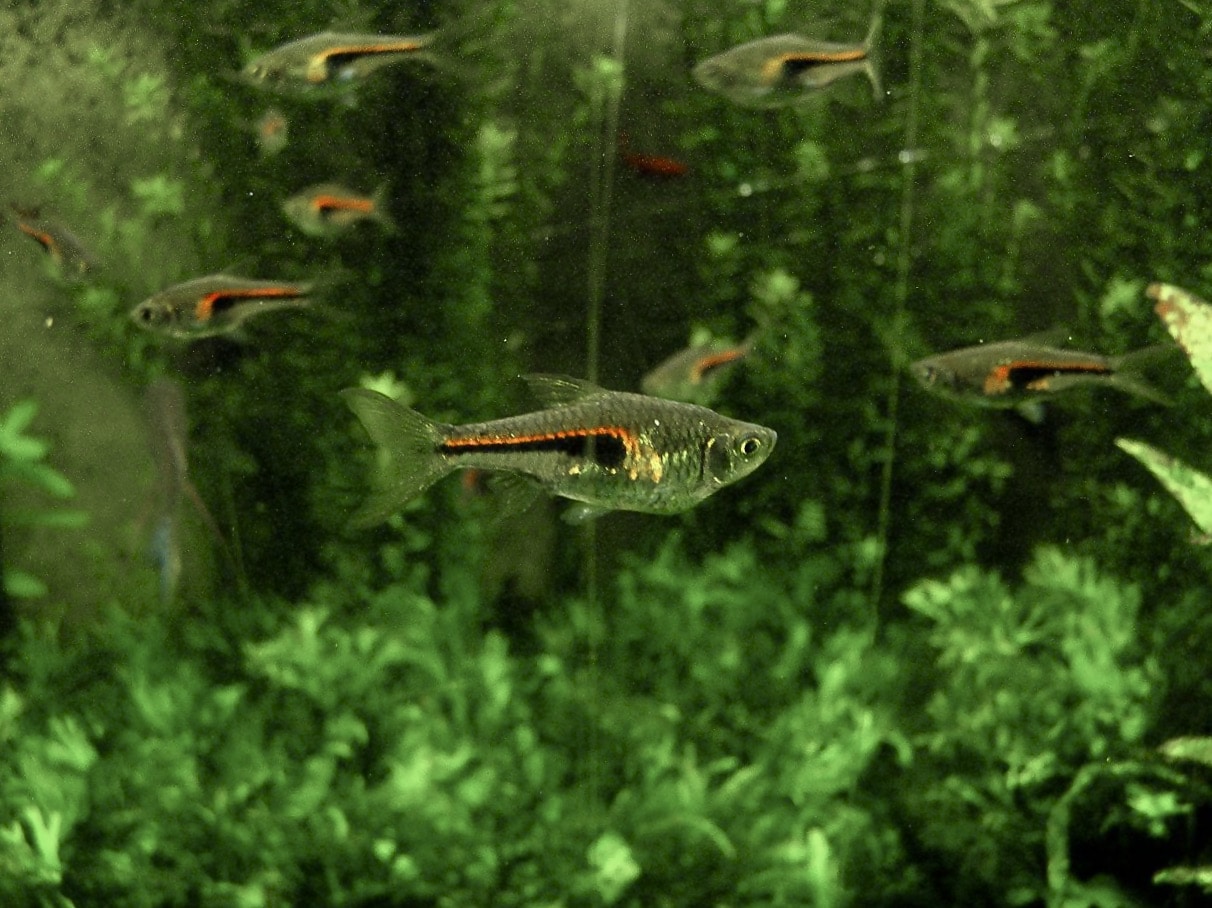
The feature that sets this species apart from every other nano fish in the hobby is the combination of its dark marking and the vivid copper-orange glow above it. The dark marking itself is noticeably thinner than what you’ll see on its relatives, more of a narrow dark stripe or sliver running along the rear half of the body, rather than a broad triangle or wedge. And directly above that thin dark line sits a concentrated band of bright copper, orange, or even neon-gold color that seems to glow under the right lighting conditions. This luminous stripe is the hallmark of T. hengeli and the main reason it’s called the “copper” or “glowing” rasbora.
The fins are transparent to faintly yellowish, and the eye has a dark pupil with a golden iris. In well-kept specimens under appropriate conditions, the copper glow can be almost startlingly bright, a neon shimmer that looks like the fish is lit from within.
The Trigonostigma Trio: Hengeli vs. Heteromorpha vs. Espei
These three species are the most commonly confused fish in the rasbora world, and mislabeling at fish stores is extremely common. All three share a similar body plan with a dark marking on the rear half of the body, but each species has a distinctly different version of that marking. Here’s how to tell them apart:
- Harlequin Rasbora (T. heteromorpha): The largest of the three, reaching up to 2 inches (5 cm). Has the broadest, most triangular dark marking that covers a large portion of the rear body. The triangle is wide and prominent with a fairly straight leading edge. The body is deeper and stockier than the other two species. This is the most widely available and best-known species in the genus.
- Lambchop/Espei Rasbora (T. espei): Mid-sized at about 1.5 inches (3.5 cm). The dark marking is narrower and more elongated than the harlequin’s, shaped like a thin wedge or lamb chop. The body is slimmer and more streamlined, with a warmer copper-orange base color. If the marking looks like a “squeezed” version of the harlequin’s triangle, you’re looking at an espei.
- Copper/Hengeli Rasbora (T. hengeli): The smallest of the three, maxing out at just 1.25 inches (3 cm). Has the thinnest dark marking of the group, reduced to a narrow dark line or sliver rather than any kind of triangle. The defining feature is the bright copper or neon-orange glow directly above that dark line, which is far more vivid and concentrated than anything you’ll see on the other two species. The overall body is more translucent and delicate-looking.
The quick identification guide: broad triangle = harlequin, narrow wedge = lambchop, thin line with a bright copper glow above it = hengeli. If you’re buying these at a local fish store, pay close attention to the shape and width of that dark marking and whether there’s a vivid copper stripe above it. The label in the tank is frequently wrong, especially since all three species sometimes get lumped together as “harlequin rasboras.” Take a close look at the actual fish before you buy.
Male vs. Female
Sexing copper rasboras is tricky, but there are a few subtle differences in mature fish:
- Males tend to be slightly slimmer and more intensely colored, particularly in the copper-orange zone above the dark marking. They may also display more vivid coloration during courtship and when competing with other males in the group.
- Females are typically a bit rounder and deeper-bodied, especially when carrying eggs. Their coloration is usually slightly less intense than males, though both sexes display the characteristic copper glow.
These differences are subtle and are easiest to spot when you have a group of adult fish for side-by-side comparison. Don’t expect to reliably sex juveniles or newly purchased fish, it usually takes a few weeks in good conditions before the differences become apparent.
Average Size & Lifespan
Copper rasboras are the smallest of the three common Trigonostigma species, maxing out at about 1.25 inches (3 cm) in total length. Most specimens you’ll see in home aquariums will be around 0.75 to 1 inch (2 to 2.5 cm). This makes them a true nano fish, small enough to keep in tanks that would be too cramped for larger schooling species.
With proper care, stable water conditions, and a varied diet, copper rasboras typically live 3 to 5 years. Some hobbyists have kept them toward the upper end of that range in well-maintained planted tanks with soft water. As with most small fish, poor water quality, stress from inadequate group sizes, and wide parameter fluctuations will cut that lifespan short.
Copper rasboras (Rasboroides vaterifloris) are one of the most strikingly colored nano fish available. They prefer soft, slightly acidic water and dark planted setups that enhance their orange-copper coloration.
Care Guide
Copper rasboras are not demanding fish, but they have clear preferences when it comes to water chemistry and environment. They’re forgiving enough for beginners who do their homework, but getting the water parameters right is what separates a tank full of pale, washed-out fish from a school that glows like embers. Get the basics right and these fish practically take care of themselves.
Tank Size
A 10-gallon tank is the minimum for a small group of 6 to 8 copper rasboras. Given their tiny size, they don’t need a massive aquarium, but more space is always better. A 15 to 20-gallon tank gives a larger school of 10 to 15 fish room to display natural schooling behavior, and the extra water volume provides more stability for the soft, acidic conditions they prefer.
These fish occupy the middle portion of the water column, so horizontal swimming space matters more than tank height. Long, shallow tanks are a better fit than tall, narrow ones. A 20-gallon long is an excellent choice if you’re building a community around this species.
Water Parameters
| Parameter | Recommended Range |
|---|---|
| Temperature | 73 to 82°F (23 to 28°C) |
| pH | 5.0 to 7.0 |
| General Hardness (GH) | 2 to 10 dGH |
| Carbonate Hardness (KH) | 1 to 4 dKH |
| Ammonia / Nitrite | 0 ppm |
| Nitrate | Below 20 ppm |
Soft, acidic water is where copper rasboras come alive. They can tolerate neutral pH, but their signature copper glow intensifies dramatically in water below pH 6.5. These are blackwater fish at heart, and when you provide conditions that reflect that, soft water, low pH, tannins, the difference in coloration is night and day.
If your tap water is hard and alkaline (above pH 7.0 or above 10 dGH), you’ll want to use RO/DI water remineralized with a product like Seachem Equilibrium, or blend RO water with tap water to bring the hardness down. Adding Indian almond leaves, alder cones, or driftwood to the tank releases tannins that naturally lower pH and give the water a warm amber tint. This isn’t just cosmetic, it closely replicates the peat swamp habitats these fish evolved in, and they respond to it with better color and more confident behavior.
Filtration & Water Flow
Copper rasboras come from nearly still water, so strong currents are a no-go. A sponge filter is the ideal filtration option for smaller tanks housing this species, it provides gentle biological filtration with minimal flow and won’t create currents that push these tiny fish around. In larger setups, a hang-on-back or small canister filter with the output baffled or directed at the glass works well. The goal is just enough surface agitation for gas exchange without any noticeable current in the swimming area.
Lighting
Subdued lighting is the way to go with copper rasboras. In their natural habitat, thick forest canopy and dark tannin-stained water mean very little light reaches the fish. In an aquarium, dim to moderate lighting brings out the best in their copper glow, it sounds counterintuitive, but these fish actually look more colorful under lower light because the copper pigmentation contrasts more sharply against the darker surroundings.
If you’re running higher-intensity lighting for demanding plants, use floating plants like water sprite, frogbit, or red root floaters to create shaded zones. The fish will naturally gravitate to these dimmer areas, and you’ll see their best color there.
Plants & Decorations
A well-planted tank is essential for getting the most out of copper rasboras. Dense planting along the sides and back provides security, while open areas in the center give the school room to swim together. Some excellent plant choices include:
- Cryptocoryne species: Thrive in the same soft, acidic water that copper rasboras prefer, and their broad leaves can serve as spawning sites
- Java fern and Anubias: Hardy, low-light epiphytes that attach to driftwood and provide structure
- Floating plants: Water sprite, frogbit, or salvinia to diffuse light from above
- Mosses: Java moss and Christmas moss draped over driftwood create a lush, natural look and provide cover
- Stem plants: Rotala, ludwigia, or hygrophila for background planting
Driftwood is highly recommended, both for the natural look and for the tannins it releases. Scattered Indian almond leaves on the substrate complete the blackwater biotope effect and provide surfaces for biofilm growth that the fish will graze on between feedings. If you want to see copper rasboras at their absolute peak, build a Southeast Asian blackwater biotope tank, it’s what they were made for.
Substrate
Dark substrate is the clear winner for this species. Dark sand, fine dark gravel, or aquasoil all work well. A dark bottom contrasts beautifully with the copper glow and mimics the leaf-litter-covered floors of their natural peat swamp habitat. Many planted tank substrates like ADA Amazonia or Fluval Stratum also buffer toward a slightly acidic pH, which is a bonus for these fish. Avoid bright white or light-colored substrates, which wash out their color and can make the fish feel exposed.
Tank Mates
Copper rasboras are gentle, peaceful fish that won’t bother anything in the tank. They’re also tiny and can’t defend themselves against anything remotely aggressive, so choosing compatible tank mates is important. The ideal companions are other small, calm species that share their preference for soft, acidic water.
Best Tank Mates
- Other rasboras: Chili rasboras, phoenix rasboras, emerald dwarf rasboras, harlequin rasboras
- Small tetras: Ember tetras, green neon tetras, neon tetras, cardinal tetras
- Corydoras catfish: Pygmy corys, habrosus corys, hastatus corys (the dwarf species are a perfect size match)
- Otocinclus catfish: Peaceful algae grazers that stay small and won’t compete
- Small gouramis: Sparkling gouramis, chocolate gouramis, licorice gouramis
- Dwarf shrimp: Cherry shrimp, amano shrimp (adult shrimp are safe; baby shrimp may be eaten)
- Kuhli loaches: Peaceful bottom dwellers that occupy a different zone
- Snails: Nerite snails, Malaysian trumpet snails, ramshorn snails
Tank Mates to Avoid
- Aggressive or semi-aggressive cichlids: Even small cichlids like rams can be too pushy for copper rasboras
- Tiger barbs and other nippy species: Will harass and stress these delicate fish
- Large or predatory fish: Anything that can fit a 1.25-inch fish in its mouth is a threat
- Bettas: Risky pairing. Some bettas will leave them alone, but aggressive males may target them. The rasboras’ small size makes them vulnerable.
- Fast, boisterous fish: Giant danios, Buenos Aires tetras, or other large active species will outcompete them for food and dominate the swimming space
Food & Diet
Copper rasboras are omnivores with very small mouths, so food size matters. In the wild, they feed on tiny insects, zooplankton, worms, and other small invertebrates. In captivity, they’re not fussy eaters, but you need to make sure the food is small enough for them to consume. Crushing or grinding standard flakes and pellets is often necessary.
A solid feeding plan for copper rasboras:
- High-quality micro pellets or finely crushed flakes as a daily staple, choose products with whole fish or insect meal as the first ingredient
- Frozen foods: Baby brine shrimp, daphnia, cyclops, and micro bloodworms are excellent. These boost color noticeably.
- Live foods: Baby brine shrimp, microworms, vinegar eels, and daphnia. Live foods trigger the strongest feeding response and are the best option for conditioning breeders.
- Freeze-dried foods: Daphnia and tubifex as an occasional treat, pre-soaked to prevent digestive issues.
Feed small amounts once or twice daily. These are tiny fish and it takes very little food to satisfy them. Aim for what the school can finish in 60 to 90 seconds. Overfeeding is the fastest way to foul the water in a small tank, and poor water quality is the number one health risk for this species.
Is the Copper Rasbora Right for You?
Before you add a Copper Rasbora to your tank, here is an honest assessment of what you’re signing up for. I’d rather you know exactly what to expect now than find out the hard way after you’ve already bought one.
- Experience level: Copper Rasboras are best suited for intermediate to advanced keepers. They have specific requirements that can overwhelm beginners.
- Tank size commitment: You’ll need at least 10 gallons, though bigger is always better. Make sure you have room for the tank before buying.
- Tank mate planning: Copper Rasboras can be territorial, so plan your community carefully. Not every fish will work as a tank mate.
- Maintenance demands: Expect regular water testing and consistent water changes. Copper Rasboras are sensitive to parameter fluctuations.
- Budget reality: Keeping Copper Rasboras costs more than typical setups. Budget for ongoing costs, not just the initial purchase.
- Time investment: Beyond daily feeding and weekly maintenance, regular observation is the best way to catch health issues early.
- Long-term commitment: With proper care, Copper Rasboras can live up to 5 years. Make sure you’re ready for years of consistent care.
Breeding & Reproduction
Breeding copper rasboras is possible in a home aquarium, but it requires more effort and attention to water chemistry than many beginner-friendly species. Like the other Trigonostigma species, copper rasboras have a unique spawning behavior, they deposit adhesive eggs on the undersides of broad leaves rather than scattering them randomly. This makes their breeding process more interesting to observe than a typical egg scatterer.
Breeding Difficulty
Moderate. Copper rasboras can be bred in captivity, but they require very specific water conditions, specifically very soft, acidic water, and a dedicated spawning setup. Don’t expect successful breeding in a community tank. Even if spawning occurs, eggs and fry will be quickly eaten by tank mates and the parents themselves.
Spawning Tank Setup
Set up a dedicated breeding tank of 5 to 10 gallons with the following:
- Dim lighting or heavy shading from floating plants
- Sponge filter set to the lowest possible flow
- Several broad-leaved plants. Cryptocoryne species and Anubias are ideal. The fish deposit eggs on the undersides of these leaves.
- Thin layer of dark substrate or bare bottom
- Cover the tank well and keep it in a quiet location away from foot traffic
Water Conditions for Breeding
Very soft, acidic water is non-negotiable for breeding copper rasboras. Target these parameters:
- Temperature: 78 to 82°F (26 to 28°C), slightly warmer than their normal range
- pH: 5.0 to 6.0
- Hardness: 1 to 4 dGH (extremely soft)
RO water remineralized with a very small amount of GH booster is the most reliable way to achieve these conditions. Adding Indian almond leaves or peat filtration helps achieve the low pH and provides tannins that seem to encourage spawning behavior.
Conditioning & Spawning
Condition your breeding group (ideally a small group with slightly more females than males) with generous portions of live and frozen foods for about two weeks before moving them to the spawning tank. Baby brine shrimp and daphnia are excellent conditioning foods. Well-conditioned females will become noticeably rounder when viewed from above.
Introduce the fish to the breeding tank in the evening. Spawning typically occurs during the morning hours. The male courts the female with a shimmering display, swimming alongside her. When the pair is ready, they move to the underside of a broad leaf. The female inverts and deposits adhesive eggs on the leaf surface while the male fertilizes them. The process repeats over several hours, producing roughly 20 to 50 eggs per spawning event, fewer than the larger harlequin rasbora, which reflects their smaller body size.
Egg & Fry Care
Remove the adults immediately after spawning is complete. They will eat the eggs if left in the tank. The eggs are tiny, translucent, and attached to the leaf undersides. They typically hatch in 24 to 48 hours depending on temperature.
The newly hatched fry are extremely small, even by rasbora standards, and will absorb their yolk sacs for the first day or two. Once free-swimming, start feeding infusoria or commercially available liquid fry food. After about a week, graduate to freshly hatched baby brine shrimp and microworms. Keep the water immaculately clean with very small, careful water changes. Growth is slow, and it may take several weeks before the fry begin to show any color. Be patient, raising T. hengeli fry is a rewarding but gradual process.
Common Health Issues
Copper rasboras are generally hardy little fish that aren’t prone to species-specific diseases. Most health problems trace back to poor water quality, stress, or unsuitable conditions. Here are the most common issues you may encounter:
Ich (White Spot Disease)
Ich is the most common freshwater fish disease and copper rasboras are susceptible, particularly when stressed by temperature swings or degraded water quality. Look for small white spots resembling grains of salt on the body and fins. Treat by gradually raising the temperature to 82 to 84°F (28 to 29°C) and using a half dose of ich medication. These small fish can be sensitive to full-strength chemical treatments, so err on the side of caution with dosing.
Fin Rot
Ragged, deteriorating fins are a sign of bacterial infection, almost always caused by poor water conditions. Mild cases often resolve with improved water quality through more frequent water changes. Advanced fin rot may need treatment with an antibacterial medication. Prevention is straightforward, keep the water clean and parameters stable.
Columnaris
This bacterial infection presents as white or grayish patches on the body, mouth, or fins and is frequently mistaken for a fungal infection. Columnaris is triggered by stress and poor water quality. Treatment typically requires an antibiotic like kanamycin or a product containing nitrofurazone.
Internal Parasites
If your copper rasboras are eating normally but losing weight, or if you notice white stringy feces, internal parasites may be the cause. This is more common in wild-caught specimens. Treat with medicated food containing levamisole or praziquantel.
The best medicine is prevention. Weekly water changes of 20 to 30%, avoiding overstocking, quarantining all new fish for at least two weeks, and maintaining stable parameters will prevent the vast majority of health problems with this species.
Common Mistakes to Avoid
- Keeping them in groups that are too small. A pair or trio of copper rasboras will be stressed, pale, and hide constantly. These are schooling fish that need at least 6, and 8 to 12 is much better. Their confidence, coloration, and schooling behavior all improve dramatically with larger group sizes.
- Hard, alkaline water. These fish evolved in some of the softest, most acidic water on the planet. Keeping them in water above pH 7.0 or above 10 dGH leads to washed-out color and chronic stress. If your tap water is hard, invest in an RO system or blend with RO water. The difference in color alone makes it worth the effort.
- Bright lighting without shade. Copper rasboras look their worst under intense, unshaded lighting. Their color washes out and they become skittish. Add floating plants and provide dimmer zones where they can retreat. Ironically, less light means more visible glow.
- Overfeeding. These are tiny fish with tiny appetites. It takes a surprisingly small amount of food to feed a school of copper rasboras, and uneaten food deteriorates water quality fast in small tanks.
- Mixing with aggressive or large tank mates. At 1.25 inches max, copper rasboras are bite-sized for many common aquarium fish. Choose companions carefully and stick to other nano species.
- Buying mislabeled fish. Copper rasboras, harlequin rasboras, and lambchop rasboras are frequently mixed up or mislabeled at fish stores. Always check the dark marking, if it’s a broad triangle, you’ve got harlequins, not hengelis. The copper rasbora has the thinnest marking of the three, almost a line, with that distinctive bright copper glow above it.
Where to Buy
Copper rasboras are less commonly stocked than harlequin rasboras at chain pet stores, but they’ve become increasingly available through specialty fish shops and online retailers as nano tanks and planted aquascaping have grown in popularity. Expect to pay around $3 to $5 per fish depending on the source and quantity.
For healthy, well-conditioned fish that have been properly quarantined before shipping, I recommend checking Flip Aquatics or Dan’s Fish. Both are reputable online retailers that consistently ship fish in great condition and are a significant step up from what you’ll typically find at big box pet stores. Buying online also makes it easier to get a larger group in one order, which is exactly what you want with a schooling species like this.
When selecting fish, look for active individuals with clear eyes, intact fins, and visible copper coloration. Avoid any fish that appear lethargic, have clamped fins, or show visible spots or patches. And take a close look at the body marking before buying, make sure you’re getting actual T. hengeli and not mislabeled harlequins or espei rasboras. The thin dark line with a bright copper glow above it is the giveaway.
Frequently Asked Questions
How many copper rasboras should I keep?
A minimum of 6, but 8 to 12 is ideal. Copper rasboras are a true schooling species that rely on group dynamics for security and natural behavior. Larger groups produce tighter schooling, bolder behavior, and visibly better coloration. In a small group of 2 or 3, they’ll be stressed, pale, and prone to hiding behind decor all day.
What’s the difference between copper rasboras and harlequin rasboras?
The copper rasbora (T. hengeli) is smaller, maxing out at 1.25 inches (3 cm) compared to the harlequin’s 2 inches (5 cm). The most obvious visual difference is the dark body marking: the harlequin has a broad, triangular wedge, while the copper rasbora has a much thinner dark line with a vivid copper-orange glow above it. The copper rasbora also has a more translucent body overall. Care requirements are similar, though copper rasboras generally prefer slightly softer and more acidic water.
Are copper rasboras good for nano tanks?
Yes, they’re one of the best nano schooling fish available. Their tiny maximum size of 1.25 inches (3 cm) makes them well-suited for 10 to 15-gallon planted nano setups. A group of 8 to 10 in a well-planted 10-gallon tank with soft water and dim lighting creates a genuinely impressive display. Just make sure the tank is fully cycled and the water stays clean, smaller tanks require more diligent maintenance.
Can copper rasboras live with shrimp?
Adult cherry shrimp and amano shrimp are generally safe with copper rasboras. The fish are small enough that even adult shrimp are far too large for them to bother. However, baby shrimp (shrimplets) may be picked off, as they’re small enough to fit in the rasboras’ mouths. If you’re breeding shrimp in the same tank, provide plenty of dense moss and plant cover to give the shrimplets hiding spots. It’s not a species that actively hunts shrimp, but opportunistic snacking on tiny shrimplets is a possibility.
Why are my copper rasboras losing their color?
Faded color in copper rasboras almost always comes down to one or more of these factors: water that’s too hard or alkaline (high pH or GH), overly bright lighting without enough shade, stress from a group that’s too small, or a bland diet lacking variety. Check your water parameters, add floating plants to create dimmer zones, make sure you have at least 6 fish, and incorporate frozen and live foods into their diet. Indian almond leaves or driftwood can help soften the water and add tannins that bring out their natural glow. When conditions are right, the transformation in color can be dramatic.
Do copper rasboras need a heater?
Yes. Copper rasboras are tropical fish that need a consistent temperature between 73 and 82°F (23 to 28°C). Unless you live in a climate where your home stays within that range year-round, a reliable aquarium heater is necessary. Temperature fluctuations stress these fish and make them susceptible to diseases like ich. A small, adjustable heater rated for your tank size is a worthwhile investment.
How the Copper Rasbora Compares to Similar Species
If you’re considering a Copper Rasbora, you’ve probably also looked at the Harlequin Rasbora. Both fill similar roles, but the differences matter when planning your tank. The Copper Rasbora has its own distinct personality and care needs. In my experience, the choice often comes down to the specific community you’re building and whether your water parameters favor one over the other.
The Lambchop Rasbora is worth considering as well. While the Copper Rasbora and the Lambchop Rasbora share some overlap in care, they bring different energy to a tank. If you have the space, keeping both in separate setups gives you a great chance to compare their behavior firsthand.
Expert Take (Mark Valderrama, AquariumStoreDepot)
After 25 years in the hobby and time managing fish stores, the copper rasbora is one of those species I always recommend to hobbyists ready to move beyond the basics. Copper rasboras (Rasboroides vaterifloris) are one of the most strikingly colored nano fish available. They prefer soft, slightly acidic water and dark planted setups that enhance their orange-copper coloration. Copper rasboras require soft water to display their best color. In hard tap water, the orange deepens to dull brown even in healthy fish – a black substrate and tannin-stained water brings out the full copper sheen.
Closing Thoughts
The copper rasbora is one of those fish that consistently surprises people when they see it in person for the first time. Photos don’t do justice to that neon copper glow, it’s something you need to see under the right conditions to fully appreciate. In a dimly lit planted tank with soft, tannin-stained water and a dark substrate, a school of 10 or 12 T. hengeli looks like a collection of tiny glowing embers drifting through the midwater. It’s one of the most visually striking displays you can create in a nano aquarium.
They’re peaceful, small enough for modest-sized tanks, and not difficult to care for as long as you respect their preference for soft, acidic water. If you’ve kept harlequin rasboras before and enjoyed them, the copper rasbora is the next step, a smaller, more luminous relative that rewards a little extra attention to water chemistry with coloration you have to see in person. A photo never gets that copper glow right.
Recommended Video
Check out our rasbora video where we cover some of the most popular rasboras in the hobby, including the copper rasbora:
References
- Trigonostigma hengeli (Meinken, 1956) – FishBase
- Trigonostigma hengeli Profile – Seriously Fish
- Glowlight Rasbora Care Guide – Practical Fishkeeping
- About the Author
- Latest Posts

I’m Mark Valderrama, founder of Aquarium Store Depot and a fishkeeper with over 25 years of hands-on experience. I started in the hobby at age 11, worked at local fish stores, and have kept freshwater tanks, ponds, and reef tanks ever since. I’ve been featured in two best-selling aquarium books on Amazon and built this site to share practical, experience-based fish keeping knowledge.
Leave a Reply