
Last Updated: June 25, 2026
Thank you for visiting! By the way… any links on this page that lead to products on Amazon and other stores/partners are affiliate links Aquarium Store Depot earns a commission if you make a purchase.
Table of Contents
- Key Takeaways
- Species Overview
- Classification
- Origin & Natural Habitat
- Appearance & Identification
- Average Size & Lifespan
- Care Guide
- Tank Mates
- Food & Diet
- Breeding & Reproduction
- Common Health Issues
- Common Mistakes to Avoid
- Where to Buy
- Frequently Asked Questions
- Closing Thoughts
- References
- What Most Care Guides Get Wrong
- Is the Lambchop Rasbora Right for You?
- Species Comparison
The lambchop rasbora is one of those fish that tends to fly under the radar, and that’s a shame. While its close relative the harlequin rasbora gets most of the attention, this little Southeast Asian gem brings a warm copper glow and a calm elegance to planted tanks that’s hard to beat. If you’ve ever seen a school of lambchop rasboras settled into a densely planted aquascape under soft lighting, you know exactly what I’m talking about. They practically light up.
Also known as the espei rasbora, Trigonostigma espei has a lot going for it. They stay small, they’re peaceful, they thrive in soft acidic water, and they look absolutely stunning in groups. They’re also a bit more slender and refined-looking than harlequins, which gives them their own unique appeal. Whether you’re setting up a nano planted tank or adding a mid-level schooling fish to a larger community, the lambchop rasbora deserves a spot on your shortlist.
What Most Care Guides Get Wrong About Lambchop Rasbora
The most common mistake with Lambchop Rasboras is keeping them in groups that are too small. These fish genuinely need eight to twelve to show natural schooling behavior. In my experience working with rasboras at the stores I managed, small groups of three or four spend all their time hiding.
Key Takeaways
- Beautiful copper-orange schooling fish that looks best in groups of 8 or more in a well-planted aquarium with subdued lighting
- Easy to care for once water parameters are dialed in, they prefer soft, slightly acidic water (pH 5.5 to 7.5, 1 to 10 dGH)
- Peaceful community fish that pairs well with other small, calm species like corydoras, small tetras, and other rasboras
- Often confused with the harlequin rasbora (T. heteromorpha), the lambchop has a narrower, more elongated wedge-shaped marking compared to the harlequin’s broad triangle
- Minimum 10-gallon tank for a group of 6 to 8, though a 20-gallon long gives them more room to school and really show off their color
- Egg scatterer that deposits eggs on the undersides of broad leaves, making them a bit more interesting to breed than typical egg scatterers, though still moderately challenging

Species Overview
| Field | Details |
|---|---|
| Scientific Name | Trigonostigma espei (Meinken, 1967) |
| Common Names | Lambchop Rasbora, Espei Rasbora, False Harlequin Rasbora |
| Family | Danionidae |
| Origin | Southeast Asia (Thailand, Cambodia) |
| Care Level | Easy |
| Temperament | Peaceful |
| Diet | Omnivore |
| Tank Level | Middle |
| Maximum Size | 1.5 inches (3.5 cm) |
| Minimum Tank Size | 10 gallons (38 liters) |
| Temperature | 73 to 82°F (23 to 28°C) |
| pH | 5.5 to 7.5 |
| Hardness | 1 to 10 dGH |
| Lifespan | 3 to 5 years |
| Breeding | Egg scatterer (deposits on leaf undersides) |
| Breeding Difficulty | Moderate |
| Compatibility | Community |
| OK for Planted Tanks? | Yes, excellent choice |
Classification
| Taxonomic Level | Classification |
|---|---|
| Order | Cypriniformes |
| Family | Danionidae (formerly placed in Cyprinidae) |
| Subfamily | Rasborinae |
| Genus | Trigonostigma |
| Species | T. espei (Meinken, 1967) |
The lambchop rasbora was described by Hermann Meinken in 1967. It belongs to the genus Trigonostigma, which was split from the larger Rasbora genus and contains the closely related harlequin rasbora (T. heteromorpha) and the copper or hengeli rasbora (T. hengeli). All three share the distinctive dark wedge-shaped body marking, though each species has a noticeably different version of it.
Like most rasboras, this species was historically classified under the family Cyprinidae. However, molecular phylogenetic studies led to the reclassification of many rasbora species into the family Danionidae, which is now the accepted placement. You may still see Cyprinidae listed on older reference material, but Danionidae is correct.
Origin & Natural Habitat
The lambchop rasbora is native to Southeast Asia, primarily found in Thailand and western Cambodia. Most populations are concentrated in the Mekong Basin and surrounding lowland areas in these countries. This is a much more restricted range compared to the harlequin rasbora, which has a broader distribution across the Malay Peninsula and Sumatra.
In the wild, T. espei inhabits slow-moving forest streams, peat swamps, and standing bodies of water shaded by dense forest canopy. These environments are typically characterized by very soft, acidic water stained dark brown by tannins leaching from decaying leaves and woody debris. The substrate is usually covered in leaf litter, and the water is shallow with minimal current. Light penetration is often low due to the overhead canopy and tea-colored water.
Understanding this natural habitat is key to keeping lambchop rasboras looking their best in captivity. These are fish that evolved in dim, tannin-rich, soft water environments. When you replicate those conditions in an aquarium, with driftwood, leaf litter, dark substrate, and gentle filtration, their copper-orange coloration intensifies dramatically. Put them in a bright, bare tank with hard alkaline water and they’ll look washed out and stressed.
Appearance & Identification
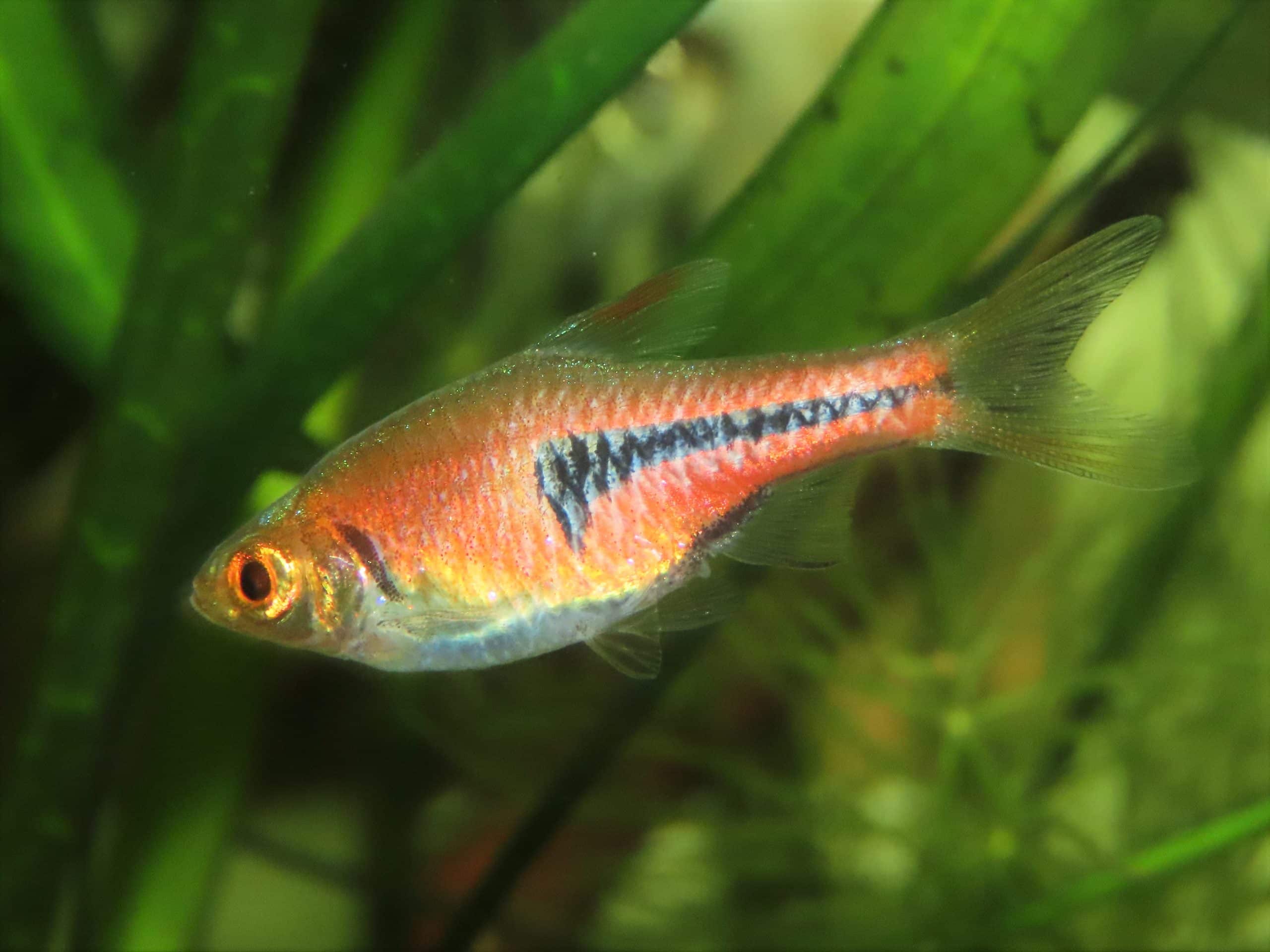
The lambchop rasbora has a slender, laterally compressed body with a warm copper-orange base color that can range from pale pinkish-orange to a deep reddish copper depending on the fish’s condition, diet, and water chemistry. The belly is lighter, fading to a silvery-white, while the back is slightly darker.
The defining feature of this species is the dark wedge-shaped marking on the rear half of the body. This marking is narrower and more elongated than the one found on harlequin rasboras, tapering to a finer point toward the tail. The shape has been compared to a lamb chop, which is where the common name comes from. The mark is typically jet black and sharply defined, with a thin line of brilliant copper or gold often visible along its upper edge.
The fins are mostly transparent to slightly yellowish-orange, and the eye is large with a dark pupil surrounded by a golden-copper iris. When the fish is in peak condition, especially in soft water with tannins, the overall copper glow becomes really eye-catching.
Telling the Trigonostigma Species Apart
If you’ve ever stood in front of a fish store tank trying to figure out whether you’re looking at harlequins, lambchops, or hengeli rasboras, you’re not alone. These three species get mixed up constantly, and mislabeling is extremely common in the trade. All three belong to the genus Trigonostigma and share a similar body plan with a dark marking on the rear half. But once you know what to look for, telling them apart is straightforward. The key is the shape and size of that dark marking.
- Harlequin Rasbora (T. heteromorpha): The largest of the three species, reaching up to 2 inches (5 cm). Has the broadest, most triangular dark marking that covers a large portion of the rear body. The triangle is wide and wedge-shaped with a fairly straight leading edge. The body is noticeably deeper and stockier compared to the other two. This is the most commonly available and widely recognized species in the group.
- Lambchop/Espei Rasbora (T. espei): Mid-sized at about 1.5 inches (3.5 cm). The dark marking is narrower and more elongated than the harlequin’s, shaped like a thin wedge or lamb chop rather than a broad triangle. The body is slimmer and more streamlined, and the copper-orange base color tends to be more vivid and warm-toned. If the dark marking looks like it’s been “squeezed” thinner compared to a harlequin, you’re looking at an espei.
- Copper/Hengeli Rasbora (T. hengeli): The smallest of the three, maxing out around 1.25 inches (3 cm). Has the thinnest dark marking of the group, reduced to more of a narrow dark line or sliver rather than a triangle. The key giveaway is a bright copper or neon-orange glow directly above the dark marking that is far more vivid and concentrated than what you see on the other two species. The overall body color is more translucent and less deeply pigmented.
The quick version: broad triangle = harlequin, narrow wedge = lambchop, thin line with a bright copper glow above it = hengeli. If you’re buying these at a local fish store, pay close attention to the shape and width of that dark marking. It’s the single most reliable way to confirm which species you’re actually getting. Don’t rely on the label in the tank, take a good look at the fish themselves.
Male vs. Female
Sexing lambchop rasboras takes some practice, but there are a few differences to look for in mature fish:
- Males tend to be slightly slimmer and more intensely colored, especially along the upper body and near the dark marking. The dark wedge may appear slightly more defined with a sharper edge.
- Females are usually a bit deeper-bodied and rounder, particularly when viewed from above. This is most noticeable when they’re carrying eggs. Their coloration tends to be slightly less vibrant than males.
These differences are subtle and easiest to spot when you have a group of adult fish together for comparison. Juveniles are essentially impossible to sex.
Average Size & Lifespan
Lambchop rasboras are a small species, topping out at about 1.5 inches (3.5 cm) in total length. Most specimens in home aquariums will be closer to 1 to 1.25 inches (2.5 to 3 cm). They’re a true nano-sized fish, which makes them a great fit for smaller aquariums.
With good care, stable water conditions, and a proper diet, lambchop rasboras typically live 3 to 5 years. Some hobbyists have reported keeping them closer to 5 years in well-maintained planted tanks with soft water. Poor water quality, stressful tank mates, or wide parameter swings will shorten that lifespan considerably.
Lambchop rasboras (Trigonostigma espei) are peaceful, undemanding nano fish suitable for most community tanks from 10 gallons. They are hardy and adaptable, making them ideal for beginners.
Care Guide
Lambchop rasboras are not difficult fish to keep, but they do have some preferences that you’ll want to respect if you want to see them at their best. The main thing to understand is that they come from soft, acidic water environments, and while they’ll tolerate a range of conditions, they truly thrive, and show their best color, in water that mimics their natural habitat.
Tank Size
A 10-gallon tank is the minimum for a group of 6 to 8 lambchop rasboras. That said, a 20-gallon long is a much better starting point if you can swing it. The extra horizontal swimming space lets them school more naturally, and a larger water volume gives you more stability with water parameters. In a 20-gallon long, you can comfortably keep a school of 10 to 12, which is where they really start to look impressive as a group.
These are mid-level swimmers that stick to the middle third of the water column. They don’t need a ton of vertical height, so long, shallow tanks work well for them.
Water Parameters
| Parameter | Recommended Range |
|---|---|
| Temperature | 73 to 82°F (23 to 28°C) |
| pH | 5.5 to 7.5 |
| General Hardness (GH) | 1 to 10 dGH |
| Carbonate Hardness (KH) | 1 to 5 dKH |
| Ammonia / Nitrite | 0 ppm |
| Nitrate | Below 20 ppm |
Soft, slightly acidic water is where lambchop rasboras do best. They can tolerate up to a neutral or slightly alkaline pH of 7.5, but their color and overall vitality will be noticeably better in the 6.0 to 6.8 range. If your tap water is hard and alkaline (above pH 7.5 or above 12 dGH), you may need to use RO/DI water remineralized with a product like Seachem Equilibrium, or mix RO water with your tap water to bring the hardness down. They can survive in moderately hard water, but their color will be less vibrant and breeding becomes very unlikely.
Adding Indian almond leaves or alder cones to the tank releases tannins that naturally lower pH, soften the water slightly, and give the water a warm amber tint. This closely replicates their wild habitat and tends to bring out deeper, richer coloration.
Filtration & Water Flow
These fish come from still to very slow-moving water, so strong currents are not appreciated. A sponge filter is an excellent choice for smaller tanks, it provides gentle biological filtration without creating excessive flow. In larger setups, a hang-on-back or canister filter with the output baffled or aimed at the glass works well. You want just enough surface agitation for gas exchange without pushing these small fish around the tank.
Lighting
Lambchop rasboras naturally inhabit shaded, dimly lit waters, so they tend to look and behave best under moderate to subdued lighting. Intense, bright lights can make them skittish and wash out their color. If you’re running a planted tank with higher light for your plants, provide plenty of shade with floating plants like water sprite, frogbit, or red root floaters. This gives the fish darker areas to retreat to and helps bring out that copper glow.
Plants & Decorations
This is a species that really benefits from a well-planted tank. Dense planting along the sides and back of the aquarium provides security, while an open swimming area in the middle gives them room to school. Great plant choices include:
- Cryptocoryne species: Perfect for the midground and foreground, they thrive in similar soft water conditions
- Java fern and Anubias: Hardy epiphytes that attach to driftwood and provide broad leaves (which these fish may use for spawning)
- Floating plants: Water sprite, frogbit, or salvinia to diffuse overhead light
- Stem plants: Rotala, ludwigia, or hygrophila for background density
Driftwood is a great addition, as it releases tannins that these fish appreciate. Dried Indian almond leaves scattered on the substrate add to the natural look and provide tannin benefits. Think blackwater biotope and you’re on the right track.
Substrate
A dark substrate is ideal for lambchop rasboras. Dark sand or fine gravel helps their copper coloration pop and more closely resembles the leaf-litter-covered bottom of their natural habitat. Aqua soil substrates designed for planted tanks work well too, as many of them buffer the water toward a slightly acidic pH, which is exactly what these fish prefer. Avoid bright white or very light substrates, as these tend to wash out the fish’s color and can make them feel exposed.
Tank Mates
Lambchop rasboras are peaceful, non-aggressive fish that do best with tank mates of a similar temperament and size. They won’t bother anyone and they won’t defend themselves against aggressive species, so tank mate selection is important. Stick with other small, calm community fish that share their preference for soft, slightly acidic water.
Best Tank Mates
- Other rasboras: Harlequin rasboras, chili rasboras, phoenix rasboras
- Small tetras: Ember tetras, neon tetras, green neon tetras, cardinal tetras
- Corydoras catfish: Pygmy corys, habrosus corys, panda corys
- Otocinclus catfish: Gentle algae eaters that stay small
- Small gouramis: Sparkling gouramis, honey gouramis
- Dwarf shrimp: Cherry shrimp, amano shrimp (adults are safe; baby shrimp may be eaten)
- Kuhli loaches: Peaceful bottom dwellers that stay out of the way
- Small peaceful livebearers: Endler’s livebearers (though they prefer harder water)
Tank Mates to Avoid
- Large or aggressive cichlids: Anything that can fit them in its mouth or bully them
- Tiger barbs and other nippy barbs: Will harass and stress out lambchop rasboras
- Large catfish: Pictus catfish, larger plecos, or anything predatory
- Bettas: Hit or miss. Some bettas will leave them alone, but aggressive males may target them, and the rasboras’ schooling behavior can stress certain bettas
- Fast, boisterous fish: Giant danios, Buenos Aires tetras, or other large, active species that will outcompete them for food and stress them out
Food & Diet
Lambchop rasboras are omnivores with small mouths, so they need appropriately sized foods. In the wild, they feed primarily on small insects, worms, crustaceans, and zooplankton. In captivity, they’re not picky eaters, but variety is important for maintaining good health and vibrant color.
A good feeding plan for lambchop rasboras includes:
- High-quality micro pellets or crushed flakes as a daily staple, look for products with whole fish or insect meal as the first ingredient
- Frozen foods: Baby brine shrimp, daphnia, cyclops, and micro bloodworms are all excellent. These are great for color enhancement.
- Live foods: Baby brine shrimp, microworms, vinegar eels, and daphnia. Live foods trigger the strongest feeding response and are especially useful for conditioning breeding pairs.
- Freeze-dried foods: Tubifex worms and daphnia as an occasional treat, pre-soaked to prevent digestive issues.
Feed small amounts once or twice daily. These are tiny fish with tiny stomachs, so it’s easy to overfeed. A good rule of thumb is to offer only what the school can consume in about 60 to 90 seconds. Uneaten food sitting on the substrate will degrade water quality fast in the small tanks these fish are typically kept in.
Is the Lambchop Rasbora Right for You?
Before you add a Lambchop Rasbora to your tank, here is an honest assessment of what you’re signing up for. I’d rather you know exactly what to expect now than find out the hard way after you’ve already bought one.
- Experience level: Lambchop Rasboras are best suited for intermediate to advanced keepers. They have specific requirements that can overwhelm beginners.
- Tank size commitment: You’ll need at least 10 gallons, though bigger is always better. Make sure you have room for the tank before buying.
- Tank mate planning: Lambchop Rasboras can be territorial, so plan your community carefully. Not every fish will work as a tank mate.
- Maintenance demands: Expect regular water testing and consistent water changes. Lambchop Rasboras are sensitive to parameter fluctuations.
- Budget reality: Keeping Lambchop Rasboras costs more than typical setups. Budget for ongoing costs, not just the initial purchase.
- Time investment: Beyond daily feeding and weekly maintenance, regular observation is the best way to catch health issues early.
- Long-term commitment: With proper care, Lambchop Rasboras can live up to 5 years. Make sure you’re ready for years of consistent care.
Breeding & Reproduction
Breeding lambchop rasboras is achievable in a home aquarium, though it takes more effort than something like a danio or most livebearers. The good news is that their spawning behavior is fascinating to observe, they don’t just scatter eggs randomly. They deposit them on the undersides of broad-leaved plants, which makes the process more deliberate and interesting to watch.
Breeding Difficulty
Moderate. Lambchop rasboras can be bred in captivity, but they need specific water conditions and a dedicated spawning setup. Casual breeding in a community tank is unlikely to produce surviving fry, since eggs and newborns are quickly eaten by tank mates and even the parents themselves.
Spawning Tank Setup
Set up a separate breeding tank of 5 to 10 gallons with the following conditions:
- Dim lighting or heavily shaded
- Sponge filter on the lowest possible setting
- Several broad-leaved plants such as Cryptocoryne, Anubias, or even plastic plants with broad leaves. The fish deposit eggs on the underside of these leaves.
- A thin layer of dark substrate or bare bottom
- Cover the tank well, keep it quiet and undisturbed
Water Conditions for Breeding
Soft, acidic water is critical for successful breeding. Target these parameters:
- Temperature: 78 to 82°F (26 to 28°C), slightly warmer than normal
- pH: 5.5 to 6.5
- Hardness: 1 to 5 dGH (very soft)
RO water remineralized with a small amount of GH booster usually provides the best results. Adding Indian almond leaves or peat filtration helps achieve the low pH and adds tannins.
Conditioning & Spawning
Condition your breeding pair (or a small group with more females than males) with plenty of high-quality live and frozen foods for about two weeks. Baby brine shrimp and daphnia are ideal conditioning foods. Well-conditioned females will become noticeably rounder as they fill with eggs.
Introduce the pair to the breeding tank in the evening. Spawning typically occurs in the morning. The male will court the female with a shimmering, side-by-side display, and the pair will eventually move to the underside of a broad leaf. The female turns upside down to deposit adhesive eggs on the leaf surface, and the male fertilizes them. This process may repeat over several hours, producing anywhere from 30 to 100 eggs.
Egg & Fry Care
Remove the adults after spawning is complete, as they will eat the eggs if given the opportunity. The eggs are small and translucent, stuck to the undersides of leaves. They typically hatch in 24 to 48 hours depending on temperature.
The newly hatched fry are extremely tiny and will absorb their yolk sac for the first day or two. Once they become free-swimming, feed them infusoria or commercially available liquid fry food for the first week. After that, graduate to freshly hatched baby brine shrimp and microworms. Keep the water very clean with small, frequent water changes, being careful not to suck up fry. Growth is slow, and it takes several weeks before they start to resemble miniature adults.
Common Health Issues
Lambchop rasboras are generally hardy fish that don’t suffer from species-specific diseases. Most health problems are related to poor water quality, stress, or improper conditions. Here are the issues you’re most likely to encounter:
Ich (White Spot Disease)
Ich is the most common disease in freshwater aquariums and lambchop rasboras are susceptible to it, particularly when stressed by temperature fluctuations or poor water quality. Look for small white spots resembling grains of salt on the body and fins. Treat by gradually raising the temperature to 82 to 84°F (28 to 29°C) and using a half dose of ich medication, since rasboras can be sensitive to full-strength treatments.
Fin Rot
Ragged, deteriorating fins usually indicate a bacterial infection brought on by poor water conditions. Improving water quality through frequent water changes is often enough to resolve mild cases. More advanced fin rot may require treatment with an antibacterial medication.
Columnaris
This bacterial infection shows up as white or grayish patches on the body, mouth, or fins. It’s often mistaken for a fungal infection. Columnaris is typically triggered by stress and poor water quality. Treatment with an antibiotic like kanamycin or a product containing nitrofurazone is usually necessary.
Internal Parasites
If your lambchop rasboras are eating well but losing weight, or if you notice white, stringy feces, internal parasites may be the culprit. This is more common in wild-caught specimens. Treat with a medicated food containing levamisole or praziquantel.
The best prevention for all of these issues is maintaining clean, stable water conditions. Weekly water changes of 20 to 30%, avoiding overstocking, and quarantining new fish before adding them to an established tank will prevent most health problems before they start.
Common Mistakes to Avoid
- Keeping them in groups that are too small. A pair or trio of lambchop rasboras will be stressed, pale, and hide constantly. You need at least 6, and 8 to 12 is better. They’re a schooling species and they need their group to feel secure.
- Hard, alkaline water. These fish are adapted to soft, acidic conditions. Keeping them in water well above pH 7.5 or above 12 dGH leads to washed-out color, increased stress, and virtually no chance of breeding. If your tap water is hard, consider using RO water.
- Too much light, not enough cover. Blasting these fish with high-intensity lighting and providing no shade makes them skittish and pale. Add floating plants and plant thickly to give them areas of shade and cover.
- Overfeeding. With tiny mouths and tiny stomachs, it takes very little food to satisfy a school of lambchop rasboras. Excess food fouls the water quickly, especially in smaller tanks.
- Mixing them with aggressive or boisterous tank mates. These are calm, gentle fish that will lose out to more aggressive species at feeding time and can become chronically stressed. Choose tank mates carefully.
- Confusing them with harlequin rasboras at the fish store. These two species are frequently mislabeled. Check the shape of the dark marking before you buy. The lambchop’s wedge is narrower and more elongated than the harlequin’s broad triangle.
Where to Buy
Lambchop rasboras are moderately available in the hobby. They’re less common than harlequin rasboras at chain pet stores, but specialty fish shops and online retailers usually carry them. Prices are reasonable, typically in the $3 to $5 range per fish depending on the source.
For healthier, better-conditioned fish that have been properly quarantined, I’d recommend checking Flip Aquatics or Dan’s Fish. Both are reputable online retailers that ship fish in excellent condition and are a step above what you’ll typically find at chain pet stores. Buying online also makes it easier to get a larger group at once, which is ideal since you want at least 6 to 8 of these fish.
When buying, look for fish that are active, have clear eyes, intact fins, and good color. Avoid any fish that appear lethargic, have clamped fins, or are showing visible spots or patches. And as mentioned earlier, double-check the dark body marking to make sure you’re actually getting lambchop rasboras and not harlequins.
Frequently Asked Questions
What’s the difference between lambchop, harlequin, and hengeli rasboras?
All three belong to the genus Trigonostigma and share a similar body shape with a dark wedge marking. The harlequin rasbora (T. heteromorpha) is the largest and has the broadest, most triangular mark. The lambchop rasbora (T. espei) is mid-sized with a narrower, more elongated wedge. The hengeli or copper rasbora (T. hengeli) is the smallest and has the thinnest marking, almost like a dark line, with a distinctive bright copper-orange glow directly above it. Care requirements are very similar for all three species, though the harlequin is widely recognized as the most widely available.
How many lambchop rasboras should I keep?
A minimum of 6, but 8 to 12 is ideal. Lambchop rasboras are a schooling species that need the company of their own kind to feel secure and display natural behavior. In larger groups, they school more tightly, show more confident behavior, and display better coloration. Small groups of 2 or 3 will be stressed, pale, and prone to hiding.
Are lambchop rasboras good for beginners?
Yes, with one caveat. They’re easy to care for and peaceful, which makes them beginner-friendly in terms of temperament and feeding. However, they do best in soft, slightly acidic water, and if your tap water is hard and alkaline, you may need to modify it. If you have naturally soft water or are willing to use RO water, these are a great beginner fish. If your water comes out of the tap at pH 8.0 with 15 dGH, you might want to start with a more adaptable species.
Can lambchop rasboras live with shrimp?
Adult cherry shrimp and amano shrimp are generally safe with lambchop rasboras. However, baby shrimp (shrimplets) may be snacked on, since they’re small enough to fit in the rasboras’ mouths. If you’re trying to breed shrimp, provide dense plant cover like moss to give the babies hiding spots. This isn’t a species that actively hunts shrimp, but opportunistic feeding on tiny shrimplets is always a possibility with any fish this size.
Do lambchop rasboras jump?
They can, though they’re not notorious jumpers like danios. It’s still a good idea to keep a lid or cover on the tank, especially if the fish are new and still settling in. Startled rasboras may leap out of uncovered tanks, and a tight-fitting lid prevents accidental losses.
Why are my lambchop rasboras pale?
Pale coloration in lambchop rasboras is almost always caused by one of three things: hard or alkaline water (too high pH or GH), too much light without enough shade, or stress from a small group size or aggressive tank mates. Check your water parameters, add floating plants for shade, make sure you have at least 6 fish, and feed a varied diet including frozen and live foods. Their copper color should intensify as conditions improve.
How the Lambchop Rasbora Compares to Similar Species
If you’re considering a Lambchop Rasbora, you’ve probably also looked at the Harlequin Rasbora. Both fill similar roles, but the differences matter when planning your tank. The Lambchop Rasbora has its own distinct personality and care needs. In my experience, the choice often comes down to the specific community you’re building and whether your water parameters favor one over the other.
The Chili Rasbora is worth considering as well. While the Lambchop Rasbora and the Chili Rasbora share some overlap in care, they bring different energy to a tank. If you have the space, keeping both in separate setups gives you a great chance to compare their behavior firsthand.
Expert Take (Mark Valderrama, AquariumStoreDepot)
After 25 years in the hobby and time managing fish stores, the lambchop rasbora is one of those species I always recommend to hobbyists ready to move beyond the basics. Lambchop rasboras (Trigonostigma espei) are peaceful, undemanding nano fish suitable for most community tanks from 10 gallons. They are hardy and adaptable, making them ideal for beginners. Keep lambchop rasboras in groups of 10 or more. Small groups become timid and washed-out in color – in groups of 10+ they school actively and display their full copper-orange coloration.
Closing Thoughts
The lambchop rasbora might not have the name recognition of its harlequin cousin, but it’s every bit as beautiful and arguably a better fit for modern planted aquascapes. That warm copper glow, the clean black wedge marking, and the calm schooling behavior all make it a standout choice for soft water community tanks. Put a group of 10 or 12 into a well-planted tank with some driftwood, tannin-stained water, and subdued lighting, and you’ve got something genuinely stunning to look at.
Keep them in a proper school, give them soft water, feed a varied diet, and they’ll reward you with years of subtle, glowing beauty. If you’re exploring the world of rasboras, the lambchop is the one that makes you stop scrolling and actually buy the harlequin’s less famous cousin. Give it a proper school and the right setup – you’ll understand why it belongs there.
Recommended Video
Check out our rasbora video where we cover the most popular rasboras in the hobby:
References
- Trigonostigma espei (Meinken, 1967) – FishBase
- Trigonostigma espei Profile – Seriously Fish
- Lambchop Rasbora Care Guide – Practical Fishkeeping
- About the Author
- Latest Posts

I’m Mark Valderrama, founder of Aquarium Store Depot and a fishkeeper with over 25 years of hands-on experience. I started in the hobby at age 11, worked at local fish stores, and have kept freshwater tanks, ponds, and reef tanks ever since. I’ve been featured in two best-selling aquarium books on Amazon and built this site to share practical, experience-based fish keeping knowledge.
Leave a Reply