
Last Updated: June 25, 2026
Thank you for visiting! By the way… any links on this page that lead to products on Amazon and other stores/partners are affiliate links Aquarium Store Depot earns a commission if you make a purchase.
Table of Contents
- What Care Guides Get Wrong
- The Reality of Keeping Black Ruby Barb
- Key Takeaways
- Species Overview
- Classification
- Origin & Natural Habitat
- Appearance & Identification
- Average Size & Lifespan
- Care Guide
- Is It Right for You?
- Tank Mates
- Food & Diet
- Breeding & Reproduction
- Common Health Issues
- Common Mistakes to Avoid
- Where to Buy
- Frequently Asked Questions
- Species Comparison
- Closing Thoughts
- Recommended Video
- References
The black ruby barb looks like nothing special in a pet store display tank. Pale, washed out, easily overlooked. But bring a group home, give them dark substrate, live plants, and stable water, and the males transform into one of the darkest, most striking barbs in the hobby. The deep black and ruby coloration only develops in the right conditions, and most people never see it because they judge the fish by the store version.
This is a cooler water species that does best in the low to mid-70s, peaceful for a barb, and excellent in planted community tanks. This guide covers how to bring out the color that makes this fish worth keeping, because the black ruby barb you see in the store is not the fish you are buying. The real one only shows up once you get the conditions right.
If you pass on this fish because it looks plain at the store, you are missing one of the best color transformations in the hobby.
The Reality of Keeping Black Ruby Barb
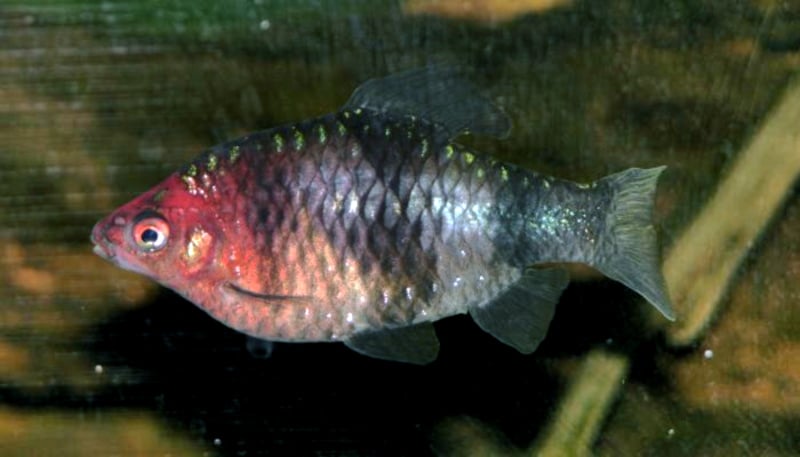
The black ruby barb is one of the most stunning barbs in the hobby when males are in breeding condition. The deep purplish-black body with ruby-red head is unlike anything else in the freshwater world. The problem is that out of breeding condition, they look completely ordinary.
Color depends on environment. Dark substrate, moderate lighting, tannin-stained water, and a group with enough males to trigger competition are all necessary for the full color display. Bright lighting on white sand produces pale, unremarkable fish.
They are a cooler water species from Sri Lanka, doing best at 72 to 79F. Not quite as cold-tolerant as rosy barbs but noticeably more comfortable below 78F than above it.
Biggest Mistake New Owners Make
Buying them based on photos of breeding males and expecting that color immediately. Black ruby barbs need months of proper conditions, a mature group, and male competition before they display peak coloration. The fish in the store bag looks nothing like the fish in the photos.
Black ruby barbs are one of the most attractive barb species, with males developing deep maroon-red coloration during breeding. They are hardy and peaceful when kept in appropriate groups.
Expert Take (Mark Valderrama, AquariumStoreDepot)
The black ruby barb in full breeding color is, in my opinion, the most beautiful barb species available. A group of eight with four or more males in a planted 30-gallon with dark substrate produces a display that rivals any cichlid setup for visual impact. But you have to earn that color. It takes the right environment, the right group dynamics, and patience.
Key Takeaways
- Males develop breathtaking deep crimson coloration with dark vertical bars during breeding condition, making them one of the most colorful small barbs available
- Peaceful schooling fish that should be kept in groups of at least 6. Males will spar harmlessly with each other, and this competition actually intensifies their coloring
- Prefers cooler water between 72 and 79°F (22 to 26°C), which makes them great companions for other subtropical and temperate species
- A 20-gallon tank is the minimum, with a planted setup and dark substrate bringing out their best colors
- Easy to breed as egg scatterers, with eggs hatching in just 1 to 2 days
- Classified as Vulnerable (IUCN) in the wild due to habitat loss in Sri Lanka, but widely captive-bred for the aquarium trade

Species Overview
| Field | Details |
|---|---|
| Scientific Name | Pethia nigrofasciata (Günther, 1868) |
| Common Names | Black Ruby Barb, Purple-Headed Barb, Ruby Barb |
| Family | Cyprinidae |
| Origin | Sri Lanka (endemic) |
| Care Level | Easy |
| Temperament | Peaceful |
| Diet | Omnivore |
| Tank Level | Middle to Bottom |
| Maximum Size | 2.5 inches (6 cm) |
| Minimum Tank Size | 20 gallons (76 liters) |
| Temperature | 72 to 79°F (22 to 26°C) |
| pH | 6.0 to 7.5 |
| Hardness | 5 to 12 dGH |
| Lifespan | 3 to 5 years |
| Breeding | Egg scatterer |
| Breeding Difficulty | Easy |
| Compatibility | Community |
| OK for Planted Tanks? | Yes |
Classification
| Taxonomic Level | Classification |
|---|---|
| Order | Cypriniformes |
| Family | Cyprinidae |
| Subfamily | Barbinae |
| Genus | Pethia |
| Species | P. Nigrofasciata (Günther, 1868) |
The Black Ruby Barb was originally described by Albert Günther in 1868 as Barbus nigrofasciatus. Like many barbs, it has gone through some taxonomic reshuffling over the years. It was later placed in Puntius, which served as a catch-all genus for many small Asian barbs. In 2012, the genus Pethia was established to accommodate a group of small South Asian barbs, and the Black Ruby Barb was moved into it. The accepted current name is Pethia nigrofasciata, though you’ll still see it listed under Puntius nigrofasciatus or even Barbus nigrofasciatus in older references.
Origin & Natural Habitat
The Black Ruby Barb is endemic to Sri Lanka, meaning it’s found nowhere else in the wild. Its natural range is restricted to forest streams in the Kelani and Nilwala river basins in the southwestern wet zone of the island. These are hilly areas at elevations up to around 1,000 feet (300 meters), where cool, clear streams flow through dense tropical forest canopy.
In the wild, these barbs live in shaded streams with gravel and sand substrates, often in areas with moderate current and plenty of marginal vegetation. The water is typically soft and slightly acidic, filtered through leaf litter and forest soils. Temperatures in these highland streams stay on the cooler side compared to lowland tropical habitats, which is why Black Ruby Barbs do best at moderate temperatures rather than the warm conditions many tropical fish prefer.
Unfortunately, the Black Ruby Barb is classified as Vulnerable on the IUCN Red List. Deforestation, agricultural expansion, and urban development in Sri Lanka’s wet zone have destroyed or degraded much of the forested stream habitat this species depends on. Collection for the aquarium trade was historically a concern as well, though today the vast majority of Black Ruby Barbs available in the hobby are commercially bred in facilities across Southeast Asia. Purchasing captive-bred fish is one small way to support this species without adding pressure to already stressed wild populations.
Appearance & Identification
The Black Ruby Barb is a deep-bodied, laterally compressed fish that reaches about 2.5 inches (6 cm) in total length. It has three to four bold, dark vertical bars running down its flanks, which are the most consistent identification feature regardless of the fish’s mood or condition. These bars are how the species got its scientific name, nigrofasciata, meaning “black-banded.”
What makes this species truly special is the dramatic color difference between males in breeding condition and, well, everything else. When a male is showing his best colors, the head and anterior body flush a deep purplish-red to ruby crimson that intensifies across the entire body. The dark vertical bars become even more prominent against this rich background. It’s genuinely one of the most striking displays you’ll see in a small freshwater fish. Outside of breeding condition, males are more muted, showing yellowish-green bodies with the characteristic black bars.
Male vs. Female
Telling males from females is straightforward once the fish are mature. Males are noticeably smaller, slimmer, and more streamlined than females. In breeding condition, males develop that unmistakable deep ruby-red coloration across the head and body. Their dorsal fin also darken considerably.
Females are rounder and deeper-bodied, with a more subdued yellowish to olive-gold base color. They retain the dark vertical bars but lack the intense red coloration entirely. Some females may show a faint pinkish or warm tone, but nothing close to the male’s display. Females are also slightly larger overall, reaching up to about 2.6 inches (6.7 cm) compared to the male’s 2.4 inches (6 cm).
Average Size & Lifespan
Black Ruby Barbs typically reach about 2 to 2.5 inches (5 to 6 cm) in aquarium conditions. Females are slightly larger and more robust than males. These are not large fish, but their deep body shape gives them a bit more visual presence than you’d expect from a 2-inch barb.
With proper care, Black Ruby Barbs typically live 3 to 5 years in captivity. Some well-maintained specimens can push past 5 years, though that’s less common. Good water quality, a varied diet, and stable conditions all contribute to a longer, healthier life.
Care Guide
Tank Size
A 20-gallon tank is the minimum for a school of Black Ruby Barbs. These are active swimmers that need horizontal space to move around, and a group of 6 or more really does need that footprint. If you want to keep them in a community tank with other species, consider stepping up to a 30-gallon or larger. They’ll use every bit of space you give them.
Water Parameters
| Parameter | Recommended Range |
|---|---|
| Temperature | 72 to 79°F (22 to 26°C) |
| pH | 6.0 to 7.5 |
| Hardness (dGH) | 5 to 12 |
| Ammonia / Nitrite | 0 ppm |
| Nitrate | Below 20 ppm |
One of the key things to understand about Black Ruby Barbs is that they prefer cooler water than many tropical community fish. Their highland stream origins mean they do best in the low-to-mid 70s°F range. You don’t want to push them above 79°F (26°C) for extended periods. If your home stays in the 70 to 76°F range naturally, you may not even need a heater, which is actually ideal for this species.
Farm-raised Black Ruby Barbs are fairly adaptable when it comes to pH and hardness. They’ll do fine in neutral to slightly acidic water, and moderate hardness is perfectly acceptable. That said, they will show their best coloration in softer, slightly acidic conditions that mimic their natural habitat.
Filtration & Water Flow
A standard hang-on-back or canister filter rated for your tank size works well. Aim for a turnover rate of about 4 to 5 times the tank volume per hour. Black Ruby Barbs come from streams with moderate current, so a gentle to moderate flow is ideal. They don’t need strong flow, but completely still water isn’t natural for them either.
Lighting
These barbs come from shaded forest streams, so subdued to moderate lighting works best. Intense, bright lighting can wash out their colors and make them feel exposed. If you’re running a planted tank with higher light, just make sure there are plenty of shaded areas created by floating plants or tall stem plants. Their deep ruby coloring really pops under softer, warmer-toned lighting.
Plants & Decorations
A planted tank is by far the best setup for Black Ruby Barbs. Live plants provide the shade and cover these fish appreciate, and the contrast of deep red males against lush green plants is genuinely beautiful. Java fern, Anubias, Cryptocorynes, and Vallisneria are all excellent choices. Floating plants like Amazon frogbit or dwarf water lettuce help diffuse light and create the shaded conditions they prefer.
Driftwood and smooth river stones also work well, adding visual complexity and additional hiding spots. A few pieces of Indian almond leaf or dried oak leaf can provide beneficial tannins and mimic the leaf litter of their natural forest stream habitat.
Substrate
A dark substrate is highly recommended. Black Ruby Barbs show significantly better coloration against a dark background compared to light-colored substrates. Dark gravel, black sand, or a planted tank substrate like Fluval Stratum or Eco-Complete all work well. In the wild, they live over gravel and sand, so either option is natural for them.
Is the Black Ruby Barb Right for You?
Before you buy, run through this honest checklist. The Black Ruby Barb is a great fish for the right keeper, but it is not for everyone.
- You want a barb that can rival expensive species in color – if you set it up right
- You have a 20-gallon or larger tank with a dark substrate
- You can keep a group of 8+ for the best color displays and sparring behavior
- Your water is on the cooler side (72-79°F) – they do not love hot water
- You appreciate a fish that transforms from plain in the store to stunning in your tank
- You enjoy watching male sparring displays that bring out peak coloration
Tank Mates
Black Ruby Barbs are excellent community fish. They’re peaceful, they stay in their own lane, and they rarely cause trouble with other species. The main thing to keep in mind is their preference for cooler water, so pair them with species that share similar temperature requirements rather than fish that need the upper 80s°F.
Best Tank Mates
- Other barbs (Cherry Barbs, Gold Barbs, Rosy Barbs)
- Tetras (Ember Tetras, Pristella Tetras, Glowlight Tetras)
- Danios (Zebra Danios, Pearl Danios, Celestial Pearl Danios)
- Rasboras (Harlequin Rasboras, Lambchop Rasboras)
- Corydoras catfish (Bronze Corys, Peppered Corys, Sterbai Corys)
- Loaches (Kuhli Loaches, Hillstream Loaches)
- Livebearers (Platies, Endler’s Livebearers)
- White Cloud Mountain Minnows (excellent temperature match)
- Dwarf gouramis (Honey Gouramis are a great choice)
- Peaceful bottom-dwellers (Bristlenose Plecos, Otocinclus)
Tank Mates to Avoid
- Large, aggressive cichlids (Oscars, Jack Dempseys, Green Terrors)
- Fin nippers or aggressive barbs (Tiger Barbs in small groups can be problematic)
- Very large fish that could view Black Ruby Barbs as food
- Fish requiring very warm water (Discus, German Blue Rams) since their temperature preferences don’t overlap well
- Highly territorial species that will stress out schooling fish
Food & Diet
Black Ruby Barbs are unfussy omnivores that will accept just about anything you offer. In the wild, they feed primarily on algae, detritus, small invertebrates, and organic matter, so they’re naturally inclined to graze and pick at things throughout the day.
A good quality flake or micro-pellet food should form the base of their diet. Choose something that includes both protein and plant-based ingredients, since these barbs do need vegetable matter in their diet. Supplement regularly with small frozen or live foods like bloodworms, daphnia, brine shrimp, and mosquito larvae. These protein-rich treats bring out the best coloration in males and help condition fish for breeding.
Blanched vegetables like zucchini, cucumber, or spinach are also appreciated. You’ll often see Black Ruby Barbs nibbling at algae growth on rocks, glass, and plant leaves, which is perfectly natural behavior. Feed small amounts two to three times daily rather than one large feeding. These are grazers by nature, and smaller, more frequent meals keep them healthier and more active.
Breeding & Reproduction
Black Ruby Barbs are one of the easier barb species to breed in captivity. They’re egg scatterers with no parental care, which means the setup and timing are fairly straightforward once you understand the process.
Breeding Difficulty
Easy to moderate. They’ll often spawn in a well-maintained community tank without any special intervention, though raising the fry requires a separate setup.
Spawning Tank Setup
Set up a dedicated breeding tank of at least 10 gallons with shallow water, around 6 to 8 inches deep. The bottom should be covered with fine-leaved plants like java moss, spawning mops, or a layer of marbles to protect eggs from the adults. Keep the lighting dim, and include some floating plants for cover.
Water Conditions for Breeding
Slightly soft, acidic water will trigger spawning. Aim for a pH of 6.0 to 6.5, temperature around 77 to 79°F (25 to 26°C), and hardness of 5 to 8 dGH. A slight increase in temperature from their normal range, combined with good water quality, often does the trick.
Conditioning & Spawning
Condition breeding pairs or groups (one male to two females works well) with plenty of high-quality live and frozen foods for one to two weeks before introducing them to the spawning tank. Bloodworms, daphnia, and brine shrimp are all excellent conditioning foods.
Spawning typically occurs in the morning hours. The male will intensify his crimson coloring dramatically and display vigorously to the female, spreading his fins and swimming alongside her. The female scatters her eggs among fine-leaved plants or into gaps in the substrate, and the male fertilizes them as they fall. A healthy female can produce over 100 eggs in a single spawning event.
Egg & Fry Care
Remove the adults immediately after spawning is complete, as they will eat their own eggs given the chance. The eggs are small and adhesive, sticking to plant leaves and other surfaces. They typically hatch within 1 to 2 days at 77°F (25°C).
The fry become free-swimming roughly 24 hours after hatching, once they’ve absorbed their yolk sacs. At that point, start feeding infusoria or liquid fry food for the first week or so. As they grow, graduate to freshly hatched baby brine shrimp and then finely crushed flake food. Keep the water clean with small, frequent water changes, and maintain gentle filtration using a sponge filter to avoid sucking up the tiny fry.
Common Health Issues
Black Ruby Barbs are hardy fish that don’t suffer from many species-specific diseases. Most health problems arise from poor water quality, stress, or improper conditions. Here are the most common issues to watch for.
Ich (White Spot Disease)
Ich is the most common disease in freshwater aquariums, and Black Ruby Barbs are susceptible to it, especially when stressed by sudden temperature changes or poor water quality. Look for small white spots on the body and fins, along with scratching against objects. Raising the temperature to 82°F (28°C) gradually and treating with a commercial ich medication is the standard approach. Since Black Ruby Barbs prefer cooler water, the temperature increase alone can be an effective first step.
Fin Rot
Ragged, deteriorating fins are usually a sign of bacterial infection caused by poor water quality. The best prevention is keeping up with regular water changes and maintaining proper filtration. Mild cases often resolve with improved water conditions alone. More advanced cases requires antibiotic treatment.
Velvet Disease
Caused by the parasite Piscinoodinium, velvet appears as a fine gold or rust-colored dusting on the fish’s body. It can be tricky to spot at first, but affected fish will often clamp their fins and scratch against objects. Copper-based medications are the standard treatment, and darkening the tank can help since the parasite relies on light.
Stress-Related Color Loss
While not technically a disease, Black Ruby Barbs that are stressed, kept in too-small groups, or housed in tanks with overly bright lighting will show washed-out, pale colors. If your males aren’t showing any red coloration, it’s usually a sign of environmental stress rather than illness. Check your water parameters, group size, lighting, and ensure there are enough hiding spots.
Common Mistakes to Avoid
- Keeping too few. Black Ruby Barbs are schooling fish that need a group of at least 6. In smaller groups, they become shy, stressed, and lose their coloring. Males also need competition with other males to drive their display behavior.
- Water too warm. Keeping them at 82 to 84°F because they’re “tropical fish” is a common mistake. They come from cool highland streams and prefer the low to mid 70s°F. Prolonged high temperatures stress them and can shorten their lifespan.
- Bright lighting with no cover. These are forest stream fish that feel exposed under intense aquarium lights. Without floating plants or dense vegetation to create shaded areas, they’ll stay stressed and pale.
- Light-colored substrate. Using white or light gravel washes out their colors dramatically. A dark substrate makes a night-and-day difference in how vivid your Black Ruby Barbs look.
- Only keeping females. If you want to see the spectacular ruby-red display, you need males. And you need multiple males, because the competition between them is what drives the most intense coloration.
- Skipping the plant-based food. These fish naturally graze on algae and plant matter. A diet that’s entirely protein-based doesn’t meet their nutritional needs. Include foods with algae or spirulina content.
Where to Buy
Black Ruby Barbs are a staple in the hobby and reasonably easy to find. Many local fish stores carry them, though the quality can vary significantly. Store-kept fish in bare tanks under bright lighting often look washed out and unremarkable, so don’t judge them by their appearance in a retail setting. Once you get them into a planted tank with dark substrate and a proper school, the transformation is dramatic.
For healthy, well-cared-for specimens shipped to your door, I recommend checking these trusted online retailers:
Both are reputable sellers who take good care of their livestock and ship responsibly. Availability varies, so check their sites regularly if the species isn’t currently in stock.
Frequently Asked Questions
How many Black Ruby Barbs should I keep together?
Keep a minimum of 6, but 8 to 10 is even better. Larger groups feel more secure, show bolder behavior, and males will display more intensely when they have competition. A school of 8 or more in a well-planted tank is genuinely spectacular to watch.
Why aren’t my Black Ruby Barbs showing any color?
Pale, washed-out coloring is almost always an environmental issue. Check these factors: group size (too few fish causes stress), substrate color (light substrates wash out colors), lighting intensity (too bright makes them feel exposed), and diet (they need variety, including plant matter). Also, only mature males in good condition show the full ruby-red display, so young or stressed males may simply need time and better conditions.
Are Black Ruby Barbs aggressive?
No. They’re one of the most peaceful barb species available. Males will spar and display to each other, but this is harmless posturing, not aggression. They almost never bother other species. Unlike Tiger Barbs, which can be notorious fin nippers, Black Ruby Barbs are well-behaved community citizens.
Can Black Ruby Barbs live with shrimp?
Adult Cherry Shrimp and Amano Shrimp are safe with Black Ruby Barbs. However, like most small fish, they will eat baby shrimp if they find them. If you’re trying to breed shrimp in the same tank, provide dense moss and hiding spots so that at least some shrimplets survive.
Do Black Ruby Barbs need a heater?
It depends on your room temperature. If your home stays consistently in the 72 to 76°F range (22 to 24°C), you may not need a heater at all. These fish prefer cooler water and actually do better without the constant 78 to 80°F temperatures that many hobbyists set for their tropical tanks. In cooler climates or during winter months, a heater set to the low 70s°F is a good safety net.
Are Black Ruby Barbs endangered?
Wild populations in Sri Lanka are classified as Vulnerable by the IUCN, primarily due to habitat loss from deforestation and development. However, virtually all Black Ruby Barbs in the aquarium trade are captive-bred, so purchasing them from reputable sellers doesn’t impact wild populations. In fact, the aquarium hobby helps maintain a healthy captive population of this species.
What It Is Actually Like Living With Black Ruby Barb
When male black ruby barbs color up, you stop what you are doing and watch. The transformation from drab olive to deep purplish-black with a crimson head happens in minutes when a rival appears. It is the most dramatic color change of any barb species.
They are peaceful community fish outside of breeding. Males spar with each other through parallel displays, but there is no fin nipping and no aggression toward other species.
Breeding happens regularly in well-maintained tanks. A group with proper conditions will spawn among fine-leaved plants without any special intervention. You will find fry if you look carefully.
Closing Thoughts
The Black Ruby Barb is one of those fish that consistently surprises people. It sits in pet store tanks looking like a fairly ordinary striped barb, and then a few weeks after you bring a school home to a planted tank with dark substrate, the males start lighting up like embers. That deep crimson-ruby coloring against dark vertical bars is genuinely stunning, and it only gets better as the males compete with each other for attention.
They’re peaceful, they’re hardy, they’re easy to feed, and they breed without much fuss. They work in cooler setups where many tropical fish would struggle, and they bring color and activity to the middle and lower levels of the tank. For anyone looking for a beautiful, low-maintenance schooling fish that doesn’t come with the behavioral baggage of some other barbs, the Black Ruby Barb is hard to beat. Set them up right, give them a proper school, and let the males do their thing. You won’t regret it.
Recommended Video
References
- Froese, R. And D. Pauly, Editors. FishBase. Pethia nigrofasciata (Günther, 1868). https://www.fishbase.se/summary/Pethia-nigrofasciata.html
- Seriously Fish. Pethia nigrofasciata. Black Ruby Barb. https://www.seriouslyfish.com/species/pethia-nigrofasciata/
- IUCN Red List of Threatened Species. Pethia nigrofasciata. https://www.iucnredlist.org
- Pethiyagoda, R. Meegaskumbura, M. & Maduwage, K. (2012). A synopsis of the South Asian fishes referred to Puntius. Ichthyological Exploration of Freshwaters, 23(1), 69-95.
- About the Author
- Latest Posts

I’m Mark Valderrama, founder of Aquarium Store Depot and a fishkeeper with over 25 years of hands-on experience. I started in the hobby at age 11, worked at local fish stores, and have kept freshwater tanks, ponds, and reef tanks ever since. I’ve been featured in two best-selling aquarium books on Amazon and built this site to share practical, experience-based fish keeping knowledge.
Leave a Reply