
Last Updated: June 25, 2026
Thank you for visiting! By the way… any links on this page that lead to products on Amazon and other stores/partners are affiliate links Aquarium Store Depot earns a commission if you make a purchase.
Table of Contents
- What People Get Wrong
- The Reality of Keeping Buenos Aires Tetra
- Key Takeaways
- Species Overview
- Classification
- Origin & Natural Habitat
- Appearance & Identification
- Average Size & Lifespan
- Care Guide
- Is It Right for You?
- Tank Mates
- Food & Diet
- Breeding & Reproduction
- Common Health Issues
- Common Mistakes to Avoid
- Where to Buy
- FAQ
- What It Is Actually Like Living With Buenos Aires Tetra
- Species Comparison
- Closing Thoughts
- Recommended Video
- References
The Buenos Aires tetra is the toughest tetra you can buy. It is also the most destructive plant eater in the tetra family. Put them in a planted tank and they will strip it bare in weeks. This is a fish that thrives in nearly any water, but it comes with a warning label that most stores forget to mention.
Buenos Aires tetras are indestructible. They will also destroy every live plant in your tank.
Expert Take (Mark Valderrama, AquariumStoreDepot)
At the stores I managed, Buenos Aires tetras were the first fish I recommended to customers running tanks without heating – apartment setups, garage tanks, older equipment. They handle conditions that crash other fish. I had one customer who added six of them to a planted tank he’d been building for months. He was back in two weeks. The plants were stripped. Not nibbled – stripped. I told him to keep the tetras and redesign around them. Three months later he had an unplanted hardscape setup with the same fish and was happier than he’d ever been. The Buenos Aires tetra is for the aquarist who will design the tank around the fish, not try to force the fish into an aquascape it will destroy.
The Reality of Keeping Buenos Aires Tetra
The plant destruction is total. This is not occasional nibbling. Buenos Aires tetras consume plants. Java fern, anubias, Amazon swords, everything. In my experience, keepers try tough plants thinking they will survive. They do not. If you value your plants, keep a different tetra.
They thrive in conditions most tetras cannot handle. Buenos Aires tetras tolerate temperatures down to 64F, making them one of the few tetras suitable for unheated indoor tanks. They also handle a wide pH range and moderate hardness. This cold tolerance sets them apart from virtually every other common tetra.
They are more active and bold than typical tetras. These are not shy, timid schoolers. Buenos Aires tetras are bold, fast, and assertive. They dominate feeding time and actively explore every inch of the tank. In a community with timid fish, they will outcompete for food.
Biggest Mistake New Owners Make
Putting them in a planted tank. Every month someone posts online about their destroyed aquascape after adding Buenos Aires tetras. The information is everywhere and people still ignore it. Do not be that person.
Key Takeaways
- Minimum 30-gallon tank for a school of 8 or more. These are active, larger-bodied tetras that need swimming room
- One of the hardiest tetras available. Tolerates temperatures as low as 64°F (18°C), making them suitable for unheated setups
- Notorious plant eaters. They will destroy soft-leaved plants; stick with Java fern, Anubias, or artificial plants
- Semi-aggressive fin nippers. Avoid housing with long-finned or slow-moving tank mates like bettas or angelfish
- Easy to breed. One of the simplest tetras to spawn in home aquaria, with females producing up to 2,000 eggs per spawn
- Captive-bred specimens are widely available and very affordable
Species Overview
| Field | Details |
|---|---|
| Scientific Name | Hyphessobrycon anisitsi |
| Common Names | Buenos Aires Tetra, Diamond Spot Characin, Red Cross Fish |
| Family | Characidae |
| Origin | Argentina, Paraguay, Uruguay, southeastern Brazil. Paraná and Uruguay River basins |
| Care Level | Easy |
| Temperament | Semi-aggressive (fin nipper) |
| Diet | Omnivore (strong herbivorous tendencies) |
| Tank Level | Mid |
| Minimum Tank Size | 30 gallons (114 liters) |
| Temperature | 64–82°F (18–28°C) |
| pH | 6.0–7.5 |
| Hardness | 2–20 dGH |
| Lifespan | 5–7 years in captivity |
| Breeding | Egg scatterer |
| Maximum Size | 2.8 inches (7 cm) |
| Breeding Difficulty | Easy |
| Compatibility | Semi-aggressive community (robust tank mates only) |
| OK for Planted Tanks? | No (will eat most plants) |
Classification
| Taxonomic Level | Classification |
|---|---|
| Order | Characiformes |
| Family | Characidae (reclassified to Acestrorhamphidae by some authors, 2020) |
| Genus | Hyphessobrycon (syn. Psalidodon) |
| Species | H. Anisitsi (Eigenmann, 1907) |
ASD Difficulty Rating
Beginner | 2/10
One of the hardiest tetras in the hobby. Tolerates a wider temperature range and harder water than most tetras. The real challenge is plant compatibility and fin-nipping – not water care. If your tank has no live plants and robust tank mates, the Buenos Aires tetra is as close to maintenance-free as a schooling fish gets.
Origin & Natural Habitat
The Buenos Aires tetra hails from the Paraná and Uruguay river basins across Argentina, Paraguay, Uruguay, and southeastern Brazil. Despite the name, some of the Buenos Aires province records may actually belong to the closely related H. Togoi, so the common name is a bit misleading geographically.
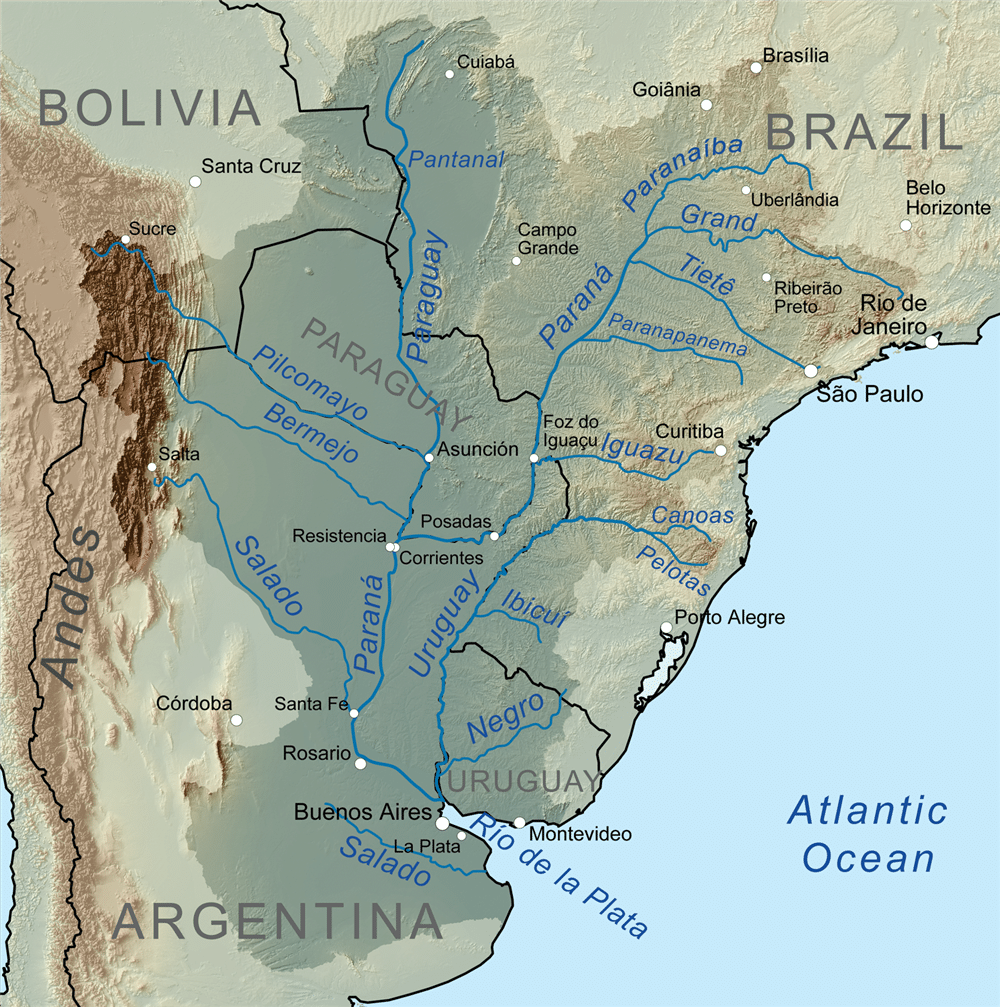
In the wild, you’ll find these fish in smaller streams, tributaries, floodplain lakes, and backwaters rather than the main river channels. The Paraná basin is massive. Nearly 4,880 km long. And the climate ranges from tropical in the upper stretches to subtropical and even temperate further south. This explains why Buenos Aires tetras tolerate such a wide temperature range compared to most tropical tetras. Their natural habitat features sandy to muddy substrates, seasonal flooding, and moderate vegetation. They share their waters with other characins, catfish, and cichlids in these subtropical South American waterways.
Appearance & Identification
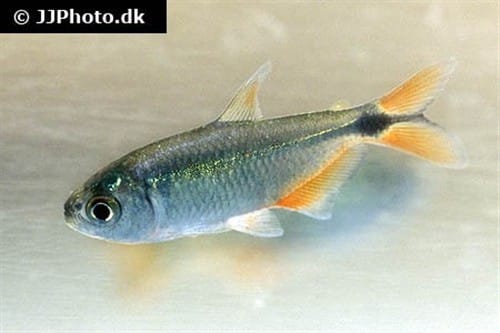
Buenos Aires tetras have a robust, slightly elongated body shape that’s noticeably larger than most common community tetras. The body is predominantly silver with a subtle blue-green iridescent sheen along the flanks. Their signature feature is the bright red-orange coloring on the caudal, anal, and pelvic fins. It really stands out against the silver body. There’s also a distinctive diamond-shaped black spot at the base of the tail fin that serves as a quick identification marker.
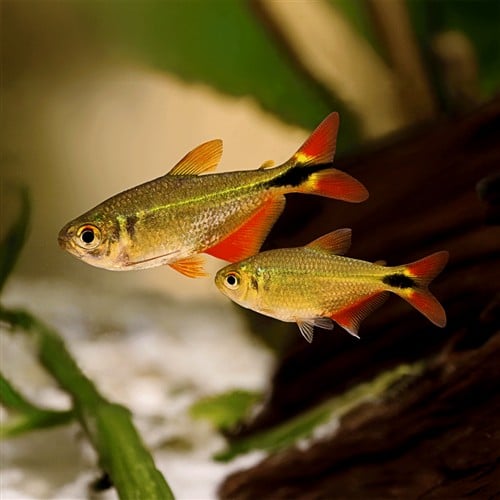
You’ll also see albino and gold variants in the trade. These selectively bred forms have a peach-orange body with light orange fins and red eyes. They’re the same species with the same care requirements.
Male vs. Female
Males are slimmer and display more intense red coloring in the fins, sometimes with yellowish tones. Females are larger overall with a deeper, rounder body. Especially when carrying eggs. The color difference is most obvious when the fish are in breeding condition, but even day-to-day, males will show more vivid finnage than females.
Average Size & Lifespan
Buenos Aires tetras reach about 2.8 inches (7 cm) in aquariums, making them one of the larger commonly available tetras. They’re noticeably bigger than neons, embers, or glowlights. In terms of lifespan, expect 5 to 7 years with proper care. These are hardy fish that will live longer than many smaller tetra species, so you’re making a reasonable commitment when you bring a school home.
Care Guide
Tank Size
A 30-gallon (114-liter) tank is the minimum for a school of 8 Buenos Aires tetras. These are active swimmers that need horizontal space to move, and their larger body size means they produce more waste than your typical small tetra. If you’re planning a community setup with other robust species, bumping up to a 40- or 55-gallon tank gives everyone more breathing room and helps diffuse any fin-nipping behavior.
If their red and orange colors look washed out, check the tank before blaming the fish. Hard, alkaline water, stress from being understocked, or a bare tank without plants or structure will drain their color. Give them the right conditions and the color comes back.
Water Parameters
| Parameter | Ideal Range |
| Temperature | 68–78°F (20–26°C) |
| pH | 6.0–7.5 |
| Hardness | 2–20 dGH |
| KH | 3–12 dKH |
Hard Rule: No soft-leaved plants. They will be consumed within days, not weeks.
Vallisneria, amazon swords, and most stem plants are food. This is not a preference – it is systematic consumption that ends with stems in sand. Java fern, anubias, and java moss survive because of their bitter, tough leaves, not because these fish become selective. If you want a planted tank, choose a different species. If you choose Buenos Aires tetras, design the tank around them – hardscape, driftwood, and artificial plants work excellently.
One of the most adaptable tetras you’ll find. Buenos Aires tetras can handle a remarkably wide range of water conditions, which makes sense given their subtropical origin. They tolerate temperatures down to 64°F (18°C), which is unusual for a “tropical” fish and means they can even work in unheated tanks in mild climates. That said, for everyday keeping, 68–78°F (20–26°C) is the sweet spot. Captive-bred specimens are especially forgiving with water chemistry. Most tap water in the US will work just fine.
Filtration & Water Flow
A good hang-on-back or canister filter rated for your tank size will do the job. These fish aren’t picky about flow. Moderate current is fine. Aim for a turnover rate of 4–5 times your tank volume per hour. Weekly water changes of 25–30% will keep nitrate levels in check. Buenos Aires tetras are hardy, but they still appreciate clean, well-oxygenated water.
Lighting
Standard aquarium lighting works well. Moderate lighting brings out the best iridescence on their flanks and highlights the red in their fins. They’re not light-sensitive like some tetras, so you have plenty of flexibility here.
Plants & Decorations
Here’s where Buenos Aires tetras earn their reputation. These fish are voracious plant eaters. Soft-leaved plants like Cabomba, Hygrophila, Vallisneria, and baby tears will be reduced to stems within weeks. Even a small group of three can destroy a bunch of Vallisneria in under a month.
If you want live plants, stick with tough, bitter-leaved species they will leave alone: Java fern, Anubias, and Cryptocoryne are your safest bets. Otherwise, artificial plants and driftwood make excellent alternatives that give your tank structure without becoming an expensive salad bar. Provide some open swimming space in the center. These are active fish that need room to cruise.
Substrate
Sand or fine gravel both work well. A darker substrate will make their silver bodies and red fins pop more dramatically. Since planted tanks aren’t really an option with these guys, your substrate choice is mostly aesthetic.
Is the Buenos Aires Tetra Right for You?
Honest assessment before you buy. The Buenos Aires tetra is excellent in the right setup – and a disaster in the wrong one.
Good fit if:
- You have an unplanted tank or are willing to go hardscape-only – driftwood, rocks, and artificial plants work beautifully with this species
- You want a cool-water or unheated tank option – Buenos Aires tetras handle temperatures down to 64°F (18°C), making them one of the few tetras that work without a heater
- You want an active, assertive tetra with genuine presence – they dominate any tank they occupy, move constantly, and are never shy
- You have robust tank mates – tiger barbs, giant danios, rosy barbs, rainbowfish, and other assertive species coexist well
- You want an easy first breeding project – Buenos Aires tetras spawn readily with minimal conditioning and produce large egg batches
- You value long-term hardiness – with good care they live 5–7 years and handle the mistakes beginners make
Think twice if:
- You have a planted tank – Buenos Aires tetras will strip soft-leaved plants within days; this is not fixable by feeding them vegetables; do not add these fish to a planted tank
- You have bettas, angelfish, or fancy guppies – the long fins will be nipped relentlessly; this is consistent behavior, not occasional
- You want small, delicate community fish – neons, embers, dwarf shrimp, and similarly small species will be outcompeted at feeding or eaten
- You want a calm, peaceful tank energy – Buenos Aires tetras are assertive, fast, and constantly active; they change the entire feel of a community
What People Get Wrong
The biggest mistake is adding Buenos Aires tetras to a planted aquarium with soft-leaved plants. People buy them, set them loose in a beautifully planted tank, and within a week the plants are shredded. This is not occasional grazing. It is systematic destruction of any plant with soft or delicate leaves. Java fern, anubias, and tough-leaved species survive. Everything else does not.
Second mistake: underestimating the fin-nipping. Buenos Aires tetras are active, energetic fish that will target slow-moving or long-finned tank mates. Bettas and angelfish are particularly at risk. Keep them with fast-moving, short-finned fish (barbs, danios, rainbowfish) and the nipping is much less of a problem.
Third: not taking advantage of their cold water tolerance. Buenos Aires tetras thrive at 64 to 82 degrees Fahrenheit (18 to 28 degrees Celsius), which means they are one of the few tetras that work in an unheated room-temperature tank. That is a real advantage for setups that do not have reliable heating, and it is something most beginners do not realize when they are stocking a tank.
Tank Mates
Best Tank Mates
- Tiger Barbs. Similarly active and robust, can hold their own
- Rosy Barbs. Hardy, similar size, won’t be bullied
- Giant Danios. Fast swimmers that match the energy level
- Rainbow Fish. Tough enough to coexist peacefully
- Corydoras Catfish. Peaceful bottom dwellers that stay out of the way
- Bristlenose Plecos. Armored and unbothered by nipping
- Serpae Tetras. Similarly semi-aggressive, matched temperament
- Black Skirt Tetras. Robust tetras that can handle the pace
- Swordtails. Active livebearers that are tough enough
- Keyhole Cichlids. Peaceful cichlids with a sturdy build
Tank Mates to Avoid
- Bettas. Long fins make them a prime nipping target
- Angelfish. Flowing fins will be shredded; angelfish are also too slow
- Fancy Guppies. Long-finned and too small to coexist safely
- Dwarf Shrimp. Will be eaten
- Small tetras (Neons, Embers). May be bullied or outcompeted for food
- Slow-moving or shy species. Will be stressed by the activity level
Food & Diet
Buenos Aires tetras are true omnivores with a strong lean toward herbivory. A quality flake or pellet food should be the staple. Something with spirulina or vegetable content works great. Supplement with frozen bloodworms, brine shrimp, and daphnia a few times a week for variety and protein.
Here’s a pro tip: offering regular vegetable foods like blanched spinach, zucchini slices, or spirulina wafers helps reduce plant-nipping behavior. It won’t eliminate it entirely, but keeping their herbivorous appetite satisfied makes a noticeable difference. Feed small portions twice daily. Only what they can finish in about 2 minutes per feeding.
Breeding & Reproduction
Breeding Difficulty
Easy. Buenos Aires tetras are one of the simplest tetras to breed in home aquaria. They’re prolific egg scatterers that require minimal intervention once conditions are right.
Spawning Tank Setup
Set up a separate 10- to 20-gallon (38- to 75-liter) breeding tank with dim lighting. Cover the bottom with marbles or a mesh grate to protect falling eggs from being eaten. Add clumps of Java moss or spawning mops as egg-catching surfaces. Use a gentle sponge filter. Strong flow will scatter eggs and stress the fish.
Water Conditions for Breeding
Slightly acidic water around pH 6.5–7.0, soft to moderately soft (4–8 dGH), and temperatures bumped up slightly to 75–79°F (24–26°C). If your regular tank water is already in this range, you will not need to adjust much at all.
Conditioning & Spawning
Condition a breeding group with protein-rich live and frozen foods. Daphnia and brine shrimp work well. For about a week. Females will visibly plump up with eggs. You can spawn them in pairs or small groups. Spawning typically happens at dawn, with males chasing females through the plants. The process lasts 2–4 hours, and a single female can scatter up to 2,000 eggs per session.
Egg & Fry Care
Remove the adults immediately after spawning. They will eat every egg they can find. Eggs hatch in approximately 24 hours, and fry become free-swimming 3–4 days later. Start feeding infusoria or liquid fry food for the first week, then transition to baby brine shrimp (Artemia nauplii) as they grow. The fry aren’t particularly light-sensitive, but keep lighting subdued for the first few days. Buenos Aires tetras are widely captive-bred in the trade, so this is a species where home breeding actually produces results.
Common Health Issues
Ich (White Spot Disease)
The most common issue you’ll encounter. Watch for white salt-grain spots on the body and fins, along with flashing behavior (rubbing against objects). Raise the temperature to 86°F (30°C) gradually and treat with a quality ich medication. Buenos Aires tetras handle treatment well due to their overall hardiness.
Always add them to a fully cycled tank. Buenos Aires tetras are tough, but no tetra handles ammonia or nitrite in a new setup. Let the tank mature before introducing them.
Fin Rot
Bacterial fin rot can show up in tanks with poor water quality. You’ll notice frayed or disintegrating fin edges, sometimes with redness at the base. Improve water quality with more frequent changes and treat with an antibacterial medication if it doesn’t resolve on its own.
Neon Tetra Disease
While named for neon tetras, this microsporidian parasite (Pleistophora hyphessobryconis) can affect any tetra species. Symptoms include loss of coloration, cysts on the body, and erratic swimming. Unfortunately there’s no cure. Affected fish should be removed immediately to prevent spread. Quarantining new arrivals is your best prevention.
Common Mistakes to Avoid
- Putting them in a planted tank without research. This is the number one mistake. Buenos Aires tetras will eat virtually every soft-leaved plant in your tank. Use tough species like Java fern and Anubias, or go with artificial plants.
- Keeping too few. A school of fewer than 8 leads to increased fin-nipping and aggression. Larger groups spread the harassment and let you see more natural schooling behavior.
- Housing with long-finned fish. Bettas, angelfish, and fancy guppies are all poor choices. Buenos Aires tetras will nip flowing fins relentlessly.
- Underestimating their size. At nearly 3 inches, these are bigger than most hobby tetras. Don’t try to keep a school in a 10-gallon tank. They need space.
Where to Buy
Buenos Aires tetras are one of the most widely available tetras in the hobby. You’ll find them at most chain pet stores (Petco, PetSmart) and local fish stores, usually for just a few dollars per fish. For healthy, captive-bred specimens shipped directly to your door, check out Flip Aquatics. They’re a reliable source for quality freshwater fish. Wild-caught specimens are uncommon in the trade since captive breeding is so well established.
FAQ
How many Buenos Aires tetras should be kept together?
A minimum of 8, but 10–12 is better. Larger schools reduce fin-nipping behavior and create a more natural dynamic where the fish feel secure and show better coloration.
What size tank does a Buenos Aires tetra need?
A 30-gallon (114-liter) tank is the minimum for a school. These are active, larger-bodied tetras that need horizontal swimming space. A 40-gallon or larger is ideal for a community setup.
Are Buenos Aires tetras easy to care for?
Very easy. They’re one of the hardiest freshwater fish available, tolerating a wide range of temperatures and water chemistry. The main challenge is their plant-eating habit and tendency to nip fins on slow-moving tank mates.
Will Buenos Aires tetras eat my plants?
Almost certainly, yes. They’re notorious plant destroyers and will eat most soft-leaved species. Java fern, Anubias, and Cryptocoryne are safe because of their tough, bitter leaves. Supplementing their diet with vegetable foods reduces the behavior but won’t stop it entirely.
Can Buenos Aires tetras live with bettas?
No. Buenos Aires tetras are active fin nippers and will harass bettas relentlessly. The betta’s long, flowing fins make it an irresistible target. Choose robust, short-finned tank mates instead.
Are Buenos Aires tetras fin nippers?
Yes, they can be. They’re semi-aggressive and known for nipping long-finned or slow-moving tank mates. Keeping them in a large enough school (8+) and choosing robust tank mates significantly reduces this behavior.
Can Buenos Aires tetras live in cold water?
They can tolerate temperatures down to 64°F (18°C), which is unusually low for a tropical tetra. This makes them one of the few tetra species suitable for unheated tanks in mild climates. However, their ideal range is 68–78°F (20–26°C).
What It Is Actually Like Living With Buenos Aires Tetras
What the care parameters don’t capture.
The plant destruction follows a predictable sequence. They go for the softest leaves first – Cabomba, Hygrophila, Vallisneria. These are reduced to bare stems within a week. Java fern and Anubias get tested, fail to satisfy them because of the bitter taste, and are mostly left alone. If you watch it happen over 10 days – full planted tank to stems in sand – you understand why the warnings exist. It is not aggression toward plants. It is feeding. The whole tank is a salad bar to them.
Designing a tank around them is its own satisfaction. When you accept that live plants are off the table, you start thinking seriously about hardscape. Slate arrangements, driftwood tangles, open sand areas, rock formations – a proper Paraná biotope setup is genuinely striking. Buenos Aires tetras look more natural and more impressive in a hardscape tank than they ever would threading through planted stems. The fish and the setup suit each other. The tank stops trying to be something it is not.
They dominate feeding time and the dynamics around it. The whole school hits the surface the moment food drops. Fast, assertive, and organized – they claim the surface and work through every piece of food before anything else gets a chance. If you have corydoras or loaches on the bottom, they need to be fed separately with sinking wafers. The tetras will not go after them, but they will eat everything before it sinks. Plan the feeding routine around this from day one.
The hierarchy is visible and interesting. Watch the school closely and you will identify the dominant fish within a week. It positions itself at the front of the tank during feeding, gets first access to every food drop, and shows the most intense red fin coloration. Subordinate fish know their position. The social structure plays out in real time, every day. It is more complex and interesting than you get from a peaceful schooler – and it deepens the more time you spend watching them.
How the Buenos Aires Tetra Compares to Similar Species
Buenos Aires Tetra vs. Serpae Tetra
Both are robust, semi-aggressive tetras that will nip long fins and need active, matching tank mates. The Buenos Aires Tetra is larger (nearly 3 inches vs. 1.5 for the Serpae) and will systematically destroy live plants. The Serpae Tetra is a worse fin nipper in most keepers’ experience but leaves plants completely alone. Choose the Serpae Tetra if you have a planted tank and want a semi-aggressive personality tetra with vivid red coloring. Choose the Buenos Aires Tetra if you want maximum hardiness, cold-water tolerance, and a larger-bodied semi-aggressive schooler for an unplanted or hardscape-only setup.
Buenos Aires Tetra vs. Bloodfin Tetra
Both are exceptionally hardy, cold-water-tolerant tetras from the Paraná basin that far outlast most community fish in terms of durability. The Bloodfin Tetra is smaller, peaceful, and genuinely plant-safe. The Buenos Aires Tetra is larger, more assertive, more destructive to vegetation, and has more presence in a tank. Choose the Bloodfin Tetra if you want a peaceful, plant-safe schooler that fits planted community setups and can still handle cool water and a wide parameter range. Choose the Buenos Aires Tetra if you want maximum boldness, larger body size, and the strongest possible hardiness in an unplanted setup where the plant-eating and fin-nipping tendencies are not a concern.
Closing Thoughts
The Buenos Aires tetra is a fantastic fish for hobbyists who want something bigger, bolder, and tougher than the typical small community tetra. They bring real energy to a tank, their colors are underrated, and they’re practically bulletproof when it comes to water conditions. Just skip the delicate planted setup and pair them with robust tank mates, and you’ll have a school that thrives for years. If you’ve kept Buenos Aires tetras, I’d love to hear about your experience in the comments below.
Recommended Video
Check out our tetra tier list video where we rank the most popular tetras in the hobby, including the Buenos Aires tetra:
References
- Hyphessobrycon anisitsi Profile. Seriously Fish
- Psalidodon anisitsi. FishBase
- Buenos Aires Tetra Care. Practical Fishkeeping
- Hyphessobrycon anisitsi. The Aquarium Wiki
- About the Author
- Latest Posts

I’m Mark Valderrama, founder of Aquarium Store Depot and a fishkeeper with over 25 years of hands-on experience. I started in the hobby at age 11, worked at local fish stores, and have kept freshwater tanks, ponds, and reef tanks ever since. I’ve been featured in two best-selling aquarium books on Amazon and built this site to share practical, experience-based fish keeping knowledge.
Leave a Reply