
Last Updated: June 25, 2026
Thank you for visiting! By the way… any links on this page that lead to products on Amazon and other stores/partners are affiliate links Aquarium Store Depot earns a commission if you make a purchase.
Table of Contents
- What Most Care Guides Get Wrong
- The Reality of Keeping Cobalt Mbuna
- Key Takeaways
- Species Overview
- Classification
- Origin & Natural Habitat
- Appearance & Identification
- Average Size & Lifespan
- Care Guide
- Is This Species Right for You?
- Tank Mates
- Food & Diet
- Breeding & Reproduction
- Common Health Issues
- Common Mistakes to Avoid
- Where to Buy
- FAQ
- What It Is Actually Like Living With Cobalt Mbuna
- Species Comparison
- Closing Thoughts
Cobalt mbuna are small, active, and more aggressive than their size suggests. They are constantly moving, constantly chasing, and constantly testing the hierarchy. I have kept metriaclima callainos in mixed mbuna tanks and the mistake people make is thinking their small size means mild temperament. It does not. A group of cobalt mbuna in a tank that is too small becomes a nonstop aggression loop that stresses every fish in the setup. Small body, big attitude, and a need for numbers that most keepers underestimate.
Not the same as the cobalt blue zebra, despite what the fish store label says.
What Most Care Guides Get Wrong About Cobalt Mbuna
Cobalt Mbuna are frequently confused with Cobalt Blue Zebras, and the names do not help. Metriaclima zebra (Cobalt Mbuna) is actually the original “zebra cichlid” from Lake Malawi, and it comes in multiple color morphs including blue, red, orange blotch (OB), and more. The misconception is that they are all the same as the solid blue Cobalt Blue Zebra. They are not. The classic M. Zebra shows faint vertical barring that the solid colored M. Callainos lacks. Make sure you know exactly which species you are buying.
The Reality of Keeping Cobalt Mbuna
Mbuna keeping is a different discipline from regular fishkeeping. The Cobalt Mbuna is no exception. Here is what you need to prepare for.
Hard, alkaline water is mandatory. Lake Malawi chemistry means pH between 7.8 and 8.6, high GH, and high KH. There is no faking this. If your tap water is soft and acidic, you need to buffer every water change without exception.
Overstocking is the strategy. Keeping 3 or 4 Cobalt Mbunas leads to one bully and victims. You need groups of 12 or more to spread aggression. But overstocking only works with heavy filtration and consistent water changes.
Diet is critical. Spirulina and veggie-based foods are essential. High-protein diets cause Malawi Bloat, which is often fatal.
Rockwork defines territories. Mbuna need piles of rocks with caves and passageways. Without proper rockwork, dominant fish have nowhere to establish boundaries and subordinates have nowhere to hide. Stack rocks from substrate to near the waterline.
Biggest Mistake New Cobalt Mbuna Owners Make
Understocking. Keeping a small group of Cobalt Mbunas means the dominant fish picks off the weak ones. You need a large group to distribute aggression. Twelve is the minimum for most mbuna species.
Expert Take
Start with a group of 12 or more in a 55 gallon minimum. Use aragonite or crushed coral substrate to buffer pH naturally. Feed spirulina-based food as the staple. Stack rocks to create territories. This formula works for Cobalt Mbunas and most other mbuna.
Key Takeaways
- Multiple color variants. Location variants display different combinations of blue, yellow, and black barring
- Compact size. Males reach only 3.5 inches (9 cm); one of the smaller mbuna species
- Moderately peaceful. Less aggressive than many mbuna; suitable for mixed mbuna and even some all-male setups
- Formerly known as C. Afra. Taxonomic reclassification; same fish, new name
- Active swimmers. Energetic and constantly on the move, especially during feeding and breeding
- Maternal mouthbrooder. Breeds readily in captivity with proper male-to-female ratios
Species Overview
| Common Name | Cobalt Mbuna, Afra Cichlid, Dogtooth Cichlid |
| Scientific Name | Cynotilapia zebroides (formerly Cynotilapia afra) |
| Care Level | Easy to Intermediate |
| Temperament | Moderately Aggressive |
| Max Size | 3. 3.5 inches (7.6. 9 cm) |
| Min Tank Size | 55 gallons (208 liters) |
| Diet | Omnivore (primarily herbivorous) |
| Lifespan | 5. 10 years |
| Water Temp | 76. 82°F (24. 28°C) |
| pH | 7.8. 8.6 |
| Origin | Lake Malawi, Africa |
Classification
| Kingdom | Animalia |
| Phylum | Chordata |
| Class | Actinopterygii |
| Order | Cichliformes |
| Family | Cichlidae |
| Genus | Cynotilapia |
| Species | C. Zebroides |
Origin & Natural Habitat
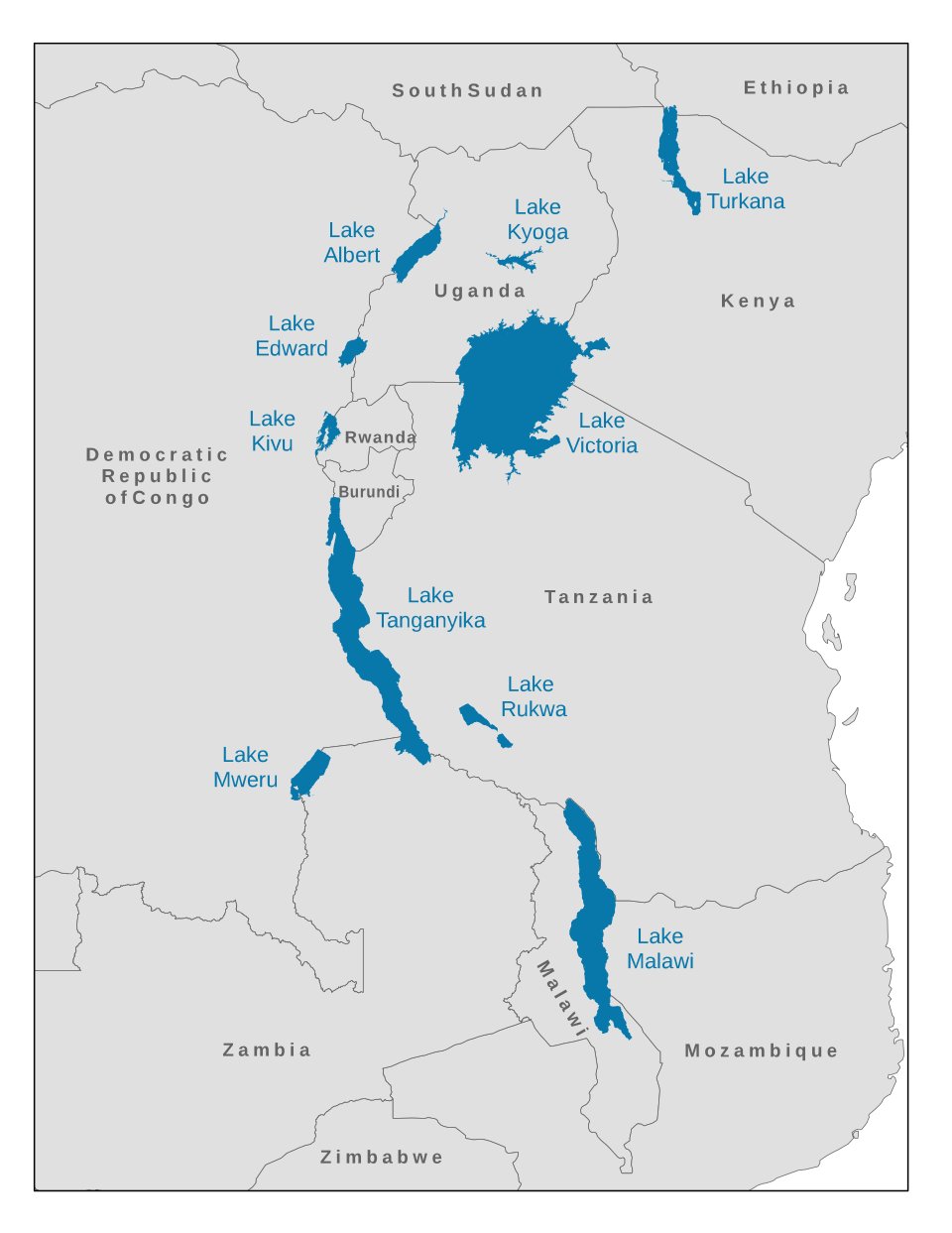
The Cobalt Mbuna is endemic to Lake Malawi in East Africa. The genus Cynotilapia is distributed widely throughout the lake, and C. Zebroides in particular is found at numerous locations along the rocky coastline. Each collection point produces a slightly different color variant, which has led to the incredible diversity of forms available in the hobby. Cobue, Jalo Reef, Likoma Island, and many others each have their own distinctive look.
In the wild, Cobalt Mbuna are cave dwellers that spend much of their time on or near the bottom among rocky substrates. They occupy the typical mbuna habitat. Boulder-strewn shorelines at shallow to moderate depths. Males establish territories around caves and rock formations, while females and non-territorial males form loose groups that move through the habitat foraging.
The genus name Cynotilapia refers to their distinctive unicuspid teeth (single-pointed, like canine teeth), which distinguishes them from most other mbuna that have bicuspid or tricuspid teeth. These teeth give them their alternate common name, “Dogtooth Cichlid.”
Appearance & Identification
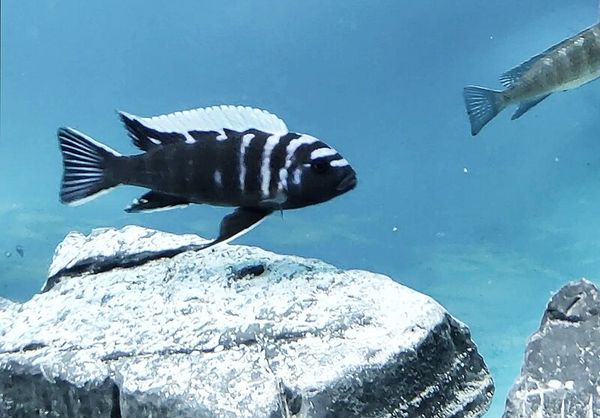
The appearance of the Cobalt Mbuna varies significantly depending on which geographic variant you have. Most forms feature a light blue base color with either black or dark blue vertical barring. Some of the most popular variants include forms with yellow or orange dorsal fins or upper bodies, creating a striking two-tone effect.
Their body shape is streamlined and laterally compressed. Typical mbuna proportions but slightly more slender than some of the stockier species like Red Zebras or Scrapermouth. They’re built for speed and agility, darting in and out of rocky crevices with ease. The “Cobue” variant, with its bright orange dorsal and blue body, is particularly popular in the hobby.
Male vs. Female
Sexual dimorphism varies by variant, but in most forms, males display more intense coloration than females. Here are the general differences:
| Feature | Male | Female |
|---|---|---|
| Color | More vivid blue with brighter barring and fin colors | Paler, less vivid coloration |
| Size | Up to 3.5 inches (9 cm) | Up to 3 inches (7.6 cm) |
| Egg Spots | More prominent on anal fin | Fewer or absent |
| Body Shape | Slightly more robust | Slightly slimmer, rounder when gravid |
| Behavior | Territorial, more active displays | More social, schools with other females |
Important: different variants of C. Zebroides should not be kept together, even if the males display different color patterns. They can hybridize, and maintaining the purity of geographic variants is important for the hobby.
Average Size & Lifespan
Cobalt Mbuna are one of the smaller mbuna species, with males reaching about 3.5 inches (9 cm) and females around 3 inches (7.6 cm). This compact size is one of their biggest advantages. They’re well-suited for medium-sized tanks where larger mbuna would feel crowded.
With proper care, Cobalt Mbuna can live 5. 10 years in captivity. Their hardiness and adaptability mean that well-maintained specimens often reach the upper end of that range. Good diet, clean water, and appropriate social structure are the keys to longevity.
Care Guide
Tank Size
A 55-gallon (208-liter) tank is appropriate for a group of Cobalt Mbuna. For a mixed mbuna community, 75 gallons (284 liters) or more is preferred. Despite their small size, these are active swimmers that appreciate horizontal space. A 4-foot tank is ideal.
Cobalt Mbuna are one of the few mbuna species that can work in all-male mixed tanks with other similarly mild species and milder Peacocks. In an all-male setup, a 75-gallon or larger tank with extensive rockwork is recommended.
Water Parameters
| Temperature | 76. 82°F (24. 28°C) |
| pH | 7.8. 8.6 |
| General Hardness (dGH) | 10. 20 dGH |
| Carbonate Hardness (dKH) | 10. 15 dKH |
| Ammonia | 0 ppm |
| Nitrite | 0 ppm |
| Nitrate | <20 ppm |
Standard Lake Malawi parameters apply. Use aragonite sand or crushed coral for natural pH buffering. Weekly water changes of 15. 25% keep the water clean and parameters stable.
Filtration & Water Flow
A quality canister filter provides the biological and mechanical filtration needed. Add a powerhead for supplemental water movement. Cobalt Mbuna appreciate moderate current and well-oxygenated water. Aim for 6. 8 times tank volume turnover per hour between your filter and powerhead.
Lighting
Standard aquarium LED lighting works perfectly. These fish display their colors well under moderate lighting. An 8. 10 hour photoperiod is ideal. Slightly longer photoperiods can encourage natural algae growth on rocks for supplemental grazing.
Plants & Decorations
Rockwork is essential. Build complex formations with caves, tunnels, and crevices. Cobalt Mbuna are cave dwellers that spend much of their time close to the bottom, so focus on creating an intricate rockscape with plenty of hiding spots. Use a dark sandy substrate with stacked limestone, lava rock, or holey rock.
Hardy plants like Anubias and Java Fern can survive in a Cobalt Mbuna tank if attached to rocks, though these fish may nibble on softer plant leaves. The focus should be on rockwork rather than plants.
Substrate
Fine dark sand is recommended. Cobalt Mbuna show their best colors over a darker substrate. Aragonite sand provides pH buffering, or use a mix of dark pool filter sand with crushed coral for a compromise between aesthetics and chemistry. These fish will sift through and rearrange sand in their territories.
Is the Cobalt Mbuna Right for You?
Cobalt Mbuna are the original zebra cichlid and a staple of the Malawi hobby. They are hardy and active, but you should know what morph you are getting and plan accordingly.
- Great fit if you want a classic mbuna species that has been a hobby staple for decades
- Great fit if you enjoy the variety of color morphs available within a single species
- Great fit if you have a 55 gallon or larger mixed mbuna community with moderately aggressive species
- Not ideal if you already keep Cobalt Blue Zebras. The visual similarity causes identification headaches and potential hybridization
- Not ideal if you want a specific color and are buying from a store that does not identify morphs accurately
- Not ideal if you keep Peacock cichlids. Cobalt Mbuna will outcompete them for food and territory
Cobalt Mbuna are reliable, colorful, and hardy. They have earned their place as one of the most popular mbuna for good reason. Just be sure you are getting the right species and morph for your setup.
Tank Mates
Best Tank Mates
Cobalt Mbuna are flexible tank mates due to their moderate aggression. They can work with a range of species, including some that wouldn’t tolerate more aggressive mbuna. Good options include:
- Yellow Lab (Labidochromis caeruleus). Classic peaceful pairing with contrasting color
- Rusty Cichlid (Iodotropheus sprengerae). Both mild mbuna, different colors
- Red Zebra (Metriaclima estherae). Good color contrast, manageable aggression
- Acei Cichlid (Pseudotropheus acei). Different tank zone, peaceful temperament
- Milder Peacock cichlids (Aulonocara spp.). Can work in well-stocked tanks
- Synodontis catfish. Reliable bottom dwellers for any Malawi setup
Tank Mates to Avoid
- Other Cynotilapia variants. Different variants will hybridize; never mix collection points
- Auratus (Melanochromis auratus). Too aggressive for the mild Cobalt Mbuna
- Kenyi (Maylandia lombardoi). Overly aggressive and boisterous
- Species with similar coloration. Blue-barred mbuna may trigger territorial aggression
- Small community fish. Not suitable for a cichlid environment
Food & Diet
Cobalt Mbuna are omnivores with a strong herbivorous lean. In the wild, they feed on a mix of algae and tiny invertebrates from the aufwuchs. In captivity, a diet high in vegetable content is essential for long-term health.
Spirulina-based flakes or pellets should form the foundation of their diet. Supplement with blanched vegetables, algae wafers, and nori. Occasional protein treats. Brine shrimp, mysis shrimp, daphnia. Are fine 1. 2 times per week. Avoid bloodworms and beef heart, which can cause digestive problems in herbivorous mbuna.
Feed 2. 3 small meals daily, providing only what is consumed within a few minutes. These are active, enthusiastic eaters that will quickly learn your feeding routine.
Breeding & Reproduction
Cobalt Mbuna are maternal mouthbrooders that breed readily in captivity with proper conditions.
Spawning Behavior
Males become more vibrant and assertive when ready to breed, displaying actively to attract females. The spawning follows the standard mbuna egg-dummy pattern. The female deposits and collects eggs in her mouth, then is lured by the male’s anal fin egg spots to pick up milt for fertilization.
For the best breeding results, keep 1 male with 5. 6 females. This distributes the male’s attention and prevents any single female from being over-harassed.
Mouthbrooding & Fry Care
The female carries the developing eggs for approximately 2. 3 weeks, fasting throughout. Her jaw will appear swollen, and she’ll become more reclusive. Clutch sizes are relatively small. 8. 15 fry. Reflecting the species’ compact size.
Once released, the fry are free-swimming and can take crushed spirulina flake, baby brine shrimp, and microworms immediately. For best survival, isolate the holding female in a grow-out tank before release. Cover the filter intake with mesh or sponge to prevent fry from being sucked in.
Common Health Issues
Malawi Bloat
All mbuna are susceptible to Malawi Bloat, and the Cobalt Mbuna is no exception. Caused by a protozoan that proliferates under stress or improper diet, symptoms include abdominal swelling, white feces, loss of appetite, and labored breathing. Prevention through plant-heavy diet and pristine water quality is essential. Treat early cases with Metronidazole in a hospital tank.
Ich (White Spot Disease)
Stress from transport or water quality issues can trigger ich. Watch for small white spots on the body and fins. Raise temperature gradually to 82°F (28°C) and treat with a quality ich medication. Cobalt Mbuna are hardy and recover well.
Bacterial Infections
Poor water quality can lead to fin rot, cloudy eyes, or red patches. Signs of bacterial infection. Maintain excellent water quality through regular changes and proper filtration. Treat with antibacterial medications if symptoms develop, and isolate affected fish in a hospital tank.
Common Mistakes to Avoid
- Mixing different Cynotilapia variants. Different collection point variants should never be kept together to prevent hybridization
- Feeding too much protein. A plant-heavy diet is essential for digestive health
- Housing with highly aggressive species. Cobalt Mbuna are moderate in aggression; they’ll be overwhelmed by Auratus or Kenyi
- Insufficient rockwork. As cave dwellers, they need plenty of hiding spots and territories
- Skipping water changes. Regular maintenance is non-negotiable for mbuna health
- Not enough females. Keep at least 5 females per male to prevent harassment
Where to Buy
Cobalt Mbuna are moderately available, with various color variants offered through specialized African cichlid retailers. Expect to pay $5. $15 per fish depending on the specific variant and size. For quality stock:
- Flip Aquatics. Quality African cichlids with various Cynotilapia variants available
- Dan’s Fish. Trusted retailer with a good selection of Lake Malawi species
When purchasing, make sure you know the specific collection point/variant you’re getting, and only buy one variant to avoid hybridization. Purchase a group of 6. 8 with a female-heavy ratio for the best results.
FAQ
Is Cynotilapia zebroides the same as Cynotilapia afra?
Essentially, yes. Cynotilapia zebroides is the current accepted scientific name for most of the fish previously sold as Cynotilapia afra. The reclassification happened as taxonomists refined the genus. If you see fish labeled as “Afra Cichlid” or “C. Afra,” they’re almost certainly C. Zebroides under the updated classification.
Can I keep different Cynotilapia variants together?
No. Different geographic variants of C. Zebroides should never be kept in the same tank, even if the males look different. Females of different variants are often difficult to distinguish, and hybridization is a real risk. Pick one variant and stick with it.
Are Cobalt Mbuna good for beginners?
They’re a solid choice for beginners to intermediate keepers. Their moderate aggression, small size, and hardiness make them more manageable than many mbuna species. If you have basic aquarium experience and understand Lake Malawi water chemistry, Cobalt Mbuna are an approachable species with a lot of personality.
Can Cobalt Mbuna live with Peacocks?
Yes. Cobalt Mbuna are mild enough to coexist with milder Peacock species, especially in well-stocked tanks with ample hiding spots. They’re actually one of the few mbuna that work in all-male mixed setups with mild Peacocks and other calm Lake Malawi species. Monitor interactions carefully and be prepared to rehome if issues arise.
What are the most popular Cynotilapia variants?
Some of the most sought-after variants include “Cobue” (orange dorsal with blue body), “Jalo Reef” (vivid blue with dark barring), “Likoma Island” (various blue/yellow combinations), and “Hai Reef” (blue with subtle barring). Each has its own distinct look, and availability varies by retailer. The “Cobue” variant is particularly popular for its striking orange-topped coloration.
Why are they called “Dogtooth” cichlids?
The name comes from their unicuspid teeth. Single-pointed teeth that resemble canine (dog) teeth. This is unusual among mbuna, most of which have bicuspid or tricuspid teeth. The scientific genus name Cynotilapia literally translates to “dog tilapia,” referencing this distinctive dental feature. Despite the name, their teeth are adapted for plucking plankton and tiny invertebrates from the water column, not for aggression.
What It Is Actually Like Living With Cobalt Mbuna
This is the part no other care guide gives you. Forget water parameters for a minute. Here is what it is actually like to share your tank with this species.
They have more personality than you expect. The Cobalt Mbuna is not a fish that just sits in the background. Once settled in, they become interactive, curious, and responsive to your presence.
Feeding time reveals their character. Watch how the Cobalt Mbuna approaches food and you will see real personality. Some are bold, some are cautious, and their feeding behavior tells you a lot about their mood and health.
They establish routines. After a few weeks, your Cobalt Mbuna will have favorite spots, preferred paths through the tank, and predictable patterns. Learning these routines makes you a better keeper.
Color is a health indicator. The Cobalt Mbuna’s coloration is a real-time report card on your husbandry. Vibrant color means happy fish. Faded color means something is wrong. Pay attention.
How the Cobalt Mbuna Compares to Similar Species
Choosing the right Malawi cichlid means understanding how similar species compare. Here is how the Cobalt Mbuna stacks up against species you will also be considering.
Cobalt Mbuna vs. Cobalt Blue Zebra
The Cobalt Mbuna (Metriaclima zebra) and Cobalt Blue Zebra (Metriaclima callainos) are the most commonly confused pair in the hobby. The simplest way to tell them apart is barring. M. Zebra shows faint vertical bars, while M. Callainos is a clean, solid blue. Both have similar care needs and aggression levels. I would not keep them together because the risk of hybridization is high, and telling juveniles apart becomes nearly impossible. You can learn more in our Cobalt Blue Zebra Care Guide.
Closing Thoughts
Cobalt mbuna are small but never stop moving, chasing, or fighting. Size is not temperament.
The Cobalt Mbuna is an excellent choice for anyone looking for a colorful, manageable, and fascinating Lake Malawi cichlid. The variety of geographic color forms means there’s a variant to suit almost any aesthetic preference, and their moderate aggression makes them far more flexible in terms of tank mate selection than most mbuna species.
Their compact size, hardy nature, and willingness to breed in captivity make them rewarding for both newcomers and experienced keepers. Just remember the golden rule of Cynotilapia keeping: pick one variant and never mix collection points. Give them clean water, a plant-based diet, plenty of rockwork, and a proper group with a female-heavy ratio, and your Cobalt Mbuna will be a lively, colorful highlight of your Lake Malawi aquarium for years to come.
This article is part of our Lake Malawi Cichlid Species Directory: Complete A-Z Care Guide List. Visit the hub page to explore care guides for all 28 Lake Malawi cichlid species we cover.
Recommended Video
References
- Seriously Fish. (n.d.). Cynotilapia zebroides. https://www.seriouslyfish.com/species/cynotilapia-zebroides/
- FishBase. (n.d.). Cynotilapia zebroides. https://www.fishbase.se/summary/Cynotilapia-zebroides.html
- Practical Fishkeeping. (n.d.). Cynotilapia species profiles. https://www.practicalfishkeeping.co.uk
- The Aquarium Wiki. (n.d.). Cynotilapia afra. https://www.theaquariumwiki.com/wiki/Cynotilapia_afra
- About the Author
- Latest Posts

I’m Mark Valderrama, founder of Aquarium Store Depot and a fishkeeper with over 25 years of hands-on experience. I started in the hobby at age 11, worked at local fish stores, and have kept freshwater tanks, ponds, and reef tanks ever since. I’ve been featured in two best-selling aquarium books on Amazon and built this site to share practical, experience-based fish keeping knowledge.
Leave a Reply