
Last Updated: June 25, 2026
Thank you for visiting! By the way… any links on this page that lead to products on Amazon and other stores/partners are affiliate links Aquarium Store Depot earns a commission if you make a purchase.
Table of Contents
- What Care Guides Get Wrong
- The Reality of Keeping Glowlight Tetra
- Key Takeaways
- Species Overview
- Classification
- Origin & Natural Habitat
- Appearance & Identification
- Average Size & Lifespan
- Care Guide
- Is It Right for You?
- What People Get Wrong
- Tank Mates
- Food & Diet
- Breeding & Reproduction
- Common Health Issues
- Common Mistakes to Avoid
- Where to Buy
- Frequently Asked Questions
- What It Is Actually Like Living With Glowlight Tetra
- Species Comparison
- Closing Thoughts
- References
The glowlight tetra is one of the most underrated community fish in the hobby. In the right conditions with dim lighting and dark substrate, the glowing orange stripe is stunning. In a bright, bare tank, it washes out to nothing. This fish rewards the keeper who pays attention to details.
Turn the lights down and this fish turns on.
The glowlight tetra in the right tank is a completely different fish than the one you see at the pet store.
Expert Take (Mark Valderrama, AquariumStoreDepot)
In the stores I managed, glowlight tetras were the fish that sold badly for weeks and then flew off the shelves once I moved them to a display with dark sand and a warm-toned light. Under the standard bright white light over white gravel, they looked like pale gray fish with a faint stripe – customers walked right past them. Same fish, dark substrate, dimmed warm light: the stripe glowed copper-orange and people would stop mid-aisle. The fish didn’t change. The light did. This is the fish that punishes the wrong setup and rewards the right one more visibly than almost anything else in the community tank category.
The Reality of Keeping Glowlight Tetra
Lighting makes or breaks this fish. Harsh white LEDs at full power wash out the glow stripe completely. Warm-toned, moderate lighting on a dark substrate is what activates the signature look. If you run your lights at maximum brightness, dial them back for this species. The difference is dramatic.
They are hardier than people think. Glowlight tetras tolerate a wider range of water parameters than most popular tetras. They handle temperatures from 74 to 82F and pH from 5.5 to 7.5 without issue. For a fish this attractive, the care requirements are surprisingly forgiving.
Group size is the biggest factor in behavior. Six glowlights look like random fish swimming near each other. Ten or more start schooling, displaying to each other, and developing deeper color. The jump from 6 to 10+ is where this species goes from acceptable to impressive.
Biggest Mistake New Owners Make
Keeping them under bright white lighting on light-colored substrate. This single setup choice eliminates the entire appeal of the species. Dark substrate and moderate lighting are not suggestions. They are requirements for seeing what this fish actually looks like.
Key Takeaways
- Minimum tank size is 15 gallons (57 liters) for a school of 6, but 20+ gallons with 10 fish looks incredible
- One of the most peaceful tetras. Safe even with long-finned species like bettas
- Omnivore. Eats virtually anything, from flake food to frozen bloodworms
- Great beginner fish. Hardy, inexpensive, and widely available
- Best colors show under dim lighting with a dark substrate
Species Overview
| Field | Details |
|---|---|
| Scientific Name | Hemigrammus erythrozonus |
| Common Names | Glowlight Tetra, Glo-Lite Tetra, Fire Neon |
| Family | Acestrorhamphidae |
| Origin | Essequibo River basin, Guyana |
| Care Level | Easy |
| Temperament | Peaceful |
| Diet | Omnivore |
| Tank Level | Mid to Bottom |
| Maximum Size | 1.6 inches (4 cm) |
| Minimum Tank Size | 15 gallons (57 liters) |
| Temperature | 75–82°F (24–28°C) |
| pH | 5.5–7.5 |
| Hardness | 2–15 dGH |
| Lifespan | 3–5 years in captivity |
| Breeding | Egg scatterer |
| Breeding Difficulty | Easy to Moderate |
| Compatibility | Community |
| OK for Planted Tanks? | Yes |
Classification
| Taxonomic Level | Classification |
|---|---|
| Order | Characiformes |
| Family | Acestrorhamphidae (reclassified from Characidae, Melo et al. 2024) |
| Subfamily | Pristellinae |
| Genus | Hemigrammus |
| Species | H. Erythrozonus (Durbin, 1909) |
ASD Difficulty Rating
Beginner | 3/10
One of the most underrated beginner tetras. As easy as a neon tetra and significantly more durable, with striking orange-gold coloring that shows best in a dimly lit planted tank with dark substrate. Setup matters more than water chemistry with this species.
The genus Hemigrammus currently contains over 70 species of small characins, and its taxonomy is considered Incertae Sedis (uncertain placement). Most experts agree a full revision is needed, which results in many species being moved to new or different genera. For now, the glowlight tetra remains firmly in Hemigrammus alongside other popular aquarium species.
Note on reclassification: In 2024, a major phylogenomic study (Melo et al.) split the traditional family Characidae into four separate families. The genus Hemigrammus was moved into the newly erected family Acestrorhamphidae under the subfamily Pristellinae. Some older references still list this species under Characidae.
Origin & Natural Habitat
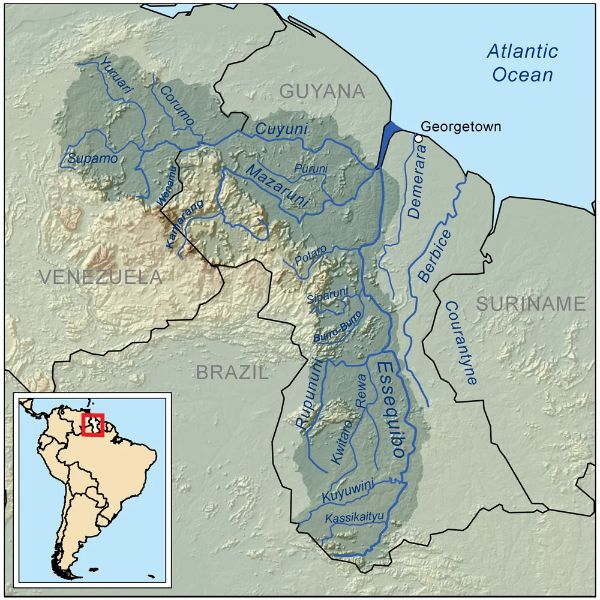
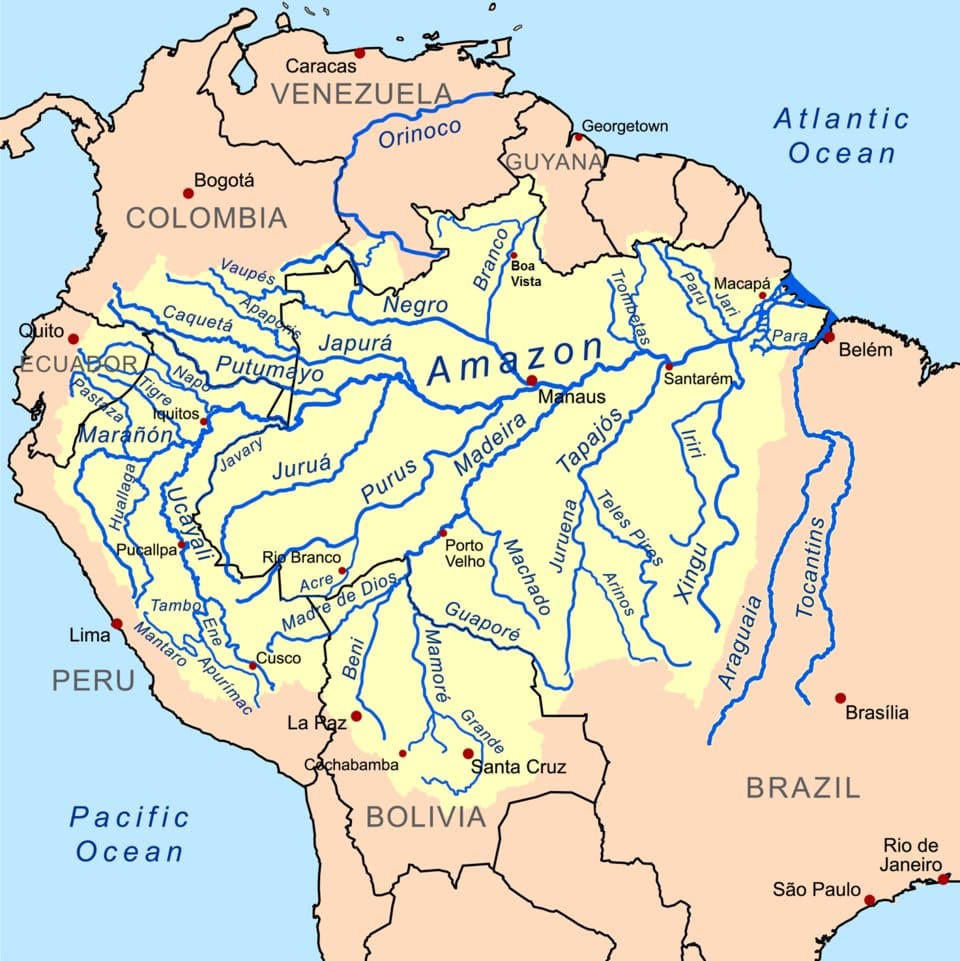
The glowlight tetra comes from a single river system. The Essequibo River in Guyana, the longest river in the country. They were first exported to Europe in the 1930s and quickly became a staple in the hobby.
In the wild, glowlights stick to forested tributaries rather than the main river channel. These small streams flow through dense jungle, where the canopy blocks most sunlight. The water is stained dark brown by tannins from decomposing leaves and wood. Classic blackwater conditions. It’s soft, acidic, and low in dissolved minerals.
The bottom of these streams is littered with fallen branches, tree roots, and layers of leaf litter. There isn’t much aquatic vegetation in the deepest blackwater areas, but the structure from all that wood and debris provides plenty of cover. Understanding this habitat explains why glowlights look their best in dimly lit tanks with dark substrates and tannin-stained water. That’s their home.
Virtually every glowlight tetra you’ll find for sale is commercially bred. Wild-caught specimens are essentially nonexistent in the trade, with most stock coming from farms in Eastern Europe and Asia.
Appearance & Identification
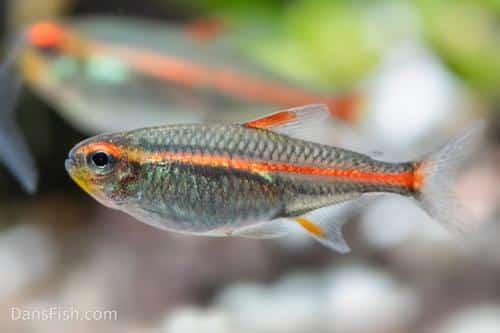
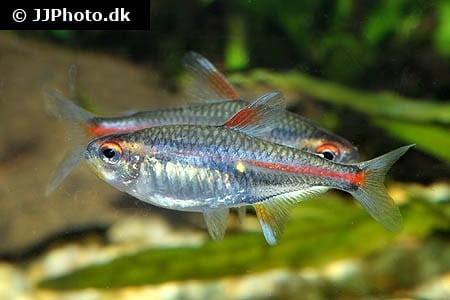
The glowlight tetra has a slender, torpedo-shaped body with a translucent silver-peach base color. The star of the show is the brilliant iridescent stripe that runs the entire length of the body from snout to tail. This stripe starts as a soft pinkish tone near the head and intensifies to a vivid neon orange-red toward the tail. The effect is genuinely striking under the right lighting.
The leading edge of the dorsal fin carries the same glowing orange-red as the body stripe, which is a nice detail that catches your eye when the fish swims. All other fins are mostly transparent with a slight silvery sheen. The belly area has a subtle silver coloring.
Interestingly, the red-orange iridescence in glowlights is fairly unusual among fish. Most iridescent species reflect blue or green light, so the warm tones in the glowlight make it genuinely unique. Under dim lighting against a dark background, the stripe does glow from within. Hence the name.
There is a selectively bred albino variety that lacks the dark body pigment but retains the orange stripe. It’s becoming more common in stores and requires identical care.
Male vs. Female
Sexing glowlights isn’t easy until they’re fully mature, but there are a couple of reliable tells. Females grow slightly larger and develop a noticeably rounder belly, especially when carrying eggs. Males are slimmer with a slightly more streamlined profile and may show marginally more intense coloration along the lateral stripe. There are no dramatic color differences between the sexes like you’d see in some other fish.
Average Size & Lifespan
Adult glowlight tetras reach about 1.5 inches (3.5–4 cm) in total length. They’re a small species, which makes them well suited for tanks in the 15–30 gallon (57–114 liter) range.
In captivity, you can expect a lifespan of 3 to 5 years with proper care. In my experience, aquarists report them living longer in ideal conditions, but that 3–5 year range is realistic for most setups. Because all commercial stock is captive bred, genetic quality is consistent, though buying from reputable sellers always helps.
Care Guide
Tank Size
A 15-gallon tank is the minimum for a school of 6 glowlight tetras, but I’d strongly recommend going with a 20-gallon long if you can. The extra swimming length lets them school naturally, and the visual effect of 10 or more glowlights moving together in a longer tank is something a smaller setup just can’t replicate.
These fish spend most of their time in the lower to middle water column, so a tank with more horizontal footprint matters more than height.
Water Parameters
| Parameter | Ideal Range |
|---|---|
| Temperature | 75–82°F (24–28°C) |
| pH | 6.0–7.5 |
| Hardness | 2–12 dGH |
| KH | 1–8 dKH |
Hard Rule: Dark substrate and a school of 8 minimum.
Under 6 fish, glowlights become skittish, hide constantly, and the orange stripe fades with chronic stress. On light-colored gravel under bright light, the stripe disappears entirely. A group of 10 to 15 on dark sand with moderate lighting shows the full schooling display and bold color that makes this fish worth keeping.
One of the best things about glowlight tetras is their adaptability. While they come from soft, acidic blackwater in the wild, commercially bred specimens handle a much wider range of conditions than their wild ancestors would tolerate. They’ll do fine in moderately hard water around neutral pH. Something neon tetras are less forgiving about.
That said, they show their best coloration in softer, slightly acidic water. If you want that stripe to really pop, aim for the lower end of the pH and hardness ranges. And as always, consistency matters more than perfection. Stable parameters beat “ideal” numbers that fluctuate.
Filtration & Water Flow
Gentle flow is the key here. Glowlights come from slow-moving forest streams, and strong currents will stress them out. A sponge filter is ideal for smaller setups. It provides biological filtration without creating much current, and it’s safe for fry if you ever try breeding. For larger tanks, a hang-on-back or canister filter with a spray bar works well as long as you keep the output diffused.
Weekly water changes of 20–25% will keep things stable. These fish aren’t particularly messy, but they are sensitive to sudden shifts in water chemistry, so regular small changes are better than infrequent large ones.
Lighting
This is a fish that genuinely transforms depending on your lighting. Under bright, harsh lights, glowlights look washed out and unimpressive. You’ll wonder what the fuss is about. Dial the lighting down or add floating plants to create shaded areas, and that orange-red stripe starts glowing like a hot ember. The difference is night and day.
If you’re running a planted tank with stronger lighting, floating plants like Amazon frogbit, salvinia, or red root floaters will create the dappled shade glowlights prefer. They’ll naturally gravitate to the shaded zones.
Plants & Decorations
A planted tank is where glowlight tetras really shine. Literally. Java fern, Anubias, Cryptocoryne species, and Java moss all work well and thrive in the same lower-light conditions glowlights prefer. Dense planting along the back and sides with open swimming space in the center is the classic layout that works beautifully.
Driftwood is a must in my experience. It provides structure, releases tannins that soften the water, and creates the dark backdrop that makes the glowlight stripe pop. Add some dried oak or Indian almond leaves on the substrate for a natural blackwater look. The leaves will slowly decompose and release beneficial tannins while providing microfauna for the fish to pick at.
Substrate
Dark substrate is non-negotiable if you want to see these fish at their best. Fine dark sand or a dark planted tank substrate makes the glowlight stripe appear significantly more vivid. On a light-colored gravel, these fish look plain and pale. You’d barely notice them. It’s one of the biggest visual differences I’ve seen substrate color make on any fish.
Is the Glowlight Tetra Right for You?
Honest assessment before you buy. The glowlight tetra is genuinely beginner-friendly – but only if you set the tank up to show what this fish actually looks like.
- Good fit if: You want a warm-toned, peaceful tetra that works with almost any community setup and won’t harass long-finned fish or adult shrimp.
- Good fit if: You have or are willing to set up a planted tank with dark substrate and moderate to subdued lighting. This is where the glowlight goes from unremarkable to genuinely stunning.
- Good fit if: You want a hardy alternative to neon tetras that handles a wider range of water parameters without the same disease sensitivity.
- Think twice if: Your tank has bright white LEDs at full power over light gravel. In that setup, the glowlight stripe disappears and the fish looks plain. This species is built for a specific aesthetic – if you won’t adjust the setup, choose a different tetra.
- Think twice if: You can only keep 4 or 5. A group under 6 is a stressed, hiding group of fish. This species needs numbers to behave and color up.
- Think twice if: You want instant visual impact straight from the store. These fish take time to settle in and show their best color – the transformation is real but it is not immediate.
What People Get Wrong
The biggest mistake is dismissing glowlight tetras as boring because they lack the fluorescent blue stripe of a neon. Under store lighting, they look pale and unimpressive. In a warm-lit planted tank with dark substrate, the orange-gold lateral stripe glows in a way that surprises people who have never seen them in the right setup.
Second mistake: keeping too few. A group of 4 or 5 glowlight tetras is a stressed group of fish that stays pale, hides, and shows nothing interesting. A group of 10 or more in a planted tank moves confidently, schools tightly, and puts the orange stripe on display. Group size is not optional.
Third: putting them in new tanks. Glowlight tetras are more sensitive to ammonia and nitrite than their hardiness reputation suggests. They need an established, cycled tank. Add them early to a new setup and you will lose fish and wonder why.
Tank Mates
Best Tank Mates
Glowlight tetras are among the most peaceful tetras in the hobby. They’re not fin nippers, which makes them safe with a surprisingly wide range of tank mates. Even long-finned species that most tetras would harass:
- Corydoras catfish. Ideal bottom-dwelling companions that stay out of the glowlights’ space
- Neon tetras. Similar size and temperament, beautiful contrast of blue and orange
- Harlequin rasboras. Peaceful mid-level schoolers that complement glowlights perfectly
- Ember tetras. Another warm-toned tetra that pairs well visually and temperamentally
- Dwarf gouramis. A colorful centerpiece fish that won’t bother glowlights
- Otocinclus catfish. Gentle algae eaters that are completely non-threatening
- Cherry shrimp. Glowlights are one of the safer tetras to keep with adult shrimp
- Kuhli loaches. Peaceful bottom dwellers that add interest to the lower tank zone
- Apistogramma dwarf cichlids. A natural pairing if you’re doing a South American biotope
- Pencilfish. Gentle, slender fish from similar habitats
Tank Mates to Avoid
- Angelfish. They’ll eat glowlights once they grow large enough
- Tiger barbs. Too nippy and boisterous for peaceful glowlights
- Large cichlids. Any fish big enough to view a glowlight as food
- Red tail sharks. Territorial and prone to chasing small tetras
- Aggressive or fast-moving species. Anything that will outcompete glowlights for food or stress them out
Food & Diet
Glowlight tetras are some of the easiest fish to feed. They’re true omnivores that will accept virtually anything you offer. Flake food, micro pellets, freeze-dried options, you name it. In the wild, they eat small worms, crustaceans, and plant matter.
A high-quality flake or micro pellet makes a good daily staple. To bring out the best color and keep them in peak health, supplement with frozen or live foods a few times per week. Daphnia, brine shrimp, bloodworms, and cyclops are all eagerly accepted and make a real difference in how vibrant that glowlight stripe looks.
Feeding frequency: Once or twice daily, only what they can finish in about 2 minutes. These are small fish with small stomachs.
Pro tip: Glowlights are reluctant to chase food that sinks to the bottom. They prefer to eat in the water column, so use slow-sinking foods or feed small pinches at the surface that they can grab on the way down. If you’re keeping them with bottom feeders like corydoras, the cories will happily clean up whatever the glowlights miss.
Breeding & Reproduction
Glowlight tetras are one of the easier tetras to breed at home, making them a solid choice if you’re getting into breeding egg scatterers for the first time.
Breeding Difficulty
Easy to moderate. They’ll breed readily once the conditions are right, and they’re more forgiving of imperfect setups than many other tetras.
Spawning Tank Setup
You’ll need a separate breeding tank. A 10–15 gallon (38–57 liter) tank works well. Keep the lighting very dim or cover the sides of the tank, as both eggs and fry are light-sensitive in the early stages. Add clumps of fine-leaved plants like Java moss or spawning mops to give the fish somewhere to scatter their eggs. Alternatively, cover the bottom with mesh large enough for eggs to fall through but small enough to keep the adults from reaching them. Glowlights will eat their own eggs if given the chance.
Water Conditions for Breeding
Soft, acidic water is key. Aim for pH 5.5–6.5, hardness of 1–5 dGH, and a temperature around 80–84°F (27–29°C). Filtering the water through peat or using RO water helps achieve these conditions. A small air-powered sponge filter bubbling gently is all the filtration you need.
Conditioning & Spawning
You can spawn them in a group (6 males and 6 females works well) or in pairs. For pair spawning, condition males and females separately for 1–2 weeks with plenty of small live foods like daphnia and brine shrimp. When females are visibly plump with eggs and males are showing their brightest colors, transfer the best pair to the spawning tank in the evening. They’ll typically spawn the following morning. Interestingly, during the act itself, the pair often turns completely upside down. It’s a unique behavior among tetras.
Egg & Fry Care
Remove the adults immediately after spawning. They will eat every egg they can find. Eggs hatch in 24–36 hours, and the fry become free-swimming 3–4 days after that. Feed infusoria or liquid fry food for the first few days, then graduate to microworms and freshly hatched baby brine shrimp (BBS) once they’re large enough. Keep the tank dark during the early stages, as the eggs and fry are light-sensitive. A healthy female can produce 120–150 eggs per spawn.
Glowlight tetras are almost exclusively captive-bred in the hobby. All commercial stock comes from farms in Eastern Europe and Asia. Wild-caught specimens are essentially nonexistent in the trade.
Common Health Issues
Glowlight tetras are hardier than many other popular tetras, but they’re not bulletproof. Here are the main health concerns to watch for:
Neon Tetra Disease (NTD)
Despite the name, neon tetra disease doesn’t only affect neons. Glowlight tetras are also susceptible. It’s caused by the microsporidian parasite Pleistophora hyphessobryconis, which invades the fish’s muscles. Symptoms include pale patches on the body, loss of color, lethargy, and eventually a curved spine. There is no effective cure. Infected fish should be removed immediately to prevent spreading.
Ich (White Spot Disease)
Like most tropical fish, glowlights can pick up ich when stressed. Usually from temperature swings or being added to a new tank. The telltale white spots are easy to identify. Gradually raise the temperature to 82°F (28°C) and treat with a standard ich medication. Glowlights generally tolerate treatment well.
General Prevention
The best defense is prevention. Quarantine all new fish for at least two weeks before adding them to your main tank. Maintain stable water parameters and keep up with your water change schedule. Glowlights are particularly sensitive to sudden swings in water chemistry, so consistency is key.
Common Mistakes to Avoid
- Bright lighting with no shade. This is the biggest mistake people make with glowlights. Under intense lighting, they look pale and boring. Add floating plants or dim the lights, and they transform into a completely different fish.
- Light-colored substrate. A white or beige gravel washes out their colors dramatically. Dark sand or substrate is essential for the full glowlight effect.
- Keeping too few. Groups under 6 lead to stressed, shy fish that hide constantly. Get at least 6, ideally 10+. In small groups, they can even become nippy. Which is out of character for this otherwise gentle species.
- Sudden parameter changes. Glowlights are adaptable to a wide range of conditions, but they don’t handle rapid shifts well. Acclimate new fish slowly and keep your maintenance routine consistent.
Where to Buy
Glowlight tetras are widely available at most local fish stores and chain pet retailers. They’re one of the more common tetras in the trade, typically priced at $2–4 per fish. You’ll often find discounts on schools of 6 or more.
For better quality stock, I recommend ordering from Flip Aquatics or Dan’s Fish. Both carry healthy, well-acclimated captive-bred glowlights that will arrive in better condition than big box store fish. All glowlights in the trade are captive bred. Wild-caught specimens from Guyana are essentially nonexistent commercially.
Frequently Asked Questions
How many glowlight tetras should be kept together?
A minimum of 6, but 10 or more is strongly recommended. Glowlight tetras are a shoaling species that become stressed, shy, and can even turn nippy in small groups. In larger schools, they feel secure and display their best behavior and coloration.
What size tank does a glowlight tetra need?
A 15-gallon tank is the minimum for a small school of 6. A 20-gallon long is the sweet spot for a proper school of 10+, giving them enough horizontal swimming space to school naturally.
Are glowlight tetras good for beginners?
Absolutely. Glowlight tetras are one of the best beginner tetras available. They’re hardier and more adaptable than neon tetras, accept any food, and are peaceful with virtually all community tank mates. Just make sure your tank is cycled before adding them.
Can glowlight tetras live with bettas?
Yes. Glowlight tetras are actually one of the safer tetra choices for a betta tank. Unlike some tetras, glowlights are not fin nippers, so they won’t harass a long-finned betta. Use at least a 20-gallon tank with plenty of plants, and monitor the betta’s temperament since some individuals are more aggressive than others.
How long do glowlight tetras live?
Glowlight tetras typically live 3 to 5 years in a well-maintained aquarium. In my experience, hobbyists report them reaching the upper end of that range or slightly beyond with optimal water quality and diet.
Why do my glowlight tetras look pale?
The most common cause is lighting and substrate. Glowlights look dramatically washed out under bright lights or over light-colored gravel. Switch to a dark substrate, add floating plants to dim the lighting, and you should see a major improvement. Other causes include stress from too few tank mates, poor water quality, or recent introduction to a new tank.
Are glowlight tetras and neon tetras the same thing?
No. They’re completely different species from different genera. Neon tetras (Paracheirodon innesi) have a blue and red stripe, while glowlight tetras (Hemigrammus erythrozonus) have a single orange-red stripe. They come from different parts of South America (neons from the Amazon basin, glowlights from Guyana). They do make excellent tank mates, though. The blue and orange complement each other beautifully.
What It Is Actually Like Living With Glowlight Tetra
This is the part no other care guide gives you. Forget water parameters for a minute. Here is what it is actually like to share your tank with this species.
The glowlight tetra is a background fish that becomes a centerpiece when the tank is set up right. In a dimly lit planted tank with dark substrate, a school of 12 or more moving together creates a warm, pulsing glow across the mid-water. The copper-orange stripes catch the light at different angles as they turn – it is genuinely unlike anything else you can do with a small tetra at this price point.
Day to day, they are one of the most low-drama fish you can own. No fin nipping, no territory disputes, no aggressive posturing. They move as a loose school, drift apart to explore, and pull back together when something startles them. The tight schooling response is visible and satisfying – a flash of orange converging into a single moving shape, then dispersing again.
Feeding is frictionless. They eat at the surface, mid-water, and slowly work their way down as food sinks. They are not competitive feeders and will not bully shrimp or smaller tank mates. If you want a peaceful, visually rewarding fish that rewards good lighting and tank design rather than demanding constant attention, the glowlight delivers.
How the Glowlight Tetra Compares to Similar Species
Glowlight Tetra vs. Ember Tetra
Choose the Ember Tetra if you are running a nano tank under 15 gallons or want a denser, more uniformly orange look throughout the school. Embers are smaller, tighter schoolers and their full-body orange is more saturated than the glowlight stripe. Choose the Glowlight Tetra if you want the defined iridescent stripe with greater visual contrast, a slightly larger fish with more presence in a standard community tank, and better tolerance of moderately hard water without losing color.
Glowlight Tetra vs. Neon Tetra
Choose the Neon Tetra if you want the classic cool blue-and-red combination and you are running soft, acidic water where neons thrive. Choose the Glowlight Tetra if you want a warmer, more naturalistic aesthetic, a hardier fish with better disease resistance, and a species that performs well in moderately hard tap water without needing acidic conditions or a blackwater setup to stay healthy.
Closing Thoughts
The glowlight tetra is an underrated gem in the freshwater hobby. It’s hardy, peaceful, affordable, and absolutely gorgeous in the right setup. Give them a dark substrate, some dim lighting, a few pieces of driftwood, and a proper school, and you’ll have one of the most eye-catching displays in a community tank.
If you’re looking for other small tetras to keep alongside your glowlights, check out our care guides for ember tetras, cardinal tetras, and black neon tetras.
Have you kept glowlight tetras? I’d love to hear about your setup. Drop a comment below!
Recommended Video
Check out our tetra tier list video where we rank the most popular tetras in the hobby, including the glowlight tetra:
References
- Hemigrammus erythrozonus Profile. Seriously Fish
- Hemigrammus erythrozonus (Durbin, 1909). FishBase
- How to Breed the Glowlight Tetra. Practical Fishkeeping
- Hemigrammus erythrozonus Species Profile. TFH Magazine
- Hemigrammus erythrozonus. The Aquarium Wiki
- About the Author
- Latest Posts

I’m Mark Valderrama, founder of Aquarium Store Depot and a fishkeeper with over 25 years of hands-on experience. I started in the hobby at age 11, worked at local fish stores, and have kept freshwater tanks, ponds, and reef tanks ever since. I’ve been featured in two best-selling aquarium books on Amazon and built this site to share practical, experience-based fish keeping knowledge.
Leave a Reply