Last Updated: June 25, 2026
Thank you for visiting! By the way… any links on this page that lead to products on Amazon and other stores/partners are affiliate links Aquarium Store Depot earns a commission if you make a purchase.
Looking for a full Mandarin Goby care guide? I have you covered today on this beautiful, but tricky to care for fish.
The Mandarin Goby is a small fish with enormous care demands. They are visually unlike anything else in the saltwater hobby, but their nearly exclusive diet of live copepods makes them one of the hardest fish to keep alive long-term. This guide gives you everything you need to know before buying one and what it actually takes to keep one thriving.
Expert Take (Mark Valderrama, AquariumStoreDepot)
After 25 years in this hobby and time managing fish stores, I’ve seen more mandarin gobies die in the first month than almost any other saltwater species. Not because they’re disease-prone. Because they starve. The pod supply runs out and the fish declines before the owner realizes what’s happening. If your tank isn’t producing or receiving a steady pod supply, this is not your fish yet. Build that foundation first.
ASD Difficulty Rating: Expert
The mandarin goby’s nearly exclusive dependence on live copepods makes it one of the most challenging reef fish in the hobby. Requires a mature, established reef with a thriving pod population, or a dedicated pod culture system. Not suitable for beginners or newly set-up tanks.
Species Overview
| Scientific Name | Synchiropus splendidus |
| Common Names | Mandarin goby, mandarinfish, mandarin dragonet, green mandarin |
| Family | Callionymidae (Dragonets) |
| Origin | Western Pacific Ocean |
| Diet | Carnivore (copepods and small invertebrates) |
| Colors | Blues, greens, oranges, reds |
| Care Level | Difficult to Expert |
| Temperament | Peaceful |
| Minimum Tank Size | 30 gallons (113 liters) |
| Max Size | 3 inches (7.6 cm) |
| Temperature Range | 76–82°F (24–28°C) |
| pH Range | 8.0–8.4 |
| Salinity | 1.025 (35 PPT) |
| Reef Safe | Yes |
| Available As Tank Bred | Rare |
What People Get Wrong
Most people buy mandarin gobies because of their colors and assume the fish is as easy as it looks harmless. It’s not. The mandarin’s challenge isn’t water parameters or disease susceptibility. It’s feeding. These fish eat almost exclusively live copepods, and a tank that hasn’t built up a thriving, self-replenishing pod population will have an empty pantry within days.
The second mistake is confusing “can survive in” with “thrives in.” Yes, hobbyists have kept mandarins in 10-gallon tanks. Those are expert-level setups with extraordinary pod management. The casual hobbyist needs at minimum 30 gallons (113 liters) with a refugium running underneath and a robust live rock ecosystem that has been established for at least a year.
Third mistake: skipping the feeding check at purchase. Never buy a mandarin goby unless the store can show you it eating. A mandarin that won’t eat frozen food and is in a tank without pods is already declining.
The Hard Rule
Do not buy a mandarin goby until your tank has been established for at least 12 months with a healthy, visible copepod population. This is not optional. A new tank does not have the pod density to sustain this fish. Buying one earlier is buying it a slow death.
Origins And Habitat
It is crazy to think that such beautiful fish exist on their own in the wild. The mandarin goby is a spectacle to find around Pacific reefs. More specifically, they can be found in the Western Pacific Ocean, from the Ryukyu Islands below Japan to the barrier reefs off the coasts of Australia.
There, they live in and around shallow reefs and lagoons less than 60 feet (18 meters) in depth. They prefer silty bottoms littered with pieces of coral that won’t injure their underbodies. These islands of reef provide good hunting grounds for their favorite food, copepods, as well as other small invertebrates and microorganisms.
Interestingly, mandarin gobies are usually seen in small groups, foraging together among this rubble.
What Do They Look Like?

Mandarin gobies are some of the most beautiful fish in the fishkeeping hobby. Unfortunately, this beauty, combined with their relatively low price point, causes them to end up in the wrong hands of inexperienced hobbyists. The colors come at a price in care complexity.
Mandarin gobies have a deep aquamarine body with swirls and spots of greens and oranges that lead into a spectacular large reddish-orange tail fin. They also have a very distinguishable red eye against a lighter green head.
These gobies have large pectoral fins that they use to navigate and hover over coral reefs and the seafloor. They also have impressive dorsal fins that can easily collapse or be raised for a sail-like effect. As we’ll discuss, these dorsal fins are also used for telling the difference between males and females.
Mandarin gobies are only 3 inches (7.6 cm) long at mature size, but they immediately catch the eye with their unparalleled colors. In fact, they’re one of the few species of fish to express true blue pigmentation.
Male vs Female
If planning to attempt to breed mandarin gobies in your own reef aquarium, it is important to be able to distinguish a male from a female. Luckily, these fish are pretty easy to tell apart from each other, making it easy to obtain one of each.
The main difference between a male and female mandarin goby is the presence of an elongated spine at the front of the first dorsal fin. Males will have a noticeable point on top of their heads that cascades into a normal dorsal fin. Females will not have this spike and will have a rounded first dorsal fin instead.
Tank Requirements
In terms of setup, mandarin gobies are easy to keep. They do well in reef settings with lots of cracks and crevices for them to hide in and to forage for food. A soft substrate, like aragonite sand, will also keep their underbellies safe from jagged, coarser granules.
Mandarin gobies are considered a nano species and hobbyists have kept them in aquarium sizes as small as 10 gallons (38 liters). However, these are expert hobbyists and the casual fish keeper will not be able to do this for dietary reasons we will discuss later.
Instead, these gobies should be kept in a minimum tank size of 30 gallons (113 liters). An even larger tank will help maintain a steady food supply. Even big tanks with mandarin gobies in them will still need supplemental feeding from time to time.
Should You Quarantine Them?
For being such a difficult fish to keep alive in the aquarium, mandarin gobies are actually quite resilient and have good immunity to most common aquarium diseases.
These fish are known to excrete a protective mucus that prevents them from getting the most common aquarium diseases, especially those that attack the external body like some parasites. In addition to this natural defense, most hobbyists don’t quarantine them due to their immediate dependency on a living ecosystem.
Placing a mandarin goby in quarantine is basically redundant. Most medications that could preemptively be dosed would end up killing any and all pods while unnecessarily stressing out your fish. This could lead to a starving fish that might have been relatively healthy in the first place.
Instead of quarantining your mandarin goby, buy from a reputable local fish store. Introduce it to the main display and observe closely for any signs of sickness. The most important thing, though, is to get your goby regularly eating and accepting a variety of foods as soon as possible.
Mandarin Goby Care Guide
While mandarin gobies are mostly peaceful, they can be aggressive towards other fish around the reef, especially other similar-looking sand dwellers.
The same is true for keeping mandarin gobies with other mandarin gobies. However, given some time, multiple goby species are able to work out territories among themselves after a bit of fin nipping. If you have a male and female mandarin goby, you might even end up with a breeding pair when all is said and done.
If planning on keeping more than one species of goby in the reef aquarium, it is imperative to have a steady source of copepods. This can be achieved through harvesting your own copepods as well as having a larger tank in general. You can also purchase pods from companies like Algaebarn.

This pod package from Algaebarn is a great way to add biodiversity to your aquarium and food sources for many reef fish. Highly recommended
Otherwise, mandarin gobies can be seen weaving in and out of the rockwork looking for food. They are shy fish and spend most of their time at the bottom of the tank, but they might venture up to the higher portions of the rockwork if hunting is good.
In general, if you see your fish picking at the rock, there is food available. You should be concerned if your fish starts to become more lethargic or duller in appearance and is drifting from rock to rock without nipping at anything.
Are They Reef-Safe?
Yes, mandarin gobies are very reef-safe. The only annoyance they may bring to corals is when they float over or sit on top of them while hunting for copepods.
Are They Poisonous?
You might’ve heard that the most colorful animals in the world are toxic, like poison dart frogs. Being one of the most colorful fish on the reef, does this mean that you need to worry about your mandarin goby killing the rest of the fish in your tank?
Yes, mandarin gobies do carry toxins. However, it’s something you’ll rarely ever have to worry about.
When threatened, these peaceful fish excrete toxic mucus that apparently has a disgusting odor as well. It isn’t exactly known how detrimental this poison can be to nearby life, but the smell of the mucus can be very noxious.
It is very rare for your fish to excrete this mucus as they are incredibly docile. However, if they are mishandled or threatened by another fish, they will use this as protection. The excretion of the mucus can be seen as fine filaments in the water radiating away from their bodies.
Having to excrete this mucus often stresses out the fish a great deal and it is likely that the fish will die shortly after. If this happens while in the reef aquarium, do a water change immediately and continue to monitor parameters. Once things are under control, look for the cause of the annoyance.
Tankmates

Mandarin gobies are reef-safe fish. They can be kept with an assortment of peaceful fish that won’t chase them around or try to steal their favorite places among the rockwork.
This can be troublesome with keeping mandarins with other gobies and blennies that might get too close to their territories. Though multiple goby species can be kept in larger tanks, it’s usually only recommended for much larger systems with a steady food supply and intricate rockwork.
Otherwise, mandarin gobies can be kept with clownfish, tangs, wrasses, and other common reef fish species as well as most invertebrates. However, these fish will not do well in aquariums with higher flow, like small polyp stony (SPS) coral systems that need lots of water flow. Excessive flow makes hunting difficult and might make them stay hidden within the rockwork.
As these fish typically stay towards the bottom of the tank though, they usually don’t irritate too many corals by floating over them.
What Do They Eat?
This is where mandarin gobies get difficult. Up to this point, mandarin goby care has been straightforward, though they’re unlike any other reef fish you might have kept before.
When looking at a mandarin goby, you realize just how small their mouth really is. These picky eaters have incredibly small mouths fit for eating one main invertebrate: copepods.
What Are Copepods?

When hobbyists refer to saltwater rock as being ‘live’, they mean it in a few ways. One of the most obvious ways is understanding that it houses microscopic beneficial bacteria that keep aquarium systems stable. Even more obvious than that, are the many macroscopic invertebrates and organisms that also make rock come alive.
In this group of living macroscopic organisms are copepods. Copepods are a type of aquatic crustacean found in both freshwater and saltwater ecosystems. There are many different types of copepod all with different roles within the natural food web. But in the marine aquarium, they are regarded as members of the cleanup crew and are a key diet item for some species.
Copepods are very small even though they are macroscopic. They can be very difficult to find in the aquarium, but they can sometimes be observed on the side of the glass, especially when a light is shone at night. The most recognizable feature about them is their two antennae that run perpendicular to their clear or white body.
In general, these animals are scavengers and help clean up microscopic waste. In return, they serve as food for some of our favorite challenging marine fish, like the mandarin goby.
Feeding Instructions
The most ideal way to feed your mandarin goby is by having a fully established and mature reef tank with a healthy population of copepods that will never expire and replenish itself. Even for the most advanced hobbyists, a self-sustainable copepod population within the main display is practically impossible.
Mandarin gobies are always searching for food and it’s rare that a copepod population will be able to replace itself at the rate at which it’s being eaten. The problem is that some mandarin gobies will only accept live copepods and reject all other foods.
In cases like this, the best way to keep your mandarin goby fed is by setting up another tank to grow and culture copepods. This setup doesn’t need to be elaborate, just enough to always have a steady population of copepods on hand to keep your goby fed.
Setting Up A Copepod Culture Tank
A copepod culture tank can be made with a 5 to 10-gallon spare aquarium or container. Most hobbyists have found fast-reproducing species, like Tigriopus and Tisbe sp., to be the most effective for keeping mandarin gobies happy. It’s also possible to start with a mix of copepod species.
This spare aquarium should be seeded with copepods and raised to a water temperature of about 75°F (24°C) for optimal reproduction rates. There should be some water movement throughout the aquarium from a small sponge filter. In order to keep salinity stable, freshwater top-offs may be necessary every couple of weeks.
Otherwise, there is no additional maintenance. In fact, you want to get the aquarium as dirty as possible so that the copepods have something to eat, like the algae that naturally grows on the sides of the aquarium.
Another alternative is setting up a refugium underneath the main display. Not only will a refugium increase nutrient transportation for your overall system, but it’s a safe place for copepods to live and naturally refill the main display reef tank.
However, refugiums give less control over manually dosing copepods and having an idea of the overall population available within the system at any given time.
How Do You Know If This Fish Is Starving?
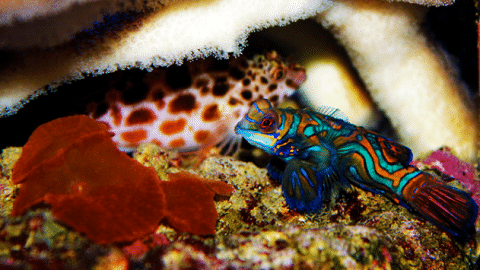
The most common cause of death among mandarin gobies is starvation. These fish can quickly devour large populations of copepods overnight. If you see your fish searching for food but not picking at the rock, there might not be anything there to pick at and it might be time to replenish.
This is a very common mistake among beginner hobbyists as their reef tank is not mature enough and copepod populations run out within a few days of adding the fish. The only way to know how much your goby is eating is by constantly observing the behavior of your fish and seeing how many copepods are present at any given time. This can be done by shining a light into the aquarium at night and seeing how many copepods are present for a rough estimate.
In addition to having a healthy population of copepods, you can supplement feedings with live brine shrimp and mysis shrimp. Some mandarin gobies will take frozen food alternatives to both of these, but they will usually prefer live foods most. This diet can get to be incredibly expensive and difficult to maintain.
Some lucky hobbyists have had mandarin gobies that would take regular flakes and pellets, but this is very rare.
Lastly, make sure that your fish is always vibrant in color and has a plump abdomen. A starving mandarin will have dull colors, a skinny body, and an overall lethargic demeanor.
Reality Of Keeping A Mandarin Goby
Here’s the honest picture. Daily life with a mandarin goby is mostly about watching and worrying. You’re watching whether the fish is actively hunting vs. drifting. You’re watching whether its belly looks full or pinched. You’re counting pods on the glass at night.
When things are working right, these fish are mesmerizing. They hop and glide along the rockwork with a unique movement pattern that no other reef fish replicates. Their colors are genuinely unmatched in freshwater or saltwater fishkeeping. When you see a healthy, well-fed mandarin goby in full color actively hunting across a thriving reef, you understand why people do the work to keep them.
When things are going wrong, it happens quietly and quickly. By the time the fish looks visibly thin or lethargic, you’re often already in crisis. The lesson experienced hobbyists learn: check on pod supply proactively, not reactively.
Should You Get A Mandarin Goby?
Good Fit If:
- Your reef has been established for 12 months or more with a visibly thriving copepod population
- You have a refugium or dedicated pod culture tank running
- You have at least 30 gallons (113 liters) with complex live rockwork
- You can observe the fish daily and adjust feeding as needed
- You’ve kept other demanding reef species successfully
Avoid If:
- Your tank is under a year old
- You don’t have a refugium or pod culture system in place
- You’re a beginner to saltwater aquariums
- You travel frequently or can’t monitor the fish daily
- You can’t get the fish to eat before purchasing it
Where To Buy
Always buy mandarin gobies from sellers who can confirm they are eating before shipping or sale. A mandarin that arrives already declining from starvation is nearly impossible to save.
- Flip Aquatics – Quality marine livestock with good handling practices
- Dan’s Fish – Reliable source for saltwater fish online
Final Thoughts
Mandarin gobies are one of the hardest fish that can be kept in the aquarium setting. They don’t actually require much in the way of tank size, water parameters, or territorial needs, but their nearly exclusive diet of live copepods makes them a huge challenge for keeping fed.
These are one of the most colorful gobies available, but their beautiful colors take time, preparation, and determination to maintain. These fish are not for every system even if you think you have everything they need to thrive. Build the pod infrastructure first. Then get the fish.
Want to learn more? This article is part of our complete Saltwater Fish & Reef Guide — your ultimate resource for marine fish, coral care, reef setup, and more.
- About the Author
- Latest Posts

I’m Mark Valderrama, founder of Aquarium Store Depot and a fishkeeper with over 25 years of hands-on experience. I started in the hobby at age 11, worked at local fish stores, and have kept freshwater tanks, ponds, and reef tanks ever since. I’ve been featured in two best-selling aquarium books on Amazon and built this site to share practical, experience-based fish keeping knowledge.

Leave a Reply