Table of Contents
- What Most Care Guides Get Wrong About Emerald Crab
- Species Overview
- Classification
- Where Do Emerald Crabs Come From?
- What Are They Compatible With?
- What Do They Eat?
- Will They Really Rid My Tank of Hair/Bubble Algae?
- Is My Pet Dead?
- How Many Should I Get For My Tank?
- Is the Emerald Crab Right for You?
- FAQs
- Where to Buy
- References
- How the Emerald Crab Compares to Similar Species
Emerald crabs are one of my go-to recommendations for reef keepers dealing with bubble algae. They’re one of the few cleanup crew members that will actually go after valonia and related species rather than ignore it. I’ve kept them in my 125-gallon reef and they earn their spot. That said, like any crab, they come with caveats you should know before adding them to a mature reef.
An emerald crab with bubble algae to eat is reef-safe. An emerald crab without it is reef-risky.
The emerald crab is one of the most underrated members of the saltwater cleanup crew. And one of the best solutions for bubble algae (Valonia) that most other cleanup members won’t touch. After 25 years in the saltwater hobby and maintaining a reef tank, I’ve used emerald crabs to handle Valonia outbreaks that would otherwise require manual removal. They’re hardy, widely available, and reef-safe. One honest note from experience: large, well-fed emerald crabs are mostly benign, but very large, underfed individuals can become opportunistic and have been known to bother small corals or disturb sleeping fish. Keep them fed and keep population in check.
As we saw in our previous post, the Emerald Crab was rated the #1 algae eater in a saltwater aquarium. I wanted to dive in deeper in this post about this crab and why this crab is a great addition to your saltwater tank. I’m going to break this post down Q A style for simplicity:
What Most Care Guides Get Wrong About Emerald Crab
Most care guides treat the emerald crab as a simple cleanup crew addition. Just toss one in and it handles your algae. In my experience, that oversimplification leads to problems. These invertebrates have specific dietary needs beyond just algae, and they can become aggressive toward corals and other invertebrates if underfed. Water quality requirements are also stricter than most guides suggest. Copper-based medications are lethal, and even small parameter swings can cause stress. In my 25+ years in the hobby, I’ve learned that success with invertebrates comes from understanding their actual needs, not just their utility.
Species Overview
| Scientific Name | Mithraculus sculptus |
| Common Names | Emerald Crab, Green Crab, Mithraculus Crab |
| Family | Majidae |
| Origin | Caribbean and Gulf of Mexico |
| Diet | Omnivore |
| Care Level | Easy |
| Temperament | Semi-aggressive |
| Minimum Tank Size | 20 Gallons |
| Max Size | Up to 2.5 inches (6.3 cm) |
| Temperature Range | 76–82°F (24–28°C) |
| pH Range | 8.0. 8.4 |
| Salinity | 1.025 or 35 PPT |
| Reef Safe | Yes |
| Available As Tank Bred | No |
| Filtration/Water Flow | Moderate |
| Water Type | Saltwater |
| Breeding | Egg-layer |
| Difficulty to Breed | Difficult to breed |
| Compatibility | Species-only tank or community tank |
Classification
| Phylum | Arthropoda |
| Class | Malacostraca |
| Order | Decapoda |
| Family | Majidae |
| Genus | Mithraculus |
| Species | M. Sculptus (Lamarck, 1818) |
Where Do Emerald Crabs Come From?
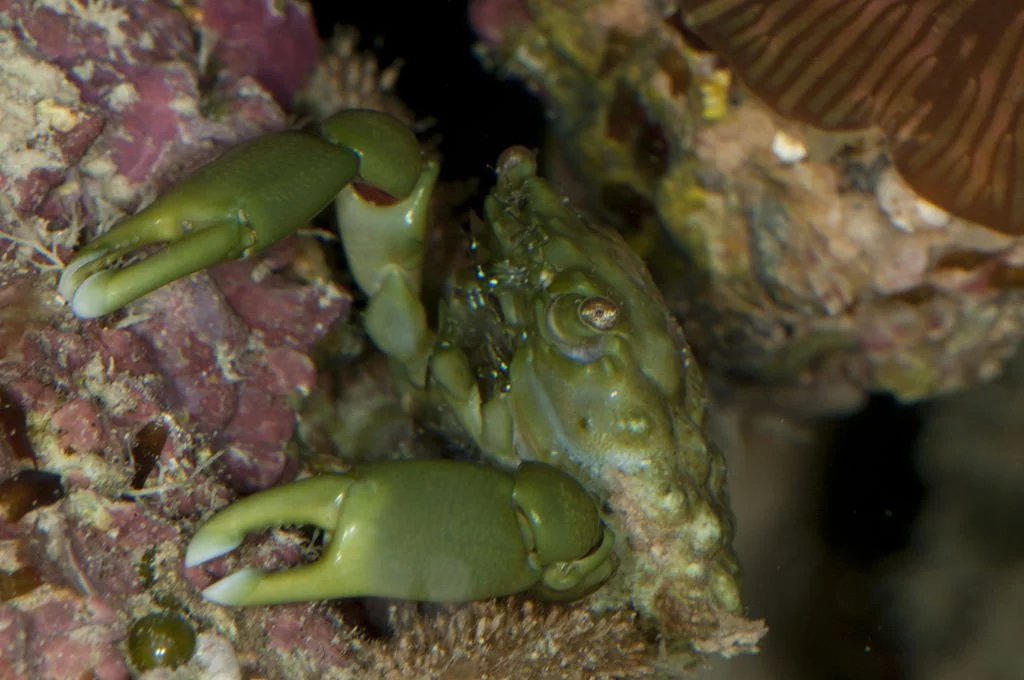
Emerald crabs hail from the Caribbean Sea to the Gulf of Mexico1. They are nocturnal and will hide in caves and rock during most of the day. While primarily a scavenger of uneaten food, it is well known in aquariums to eat algae.
What Are They Compatible With?
Emerald crabs are compatible with just about every fish or invert you can place in the tank., as long as you food sources (waste, algae,and food from an established tank), they should not bother any fish, inverts, or coral in the tank. If they are starving, they may go after snails, smaller fish, and even polyps. As long as the crab is well-fed, they shouldn’t pose a threat to the other inhabitants in the tank. I have seen of them eating other animals, it was due to lack of food, poor water quality (which lead to drying inverts and fish), or overstocking.
In a mature tank, normally what we need to look out for are fish that might actually try to eat them. Avoid placing them with predatory fish such as hawkfish, triggers, puffers that are known for preying on them.
Bubble algae is mainly the algae it is known for eating and they end up on a reefer’s shopping list the first time they have a bubble algae outbreak and they are recommended on a forum or Facebook group.
Is the Emerald Crab Right for You?
Before you add an emerald crab to your tank, it’s worth asking whether this species actually fits your setup and your goals. Here’s a quick breakdown to help you decide.
Good fit if:
- You have an active bubble algae or hair algae problem and want something that actually tackles it.
- Your tank is fully cycled and stable, as emerald crabs are sensitive to parameter swings, just like all invertebrates.
- You’re not using copper-based medications. Copper is lethal to them.
- You’re willing to supplementally feed them (dried nori, pellets) when algae runs low.
- Your tank mates are reef-friendly: no triggers, puffers, or hawkfish that will hunt them.
- You have enough live rock and caves to give them places to hide and feel secure.
Avoid if:
- You’re not prepared to supplementally feed them. An underfed emerald crab will go after things you don’t want it to touch.
- Your tank is under 20 gallons. They need space and they’re territorial with each other.
- You keep large, expensive SPS corals and have no feeding plan. The risk goes up when they’re hungry.
- You have triggers, puffers, or hawkfish. Those fish will eat the crab, not the other way around.
- You’re still cycling or running copper-based treatments.
🦀 ASD Difficulty Rating: Easy (with one catch)
Emerald crabs are genuinely one of the easiest cleanup crew members to keep, as long as they have a job to do. The difficulty spikes when the algae runs out and you don’t supplement. Get that part right and they’re low-maintenance and rewarding.
⚠️ Biggest Mistake: Not Feeding Them After the Algae Is Gone
Most reef keepers add an emerald crab, watch it demolish the bubble algae, and then assume it’s handling itself. When the algae runs out (and it will), the crab starts looking for protein elsewhere. Polyps, sleeping fish, and small snails become targets. Feed dried nori twice a week. It takes 30 seconds and it’s the difference between a crab that earns its spot and one that becomes a $20 problem.
What Do They Eat?
Crabs are scavengers and omnivorous. They will happily eat leftover meaty food and clear nuisance algae like bubble algae in the aquarium. You may want to consider supplemental feed if the emerald crab is new to your tank or you do not have enough algae for it to eat in the tank. Dried nori and and pellet foods are good choices for feeding. Nori, in particular is quite a show as you can hand feed it to them and they go nuts when feeding off it.
Will They Really Rid My Tank of Hair/Bubble Algae?
Yes and no actually. Yes, they will eat bubble & hair algae, but if your tank is infested with a large outbreak you should not rely on an emerald crab being able to remove all of it. You should consider manually removing what you can, reducing nutrients, and then having the emerald crab control and eliminate the leftover. You should also purchase from a store that can attest to the fact that they will eat bubble algae. There are some on-line stores that will guarantee this.
Is My Pet Dead?
This is a common question for newbies when their crab molts for the first time. Like shrimps, these emerald crabs will shed their exoskeleton as they grow leaving behind a what looks like a dead crab. Often times, the emerald crab will appear back out of hiding after a few days.sometimes a week. Either way, it is best to remove the molt or suspected dead tank as you see it to prevent any nutrient build up.
How Many Should I Get For My Tank?
Emerald crabs max out around 2.5 inches (6.3 cm) and you’ll only need one or two in most setups. The standard guidance is one per 30 gallons, though this depends on your rockwork and available food. Overpopulate them and you’ll get crab-on-crab aggression before you get an algae problem.
🔒 Hard Rule: One emerald crab per 30 gallons. That’s it. Two males in a small tank will fight. More crabs does not mean more algae control. It means more conflict.
How the Emerald Crab Compares to Similar Species
Choosing between similar species is tricky. Here’s how the emerald crab stacks up against some common alternatives.
Emerald Crab vs. Peppermint Shrimp: Both are popular cleanup crew members, but they tackle different problems. The emerald crab is your go-to for bubble algae, while peppermint shrimp target aiptasia. Emerald crabs are more robust and can handle themselves with fish, but they’re also more likely to nip at coral if they get hungry. Peppermint shrimp are more delicate but less likely to cause collateral damage. In my experience, both have a place in a well-planned reef tank, but they’re not interchangeable.
FAQs
Are Emerald Crabs aggressive?
They can be, and it’s mostly the males. Emerald crabs get a bad reputation in the reef hobby largely because of aggressive males, especially when kept in groups without enough territory or food. If you can select a female (smaller, narrower abdomen), you’ll have far fewer issues. A well-fed, solitary emerald crab in a spacious tank is rarely a problem.
Will Emerald Crabs eat my corals?
A well-fed emerald crab will not consume healthy corals. They eat dead or dying tissue, which is why they get blamed for coral loss, they’re usually cleaning up a coral that was already declining. That said, a hungry emerald crab is a different animal. If they’re not getting enough to eat, they can and will nip at soft corals and polyps. Feed them regularly and the risk drops dramatically.
Do Emerald Crabs eat diatoms?
Yes: reef keepers have documented emerald crabs eating diatoms, and they can be a useful part of your cleanup crew for the early brown algae phase of a tank. They’re not as efficient at diatom removal as some snails, but they contribute.
What is the white shell I found (is my emerald crab dead?)
Almost certainly not, it’s a molt. Like all crustaceans, emerald crabs shed their exoskeleton as they grow. The empty shell looks exactly like a dead crab, which panics a lot of first-time keepers. The actual crab will hide for several days while its new shell hardens, then reappear. Remove the molt when you see it to avoid ammonia spikes, but don’t assume the crab is gone.
How long do Emerald Crabs live?
In a well-maintained reef tank, emerald crabs typically live 2–4 years. Longevity depends heavily on stable water parameters, consistent feeding, and absence of copper-based medications. Underfed or stressed crabs tend to have shorter lifespans and are more likely to become aggressive before they decline.
Where to Buy Emerald Crabs
Emerald crabs are widely available from online reef suppliers. Buying online is often better than a local fish store for invertebrates because you can read specific livestock reviews and confirm the crab is eating. Two suppliers I recommend:
- Flip Aquatics: great for reef invertebrates, reliable shipping, and they stand behind their livestock.
- Dan’s Fish, solid selection of cleanup crew members including emerald crabs.
When purchasing, look for a crab that is active and moving. Avoid any that appear lethargic or aren’t responding to stimuli, invertebrates ship under stress and a weak crab on arrival rarely recovers well.
References
- Rhyne, A.L., et al. (2012). Revealing the appetite of the marine aquarium fish trade: the volume and biodiversity of fish imported into the United States. PLOS ONE. (Context: marine invertebrate trade data)
- World Register of Marine Species (WoRMS). Mithraculus sculptus (Lamarck, 1818). Retrieved 2024. marinespecies.org
- Calado, R., et al. (2003). The stomatopod Gonodactylus oerstedii Hansen as a cleaner organism in a reef tank. Aquarium Sciences and Conservation. (Context: cleanup crew invertebrate behavior)
- Shimek, R.L. (2004). Marine Invertebrates: 500+ Essential-to-Know Aquarium Species. TFH Publications.
- Fisheries and Oceans Canada. Caribbean crab species profiles. dfo-mpo.gc.ca
Any Other Questions? Leave Us A Comment Below!
What experiences have you had with this crab? Please leave your comments below or any questions you have.