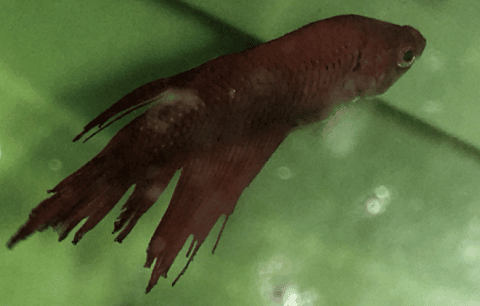
Color fading in bettas is one of the most common concerns I hear from keepers, and in most cases it’s fixable once you identify the actual cause. After years of keeping bettas, the first things I always check are water quality and temperature. a stressed or cold betta will pale out fast, and those two factors account for most cases I’ve seen.
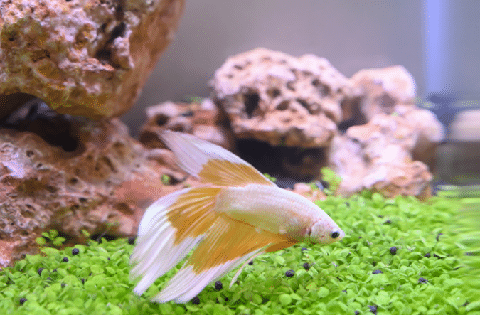
That said, some color changes are completely normal. Marble bettas change color throughout their lives. that’s genetics, not disease. Older bettas (2+ years) will naturally fade some. Knowing which situation you’re in changes what you do about it. Here are the 7 most likely reasons and how to tell them apart.
Top 7 Reasons Why Your Betta Fish Is Losing Its Color
Here are the top 7 reasons why your Betta is losing color.
1. Introducing A New Member To The Tank
Betta fish are highly territorial and aggressive. Therefore, any new fish added to the aquarium is seen as a potential threat to their territory. Hence, this leads to aggression and territorial behavior in the aquarium. Your betta fish might flare the fins or chase new fish to get rid of the new fish, eventually leading to stressful behavior.
Therefore, I always suggest choosing the tank mates carefully for your betta’s aquarium. If you’re planning to introduce a new fish in the tank, provide lots of hiding places and decorations for the fish.
2. Stress
Betta will always lose color under stress. When Bettas are under stress, their bodies release a hormone that results in your fish losing color. The amount of color loss is dependent on the severity of the stress. In serious circumstances, your betta fish turns white or loses color1.
There are so many reasons for stress in Betta fish such as changes in the environment, poor water quality, poor diet, and other fish that are incompatible.
If you want your fish to maintain their vibrant colors, it’s important to provide them with a stress-free environment. Always maintain water quality, monitor water parameters, and avoid adding too many fish in the betta tank.
3. Diseases
If stress or other water parameters are not the underlying cause of your betta fish losing color, then illness is a possible reason.
Betta fish may catch fish diseases such as parasites or bacterial infections that cause them to lose their vibrancy.
Ich
Ich is a parasitic infection that causes white spots on the betta’s skin and fins. Ich is one of the leading reasons your betta fish turning white or losing color. To treat ich, several medications are prescribed but it’s important to identify the underlying cause.
Fin Rot
Fin rotis caused by bacterial infections. The symptoms include; frayed betta fins or ragged fins and may also affect the fish’s skin. If left untreated, it can be a deadly infection.
Anchor worms are contagious. And the best part is they can see with the naked eye. Anchor worms are parasites that appear as long, thin, and thread-like particles on the betta’s body.
The infected fish shows symptoms such as:
Scratching or rubbing against objects
Loss of appetite
Loss of color
Lacerations and ulcerations on the betta’s body
4. Poor Water Quality
Betta fish are native to slow-moving waters in Southeast Asia. Therefore, they need particular water conditions to remain healthy and happy in their tank. When the water parameters are not properly maintained, it can lead to a variety of problems, including fish diseases and loss of color.
I always suggest regularly testing the water and making adjustments to maintain water parameters and quality. Always test the water to make sure that it is within the ideal ranges.
pH
First of all, the pH of betta tank water should be maintained. Betta fish likes slightly acidic pH ranging between 6.5 to 7.5. If you keep the pH too high or low, your fish might fall victim to stress and ultimately lose color.
Ammonia, Nitrite, and Nitrates
It is vital to monitor the levels of ammonia, nitrite, and nitrate in the tank water. High levels of ammonia and other toxins may result in deadly fish diseases.
If the tank water is not properly maintained, it can lead to a variety of health problems, including a loss of color. Proper water quality is essential for bettas, and it is important to regularly test the water and make sure that it is within the proper range for pH, ammonia, nitrite, and nitrate levels to avoid ammonia poisoning or nitrate poisoning.
Betta fish require a varied, nutritious, and carnivorous diet in order to maintain their health and vibrancy. A diet that is lacking in nutrients or that is unbalanced can lead to a variety of health problems, including a loss of color.
Since betta is carnivorous, their diet mainly consists of protein. It’s crucial to feed them food high in protein such as live or frozen foods, brine shrimp, daphnia, and bloodworms. I also advise feeding them freeze-dried foods or dry food supplements to improve their health and color vibrancy.
Along with protein-rich diet, feed your betta vitamins and minerals as a color-enhancing food but make sure the diet is balanced to maintain the health and vibrancy of the fish, without overfeeding fish.
6. Incorrect Water Temperature
Water temperature plays a vital role in maintaining the vibrancy of your betta fish. Since bettas are tropical fish, they prefer consistent water temperatures to remain happy and healthy. Too high or too low water temperature can cause stress and other health problems in your betta fish, including color loss.
Effect Of High Temperatures
At high temperatures, betta fish is susceptible to stress and diseases, and this might be the reason for your betta fish turning white or losing color. At high temperatures, the betta’s body stops functioning properly, which results in low pigment production. Hence, the color loss.
Effect Of Low Temperatures
Low water temperature is equally harmful to the betta fish as the cold water usually slows down your fish’s metabolism. As a result, they become more prone to diseases and stress. Additionally, the pigment cells of betta fish contract at low temperatures, resulting in a loss of color.
Ideal Water Water For Betta Fish
To maintain the color and vibrancy of your betta fish, it’s important to keep the water temperature in ideal range.
The ideal water temperature for your betta tank is between 76 and 82 degrees Fahrenheit (24-28 degrees Celsius). I suggest using a reliable thermometer to monitor and maintain a consistent temperature.
7. Old Age
One of the main reasons your betta is suffering from color loss is nothing, but the inevitable; old age!
As your betta fish ages, you’ll realize that it appears less vibrant and less colorful as the younger fish in the tank.
There are many factors that contribute to the color loss in older betta fish.
Low production of pigment in the betta’s body
Decline in overall’s betta health
Stress and fish diseases
If your older Betta is suffering from color loss, it’s not uncommon. However, you need to maintain proper water quality and betta’s diet to avoid other problems and illness.
How To Brighten Their Color
If your betta fish is progressively losing its color and you have no idea why, there are a few things you can do to get those beautiful, bright colors back.
Monitor Water Quality
The good thing about betta fish is its ability to thrive in small aquariums. However, the small containers, vases and jars often become too toxic for your betta fish to live in. The traces of ammonia, nitrates, and nitrites may cause other deadly fish diseases, resulting in a loss of color.
Therefore, it is recommended to monitor and maintain the water quality and choose the appropriate tank size for your betta fish. The ideal tank size should be no less than5 gallons.
Feed Them Shrimp
It’s a known fact that betta regains their bright, beautiful colors when you feed your betta protein-rich food. Also, natural foods containing carotenoids have a proven record to restore Betta’s color.
Thus, when you feed your betta just fish food, they become constipated and lose color. Experienced betta keepers always recommend feeding betta fish color-enhancing foods such as brine shrimp and other crustaceans to brighten up your tank with the natural beauty of your adorable bettas.
Use LED Aquarium Lighting
This might sound like the most bizarre option, but it actually works.
If you notice your betta fish turning white or getting grey and dull in color, just install LED aquarium lighting and within the next few hours, the colors will be back. That’s because the aquarium lighting causes the colors of betta to become more intense and darker.
Why Are They Turning Black?
Sometimes, betta doesn’t lose their color but turns black, especially from their fins. The process of betta fish turning black might disturb aquarists. However, it’s not worrisome if your fish’s health is good.
There are several factors that contribute to your betta fish turning black.
The Marble Betta Gene Factor
If your betta has the marble gene, it will most likely turn black after the age of two. And as your betta ages, it will become darker and darker with time. Therefore, under the age of one or two, if your betta turns black, there can be a problem. The problem can be poor water quality, stress or improper tank cycling. In severe cases, it can be a disease called the black spot disease.
What Should I Do If They Are Turning Black?
If your betta is suffering from black spots or turning black, you should first rule out the black spot disease and other environmental factors. If everything seems okay, the fish changing color should not be a problem.
Here are a few things you could do to avoid your bettas from getting black.
Provide enough oxygen to the betta tank by using airstone kits that are reliable and easy to use.
Cycle your tank properly by establishing beneficial bacteria that help balance the nitrogen levels in the tank.
Choose suitable tank mates for your betta tank and eliminate stress from the aquarium.
FAQs
Why Are They Turning White?
Your beloved betta fish might be turning white because of stress, some underlying cause such as stress, and other fish diseases, including bacterial infection, fungal infection, or poor water quality and water parameters. Last but not the least, the major cause of color loss in your precious betta fish might be as simple as old age.
How Do I Get Their Color Back?
If you experience your betta fish losing color, there are things you can do to restore the vibrancy. 1. Identify and address the underlying cause 2. Provide a balanced nutritious diet 3. Maintain a healthy and consistent tank atmosphere 4. Seek professional help
Do They Turn White When Stressed?
Yes, betta fish can turn white when stressed. It is due to the release of hormones that cause the color pigments to contract, resulting in a loss of color.
Do They Turn White?
Yes, Betta can turn white or pale under certain circumstances. Some possible causes of color loss in bettas include:
1. Introducing a new fish to the betta tank 2. Old age 3. Stress 4. Bacterial or fungal infection 5. Poor water quality 6. Poor diet 7. Fish diseases 8. Incorrect water parameters and water temperature
Final Thoughts
Betta fish are beautiful aquatic creatures with long, flowy fins that drape beautifully around their bodies. The key characteristic of betta fish is their vibrant colors and beautiful patterns. However, stress, poor water quality, fish illness, and other factors may result in a loss of color that concerns fish keepers.
To keep your betta fish healthy and happy and in their best shape and colors, it’s essential to provide them with the right water conditions, diet, and tank mates, so they develop more vivid colors to awe their owners.
📘 Want to learn more? This article is part of our complete Betta Fish Guide. your ultimate resource for betta care, types, tank setup, feeding, tank mates, and more.
Water hardness is one of the parameters beginners most often overlook. it doesn’t affect fish the same immediate way ammonia does, but long-term mismatches between your tap water hardness and your fish’s requirements will quietly work against you. I’ve seen it cause health problems that take months to show up and are hard to diagnose without testing the right things.
The two numbers you need to understand are GH (general hardness) and KH (carbonate hardness/alkalinity). they measure different things and affect your fish differently. If you’re keeping African cichlids, hard and alkaline is what you want. If you’re keeping bettas, apistos, or tetras, soft and acidic is the goal. Here’s how to test both, what the numbers mean, and how to adjust them in either direction.
Key Takeaways
Water hardness is a measure of the dissolved minerals in your water.
Tap water from different parts of the world has different total hardness/ general hardness (GH) and carbonate hardness (KH) levels.
GH is a measure of calcium and magnesium ions, while KH is a measure of calcium carbonate anions. pH is a measure of the acidity or basicity of the water.
Water hardness affects the kind of tropical fish, invertebrates, and plant species you can keep in your aquarium.
It is possible to adjust water hardness, but it is easier to choose fish species that are adapted to your local water.
What Is Water Hardness?
Water hardness is the concentration of minerals dissolved in the water. More specifically, it refers to the amount of calcium and magnesium in the water, as well as trace amounts of other minerals. You can check out our lastest video from our YouTube Channel. We go into more details in the blog post below. Be sure to subscribe if you enjoy our content!
The concentration of these minerals depends on the geology of the area where the water originates. That means water hardness varies from area to area, and it all depends on the kinds of rocks the water passes over before it gets to your home. Dolomite and limestone are common rock types that alter water chemistry.
You can get a general idea of the hardness of your tap water in the US by checking out the United States Geological Survey (USGS) website1. However, testing your aquarium water quality and parameters at home is the best way to get an accurate picture.
We can break it down one step further and measure general hardness (GH) and carbonate hardness/alkalinity (KH), and both can be very important.
Read on to learn everything you need to know about water mineral levels.
General Hardness (GH)
General hardness measures the concentrations of mineral salts in your aquarium water. These minerals are magnesium (Mg) and calcium (Ca) ions, and they can be measured in degrees (dGH) or parts per million (ppm).
A water GH level of 4-8dGH or 70-140 ppm is a suitable level for most freshwater fish tanks. However, this depends on the type of fish, invertebrates, and plants you keep.
Carbonate Hardness (KH)
Carbonate hardness refers to the measure of carbonate and bicarbonate levels in the water. This determines your water’s buffering capacity against pH crashes and swings. Unstable water quality can be very dangerous to many fish, so this is an important parameter to consider.
Water pH levels change slightly throughout the day but within a certain range. This is a natural process, but it is dangerous if it happens too fast.
The higher the KH, the higher your pH is likely to be, and also, the more stable your pH level will stay. On the other hand, a very low KH is typical in a tank with a low pH which is prone to fluctuations.
However, a higher KH is not always ideal. High carbonate hardness makes it more difficult to adjust your pH levels. This can be a problem if you want to change your water parameters to keep a certain species of fish.
When it comes to carbonate hardness, 3 dKH is a safe level, although many commercially bred aquarium fish are adaptable between 1 and 10 dKH.
Does Water Hardness Really Matter?
Different aquatic plants and fish species have evolved to live in the type of water found in their part of the world. The minerals that make water hard or soft are very important for healthy fish and plants, but the amount they need varies between species.
Many aquarium fish are very adaptable to water hardness, especially when captive bred. However, it’s still a good idea to match the preferred natural habitats and water chemistry of your fish. Some species have very specific requirements and just won’t do well in the wrong water.
Most fish do well in slightly hard water, and many can adapt to even harder water parameters. However, few species will thrive in very hard water. African cichlids are a notable exception and a great example of fish that need very hard water.
As you will learn later in this guide, you can change the water hardness in your aquarium to suit the types of fish you want to keep. However, it might be easier to match your fish to the kind of water you already have.
How Does Water Hardness Affect Fish?
Water hardness affects osmoregulation in fish. This impacts their ability to regulate salt and water in their bodies. Outside of their tolerance range, fish can become very stressed or even die.
Carbonate Hardness (Kh)
Earlier in this post, we learned that a low carbonate hardness (KH) allows your pH value to swing drastically, which can be stressful for your fish.
Carbonate Hardness does not have the same physiological effects as general hardness, but the buffering capacity is key to maintaining a stable pH level and environment for your pets.
General Hardness (GH)
Fish need minerals, just like we do. Without them, normal bodily functions like growing and reproducing would be impossible.
So, we know that incorrect carbonate and general hardness can be dangerous for fish, but what about the other life in our aquariums? Does hard water affect invertebrates and plants too?
Low general hardness can be very dangerous for aquarium invertebrates. It can cause problems for molting shrimp and cause thin, weak shells on snails.
Very soft water can also be dangerous for live aquarium plants, although many plants are also sensitive to high carbonate hardness. Some plant species, like Vallisneria, show a definite preference for harder water.
How to Measure Your Water Chemistry
You probably know that you should measure your aquarium water parameters regularly to be sure you are performing enough regular aquarium maintenance. However, aquarium water testing also allows you to monitor other important parameters like hardness.
Unfortunately, simply testing your pH levels is not enough. pH, KH, and GH are often linked in nature, which means that water with a low pH tends to have a low GH and KH too.
However, tap water can be different. Therefore, it is important to test both GH and KH, since they aren’t necessarily linked to pH.
The good news is that the process is pretty much the same as measuring other water quality parameters like nitrates. Let’s take a look at the basic process of testing your hardness levels.
Strip Tests
Strip tests are super easy to use. Some all-in-one kits can be used to measure multiple parameters, including pH, GH, KH, nitrates, and nitrites.
Simply dip the strip into your aquarium water and compare the colors on the strip with the example card to read your water parameters. Some aquarists even cut the strips in half to save a few bucks, but be sure to follow the instructions on your product for the most accurate results.
Liquid Test Kits
Liquid test kits are also very easy to use and even more fun! These tests use droplets of colorful liquid to measure the GH, KH, and other parameters of your aquarium water.
We can put water hardness into different categories from very soft water, all the way up to ‘liquid rock’! Let’s take a look at five basic categories and their general hardness levels:
Very soft water: 0-4 dGH /0-70 ppm
Very soft water has low levels of dissolved calcium and magnesium. Most plants and animals will not do well in these conditions.
Soft water: 4-8 dGH/70-140 ppm
Many South American and Southeast Asian fish thrive in softer water. Softer water is also ideal for many freshwater plant species.
Livebearers and other fish that enjoy moderately hard water can often adjust to hard water conditions.
Very hard water: 18-30 dGH/ 320-530 ppm
Very hard water is often known as ‘liquid rock’ because it contains high concentrations of minerals. Most freshwater fish will not thrive in very hard water, although cichlids from Central America and East Africa prefer these parameters.
What Fish Are Good For Hard (And Soft) Water
Let’s take a look at some popular examples of hard and soft water fish that you might want to keep in your home aquarium.
It is possible to change your water hardness, but that is not always your best option. Stability is important, and when you start having to adjust levels, there is always the chance of human error.
Inconsistent water parameters can be stressful for your fish. However, if your water is naturally soft and you want to keep African Cichlids, you’re going to need to increase your water hardness.
Increasing Your Water Hardness
Increasing general hardness is a matter of adding calcium and magnesium salts to the water in a safe and manageable way. Before you adjust your water hardness, make sure you have tested your GH, KH, and pH level.
Let’s take a look at some simple methods of increasing water hardness.
Crushed Coral/Coral Sand
Adding crushed coral is a great natural way to increase your water hardness. However, it is not easy to reach an exact level using this method.
You can add crushed coral directly to your substrate or use it in your aquarium filter. It will act faster if you place it in a mesh bag in your filter where there is a constant flow of water.
Limestone Rock
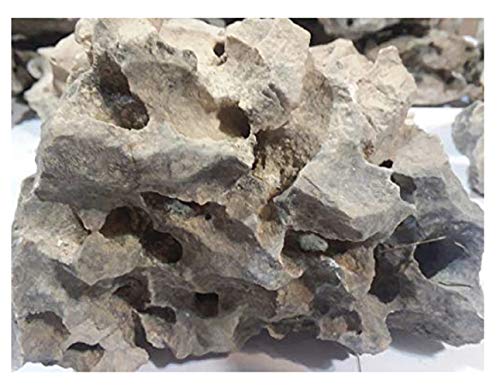
Another way to gradually increase your tank water hardness is to use certain types of rocks as your hardscape. Rocks like Texas Holey Rock are beautiful limestone-based rocks that are very popular. This rock is high in calcium carbonate, so it will increase the pH, Gh, and KH of your water over time.
Purpose-made products like Seachem Equilibrium are available for managing your water hardness levels.
Similarly, products like Seachem Alkaline Buffer are available for managing your carbonate hardness levels. These products are great because they allow more precise control.
Decreasing Your Water Hardness
Decreasing your water hardness can be achieved by reducing the concentrations of magnesium and calcium salts in the water. Read on to learn how to soften aquarium water.
RO/DI Water
It is more difficult to soften aquarium water if you have very hard water. One way to achieve this is to start over with pure water and add the minerals that you need. Reverse osmosis deionized (RO/DI) water is neutral and contains no minerals.
You can make your own RO/DI water at home using a reverse osmosis system. Buying one of these systems is a small investment, but they will pay for themselves in the long run.
This pure water is extremely soft and has a neutral pH. It is not safe for your fish or plants until you have remineralized it with something like Seachem Equilibrium or mixed it with tap water.
Distilled Water
Distilled water can be used in the same way as reverse osmosis water. However, you will still need to increase the total hardness of the water with magnesium and calcium carbonate compounds before it is suitable for keeping fish.
A simple way to remineralize distilled and RO/DI water is to cut it with tap water. Simply add small amounts of tap water to the pure water until the desired water hardness level is reached.
Your water will become harder over time if you are not performing regular water changes and simply topping up your tank with tap water. Test your water regularly and use the correct mixture of distilled and tap water each time you top up your tank to keep your levels stable.
Water Softening Pillows
Water-softening pillows are another great option, and they are very easy to use. These pouches use a resin that attracts magnesium and calcium to remove them from the water.
You will have less precise control when using this method, but it is very easy and works well for soft water fish like tetras and angelfish.
Peat Moss
Peat moss can be used to lower pH levels in your fish tank. This organic material will leach tannins into the water, staining it yellow or darker.
Peat moss can be effective for creating blackwater freshwater aquariums and softening your water to some degree, but it is not very effective as a water softener if you have very hard water.
Aquarium Soils and Driftwood
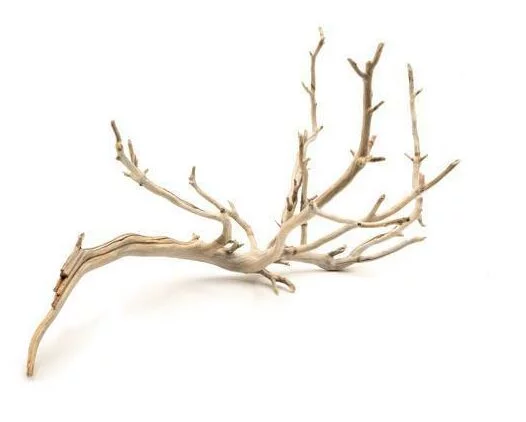
Some aquarium soils, like Controsoil, can also effectively soften water, making them a great choice for planted tanks. Driftwood, almond leaves, and other plant materials that leach tannins and stain the water will lower the pH and hardness somewhat.
Water hardness is the amount of dissolved calcium carbonate anions, and magnesium and calcium ions in the water. The hardness of water varies depending on where you live in the world and the kinds of rocks your water flows over before reaching your home.
Does Aquarium Water Hardness Matter?
Aquarium water hardness can be very important. Most aquarium fish are quite adaptable, but some species have specific requirements for survival and breeding.
What Should Water Hardness Be For An Aquarium?
The ideal water hardness varies depending on which kind of fish you keep. Most aquarium fish and plants will thrive in water with a general hardness (GH) of 4-8 degrees or 70-140 parts per million.
What Should Water Hardness Be For An Aquarium?
The ideal water hardness varies depending on which kind of fish you keep. Most aquarium fish and plants will thrive in water with a general hardness (GH) of 4-8 degrees or 70-140 parts per million.
Does Water Hardness Affect Aquarium Fish?
Water hardness has some important effects on a fish’s ability to live and grow, so fish can become sick in water that is too soft or too hard. Some fish will survive in water with an incorrect hardness but will not spawn or breed.
Final Thoughts
Understanding water hardness is important, especially if you want to keep fish or plants with specialized requirements. I recommend testing your local water parameters before you set up an aquarium. That way, you can choose the perfect species to match your conditions.
However, it is possible to adjust your water hardness with the right materials, techniques, and a little practice. Just be sure to make your changes slowly and carefully to avoid stressing out your fishy friends!
Do you have a hard or soft water fish tank? Tell us about your experiences in the comments below!
🐟 Want to learn more? This article is part of our complete Aquarium Care Guide. your ultimate resource for water chemistry, maintenance, feeding, disease prevention, and everything you need for a healthy tank.
Fast-growing plants are one of the best tools in a planted tank. they out-compete algae for nutrients, fill in a new setup quickly, and give you immediate results while slower species establish. After years of planted tank work, I know which species grow fastest and where each fits best in a layout.
Fast-growing plants are the best natural algae control you can add to an aquarium. and I say that after 25 years of trying every chemical solution on the market. The principle is simple: fast growers outcompete algae for the same nutrients, especially nitrates and phosphates. In my early reef-keeping days I used chaeto in the sump for exactly this reason. In freshwater, I lean on hornwort, water sprite, and guppy grass for the same effect. The plants on this list grow fast enough to make a visible difference within days, which is exactly what a tank struggling with algae or a new cycle needs. The bonus is that most of them are nearly indestructible for beginners.
In this article, I’ll walk you through the 10 types of the fastest growing plants with all the basics you need to know.
Expert Take (Mark Valderrama, AquariumStoreDepot)
Fast-growing plants are the most underrated tool in freshwater fishkeeping. After 25 years, I use them in almost every new tank I set up, not because hornwort or water wisteria are the most beautiful plants, but because fast growers do something no filter can: they pull ammonia and nitrates out of the water column in real time. In a cycling tank, that protects your fish. In an established system, it’s a buffer against parameter swings. The plants on this list are workhorses. Most are inexpensive, nearly indestructible, and fast enough to show visible growth within a week of planting.
Key Takeaways
The best thing about fast-growing aquarium plants is that they don’t leave nutrients for algae to feed on
You can use most of these fast-growing plants regardless of your experience
Most fast-growing plants are very easy to maintain and pretty hardy in nature
What Are Fast Growing Aquarium Plants?
Fast-growing aquarium plants are those plant species that help you keep algae at bay without any specific needs or requirements. Since they have a rapid growth rate, they don’t let nutrients stay in the water column for algae to consume for a long time.
In addition to that, most of these plants grow swiftly which makes them slightly demanding to manage in small aquariums. But if you know your way around them, these plants will be one of the best decisions you can make as an impatient aquarist.
Depending on the size of your aquarium, you can use them as background plants, mid-ground plants, and even as foreground plants.
The Benefits Of Fast Growing Plants
Listing down all the advantages of fast-growing plants can be challenging. But to help you understand some of the most important ones, I’ve put down these benefits you can surely get by planting them in your aquarium. I’ve also included a video from our YouTube channel so you can follow along as well. The blog post goes into further detail so check out both and subscribe if you like our content.
Algae Control
Excessive algae growth results from a high number of nutrients present in the water column. Apart from nutrients, algae thrive on light. Even though not all algae is harmful, the rapid growth of algae can be dangerous for your fish and plants.
Aquarium fish and plants can’t obviously go without water and light so you have to find ways to fight this overgrowth. In this case, the fast-growing aquarium plants are your solution.
Under their preferred conditions, these plants grow quickly by absorbing nutrients and light. When you observe how algae grow, you will notice that it, too, needs access to both.
While planting fast-growing aquarium plants, these fast-growing aquatic plants will compete for nutrients and light that will make algae starve, restraining the overgrowth and sometimes causing it to die altogether.
Food and Oxygen
Live aquatic plants make a good round diet for aquarium fish, shrimp, and fry and provide oxygen to the inhabitants of home aquariums. Plants are known to absorb carbon dioxide and promote a well-oxygenated environment that is beneficial for the fish.
A fast-growing aquatic plant helps better with oxygenating water and producing food since it doesn’t take too long to grow.
Shade
Aside from making otherwise drab aquariums beautiful to look at, fast-growing aquatic plants are popular for providing fish species with shade.
While smaller fish use them to stay away from getting nagged, these plants are perfect during the spawning season.
Mark’s Pick
Hornwort is my top pick for a fast-growing plant in almost any setup. It thrives in a huge range of water parameters (pH 6.0–7.5, 59–86°F / 15–30°C), grows several inches per week under moderate light, and can be left floating or anchored. In a new tank it outcompetes algae for nutrients, and in an established tank it gives fry and small fish excellent cover. The downside: it sheds needles when stressed. Keep water parameters stable and that stops within a week or two.
10 Of The Fastest Growing
Now I am going to walk you through 10 of the fastest-growing plants suitable for beginners, intermediate, and experienced aquarium owners.
You will read about their specific needs, and qualities, and how to keep them without any risks.
Perfect for controlling algae growth, Elodea is a fast-growing plant popular in the aquarium hobby for its hardy nature and ability to withstand a range of aquatic conditions. The plant goes by different names such as Brazilian waterweed, Anacharis, and Elodea Densa.
Since it has a rapid growth rate, it can absorb nutrients from the water column faster than algae.
Apart from that, the plant looks absolutely stunning in home aquariums and does well in a water temperature that stays between 65 to 75 degrees Fahrenheit. Elodea is also perfect for young fish and invertebrates if you want to give them a nursery habitat.
Although the plant stays underwater, it can shoot white flowers above the water’s surface to produce seeds. Almost all species feature deep green stems and light green leaf blades. Some can vary slightly in colors, though.
To feed these plants, consider liquid fertilizers so that they can get enough minerals to survive. Also, iron deficiency is common among these plant species, usually visible when the leaves turn yellowish or when the edges become yellow or brown.
Author's note: Elodea can grow well if it freely floats, but for proper growth, it should be rooted in the substrate.
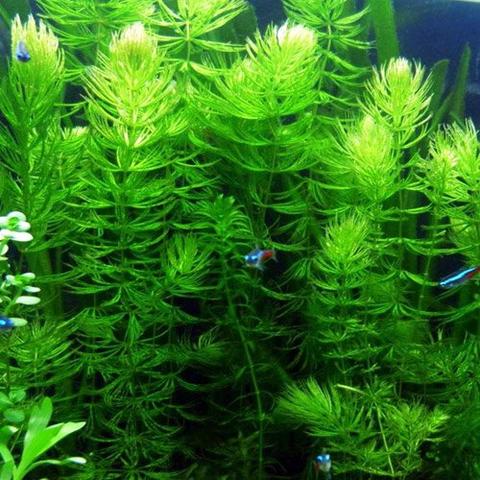
In addition to tolerating a wide range of water temperatures and higher levels of pH, Hornwort is an excellent choice for a number of reasons.
This background plant is highly adaptive, with the ability to reduce unwanted nutrients from the water column. This hardy plant is found in freshwater ponds, steady streams, and lakes, making it resilient when it comes to environmental changes.
It does best as a floating plant, but you can consider loosely attaching it to the substrate. One of the best things about Hornwort is that it gives fish a strong cover to use as a hideout and helps control algae by absorbing a large number of nutrients.
Hornwort doesn’t grow roots to soak up nutrients. Instead, the plant uses its stems and leaves to access nutrients in the water.
The main downside to Hornwort is that it grows very rapidly which can lead it to cover most of your aquarium. You have to make occasional trimmings once or twice a month to prevent them from blocking out lighting and becoming a hassle for other plants and fish species living in the aquarium.
Hornwort doesn’t require strong lighting as well as carbon dioxide injection. Keep the water temperature above 60 and below 80 degrees Fahrenheit.
Pro Tip: Since Hornwort grows quickly, it can use up all nutrients present in the water column. To ensure that the other live plants get enough nutrients, use liquid fertilizers.
Water wisteria is a highly recognized plant species due to its relatively low maintenance and high adaptability qualities. Like other plants, water wisteria brings plenty of benefits to your planted tank.
You can always count on it for cleaning aquarium water, as well as providing your fish with a strong shelter and making your aquarium aesthetic to look at.
Water wisteria features dark green leaves that add a unique accent to aquariums. And just like other fast-growing plant species, it also grows rapidly and makes algae starve to death even before you notice it.
Coming back to its appearance, the dark green leaves form tight protrusions along the length. These leaves take on various forms, mainly influenced by the environment.
The leaves are large, while the roots are thin and white. The roots are usually buried underneath the substrate, making them a strong source of support for the plant to stay in place.
Depending on genetics and how you plant them, the leaves can slightly alter their shape. Since water wisteria is known for growing quickly, it’s always better to perform regular pruning unless you want it to cover your entire aquarium with its dark and heavy leaves.
Although it is pretty hardy, sudden environmental changes can highly influence the overall stability of the plant. You have to learn about how to avoid going through the melting phase before purchasing it.
Also, water wisteria does best when kept in its ideal water temperature range which is above 68 and below 86 degrees Fahrenheit.
Not all fast-growing plant species have to be large. Some can be small and still save you time and absorb nutrients from the water to kill excess algae.
Duckweed is one of those few plants on earth that grows to a very small size. But don’t let its diminutive size stops you from buying it.
The plant has wonderful qualities. Duckweed is a very hardy plant that can easily withstand shifting water parameters and even a range of tank setups. Another irresistible feature is its quality of devouring ammonia and nitrates in the tank, which can help with keeping the water pure.
Despite the small size that makes it almost impossible to see, Duckweed grows through budding. When it flowers, you can see small green-colored blooms.
Duckweed floats above the water’s surface and helps you protect underwater creatures. Not only that, it can grow on top of ponds regardless of the cold temperature of winter. To improve its short lifespan, make sure you get plenty of light so it can thrive.
Ludwigia Repens is not a rare plant in the aquarium hobby. In fact, many beginners and experts use this plant on a very large scale because of how versatile, easy to grow, and beautiful it is.
The beautiful color combination of vibrant red and deep green adds to the beauty and uniqueness of the plant. Make sure you expose it to bright lighting to get that mesmerizing red and green shades.
Ludwigia Repens can tolerate a wide range of water fluctuations, given you understand other contributing factors to their well-being. Generally, the plant does best in warm water temperatures, ranging from 75 F° to 79 F°. And apart from growing underwater, Ludwigia Repens can grow out of the water, making it an amphibious plant.
Like other fast-growing aquarium plant species, Ludwigia Repens also grows pretty fast and consumes nutrients from the water column, making avoiding algae growth easy.
Some of the most common advantages this plant brings to your aquarium are enhancing water conditions, helping the anxious fish stay away from aggressive fish species using the plant, and adding to the beauty of your tank with its red-pigmented olive green leaves.
The plant will grow out of the aquarium if the water column is not deep. Even though the roots are already strong, you have to get them a nutrient rich substrate for optimal growth.
Author's Note: Ludwigia Repens is extremely sensitive to environmental transitions. Once the plant gets used to a particular temperature including pH levels, avoid disturbing the water parameters as much as possible.
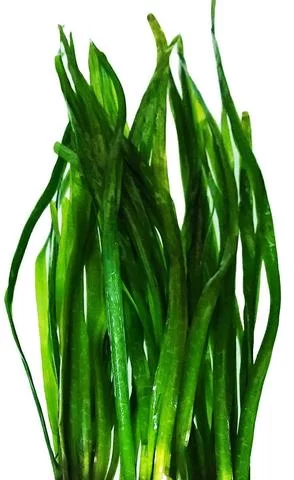
For those aquarists who want to give a classic look to their aquariums, Vallisneria is for you! It is one of the most popular and earliest plants used in home aquariums. It’s easy to grow and adds up to the beauty of your aquarium’s background.
The growth rate of Vallisneria is somewhat faster than those discussed above. This can make it hard for you to keep it in a small aquarium.
And even if you have a large one, you need to make frequent trimmings to control the growth. You can trim the leaves to the length you like so that the plant doesn’t cover the entire top of the tank.
Being a very undemanding plant and one that grows swiftly, Vallisneria allows you to enjoy your time without stressing over how to avoid algae from intruding on your tank.
The plant looks like grass. When you observe their light green leaves, you see spines visible on them. The leaves can be highly variable in shape. Some are straight, while others can go twisted or spiraled.
Before sending out roots, the plant throws runners to the top of the substrate. Once they grow out of the water, they develop flowering and production of seeds.
Vallisneria doesn’t do well in soft waters. You have to keep acidic levels between 6.5 to 8.0 and water temperature above 68 F° and below 82 F°.
Pearlweed is another great option for those aquarists who don’t want to spend days and nights waiting for their plant to grow.
This plant is an extremely versatile, simple, and adaptable carpeting plant. It features a bright green-colored stem that is usually delicate. Depending on how you want to use it, you can use this plant to decorate your foreground, mid-ground, and background.
The plant grows small leaves that are also green in coloration. Contrary to the delicate stems, the leaves grow pretty thick, forming beautiful vegetation.
Since the plant has good adaptability, you can keep it under low lighting as well as intense lighting conditions.
The only difference between these two conditions is that low lighting will encourage thin stems with upward growth and longer gaps between the leaf nodes. While under intense lighting, Pearlweed will grow dense mats and dark green leaves.
You can give it CO2 for a better growth rate. And as far as water parameters go, keep the temperature under 66 F° – 82 F° and acidity level 6.5 to 7.5.
Pearlweed is a water column feeder because of its weak roots. The plant will get nutrients through the leaves most of the time. So, you have to dose them a liquid fertilizer instead of root tabs.
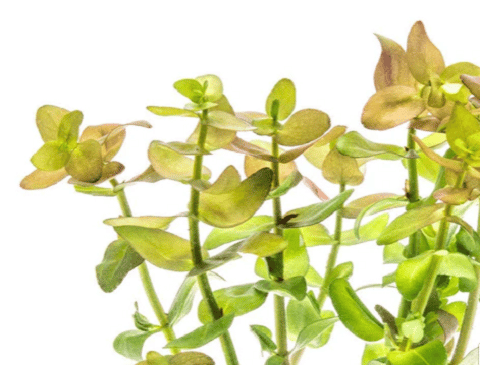
As a hardy plant, Bacopa Caroliniana is a considerably easier species for beginners to try out.
Even though the growth rate of this plant is slow compared to other aquatic plants, but this is a great plant for those who want to oxygenate water for their fish and provide them a healthy environment. Since the plant doesn’t grow that fast, you can inject CO2 to improve the growth rate.
Bacopa Caroliniana can tolerate different water parameters as well as minor environmental changes. This makes it a perfect choice for those aquarists who want a hassle-free experience.
When it comes to offering your tank a beautiful and pleasing look, this plant is no less. The surface of the leaves look glossy green while the lower surface appears pubescent.
Flowers can be either deep blue or light blue. Depending on the lighting conditions, the shoots take on bronze or copper colors which can sometimes appear pink.
To enhance their chances of getting a richer shade of classic green and red, put the plant under strong lighting.
Apart from this, you can grow it in soil, and sand. It can while floating on the surface as well. This can help you provide your fish with appropriate shade.
9. Giant Ambulia
Scientific Name: Limnophila sessiliflora
Skill Level: Moderate
Lighting: High
Size: 16 inches
Tank placement: Background
Growth Rate: High
CO2 Requirement: Recommended
Some people consider Ambulia (video from Tropica Aquarium Plants) as one of the finest plants for maintaining the beauty standards of aquariums. And while they are absolutely right, there are other advantages to bringing them home.
The plant is laced with intense shades of green. If you take care of what the plant prefers, you will paint the leaves emerald.
The plant has another feature that is loved by almost every aquarist. It is the topmost area of the stem. The stem features a set of leaves that never stops growing.
The stem is divided into multiple internodes that sit one centimeter apart. The leaves can be seen emerging from each one. The leaves are designed in a way that resembles a palm tree. This adds up their ornamental value even more.
You don’t have to worry about cultivation and maintenance because this plant will be one of the easiest plant species to care for.
Ambulia has a good growth rate that you can increase with CO2 injections. This will discourage the presence of algae as well. Keep the water temperature around 60 F° to 82 F°.
10. Amazon Frogbit
Scientific Name: Limnobium laevigatum
Skill Level: Easy
Lighting: High
Size: 3 to 20 inches
Tank placement: Surface
Growth Rate: High
CO2 Requirement: No
Capable of withstanding various water conditions as well as providing a smooth planting experience to beginners, Amazon Frogbit is one of the most commonly used plants in the aquarium world.
The plant is famous for different qualities, such as its ornamental nature, versatility, adaptability, and simplicity.
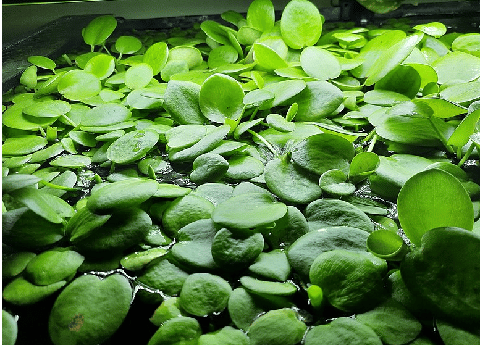
The structure looks round, and the plant consists of bright green leaves that have a smooth texture. Upon hitting maturity, they get laced with white color. You don’t have to wait for the plant to get mature to cover the top of the tank with its leaves. Amazon Frogbits can do it while still being young.
As for roots, the roots are long with neat hairs. The flowers, however, look very tiny but extremely appealing to the eyes.
The growth rate is high, so don’t need to use CO2 injections. As far as size is concerned, it can go anywhere between 3 to 20 inches, depending on how well you take care of them. If you keep water parameters consistent, the plant will not fall prey to anything. Keep the water temperature above 60 and below 80 degrees Fahrenheit and pH level between 6.0 to 7.5.
Pro Tip: Amazon Frogbits are prone to rot if the surface is wet. Make sure you keep the surface dry at all times.
Tank Setup For The Fastest Growing
Fast-growing plants don’t take too much time to grow. If you understand and take care of their basic needs, they can thrive and make your aquarium environment beautiful and healthy for the inhabitants.
But there are certain things you should never ignore. For most species discussed above, lighting acts as a contributing factor to their maintenance. Aside from this, most plants will take nutrients from the water so you don’t have to worry about a thing when it comes to algae.
Make sure you use water fertilizers to keep things stable. Let’s have a look at how to successfully run an aquarium that has fast-growing plants.
Lighting
Most aquatic plants that grow fast need high lighting. You can consider planted tank LEDs. Using T5 fluorescent bulbs can be another great option. Current USA’s Serene RGB Pro is a great all-around LED light that works for virtually all plants.
Filtration is as important as lighting for these plants. Even though they can get nutrients from the water and improve your aquarium’s water conditions, you still need to get a good quality filter.
You have to be careful with the currents since some plants still need water to thrive, while others can tolerate subtle currents.
Caring for these plants is pretty straightforward. Being a novice might hold you back but with proper guidance, you can ensure that the plants are doing fine.
Feeding
Most fast-growing plants are aggressive when it comes to taking nutrients from the water. They can also fulfill their needs through fish waste and leftovers of food.
In case you are just setting up the tank, get liquid fertilizers as soon as possible so the plants don’t have to go through anything rough because of the absence of nutrients in the water.
Some plants need CO2 to grow faster, while others don’t. With some plants, using CO2 will trigger their already high growth rate even further, which can be seriously challenging for an aquarist.
Plants that grow out of the water don’t need Carbon Dioxide injection. You can also use Carbon Dioxide for Giant Ambulia, Pearl Weed, and Duckweed.
Propagation
Most plants are easy to propagate. Some plants produce seeds, while others can be grown by division. Some plants will grow on their own once you separate the plantlets produced by the mother plant.
Tank Maintenance
It doesn’t matter whether you run a small fish tank or one with lots of fish and plants or your own species of floating plants or submerged ones. Tank maintenance is extremely essential and beneficial.
Most species that grow fast use all the nutrients they can get. This helps with keeping algae at bay. Moreover, you don’t have to worry about nitrates as the plants will use them. But I highly recommend making partial water changes and using a liquid test kit to maintain proper water parameters.
You should also consider cleaning the substrate and the tank walls.
Tank Mates
Choosing the right tank mates is always one of the most important things to consider before turning your traditional tank into a heavily planted tank.
Some animals can get along with different plants, while other aquarium plants are prone to get nipped. Other than that, you can add animals to a heavily planted tank to reduce the chances of algae attacking your tank.
One of the fastest-growing plants that you can get is Hornwort. The stem plant does wonders to your aquarium and has been a part of home aquariums for a long time. Plants like Ludwigia Repens, Vallisneria, Giant Ambulia, and Amazon Frogbit are some other great choices.
Do They Grow Faster In Warm Water?
Aquarium plants have a higher chance of growing faster in warm water temperatures as compared to cold water. Aquarium plants have a higher chance of growing faster in warm water temperatures as compared to cold water.
Do Tank Stem Plants Need Substrate?
Some plants absorb nutrients through their leaves, and they can survive without any substrate. However, plants that take nutrients through their roots need soil to thrive.
You can plant these versatile plants in any substrate. It can be soil, gravel or sand. Just make sure you know what plants are best for growing in soil and what plants can go without any substrate.
Fast-Growing Plants at a Glance
Plant
Growth Rate
Light
CO2
Difficulty
Hornwort
Very Fast
Low–High
Not required
Easy
Elodea (Anacharis)
Very Fast
Low–Moderate
Not required
Easy
Water Wisteria
Fast
Moderate
Not required
Easy
Duckweed
Extremely Fast
Moderate
Not required
Easy
Vallisneria
Fast
Moderate
Not required
Easy
Ludwigia Repens
Moderate–Fast
High
Recommended
Moderate
Amazon Frogbit
Fast
Moderate
Not required
Easy
Pearl Weed
Fast
High
Recommended
Moderate
Avoid If:
You have a low-tech tank and want foreground carpeting: fast growers like pearl weed need high light and CO2 to carpet properly
You want to add duckweed to an open-top tank with surface agitation: it will clog the filter intake and block light to everything below
You want low-maintenance aquascaping: fast growers need frequent trimming or they take over the tank
Your tank is under 10 gallons and you choose hornwort: it gets large fast and overwhelms nano setups
Closing Thoughts
If you’re looking for some new plants to grow in your aquarium, why not try one of these fast-growing varieties? They’re easy to care for and will add a splash of color to your tank in no time. Plus, they’ll give you the satisfaction of seeing results quickly. So what are you waiting for? Give them a try and let us know how it goes in the comments below.
Aquarium plants that actually flower are one of those things in this hobby that catch people off guard. most keepers don’t realize it’s possible until it happens in their own tank. I’ve had Anubias send up flower spikes above the waterline and Amazon swords push out blooms from emerged leaves, and it genuinely never gets old. It’s a sign the plant is healthy and conditions are right.
Most of these species flower when grown emersed or when a stem reaches the surface. it’s the plant’s natural reproduction strategy. Here are 11 species that will flower under the right conditions, with honest notes on what it actually takes to get them there.
Key Takeaways
Many common aquarium plants produce flowers when given some extra care and attention to lighting, water parameters, and nutrient levels.
Some of the most popular species of live plant can be kept underwater in submersed conditions while others do best above the surface of the water in emersed conditions.
Many of the flowers produced by flowering aquarium plant species are small and easy to miss but can be an exciting challenge to achieve for the experienced plant keeper.
Introduction to Flowering Aquarium Plants
There are hundreds of different fish species we can keep in our aquariums, but many forget about the dozens of aquatic plants available that keep our systems healthy and beautiful. Live plants help export nutrients in the aquarium, stabilize the substrate, and provide food and shelter for fish and invertebrates. Too few are taking advantage of these benefits!
Many of the species available in the aquarium hobby are undemanding in terms of lighting and carbon dioxide requirements. By meeting their basic needs, happy and healthy aquarium plants will return the favor in color, growth, and even a flower or two.
There is little difference between underwater plants and terrestrial plants. The main difference lies in where the stomata, or pores that facilitate gas exchange are on the leaves of the plant. Terrestrial plants typically have stomata on the underside of their leaves, while aquatic plants have stomata on the top of their leaves; some may lack stomata entirely.
Both terrestrial plants and aquarium plants can be angiosperms, or flowering plants that produce seeds within a fruit. This is in contrast to gymnosperms, like conifers, that have exposed seeds. As of now, there are no known underwater flowering plants that are gymnosperms.
Can Flowers Grow In A Fish Tank?
Yes! If your plant is an angiosperm, then it has the ability to produce a flower. However, flowers can be difficult to produce in the aquarium setting and greatly vary in appearance; even if you experience your aquarium plants flowering, there’s a chance you might miss them due to them being so small and sudden.
The truth is that flowering aquarium plants don’t produce the most magnificent flowers ever. The most apparent flowers are usually those of water lilies and lily pads. Even then, flowers are short-lasting and easy to miss.
Many aquarium plants grow white, off-white, or pink flowers. These are often very small, forming around the tip of a singular stem. Some species grow best fully emersed or out of the water, while others will bloom while underwater. Some may reach toward the water’s surface, so only their flowers are dry while the rest of the plant stays submerged.
While keeping flowering plants is easy, getting them to bloom can be challenging. No matter how perfect your fish tank might test, there is a chance that your flower never blooms. There are a few ways to increase the odds of your aquarium plants blooming:
1. Keeping stable and ideal planted tank parameters. Some live plants can be sensitive, but some live plants that are in the process of blooming can be even more sensitive. While terrestrial plants rely on other insects and wind to pollinate, plants need good water parameters and ideal water conditions to germinate; many aquarium plants reproduce via rhizomes where new plants stem from the main plant and create clones.
Creating flowers and reproducing takes a lot of energy. Plants need to ensure that conditions are favorable for success. This means stable water parameters with available light and nutrients. A healthy plant will transfer its energy from the growing process into the flowering process, resulting in reproduction through tiny flowers. In some cases, dosing dry or liquid fertilizer and injecting carbon dioxide might be necessary to create ideal conditions.
The highest end offering by CO2Art. This package includes everything you need to perform consistent and the highest quality CO2 injection in the industry!
2. Pruning. Many flowering aquarium plants grow too tall or too wide to our liking. In response, hobbyists trim their plants so that they fit the aquascape or don’t suffocate other species. In the wild, plants compete with each other for space, light, nutrients, and other resources. Once successful, they begin to flower so that this competition may continue.
In the aquarium, these conditions should be replicated and the plant should be left to grow freely. At the same time, pruning can actually influence some species to germinate. This is because the resources that would have been attributed to new leaves now go into forming new flowers. However, this does not work all the time and pruning can lead to exponential leaf growth instead.
Which Aquatic Plants Can Grow Out Of Water?
Apart from aquariums that feature tropical plants and fish, many hobbyists set up semi-aquatic systems in paludariums or entirely terrestrial biomes. These different setups have become increasingly popular over the past few years and are a great alternative for people looking to bring nature into their homes without the worry of caring for fish.
Luckily, many flowering aquarium plants can grow in semi-aquatic or terrestrial setups as long as humidity requirements are met.
Here are some of the best flowering aquarium plants for a semi-aquatic setup:
Here are some of the most popular terrestrial plants available:
Echinodorus muricatus
Labisia spp.
Ardisia spp.
Keep in mind that terrestrial plants can drown if they’re placed fully underwater. Many of the plant species listed as terrestrial live in wet and humid conditions where the soil is constantly damp. This is best recreated in a closed paludarium or terrarium where moisture cannot easily escape.
The 11 Best Tank Plants That Blossom
Not many hobbyists are aware that the plants they buy are actually flowering plant species.
The simple fact is that it is rare to ever witness a freshwater live plant flowering. Instead, hobbyists heavily rely on the shapes and colors of their leaves for design and aquascaping purposes. But if you’re looking for a challenge above keeping a heavily planted aquarium, getting your flowering plant to bloom might be your next big accomplishment.
Here are some of the best and most popular flowering aquarium plants readily available at local fish stores and online!
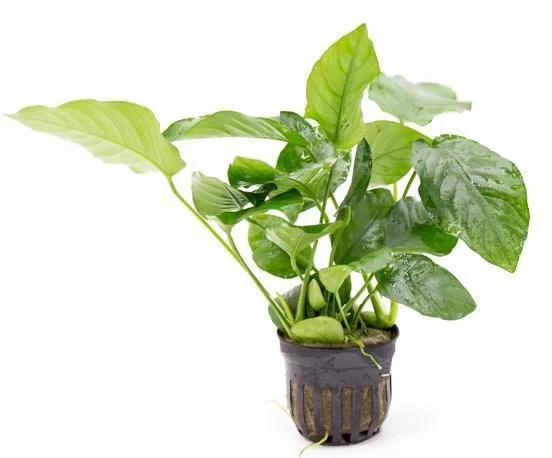
Anubias barteri, known by its scientific name or as a general species of Anubias, is one of the most popular species of Anubias available to freshwater enthusiasts. While many hobbyists use these underwater plants as a submersed foreground plant or as coverage for decorations, these plants can also be grown–and actually grow better–out of the water.
Anubias members are very hardy plant species. They do not require additional carbon dioxide and can thrive in low light settings. Anubias barteri is one of the smaller species available from this genus, and have broad, dark green leaves attached to a center rhizome. Unlike most other freshwater plants, Anubias plants grow best when their rhizome is uncovered and attached to a hard surface. This can be done with glue or fishing line.
Does Anubias Blossom Underwater?
Yes, Anubias plants produce a noticeable flower with an extra long flower stalk from the center of the rhizome. The actual flower emerges from a small cupped leaf and has a yellow-white scaly appearance.
Echinodorus muricatus is a fast-growing freshwater plant. It is not the most common species of Echinodorus to find due to the popularity of its close relative, the Amazon sword (Echinodorus grisebachii/Echinodorus amazonicus). Echinodorus muricatus is also commonly confused with Echinodorus cordifolius.
Both these species of Echinodorus are regularly referred to as the radican sword plant.
Echinodorus muricatus is used as a midground or background plant. It has long stems attached to skinny, oval leaves. These leaves are light green with prominent veins. They are relatively hardy and don’t require carbon dioxide dosing, but will grow fastest under moderate to high lighting. They are heavy root feeders and need a good supply of nutrients available in the aquarium substrate; many hobbyists find success through the use of root tab fertilizers.
The radican sword plant can grow emersed and is most likely to produce flowers when done so. These flowers grow along a long stem in clusters of three. The flowers are white with yellow centers and are moderately sized.
Ardisia plants are known for their ability to thrive in a wide range of climates and environments. They can be found in tropical, subtropical, and temperate regions around the world.
Ardisia species are normally regarded as an uncommon houseplant, but they’re slowly making their way into the terrarium and aquarium keeping hobby as well. There are over 500 species of Ardisia available, but only a few species are familiar to aquatic hobbyists:
Ardisia dino
Ardisia silver
Ardisia blue
Other tricolor and pink line varieties
These flowering plants greatly vary between species. Some species, like Ardisia dino, have circular broad leaves with many ruffles and a reddish-brown stem. Other species, like Ardisia silver and Ardisia blue, are named after the respective hints of color in their skinny and tapered leaves.
Ardisia does best when grown in constantly moist soil with bright yet indirect moderate lighting. When happy, these plants produce small white flowers that may turn into red berries.
Hydrocotyle verticillata goes by a few names, including whorled pennywort, whorled marshpennywort, and shield pennywort. Hydrocotyle is some of the most recognizable semi-aquatic plants in the botany world and make perfect foreground, midground, or background additions to the freshwater aquarium.
This aquatic plant has large half-dollar leaves that grow upwards along a singular stem. Together, these stems make a very bushy appearance that can become overwhelming if left uncontrolled. Providing higher light and carbon dioxide can help keep growth compact, but the plant will still need to be regularly trimmed.
Whorled pennywort grows best when its leaves are allowed to grow emersed. This flowering plant has small, delicate white flowers that emerge from the top of a long stem. They open to create a radial cluster at the top.
The Anubias Barteri Glabra is a beautiful and hardy plant that is perfect for any aquarium. This plant is known for its narrow, wavy leaves and vibrant green color.
Another species of Anubias, Anubias glabra is much larger than Anubias barteri and is best used as a midground plant species. These flowering plants come in many variations but have thick stems that give way to individual, long, narrow, and tapered leaves.
This aquatic plant has the same requirements as most species of Anubias, and will thrive under low light and with minimal nutrients. Again, Anubias glabra will grow best when left to grow out of the water and has the possibility to produce small and scaly whitish-yellow flowers.
Members of the Bucephalandra genus are a relatively new addition to the freshwater planted tank hobby. These aquatic plants are regularly added to the submersed aquarium but are especially popular among paludarium and terrarium keepers.
Bucephalandra are very slow growing but offer thick, blue, red, and dark green foliage that can’t be achieved with other species. These flowering aquarium plants can be difficult to transition between emersed and submersed conditions, so it’s best to buy it growing in the way that it will be used.
The flowers of Bucephalandra are very similar to those of Anubias. These flowers have a scaly white or pink stalk in the middle of a white or pink veil of petals. This flower emerges from a long, oftentimes lighter-colored stem.
These flowering aquarium plants are relatively rare to find available in pet stores but are commonly sold online on general houseplant sites. Labisia are unique terrestrial plants that thrive in humid conditions, making them a perfect addition to a paludarium or terrarium setup. Submerging these plants will kill them.
Labisia have thick leaves, oftentimes with apparent venation patterning with alternating light and dark green. One of the most unique species of this aquatic plant is Labisia sp. ‘Turtle Back’, which has the most apparent venation.
Little is known about these plants. They produce flowers that can either be white or purple along the length of the stem. If left to bloom until the end, these flowers will turn into red berries.
8. Aponogeton
Scientific Name: Aponogeton spp.
Skill Level: Easy to advanced
Size: <20 inches
Lighting: Low to high
pH: 6.0-7.5
Growth Rate: Moderate
CO2 Requirement: Recommended
The Aponogeton genus has some of the most interesting-looking species of flowering aquarium plants due to their waves and ruffles (video source). One of the most notable species is Aponogeton madagascariensis, commonly known as the Madagascar lace plant. While relatively new to the hobby, other popular species of Aponogeton include:
Aponogeton boivinianus
Aponogeton longiplumulosus
Aponogeton ulvaceus
These plants range in color from dark green to light green. They are most identifiable by their ruffled-leaf appearance, which can bring a lot of texture to the midground or background of the aquarium. Each species of Aponogeton has different care requirements fit for hobbyists of different experience levels.
While species of the Aponogeton genus prefer to be planted under the water, their flowers do not. These are underwater flowering plants and will not grow emersed. While the leaves won’t grow out of the water, the flowers float at the water’s surface. These flowers can be white, pink, or purple and have an octopus-like appearance. Four stems reach out of the water, covered in frilly, small purple flowers.
These flowering aquarium plants are more demanding than some of the others on this list and require good water flow, moderate to high lighting, a nutrient-rich substrate, and carbon dioxide dosing. Good maintenance and stable water parameters will lead to large, bright green leaves and flowers. Unlike most other aquatic plants, this is a bulb plant.
Sadly, the Madagascar lace plant is endangered in the wild.
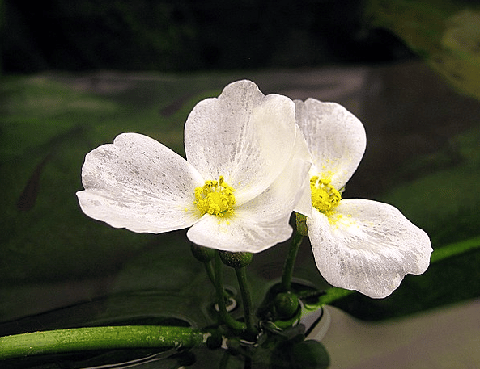
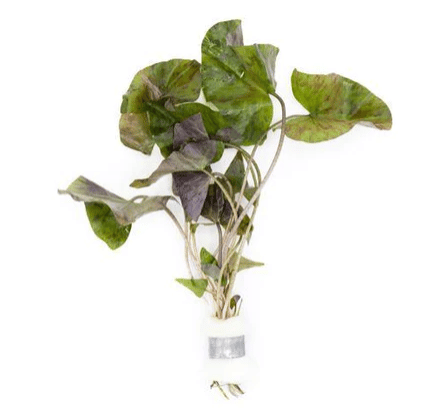
No pond is complete without lily pads. The red tiger lotus is a beautiful addition to the home aquarium or the pond setup.
These pond plants bring a burst of color to both the water column and the surface of the water. Their leaves turn brownish-red while reaching for the surface where they turn into large lily pad-like leaves. Eventually, they give way to a beautiful flower during late spring and early summer. These flowers can be white or purple. They have many thin petals that radiate from the bright yellow center.
While the red tiger lotus grows tall outdoors, many aquarium hobbyists also successfully keep them indoors. Even in the aquarium, these flowering plants will reach the surface of the water and bloom if left untrimmed.
11. Giant Hygro
Scientific Name: Hygrophila corymbosa
Skill Level: Easy
Size: <24 inches
Lighting: Moderate
pH: 6.0-7.5
Growth Rate: Fast
CO2 Requirement: Not required
As its common name suggests, the giant hydro (video source) is a large flowering plant that can quickly fill up the backdrop of freshwater fish tanks. This plant is also known as the temple plant or starhorn plant.
There are several variations of giant hygro, including a red variety and a compact variety. This species can grow up to 2 feet tall under moderate lighting without carbon dioxide, but can easily be maintained at smaller sizes through pruning. If overgrowth is a potential problem, then choosing the compact variety might be better for your personal system as this is a very fast growing plant.
The giant hygro has a simple yet effective appearance. This flowering plant has long and skinny bright green leaves that radiate from the center, leaving the stems buried under foliage. The colors of the leaves may vary and contain red depending on the variety.
This flowering plant doesn’t bloom often but has some of the most beautiful, tiny flowers. Due to the massive natural size of the plant, giant hygro flowers prefer to bloom above water. They produce small purple flowers that have some fragrance.
Final Thoughts
Many hobbyists keep popular flowering aquarium plants without even knowing it! Some of the species on this list are very common plants that can be found in most aquarium setups but aren’t given a chance to bloom. By providing stable water parameters, plenty of nutrients, adequate lighting, and careful pruning, there is a chance that your mundane aquarium plant might just flower!
🌿 Want to learn more? This article is part of our complete Planted Tank & Aquascaping Guide. your ultimate resource for aquarium plants, aquascaping styles, substrates, and more.
I’ve had mystery snails fake me out more times than I can count. You’ll find them sealed up tight with their operculum, completely motionless, and every instinct says something is wrong. but they’re just dormant. After keeping snails in my tanks for years, I’ve learned the difference between a snail that needs time and a snail that’s actually dead, and there are a few reliable tells that remove most of the guesswork.
Snails have a reputation for making you second-guess yourself. Mystery snails especially will seal themselves up with their operculum and go dormant for days. sometimes weeks. and look completely dead the whole time. I’ve been fooled more than once. After 25 years of keeping everything from nerite snails to giant apple snails, I can tell you the smell test is still the most reliable method, as unpleasant as that sounds. Here are six ways to tell if your snail has actually died.
Key Takeaways
The smell is the most obvious way to tell if a aquarium snail is dead in your aquarium
When snails die, they release a large amount of ammonia. Death of a large snail or numerous snails may require a water change
Old age is the most common reason for a snail’s death in an aquarium
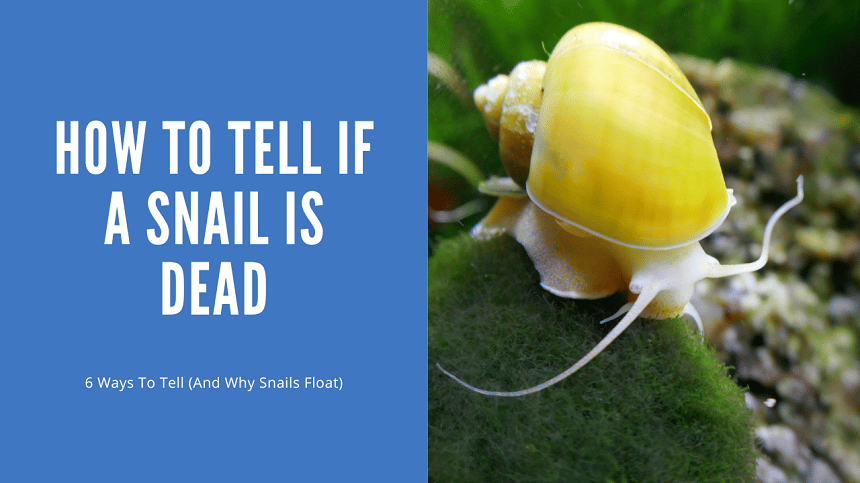
How To Tell If A Snail Is Dead – 6 Ways To Tell
Here are 6 obvious signs to see if your snail is dead or just sleeping. You can check out YouTube video below. We also go into further detail in our blog post. If you like our content, be sure to subscribe as we post new videos every week.
1. Smell Test
The smell test gives the most authentic results. If you suspect that your snail is dead, take a sniff and you’ll know.
That’s because dead snails produce a lot of Ammonia and decompose very quickly, leaving behind a pungent smell like rotting food. I also advise testing your tank water because there are high chances of Ammonia spike that require immediate water change after removing the dead snail.
You can also sniff the foot of your snail if the shell doesn’t smell bad. A dead snail’s body, especially the foot will smell equally bad. However, poor water quality can also add to a stinky foot.
If your snail is alive but has smelly feet, consider doing partial water changes.
2. Examine The Body
Look out the snail’s shell and body closely. When a snail dies, its body shrinks into the shell and then slowly decomposes. Look at the opening of the shell, if you cannot spot the body inside, it is most likely a dead snail. Also, when you hold the snail and it feels very light with nothing inside, the snail has died.
If the body shrinks, the snail produces a lot of ammonia shortly. Thus, immediate partial water changes and filtration is required to keep things at bay.
3. Check The Trap Door
This option is well suited for larger snail varieties such as Mystery snails or Apple snails. Carefully tug at the trap door of your snail. If it’s alive, you will feel resistance. But if it opens easily, the snail is dead.
4. Transport Your Pet To A New Environment
Another effective method to check if a snail is dead is to move it to a new environment. You can transport your snail to a smaller or larger aquarium or container with different water parameters.
The change in water parameters and overall environment would entice curiosity in your snail and it will most likely wake up to explore its new environment.
5. Check If They React
Snails, almost like all living things, react to certain external stimuli. And so, you can tap the snail shell carefully to see if it reacts. Or you can also try tickling its belly to check if it retracts. If it does, there’s nothing to worry. But if it remains motionless, your snail is dead.
6. Light Test
You can try holding the snail in your hands and exposing it against the flashlight or light bulb. If you see no matter inside or if the body is slightly shrunken, the snail is most likely dead.
How Long Can They Go Without Moving?
In the wild, snails hibernate for around three years or longer without moving. However, aquarium snails sleep or remain inactive for around two weeks. The inactivity may be a result of a number of factors.
Most snails don’t move for approx three to four days as a result of transportation. Freshly introduced Nerite snails don’t move when added to a new ecosystem.
Why Do They Die?
There are many reasons for a snail to be dead in your aquarium.
Old age is one of the most common causes.
Snails are extremely sensitive to high levels of toxins in the water, so if you neglect regular water changes in your tank and the water’s ammonia, nitrite, and nitrate levels rise, your snails and some of your fish could die.
Algae and debris are not sufficient for the survival of snails. Your snails risk starvation if not fed properly.
Many fish treatments contain copper, which can be fatal to plants and snails. Fish that require treatment should be put into a quarantine tank rather than your display tank since those medications include copper.
Warm water is required by tropical snails. Your snails will die if the water in your aquarium is too cold. below 50 degrees Fahrenheit.
What To Do With Deceased Ones?
The soft component of a dead snail is typically damaged or melted away when it decomposes. The snail in hibernation has a membrane within and its shell will be extremely fragile. If the snail has been dead for a while, all you find are empty shells.
You must remove any dead snails from the tank or the vicinity right away, whether they are in the water or on land, especially if there are other snails or marine animals nearby (in the case of an aquarium).
To avoid contaminating the water or sand for the other snails or animals, make it a point to completely change the water or sand.
The dead snail body may occasionally be consumed by the fish in your tank before it turns poisonous to them. If not, quickly remove the dead snail before it contaminates the water.
I advise avoiding removing the shells from the water because they don’t deteriorate and add beauty to your aquarium. In addition to being useful as raw materials for numerous goods, snail shells are also quite aesthetically beautiful and can be utilized for clothing and home décor.
How To Distinguish Between A Dead Snail And A Hibernating One?
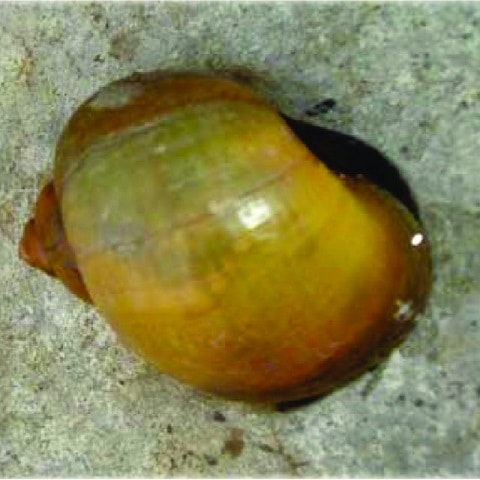
Nerite and mystery snails frequently go dormant for days at a time in aquariums. By examining its shell, you can tell a hibernating snail from a dead one. The shell of a dead snail is discolored, weightless, and lifeless.
Even while the snail is hibernating, its slime keeps it glued to objects. However, dead snails don’t have clingy slime, thus they float away from any surface more frequently. In any case, don’t be too quick to discard your snail. It needs time to wake up.
Pro tip: A snail in hibernation will stay put, won't emerge from its shell, and will instead stay affixed to a surface. A dead snail, on the other hand, is unable to adhere to any surface and will remain stationary.
Why Do They Float?
Many novice snail keepers often ask “Is my floating snail dead?” Today I’m going to answer this question.
Many aquarium snail species float. including mystery snails that occasionally float (video source). So, Good news! Your snail might not actually be dead. Because they can store air inside their shells, snails have enough buoyancy to float.
Some snail species in nature purposefully float on the water’s surface so that they can be carried along by the current and move more quickly, perhaps in quest of better eating grounds.
In captivity, hunger is a frequent reason why snails float at the water’s surface, often upside down as they attempt to catch dangling food pieces.
Snails cannot thrive on algae alone, contrary to popular belief. To help keep the snails’ shells in good condition, be sure to add vegetables and other high-calcium foods to their diet.
Lift a floating snail carefully out of the water and give the shell a sniff if you’re unsure whether it’s alive or dead. If it doesn’t stink keep your snail floating.
How To Improve The Health Of Your Tank Pet?
Snails need clean, filtered, oxygenated water to stay healthy, just like your fish do.
Therefore, to maintain a clean environment, be sure to properly maintain your aquarium filtration system, perform weekly partial water changes, and completely vacuum the substrate.
Snails can handle water temperatures between 65° and 82° Fahrenheit and prefer a pH level close to 7.0.
Despite their small size, each of your snails needs at least 2.5 liters of water. That makes sure the mollusks won’t go hungry and gives each snail plenty of room to forage.
Leave a six-inch area below the tank lid or cover slide so that the snails can deposit eggs if you wish them to reproduce. Examine the aquarium lid and seal any openings that the snails might use to elude capture.
Aquatic snails may live for a short time without water, but eventually, they will become dehydrated and pass away.
Choose Tank mates Carefully
If you raise an aquarium snail, be selective with your tankmates. Avoid fish including puffers, cichlids, goldfish, and some catfish that feed on snails.
FAQs
How Do I Know If They Have Died?
First of all, if your snail is not moving. You can try doing the following things to see if it’s dead.
1) Sniff the snail’s shell or feet to see if any foul smell is coming. If yes, your snail is dead. If no, it’s alive.
2) Examine the snail’s body properly. If it’s shrunken, your snail is no more. If not, it’s still there.
3) For larger snails, you can tug at the trapdoor to see any reaction or you can even transport your snail to a new fish tank or aquarium with different water parameters to see if it reacts.
4) Check out the snail shell with the help of flashlight to see if there’s any matter inside the shell.
What Do They Look Like When They Pass Away?
A dead snail snail is the one with empty shells. When the snail is found hanging out of their shells or their shells are crushed, they are most likely dead. The dead snail are no longer slimy and have a different color that is darker than the original.
How Do You Know They Are Alive?
1) If the snail does not stink 2) If it reacts on external stimuli 3) Here’s a little test to check if your snail is alive:
Lift your snail out of the water and very carefully bring the back foot toward you, if the snail retracts, it’s alive.
Why Are They Not Moving?
A snail typically won’t move or emerge from its shell because of the low temperature. Nerite snails and mystery snails prefer temperatures of 76 to 84 degrees Fahrenheit. They must hibernate because of the drop in temperature.
However, your snail will die below 23°F. If it’s too cold, put the snail in warm water to help it emerge from its shell and begin moving.
Is My Pet Dead Or Sleeping?
Your snail is probably sleeping, hibernating, or relaxing if it isn’t moving and is still clinging to the aquarium glass or decorations.
Why Did My Nerite Ones Die?
There are four possible reasons for your Nerite snails to die.
Nerite snails are extremely sensitive. As a result, nerite snails will eventually die in the aquarium if even a small amount of copper is present.
A nerite snail has a higher likelihood of dying if there is an excess of Nitrate and Ammonia.
Poor water conditions for your nerite snails
Since they are natural algae eaters, if you completely remove or filter out the algae from your aquarium, they will eventually die.
Final Thoughts
Freshwater snails are very popular in the freshwater fishkeeping niche. And now you know why!
Their fascinating and peaceful appearance is a go-ahead for any aquarists to raise them as pets. Now you know how to tell if a snail is dead or sleeping or hibernating or peacefully floating, things would be much easier for you.
📘 Want to learn more? This article is part of our complete Freshwater Fish Guide. your ultimate resource for freshwater species, care tips, tank setup, and more.
I’ve set up more betta tanks than I can count. from minimalist 5-gallon planted setups to more elaborate community tanks housing a male betta with carefully chosen tank mates. The good news is that bettas aren’t nearly as demanding to set up as some fish, but there are a handful of non-negotiables I see people cut corners on constantly: tank size (a bowl is not a home), a proper heater, and appropriate filtration. Here are the five steps to getting a betta setup right the first time.
Key Takeaways
A single betta fish needs a tank of at least 5 gallons. You’ll need a larger tank if you plan on adding any tank mates. Avoid very small tanks, bowls, or cups- these are bad for your fish’s health
Every betta fish tank should include a filter, and you’ll probably need an aquarium heater too. Unfiltered tank setups can result in poor water quality.
Live plants and decorations are a great way to create a natural environment for your betta fish. Just make sure your decorations are smooth and fish safe.
Betta fish tanks need regular testing and regular maintenance to ensure your betta’s health.
Aquarium Size
Alright, let’s start with the most controversial topic when it comes to betta fish keeping, tank size. You’ve probably seen bettas in tiny plastic bowls, cups, and other small containers. The salesman at the local pet store might have even told you that that’s what they prefer.
The fact is that betta fish need a good amount of room to swim and explore, and more importantly, you need a decent amount of water volume in the tank to maintain good water quality and a healthy betta.
Some aquarists will tell you that a 2-gallon tank is enough, and then you get fish keepers who insist that every fish needs a huge tank to be happy. Well, my advice is to start with 5 gallons as your minimum. This is a great size for a single male betta fish.
If you plan on adding more fish and setting up a community tank, however, it’s better to start off with a 10 or 20 gallon tank. The shape isn’t all that important, but avoid very tall, deep tanks or anything that is difficult to clean.
Finally, I recommend using a lid/hood over your tank to avoid your betta jumping out. Bettas can jump pretty high when they want to, and a sealed tank will also maintain its water level much better.
Filtration
Filtration can be another sticky subject. Some experienced aquarists are able to maintain heavily planted tanks without filters, but why risk it? You might find yourself performing more water changes than you’d like!
Betta males have been bred to have long, flowing fins, which means they are not very strong swimmers. Your filter should not create a strong current because your betta will be exhausted just trying to stay in one place!
Filters come in all sorts of sizes and shapes, but a sponge filter or hang-on back is going to work best in a small betta fish tank setup. Let’s take a look at the best filters for your betta aquarium setup.
Hang On Back (HOB) Filters
Hang-on back filters are all-in-one units that pump water over filtration media. This type of filter clips onto the rim of your tank and can create a gentle cascade effect. Choose a model that matches your tank size and has an adjustable flow for the best results.
Sponge Filters
Sponge filters are set at the bottom of your aquarium, usually in a back corner where they can be hidden away. This type of filter requires a small air pump, a length of airline tubing, and a one-way in-line valve to operate safely.
Sponge filters are often the cheapest option, and they work great, just be sure to buy a decent air pump to minimize noise.
Heating
Bettas are tropical fish, which means they come from a part of the world where it stays warm all year long. You might not need to worry about water temperature if you live in a similar climate, but for most of us, an aquarium heater is required.
Most heaters simply attach to the inside of your aquarium with suction cups. You’ll need to make sure that a heater will fit into your aquarium before you purchase it, of course. A 50-watt heater is a good choice for 5-gallon tanks and more, but if you live in a warm climate, a 25-watt could work out too.
Aquarium heaters are adjustable, but I always recommend adding a thermometer to your tank because it makes monitoring the actual temperature possible. These range from simple stick-on glass thermometers to handy digital models with alarms that alert you if the tank temperature gets too hot or too cold.
Lighting
Betta fish do not have any specific lighting needs, but they do require a natural day/night cycle. You might need to invest in better lighting if you plan on growing a lot of plants, however.
Choose a model that can be run on a timer for 6 – 8 hours per day so you don’t have to switch it on and off manually. Lighting can be attached under your hood, clip onto the rim of your aquarium, or be supported on its own stand.
Substrate
The sand, gravel, or other material at the bottom of a fish tank is called the substrate. There are many options to choose from when putting together a great betta fish tank. These include:
Sand and gravel are known as inert substrates because they do not leach out any nutrients into the water. These are usually the best options unless you plan on setting up a heavily planted tank. The color is completely up to you, although natural colors look so much better in a planted tank.
Excellent aquarium soils are available for aquarists looking to set up heavily planted aquariums. These substrates are more expensive, but fortunately, you won’t need too much in a small aquarium!
Substrates should be rinsed off before adding them to your tank because they can be dusty and cloud up your water. This is easy to do by putting the substrate in a bucket and running water through it until it stays clear.
Hardscape and Decorations
The hardscape in your betta fish tank is the collection of solid objects that are used to create structure and interest in the tank. Natural hardscape features like driftwood and stones are the best for creating a natural habitat for your fish.
Decorations can be a fun way to add character to your betta tank. There are many types of aquarium decorations, including themed objects like:
Sunken ships
Castles
Cartoon characters
One important thing to note is that any ornament you put into your tank needs to be aquarium-safe, and made specifically to be used in a fish tank. Betta fish have very long, flowing fins that tear easily on sharp edges, so inspect your ornaments carefully and file down any sharp points.
Fake Plants
Artificial plants are a great way to make your tank look more natural while avoiding caring for the real thing. As with plastic ornaments, however, plastic plants can have very sharp edges that can be dangerous for your fish. Silk plants and very soft plastic materials are the safest options.
Aquarium backgrounds are sheets of material that are attached to the outside of your aquarium’s back wall. These are completely optional but they can make your aquarium that much more interesting.
A plain matte black background is always a great option, but designs with rocks, pebbles, or plants are also available.
Live Plants
Live plants are fun to grow and care for, look amazing in a betta tank, and also help to maintain high water quality. Read this section for a brief introduction to growing live plants in your betta fish tank!
Plant Types
There are hundreds of different types of aquatic plants in the aquarium hobby, and their care needs differ from species to species.
All plants need the following:
Good light for 6-8 hours per day
Nutrients from the substrate or water column
Correct pH, temperature, and other parameters
Floating plants for your aquarium:
Floating plants float on top of the water. Betta fish breathe air from the surface, so never allow these plants to completely overgrow your tank.
Stem plants are fast-growing species that grow from the substrate or by drifting in the water. These plants are great for soaking up excess nutrients in the water.
Limnophila sessiliflora
Rotala rotundifolia
Ludwigia repens
Epiphyte plants for your aquarium:
Epiphytes are plants that grow attached to objects like driftwood. They should not be grown in the substrate.
Stem plants and rosette plants need to be planted into the substrate to grow. This is easily done by grasping the bottom of the plant with a pair of aquascaping tweezers and gently pushing it into the substrate.
Epiphytes like Java ferns and moss should never be planted in the substrate. These plants should be attached to your driftwood or decorations with fine green cotton thread or even super glue.
Feeding Your Plants
Plants need nutrients to live and grow. If you plan on setting up a heavily planted aquarium, you will need to fertilize them regularly.
Plants that grow rooted in the substrate will take their nutrients from a good quality aquarium soil or root tabs. Floating plants and epiphytes can be fed with a water column fertilizer.
Large, fast-growing plants can do an amazing job of maintaining good water quality, but they tend to need frequent trimming. A sharp pair of aquascaping scissors are your best friend here, just remember to net out all of the trimmings after you’re done.
Aquascaping
No introduction to aquarium plants would be complete without mentioning aquascaping. This is the art of creating amazing underwater ‘landscapes’ with live plants.
There are many different styles, but the two best options for a small betta tank are a sloping scape with the smallest plants in the front, moving to taller plants in the back, or an island of plants in the middle of the tank.
Setting Up Your Aquarium – 5 Steps For Success
Once you have everything you need to create the perfect tank for your betta, it’s time to put it all together! Read on to learn how.
1. Location
The first step when setting up a great tank for your betta is to choose the right location. An aquarium stand or cabinet is the ideal place to set up an aquarium, but smaller tanks can be put on other sturdy surfaces such as desks.
The surface should be perfectly level, perfectly flat, and strong enough to support the weight of the aquarium, water, and substrate. Avoid setting up your betta tank near a furnace or cold window, and avoid direct sunlight.
You should also avoid setting up your betta tank next to any electronics or other equipment that should not get wet. You will need an electrical outlet nearby of course to run your filter, heater, and lighting.
2. Protecting Your Aquarium
Before placing your aquarium on its surface, it’s vitally important that you make sure the bottom of the glass and the surface are clean and level. Any small object can cause your aquarium glass to crack and break.
If your tank didn’t already come with cushioning, you’ll need to purchase a padded aquarium mat to protect the bottom.
3. Decorating Your Aquarium
Once your aquarium is in place, it’s time to start decorating your tank and installing all the hardware. Let’s get started!
Start by cleaning your aquarium, just to make sure there are no chemicals or unwanted traces left from manufacturing and packaging. This is also a good time to add your aquarium background if you have one.
Now it’s time to add your substrate. Rinse it off first and then add it to the bottom of the tank gently. You can create depth in your layout by sloping your substrate up from the front to the back of the tank.
Next, you can decide where you want to position your filter and heater. It is best to place these items at the back of the tank where they can be hidden by driftwood, plants, or ornaments. Do not switch them on until your tank is filled with water!
Now it’s time to carefully arrange your decorations and hardscape. Give them a thorough cleaning before adding them to the tank.
New driftwood can often leach out tannins into the tank in the first few weeks. Soak it in water before adding it to your tank to see if this is the case. If so, you can speed up the process by soaking it in warm water.
4. Adding Water
The next step is to add water to your aquarium for the first time. This is an exciting step because you get a real feel for what it is going to look like! This is also the time when you can add live plants if you choose to go that route.
Tap water usually contains some chemicals that keep the water safe for human consumption. Unfortunately, these chemicals are harmful to aquatic organisms, so make sure you treat the water with a dechlorinator.
Pouring water into your aquarium will disturb the substrate and even move your decorations, so do this step slowly. One trick that works really well is to place a small plastic bag or sleeve onto the bottom of the tank and pour the water onto it.
Alternatively, you can make small holes in a plastic bag and pour the water through it, or even borrow a colander from the kitchen. Once your tank is full of water, you can turn on the filter and heater.
5. Cycling The Aquarium
Have you ever heard of aquarium cycling? Cycling is the process of establishing a beneficial bacteria population in your tank to get the nitrogen cycle up and running and provide biological filtration.
You can do this before you get your new betta fish by setting up the tank and running the filter for 2 to 4 weeks. Adding a little fish food to the water will provide the bacteria with the food they need to start growing.
You can also cycle your tank if you already have your betta fish (in fish cycle) by using a product like API Quickstart, but it’s important to test your water regularly and make water changes if necessary.
Recap
Here’s an example of the sequence you should follow:
Purchase all equipment
Choose your tank location
Put your aquarium in place
Rinse and then add your substrate
Position your filter, heater, hardscape, and decorations
Dechlorinate and then add water
Add live plants
Switch on your filter and heater
Cycle the aquarium and add your betta when you detect some nitrate, but no nitrite or ammonia in the water
Maintenance – Keeping Your Aquarium Healthy
When it comes to keeping bettas, maintenance is a really important part of the deal. Regular maintenance will keep your betta fish healthy and keep your tank looking beautiful. So what do you need to do?
The most important part of fish tank maintenance is managing the nitrogen cycle. In a healthy, cycled aquarium, the ammonia from fish waste and uneaten food will be broken down into nitrite and then into nitrate. Unfortunately, nitrate is not broken down any further (unless in a planted tank) and will build up to toxic levels if you don’t do anything about it.
Testing
Testing your water regularly is the only way to know how good your water quality is because harmful chemicals are invisible to the eye. You will need a test kit that can measure the following water parameters:
Once your aquarium is cycled and your betta is enjoying his or her new home, you will notice that the levels of nitrate (NO-3) start to rise. This nitrogen compound is safe for your betta fish in low concentrations but should be kept to below 20 parts per million (ppm) or so.
Read on to learn how to maintain high water quality!
Water Changes
The best way to manage the nitrate levels in your betta tank is to perform regular partial water changes. The process is really simple, here’s what you will need:
A water test kit to measure the nitrates before your water change
A gravel vacuum to siphon water out of the tank
A bucket for the old water
A bucket for the new water
A water conditioner/dechlorinator to neutralize tap water
A thermometer to help you bring the new water to the same temperature before adding it to the tank
At this point, you’re probably wondering how much water you should change and how often you need to do it. This is easily determined by testing your water.
If, for example, your test kit reads nitrates at 20 ppm and you want to bring it down to 10 ppm, you will need to do a 50% water change. if your nitrate levels jump back to 20 ppm after a week, you will need to repeat this schedule each week.
Other Maintenance
Testing your tank regularly and performing partial water changes are the most important maintenance tasks, but what else do you need to do to keep your tank clean?
From time to time your filtration media can get clogged with waste. Simply rinse it in old tank water (outside of your aquarium) to clean it out and protect your beneficial bacteria.
Algae often grow on aquarium glass and hardscape. They can be removed with an algae scraper and a small brush like a clean toothbrush.
Aquarium Mates
The great thing about betta fish is that they can be kept on their own in relatively small tanks. That doesn’t mean you can’t keep them with any other types of fish though.
The most important thing to remember is that you can’t keep more than one male betta fish in the same tank. They are called Siamese fighting fish for a reason! If you want to see a great video from our YouTube channel that goes over Betta Tank Mates, check it out below!
Adding a nerite snail is a great idea to help control algae in your betta fish aquarium. Shrimps can be risky though because many betta fish will attack them. If you would like to add more fish, however, you’re going to need a tank of at least 10 gallons to avoid overcrowding.
Here are 4 awesome freshwater fish that make great tank mates with betta fish in a larger community aquarium:
Kuhli loach – An interesting, eel-like aquarium fish that will eat uneaten food from the bottom of the tank.
Part of the deal when setting up a community tank is making sure that each species is comfortable in the same tank size, setup, and water parameters. Here’s a quick recap on the requirements of your betta fish:
pH: 6.5-8
Hardness: 5-20 DH
Water temperature: 76-81°F
Minimum tank size: 5 gallons
Water flow: Low
FAQs
What do they need in their aquarium?
Every betta fish tank setup should include a good quality filter, a heater, a thermometer, and aquarium-safe decorations or hardscape. Substrate and live plants are optional but highly recommended.
How long should you wait to put them in a new aquarium?
It usually takes 2 to 4 weeks to complete a fishless cycle. Your tank is cycled when ammonia and nitrite levels read zero but nitrates are present.
Do they need rocks or sand?
Betta fish do not necessarily need substrate in their aquarium although it can make your aquarium look more interesting and natural. Sand or gravel will also help to anchor ornaments and even live plants. Barebottom aquariums are an option but they need a lot of cleaning or they tend to look a little messy.
How do you prepare the water for them?
Start by testing your water to see if the pH is correct for your betta fish. The water will also need to be in the safe temperature range to avoid temperature shock. Tap water should always be treated with a water conditioner/dechlorinator to neutralize chemicals.
What do you need for a their setup?
Bettas need a tank of at least 5 gallons with a filter and a heater. Decorating their home with substrate, ornaments, and live plants will create a more natural and comfortable home for your betta fish.
Final Thoughts
Setting up your first betta fish tank is easy and really affordable. Follow the advice in this guide to set up a betta tank that is fit for your amazing new pet!
Do you keep betta fish? Tell us about your betta tank setup in the comments below!
📘 Want to learn more? This article is part of our complete Betta Fish Guide. your ultimate resource for betta care, types, tank setup, feeding, tank mates, and more.
After 25 years in the hobby and a YouTube channel where I talk about fish almost every day, I’ve somehow accumulated more fish puns than I should probably admit to. My team finally convinced me to compile them. Some are genuinely clever. Some are terrible. All of them are exactly what you’d expect from someone who has spent decades obsessing over aquarium fish. Here are 100+ fish puns for fellow fish keepers with a sense of humor.
Fish Puns
Let’s get started with a hilarious list of fish puns that you can use with your fish-keeping friends. We’ve got a carp-load of puns for you (carp is a fish, duh!).
Let me take this oppor-tuna-ty to warn you though, that some of these puns are a little fishy. The fun doesn’t stop there though, if you make it through this list of clever fish puns, there are a ton more funny fish jokes to enjoy.
Get ready for some funny fish puns!
They say you can tune a bass but you can’t tuna-fish
Holy mackerel that was a lot of fish puns! Alright, it’s time to scale back on all these fish puns and move on to some-fin a little different. In this next section, we’ll be laying down the ultimate list of fish jokes that incorporate fish puns. Stay tuna’d for the ultimate list of fish jokes to split your gills!
Jokes
If you think that was too many fish puns, we’re only just getting started! Sure, some of those fish puns were below sea level, but these fin-tastic fish-pun-filled jokes are sure to get you smiling!
Let’s get Kraken!
How do you make an octopus laugh?
Give it ten-tickles!
What is the funniest fish?
The clownfish
What do bored fish do? They watch tele-fish-ion
What’s a guppy’s favorite TV show? Tuna half men
What’s a kid guppy’s favorite show? They prefer cartunas
Who is a fish’s favorite action hero? Pond, James Pond
Why didn’t the oyster twins share these jokes? They were too shellfish to share
Health Jokes
All good aquarists take pride in keeping their fish happy and healthy. Let’s take a look at the light side of the hobby with these funny fish jokes.
What should you call a fish with no eyes? A fsh has no ‘I’s
What do you call a short-sighted fish? A fish-ually impaired fish
What do you call a fish that’s hard of hearing? Herring-impaired fish don’t hear so well
What do you call a fish without its herring aid? Anything you want, it can’t hear you
How do you take care of a fish with a cold? Give sick fish worm soup and vitamin sea
What do you do with a sick fish? Take sick fish to the weterinarian
What do you do with a really sick fish? You call a clambulance with your shell phone
Where do you take a shark with a head injury? Straight to a brain sturgeon
Where do you take a pirana with bad teeth? The orca-dontist
Why did the snail faint? It was shell-shocked
How do fish stay in shape? They have their own scales
It’s o-fish-all, these are the best fishy law jokes on the net!
What should a fish do to avoid getting caught? Keep its mouth shut
What do police do with criminal shrimp? Law-breaking shrimp are taken down to the crust-station for questioning
What do fish judges do? Fish judges balance the scales of justice
What’s the difference between a lawyer and a pleco? A lawyer is a scum-sucking scavenger and a pleco is just a fish
Who was the most dangerous fish in the sea? Jack the kipper was the most feared fish in all the sea
Why do octopuses make the best soldiers? They’re heavily armed (Especially in tanks)
Schooling Fish
Are you hooked on fish puns? Fish can be smarter than they look. Polyp a chair, because these jokes are all about fish education. You’re about to be schooled!
Why do Fish swim in schools? Fish swim in schools because they can’t walk
Why are fish so smart? Because they live in schools, of course!
What kind of fish is not smart? The dumb bass is not a very smart fish
Why did the teenage fish get bad grades? He was on his shell-phone all day long
What did his teacher do? She decided to con-fish-scate it and send him to the offish
Have you heard about the illiterate fisherman? He got lost at C
Everyday Fish Life
Whale whale whale, I sea you’re still with us! It’s fun to think about fish as if they were people, isn’t it? This next collection of fishy jokes is sure to make you laugh out loud, so keep clam and read on.
How do fish get to work? They ride a motor pike
How do fish make their cars go faster? They turbot-charge them!
How do fish get to school? Young fish take the octo-bus to school
Which fish work in balloon factories? Blowfish always get the job
What do cowboys of the sea ride? Sea cowboys scallop around on seahorses. Yee-ha!
What’s a fish’s favorite music? Drum and bass is a fish’s favorite music
Where do tired fish sleep? Tired fish sleep on the seabed
How do you call a fish? The best way to get in touch with a fish is to drop it a line with your shell phone
How do you get hold of a fish after office hours? Ask someone to hand it to you
What did the hopeful fish say to his girlfriend? He asked: ‘Your plaice or mine?’
What’s a fish’s favorite instrument? The bass drum is a fish’s favorite musical instrument
What kind of fish can you find in apartments? Flatfish live in apartments
Where do Brazillian fish wash their fins? Brazillian fish wash their fins in the Amazon river basin
Why do reef fish live in saltwater? They would live in pepper water but it makes them sneeze
Holy carp, the only thing more shocking than those jokes is an electric eel. But wait, there’s more. Check out these fishy jokes about fish and money!
Which fish has the highest price tag? The goldfish is the most expensive fish in the world
What’s the second most expensive fish in the world? Silver dollars
What is the third most expensive fish in the world? The bronze cory
What is printed in the middle of a fish dollar bill? ‘In cod we trust’
Where do fish go to get their loans? Fish get loans from the river bank
Where do ladyfish keep their money? Ladyfish keep their money in an octo-purse
Where do male fish keep their money? Male fish keep their cash in a walleye-t
Why did the fisherman close his business? Unfortunately, the unlucky fisherman made a net loss
Why did the shark drop out of college? The shark dropped out because he just couldn’t mako it
Where do fish sell their stuff? Fish sell their used goods down at the prawn shop
Fish Food Jokes
We all know fish need a healthy balanced diet. But do you know what your fish’s favorite food is? Let’s hear what the fish say!
What’s a fish’s favorite sandwich? Fish love peanut butter and jellyfish sandwiches
What do fish eat on the weekends? They get together with their pals for barbeque gills
What does moby dick eat? Moby dick ate fish and ships!
What do fish eat on their birthdays? Fish eat fishcakes on their birthdays
What do you tell a fish on its birthday? Happy birthday, best fishes, and many more
Why did the fishy chef make tons of fish eye soup? The chef made tons of fish eye soup because he thought it would see him through the winter
Why don’t they serve guppies at seafood restaurants? Seafood restaurants have much bigger fish to fry
So this gasping fish walks into a bar…Barman: What can I get you?Fish: Water! I need water!
Which fish drink the most? Beer-acudas are always getting drunk and rowdy
Which day do fish fear the most? Fryday is the most dangerous day for fish
Best Of The Rest
Wow, these fish jokes are really Kraken me up! Here are a bunch more funny fish jokes that you can share with your friends.
Which fish never stop talking? Big-mouthed bass never shut up
Where do starfish live? Starfish live way out in trouter-space
What is the smelliest fish in the ocean? The stink ray is the worst smelling fish in the sea
What did the fish say when his friend swam into a wall? Dam!
Which fish pray the most? Monkfish and holy mackerel pray the most
Which fish live in heaven? Angelfish live in heaven
What’s a fish’s favorite hymn? I once was lobster, but now I’m flounder
Why did the fish blush? It was in a bare-bottom aquarium
What do fish magicians say? Pick a cod, any cod
What comes after a goldfish? A silverfish comes after a goldfish
Knock knock Jokes
Ah, the good old knock-knock joke. Here are three hilarious fish knock-knock jokes that you can share!
Knock knock!
Who’s there?
A fish
A fish who?
Bless you dear
Knock knock!
Who’s there?
Fish tank
Fish tank who?
You’re welcome
Knock knock!
Who’s there?
Artie fish
Artie fish who?
Artie fish-al intelligence
Final Thoughts
Whale, that’s all folks. I hope you enjoyed this funny fish post. Remember, don’t be shellfish, share the fun with your friends and family. Tanks for stopping by and be sure to tuna in next time for more great fishy content! Follow us on YouTube if you like our content. We will be expanding this year!
Do you have your own fish puns? Let minnow in the comments below!
After 25 years of watching goldfish keepers make the same mistakes, goldfish are not easy. They produce more waste than fish three times their price and need more space than most people realize. A single goldfish needs 20 gallons minimum and heavy filtration. Most goldfish deaths come from undersized tanks and inadequate filtration.
The minimum tank size for one goldfish is bigger than most people want to hear.
A goldfish kept properly is more impressive than most tropical fish. The problem is almost nobody keeps them properly.
Goldfish tank size is probably the most misunderstood topic in the hobby. The old “one inch per gallon” rule is completely wrong for goldfish. Common and comet goldfish can hit 12+ inches and produce enormous amounts of waste, while even fancy goldfish need far more space than most beginners realize. I’ve seen countless goldfish kept in bowls and small tanks that struggle their whole lives and die young. After 25+ years, here’s the honest breakdown of what size tank goldfish actually need.
Expert Take (Mark Valderrama, AquariumStoreDepot)
The number one cause of premature goldfish death is inadequate tank size. After 25 years, I still see single-tail goldfish in 10-gallon tanks at pet stores, and I still see those fish dead within a year from chronic ammonia exposure and stunted growth. A single common or comet goldfish needs a minimum of 40 gallons (151 L). Fancy goldfish are slightly more manageable, but they still produce enormous waste relative to their size and need much more space than most people plan for.
Key Takeaways
Goldfish grow too large sizes and need aquariums of at least 20 gallons with 40 gallons being preferred
Slim-bodied goldfish grow longer than fancy varieties
All goldfish are hard on a bioload due to their mass
Introduction to Goldfish
Chances are, you’ve owned a goldfish before. Whether you won one at a local fair or took care of a pet goldfish as a child, these fish have made their way into the homes of many. The problem is that they’re not exactly fish suitable for the home environment, though.
Goldfish are ancient fish. They have domesticated a millennium ago in China and spread worldwide by the early 1800s. Goldfish are the byproduct of mutations from wild carp native to East Asia, more specifically the crucian carp (Carassius carassius).
It is easy to see how bright orange goldfish were derived from their more musky-colored relatives. Crucian carp can range greatly in color, though they always appear in more natural tones. They are commonly found in hues of brown, green, and yellow.
Every now and then, these fish would exhibit exceptional colors, more like the ones we see on typical goldfish today. Practitioners of Buddhism saved and preserved these fish. Over hundreds of years, mutated crucian carp were collected and bred to show the best yellow and orange colors. By the 1600s, even more, desirable traits, like long fins, took shape as more and more enthusiasts moved their goldfish inside from their outdoor ponds.
Today, there are many breeds of goldfish, all considered members of the Carassius auratus species. This species is categorized into two groups: single-tail and double-tail/fancy goldfish.
Single Tail (AKA Slim Bodied)
Single-tail goldfish are some of the most common goldfish to see. These are the typical take-home-from-fair prize fish. Single-tail goldfish are more challenging in some ways than their fancier counterparts due to their immense size and activity. Because of this, they are best kept in outdoor ponds.
Single tail goldfish can grow to be over a foot in length and live up to 40 years. These slim-bodied goldfish are also extremely active and is seen swimming from one side of the tank or pond to the other.
Double-tail goldfish are much more compact and ornate, but don’t be fooled! These round fish are just as messy as single-tail breeds and live almost as long.
Fancy goldfish stay under 10 inches in size. They aren’t as active as single-tail varieties as each breed features some body modification. Whether it be longer fins, eye enhancements, or emphasis on other body parts, fancy goldfish are limited in activity; especially ornate fish might even have difficulty swimming correctly. This makes them ideal for indoor aquariums as opposed to pond setups.
Although goldfish have been domesticated for over 1,000 years, they haven’t lost their spirit. These fish are incredibly active swimmers, rarely standing still. The only reasons they might slow down in activity are due to illness, old age, or hibernation. Look down into a pond during the summer versus the winter and you’re sure to see a difference (video source).
Not only are goldfish incredibly active fish, but they’re also some of the largest and messiest freshwater fish you can get. Remember, common goldfish can well surpass a foot in length. Contrary to popular belief, these fish won’t stop growing depending on the tank size they’re kept in.
As we’ll see, all these reasons make the idea of keeping goldfish in a goldfish bowl completely absurd.
Recommended Tank Size
Quick Answer
Single-tail goldfish (common, comet, shubunkin): 40 gallons (151 L) minimum for the first fish, 10 to 15 gallons more per additional fish. Fancy goldfish (oranda, ryukin, telescope, ranchu): 20 to 30 gallons (75 to 113 L) for the first fish, 10 gallons more per additional fish. Bowls and tanks under 10 gallons are not appropriate for any goldfish at any life stage.
The recommended goldfish tank size depends on the type of goldfish you’re keeping. Single-tail breeds that have large and long bodies need a minimum tank size of 40 gallons per fish. Double-tail breeds that have short and compact bodies need a minimum tank size of 20 gallons per fish.
In many cases, these are only beginning tank sizes. Many single-tail breeds will outgrow this size tank in a few years and will do best in a pond setting long-term. Double tail breeds are successful in a 20-gallon tank for the duration of their lives as long as the tank is never overstocked and regularly cleaned.
What is the Ideal Tank?
Believe it or not, goldfish tanks do best with a bare minimum tank setup. The most important aspect of a goldfish tank is filtration.
In terms of the actual setup and goldfish care, less if more. These fish thrive in a bare-bottom tank with plenty of swimming space. This means no plants or decorations. Trust us, your goldfish would eliminate most plants you decided to put in anyway!
Besides the filtration, additional tank equipment is minimal.
Water Temperature
Goldfish are unique. They are coldwater fish that does best when aquarium water temperatures are between 68 to 74˚F. For most, this means that ambient room temperature will keep the aquarium at the correct temperature.
The bigger concern is maintaining that temperature, though.
Although extremely cold-hardy, goldfish are still susceptible to rapidly changing water temperatures. For this reason, hobbyists may use an aquarium heater to keep the water temperature steady. In contrast, overly hot climates might require the usage of a chiller to keep water temperatures down.
If keeping goldfish in a pond, then there is little need to worry about temperature. A chiller may still be needed, though, the construction of the pond allows for shaded areas and deeper sections for cool pockets of relief. During the winter, goldfish will safely hibernate at the bottom of the pond no matter the temperature of the air outside.
Goldfish Filtration
Probably the most important aspect of owning goldfish: the filtration. While you is able to get by with minimal filtration on tropical community tanks with plenty of live plants, goldfish need heavy equipment.
Not only are goldfish messy eaters that create a lot of waste, but beneficial bacteria also have few places to populate due to the absence of plants, substrate, and decorations.
It is strongly recommended to use a canister filter for goldfish tanks to allow for more space for biological, chemical, and mechanical filtration; a hang-on-the-back filter may work, but is oversized in comparison to the tank.
Ideally, goldfish filters should be rated for 10x the hourly turnover or close to that; this means that a 20-gallon tank size would need a filter rated for 200 gallons per hour, and a 40-gallon tank size would need a filter rated for 400 gallons per hour.
In general, canister filters are more efficient than hang-on-the-back ones and only need about a 7-8x turnover, though it’s always best to aim for the full 10x.
Water Parameters
Goldfish need good water quality. They are very likely to succumb to ammonia and nitrite poisoning and need frequent tank maintenance. Ammonia and nitrite should always be 0 ppm. Nitrate should be minimal as live plants can’t be used for export.
Otherwise, goldfish are very adaptive fish. They prefer neutral 7.0 pH conditions, but is kept in slightly hard or soft water. As discussed before, they need a water temperature between 68 to 74˚F, though they can withstand lower temperatures too as long as values don’t fluctuate.
Tank Maintenance
Believe it or not, goldfish are pretty demanding fish. Even though they’re easy to keep, they need good aquarium husbandry.
How much maintenance you need to perform on your goldfish tank largely depends on how many goldfish are in the aquarium and how efficient the filtration is. In general, a weekly water change of about 20-30% is the bare minimum. Some hobbyists perform several smaller water changes of about 10-15% throughout the week instead of doing a large amount all at once.
It is crucial to keep a goldfish tank clean as waste accumulates. The bottom of the aquarium should be vacuumed to remove fish waste and leftover food. The filtration media should also be rinsed out every couple of weeks.
If you start to notice that the tank smells, your fish becomes uninterested in swimming and eating, or red spots become apparent around your fish’s gills, test for ammonia and nitrite immediately. Poor water quality and tank maintenance will lead to excess amounts of ammonia and nitrite which can quickly become deadly in a goldfish tank.
Diet
Goldfish are omnivores. This means that they need a balance of meaty and plant-based foods to give them a happy and healthy life.
Most aquarium companies make goldfish-specific flake and pellet foods. While these will provide your fish with the necessary nutrients to survive, they won’t give your fish different trace elements or the excitement of trying new foods.
The best goldfish diet will have a flake or pellet staple food alongside a variety of live, frozen, and freeze-dried options as well as a selection of fresh vegetables. Goldfish will happily accept various worms and insects along with blanched lettuce and cucumber. Just keep in mind that these foods is messier than simple flake or pellet foods, so leftovers need to be removed.
If you want to make your goldfish tank more natural, then you can include live plants. But wait. Didn’t we say that you can’t keep plants in your goldfish aquarium? That’s true, as long as you don’t mind your goldfish eating them.
Live plants are a great source of food for goldfish. Some species of plant, like anacharis (Elodea spp.), have a fast enough growth rate that they can outcompete your goldfish’s appetite. Some hobbyists even set up separate tanks entirely to grow out fresh greens for their fish.
Tank Mates
The best tank mates for goldfish are other goldfish. There are a few reasons why additional fish species end up being incompatible.
1) Temperature. The biggest problem with finding goldfish tank mates is temperature. These fish are some of the most cold-tolerant in the hobby and not much other fish can compare or adapt.
2) Space. Goldfish need plenty of open swimming space and water volume to dilute their waste. Many breeds of double-tail goldfish are also limited in their maneuverability, which other fish might take advantage of, especially during feeding times.
3) Tank setup. All in all, goldfish have a pretty specific tank setup. Many of the tropical fish commonly kept in the hobby require substrate and decorations to feel safe.
4) Aggression. Goldfish are relatively peaceful fish. However, many hobbyists think they can throw a bottom-dweller into their tank with no repercussions. Sadly, there are many horror stories of pleco species sucking the slime coats off goldfish, which can lead to disease and eventual death.
This isn’t to say that hobbyists haven’t successfully kept additional fish in a goldfish tank. Many goldfish keepers have luck with dojo loaches (Misgurnus anguillicaudatus) and white cloud mountain minnows (Tanichthys albonubes). With more fish also comes the need for a larger aquarium.
FAQs
What size tank do you need for 2?
This depends on the breeds of goldfish you are keeping. If you have two single-tail goldfish, like comet goldfish, then you will need an 80-gallon tank size. If you have two fancy goldfish, like telescope eye goldfish, then you will need a 40-gallon tank size.
What tank size do you need for 3?
Using the same ratio of 40 gallons per single-tail goldfish and 20 gallons per double-tail goldfish (fancy), 3 goldfish would need 120 gallons or 60 gallons respectively.
Is 1 gallon enough?
No! 1 gallon is never enough room for a goldfish due to their size and bioload. Unfortunately, companies target unknowing hobbyists with images and displays of goldfish happily living in small containers. This is the opposite of the truth and all goldfish require an appropriately sized tank to live.
How many is in a 10-gallon tank?
Again, none. The smallest fancy goldfish varieties require at least 20 gallons on their own. Smaller goldfish is grown out in a 10-gallon tank size by experienced hobbyists, but an upgrade will be needed within a couple of months.
Final Thoughts
Goldfish tanks are simple and elegant. But the truth is that these is quite demanding fish and beginners might struggle to meet all their needs.
Most important is a good goldfish tank size. Single-tail breeds need 40 gallons each while double-tail breeds need 20 gallons each. After that, filtration and maintenance will keep your goldfish tank clean and clear of any excess nutrients. Lastly, a well-varied omnivorous diet will keep your fish shining like gold.
Betta tank size is one of the most argued topics in the hobby and I have strong opinions after keeping bettas in everything from tiny setups to proper 10-gallon+ tanks. The difference in behavior, health, and lifespan between cramped and appropriately sized bettas is stark. Let me break down what bettas actually need.
Betta tank size is one of the biggest sources of misinformation in the hobby. I’ve seen bettas kept in tiny cups and vases for years. and they survive, but survival isn’t the same as thriving. After keeping bettas myself and answering this question constantly on YouTube, my answer is clear: bigger is always better, and the “5 gallon minimum” you see everywhere is genuinely the floor, not the sweet spot. Here’s the full breakdown.
If you’re a new betta owner, you’re usually bombarded with a massive influx of information while searching for the best betta fish tank size on the Internet. And you might wonder, “What exactly is the right size for a betta fish tank?”
Unfortunately, naive pet owners keep their bettas in all bizarre things of all sizes, such as in a vase or a bowl, and pose questions to themselves, “why did their betta die?” I understand the frustration and this is why, today, I’m clearing all the misconceptions about betta fish tank size.
Stick with me to crack the code.
Expert Take (Mark Valderrama, AquariumStoreDepot)
The 1-gallon bowl is the worst thing that ever happened to betta fish. After 25 years in this hobby, I still see bettas sold in cups and kept in tiny vases, and I still see them die within months from ammonia poisoning and temperature instability. A betta is a tropical fish. It needs heat (75 to 82°F / 24 to 28°C), space, and a functioning nitrogen cycle. The minimum is 5 gallons. That is not a recommendation, it is the floor.
Betta Fish Need Room To Swim
Since betta fish originally lives in warm water rice puddles around Asia1, many people think they are fine in a vase or small tank. However, that’s not true.
Betta fish needs enough swimming space that is its own private space with lots of aquatic plants. The rice paddies in Asia might seem like little puddles but these are mostly waterlogged for miles, which allows your betta to swim freely in its own space.
The truth: Get your betta fish the largest tank possible to meet their needs. Originally, the tank size should be no less than 5 gallonsfor a single betta. To accommodate betta fish with other tank mates, the recommended tank size should be no less than 10 gallons.
Recommended Tank Size for a Betta Fish
Quick Answer
Minimum tank size for a single betta: 5 gallons (19 L) with a heater and a gentle, low-flow filter. The ideal starting tank is 10 gallons (38 L), which provides stable parameters and room for a small cleanup crew (otocinclus, nerite snails, corydoras). Tanks under 5 gallons allow ammonia and temperature to swing too fast for the fish to survive normal fluctuations.
In pet stores, you will find different tank sizes at different costs. However, you’ll realize that the cost of a 10-gallon tank is very reasonable as compared to a 1-gallon tank. That’s because a 10-gallon tank is the standard recommended size for a betta fish and many reliable companies produce them in bulk. Besides the cost difference between a 1-gallon tank and a 10-gallon tank is so trivial provided the amount of free-swimming space you’ll get for your betta. Therefore, I suggest investing in a betta tank of no less than 5 gallons, if you want to keep a single betta in it. Otherwise, if you plan to build a community tank, the bigger your tank, the better.
Many experienced aquarists would recommend you get a larger tank for your betta fish because no one fancies a sad betta fish in a plain water bowl with no decorations and aquarium plants in it. Bettas are territorial and they require plenty of hiding places, aquatic plants, and decorations to ensure the longevity and happiness of betta fish.
What Is The Ideal Tank?
In the pet stores, you will find all kinds of betta tanks ranging from plastic ones, gallon tanks, a tank that is curved from the front, and a 10-gallon tank. Therefore, it is baffling to choose between a myriad of options.
The ideal betta tank is the one that is feasible for your betta first, and then, the owner.
Here are the requirements for an ideal betta fish tank.
A Low Wide Tank
In their natural habitat, betta lives in shallow waters (rice paddies, particularly). The fact that bettas are surface dwellers makes it pointless to get a tank that is deeper and not wider. Your betta will not use the space at the top. Also, it makes the cleaning process difficult for you.
I recommend purchasing a wide low tank for your bettas. For example, a 10-gallon tank would be an ideal tank size in this scenario. This 13 gallon tank by current USA is a great kit to try as well.
Yes, betta fish prefers warm water, and anything below 76° F would pose a problem to their immune system. It also means that you should get a tank that can accommodate house a heater. Setting the heater at 80 degrees is an ideal water temperature for your betta fish.
Also, install a filter to move the water so there are no hot or cold spots.
Fog and Scratch-Free Aquarium Walls
Betta fish is a highly interactive pet that can bond with its owners, watches them, plays with them, and perform for them.
However, plastic tanks obstruct their vision to see the owners and play with them. Therefore, I always recommend choosing glass or acrylic aquariums rather than plastic. Glass or acrylic materials do not fog up or scratch over time.
Tips For Buying The Tank And Other Accessories
Now that we know the right tank size for a single betta fish is at least 5 gallons, and for betta fish with tank mates, the recommended size is 10 gallons.
Here are some tips that will cut your tank shopping time in half.
Tank size
As mentioned above, if you’re planning to keep a single betta fish, the bare minimum tank size is a 5-gallon tank. However, if you plan to keep tank mates with your betta, the recommended size is a 10-gallon tank. And if you’re considering more than one betta fish. For example, 5 female betta fish, the recommended aquarium size should be 30 gallons.
Location of the aquarium
The location of the aquarium matters: even if you get the ideal tank size, the location can mess everything up. Since betta fish are a tropical fish, many aquarists prefer placing the tank in an area with direct sunlight to keep the water temperature high. However, this practice can be detrimental to your fish.
Betta fish do not enjoy their tanks placed in an open area where direct sunlight could reach them all day. Direct sun can result in an abnormal rise in the temperature, which is unhealthy for your betta fish. As a result, the fish either stop swimming or swim in crazy patterns. I recommend placing your betta tank on the inside wall, enabling only indirect sunlight to reach the tank.
Also, avoid placing your betta tank opposite mirrors. Male betta fish is territorial and can get pretty aggressive when introduced to other fish. Therefore, placing your tank against the mirror will allow your male betta fish to think he has another competitor in the tank and will try to constantly attack the other fish. Eventually, he will stress out and die of exhaustion.
Instead, I suggest putting a magazine cover with flowers, floras, and reefs on the back of the aquarium to give him colorful vibes.
Travel Tanks
If you’re a betta connoisseur and a travel enthusiast who often travels in a car, truck, or RV, I suggest getting plastic aquarium tanks. There are travel-friendly aquarium tanks of all sizes in pet stores. However, if you’re investing in a small tank, don’t keep more than one betta fish tank size in a tank.
Tank Toys
Betta fish are one of the most active fish I came across, so, it would be a sad thing to watch them in a boring, dull tank with just water. To keep your betta happy and healthy, I suggest adding some tank toys to the aquarium. A few river rocks placed above each other can make an excellent hiding place. Besides, colorful gravel on the bottom will add more stimulation and life to your tank.
Water Conditioner
Betta, like most fish, is vulnerable to harmful chemicals and toxins, such as Chlorine, Ammonia, and Chloramines. Therefore, it is advisable to neutralize the tap water before adding the fish.
There’s a lot more to the beta tank setup than just size. However, when it comes to betta fish, size matters. Since betta has an organ named labyrinth, which allows your fish to breathe like humans, surviving outside of water for a few minutes, many novice aquarists believe betta can live in a small tank. However, it’s not true.
Betta fish tank size should be no less than a 5-gallon tank. Anything smaller than a 5-gallon tank is detrimental to their health and wellbeing. However, if there are some emergency reasons you cannot provide even a 5-gallon tank, you should invest your time in changing the water of your betta’s tank regularly, if you want their long, flowy wings to remain vibrant and beautiful.
Filtration
I don’t recommend filtration for bettas living below a 5-gallon tank, but water changes on a regular basis are crucial for those living in a smaller tank. If you have a tank size of around 5 gallons or more, then filtration is important.
Therefore, I recommend getting a reliable water treatment kit or an aquarium test kit from pet stores. Follow the directions mentioned on the kit and get the tank water ready for your bettas.
Experts recommend letting the water sit for around 48 hours. It allows the chemicals to affect the water, starting with the nitrates to offer the best environment for a happy life for your betta fish.
I also advise investing in a filtration system that has a multi-stage filtration system that allows the good bacteria to live freely and keep the water quality optimal.
Heater
Since betta fish are tropical fish, they hardly need chillers, however, heaters are imperative to their physical and mental health.
As mentioned above, the ideal water temperature for betta fish is around 76° to 81 °F. Thus, if you’re getting a tank smaller than 5 gallons, I advise investing in a small heater as a regular-sized heater would be too much to handle. I recommend getting a 3 or 5 watts per gallon heater for a betta tank that maintains the water temperature at the proper parameter. Additionally, you can get a temperature gauge to monitor your temperature.
Frequent Water Changes
You should change your betta’s tank water regularly to maintain the quality. Changing the water frequently results in a happy, healthy, and thriving betta fish. Also, it protects your betta fish from potential diseases.
Here’s how you frequently should you change the tank water, depending upon the size.
If the tank is below 2.5 gallons, change the water every 2 to 3 days. (100% water change)
If the tank size is around 2.5 gallons to 5 gallons, change the water every 3 to 5 days. (50% water change)
If it is a 5-gallon tank and above, change your tank water twice a month with a 25% water change once a week
Aeration
For bettas, aeration is the most important thing to do. No matter how large your tank is and how great your filtration system is, aeration is still a major factor in the well-being of your betta. Many aquarists go with an airstone and connect it to their air pump. It allows a cloud of bubbles that makes your betta tank much wholesome and betta loves these bubbles as well.
However, make sure that the aeration in your tank is not overpowering because betta fish lives in stagnant waters, in their natural habitat. Thus, don’t forget to be gentle.
To manage the water flow, I suggest placing your driftwood, aquatic plants, and other tank ornaments in the direction of the pump to weaken the flow and protect your betta fish.
Accessories
I don’t recommend adding accessories to the tank if your betta’s tank mates are fish with long and flowy fins. For example, half moons and crown tails. But many people prefer live or plastic plants. If you opt for these decors, make sure you don’t get the ones with sharp or pointed edges, harming your betta’s fins.
If you have small tanks, I don’t recommend any substrate, decors, or plants. That’s because it makes the cleaning process tedious.
Substrate
If you think substrate is not important, think again.
Substrate allows good bacteria to host in your tank. These good bacteria eat the harmful comes and keep ammonia development at bay. For adding substrate to your betta tank, I suggest getting medium size gravel. I don’t recommend adding sand, even though it looks beautiful, it’s harder to clean and a budding ground for algae.
Aquatic Plants
Most people think betta plant selection is easy as a breeze. You choose a plant, take it home, and place it in the tank. But that’s not how easy it is.
For betta fish, choosing the right plant can do wonders. Firstly, the right plants produce a perfectly healthy life for your betta. Secondly, it provides you with some visual satisfaction. Therefore, I’m listing some great plant options for your betta fish tank.
Plastic or Natural Plants
You can choose plastic or live plants for your tank. However, there are downsides and upsides to both types. The first advantage of plastic plants is they don’t die or dirty up your water. But the disadvantage is that they don’t produce oxygen for your tank.
On the contrary, natural produce oxygen for your tank, but they die and need to be replaced. The other problem with live plants is it makes your water very hard to clean.
Some ideas for live plants for your tank
If you want plastic plants, you can get all the colors, sizes, and shapes you want. Until and unless they are not pointed or sharp, they are fine for your tank.
However, the live plants that are ideal for your betta include water Lillies and other floating plants. Floating plants are good for your betta tank as they provide a natural cover for your fish. Also, male bettas can create their bubble nest in the floating plants easily.
Water wisteria is another great option for your betta tank. Water wisteria has round leaves, which helps your betta to sit on their underwater leaves. I also suggest adding plants with a large foilage underwater to help bettas hide and play. Also, Java fern and pothos make an excellent choice of plants for the betta tank.
Maintenance Guide
Betta fish are considered very hardy and easy to look after. However, they will fall ill and inactive if the proper requirements are not met. In this section, I’ll discuss some important tank maintenance tips to give your betta fish a happy and healthy life.
Daily Tank Maintenance
Make it your habit to inspect the tank water and fish regularly. Any signs of illness or stress should be administered immediately. The earlier you’ll rule out any problems, the better.
Look out for cloudy water or a foul, unusual smell. If this happens, check your filtration system and assess the water flow through your filter system. Most probably, you’ll need to change the water if this happens.
Invest in a tank thermometer, and monitor the temperature daily. Make sure the water remains at the ideal temperature for your betta. If it fluctuates, adjust the heating system.
Keep an eye on the food you feed. Do not overfeed your betta fish. Remove any uneaten food from the tank to avoid water fouling. Make sure your betta is eating properly. If not, quarantine the fish as it suggests signs of illness or stress in the fish.
Weekly Tank Maintenance
Change the water weekly to maintain water quality. The best way to do this is to remove around 20% of water and replace it with already conditioned water at the same water temperature as the betta tank.
When you change the water, don’t forget to clean the substrate. Use a siphon to clean the underlayer and clean the debris. Scrape the aquarium from the inside and clean it from outside the tank. Check the lighting and filtration system, and adjust the temperature.
Monthly Tank Maintenance
Clean the tank using lukewarm water thoroughly. Rinse the decorations in hot water and sanitize them with aquarium-safe sanitizers.
Maintain the filter system and rinse it well. Avoid touching or cleaning the biological filter to maintain the beneficial bacteria in your tank.
FAQs
Is 1 gallon enough?
A 1-gallon tank is certainly not enough for a betta. But better than the small container, or cups, or a washing machine, or a lemonade glass, or any other bizarre place where bettas are usually kept in fish stores.
Is 2 gallons enough?
Betta fish can survive in a 2-gallon tank. However, if you want to keep it happy, a 2-gallon tank is not enough. If you’re keeping fish in a 2-gallon tank, make sure to change the water daily 100%, and the lights should be low.
Can they fish live in a 2-gallon tank?
However, not recommended, betta fish can live in a 2-gallon tank, provided that you change the water 100% daily and clean the tank thoroughly.
Is a 20-gallon tank too big?
No. No tank is too big for your betta. A 20-gallon tank laden with rocks, driftwood, aquatic plants, heater, and filtration system is a dream home for your betta. Besides, if you’re planning to add tank mates, a 20-gallon tank is a great size to start.
Do they like large tanks?
Yes, betta fish loves and thrives in a large tank. A betta will get seriously stressed when placed in a small tank (smaller than 5 gallons). Therefore, it is recommended to keep your betta fish tanks larger and provide them with enough space to avoid potential health issues and stressful behavior in your fish.
Will they be happy in a 5-gallon tank?
Yes, a single betta fish will be very happy in a 5-gallon tank.
Final Thoughts
Betta fish is a beautiful creation that adds an extra oomph to your home aquariums. However, providing them with the right tank size and optimal tank setup is your responsibility as an owner. If you’re confused, let me break it down for you: for a single betta fish, we recommend a tank of no less than 5 gallons. And for a community aquarium, the recommended tank size is 10 gallons. Furthermore, no matter how big your tank is, you should avoid putting two male bettas in a single tank.
A good aquarium background is the cheapest upgrade you can make to a display tank. A $200 setup with the right background looks like a $500 setup. A $500 setup with no background looks unfinished. I’ve been setting up tanks for over 25 years, and the background decision comes up every single time.
Most hobbyists treat backgrounds as an afterthought. They’re not. They set the entire visual tone of the tank.
This guide covers the 7 backgrounds I’d actually recommend, why background color matters more than most people realize, and when to skip a flat background entirely and go 3D.
Expert Take | Mark Valderrama, AquariumStoreDepot
On my own display tanks, I run black as the default. It makes fish colors pop in a way that blue or printed backgrounds just don’t. I switched my main planted tank from a printed tropical scene to a solid black SPORN cling years ago and the difference was immediate. People who visit assume I got new fish. The Serene backlit kit is the one product I push for aquascapers who want that frosted glow behind their hardscape. It’s the single upgrade that elevates a tank from “hobbyist setup” to “showpiece.” I’ve installed it in demo tanks at stores I’ve managed and the reaction from customers is always the same: they want to know what that light is behind the tank.
An aquarium background is one of those things that seems minor until you take one off a tank, and then you realize how much it was doing. A good background hides the equipment behind the tank, eliminates reflections that can stress fish, and gives depth to the aquascape. I prefer solid black or dark blue for planted tanks because it makes the colors of fish and plants pop. The 3D foam backgrounds are impressive but add significant depth to the tank and can reduce swimming space.
Our Criteria (How These Backgrounds Made The Cut)
I’ve been involved in aquariums since I was 11. Through 25+ years of experience setting up various aquariums, there are certain things I look for in a fish tank background. Here is what I focused on when selecting the best to buy:
Backlight Features. Backlighting comes from Nature Scape aquascaping. When you have a backlit aquarium background, you can replicate a sky environment in freshwater tanks, with color changes on some models.
Static Clings. A backlit aquarium background is usually a panel you mount. For traditional backgrounds, you want a cling product. These adhere to the back of your aquarium and won’t peel away like the cheap tape-on backgrounds you find in chain pet stores.
Brand. You want a solid brand that makes backgrounds for serious hobbyists. A pet store brand fish tank background is usually going to be cheap, taped on, or fall apart easily. An aquarium background needs to last through the life of the tank.
How We Ranked These Aquarium Backgrounds
Visual impact: how much it improves the tank’s overall appearance
Fish color enhancement: whether it makes fish colors pop vs. wash out
Ease of installation: clean application without bubbles or peeling
Durability: doesn’t fade, peel, or discolor over time
Value: cost relative to the visual upgrade it provides
What People Get Wrong About Aquarium Backgrounds
The most common mistake I see is hobbyists defaulting to that printed blue ocean scene from the pet store because it “looks like water.” Here’s the problem: blue or busy printed backgrounds compete with the fish visually. Your eye gets confused about where to look. Dark backgrounds, especially black, push all the visual weight forward onto the fish and hardscape where it belongs.
The second mistake is using the wrong color for the fish species. Running a blue background behind dark-bodied cichlids like frontosas or black ghost knife fish washes them out completely. Black is the right call. Running a black background behind a bright white sand Malawi setup with yellow labs and electric blues looks wrong too. In that case, a lighter or natural-toned background works better. Background color is a decision, not a default.
The third mistake is skipping the background entirely because the tank “looks fine.” It doesn’t. Bare glass reflects light back into the tank, causes glare, and exposes every cord, hose, and filter intake behind the glass. Even a cheap static cling in solid black fixes all of that instantly.
The Hard Rule on Background Color
Black is the default for most freshwater and saltwater display tanks. It makes fish colors pop, eliminates reflections, and gives the aquascape visual depth. If you’re uncertain, go black. You can always swap a static cling background, but you can’t get back the weeks you spent looking at a washed-out tank.
Which Background Is Right for Your Tank?
Good Fit
Black background: most freshwater and saltwater display tanks
3D background: show tanks where depth and naturalism are priorities
Dark blue or green: planted tanks with green-heavy aquascapes
Any color background: better than no background for most setups
Skip or Reconsider
Bright blue on dark-bodied fish: washes them out
3D background in a small tank: eats valuable space
Pattern backgrounds (ocean scenes, etc.): usually looks cheap
White or light backgrounds for most setups
The Fish Tank Background Candidates
Now that you know my criteria, here’s who made the cut. I’ll go into further detail below.
The Serene Backlit Light Kit is my top pick and it’s not close. I use it on my own display tanks and I’ve installed it in store demo setups. The frosted panel plus the color-changing LED strip gives you that deep, luminous background that the ADA unit is famous for, at a fraction of the cost. Use code ASD15 to knock 15% off at checkout. If you’re building a serious aquascape or planted tank, this is the one to get.
In the aquascaping world, there is a gold standard when it comes to aquarium backgrounds: backlit panels that come in frosted white. Current USA’s Serene kit meets that standard, costs far less than the ADA equivalent, and adds color-changing capability on top.
What I love about this kit (aside from the price) is its ability to change colors. You set the mood you want for the tank and the living space around it. Because the light is backlit, it doesn’t interfere with your plant lighting. The color range is genuinely impressive.
Installation is straightforward. You can use the included static cling or the mounting clips Current USA provides. This is the background I point people toward when they want their tank to look like something out of a magazine. Give it a try with code ASD15. You won’t be disappointed.
Static cling aquarium backgrounds are some of the most reliable products in the hobby. I’m still surprised that pet stores keep selling cheap tape-on backgrounds to new hobbyists. Static clings are just better in every way.
ADA’s backlit panel is widely considered the best in the hobby for backlit backgrounds. The FJARDE is a direct clone of that concept, but with gradient color options added on top.
This panel is designed for rimless aquariums and uses a mounting clip system that keeps everything clean and flush. Install is simple.
If you’re shopping for a premium backlit screen and want to compare against the Serene, this is the other contender. It’s more expensive than the Serene and doesn’t quite match it on features, which is why it ranks at #3. But if rimless mounting compatibility is a priority for your setup, give it a look.
Not everyone wants a backlit panel. For planted freshwater setups, a frosted white static cling is a great choice, especially in Nature Style and Iwagumi aquascapes where the bright diffuse background complements the hardscape.
DUOFIRE makes this as a residential window film, but it works perfectly on aquariums and is built for humid, high-stress environments like bathrooms. That durability translates directly to long-term aquarium use.
It’s more expensive than the SPORN line, but frosted white in an aquarium-specific brand is hard to find. The premium is worth it.
If you want a photo background behind a saltwater tank, you need one that holds. The problem with traditional tape-on photo backgrounds is they don’t adhere cleanly and they degrade over time. SPORN solves this with a static cling version.
SPORN’s coral background gives you HD print quality with static cling durability. It adheres cleanly to the back of the tank and lasts. The coral print works well for fish-only saltwater setups where you want the ocean scene effect without paying for live rock all the way to the back wall.
For freshwater, look at the tropical option below instead.
For freshwater tanks, SPORN offers a tropical photo background in the same static cling format. Easy installation, durable, and a better-looking freshwater scene than anything you’ll find in a local pet store.
One note: if your tank is on the smaller side, the scene proportions look off. This background works best on tanks 24 inches wide and longer. On a 36-inch or 48-inch tank, it looks great.
The Seaview is the kind of background you see at every pet store. It’s taped on, and that’s the problem. The tape doesn’t hold over time. The image washes out without proper backlighting. I include it here because it’s widely available and some people want the taped option, but I’m recommending it with reservations.
If you go this route, add the mounting and illumination kit. It converts the tape-on into something closer to a properly mounted cling and backlights the image properly. Without it, the background looks flat and washed out. With it, it’s acceptable. But at that combined price point, you’re better off buying SPORN.
Adding this kit properly mounts the background and brings it in line with the lighting. It converts a tape-on into a glue-mounted cling with backlighting. That’s a meaningful upgrade, but the Seaview background plus this kit ends up costing more than just buying a SPORN static cling directly. I’d only go this route if you already have the Seaview on hand.
Pros and Cons
Pros
Cheap
Easy to find locally and online
Cons
Tape-on only
Needs the illumination kit to show properly
More expensive once you add upgrades
3D vs. Flat Background: Which Is Right for Your Tank?
This question comes up constantly, and the answer depends entirely on what you’re trying to do with the tank.
Flat backgrounds (static clings, frosted panels, backlit panels) are the right call for 90% of setups. They’re easy to install and remove, don’t reduce tank volume, and create the visual depth you need without complicating anything. A black static cling on a 75-gallon African cichlid tank looks incredible. Zero complications.
3D backgrounds (foam rock panels, resin walls) are show tank territory. They look genuinely impressive when done right, and some fish (like cichlids and loaches) actively use the caves and crevices built into them. But they have real drawbacks you need to understand before buying.
First, they eat tank volume. A 3-inch foam background on a 20-gallon tank turns it into a functional 14-gallon tank. On a small tank, that’s not acceptable. Second, they’re a pain to remove. Unlike a static cling you can peel off in ten minutes, a foam background that’s been siliconed in is essentially permanent. Third, debris collects in the crevices, which creates maintenance headaches.
My recommendation: use a flat cling or backlit panel on anything under 75 gallons. Reserve 3D backgrounds for larger tanks where you’re specifically building the aquascape around the background, and where you’re committed to that look long-term.
How To Install
Installing an aquarium background is straightforward. Here’s the video from SPORN that shows the exact process for static clings, plus my additional tips below.
Install Before You Fill the Tank
Install the background on an empty tank. Static clings need a clean, dry glass surface to adhere properly. If you’re stuck installing on a running tank, use a mounted backlit panel instead of a cling. Always measure your tank before ordering.
Clean the Glass First
Clings need a clean surface to adhere. Use a household cleaner on the outside of the back glass, but avoid ammonia-based products like Windex. Method brand (available at Target) is a good aquarium-safe option.
Use a Squeegee, Not a Credit Card
You need to squeegee out the bubbles for a proper cling. A credit card works in a pinch, but a proper squeegee gives you better leverage and a flatter result.
Use a Straight-Edge Razor for Final Cuts
Make your initial cuts to rough size before mounting. Once it’s on the glass, use a straight-edge razor or X-Acto knife to trim the edges flush. Scissors leave a rougher edge and are harder to control on the glass.
Why Static Clings Are the Standard
Cling backgrounds are the best practice solution in the hobby. Here’s why:
They’re removable. Don’t like your background? Peel it off and swap it.
Easy to install.
Last longer and stay more durable than tape-on backgrounds.
Because they adhere directly to the glass surface, they illuminate better with backlighting.
To understand how static clings work at a technical level, 858 graphics has a good breakdown below. The short version: aquarium backgrounds are printed on white opaque material, which is what gives them a solid, non-transparent look. Don’t buy clear cling film for an aquarium background. It won’t show properly in a display tank.
What Most Background Reviews Miss
Background color directly affects how fish colors read. A blue background washes out dark-bodied fish. A black background saturates colors. This is the most important decision in background selection and most reviews skip it entirely.
Light reflection matters. Some backgrounds, especially lighter ones, cause glare under strong LED lighting. If you run high-output reef lighting over a freshwater display tank, test your background choice before committing.
Adhesive vs. static cling installation is a completely different experience. Adhesive backgrounds are effectively permanent. Static clings are removable. Most reviews treat these as equivalent options.
3D backgrounds reduce tank volume and are nearly impossible to remove once siliconed in. Most reviews mention them as a premium option without explaining this tradeoff clearly enough.
FAQs
Are Backgrounds Good For Tanks?
Aquarium backgrounds improve every tank they’re on. They hide equipment, eliminate reflections that stress fish, and give the aquascape visual depth. Every display tank should have a background unless it’s designed to be viewed from multiple sides, like a peninsula-style setup.
Are They Tacky?
The cheap tape-on backgrounds from pet stores can look tacky. These are usually printed scenes in colors that don’t suit most fish, and they crack, fade, and fall off over time. Solid-color static clings and backlit panels look clean and modern. The upgrade cost is minimal.
Is A White Color Good For A Tank?
A solid white background doesn’t work well for most setups. A frosted white background is a different story. Frosted works beautifully in planted tanks, especially Nature Style and iwagumi aquascapes.
Can I Put A Mirror Behind A Fish Tank?
You can, but it’s not a good idea long-term. A mirror causes fish to see their reflection and react to it constantly, which is stressful. It may redirect aggression in some cases, but it’s not a substitute for a proper background and shouldn’t stay on the tank permanently.
Can I Paint The Back Of My Tank?
Yes. Paint the exterior back glass only, never the inside. Use aquarium-safe spray paint. Krylon Fusion is the standard choice hobbyists have trusted for years. Two coats of flat black on the outside back glass gives you a clean, permanent background for almost no cost.
Closing Thoughts
A background is the single cheapest visual upgrade you can make to a display tank. I’ve seen hobbyists spend hundreds of dollars on fish and hardscape and then leave the back glass bare, and the tank looks unfinished. Twenty dollars worth of static cling changes that entirely.
Start with black. It works for most setups, makes your fish look better, and costs almost nothing. If you want to step it up, the Serene backlit kit is my personal pick and the one I reach for on show tanks. Everything else falls in between.
The right background doesn’t just finish the tank. It makes the fish you already have look like a completely different collection.
Want to learn more? This article is part of our complete Aquarium Equipment & Gear Guide, your ultimate resource for filters, heaters, lights, pumps, tanks, and more.
A fish tank coffee table is a lifestyle purchase, not a fish-keeping purchase. I want to be honest about that upfront, because people who buy these thinking they’re getting a serious aquarium are consistently disappointed. The tanks are small. The filtration is limited. The top-down viewing angle is awkward compared to a front-viewing standard tank. And access for maintenance is genuinely inconvenient.
That said, a well-chosen coffee table aquarium in the right living room is one of the most striking conversation pieces in the hobby. I’ve seen them done well and done poorly. The difference almost always comes down to expectations and fish selection, not the tank itself.
EXPERT TAKE | MARK VALDERRAMA
After 25 years in this hobby, I’ll say this plainly: fish tank coffee tables work best when you treat them as furniture first and aquariums second. The fish selection has to be driven by what the tank can support, not what you want to keep. That means cold-tolerant nano fish, no heater wires running across the living room floor, and no aggressive or large species. The people who love these tanks built the tank around that constraint from day one. The people who regret them tried to force a standard aquarium stocking into a furniture piece.
What People Get Wrong About Coffee Table Aquariums
The two most common mistakes I see are saltwater attempts and tropical fish in unheated setups. Saltwater in a coffee table aquarium is a bad idea full stop. Salt creep reaches the furniture, the smell becomes noticeable in the living room, and the equipment requirements conflict directly with the aesthetic you’re trying to achieve. Tropical fish without a heater fare no better: most people don’t realize their living room sits around 68 to 72 degrees Fahrenheit (20 to 22 degrees Celsius), which is too cold for bettas, tetras, and most community fish. You end up with sluggish, stressed fish that die faster than they should.
The Biggest Mistake
Buying the table first and figuring out the fish later. These tanks dictate the fish, not the other way around. The filtration is limited, the volume is fixed, and the temperature fluctuates with your room. Pick the table that fits your space, then stock it with fish that work within those constraints. Danios, cherry barbs, and white cloud mountain minnows are the species that genuinely thrive in this type of setup. Anything on the tropical side requires a heater, and heaters in coffee table tanks create wire management headaches that undermine the whole aesthetic point.
BUY OR SKIP?
Buy if: You want a living room statement piece, you’re comfortable with the fish limitations, your home stays between 68 and 74 degrees Fahrenheit (20 to 23 degrees Celsius) year-round, and you have the budget for a Midwest Tropical or similar quality unit.
Skip if: You want a serious fish-keeping setup, you have young children or large pets who will regularly impact the table, you live somewhere with significant temperature swings, or you’re hoping to keep tropical fish without dealing with heater equipment.
Our Criteria (How These Coffee Tables Made the Cut)
Build: Acrylic construction is required. These tanks sit low, take accidental kicks, and need to handle years of living room use. Glass is not appropriate for this application.
Dimensions: The footprint and height have to work as furniture first. The fish selection follows from what the volume supports.
WHY THIS RANKING
I ranked these on three factors: fish capacity (more volume means healthier fish and more stocking options), furniture quality (how well it passes as a piece of furniture without wires and equipment visible), and build durability (acrylic over glass, resistance to impact). The Midwest Tropical brand dominates this category because they’ve been building dedicated aquarium furniture for over 30 years and their acrylic construction holds up. The Aquatic Furnish option ranks last on aesthetics but first on fish-keeping function.
Midwest Tropical has been building custom water features and aquarium furniture for over 30 years. This Long Octogen is their flagship product, and it shows. At 28 gallons across 45 inches (114 cm) of length, it gives you the largest swimming space in the coffee table category and works as actual furniture in a large living room. The cell-cast acrylic body handles the accidental kicks, bumps, and heavy-object drops that all coffee tables take over the years. Glass doesn’t survive that environment long-term. This does.
The included filter, plant decor, and blue gravel give you a functional starting point. The filtration is basic, so I’d recommend upgrading to an OASE Bioplus Thermo if you want to keep tropical fish and run a heater cleanly. The built-in heater compartment on that filter solves the wire management problem that normally kills the aesthetic of a heated coffee table setup.
Pros and Cons
Pros
4 feet long, largest swimming space in category
Acrylic construction, durable under living room conditions
At 40 gallons, this is the largest capacity option in the coffee table category. The octagon shape fits square living rooms better than the Long Octogen, and the symmetric footprint reads as a deliberate design choice rather than an aquarium dropped into a piece of furniture. The top is heavy to remove for maintenance, which is the most honest downside: plan for a two-person job when you need full access to the tank.
Choose this over the Long Octogen when your room layout calls for a more centered, symmetric piece rather than a linear table. Choose the Long Octogen if you have a large rectangular living room and want the most linear surface space.
This 28-gallon square format works cleanly in modern, minimalist rooms where the octagon shapes would feel out of place. At 25 x 27.5 inches (64 x 70 cm), the footprint is compact enough for smaller living rooms without sacrificing meaningful water volume. One practical warning: the glass corner edges are sharp. If you have young children or large dogs, add bumper guards before the tank goes live. This is a real safety consideration, not a minor inconvenience.
Not every room has space for a 28 to 40-gallon centerpiece. The End Table format at 15 gallons and 21 x 21 inches (53 x 53 cm) fits naturally as a bedroom or office accent piece. It works as a side table rather than a primary table, which reduces the pressure on the fish selection: with the table next to a couch rather than in the center of foot traffic, the safety concerns around sharp edges and accidental kicks are reduced. Fish capacity is limited at 15 gallons, but for a small school of danios or a planted nano setup, it’s workable.
Handmade, customizable. More fish tank than furniture, but the 29-gallon capacity gives you the most fish-keeping flexibility of any option on this list.
The Aquatic Furnish tables from Etsy are for hobbyists who prioritize fish keeping over furniture aesthetics. You’ll see the bracing, the glass body, and the equipment more obviously than with the Midwest Tropical units. At 29 gallons in a 24 x 36 inch (61 x 91 cm) footprint, the fish capacity is excellent for this category and customization is available by contacting the maker directly. If you want maximum fish-keeping functionality and you’re willing to accept a more industrial look, this is the one. If the table needs to look like furniture first, go Midwest Tropical.
Pros and Cons
Pros
29 gallons, excellent fish capacity
Customizable dimensions
More affordable than Midwest Tropical
Cons
Glass body, less durable than acrylic
Looks like an aquarium, not furniture
MARK’S TOP PICK
The Midwest Tropical Long Octogen is the best overall pick for most living rooms. The combination of 28 gallons, 4-foot acrylic construction, and 30-year manufacturer experience makes it the most defensible choice. Choose the Octogen (40 gallon) if your room layout suits a square centerpiece and you want maximum fish capacity. Choose the Aquatic Furnish if budget is a primary constraint and you’re a hobbyist first, decorator second.
Why You Should Consider a Coffee Table Aquarium
Your Tank Will Be in the Most Active Hub of the Home
Outside of the kitchen, the living room gets more daily foot traffic than any other room. A coffee table aquarium puts your fish where you actually spend time, not in a bedroom corner you visit twice a day. You’ll observe your fish more, catch health problems earlier, and genuinely enjoy the tank rather than checking in on it.
The Health Benefits Are Real
Research consistently shows that watching fish reduces stress and lowers blood pressure. Aquariums appear in medical and dental waiting rooms for that reason. A coffee table tank you actually sit in front of for an hour each evening delivers those benefits far more consistently than a display tank in a less-frequented room.
Disadvantages to Know Before You Buy
Equipment Is Limited
You cannot run a canister filter or a sump on a coffee table aquarium. The included filtration is typically a basic internal filter. This limits bioload capacity and restricts you to fish that are not heavy waste producers. If you want to upgrade, the OASE Bioplus Thermo is the best internal filter option: it holds a heater inside the unit, which solves the wire management problem for tropical setups.
Saltwater tanks generate salt creep, produce an ocean smell in an enclosed living space, and require equipment that conflicts with the furniture aesthetic. You might get away with a simple fish-only setup or a very basic soft coral nano reef, but generally, this is a freshwater application. Don’t fight that constraint.
Fish Selection
Best Without a Heater
Wire management and clean aesthetics matter in a living room setting, so running without a heater is the cleanest approach. Your room temperature dictates your fish options. Most living rooms stay between 68 and 74 degrees Fahrenheit (20 to 23 degrees Celsius), which is suitable for cold-tolerant nano fish that are not temperature-sensitive.
The Filtration Is Limited
The included filters on these tanks are basic internal units. Keep the fish load light. Nano fish that produce minimal waste are the right choice. Large fish add bioload that the filtration cannot handle, and the water quality deteriorates faster than it does in a well-filtered standard tank.
White cloud mountain minnows are the single most underrated fish for coffee table aquariums. They’re cold-tolerant (they prefer 60 to 72 degrees Fahrenheit, or 16 to 22 degrees Celsius), they’re active, they school tightly, and they look visually striking in a group of 8 to 10. They’re also cheap and hardy, which means a beginner mistake doesn’t result in expensive losses. Most people default to guppies or danios, which work fine, but white clouds are purpose-built for this type of unheated, low-filtration setup.
FAQs
Can you put a fish tank on a coffee table?
You can put a nano tank on a sturdy coffee table if it supports the weight. A 10-gallon tank weighs around 110 pounds (50 kg) filled. Most standard coffee tables are not rated for that. The Midwest Tropical units are designed as coffee tables that are also aquariums, which solves the structural problem. Building your own DIY setup on a standard table is possible but requires knowing your table’s weight rating.
How do I turn my fish tank into a coffee table?
The cleanest approach is to buy a tank designed as a coffee table like the Midwest Tropical models. The DIY alternative is building a frame around an existing aquarium and placing a glass top over it. The top needs to be tempered glass rated for the load, and you need clear sight lines down into the tank. Most DIY versions end up looking like a table with an aquarium in it rather than an integrated unit.
How much weight can you put on tempered glass?
It depends on the glass dimensions and thickness. A glass calculator tool is available at dullesglassandmirror.com where you can input dimensions and thickness to get a load estimate. Generally, 3/8-inch (10 mm) tempered glass on a well-supported frame handles significant weight, but get the calculation before relying on any glass top.
What is the difference between tempered glass and regular glass?
Tempered glass is heat-treated to be roughly four times stronger than standard annealed glass. When it breaks, it shatters into small rounded pieces rather than sharp shards. For a coffee table application, tempered glass is the only appropriate choice. Standard glass breaking in a living room environment is a genuine safety hazard.
Closing Thoughts
A fish tank coffee table done right is one of the most impressive aquarium setups you can have in a home. Done wrong, it’s an expensive mistake and a fish welfare problem. The key is matching the setup to what the tank can actually support: cold-tolerant nano fish, limited bioload, clean wire management, and realistic maintenance expectations. Go with a Midwest Tropical unit for the best combination of furniture quality and fish capacity, or the Aquatic Furnish option if you’re a hobbyist who wants more customization and fish-keeping flexibility at a lower price.
For stocking recommendations and quality livestock to fill your new coffee table tank, check out Flip Aquatics and Dan’s Fish. Both stock the kind of cold-tolerant nano fish that work well in this type of setup and have solid track records for shipping quality.
🔨 Want to learn more? This article is part of our complete Aquarium Equipment & Gear Guide, your ultimate resource for filters, heaters, lights, pumps, tanks, and more.
A 100-gallon tank is a serious commitment. and I mean that in the best way. My main display tank is a 125-gallon reef, and moving up to that size changes what’s possible in the hobby. You get genuine stability (larger water volume means slower swings in temperature, pH, and chemistry), room for fish that would be cramped in a 55 or 75, and the kind of visual impact that makes people stop and stare. The practical reality: 100 gallons of water weighs over 800 pounds before you add substrate, rocks, and the tank itself. You need a proper stand and ideally floor support below it. Get those logistics sorted first, then choose the tank. Here are 5 worth considering.
Our Criteria (How These Aquariums Made The Cut)
I’ve been involved in aquariums since I was 11. Through my over 25 years of experience as a fish tank keeper, There are certain things I look for when purchasing an aquarium. Here is what I focused on when I made this list:
Features – Aquariums of this size are usually more than just the aquarium. I like systems that have everything in one because you don’t need to guess what your fish needs! The equipment is also better than most entry-level setups and budget builds
Build – For a good quality product, it’s important to look for the right manufacturer. You should make sure that they have warranties and reviews of their workmanship if you want your purchase protected or even replace any broken pieces in case something goes wrong later on down the line! Brace aquariums have been around for a very long time, while rimless are new and need more vetting to determine if they are a smart buy
Dimensions – A 100-gallon fish tank can be 4 or 6 feet. If the tank is 4 feet, you will more space for aquascaping, and spend less on other equipment like lighting. A 6 feet length will be better for most fish as they prefer more horizontal swimming space.
Waterbox offers one of the best in class peninsula setups you can purchase in the industry. Modern touches with a high quality sump. A statement piece in any home!
Peninsula aquariums are great for living rooms or room splitters. With a 100 gallon fish tank, their size makes them ideal to purchase one with this configuration. Waterbox offers an excellent choice when it comes to a Peninsula-style aquarium.
This aquarium is 48 inches in length with a total water volume of 108.5 gallons when you include the sump. The Peninsula style allows you to either keep saltwater or freshwater fish. The drain is a bean animal style, which is going to be of better quality than anything else you will find at a chain pet store or even some local fish stores.
The sump comes with dual filter socks, which you can convert to a media cup. A media cup setup is more useful for freshwater setups. The sump is well-sized with both a skimmer section and a refugium section. For a freshwater setup, you can load your skimmer section with biological media like marine pure and the fuge section with floating plants if you want some nitrate control. For reef tanks, this is a get setup to house microorganisms in the fuge section.
Peninsula aquariums do come with a hefty price tag. This aquarium is a statement piece. If you are looking for high-quality and looks, you can’t go wrong with this fish tank.
The Red Sea Reefer 425XL is a top-of-line rimless aquarium that comes with a sump and overflow. It was one of the first ready-to-run large saltwater tanks in history. It started up an entire craze for those who want their worry-free premium setup! You can see how proud they are about this process below:
This 425 XL model is the best choice if you’re looking for more space to customize your scaping. It is wider as it’s 4 feet long and the piping is already assembled for you. The pipes require no gluing.
I also love how well setup the newest generation models are with the sump. The ATO container sits at the top of the sump, freeing room on the opposite side of the aquarium stand to place all your equipment and wire manage efficiently.
Red Sea Reefers are expensive but are a great way to get started in the reefing hobby. They have everything you need and look great too!
Innovative Marine is well known for developing premium quality all-in-one aquariums. They have to lead the aquarium industry with larger all in aquariums like this INT 100 model. This model is a 100 gallon, 4 foot long aquarium with its overflow built into the back.
This is the one of the few internal overflow systems of its kind that incorporates a bean animal drain system for added safety. The overflow is a trapezoid style, which doesn’t put as big of a footprint as typical internal overflow box systems.
The stands that comes with these systems are premium quality. They are made of anodized aluminum, which makes them corrosion-resistant. They will not warp or swell and provide better long-term reliability then wooden cabinets. Because of their aluminum structure, they are lightweight as well. The white or black aquarium stand also have a modern look to them and they are easy to assemble.
Innovative also sells their own line of aquarium equipment, most of which are designed to work and fit in this aquarium.
If you are looking for a premium quality all in one aquarium at this size, this is the aquarium to buy. It can be suited to work with both freshwater and saltwater aquariums. Keep in mind that these do not come with sumps.
UNS is the leading brand for high-quality freshwater fish aquariums. They have world class manufacturing process with 45 degree precision cut mitered edges that are made from low iron glass, which has 91% Diamant grade material making it ideal to be used in commercial applications like restaurants or hotels where heavy wear may come about due other factors such as temperature changes.
This 24″ tall and wide aquarium is perfect for scaping. It has plenty of room to roam, with a large number of schooling fish in the tank as well as larger ones like angels and discus fish! The clear background also makes it better looking for planted tanks than the other reef ready systems showed beforehand. You can plant things without worrying about covering up your beautiful decorations because they’ll still be visible through their water surface
It’s not best to picture this tank if you are looking for a saltwater setup and the price can be up there. However, if you are looking for a large aquascape tank, this is the one to buy.
A great choice if you want a sump and good price is to look at SC Aquariums 100 gallon fish tanks. They are a eurobaced glass aquarium, which is a good compromise from the rimless aquariums we have seen so far.
The overflow is three drains in a bean animal configuration. The aquarium stand is closer to the standard wood cabinets you will see at a fish store, except they use oak instead of MDF that you would find in cheaper builder.
What you get here is a high quality setup at a more reasonable price. The aquariums come with a 3 year warranty and black background is removable if you want to swap out for another or need it clear for a freshwater tank setup. Overall, it’s an excellent buy if you want an sump system.
Pros and Cons
Pros
Great price
6 foot long tank
Easy to find locally
Cons
Rimmed Tank
Low cabinet quality
Limited space in cabinet
Buying Guide
What Do You Want
Figuring out which type of fish you want in your 100 gallon fish tank will narrow down what equipment is necessary for running and maintaining it. Do have a particular species or setup that suits YOU better than others do – like:
Saltwater versus freshwater aquariums
Saltwater fish only vs. Fish only with live rock (FOWLR) vs. Reef aquarium
Particular species of fish only tanks like Discus Fish
There are so many ways to find inspiration for what you want in your fish tank. You can visit forums, go to an aquarium club meeting, or check out Pinterest and get a few ideas from there!
Budget Concerns
Aquariums of this size are expensive. They are even more so than 2 or 3 foot long tanks. When you get into 4 and 6 foot long tanks, the amount of equipment can double and it goes up higher the more complex the setup. Fish only is reasonable compared to a aquascape or a reef tank.
You should expect to spend over $45 per gallon on a reef aquarium setup vs 10 – $30 dollars a gallon for a freshwater setup. If you want to save some money, consider getting a carpenter friends to build a cabinet for you or purchase cheap aquariums second hand locally.
Equipment Investment
When you get to aquariums over 100 gallons, you usually start looking at higher end filtration systems to run your tank regardless if your goal is fish only, a planted tank, or reef tank. This has to do with the amount of bioload these tanks will be handling.
When you get to aquariums over 100 gallons, the type of filtration system is important for maintaining clean water. For example if your goal is just fish only then a simpler filter will be sufficient but when planning on keeping plants or reefs there are more expensive options that will be needed. For example, you may need to get RO water for a planed tank and RODI water for a reef tank.
A canister filter is the best choice for a freshwater aquarium. It has large media capacity and will keep your tank more stable than other systems, you won’t need to place heavy hang-on back filters on top of it or add ugly equipment that stick out like sore thumbs with this size!
The best way to keep a saltwater tank is with an aquarium sump. Sumps offer ultimate flexibility and the ability to hide away equipment in the sump instead of the display thank.
Even if you purchase a used tank, you can always convert an aquarium to a sump system either by drilling it or installing a hang on back overflow box system. A drilled overflow box will be the most reliable.
You will also need to consider a CO2 system if you want to keep a lot of plants and dosing pumps for a major reef tank setup.
Aquarium lighting is the last major piece of equipment to look at. This will vary depending on if you go with a saltwater or freshwater setup. For either setup, Current USA offers great options at reasonable prices. Note that your lighting costs will increase significantly if you go with a 6 foot format versus a 4 foot format.
A 100 gallon fish tank will be more maintenance extensive than smaller aquariums. The water changes are larger and the amount of glass cleaning will be greater. Pruning a tank like this can be a major chore as well!
For saltwater tanks, you will be using lots of aquarium salt and RODI water for water changes. A freshwater tank will be cheaper and take less time to maintain. There are some saltwater reef tanks however, that can get to the point of requiring minimal water changes. You can achieve the same with planted tanks, but you will still need to prune.
Keep maintenance in mind when you are determining if a 100 gallon tank is for you.
Types
Rimless vs Rimmed Tanks
Rimless vs rimmed tanks becomes a big consideration at this size. Not only is a 100-gallon fish tank large, there is also a noticeable black rimmed on standard glass tanks of this size. The appeal of a rimless really shows cosmetically when you get to 4 and 6-foot-long tanks.
Rimmed tanks will use standard glass, which will have a green hue to them. You will notice a clarity difference at this size. Rimless tanks will use low iron glass, which will be more transparent, and also more expensive than rimmed tanks.
The extra cost for this clarity is totally worth it! The look and more transparent hue are noticeable when looking at 4 or 6-foot-long tanks.
Glass vs Acrylic
Another consideration will be glass vs acrylic. There are pros and cons to both:
Glass is very difficult to scratch
Acrylic is much lighter
An acrylic tank will have the best clarity of any tank type
Glass are offered in rimless formats. Acrylic tanks have bracing
Glass can crack, acrylic is difficult to break
Acrylic is easier to drill than glass
I did not include any acrylic tanks in this list. Acrylic tanks sold online are pretty subpar compared to the glass tanks you can find online. To get a higher quality acrylic tank, you will need to go to a local fish store or work with a custom manufacturer. Buying locally is the best bet for arycilic tanks.
A 100 gallon can be purchased in a 4 foot or 6 foot long format. The 4-foot format is going to be more readily available. There are some factors to consider when thinking about a 4 vs 6-foot tank:
The 4-foot format will be wider than taller making it more ideal for aquascaping
Because of the shorter length, a 4-foot tank will generally be cheaper to set up. You only need one or two light fixtures and less substrate over a 6-foot format!
Most premium level ready-to-run setups are going to be in 4 foot sizes over 6.
Because of its long length, the 6-foot format gives you plenty more options when it comes to what fish can be placed in a tank
Longer fish tanks will have fewer territorial disputes amongst tank mates
You will have more room to store equipment in a longer tank
If you are purchasing a 100-gallon tank primarily for fish, I would recommend that you purchase the 4-foot format. You tend to get a thin tank with at the 100 gallon size. If you want a 6-foot long tank, I would suggest looking at 125 gallon aquariums.
Best Options
For those who are looking at the 100 gallon aquarium, we’ll discuss what types of setups suit this size best. Let’s look at the different options!
Aquascape Aquariums
An Aquascape Aquarium is an incredible display tank. It typically isn’t seen at 6 feet as many will cap out around 4′ in length, but if you’re looking to go this route then your options for fish open up quite significantly. Angelfish and discus are ideal for this size!
African Cichlid Tanks
African Cichlids are beautiful, colorful fish that need space to thrive. The size of a 100-gallon tank allows them plenty room for to settle territory – making it the perfect choice for them!
Discus Fish Tanks
A large tank like this is great for Discus Fish. Discus need tall and long tanks to thrive. You get both with a 100 gallon setup. It’s also large enough to consider tank mates for them.
Reef Tanks
A 100 gallon tank is great entry level aquarium at the 4 foot size for a reef tank. You get a lot of stability with this volume and have great size for corals. Dwarf angelfish and some Tangs can be housed at this size.
The height and length of a 4 foot 100 gallon tank works great for mixed reefs, softy, or LPS coral tanks.
FAQs
How Big Is this size of Aquarium?
A standard 6 foot long 100 gallon tank is 72″ x 18″ x 20″. In the 4 foot format, it will be 48″ x 20″ x 24″. When filled up, they can easily weigh over 1100 lbs. They will need to placed in an area of your house that can support its weight. This makes a 1st floor or basement location ideal. If you are going to run a reef tank, try to working with a 15 or amp circuit breaker.
What Are The Dimensions?
A standard 100 gallon aquarium will measure 72″ x 18″ x 20″. A 4 foot 100 gallon aquarium will measure 48″ x 20″ x 24″
How Many Fish Can I Put In This Size of Aquarium?
How many fish you can put in a tank will depend on your setup and the type of fish you want to keep. You can use an advisor as a great tool for freshwater tanks. I don’t feel this is a good tool for saltwater fish though. For saltwater, it does depend on the fish, but generally, 1 inch for every 5 gallons is the rule of thumb for saltwater. This is about 20 inches of fish which will get you about 4-5 fish that average 5 inches in length.
You can certainly get more saltwater fish, however, most fish are semi-aggressive and territorial. Because of this, most reef keepers will mix in more corals to fill up their tanks.
What size sump for this size of an aquarium?
You have plenty of options with a 100 fish tank regarding a sump. Most aquarium sumps you can buy will be at 36 inches and should fit in your aquarium stand. 48 inch sumps are hard to come across. You can make a DIY sump out of a 55 gallon aquarium.
What Size Heater?
According to my best aquarium heater article, 300 watts is what you will need. It is best to run two heaters for this size (150W each) and to pair it will a quality heater controller or aquarium controller to prevent failure.
Closing Thoughts
I hope that this article was able to help you in your quest for the perfect fish tank. If you have any questions or concerns, please leave a comment below, and let’s have a conversation. I’ll do my best to answer any questions you may have and continue to update this post as more information comes to light. Thanks for reading and happy fishkeeping!
🔧 Want to learn more? This article is part of our complete Aquarium Equipment & Gear Guide. your ultimate resource for filters, heaters, lights, pumps, tanks, and more.
🐠
Before you go — free aquarium tips!
Get Mark's weekly fish & reef guides. No fluff, no spam — just real hobby experience from 25+ years in the tank.