
Last Updated: June 25, 2026
Thank you for visiting! By the way… any links on this page that lead to products on Amazon and other stores/partners are affiliate links Aquarium Store Depot earns a commission if you make a purchase.
Table of Contents
- Key Takeaways
- Species Overview
- Classification
- Origin & Natural Habitat
- Appearance & Identification
- Average Size & Lifespan
- Care Guide
- Tank Mates
- Food & Diet
- Breeding & Reproduction
- Common Health Issues
- Common Mistakes to Avoid
- Where to Buy
- Frequently Asked Questions
- What It Is Actually Like Living With True Rummy Nose Tetra
- Closing Thoughts
- Recommended Video
- References
The true rummy nose tetra is the gold standard of the three rummy nose species. Hemigrammus bleheri shows the most intense red coloration and the tightest schooling of any tetra in the hobby. But it demands pristine water. Any ammonia, any instability, and the red fades to pink within hours.
The true rummy nose tetra is the best schooling fish in the freshwater hobby. It is also the most honest about your water quality.
The Reality of Keeping True Rummy Nose Tetra
Group size is not a suggestion. The minimum school size for true rummy nose tetra is not just a guideline. In small groups, these fish lose color, become stressed, and display abnormal behavior. A proper group of 6 to 8+ is where you start to see natural schooling behavior, full color expression, and the confidence that makes them worth keeping.
Store appearance is not home appearance. Fish in store tanks are stressed, crowded, and under inappropriate lighting. The true rummy nose tetra almost always looks better in a properly set up home aquarium than it does at the store. Dark substrate, live plants, and appropriate lighting bring out colors and behaviors you will never see in a retail environment.
Water quality shows in their behavior. Healthy true rummy nose tetra in clean water are active, colorful, and display natural social behaviors. In neglected tanks, they become dull, listless, and prone to disease. This fish is a reliable indicator of your maintenance habits.
Biggest Mistake New Owners Make
Keeping them with fish small enough to eat. This is a predator. It will eat anything it can fit in its mouth. If you stock smaller fish with a true rummy nose tetra, you are feeding it expensive live food.
Expert Take (Mark Valderrama, AquariumStoreDepot)
In my 25+ years in the hobby, the true rummy nose tetra has always been one of my benchmarks for water quality. If the red is fading, something is wrong with the tank. They are honest fish – they tell you exactly how good your water is before your test kit does.
Key Takeaways
- The “original” rummy nose tetra, described before the more common brilliant rummy nose (H. bleheri)
- Excellent schooling behavior with tight, coordinated group movement
- Sensitive to water quality, making their red nose a reliable indicator of tank health
- Peaceful community fish that does best in groups of 8 or more
- Prefers soft, acidic water for optimal coloration and health

Species Overview
| Field | Details |
|---|---|
| Scientific Name | Hemigrammus rhodostomus |
| Common Names | True Rummy Nose Tetra, Rummy Nose Tetra |
| Family | Characidae |
| Origin | Lower Amazon basin, Rio Negro, Orinoco basin |
| Care Level | Moderate |
| Temperament | Peaceful |
| Diet | Omnivore |
| Tank Level | Mid |
| Maximum Size | 2 inches (5 cm) |
| Minimum Tank Size | 20 gallons (76 liters) |
| Temperature | 75-82°F (24-28°C) |
| pH | 5.5-7.0 |
| Hardness | 2-12 dGH |
| Lifespan | 5-6 years in captivity |
| Breeding | Egg scatterer |
| Breeding Difficulty | Difficult |
| Compatibility | Peaceful community |
| OK for Planted Tanks? | Yes |
Classification
| Taxonomic Level | Classification |
|---|---|
| Order | Characiformes |
| Family | Characidae |
| Subfamily | Stethaprioninae |
| Genus | Hemigrammus |
| Species | H. rhodostomus (Ahl, 1924) |
There are three species commonly sold as “rummy nose tetras” in the aquarium hobby, and keeping them straight is confusing:
- Hemigrammus rhodostomus (this species) – The true rummy nose, described by Ahl in 1924
- Hemigrammus bleheri – The brilliant or common rummy nose, the most widely available in the trade
- Petitella georgiae – The false rummy nose, from a different genus entirely
Note on family placement: Hemigrammus remains in Characidae following the 2024 Melo et al. phylogenomic revision. While many genera were moved to Stevardiidae or other families, Hemigrammus stayed within the core Characidae.
Origin & Natural Habitat

The true rummy nose tetra is native to the lower Amazon basin in Brazil, particularly the Rio Negro and its tributaries, as well as parts of the Orinoco drainage in Venezuela. Its range overlaps somewhat with the brilliant rummy nose (H. bleheri), which adds to the identification confusion in the hobby.
In the wild, these fish inhabit slow-moving blackwater streams and tributaries with soft, acidic water heavily stained with tannins from decomposing organic matter. The water is often tea-colored with very low mineral content. The substrate is typically sand and leaf litter, with overhanging vegetation providing shade and cover.
They are found in large groups in the wild, often mixed with other small tetras, and use their tight schooling behavior as a primary defense against predators.
Appearance & Identification
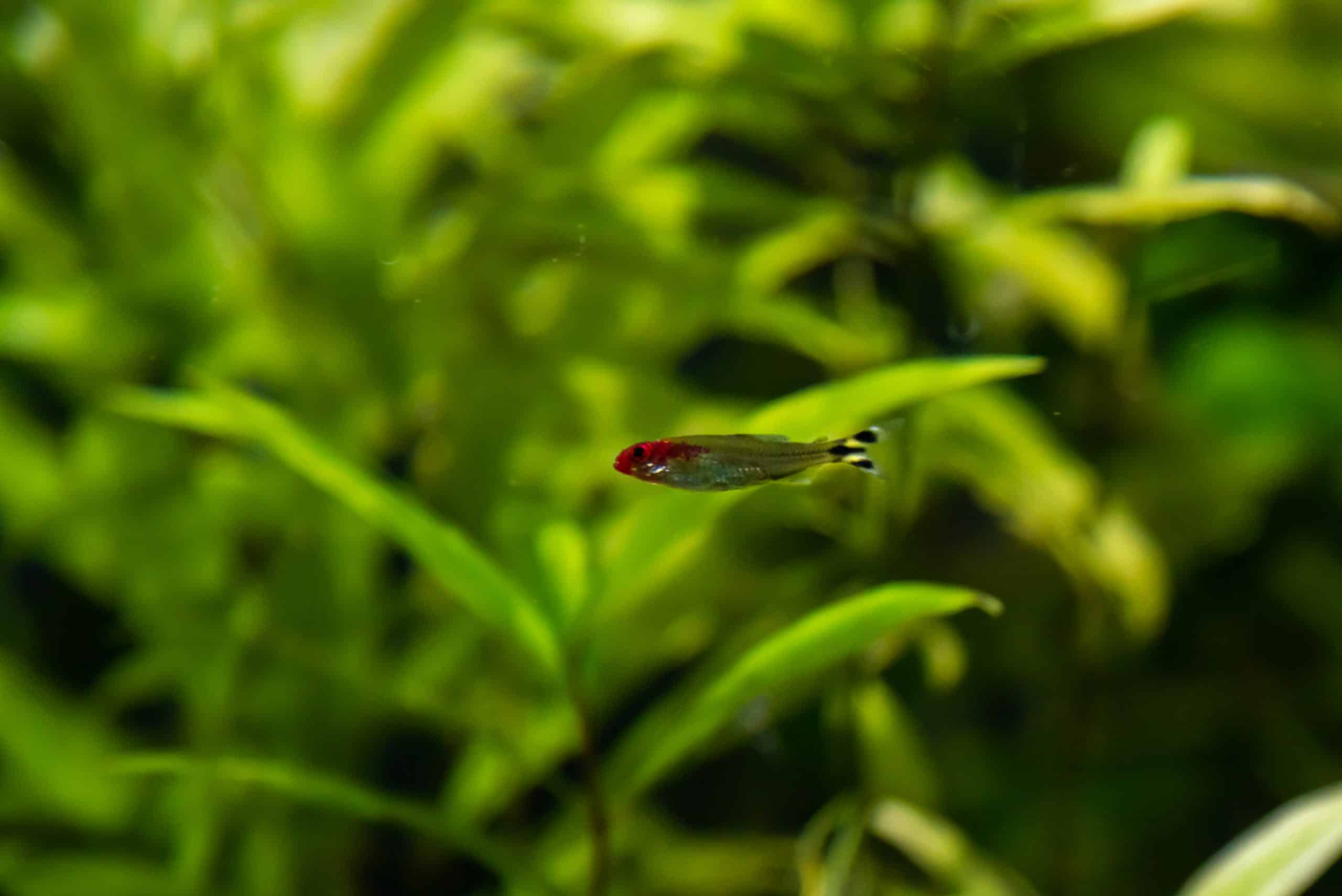
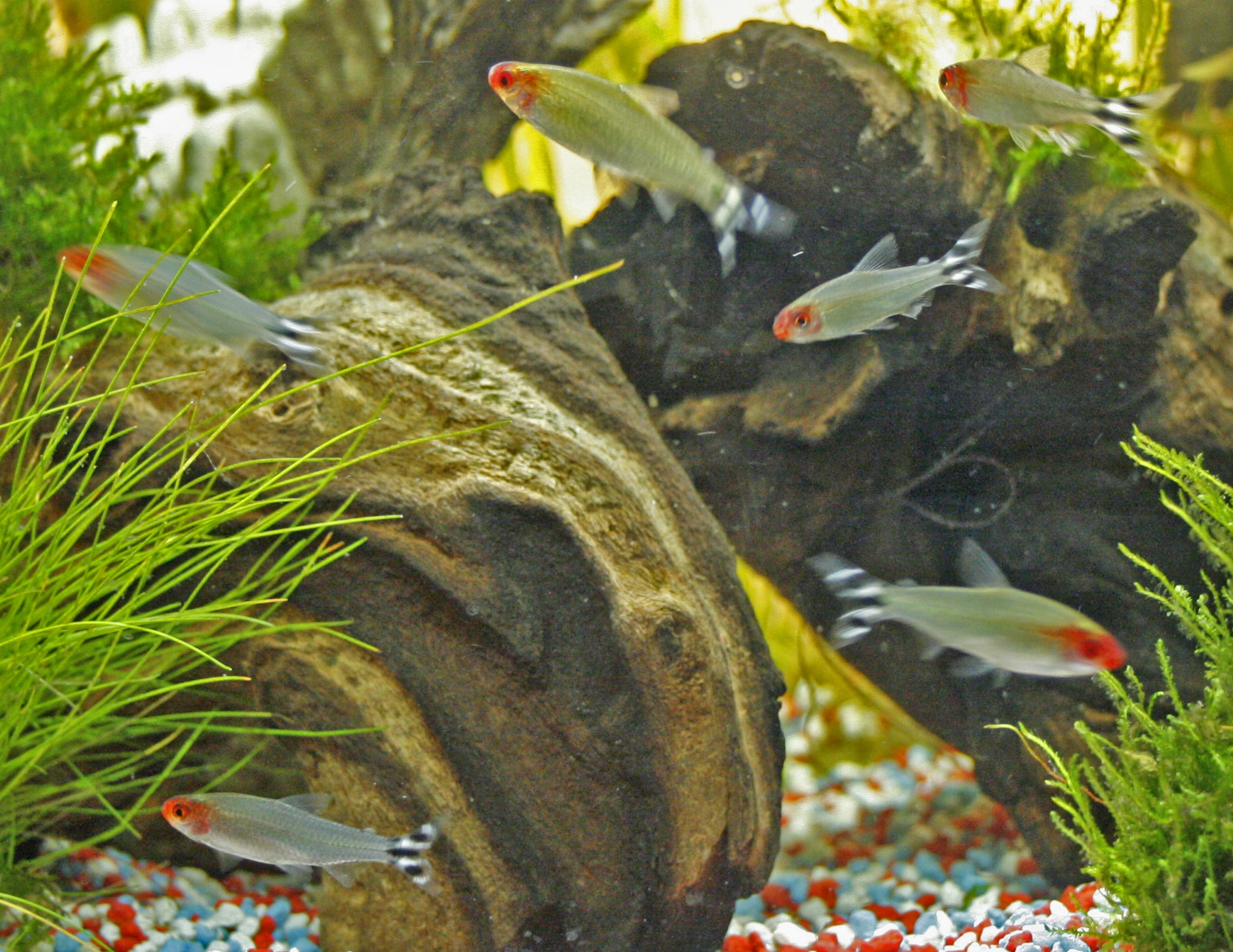
The true rummy nose tetra has the classic rummy nose look: a vivid red patch on the head and snout, a silvery body with a subtle greenish sheen, and a boldly striped black-and-white caudal fin. The tail pattern consists of horizontal black bars alternating with white, creating a distinctive flag-like appearance.
The key visual difference from the brilliant rummy nose (H. bleheri) is in the extent of the red coloration. In the true rummy nose, the red is more confined to the snout and does not extend as far back past the gill covers. In H. bleheri, the red extends well behind the gill plates and can cover a larger portion of the head. In practice, telling the two apart requires a side-by-side comparison, and most hobbyists won’t notice the difference.
Sexual dimorphism is minimal. Females are slightly fuller-bodied when mature, especially when carrying eggs, but color and finnage are similar between the sexes.
Average Size & Lifespan
The true rummy nose tetra reaches about 2 inches (5 cm) in total length, which is typical for the rummy nose group. They’re not large fish, but their schooling behavior and bold coloration give them a presence in the tank that belies their size.
With good care, expect a lifespan of 5 to 6 years. Clean, stable water conditions and a varied diet are the biggest factors in longevity.
ASD Difficulty Rating: Moderate
Moderate. More sensitive to water quality than most beginner tetras. Needs stable, well-established water and a consistent maintenance schedule. In the right conditions – soft slightly acidic water, mature tank, group of 12 or more – the synchronized schooling behavior is one of the most impressive displays in freshwater fishkeeping.
Care Guide
Tank Size
A 20-gallon long is the minimum recommended tank size for a school of true rummy nose tetras. These are active swimmers that look their best in groups of 8 or more, and the elongated footprint of a 20-long gives them the horizontal swimming space they prefer. For a larger school of 15 to 20, a 40-gallon breeder or larger is ideal.
Water Parameters
| Parameter | Ideal Range |
|---|---|
| Temperature | 75-82°F (24-28°C) |
| pH | 5.5-7.0 |
| General Hardness | 2-12 dGH |
| KH | 1-6 dKH |
| Ammonia / Nitrite | 0 ppm |
| Nitrate | Below 20 ppm |
Rummy nose tetras are well known for being sensitive to water quality. Their red nose coloration is one of the best biological indicators in the hobby. When the water is clean and parameters are stable, the red is intense and vivid. When something is off, whether it’s elevated nitrates, a pH swing, or dissolved organics building up, the red fades noticeably. Many experienced aquarists use rummy noses as a canary-in-the-coal-mine for water quality.
Soft, slightly acidic water brings out the best coloration. Indian almond leaves, driftwood, and peat filtration helps achieve these conditions naturally. Consistent water changes of 25 to 30 percent weekly are important for keeping nitrates low and water fresh.
Tank Setup
A planted tank with open swimming areas and some cover works best. Leave the middle of the tank relatively open for schooling, with plants and hardscape along the sides and back. Driftwood and leaf litter add to the natural blackwater aesthetic and provide tannins that these fish appreciate.
Moderate lighting is fine, though they look especially stunning under subdued lighting with a dark substrate. A dark background also helps showcase their red noses and striped tails against a contrasting backdrop.
Filtration should be efficient but not create excessive current. A hang-on-back or canister filter with a spray bar works well. These fish don’t like being blasted by strong flow.
Tank Mates
True rummy nose tetras are among the most peaceful community fish available. They’re completely focused on their school and rarely interact with other species beyond sharing space.
Good Tank Mates
- Other peaceful tetras (cardinal, ember, neon, green neon)
- Corydoras catfish (any species)
- Otocinclus
- Small rasboras (harlequin, chili, espei)
- Dwarf cichlids (Apistogramma, rams)
- Peaceful gouramis (honey, sparkling)
- Shrimp (Amano, cherry)
- Bristlenose plecos
Tank Mates to Avoid
- Large or aggressive cichlids
- Fin-nipping species (tiger barbs, serpae tetras in small groups)
- Large predatory fish
- Highly active or boisterous species that would stress them
Food & Diet
True rummy nose tetras are omnivores that accept a wide range of foods. They’re not picky eaters, which is one of the easier aspects of their care.
- Staple: High-quality flake food or micro pellets
- Frozen foods: Brine shrimp, daphnia, bloodworms (chopped), cyclops
- Live foods: Baby brine shrimp, daphnia, microworms
- Supplements: Spirulina-based foods for plant matter
Feed small amounts two to three times daily rather than one large feeding. A varied diet that includes both protein-rich foods and some plant-based options supports the best coloration and overall health. Live and frozen foods really bring out the intensity of the red nose.
Breeding & Reproduction
Breeding true rummy nose tetras in captivity is considered difficult and is not commonly achieved by hobbyists. Most fish in the trade are wild-caught or commercially bred in large outdoor facilities.
Breeding Setup
- Breeding tank: 10 to 15 gallons, dimly lit
- Water: Very soft (1-2 dGH), acidic (pH 5.5-6.0), temperature 80-82°F
- Decor: Fine-leaved plants like Java moss or spawning mops
- Filtration: Gentle air-driven sponge filter
- Conditioning: Heavy feeding with live foods for 2 to 3 weeks before spawning attempts
Spawning typically occurs at dawn. The pair scatters adhesive eggs among fine-leaved plants. Clutch sizes are relatively small, usually 50 to 100 eggs. Adults will eat eggs if given the opportunity, so remove the parents after spawning or use a mesh to separate them from the eggs.
Eggs hatch in 24 to 36 hours, and fry become free-swimming about 3 to 4 days later. First foods should be infusoria or liquid fry food, transitioning to baby brine shrimp as they grow. The fry are tiny and grow slowly compared to many other tetra species.
Common Health Issues
- Ich (white spot disease): Common during acclimation or after temperature fluctuations. Rummy noses are more susceptible than many other tetras, so quarantine new additions carefully.
- Loss of red coloration: Usually the first sign of stress or declining water quality. Check ammonia, nitrite, nitrate, and pH if the red fades.
- Neon tetra disease: Like other small tetras, they are affected by Pleistophora hyphessobryconis. Symptoms include faded coloring, erratic swimming, and body wasting. There is no reliable cure, so quarantine and prevention are key.
- Bacterial infections: Can occur in tanks with poor water quality or organic buildup. Regular maintenance prevents most issues.
Hard Rule
Do not add true rummy nose tetras to a new or recently cycled tank. They need mature, stable water chemistry. Ammonia or nitrite spikes that other tetras shrug off will kill them quickly. The red color fading is the first warning sign – by then the fish is already stressed.
Common Mistakes to Avoid
- Keeping too few: A group of 3 or 4 rummy noses looks stressed and scattered. They need at least 8 to show proper schooling behavior and feel secure.
- Skipping quarantine: These fish are more sensitive to disease during shipping and acclimation than hardier species. Always quarantine new arrivals.
- Ignoring the red nose: When the red fades, it’s telling you something. Don’t ignore this built-in water quality indicator.
- Adding to uncycled tanks: Their sensitivity to ammonia and nitrite means they should never be used to cycle a new aquarium. Only add them to fully established tanks.
- Hard, alkaline water: They can survive in harder water, but coloration will be noticeably duller and they’ll be more prone to health issues.
Where to Buy
True rummy nose tetras is found through specialty retailers, though many sellers don’t distinguish between H. rhodostomus and H. bleheri. If you specifically want the true rummy nose, look for sellers who list the scientific name. Check these trusted sources:
Frequently Asked Questions
What is the difference between the true rummy nose and the brilliant rummy nose?
The main difference is in the extent of the red coloration. The true rummy nose (H. rhodostomus) has red that’s mostly confined to the snout, while the brilliant rummy nose (H. bleheri) has red that extends further back past the gill covers. Care requirements for both species are essentially identical. Most fish sold in stores as “rummy nose tetras” are actually H. bleheri.
Why did my rummy nose tetra lose its red color?
Faded red coloration is almost always a sign of stress or poor water quality. Test your water parameters immediately, focusing on ammonia, nitrite, and nitrate. Other causes include recent transport stress (the red comes back as they settle in), disease, aggression from tank mates, or temperature swings. If water quality checks out, give newly added fish a few days to acclimate before worrying.
How many rummy nose tetras should I keep together?
At minimum 8, but 12 or more is better. Rummy nose tetras are one of the tightest-schooling species in the hobby, and larger groups produce the most impressive synchronized swimming displays. In small groups, they are nervous and scattered.
What It Is Actually Like Living With True Rummy Nose Tetra
In a proper school, true rummy nose tetra display natural movement patterns that are genuinely engaging to watch. The fish interact with each other, establish subtle hierarchies, and move through the tank with purpose.
They occupy the middle water column during active hours, creating movement and visual interest in the zone where most fishkeepers want action.
Feeding time is when their personality comes out. They learn your routine quickly and will anticipate feeding before you even open the lid.
Their color and behavior improve over time as they settle into a stable environment. Fish that have been in the same tank for months look noticeably better than recently added stock.
They coexist peacefully with virtually every other appropriately-sized community fish. This compatibility makes tank planning straightforward.
Closing Thoughts
The true rummy nose tetra will not be the most commonly sold of the three rummy nose species, but it carries the same appeal that has made the rummy nose group a staple of the planted tank hobby. That red face, those striped tails, and the way a school of them moves in perfect unison through a planted aquarium is one of those sights that never gets old.
They ask a bit more of you than some other community fish. They want clean water, stable parameters, and a properly cycled tank. In return, they give you a living water quality monitor and some of the best schooling behavior you’ll ever see in a home aquarium. That’s a fair trade.
Recommended Video
Check out our Tetra Tier List video where we rank popular tetra species for the home aquarium:
References
- Froese, R. and D. Pauly, Eds. FishBase. Hemigrammus rhodostomus. Accessed 2025.
- SeriouslyFish. Hemigrammus rhodostomus species profile. Accessed 2025.
- Melo, B. F, et al. (2024). Phylogenomics of Characidae. Molecular Phylogenetics and Evolution.
Explore More Tetras
The true rummy nose tetra is just one of dozens of characin species we cover in our complete species directory. Whether you’re into tight schooling fish or colorful nano species, our guide has you covered.
👉 Tetras: Complete A-Z Species Directory
- About the Author
- Latest Posts

I’m Mark Valderrama, founder of Aquarium Store Depot and a fishkeeper with over 25 years of hands-on experience. I started in the hobby at age 11, worked at local fish stores, and have kept freshwater tanks, ponds, and reef tanks ever since. I’ve been featured in two best-selling aquarium books on Amazon and built this site to share practical, experience-based fish keeping knowledge.
Leave a Reply