
Last Updated: June 25, 2026
Thank you for visiting! By the way… any links on this page that lead to products on Amazon and other stores/partners are affiliate links Aquarium Store Depot earns a commission if you make a purchase.
Table of Contents
- What Care Guides Get Wrong
- The Reality of Keeping Stoliczkae’s Barb
- Key Takeaways
- Species Overview
- Classification
- Origin & Natural Habitat
- Appearance & Identification
- Average Size & Lifespan
- Care Guide
- Is It Right for You?
- Tank Mates
- Food & Diet
- Breeding & Reproduction
- Common Health Issues
- Common Mistakes to Avoid
- Where to Buy
- Frequently Asked Questions
- Species Comparison
- Closing Thoughts
- Recommended Video
- References
Stoliczkae’s barb is an obscure species that almost nobody intentionally seeks out, and that is a shame. It develops a warm coloration with dark barring that is more attractive than most common barbs, stays at a manageable 2 to 3 inches, and fits perfectly in a mid-sized community tank. It is peaceful, hardy, and easy to keep.
The only challenge is finding it. This species rarely shows up in pet stores, and most hobbyists learn about it only by accident. This guide covers what you need to know if you come across it, because Stoliczkae’s barb is the fish nobody searches for and everyone likes once they see it.
If it showed up in pet stores more often, this would be one of the most popular barbs in the hobby. It is that good.
The barb everyone walks past at the store is the one that would have looked best in their tank.
The Reality of Keeping Stoliczkae’s Barb
Stoliczkae’s barb is a small, attractive species from Myanmar with red-tipped fins and subtle body markings. It stays under 2.5 inches and works well in community tanks starting at 20 gallons.
It is uncommonly available but worth seeking out for its combination of color and peaceful temperament.
Hardy and adaptable, it handles a range of water parameters without issues.
Biggest Mistake New Owners Make
Confusing it with other small barbs and not appreciating its unique coloration. The red fin tips on Stoliczkae’s barb are distinctive and attractive when the fish is in good condition.
Expert Take
Stoliczkae’s barb is the gem that collectors find and casual hobbyists miss. The red-tipped fins against a silver body create an accent that works in any planted community. A group of six in a 20-gallon with live plants and dark substrate is a clean, effective display.
Key Takeaways
- Minimum tank size is 15 gallons (57 liters) for a school of 6, though 20+ gallons gives them more room to show natural behavior
- Very hardy and beginner-friendly. Tolerates a wide range of water conditions and adapts easily to aquarium life
- Males develop stunning scarlet coloring that intensifies with good diet and stable conditions
- Peaceful schooling fish. Works well in community setups with other small, non-aggressive species
- Often confused with the ticto barb (Pethia ticto), but the Stoliczkae’s barb shows noticeably more red coloration
Species Overview
| Field | Details |
|---|---|
| Scientific Name | Pethia stoliczkana |
| Common Names | Stoliczkae’s Barb, Scarlet Barb |
| Family | Cyprinidae |
| Origin | South Asia (India, Myanmar, Bangladesh) |
| Care Level | Easy |
| Temperament | Peaceful |
| Diet | Omnivore |
| Tank Level | Mid to Bottom |
| Maximum Size | 2 inches (5 cm) |
| Minimum Tank Size | 15 gallons (57 liters) |
| Temperature | 68. 77°F (20. 25°C) |
| pH | 6.0. 7.5 |
| Hardness | 2. 12 dGH |
| Lifespan | 3. 5 years in captivity |
| Breeding | Egg scatterer |
| Breeding Difficulty | Easy to Moderate |
| Compatibility | Community |
| OK for Planted Tanks? | Yes |
Classification
| Taxonomic Level | Classification |
|---|---|
| Order | Cypriniformes |
| Family | Cyprinidae |
| Subfamily | Barbinae |
| Genus | Pethia |
| Species | P. Stoliczkana (Day, 1871) |
This species was originally described by Francis Day in 1871 and has gone through several name changes over the years. For a long time, it was classified as Puntius stoliczkanus, and you’ll still see that older name used in many aquarium references and fish store labels. The genus Pethia was established by Pethiyagoda, Meegaskumbura, and Maduwage in 2012 to accommodate a group of small South Asian barbs that were previously lumped into the catch-all genus Puntius.
The species name honors Ferdinand Stoliczka, a Czech-born paleontologist and zoologist who did extensive natural history work in India during the 1800s. If you see this fish labeled as Puntius stoliczkanus or Barbus stoliczkanus at a local fish store, it’s the same species. Just an outdated name.
Origin & Natural Habitat
The Stoliczkae’s barb is native to South Asia, with a range that spans parts of India (particularly the Irrawaddy and Salween drainages on the Indian side), Myanmar, and Bangladesh. It inhabits streams, rivers, and associated floodplain habitats across this region.
In the wild, these barbs are found in relatively shallow, slow to moderately flowing streams with sandy or gravelly substrates. The water is clear to slightly turbid, with plenty of marginal vegetation along the banks. They’re often found in areas with submerged roots, aquatic plants, and leaf litter. The kind of structurally diverse environment that provides both feeding opportunities and cover from predators.
Most specimens in the aquarium trade are commercially bred, though wild-caught fish do appear occasionally from exporters in Myanmar and India. Their natural adaptability to varying seasonal conditions is a big part of why they’re so forgiving in aquariums.

Appearance & Identification
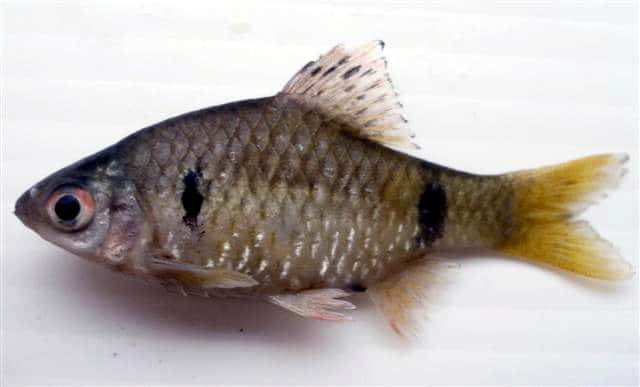
The Stoliczkae’s barb has a compact, laterally compressed body typical of small Pethia barbs. The base body color is silvery to golden-olive, and the fish displays a dark spot near the base of the caudal fin (tail) and often another near the gill cover area. These dark markings are characteristic of the species and help with identification.
What really sets this fish apart is the coloring that develops in mature males. When conditions are good and the fish is settled in, males develop a gorgeous scarlet to deep red flush across much of their body, particularly along the flanks and into the fins. The dorsal fin often picks up an intense reddish hue with a darker edge, and the anal and pelvic fins can show similar coloring. It’s a genuinely attractive fish when it’s in full color. The common name “scarlet barb” is well earned.
This species is frequently confused with the closely related ticto barb (Pethia ticto). The two look quite similar in body shape and general patterning, but the Stoliczkae’s barb consistently shows more red coloration, especially in the fins. Telling them apart in a pet store can be tricky, and honestly, they’re sometimes sold interchangeably, which doesn’t help. If the males are showing color, the Stoliczkae’s barb will be the redder of the two.
Male vs. Female
Sexing Stoliczkae’s barbs becomes straightforward once the fish are mature. Males are slimmer-bodied and develop the vibrant scarlet-red coloration that gives this species its appeal. Their fins, particularly the dorsal, take on deeper red tones. Females are fuller-bodied and rounder, especially when carrying eggs, and their coloring is more subdued. Typically a golden-olive to silvery tone without the intense red flush. During spawning condition, the difference between males and females is unmistakable.
Average Size & Lifespan
Adult Stoliczkae’s barbs reach about 2 inches (5 cm) in total length. They’re a small barb species. Roughly the same size as a cherry barb and noticeably smaller than tiger barbs or rosy barbs. Their compact size makes them well suited for mid-sized community aquariums.
In captivity, expect a lifespan of 3 to 5 years with proper care. Good water quality, a varied diet, and a stress-free environment with appropriate school size are the main factors that determine whether your fish hit the upper end of that range. These are not demanding fish by any measure. Give them the basics and they’ll reward you with years of activity and color.
Care Guide
Tank Size
A 15-gallon (57-liter) tank is the minimum for a school of 6 Stoliczkae’s barbs. That said, I’d recommend a 20-gallon long (75-liter) if you can swing it. The extra horizontal swimming space makes a noticeable difference in how the group behaves. They school more actively and the males display more intensely when they have room to establish small territories within the group.
These barbs occupy primarily the middle and lower portions of the water column, so a longer, wider tank serves them better than a tall, narrow one. If you’re planning a community setup with other species, a 20-gallon long or larger gives you much more flexibility.
Water Parameters
| Parameter | Ideal Range |
|---|---|
| Temperature | 68. 77°F (20. 25°C) |
| pH | 6.0. 7.5 |
| Hardness | 2. 12 dGH |
| KH | 1. 8 dKH |
One thing that stands out about the Stoliczkae’s barb is its temperature preference. This is a subtropical to mild tropical species that actually does best at cooler temperatures than most tropical community fish. That 68. 77°F (20. 25°C) range means you may not even need a heater in many homes, and in some setups, they can coexist with species that prefer slightly cooler water, like white cloud mountain minnows or hillstream loaches.
They’re quite adaptable on the water chemistry front. Soft to moderately hard water with a slightly acidic to neutral pH suits them fine. Captive-bred specimens are especially tolerant, handling a wider range than wild-caught fish would. As with any species, consistency matters more than hitting a specific number. Avoid sudden parameter swings and you’ll have healthy fish.
Filtration & Water Flow
Gentle to moderate water flow works best. These barbs come from streams with some current, so they can handle a bit of flow. More than, say, a betta would tolerate. But they’re not river rapids fish. A hang-on-back filter or small canister filter that turns over the tank volume about 4. 6 times per hour is ideal. A sponge filter also works great for smaller setups and is particularly useful if you’re considering breeding.
Good biological filtration and regular water changes (25. 30% weekly) are essential. They’re hardy, but clean water brings out the best coloring.
Lighting
Standard aquarium lighting is fine for Stoliczkae’s barbs. They don’t have strong preferences here, though moderate lighting with some areas of shade will bring out their best behavior. If you’re running a planted tank, whatever lighting keeps your plants happy will work for the fish. Some floating plants to break up the light are always a nice addition. The barbs seem to feel more secure when they have both open swimming space and shaded retreats.
Plants & Decorations
A planted tank is the ideal setup for Stoliczkae’s barbs, and the good news is they won’t destroy your plants the way some larger barbs will. These are plant-safe fish. Use a mix of rooted plants like Java fern, Vallisneria, and Cryptocoryne species along with some floating plants for cover. Driftwood pieces and smooth river stones create a natural-looking hardscape that mimics their stream habitat.
Leave some open swimming space in the center and front of the tank. These are active fish that need room to swim as a group. Concentrate planting along the sides and back.
Substrate
Fine gravel or sand works well and reflects their natural stream habitat. A darker substrate will bring out better coloring in most barbs, and the Stoliczkae’s barb is no exception. The scarlet tones in the males look more vivid against a darker background. If you’re doing a planted tank, a nutrient-rich planted substrate capped with fine gravel or sand gives you the best of both worlds.
Is the Stoliczkae’s Barb Right for You?
Before you buy, run through this honest checklist. The Stoliczkae’s Barb is a great fish for the right keeper, but it is not for everyone.
- You want an underrated barb that looks stunning once it colors up in a proper setup
- You have a 20-gallon or larger planted tank with a dark substrate
- You keep a group of 8+ for the best color development and social behavior
- You enjoy watching male sparring displays – they are dramatic but harmless
- Your tank includes other peaceful to moderately active species
- You appreciate value – this fish delivers premium looks at a budget price
Tank Mates
Stoliczkae’s barbs are peaceful community fish that get along with a wide variety of tank mates. The key requirements are that companions should be non-aggressive, similarly sized, and comfortable in the same temperature range. That slightly cooler temperature preference (68. 77°F / 20. 25°C) does narrow the field a bit compared to fish that like warmer tropical temperatures.
Best Tank Mates
- Other small barbs. Cherry barbs, gold barbs, and ticto barbs all make natural companions with similar care requirements
- Danios. Zebra danios, pearl danios, and celestial pearl danios do well in the same temperature range
- Rasboras. Harlequin rasboras and similar species are peaceful enough to coexist easily
- Corydoras catfish. Especially species that tolerate slightly cooler water, like Corydoras paleatus (peppered cory)
- White cloud mountain minnows. An excellent match for the cooler end of the Stoliczkae’s temperature range
- Bristlenose plecos. Peaceful bottom-dwellers that stay out of the barbs’ way
- Small loaches. Kuhli loaches and similar species make good companions
- Snails and shrimp. Nerite snails, mystery snails, and larger shrimp species (like Amano shrimp) are safe
Tank Mates to Avoid
- Large cichlids. Anything big enough to eat a 2-inch (5 cm) fish is an obvious no
- Aggressive species. Tiger barbs in small groups can be nippy, and aggressive cichlids will stress them out
- Very long-finned fish. While Stoliczkae’s barbs aren’t known fin nippers, keeping them with extremely slow, long-finned species is a risk with any barb
- Strictly warm-water species. Fish that need 80°F+ (27°C+) consistently aren’t a good match for these cooler-water barbs
Food & Diet
Stoliczkae’s barbs are unfussy omnivores that will eat just about anything you offer. In the wild, they feed on small invertebrates, insect larvae, algae, and plant matter. A typical opportunistic diet for small stream-dwelling barbs.
In the aquarium, a high-quality flake or micro pellet food makes a solid staple. Supplement this 2. 3 times per week with frozen or live foods. Bloodworms, brine shrimp, daphnia, and tubifex worms are all eagerly accepted. The live and frozen foods make a real difference in coloring, especially for males. A fish on a flake-only diet will survive just fine, but one getting regular protein-rich supplements will develop significantly better red coloration.
Some blanched vegetable matter is also appreciated. Zucchini, spinach, or cucumber provide variety and fiber. Feed small amounts twice daily rather than one large feeding, and only offer what they can consume in about 2. 3 minutes.
Breeding & Reproduction
Stoliczkae’s barbs are egg scatterers that are relatively straightforward to breed at home. Like most small cyprinids, they show no parental care and will eat their own eggs, so planning is needed to raise fry successfully.
Breeding Difficulty
Easy to moderate. These barbs will often spawn spontaneously in a well-maintained community tank, though raising the fry requires a dedicated setup. If you can breed cherry barbs, you can breed Stoliczkae’s barbs. The process is very similar.
Spawning Tank Setup
Set up a dedicated spawning tank of at least 10 gallons (38 liters) with dim lighting. Cover the bottom with fine-leaved plants like Java moss, spawning mops, or a mesh grid that allows eggs to fall through and out of reach of the parents. Keep the tank sparsely decorated. The focus is on protecting eggs, not aesthetics.
Water Conditions for Breeding
Slightly warmer and softer water encourages spawning. Aim for a temperature around 75. 77°F (24. 25°C), pH 6.0. 6.5, and hardness of 2. 6 dGH. Slightly acidic, soft water mimics the conditions that trigger spawning behavior in their natural habitat. A gentle sponge filter provides filtration without creating currents that could disturb eggs.
Conditioning & Spawning
Condition your breeding pair or trio (one female, two males works well) with generous live and frozen foods for 1. 2 weeks. Bloodworms, brine shrimp, and daphnia all work well. The female is ready when she appears visibly plumper with eggs.
Introduce the conditioned fish to the spawning tank in the evening. Spawning typically occurs the following morning as light first reaches the tank. The male will pursue the female, and she’ll scatter adhesive eggs among the fine-leaved plants while he fertilizes them. A single spawning event can produce anywhere from 100 to 300 eggs.
Egg & Fry Care
Remove the adults immediately after spawning. They have no parental instincts and will eat the eggs if given the chance. The eggs hatch in approximately 24. 48 hours depending on temperature. Fry become free-swimming 2. 3 days after hatching.
Feed newly free-swimming fry infusoria or liquid fry food for the first 5. 7 days. Once they’re large enough, transition to microworms and freshly hatched baby brine shrimp. Keep the rearing tank dimly lit and perform small daily water changes (10. 15%) to maintain water quality without disturbing the tiny fry. Growth is relatively quick with good nutrition, and the young fish should be large enough to join the main tank at around 6. 8 weeks.
Common Health Issues
Stoliczkae’s barbs are genuinely hardy fish that rarely run into health problems when kept in properly maintained aquariums. They’re among the more disease-resistant small community fish available. That said, no fish is immune to the standard tropical ailments:
Ich (White Spot Disease)
The most common issue you might encounter, usually triggered by temperature swings or stress from a new environment. Small white cysts appear on the body and fins. Gradually raise the temperature to around 80°F (27°C) and treat with a standard ich medication. Stoliczkae’s barbs typically respond well to treatment and recover quickly.
Fin Rot
Bacterial infection that causes the edges of the fins to deteriorate and appear ragged. This is almost always a water quality issue. Address the root cause with extra water changes and improved filtration, and treat with an antibacterial medication if the condition doesn’t improve within a few days.
General Prevention
The best medicine is prevention. Quarantine all new fish for at least two weeks before adding them to your display tank. Maintain consistent water parameters, perform regular water changes, and avoid overfeeding. A well-maintained tank with stable conditions is where these barbs thrive. They’re tough fish that rarely get sick when the basics are covered.
Common Mistakes to Avoid
- Keeping them too warm. This is a subtropical species that prefers 68. 77°F (20. 25°C). Running the heater at 80°F+ (27°C+) long-term stresses them and shortens their lifespan. Check the temperature range before adding them to a warm tropical setup.
- Too few in the group. Like all schooling barbs, they need a minimum group of 6. Smaller numbers lead to stress, hiding, and washed-out coloring. A group of 8. 10 is where you’ll see the best behavior and color.
- Bland diet. Males on a flake-only diet never develop their full scarlet coloring. Regular supplementation with frozen or live foods makes a dramatic difference in how the males look.
- Confusing them with ticto barbs. These two species look very similar and are sometimes mislabeled in stores. If you specifically want the Stoliczkae’s barb, look for the more intense red coloring in males and buy from a reputable source that can confirm the species.
- Pairing with incompatible temperatures. Avoid housing them with fish that need temperatures above 80°F (27°C), like discus or rams, as there’s no comfortable overlap.
Where to Buy
Stoliczkae’s barbs are not as commonly stocked as cherry barbs or tiger barbs, but they do appear at specialty retailers and through online sellers. Because they’re sometimes mislabeled as ticto barbs (or vice versa), it’s worth confirming the species identification when purchasing. Expect pricing in the $3. 6 range per fish.
For quality stock, check Flip Aquatics and Dan’s Fish. Both are reputable online retailers that ship healthy, well-acclimated fish with live arrival guarantees. Even if they don’t have Stoliczkae’s barbs in stock at the moment, both regularly update their inventory and are worth bookmarking for availability.
Frequently Asked Questions
What is the difference between a Stoliczkae’s barb and a ticto barb?
Both are small Pethia species with similar body shapes and dark lateral markings, but the Stoliczkae’s barb (P. Stoliczkana) develops noticeably more red coloration than the ticto barb (P. Ticto), particularly in the fins of mature males. They have overlapping ranges in South Asia, and the two species are frequently confused in the aquarium trade. If the males are in color, the Stoliczkae’s barb will be redder.
How many Stoliczkae’s barbs should I keep together?
A minimum of 6, but 8. 10 is ideal. Larger groups encourage natural schooling behavior, reduce stress, and bring out the best coloring in males as they compete for attention. In small numbers, these barbs hide and look washed out.
Do Stoliczkae’s barbs need a heater?
It depends on your room temperature. With a preferred range of 68. 77°F (20. 25°C), many homes stay within this range year-round without a heater. If your house drops below 68°F (20°C) in winter, you’ll want a heater set to the low 70s. They don’t need warm tropical temperatures and actually do better on the cooler side.
Are Stoliczkae’s barbs good for beginners?
Absolutely. They’re hardy, adaptable, peaceful, and tolerant of a wide range of water conditions. They eat anything, don’t require specialized equipment, and they’re forgiving of minor mistakes that new fishkeepers commonly make. One of the best beginner barb species available.
Can Stoliczkae’s barbs live with shrimp?
Larger shrimp species like Amano shrimp are safe. With smaller shrimp like cherry shrimp, adult shrimp will usually be left alone, but baby shrimp may be eaten. As is the case with most small fish. If you’re breeding shrimp in the same tank, provide plenty of dense plant cover for the shrimplets to hide in.
Why aren’t my Stoliczkae’s barbs showing red color?
Several possible reasons: they may be female (females don’t develop red coloring), they may be juveniles that haven’t matured yet, their diet may lack variety (supplement with frozen and live foods), or they may be stressed from a new environment or too-small group size. A dark substrate and stable water conditions also help bring out the best color. Give them time and good care.
What was the old scientific name for Stoliczkae’s barb?
The species was previously classified as Puntius stoliczkanus and before that as Barbus stoliczkanus. The current accepted name is Pethia stoliczkana following the 2012 revision by Pethiyagoda, Meegaskumbura, and Maduwage. You’ll still commonly see the old Puntius name used in fish stores and older references.
What It Is Actually Like Living With Stoliczkae’s Barb
The red fin accents catch the eye without overwhelming the tank. Stoliczkae’s barb adds color notes rather than color blocks.
They school peacefully, integrating into community setups without creating any social disruption.
Breeding happens quietly in well-maintained tanks, with eggs scattered among plants during early morning spawning events.
Closing Thoughts
The Stoliczkae’s barb is one of those quietly excellent aquarium fish that deserves way more attention than it gets. It checks every box for a community tank. Peaceful temperament, hardy constitution, easy care requirements, and when the males color up, genuinely beautiful. The fact that it thrives in slightly cooler water also opens up some interesting stocking combinations that you can’t pull off with strictly tropical species.
If you’re tired of seeing the same fish in every community tank and want something a little different that still plays nicely with others, give the Stoliczkae’s barb a shot. Keep them in a group of 8 or more, feed them well, and watch those males turn scarlet. You won’t be disappointed.
Looking for more barb species to consider? Check out our complete barb species directory for care guides on all the best barbs in the freshwater hobby.
Recommended Video
Check out this video for more information on barbs in the aquarium hobby:
References
- Pethia stoliczkana (Stoliczkae’s Barb). Seriously Fish
- Pethia stoliczkana (Day, 1871). FishBase
- Pethia stoliczkana. Wikipedia
- Pethiyagoda, R. Meegaskumbura, M. & Maduwage, K. (2012). A synopsis of the South Asian fishes referred to Puntius. Ichthyological Exploration of Freshwaters, 23(1), 69. 95.
Explore More Barbs
Looking for more barb species? Check out our complete Barbs directory covering all the best barb species for your freshwater aquarium.
- About the Author
- Latest Posts

I’m Mark Valderrama, founder of Aquarium Store Depot and a fishkeeper with over 25 years of hands-on experience. I started in the hobby at age 11, worked at local fish stores, and have kept freshwater tanks, ponds, and reef tanks ever since. I’ve been featured in two best-selling aquarium books on Amazon and built this site to share practical, experience-based fish keeping knowledge.
Leave a Reply