
Last Updated: June 25, 2026
Thank you for visiting! By the way… any links on this page that lead to products on Amazon and other stores/partners are affiliate links Aquarium Store Depot earns a commission if you make a purchase.
Table of Contents
- What Care Guides Get Wrong
- The Reality of Keeping Ticto Barb
- Key Takeaways
- Species Overview
- Classification
- Origin & Natural Habitat
- Appearance & Identification
- Average Size & Lifespan
- Care Guide
- Is It Right for You?
- Tank Mates
- Food & Diet
- Breeding & Reproduction
- Common Health Issues
- Common Mistakes to Avoid
- Where to Buy
- Frequently Asked Questions
- Species Comparison
- Closing Thoughts
- Recommended Video
- References
The ticto barb does everything a good community fish should do. It is peaceful, hardy, stays at a manageable 3 to 4 inches, and gets along with virtually everything. And absolutely nobody recommends it. It is the forgotten barb, overlooked in favor of flashier species that cause more problems and cost more money.
In a group of six or more, ticto barbs are reliable, attractive, and easy to keep. They are not going to be the centerpiece of your tank, but they will fill out a community setup without causing a single issue. This guide covers what you need to know, because the ticto barb is the definition of a solid fish nobody recommends because nothing about it is dramatic.
Sometimes the best fish for a community tank is the one nobody is talking about.
The Reality of Keeping Ticto Barb
The ticto barb is a small, hardy species from South Asia that is often overlooked in favor of flashier barbs. It reaches about 2.5 inches and works well in community tanks starting at 20 gallons.
Males develop a subtle red flush on their fins during breeding, which is the primary visual interest beyond the basic silver body with dark spot.
They are one of the hardiest barb species available, tolerating a wide range of temperatures and water chemistry. This makes them reliable but rarely exciting.
Biggest Mistake New Owners Make
Expecting bright colors. The ticto barb is a subtle fish. It adds motion and structure to a community tank without being a visual centerpiece. If you want flash, look elsewhere. If you want reliability, the ticto delivers.
Ticto barbs (Pethia ticto) are a hardy, adaptable barb from South Asia with distinctive spot patterning. They tolerate a wide range of water parameters and are suitable for community tanks from 30 gallons.
Expert Take (Mark Valderrama, AquariumStoreDepot)
The ticto barb is the fish you add to fill the mid-level of a community tank without worrying about anything. It schools, it eats everything, it gets along with everything, and it never surprises you. A group of six in a 20-gallon is the definition of a worry-free addition.
Key Takeaways
- One of the hardiest barbs available, tolerating a remarkably wide temperature range of 62 to 77°F (17 to 25°C) and adapting to a broad range of water chemistry
- Peaceful and community-friendly, making it an excellent choice for mixed-species tanks with other small, non-aggressive fish
- Keep in groups of 6 or more in a minimum 15-gallon (57 liter) tank to see natural schooling behavior and the best fin coloration in males
- Easy to breed as an egg-scattering species, ideal for beginners looking to try their hand at breeding cyprinids
- An underappreciated classic that was formerly classified as Puntius ticto and is one of the original aquarium barbs from South Asia
Species Overview
| Field | Details |
|---|---|
| Scientific Name | Pethia ticto (Hamilton, 1822) |
| Common Names | Ticto Barb, Two Spot Barb, Firefin Barb |
| Family | Cyprinidae |
| Origin | South Asia (India, Pakistan, Bangladesh, Nepal, Sri Lanka) |
| Care Level | Easy |
| Temperament | Peaceful |
| Diet | Omnivore |
| Tank Level | Middle |
| Maximum Size | 2 inches (5 cm) |
| Minimum Tank Size | 15 gallons (57 liters) |
| Temperature | 62 to 77°F (17 to 25°C) |
| pH | 6.0 to 7.5 |
| Hardness | 2 to 12 dGH |
| Lifespan | 4 to 6 years |
| Breeding | Egg scatterer |
| Breeding Difficulty | Easy |
| Compatibility | Community |
| OK for Planted Tanks? | Yes |
Classification
| Taxonomic Level | Classification |
|---|---|
| Order | Cypriniformes |
| Family | Cyprinidae |
| Subfamily | Smiliogastrinae |
| Genus | Pethia |
| Species | P. Ticto (Hamilton, 1822) |
The ticto barb was originally described by Francis Hamilton in 1822 as Cyprinus ticto, and for much of the 20th century it was known as Puntius ticto. The genus Puntius was a catch-all for dozens of small Asian barbs until molecular studies made it clear the group needed splitting up.
In 2012, a major revision moved many of these species into new genera. The ticto barb landed in Pethia, named after the Sinhalese word for small barb-like fish. You’ll still see it sold under the old Puntius ticto name at many stores, so don’t be thrown off by the labeling. It’s also been historically confused with the Odessa barb (Pethia padamya), so you may encounter mislabeled fish.
Origin & Natural Habitat
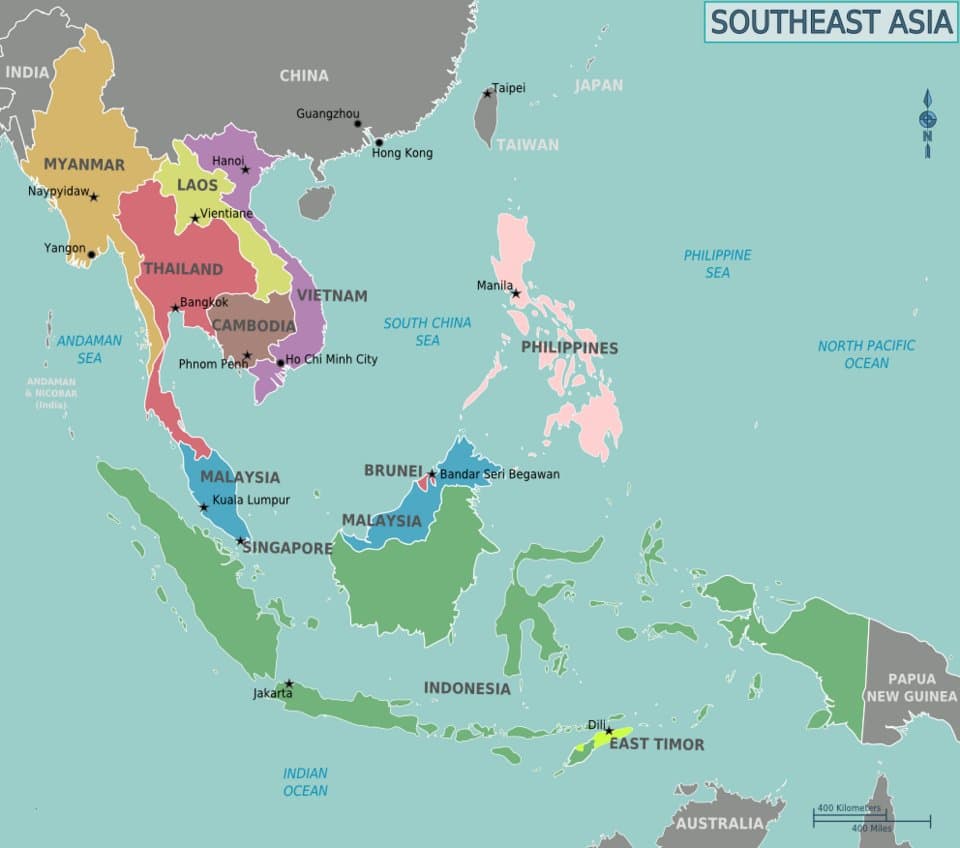
The ticto barb is one of the most widespread small cyprinids in South Asia. Its native range spans India, Pakistan, Bangladesh, Nepal, and Sri Lanka, covering river systems from the Indus drainage in Pakistan through the Ganges and Brahmaputra basins and south into Sri Lanka. This is not a fish confined to a single river or valley, and that broad distribution is a big part of why it’s so adaptable in captivity.
In the wild, ticto barbs inhabit slow-moving streams, rivers, ponds, rice paddies, and irrigation ditches. They favor shallow, still to slow-flowing water with sandy and muddy substrates, often with aquatic vegetation or overhanging riparian cover. These habitats vary considerably in water chemistry and temperature depending on the season and altitude, which explains the species’ remarkable tolerance for a range of conditions in the aquarium.
South Asia’s monsoon climate means temperatures in their native range can drop into the low 60s°F during cooler months and climb into the upper 70s°F during the warm season. This seasonal variation is worth keeping in mind, as ticto barbs genuinely benefit from not being kept at a single static temperature year-round.
Appearance & Identification
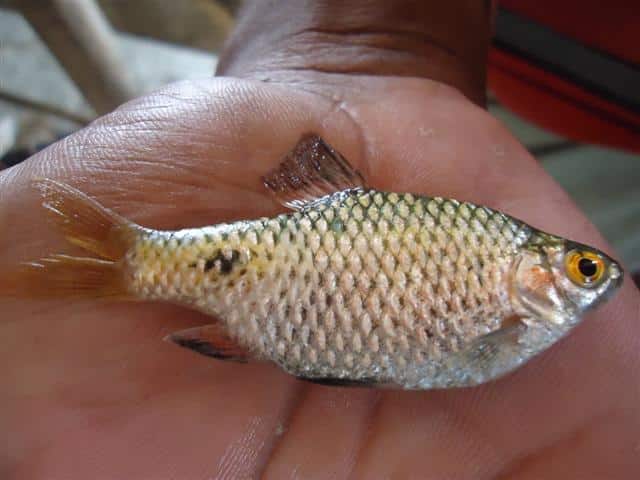
The ticto barb is a small, compact fish with a moderately deep, laterally compressed profile, a slightly arched back, and a forked tail. The base body color is silvery to olive-golden, with scales that catch the light with a subtle iridescent sheen. It’s not an in-your-face colorful fish, but under good lighting there’s a warmth to their coloring that’s easy to appreciate.
The defining feature is the “two spot” pattern that gives the fish one of its common names. There’s a prominent dark blotch just behind the gill cover near the pectoral fin base, and a second dark spot at the base of the caudal fin (tail). These markings are present in both sexes and are the quickest way to identify a ticto barb. The spots are deep black and well-defined, giving the fish a clean, graphic look.
Where the ticto barb really comes alive is in breeding-condition males. Their dorsal and anal fins develop a striking reddish to orange-red coloration at the tips and margins, which is where the common name “firefin barb” comes from. The red is most intense during courtship and spawning, and it fades when the fish is stressed or kept in poor conditions. Females maintain a more subdued appearance year-round.
Male vs. Female
| Feature | Male | Female |
|---|---|---|
| Coloration | Silvery-gold with red-tipped dorsal and anal fins | Silvery-olive, fins mostly clear |
| Body Shape | Slimmer and more streamlined | Rounder and deeper-bodied, especially when gravid |
| Fin Color | Dorsal and anal fins develop red-orange margins | Fins largely transparent or pale |
| Two Spots | Present but sometimes less bold | Both spots typically dark and well-defined |
| Size | Slightly smaller on average | Slightly larger when full of eggs |
Average Size & Lifespan
Ticto barbs reach a maximum size of about 2 inches (5 cm). Most aquarium specimens top out around 1.5 to 2 inches (4 to 5 cm), with females occasionally running slightly larger when carrying eggs. This small size is one of the reasons it works well in modestly sized aquariums.
With proper care, ticto barbs live 4 to 6 years in captivity. Good water quality, a varied diet, and an appropriately sized group are the main factors in reaching the upper end of that range. Hobbyists report specimens living beyond 6 years, but 4 to 5 is a more typical expectation.
Care Guide
Tank Size
A 15-gallon (57 liter) aquarium is the minimum for a school of ticto barbs. This provides enough horizontal swimming space for a group of 6 with room for plants and decor. For a larger group of 8 to 12 or a mixed community, step up to a 20-gallon (76 liter) long or 30-gallon (114 liter) tank. A longer tank is always preferable to a taller one for active schooling fish.
Water Parameters
| Parameter | Ideal Range |
|---|---|
| Temperature | 62 to 77°F (17 to 25°C) |
| pH | 6.0 to 7.5 |
| Hardness | 2 to 12 dGH |
| Ammonia | 0 ppm |
| Nitrite | 0 ppm |
| Nitrate | Below 20 ppm |
The temperature range on this fish is genuinely impressive. In many homes, an unheated aquarium at room temperature is right in their comfort zone. A heater set to the low end as a safeguard against sudden drops isn’t a bad idea, but you may not need one at all.
They prefer soft to moderately hard water with a slightly acidic to neutral pH. While they can adapt to harder water within reason, they show their best colors in softer conditions. Consistency matters more than hitting a specific number, so focus on stable parameters and regular water changes of 20 to 30 percent weekly.
Filtration & Water Flow
A hang-on-back or small canister filter that turns the tank volume over 4 to 5 times per hour is ideal. Ticto barbs come from still to slow-moving water, so aim for a gentle to moderate current. A sponge filter is also an excellent option, especially in a breeding setup, since it provides biological filtration without generating strong flow.
Lighting
Standard aquarium lighting works fine. They look their best under moderate lighting rather than harsh, bright conditions. If you’re running a planted tank, the lighting you choose for your plants will work perfectly. Aim for 8 to 10 hours of light per day on a timer.
Plants & Decorations
Ticto barbs are perfectly safe in planted tanks and won’t uproot or eat your plants. Hardy, undemanding plants are a natural fit given the cooler water preference. Java fern, Anubias, Vallisneria, Cryptocoryne species, and various aquatic mosses all thrive in the same temperature range.
Arrange the tank with open swimming space in the center and denser planting along the sides and back. Driftwood, smooth river rocks, and leaf litter add a natural feel while creating visual barriers that reduce stress and encourage natural behavior.
Substrate
Fine gravel or sand both work well. A dark-colored substrate will bring out the best coloration in most barb species, and the ticto barb is no exception. The silvery body and red fin tips contrast nicely against a dark background. Planted tank substrates like aqua soil are also a fine choice if you’re building a heavily planted setup.
Is the Ticto Barb Right for You?
Before you buy, run through this honest checklist. The Ticto Barb is a great fish for the right keeper, but it is not for everyone.
- You want an easy, peaceful barb for a community tank
- You have a 20-gallon or larger tank with a planted setup
- You can keep a group of 6+ for schooling behavior
- You enjoy subtle coloring that improves over time with good care
- Your tank includes other small, peaceful species
- You want a hardy species that tolerates a range of conditions
Tank Mates
Ticto barbs are genuinely peaceful community fish. They’re not fin nippers and they don’t bother other species. The main consideration is temperature compatibility, since ticto barbs prefer cooler water than many tropical species.
Best Tank Mates
- Other peaceful barbs like cherry barbs, gold barbs, Odessa barbs, and rosy barbs
- White Cloud Mountain minnows, which share a similar cooler temperature tolerance
- Zebra danios and other danio species that appreciate active, well-oxygenated water
- Corydoras catfish, especially cooler-tolerant species like peppered corys (Corydoras paleatus) and bronze corys (Corydoras aeneus)
- Bristlenose plecos, which are adaptable enough to handle cooler setups
- Smaller peaceful tetras that tolerate lower tropical temperatures, such as bloodfin tetras and Buenos Aires tetras
- Hillstream loaches, which also prefer cooler, clean water
- Amano shrimp and nerite snails for algae control and cleanup
Tank Mates to Avoid
- Fish that require consistently warm water above 80°F (27°C), such as discus, German blue rams, and cardinal tetras
- Large aggressive cichlids that would intimidate or prey on them
- Very slow-moving, long-finned fish like fancy guppies or bettas, as the active swimming style of a barb school can stress them
- Large predatory fish that could view ticto barbs as food
- Tiger barbs, which are significantly more aggressive and can harass smaller, gentler barb species
Food & Diet
Ticto barbs are unfussy omnivores that will eat just about anything you offer. In the wild, they feed on small invertebrates, insect larvae, algae, zooplankton, and plant matter.
Start with a high-quality flake food or micro pellet as the daily staple. Supplement two to three times a week with live or frozen foods like bloodworms, daphnia, brine shrimp, and tubifex worms. These protein-rich foods are important for conditioning fish for breeding and bringing out the red fin coloration in males. Blanched vegetables like zucchini or spinach can be offered occasionally.
Feed small amounts two to three times per day rather than one large meal. They’re enthusiastic mid-water feeders that will quickly learn your schedule. Remove uneaten food after a few minutes to maintain water quality.
Breeding & Reproduction
The ticto barb is one of the easier barb species to breed, making it an excellent project for hobbyists who are new to breeding cyprinids. Like all Pethia species, they’re egg scatterers with no parental care.
Breeding Difficulty
Easy. Healthy, well-conditioned fish will often spawn without any special intervention. The challenge isn’t getting them to spawn. It’s saving the eggs from being eaten by the adults.
Spawning Tank Setup
Set up a separate breeding tank of 10 to 15 gallons (38 to 57 liters). Fill the bottom with fine-leaved plants like java moss, spawning mops, or clumps of Cabomba. Alternatively, place a mesh grid or marbles on the bottom to allow eggs to fall through where the adults can’t reach them. Use a gentle sponge filter for filtration, as it won’t suck up eggs or tiny fry.
Water Conditions for Breeding
Slightly warmer water within their range will encourage spawning. Aim for around 72 to 77°F (22 to 25°C). Keep the pH slightly acidic to neutral, around 6.5 to 7.0, and use soft to moderately soft water (4 to 8 dGH). A partial water change with slightly cooler water will trigger spawning behavior by mimicking the onset of the monsoon season in their native range.
Conditioning & Spawning
Condition your breeding group with frequent feedings of live and frozen foods for one to two weeks before placing them in the breeding tank. Males will intensify their fin coloration and display actively, chasing and nudging the females.
Spawning typically happens in the early morning. The female scatters 100 to 300 small, adhesive eggs among the plants while the male fertilizes them. Remove the adults immediately after spawning, as they will eat every egg they can find.
Egg & Fry Care
Eggs hatch within 24 to 48 hours depending on temperature. Keep the tank dimly lit, as eggs and fry are light-sensitive. The fry absorb their yolk sacs over one to two days before becoming free-swimming.
Feed free-swimming fry infusoria or liquid fry food for the first week, then transition to freshly hatched baby brine shrimp and microworms. Young ticto barbs show the two-spot pattern within a few weeks and develop sex-specific coloration at around 8 to 12 weeks.
Common Health Issues
Ticto barbs are genuinely hardy fish. Their wide natural distribution across varied habitats has produced a species with strong disease resistance when kept in clean water. That said, no fish is completely bulletproof, and there are a few issues to be aware of.
Ich (White Spot Disease)
The most common freshwater aquarium disease, showing up as small white spots on the body and fins. Usually triggered by temperature fluctuations or stress from transport. Treat with a standard ich medication and raise the temperature slightly to around 78°F (26°C) to speed up the parasite’s lifecycle. Quarantine all new arrivals for at least two weeks before adding them to your display tank.
Fin Rot
A bacterial infection that causes ragged, frayed, or discolored fin edges. Almost always a water quality issue. Test your parameters, do a large water change, and in many cases the problem will resolve on its own. For advanced cases, an antibacterial medication may be needed.
Columnaris
A bacterial infection that presents as white or grayish cottony patches on the body, mouth, or fins. It can progress quickly if left untreated. Maintain excellent water quality, reduce stress factors, and treat with an appropriate antibacterial medication. Columnaris thrives in warmer water, so keeping ticto barbs at their preferred cooler temperatures actually offers some natural protection.
Intestinal Parasites
Wild-caught specimens may carry internal parasites. Signs include weight loss despite eating, stringy white feces, or a hollow belly. An antiparasitic medication can address most common internal parasites. Buying from reputable sources and quarantining new fish helps prevent introducing parasites to your tank.
Common Mistakes to Avoid
- Keeping them alone or in pairs. Ticto barbs are schooling fish that need a group of at least 6 to feel secure and behave naturally. Solitary specimens become stressed, pale, and prone to hiding.
- Overly warm water. While they can technically handle temperatures up to 77°F, keeping them at 80°F+ will stress them over time. They’re a subtropical to temperate species, not a tropical one in the traditional sense.
- Skipping variety in their diet. A flake-only diet will keep them alive, but males will never develop their full red fin coloration without regular offerings of live or frozen foods.
- Too small a tank. A 10-gallon tank might seem big enough for a 2-inch fish, but a school of 6 or more active swimmers needs at least 15 gallons (57 liters) of horizontal space.
- Confusing them with Odessa barbs. Both species are in the genus Pethia and share some superficial similarities, but they’re different species with different care preferences. Odessa barbs develop a bold red lateral stripe, while ticto barbs show red on the fin margins only. Make sure you’re buying the species you actually want.
- Neglecting water changes. These fish are hardy, but that doesn’t mean they can handle neglect. Consistent 20 to 30 percent weekly water changes are essential for long-term health and coloration.
Where to Buy
The ticto barb isn’t as commonly stocked as tiger barbs or cherry barbs, but specialty retailers and online vendors carry them. Your local fish store may be able to special order them. For online purchasing, I recommend:
- Flip Aquatics is a great source for high-quality freshwater fish, including barb species. They’re known for carefully packing and shipping healthy livestock directly to your door.
- Dan’s Fish carries a wide selection of barbs and cyprinids, and they regularly stock species that are harder to find at chain pet stores. Their pricing on schooling fish is competitive.
When buying ticto barbs, purchase a group of at least 6 to 8 fish. Try to get a mix of males and females if possible. Males can be identified by their slightly slimmer build and red-tipped fins, though young juveniles may not show clear sex differences yet. Expect to pay around $3 to $5 per fish depending on the source and size.
Frequently Asked Questions
How many ticto barbs should I keep together?
At least 6, with 8 to 10 being even better. They’re schooling fish that show their best behavior and coloration in a group. Larger schools distribute any chasing behavior among more individuals, keeping stress low for everyone.
Do ticto barbs need a heater?
In most homes, no. If your room temperature stays above 62°F (17°C), these fish will be comfortable without a heater. A heater set to around 68°F (20°C) can serve as a safety net during winter in colder climates, but they don’t need the consistently warm temperatures that most tropical fish require.
Are ticto barbs aggressive?
No. They’re one of the more peaceful barb species available. Males may chase each other during spawning, but it’s harmless sparring that rarely results in injury. They’re much gentler than tiger barbs and safe with most community tank inhabitants.
What’s the difference between a ticto barb and an Odessa barb?
Both are in the genus Pethia and share some physical similarities, which is why they’re often confused. The key difference is male coloration. Male Odessa barbs (P. Padamya) develop a bold crimson stripe along the body, while male ticto barbs show red only on the fin margins. Geographically, ticto barbs are from South Asia while Odessa barbs are from Myanmar.
Can ticto barbs live with shrimp?
Adult Amano shrimp are safe. Smaller species like cherry shrimp may be at risk, especially baby shrimplets. Provide dense plant cover if keeping a shrimp colony alongside them. Very small shrimp will likely become snacks.
Why are my ticto barb’s fins not red?
Only males develop red-tipped fins, so first check whether you have males. If you do and they’re not coloring up, the usual causes are stress, poor water quality, a bland diet, or too small a group. Increase live and frozen food offerings, maintain clean water, and keep at least 6 fish. A dark substrate also helps.
Are ticto barbs good for beginners?
Absolutely. Their hardiness, wide temperature tolerance, peaceful temperament, and easy feeding requirements make them one of the best barb species for newcomers. They’re forgiving of minor mistakes and easy to breed once you’re ready to try. The only caveat is they may be harder to find in stores than more mainstream barb species.
How the Ticto Barb Compares to Similar Species
Ticto Barb vs. Stoliczkae’s Barb
These two are frequently confused, and for good reason. They look similar. Stoliczkae’s Barb generally shows brighter red coloring and a more distinct shoulder spot. If you can tell them apart (and your supplier can accurately identify them), Stoliczkae’s Barb is the more colorful option. In practice, you may get either one regardless of the label.
Ticto Barb vs. Melon Barb
The Melon Barb has warmer, more distinct coloring and is easier to identify. Both are peaceful, easy-to-keep community barbs. The Melon Barb is the better choice if you want guaranteed visual appeal. The Ticto Barb is fine if you want a simple, reliable schooler.
What It Is Actually Like Living With Ticto Barb
Ticto barbs are background fish that make the foreground fish look better. They add motion and life to the mid-level without competing for visual attention.
Schooling behavior is reliable and consistent. A group of six maintains formation throughout the day, providing a steady visual rhythm.
They are the first fish to the food and the last to complain about anything. Maintenance is minimal and problems are rare.
Closing Thoughts
The ticto barb is the definition of an underappreciated fish. It’s been in the hobby since the earliest days of tropical fishkeeping, yet it barely gets a mention in most modern stocking discussions. This is a small, peaceful, incredibly hardy barb that handles a wider range of conditions than most community fish, breeds easily, and looks genuinely attractive when kept well.
In person, a school of these fish in a planted tank with males flashing their red-tipped fins is a sight that grows on you in a way that flashier fish sometimes don’t. If you’re setting up a cooler-water community tank or you just want a bulletproof barb species that won’t cause problems, give the ticto barb a chance. It’s been quietly proving itself for over a century and deserves a spot back in the conversation.
Recommended Video
References
- Hamilton, F. (1822). An account of the fishes found in the river Ganges and its branches. Edinburgh & London.
- Pethiyagoda, R., Meegaskumbura, M. & Maduwage, K. (2012). A synopsis of the South Asian fishes referred to Puntius. Ichthyological Exploration of Freshwaters, 23(1), 69-95.
- Froese, R. & Pauly, D. (Eds.). (2024). Pethia ticto in FishBase. fishbase.se
- SeriouslyFish. (2024). Pethia ticto species profile. seriouslyfish.com
- About the Author
- Latest Posts

I’m Mark Valderrama, founder of Aquarium Store Depot and a fishkeeper with over 25 years of hands-on experience. I started in the hobby at age 11, worked at local fish stores, and have kept freshwater tanks, ponds, and reef tanks ever since. I’ve been featured in two best-selling aquarium books on Amazon and built this site to share practical, experience-based fish keeping knowledge.
Leave a Reply