Author: Mark Valderrama

  • 7 Best Flake Fish Foods: What I’ve Actually Used After 25 Years in the Hobby

    7 Best Flake Fish Foods: What I’ve Actually Used After 25 Years in the Hobby

    Flake food gets a bad reputation in some hobbyist circles, but the truth is that quality varies enormously. I’ve used a lot of different flake and pellet foods over 25 years, and the gap between a quality flake and a cheap grocery store brand shows up in your fish โ€” in their color, their health, and how much uneaten food is clouding your water. The main thing I look at is the ingredient list: fish meal and marine proteins should be at the top, not corn starch or soy fillers. Here are the 7 best flake foods I’d actually recommend based on real-world use.

    Our Criteria

    There are hundreds of fish food available and dozens of fish food brands. Not all are created equal. There are great fish flakes – and also really bad ones. Filtering through all the types of foods available can be a major tasks, and I’m here to make it easier for you. Here is what I looked at when creating this list.

    Probiotics

    Probiotics is new in the fish-keeping hobby, but has been known in other pet since the 1970s. It’s also been recommended by veterinarians for other animals such as cats and dogs. Fish needs probiotics just like these other animals. Gut health prevents diseases in fish. As such, these foods with probiotics are great a extra look.

    Whole Foods

    Fish food that uses whole ingredients like krill, shrimp, and plankton are what we want to see in our foods. We want to avoid artificial color enhancers and fillers in our fish food.

    Brand Name

    You should purchase from a trusted fish food brand that has done the research and advanced hobbyists’ trust. Brands like Ocean Nutrition and Xtreme are well-known in the community. Other brands like Cobalt have pioneered probiotics and pushed product innovation in our industry.

    Availability

    You want to be able to find these foods locally and online when you need to buy them. I’ve avoided smaller sellers for this reason. While their fish food may be of great quality, they may not be available from internet retailers and local fish stores. I prefer to recommend fish that are readily available for easier ordering.

    The Fish Flake Food Candidates

    Below are the flake foods that made the cut. I’ll go into detail below

    In a hurry? I recommend Cobalt Flake Food for freshwater and Ocean Nutrition Flakes for saltwater fish!

    PictureNameFeaturesLink
    Tropical Fish Choice!
    Cobalt Aquatics Tropical Flake
    Cobalt Aquatics Tropical Flake
    • Probiotics
    • Color enhancing
    Buy On AmazonBuy On Chewy
    Saltwater Fish Choice!
    Formula One Flake Food
    Formula One Flake Food
    • Marine formula
    • For all saltwater fish
    Click For Best PriceBuy On Amazon
    Fluval Bug Bites Flakes Fluval Bug Bites Flakes
    • High protein
    • Made of insects
    Buy On Amazon
    Xtreme Aquatic Community Crave Fish Food Xtreme Aquatic Community Crave Fish Food
    • Omnivore mix
    • Good for all fish
    Buy On AmazonBuy On EBay
    Cobalt Aquatics Spirulina Flakes Cobalt Aquatics Spirulina Flakes
    • Spirulina Based
    • Good for plant and algae eaters
    Buy On AmazonBuy On Chewy
    Formula Two Flake Food Formula Two Flake Food
    • Algae and spirulina based
    • For saltwater Fish
    Click For Best PriceBuy On Amazon
    Avoid!
    Wardley Tropical Fish Food Flakes
    Wardley Tropical Fish Food Flakes
    • Easy to find
    • Cheap
    Buy On Amazon

    The 7 Best (2023 Reviews)

    Now that we know what foods made, lets see why they stand out. Let’s start with the first pick!

    1. Cobalt Aquatics Tropical Flake Food

    Best Tropical Fish Flake Food
    Cobalt Aquatics Tropical Flake

    Best Tropical Fish Flake Food

    Cobalt offers a premium level flake food with probiotics. A color enhancing formula that works great for all tropical fish

    Buy On Amazon Buy On Chewy

    If you are looking for a flake fish food that can be considered a staple in their diet, the Cobalt brand is the way to go. Cobalt was the first in the industry to include probiotic bacteria in their flake formulas. You get some great benefits from a probiotic product including:

    • Better digestion
    • Better coloration
    • Cleaner aquariums

    This formula incorporates Bacillus subtilis and Bacillus liceniformis. Subtilis has been proven to increase fish food digestibility and prevent diseases in both shrimp and fish1. Liceniformis has been studied and shown to improve the health of Tilapia fish2.

    This is the highest quality flake you can purchase today. It will not cloud your water like lower quality foods and promotes your fish’s health. This has my full recommendation if you own freshwater fish and you want to use flake foods.

    Pros and Cons

    Pros
    • Probiotics 
    • Works for all tropical fish
    • Made in the USA
    Cons
    • Expensive
    • Larger flakes

    2. Ocean Nutrition Formula One Flakes

    I will be very honest to my readers here. I’m not a fan of flake food when it comes to saltwater fish. There are so many better options these days with balanced frozen foods from LRS that really should be your go to.

    However, I understand that people who keep marine fish want easy and convenient when they are in a rush. For cases like this, my recommendation is the Ocean Nutrition brand of fish food. This fish food is made in the USA and contains a solid nutrient profile that supports all saltwater fish.

    You will see some high quality ingredients in the formula such as salmon, mussels, kelp, and brine shrimp. This is the flake variation of Ocean Nutrition’s great frozen food. I do recommend that you get their frozen food too as it is better for your fish overall.

    What puts Ocean Nutrition ahead of Cobalt in the Saltwater hobby is their availability and their brand name. You can get Ocean Nutrition products even at chain pet stores and they have been around the hobby for many years. If you have to have a flake food for your saltwater fish, this is the fish food to buy!

    Pros and Cons

    Pros
    • Probiotics 
    • Works for all tropical fish
    • Made in the USA
    Cons
    • Expensive
    • Larger flakes

    3. Fluval Bug Bites Flakes

    Fluval Bug Bites Flakes

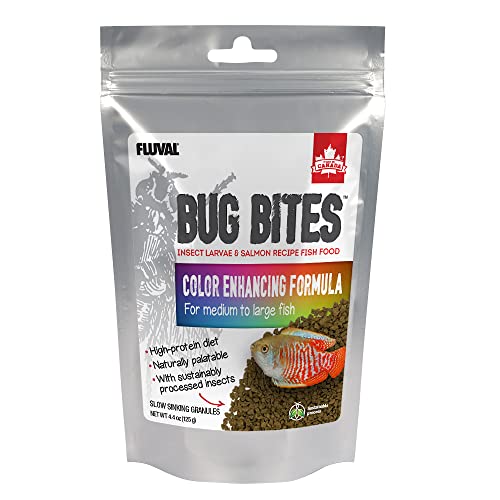
    A flake version of Fluval’s amazing pellet bug bits products. Great for all tropical fish and high in protein.

    Buy On Amazon Buy On Petco

    I love the Fluval Bug Bites food line. They built their formula off solider fly larvae, which freshwater fish tend to go crazy for. Not only that, but because this tropical fish food is more to most fish’s natural diet, it’s healthier for them overall. This variant is Fluval’s flake version, and is a color enhancing formula. It has the same formula just processed down to a flake. Learn more about their formula in the video by Fluval.

    This fish food is high in protein, has a great amino acid profile, and easily digestible – which means it shouldn’t cause bloat!. It’s based on your fish’s natural prey (most freshwater fish eat insects).

    While this make it super convenient for the end hobbyist, I do feel their pellet product is the better buy. If you want to diversify your food selection, definitely buy it. I would just prefer to go with their pellet version if I could only buy one.

    Pros and Cons

    Pros
    • Insect based
    • Works for all tropical fish
    • Made in the USA
    Cons
    • Expensive
    • Pellet product is superior

    4. Extreme Aquatic Community Crave

    Xtreme Aquatic Community Crave Fish Food

    Extreme Aquatics Fish Food offers a high quality flake food. A 60/40 mix of spirulina and krill

    Buy On Amazon Buy On Ebay

    Extreme aquatics has really built a name for themselves as an independent company. They are not like your Hagen or Tetra, which are massive fish brands. They built their reputation with YouTube influencers who are passionate fish keepers. They have the likes of Aquarium Co-Op, KG Tropicals, and Bay Area Aquatics who have all endorsed their products. They have even been featured at my favorite aquarium trade show, Aquashella.

    All these endorsements tell us that Xtreme is made for serious hobbyists. This formula is their community crave product. This formula is built for community fish tanks where you will have a blend of various freshwater fish. Their formula consists of 60% Spirulina and 40% Krill. This makes it perfect for all fish.

    This food has an amazing feeding response for a flake food and you can see the quality in the flake itself from it’s texture. The only reason this does go ahead of Cobalt is because I’m partial to the probiotics (it’s also more expensive because it comes in bigger sizes). Several hobbyist would disagree with me, but that’s why I have a list here – so you can make the decision for what is best for your fish. You can’t go wrong with Xtreme foods!

    Pros and Cons

    Pros
    • 60/40 mix
    • Works for all tropical fish
    Cons
    • Expensive
    • Hard to find locally

    5. Cobalt Aquatics Spirulina

    Cobalt Aquatics Spirulina Flakes

    Cobalt Offers a great spirulina flake formula with probotics. Get for fish that need greens in their diet

    Buy On Amazon Buy On Chewy

    For fish that need their greens, spirulina is what you want to buy. Having a product with spirulina and probiotics take it to another level. That is exactly what this fish food is by Cobalt Aquatics.

    This food is perfect for algae eating fish like molly fish, African cichlids, and even saltwater fish like tangs and rabbitfish. This food is easy to feed, easily digestible, and won’t cloud up your water.

    It is the the best flake food for algae and plant eating fish. There is no second. You will not be disappointed.

    Pros and Cons

    Pros
    • Probiotics 
    • Great for fish that need greens
    Cons
    • Expensive

    6. Formula Two Flakes

    When it comes to algae eating saltwater fish, nori is a great choice, but not always the most convenient. If you want a convenient food for them, Ocean Nutrition’s Formula Two flakes are a great choice.

    This food mixes marine algae and spirulina. It also includes garlic, which is a appetite enhancer for an added fedding response. These flakes are easy to digest and easy to feed.

    While nori and Ocean Nutrition’s frozen food version of formula two are a better choice, this is great to use when you don’t have time to prepare food.

    Pros and Cons

    Pros
    • Great for marine fish that need greens
    • Three types of greens
    • Readily available
    Cons
    • Expensive

    7. Wardley Tropical

    Avoid!
    Wardley Tropical Fish Food Flakes

    Wardley is a basic brand of fish food that you will fish in grocery stores. While your fish will eat it, it’s not the best food out there. Ok if you are in a pinch

    Buy On Amazon

    Warley is the type of freshwater fish food you will find in grocery stores and mega retailers like Walmart. While you can find this easily and even it purchase it late at night since these store are open 24-7.

    However, I would caution aquarist in purchasing foods like this. These lower quality foods usually contain fillers and they are known to cloud up your water.

    With so many other superior choices available both locally and online, it’s not my first choice. Purchase the others mentioned here and your freshwater fish will thank you for it.

    Pros and Cons

    Pros
    • Easy to find
    • Made for all tropical fish
    Cons
    • Cheap
    • Not the best quality
    • Clouds water
    • Strong smelling

    Knowing The Hierarchy

    While this is a flake food blog post, it would be wrong of me not to say that there are better foods out there. Let’s look at the full list of foods available. In summary from lower quality to best it goes flake foo -> pellet food -> freeze-dried food > frozen > cultivated live foods.

    Pellets

    Pellet food is a step up from flake food as it is less processed. This is usually where more advanced aquarists start with staple food. You tend to get higher quality brands and foods when it comes to pellets. The downsides with pellet food is they expand with water and can cause bloat. Look for the best pellet food that you can buy to avoid bloating and digestion issues.

    Freeze Dried

    Freeze Dried Food is more of a whole food, which is great for digestion. Then can be soaked in vitamins and can provide better overall nutritional content than pellet food when you combine vitamins.

    Freeze dried food is more expensive than pellet food and require vitamins since they are usually only include single ingredients – like freeze dried krill.

    Frozen

    Frozen foods offer a great combination of variety in their formulas and whole foods being frozen. They are very filling foods and will make your fish look fat in a hurry. The best foods you can purchase in the hobby are going to be frozen and are going available only in specialty retailers or only online.

    Frozen food is the most expense of all the types food and also the most nutrient dense. It’s easy to overfeed with this food. It’s also harder to feed small fish with frozen food because of their small mouths.

    Cultivated Live

    While you can purchase live foods at a local fish store, I usually do not recommend this because there is a good chance you will introduce diseases to your aquarium. I prefer if you are going to feed live foods that you consider cultivating them. Blackworms, rotifers, and brine shrimp are the best foods to cultivate. Blackworms can be cultivated without any special foods. Brine shrimp and rotifers can be enhanced by supplementing Spirulina.

    Cultivated live foods provide much needed live gut bacteria to your fish and are considered the best for your fish’s long term health. However, it’s not realistic for most hobbyist because of the time and dedication required. Many hobbyist will raise and keep very healthy fish sticking to frozen foods and a mix or other foods.

    Knowing What Type Of Fish You Have

    Understanding the type of fish you have is also very important when choosing the food to feed your fish. Let’s breakdown the 3 types. Flake food is going to be best for surface and midwater fish.

    Surface

    Fish like betta fish and gouramis like to swim and hunt at the surface. They will be the first fish to go after flake fish foods since this is where they hunt for food. Most community fish will fall into the surface or midwater category.

    Midwater

    Midwater fish like Angelfish, most tetras, and barbs tend to hand in the middle of the water. They will go after food once it starts to sink. These aquarium fish do best with pellet foods.

    Bottom Feeders

    Bottom feeders will generally not show an interest in food until it hits midwater or the bottom of the tank. These types of aquarium fish are best suited for wafer types of food and food that falls to the bottom of the tank.

    FAQs

    Which Flakes Brand Is Best?

    The best flake food will have raw quality ingredients and lack fillers. Some flake food will have probiotics or be make of insects or sea creatures like krill. For freshwater fish, I recommend Cobalt’s probiotic flake food. For saltwater fish, I recommend Ocean Nutrition. Both brands do a lot of research for their products and offer high quality food at a reasonable price.

    Is This Type of Food Good For Fish?

    A quality flake food can be used as a staple for their diet. However, it’s not the best food out there. You can opt for pellet, freeze dried, frozen, and even cultivate your own live food. All these other foods are potentially higher quality than most processed flake fish foods out there.

    Is It Better To Feed Flakes Or Pellets?

    For the most part, pellet food will be superior in quality to flake food. However, flake food can be easier to eat for smaller fish. Do your research to determine what works best. There is high quality flake food available as shown in this post.

    How Long Is Flakes Food Good For?

    Flake food has a long shelf life. It has the longest shelf life of all fish food. Depending on the manufacturer, it can be as short as 18 months to as long as 3 years. They will degrade in nutritional value over time. In general, I suggest replacing your fish every 6 months regardless of manufacturer’s claim to maintain the nutritional value of your food.

    Should I crush the flakes?

    You can crush fish flakes for smaller fish. Most aquarists will just crush the fish flakes with their fingers. You can also crush flake food for frying. Keep in mind that crushed flake food can make the food not attractive for larger fish

    Closing Thoughts

    It is important to feed your fish a variety of foods in order to provide them with the best possible diet. While high-quality flake food can be a good staple, it should not be the only thing you give your fish. There are many different types of foods available on the market, so make sure to do your research and buy a variety of brands and types to keep your fish healthy and happy. Leave a comment below and let us know which brand of flake food you like best!

  • Can Fish Drown? The Short Answer, the Long Answer, and What It Means for Your Tank

    Can Fish Drown? The Short Answer, the Long Answer, and What It Means for Your Tank

    Can fish drown? It’s one of those questions I get asked more than you’d expect โ€” and the answer is yes, technically, though not in the way people imagine. I’ve seen hobbyists accidentally create conditions in their tanks where fish were effectively “drowning” through oxygen deprivation. Understanding how fish breathe and what depletes oxygen in a tank can genuinely save fish lives. Here’s the full explanation.

    It sounds like a trick question, but the answer is yes โ€” fish can effectively drown, just not the way we think of it. “Drowning” for a fish means suffocating from lack of dissolved oxygen in the water, not inhaling water into lungs. As someone who’s managed tanks for 25 years, the more practical concern is recognizing when oxygen levels in your aquarium are dangerously low. Fish gasping at the surface is the classic warning sign. There’s also an interesting wrinkle with labyrinth fish like bettas โ€” they breathe atmospheric air and can actually suffocate if they’re prevented from reaching the water’s surface. This article covers both the biology and the real-world implications for your tank.

    The Short Answer

    Yes, fish can drown. However, it’s better to think about a fish drowning as the result of a lack of oxygen instead of seeing their lungs fill with water.

    Fish can be deprived of oxygen due to several reasons, including oxygen levels in the water, poor water quality, parasites and diseases, and even physical deformities.

    In short though, fish can drown in water due to not being able to extract the oxygen they need from their surroundings.

    The Long Answer

    It isn’t every day that you hear about a fish dying due to drowning. This lack of oxygen can be due to several biological, chemical, and pathological problems within the aquarium including poor water quality, parasites and diseases, and deformities.

    First, we need to understand how oxygen enters the aquarium and how fish breathe. Then we can understand how the transfer of oxygen from the water to the bloodstream of the fish can fail.

    Dissolved Oxygen In The Aquarium

    Air Bubbler

    Dissolved oxygen, often abbreviated as DO, is how much oxygen is available in water in comparison to how much oxygen that water can hold; simply put, dissolved oxygen shows how much oxygen is available in the water to be used by plants and animals at any given time.

    While dissolved oxygen levels remain pretty consistent in the aquarium setting, this scientific parameter can be affected by several factors, including water temperature and depth, surface exchange, photosynthesis and respiration, and fish medications.

    Water Temperature And Depth

    Water temperature and depth are the main factors that influence dissolved oxygen levels in bodies of water.

    Due to the physical properties of water, cold water holds more oxygen while hot water holds less oxygen. This means that the warmest surface waters, that aren’t affected by surface exchange, hold less oxygen than the coldest water at the very bottom of the ocean. Other external factors, such as seasonal, altitude, and latitude differences, all play a role in how much oxygen is actually available at any given time.

    In the aquarium, the water temperature can definitely affect dissolved oxygen levels. For instance, if you need to raise water temperatures to treat a parasite, like ich, it is recommended to increase surface agitation and to add an air stone and air pump. This is because the warmed water will hold significantly less oxygen, causing your already-sick fish to have even more difficulty breathing.

    Though it is likely for fish to succumb to the shock of rapidly changing temperatures first, it is possible for fish to drown if oxygen levels are low in warm water.

    Surface Agitation

    Surface agitation is one of the ways that oxygen enters the water column. This is a physical exchange between atmospheric oxygen and water through wind and wave action. Other gases, such as carbon dioxide, are also exchanged at this point to create a cycle.

    In the aquarium, surface agitation is very important. Filters, powerheads, and air stones are common methods of increasing surface agitation to help increase dissolved oxygen levels and to improve overall gas exchange. If surface agitation is poor in the aquarium, then dissolved oxygen levels will also be low.

    This is a very common problem in betta fish (Betta splendens) aquariums. These labyrinth fish are very delicate and need little to no water flow in order to prevent injury. As a result, there is usually minimal surface agitation, leaving the betta to sometimes rely on its labyrinth organ; the labyrinth organ is a specialized lung-like organ that allows the fish to process atmospheric air directly.

    Photosynthesis And Respiration

    Photosynthesis is the process by which an organism converts carbon dioxide into oxygen in order to make food. Respiration is the opposite of this process where oxygen is converted back into carbon dioxide.

    During the day, aquatic plants and vegetation perform photosynthesis while fish perform respiration. At night, both plants and fish respire. Together, this ecosystem works as a constant exchange between carbon dioxide and oxygen.

    In freshwater and saltwater systems, autotrophic plankton called plankton is responsible for producing most of the available oxygen in the world. However, an imbalance between photosynthesis and respiration can lead to problems and fish drowning.

    One of the most damaging events to happen in nature is a harmful algae bloom (HAB). Harmful algae blooms happen when nutrients and resources are abundant, usually due to excess fertilizer and runoff, leading to exponential growth. This growth can be seen in algae and some harmful bacteria, like cyanobacteria, that can produce deadly toxins.

    When algae and bacteria populations are left to grow out of control, there becomes an imbalance of resources. Eventually, sunlight is blocked while nutrients are depleted, depriving the plants below of performing photosynthesis and putting oxygen back into the system. Once these plants die, the decomposition of the organic matter also increases nutrient and respiration rates, fueling growth and further depleting oxygen.

    As this happens, oxygen levels are incredibly low and most fish and invertebrates suffer and die. If the harmful algae bloom is caused by cyanobacteria, they may be affected by deadly toxins as well; these toxins are why some bodies of water are off-limits to people during harmful algae blooms.

    Harmful algae blooms to this extreme are not likely to happen in the aquarium, though strains of harmful cyanobacteria do exist in the hobby. Instead, it is possible to have too many nutrient-hungry plant species that quickly overrun the aquarium and then die off when resources are depleted. This die off can have similar effects where the decomposition quickly removes oxygen from the water.

    Medications

    spectrogram Medication

    Many medications for freshwater and saltwater fish advise increasing aeration during the treatment period. This is due to how the medications interact with the water chemistry. Effects can be enhanced if mixing medications.

    Not all medications will lower the oxygen level in the tank, but it’s definitely worth running an air pump if it is advised.

    How Do Fish Breathe?

    Before we see how fish drown, we need to understand how they breathe first. Here is a great video below by Steve Griffins. I’ll explain more below.

    Most fish breathe through their gills; many fish have made adaptations to combat lower oxygen levels, though we will only look at standard fish anatomy. Gills provide a large and highly-folded surface area with an extensive network of capillaries that can be used for the exchange of gases, like oxygen and carbon dioxide.

    In order to breathe, fish pull water into their mouth which is then pushed across their gills. Oxygen is absorbed and diffused into the bloodstream and transferred throughout the body due to differing concentrations; the concentration of oxygen is lower in the blood than in the surrounding environment.

    Carbon dioxide is then moved across the gills, out of the body of the fish, and back into the water.

    Can Fish Drown?

    Now that we know what affects dissolved oxygen levels and how fish breathe, we can see where the process can go wrong. Possible problems include poor water quality, parasites and diseases, and physical deformities.

    Some of the telltale signs of a drowning fish are:

    • Heavy breathing
    • Red or inflamed gills
    • Laying at the bottom of the aquarium or gasping for air at the surface

    Poor Water Quality

    Poor water quality can be a secret killer of fish, especially if water parameters aren’t being regularly tested. Bad water parameters, namely high levels of ammonia and nitrite, can make breathing very difficult and very painful for fish.

    It should be noted that high levels of nitrate can also prove to be deadly to fish and invertebrates but is not as common of a problem as the other parameters.

    Ammonia Poisoning

    Ammonia poisoning happens when there are especially high levels of ammonia present in the aquarium; any level of ammonia past 0.0 ppm can be damaging to fish and invertebrates, but serious damage starts to happen past 0.5 ppm.

    Ammonia is toxic and will burn the internal and external organs of fish, including gills. This can quickly lead to fish being unable to pull enough oxygen across their gills, leaving them to suffocate and drown.

    High levels of ammonia are usually caused by having too many fish, excess feedings, or stocking an aquarium that is not fully cycled.

    Nitrite Poisoning

    Nitrite poisoning is just as deadly as ammonia poisoning and can be a much more silent killer. Again, nitrite levels should always be 0.0 ppm. Any amount past this can start to cause damage to internal and external organs.

    Nitrite poisoning happens when there are excess levels of nitrite in the aquarium. Due to the chemical structure of hemoglobin, nitrite can bind to blood where oxygen would otherwise. This means that your fish will suffocate from the inside out, making for a very painful death.

    High levels of nitrite are the result of high levels of ammonia; any trace of nitrite is indicative of a nitrogen cycle happening in the fish tank.

    Parasites And Diseases

    Unfortunately, many parasites and diseases that are in the fish tank target the gills of fish. Luckily, most parasites and diseases present themselves before there is irreversible damage, but some ailments might be quicker and more difficult to treat than others.

    One of the worst parasites to encounter are species of flatworm, particularly from the Monogenenea class.

    Gill Flukes

    Gills flukes (Dactylogyrus spp.) are one of the most dangerous parasites that can make fish drown. These flukes are most likely to occur on members of the Cyprinidae family, including goldfish and koi, though they can infect any freshwater fish species.

    Gill flukes are initially free-swimming parasites that quickly need to find a host. At that point, they attach to the gills of the fish and reproduce. The gills will then become inflamed and your fish may try to scratch itself against hard surfaces to try to get them off. This can lead to a secondary infection, making treatment even more difficult.

    A gill fluke infection often presents itself as red and inflamed gills, lack of appetite, scratching, and heavy breathing. Parasitic-specific medications, like Praziquantel, will need to be dosed to eradicate the flukes.

    Ich

    Freshwater Ich

    Ich (Ichthyophthirius multifiliis) is one of the most common parasites to come across in the aquarium. Though these organisms do not target fish’s gills specifically, they can infect the gills which can cause the fish to drown; unfortunately, there are a few different types of ich that will only affect gills and leave the rest of the body alone, making the initial diagnosis difficult.

    Otherwise, ich is easy to diagnose and presents itself as tiny white spots that cover the body of the fish. Other symptoms are similar to those found with gill flukes.

    Deformities

    Lastly, some physical deformities can cause aquarium fish to drown, specifically betta fish.

    Betta fish have been bred to have the most extreme colors and finnage. While beautiful to look at, some of these modifications have turned into deformities that hinder the fish from being able to breathe air.

    Though betta fish have gills that they can use to get enough oxygen from the water, they will still venture to the surface of the fish tank to take in atmospheric air regardless of water parameters. However, some deformities, like excess finnage, can drag your labyrinth fish down, never allowing them to get the atmospheric air they need.

    At the same time, your fish may become exhausted while trying to swim to the top of the tank. This activity will cause your fish to breathe harder, which will cause carbon dioxide levels to rise. Though this only happens in extreme cases, it’s possible for your betta fish to over-exhaust itself and not get enough oxygen from the water as a result.

    Does Your Aquarium Have Enough Oxygen?

    As long as the water is flowing in the aquarium and regular tank maintenance is maintained, there’s usually no reason to worry about adding additional aeration to the system. However, problems may arise when too many fish are kept in too small of a tank or if water movement is inadequate.

    How To Improve Aquarium Oxygenation

    The best ways to improve oxygenation in the aquarium are through equipment, tank maintenance, and photosynthetic additions.

    In general, it’s recommended to choose a filter that is rated for at least double the size of your aquarium. Not only does this allow for more beneficial bacteria growth, but the subsequent surface agitation is a great source of oxygenation.

    Freshwater tanks need at least a 6-10x turnover rate; heavily planted tanks will need better circulation to ensure that water can pass through. Saltwater reef tanks may need at least a 20x turnover rate with specialized tanks reaching much higher.

    In addition to filtration, powerheads and wavemakers can be added to the freshwater or saltwater aquarium. If using external filtration, water will also be oxygenated as it moves from the tank and through the plumbing. Protein skimmers may also be added to the saltwater aquarium for additional filtration and oxygenation.

    While filtration and equipment will help create surface agitation and distribute oxygen throughout the tank, corals and plants may also be added for additional photosynthesis. Fast-growing plants will quickly take up nutrients, releasing oxygen into the water in the process. Symbiotic algae within coral are slightly slower to photosynthesize, but they will contribute to oxygen levels while helping take up excess nutrients as well.

    Regular tank maintenance will also introduce new oxygen and help accelerate gas exchange. Though this is a temporary effect, water changes are very effective for aerating and circulating new water throughout the tank.

    Final Thoughts

    Believe it or not, fish can drown. There are many factors that determine oxygen levels in the aquarium, including water temperature and depth, surface exchange, photosynthesis and respiration, and medications. Water quality, parasites and diseases, and physical deformities can further make it difficult for fish to breathe, leaving them to drown.

    If you’re not sure about how much water flow you should have in your aquarium, add as much as you can without disturbing the substrate or stressing out fish and invertebrates.

  • Angelfish Tank Mates: My 15 Best Picks (And 4 I’d Avoid)

    Angelfish Tank Mates: My 15 Best Picks (And 4 I’d Avoid)

    Angelfish tank mates are one of those topics where I see people make the same mistake over and over: forgetting that angels are cichlids. I’ve kept angelfish in community tanks for decades, and the wrong tank mates can bring out real aggression โ€” especially as the fish mature. These 15 picks are the ones I’d actually trust in an angelfish community, with honest notes on what to watch for.

    Angelfish are cichlids โ€” and a lot of hobbyists forget that when they’re stocking a community tank. They’re generally peaceful, but they will eat smaller fish as they grow, and a breeding pair can become surprisingly territorial. I’ve seen neon tetras disappear overnight once angelfish in the same tank hit 3 inches. The tank mates that work best are mid-to-large tetras, corydoras, peaceful gouramis, and other similarly-sized community fish. This guide covers 15 species that consistently coexist well with angelfish, and 4 that I’d avoid based on experience.

    Choosing Angelfish Tank Mates- What You Need To Know

    Putting together a peaceful community aquarium can be a bit of a juggling act. You need to make sure every fish in the tank will be happy and get along. Angelfish make the perfect centerpiece fish for tropical community tanks, and it’s a good idea to start by building the tank around their needs.

    All you need to do then is make sure that all the other fish are compatible with your angelfish and the conditions it prefers. Before we move on to some great angelfish tank mates, let’s take a few minutes to get to know the star of the show!

    Temperament

    Angelfish are very peaceful as far as cichlids go. If you have a breeding pair, expect them to become a little more aggressive, however, especially with their own species. Angelfish will also defend their nest site against any intruders after breeding.

    Size

    Angelfish grow pretty large, so there isn’t a whole lot of common aquarium fish that can eat your angels. A standard angelfish can reach 6 inches in length and 8 inches from top to bottom, and altum angels grow even bigger!

    Despite their size, angelfish have pretty small mouths compared with other cichlids. They are generally safe around smaller fish, but they will eat any fish small enough to swallow whole. Fish fry and very small nano species should not be kept with angelfish.

    Competition

    Angelfish are not the fastest-moving fish, but they can be pretty competitive around mealtimes. Avoid keeping fish that are too slow to get their fair share of the food. It is best to watch your fish closely to make sure no one is getting out-competed.

    Feeding different areas of the tank simultaneously and using a combination of floating and sinking foods can be very helpful to spread out the competition.

    Parameters & Aquarium Setup

    Before you can choose suitable tank mates, it’s important to understand the needs of your angelfish. Angelfish are tropical freshwater fish that prefer water temperatures between 78 and 84ยฐF. This is on the warmer side so it’s important that their tank mates are comfortable in the same temperatures.

    Angelfish require good water quality, with zero ammonia or nitrite in the water. They prefer water with a slightly acidic to neutral pH, between 6.5 and 7.8. The water flow in the tank should be gentle because angelfish are not very strong swimmers.

    The 15 Best

    After reading about how to select tank mates for your angelfish, you’re probably very interested to learn about some great options! I’ve put together a list of 15 awesome compatible species to help you choose. Check out our video below from our YouTube channel. More detail is provided in the blog post below.

    Even though each species on the list will make a great addition to your angelfish tank, make sure you pay attention to the following important information:

    • Scientific Name
    • Adult Size
    • Water Temperature
    • Minimum tank size
    • Care Level
    • Diet
    • Origin
    • Swimming Level

    Now let’s get started!

    1. Corydoras Catfish

    What Does A Cory Catfish Look Like
    • Scientific Name: Corydoras spp.
    • Adult Size: 1-4 inches
    • Water Temperature: 72-82ยฐF
    • Care Level: Easy
    • Diet: Omnivore
    • Minimum tank size: 15 gallons for most species
    • Origin: South America
    • Swimming Level: Mostly bottom dwellers

    Corydoras catfish, or cory cats as they are affectionately known, are awesome little bottom dwellers for tropical fish tanks. There are many different species to choose from in the aquarium hobby.

    Corydoras catfish are social fish so make sure you pick up a group of at least 5 of the same species. They are incredibly peaceful little fish that will not bother your angelfish. The fact that they stay on the bottom means they will add another layer of interest and activity to your aquarium.

    2. Ram Cichlids

    Blue Ram Cichlid in Planted Tank
    • Scientific Name: Mikrogeophagus ramirezi
    • Adult Size: 1.5 inches
    • Water Temperature: 80-86ยฐF
    • Care Level: Moderate
    • Diet: Omnivore
    • Minimum tank size: 15 gallons
    • Origin: Venezuela, Brazil & Colombia
    • Swimming Level: Bottom

    Ram cichlids are an amazing dwarf cichlid with great colors. Unlike other South American cichlid species, these fish are peaceful and stay very small. Rams come in some amazing color varieties like electric blue and golden.

    Ram cichlids are shy little fish that need pristine water quality. This means they aren’t a great choice for beginners, but more experienced aquarists will find these stunning fish make an awesome tank mate for their angelfish!

    3. Molly Fish

    How Do Molly Fish Look Like
    • Scientific Name: Poecilia sphenops & Poecilia latipinna
    • Adult Size: 3-5 inches
    • Water Temperature: 68-82ยฐF
    • Care Level: Moderate
    • Diet: Omnivore
    • Minimum tank size: 30 gallons
    • Origin: South, Central, & North America
    • Swimming Level: Midwater, top

    Molly fish can make great tank mates for your angelfish. These hardy fish are livebearers that will breed readily in your aquarium. The fry usually get snapped up pretty quickly in community tanks but ask for females only if you would prefer them to not breed.

    There are many great types of molly fish in the hobby, including sail fins and balloon varieties. Mollies prefer higher pH than most other tropical fish species, so they should only be kept in tanks with a pH over 7.5.

    4. Kribensis

    Kribensis Cichlid Male and Female
    • Scientific Name: Pelvicachromis pulcher
    • Adult Size: 3-4 inches
    • Water Temperature: 75-81ยฐF
    • Care Level: Easy
    • Diet: Omnivore
    • Minimum tank size: 20 gallons
    • Origin: Nigeria, Cameroon
    • Swimming Level: Bottom

    The kribensis is a stunning cichlid from over the ocean in West Africa. These small fish are happy in the same water parameters as angelfish, making them an ideal tank mate.

    Kribensis are dwarf cichlids that spend most of their time at the tank bottom. These fish have a peaceful nature but can be aggressive towards other members of their own species, so it is best to keep them in a pair.

    5. Rosy Tetras

    Rosy Tetra in Aquarium
    • Scientific Name: Hyphessobrycon rosaceus
    • Adult Size: 1.5 inches
    • Water Temperature: 75-82ยฐF
    • Care Level: Easy
    • Diet: Carnivore
    • Minimum tank size: 20 gallons
    • Origin: Brazil, Suriname & Guyana
    • Swimming Level: Mid-water

    Rosy tetras are a little-known but awesome tropical aquarium fish. They are very small fish but they are safe to keep with larger angelfish because of their shape. It is best to keep 6 or more of these peaceful schooling fish in a community aquarium so that they can be more confident and behave naturally.

    6. Zebra Danios

    What Does A Zebra Danio Look Like
    • Scientific Name: Brachydanio rerio
    • Adult Size: 1.5-2 inches
    • Water Temperature: 70-78ยฐF
    • Care Level: Easy
    • Diet: Carnivore
    • Minimum tank size: 20 gallons
    • Origin: India
    • Swimming Level: Midwater

    Zebra danios are another species that make great tank mates for freshwater angelfish. They will add more activity and excitement to your angelfish tank without bothering their tank mates.

    They are hardy fish that get their common name from their black and white striped bodies. Zebra danio fish are lively little creatures that are very peaceful and easy to care for.

    7. Cardinal Tetra

    Cardinal Tetra Fish
    • Scientific Name: Paracheirodon axelrodi
    • Adult Size: 0.75-1.25 inches
    • Water Temperature: 73-84ยฐF
    • Care Level: Moderate
    • Diet: Omnivore
    • Minimum tank size: 15 gallons
    • Origin: Brazil & Venezuela
    • Swimming Level: Midwater

    The cardinal tetra is one of the most colorful tropical aquarium fish in the hobby. Apart from their colors, the great thing about these tetra fish is how peaceful they are! A school of 6 or more would make ideal tank mates for your freshwater angelfish.

    8. Bristle Nose Plecos

    Bristle Nose Pleco
    • Scientific Name: Ancistrus spp.
    • Adult Size: 4-5 inches
    • Water Temperature: 70-79 ยฐF
    • Care Level: Easy
    • Diet: Herbivore
    • Minimum tank size: 15 gallons
    • Origin: South America
    • Swimming Level: Bottom dweller

    Bristlenose plecos are really strange-looking bottom feeders that make one of the best angelfish tank mates. These bottom-dwelling fish hail from the Amazon river basin but have found a second home in aquariums all over the world.

    Bristlenose plecos are very peaceful with other fish, but they should be the only member of their species unless you have a very large tank. There is also a Albino variety available.

    9. Otocinclus Catfish

    Otocinclus Catfish in Planted Tank
    • Scientific Name: Otocinclus spp.
    • Adult Size: 2 inches
    • Water Temperature: 74-79ยฐF
    • Care Level: Easy
    • Diet: Algae
    • Minimum tank size: 10 gallons
    • Origin: South America
    • Swimming Level: All levels

    Otocinclus catfish are amazing algae eaters that will help to keep your glass, hardscape, and plants clean. These hardworking tank cleaners look great too, and they can be very interesting to watch as they zoom around the tank looking for new feeding spots.

    Otos need a good supply of algae to stay healthy, so make sure you wait until your tank is mature before introducing them.

    10. Praecox Rainbow Fish

    Rainbow Fish in Planted Tank
    • Scientific Name: Melanotaenia praecox
    • Adult Size: 2-3 inches
    • Water Temperature: 73-82ยฐF
    • Care Level: Moderate
    • Diet: Omnivore
    • Minimum tank size: 15 gallons
    • Origin: New Guinea
    • Swimming Level: Midwater, top

    Rainbowfish are another great schooling fish that can really help to liven up your aquarium. The praecox rainbowfish is just one of many rainbowfish that make great angelfish tank mates.

    Rainbowfish need great water quality but are otherwise easy to care for. They should be kept in groups of 6 or more to bring out the best of their colors and behaviors.

    11. Harlequin Rasbora

    Rasboras
    • Scientific Name: Trigonostigma heteromorpha
    • Adult Size: 1.25-1.75 inches
    • Water Temperature: 70-82ยฐF
    • Care Level: Easy
    • Diet: Carnivore
    • Minimum tank size: 15 gallons
    • Origin: Southeast Asia
    • Swimming Level: Midwater

    These popular freshwater fish are recognizable by their bright orange color and the black triangular marking on their sides. They are very attractive fish that look amazing as they school together in the water column. Harlequin rasboras are very peaceful fish that add will vibrant color and activity to your angelfish community aquarium.

    12. Cherry Barbs

    Male Cherry Barb
    Male
    • Scientific Name: Puntius titteya
    • Adult Size: 1.5-2 inches
    • Water Temperature: 68-80ยฐF
    • Care Level: Easy
    • Diet: Omnivore
    • Minimum tank size: 15 gallons
    • Origin: Sri Lanka
    • Swimming Level: Midwater

    Not all barb species make good tank mates for angelfish, but the peaceful cherry barb makes an excellent choice! These popular shoaling fish have a peaceful nature, making them a great community fish. Cherry barbs are a social species, so make sure you pick up a group of at least 6.

    13. Rummy Nose Tetras

    Rummy Nose Tetra
    • Scientific Name: Hemigrammus rhodostomus
    • Adult Size: 2 inches
    • Water Temperature: 76-80ยฐF
    • Care Level: Moderate
    • Diet: Omnivore
    • Minimum tank size: 20 gallons
    • Origin: Amazon river basin, Brazil & Venezuela
    • Swimming Level: Midwater, top

    Rummy nose tetras are schooling fish that make great tank mates for angelfish. They are active community fish that should be kept in groups of ten or more to see them at their best. The rummy nose tetra needs excellent water quality to really thrive so good filtration and regular maintenance are very important.

    14. Nerite Snails

    • Scientific Name: Neritina spp., Vittina spp., Clithon spp.
    • Adult Size: 1-1.5 inches
    • Water Temperature: 72-82ยฐF
    • Care Level: Easy
    • Diet: Algae
    • Minimum tank size: 5 gallons
    • Origin: Africa & Asia
    • Swimming Level: Bottom

    If you’re looking for some excellent tank cleaners for your angelfish community setup, nerite snails could be a perfect choice. These harmless aquarium snails have beautiful shells and do an amazing job of eating pesky algae in the tank. One of the best things about these snails is that they can’t breed in freshwater, so you never have to worry about them becoming a pest!

    15. Black Skirt Tetra

    What Does Black Shirt Tetra Look Like
    • Scientific Name: Gymnocorymbus ternetzi
    • Adult Size: 2-2.4 inches
    • Water Temperature: 68-78ยฐF
    • Care Level: Easy
    • Diet: Omnivore
    • Minimum tank size: 20 gallons
    • Origin: Argentina, Bolivia, & Brazil
    • Swimming Level: Midwater

    The black skirt tetra is another peaceful species of schooling fish that works great with freshwater angelfish. These fish are also known as the black widow tetra but don’t worry, there’s nothing dangerous about them.

    Black skirt tetras are active swimmers that should be kept in groups of 6 or more. They aren’t the most colorful tetras, but this can help draw attention to your centerpiece fish, the angels.

    Bonus Tank Mates For Angelfish

    The 15 peaceful fish in this list make awesome tank mates for freshwater angelfish, but there are many other options to choose from. Here are a few more popular species to consider:

    4 Fish To Avoid

    Now that you know 15 great tank mates for angelfish, let’s take a look at some common species that you should avoid:

    1. Goldfish

    The obvious problem with goldfish is that they are coldwater fish that prefer water that is 72ยฐF or cooler. This is too cold for your angelfish, so the two species are not compatible. For the same reason, other coldwater fish like white cloud mountain minnows and dojo loaches do not make good angelfish tank mates.

    2. Betta Fish

    WYSIWYG Available!
    Betta Fish

    Use Coupon Code ASDFISH at Checkout

    Betta Fish are one of the most beautiful varieties of freshwater fish available in the hobby. Easy to care for with plenty of varieties!

    Buy Premium Varieties Buy On Petco Online

    Bettas are slow-moving fish with long flowing fins. Keeping them with angelfish is risky because they can be easy targets for aggressive individuals. Some fish keepers might have had success, but I would not recommend trying this combo.

    3. Semi-aggressive Barbs

    Some aggressive species of barbs are notorious fin nippers and will not make good tankmates for angelfish. Tiger barbs, including green tiger barbs and Glofish barbs, should not be added to your angelfish community.

    Other potential fin-nipping species like zebra loaches and head and tail light tetras should also be avoided.

    4. Freshwater Shrimp

    Angelfish will not think twice about snacking on freshwater shrimp. Some shrimp might survive in a heavily planted tank with loads of hiding space, but you’ll probably see their population decreasing pretty steadily!

    Angelfish Community Aquarium Setup

    Setting up an awesome angelfish community tank could be as simple as introducing other fish to your existing aquarium. If you don’t already have an angelfish community tank, here’s what you need to know:

    Introducing Aquarium Companions

    It’s really important to have a backup plan in case your angelfish don’t get along with their new tank mates. At the end of the day, each fish has its own personality, and what works for a hundred other fish keepers might not work in your tank.

    I recommend setting up a small, inexpensive aquarium separate from your angelfish community tank. This tank only needs to be a few gallons, with a small filter and a heater. If war breaks out after you introduce tank mates, they can always be moved into this tank temporarily until you return them to the store or make another plan.

    A tank like this has other great benefits too. New fish can be quarantined in this tank before going in with your angelfish to prevent spreading any diseases to your other fish. It will really come in handy down the line if any of your fish get sick and need a hospital tank.

    If you have some issues with angelfish aggression, check out this video below by Hardyaquariums. His 5 tips are summarized below:

    • Balance the number of males and females
    • Buy dither fish for your angelfish to chase around (like Danios)
    • Get a bigger aquarium that is tall
    • Make hiding spaces for your angelfish for them to claim territory
    • Feed your angelfish well – Well fed fish will not fight as much

    Aquarium Size

    Angelfish can be kept in tanks as small as 29 gallons. Some fish keepers even go as low as 20 gallons, but I would recommend going larger if you can. 55 gallons or larger will allow you the room to create a thriving and busy angelfish community with loads of amazing tropical tank mates.

    One important thing to remember when picking out a tank is the angelfish body shape. These fish have really deep bodies that are taller than they are long. Tall tanks are therefore a better choice than long ones.

    Heating

    Angelfish prefer warm water between 78 and 84ยฐF. You’re going to need an aquarium heater to maintain this temperature in your tank. Make sure the heater you buy is rated for the size of your aquarium.

    I recommend using a thermometer if your heater does not have a display, this makes monitoring the water temperature in your tank much easier. Heater control is even better if it’s within your budget.

    Filtration

    Maintaining a healthy and beautiful angelfish community aquarium is almost impossible without good-quality filtration. There are so many different types of aquarium filters on the market, however, so which type should you choose?

    Aquarium filters come in different sizes, but the amount of water the manufacturers claim they can filter is just a guideline really. I recommend opting for a slightly larger filter if it doesn’t take up too much room. Canister filters are ideal for this purpose because they can be kept out of sight in the cabinet under your tank.

    Hang on back and internal filters work great too, just make sure the filter isn’t producing too much current. Remember, angelfish aren’t very strong swimmers! A filter with an adjustable output is very useful for dialing in the perfect flow.

    Aquarium Maintenance

    Aquarium maintenance is very important for maintaining happy and healthy fish in your angelfish community tank. Here’s what you need to do:

    • Use a test kit regularly to monitor your water parameters. Your nitrate levels should not go over about 30 parts per million, and ammonia and nitrite should always read zero.
    • Remove any physical waste and uneaten fish food from the bottom of your tank with a gravel vacuum.
    • Perform a partial water change 2-4 times per month to keep your nitrate levels safe.
    • Follow the recommended maintenance schedule for your filter model, and rinse out the media when necessary.

    Feeding

    Angelfish are not that picky about their diet. These fish can be fed a staple diet of dried food like pellets (like Fluval Bug Bites) and freeze dried foods. Supplement this diet with frozen or live foods like brine shrimp and blanched veggies like zucchini for a complete and balanced diet.

    My Pick
    Fluval Bug Bites – Tropical Formula

    Fluval bug bites tropical fish is an excellent staple food for most tropical fish. Made of black solider fly larvae

    Buy On Amazon Buy On Petco

    Not all of the tank mates in this list will thrive on this diet so it’s important to cater to each species in the tank. Bottom dwellers like cory catfish, for example, should be given sinking pellets or tablets. Algae eaters like otocinclus catfish will need a steady diet of algae, but you can suppliment this algae wafers.

    Avoid overfeeding your fish because uneaten food can spoil and cause dangerous ammonia spikes. Feeding your fish small amounts of food more than once a day is a good way to avoid this. Another good tip is to provide only enough food for the fish to finish in a minute or two.

    Live Plants

    Angelfish thrive in a heavily planted tank. Fortunately, so do all the other fish species on this list! Many fishkeepers think you need very deep pockets and a degree in botany to grow live aquarium plants, but it’s actually really easy to get started.

    If you’ve never grown live plants before here are a few things to know:

    • Plants need light to grow. Different species need different amounts of light, but there are many aquarium plants you can grow under regular aquarium lighting.
    • Plants need nutrients. Different types of plants get their nutrients in different ways. Some types of plants can be grown without soil or substrate and get their nutrients from liquid fertilizers. Other types of plants need nutrients at their roots.
    • Plants need carbon dioxide. All plants need CO2 to grow, but some species need more than others. If you want to get serious about growing plants, you’ll probably want to invest in a CO2 injection system. If you’re just starting out, choose low light, low CO2 plants.

    You’ll find loads of great articles on caring for different plants on this website, go ahead and check them out. Growing live plants is fun, and your angels and their tank mates will thank you for it!

    Substrate & Decorations

    The substrate is the sand or gravel at the bottom of the aquarium. There are so many different types available that it can be hard to pick one! The color is up to you, but most aquarium fish seem to prefer darker colors.

    Sand or gravel can work great, just make sure they are aquarium safe and that you wash them out thoroughly before setting up the tank. There are some great aquarium soils available for planted tanks. Avoid these unless you plan on growing a lot of plants.

    Decorations can turn an average-looking fish tank into an amazing one. As with the substrate, you can use your creativity and decide whether to go for a natural look or create a unique scene. Again, its really important that anything you put into the tank is clean and aquarium-safe. Natural decor like driftwood or aquarium rocks are great if you want to try build to an aquascape style

    Where To Buy

    Most of the angelfish tank mates in this list are common species that are easy to find in most aquarium stores and pet shops. If you don’t have a decent local fish store where you live, you can always go ahead and order your fish online. Buying online will also give you access to rarer breeds.

    FAQS

    What Fish Can Be Kept With This Type of Fish?

    Popular aquarium fish like cory catfish, otos, rainbow fish, and many types of tetras can be kept with angelfish. There are plenty of other fish species that make great angelfish tankmates too. The ideal tank mates are peaceful fish that enjoy the same water parameters.

    What Fish Do They Not Get Along With?

    Angelfish should not be kept with aggressive fish or fin nippers. Avoid larger cichlids like oscars and small aggressive fish like tiger barbs.

    Are They Good Community Fish?

    Angelfish make great peaceful community fish if they are kept with the right tank mates. They can be a little aggressive when breeding but are generally safe to keep with other peaceful fish that enjoy the same conditions.

    How Many Can Be Kept Together?

    Angelfish can be kept in pairs or small groups of 4-6 individuals. The number of angelfish you can keep together will also depend on the size of your tank. These fish can get territorial when breeding, so it’s important that the non-breeding angelfish have enough space to avoid conflict.

    Final Thoughts

    Angelfish are easily one of the most beautiful species for freshwater aquariums and they make great community fish too. With the right tank mates and knowledge, any fishkeeper can create a thriving tropical community in their own home.

    So what are you waiting for? Go ahead and start planning your own angelfish community today!

    Do you have an angelfish community tank? Tell us about your favorite angelfish tank mates in the comments below!


    ๐Ÿ“˜ Want to learn more? This article is part of our complete Freshwater Fish Guide โ€” your ultimate resource for freshwater species, care tips, tank setup, and more.

  • 7 Best Aquarium Backgrounds: My Picks After 25 Years of Tank Setups

    7 Best Aquarium Backgrounds: My Picks After 25 Years of Tank Setups

    Aquarium backgrounds are one of those finishing touches that make a bigger visual difference than most hobbyists expect. I’ve tried everything from printed backgrounds to 3D foam backgrounds in my own tanks, and the right choice depends heavily on the tank style and fish you’re keeping. This guide covers the 7 options I’d actually recommend, with honest notes on installation, durability, and what looks best in practice.

    An aquarium background is one of those things that seems minor until you take one off a tank โ€” and then you realize how much it was doing. A good background hides the equipment behind the tank, eliminates reflections that can stress fish, and gives depth to the aquascape. I prefer solid black or dark blue for planted tanks because it makes the colors of fish and plants pop. The 3D foam backgrounds are impressive but add significant depth to the tank and can reduce swimming space. After setting up tanks for 25+ years, here are the 7 backgrounds I’d actually recommend.

    Our Criteria (How These Backgrounds Made The Cut)

    Iโ€™ve been involved in aquariums since I was 11. Through my over 25 years of experience setting up various aquariums, there are certain things I look of if I’m going to install a fish tank background. Here is what I’m going to focus on when selecting the best to buy:

    • Backlight Features โ€“ Backlighting is something that comes from Nature Scape aquascaping. When you have a backlight aquarium background, you can replicate a sky environment in freshwater tanks. You can also change colors with some.
    • Static Clings – A backlight aquarium background is usually going to be a plate that you mount. For more traditional backgrounds we want a cling type product. These adhere to the back of your aquarium and won’t peel away like the cheap tape on backgrounds you find in chain pet stores.
    • Brand – We want a solid brand that that makes backgrounds for serious hobbyists. A pet store brand fish tank background is usually going to be cheap, be taped on, or fall apart easily. An aquarium background needs to lasts through the life of the tank.

    The Fish Tank Background Candidates

    That that we have seen what my criteria is, lets see who made the cut. I’ll go in further detail below.

    In a hurry? I recommend Serene Background Kits. Use discount code ASD15 at checkout!

    PictureNameFeaturesLink
    Editor’s Choice
    Serene Backlight Light Kit
    Serene Backlight Light Kit
    • Backlight
    • Static Cling
    Click For Best PriceBuy On Amazon
    Best Value
    SPORN Black Aquarium Blackground
    SPORN Black Aquarium Blackground
    • Static Cling
    • Dark Background
    Buy On AmazonBuy On Chewy
    FJARDE Lit Background FJARDE Lit Background
    • Backlight
    • Multiple Colors
    Buy On Amazon
    DUOFIRE Frosted White Background DUOFIRE Frosted White Background
    • Static Cling
    • Great For Planted Tanks
    Buy On Amazon
    SPORN Coral Background SPORN Coral Background
    • Static Cling
    • Photo background
    Buy On AmazonBuy On Chewy
    SPORN Tropical Background SPORN Tropical Background
    • Static Cling
    • Photo Background
    Buy On AmazonBuy On Chewy
    Seaview Sea of Green Background Seaview Sea of Green Background
    • Photo Background
    • Tape attached
    Buy On PetcoBuy On Amazon

    7 Best (2023 Reviews)

    Let’s look at each product below and see why they made the cut.

    1. Serene Backlit Light Kit

    In the aquascaping world, there is a gold standard when it comes to aquarium backgrounds. These are backlit backgrounds that come in a frosted white color. Current USA’s Serene kit meets this standard, is far cheaper than the gold standard ADA kit, and offers more features.

    What I love about this kit (aside from the price) is its ability to change colors. You can change it according to the mood you want to set in your fish tank and in your living space. Because the light is backlit, it does not affect your ability to provide lighting to the aquarium plants in your fish tank. You can see the multiple vibrant colors it can display below.

    I love how flexible this kit is. You can use this for virtually any type of setup and it’s super easy to install. You can either install it with a static cling or the mounting clips that Current USA provides. This light offers the ultimate balance of looking good for your home and guests while looking great as a fish tank. While it is more expensive than typical backgrounds, it’s features are second to none. Give it a try. You won’t be disappointed. It’s one of the best aquarium backgrounds you can buy today!

    Pros and Cons

    Pros
    • Frost default background
    • Multiple color options
    • Easy to install
    Cons
    • Expensive
    • Colors aren’t for everyone

    2. SPORN Black

    Best Value
    SPORN Black Aquarium Background

    SPORN backgrounds are static cling aquarium backgrounds that are easy to install and look great. Best for saltwater aquariums

    Buy On Amazon Buy On Chewy

    Static cling aquarium backgrounds as some of the most reliable backgrounds you can purchase in the hobby. I continue to be surprised to this day that pet stores continue to sell cheap tape on the back backgrounds for new hobbyists.

    SPORN offers not only high quality backgrounds, but they also cheap and easy to install. This one showed above is a classic black, which works amazing for saltwater tanks, African cichlid tanks, brackish water tanks, and some betta tank setups.

    This is a great buy. You really can’t go wrong with this brand.

    Pros and Cons

    Pros
    • Static cling
    • Easy to install
    • Easy to cut to shape
    Cons
    • Black doesn’t work for all setups

    3. FJARDE Background Light

    FJARDE Backgrounds

    An attempt at an ADA backlight aquarium back clone. It is cheaper than ADA and offers a few extra features.

    Buy On Amazon

    ADA’s backlight screen is considered the best in the business when it comes to backlit backgrounds. You figure it would be time for someone to make a clone of the product. Here we have FJARDE cloning the ADA screen, but with some additional features.

    This screen is designed to fit on rimless aquariums. It offers both gradient and solid vibrant colors. This screen is very easy to install, using a mounting clip that is designed for rimless aquariums.

    This is a great alternative if you are shopping for a premium backlit screen. It offers a lot of what ADA offers without the massive price tag. That being said, it’s still the most expensive aquarium background on this list. If you have the budget for it, I would give this fish tank background a look and compare it against the Serene. I personally think the Serene is a better to buy, which is why this one comes at #4 on the list.

    Pros and Cons

    Pros
    • Static cling
    • Easy to install
    • Easy to cut to shape
    Cons
    • Black doesn’t work for all setups

    4. DUOfire Frost White

    DUOFIRE White Frosted Background

    This background is designed for homes, but also works great for aquariums. Frosted backgrounds are ideal for planted aquariums and freshwater tanks

    Buy On Amazon

    Not everyone wants a backlit aquarium background. For a freshwater fish tank, a frosted white background offers a great aquarium background, especially with planted aquariums.

    This aquarium background from DUOFIRE is a product to use on an aquarium. These clings are designed for residential use, but still work for aquariums and are built to last a very long time.

    They are more expensive than the SPORE brand, but it is difficult to find this style in an aquarium brand. The premium you spend purchasing these is worth it. They are built for more stressful environments like bathrooms.

    Pros and Cons

    Pros
    • Frosted white background
    • Easy to install
    • Static Cling
    Cons
    • Expensive
    • Not ideal for saltwater tanks

    5. SPORN Coral

    SPORN Coral Background

    This static cling background offers a coral backdrop for saltwater fish tanks

    Buy On Amazon Buy On Chewy

    I understand some fish tank keepers want to have a real picture for their aquarium background. The problem you run into with the traditional tape on back aquarium backgrounds is that they don’t show well and they break over time.

    Enter SPORN’s coral aquarium background product. This has a great HD quality picture aquarium background, but it’s a static cling. This means that it adheres to the back of your fish tank, and it will last a very long time. This product is great for saltwater aquariums.

    This is a great product if you want an aquarium environment picture. If you have a freshwater tank, check out the other option below.

    Pros And Cons

    Pros
    • High quality picture background
    • Easy to install
    • Static Cling
    Cons
    • Needs a backlight to show well

    6. SPORN Tropical

    SPORN Tropical Background

    Spoon offers a static cling planted tank background. Great for freshwater aquariums

    Buy On Amazon Buy On Chewy

    For those with freshwater tanks, SPORN offers a great background that gives the look of a planted tank. These backgrounds are easy to install, and will last longer than the traditional taped backgrounds you will find in most pet stores.

    One thing to caution about this aquarium background is if your fish tank is on the small size, the image will look too big. This fish tank background is best for aquariums 2 feet wide and up.

    Pros and Cons

    Pros
    • High quality picture background
    • Easy to install
    • Static Cling
    Cons
    • Needs a backlight to show well

    7. Seaview Sea of Green

    This aquarium background from Seaview is what you usually see at most pet stores. These are your taped-on backgrounds. While this is of higher quality than what you will find locally. I would still caution against purchasing these types of aquarium backgrounds.

    The main issue with taped backgrounds is they do not hold well. The tape will not stick over time, leading the fish tank background to fall down. You also will not have a clean look in the aquarium background as the image is often times washed out. One way to correct the washout effect would be to purchase a mounting and illumination kit.

    Seaview Mounting and Illumination kit

    A mounting kit mean to adhere a traditional aquarium background and enhance the look

    Buy On Amazon

    Purchasing this kit will properly mount your aquarium background and bring it in line with your lighting. It turns your tape on into a glue on fish tank background that mounts like a cling product. While it is a good upgrade, the combo of this upgrade and the fish tank background itself make it more expensive than the SPORE line.

    Therefore, I wouldn’t recommend this product if similar SPORE offerings are available when you are shopping. I feel that SPORE is a much better buy. These tape on backgrounds are only suitable if mounted with a kit.

    Pros and Cons

    Pros
    • Cheap
    • Easy to find locally and online
    Cons
    • Has to be taped
    • Needs upgrades to show better
    • Expense when you add the upgrades

    How To Install

    Installing an aquarium background is easier than you think. Below is a video by SPORN that you exactly how to install your background on your fish tank. I’ll leave some additional tips below.

    Avoid Installing On An Empty Tank

    Avoid installing these on a running aquarium. If you have to install these on a running aquarium, consider a mounted backlit background or a taped-on aquarium background. Also, always measure your aquarium with a tap measure to ensure you get the correct size prior to ordering or purchasing locally.

    Clean The Back Of The Tank Before Mounting

    Clings need a clean surface in order to fully adhere to the back of the aquarium. You can use household cleaner for the back, but make sure you do not use an ammonia-based product like Windex. The method brand at Target is good to use if you want an aquarium-safe option.

    Use a Squeegee Or Credit Card

    When installing, you need to edge out the fish tank background to eliminate the bubbles and to get a proper cling to the aquarium. A credit can work if you have nothing else, however, a squeegee is preferred as it is longer and easier to use.

    Use A Straight Edge Razor For Final Cuts

    You will need to make initial cuts to fit the background. Once it mounts, you can use a straight-edge razor or x-acto knife to cut the edges of the background for a flush fit. You can use scissors instead, but they aren’t as precise as a blade.

    Why Are Static Clings So Good For Tanks?

    Cling backgrounds are the best practice solution for aquariums in our industry. Here are several reasons why:

    • They can be removed – Don’t like your fish tank background, just remove it and install another
    • They are easy to install
    • They last longer and are more durable than taped-on backgrounds
    • Because they adhere to the surface of the aquarium, they illuminate better

    To learn more about how static cling backgrounds work, you can check out this video below by 858 graphics. They explain how cling stickers work. Aquarium backgrounds are designed off white material, giving them a solid look. You shouldn’t purchase clear material clings for aquariums, as they will not show well in a display tank.

    FAQS

    Are Backgrounds Good For Tanks?

    Aquarium backgrounds are great for fish tanks. They look great when installed correctly, hide wires and compliment the scaping you have in the tank. All aquariums should install an aquarium background unless the tank is designed to be viewed from multiple angles (e.g. – a Peninsula style tank)

    Are They Tacky?

    Some of the cheap backgounds you fish at pet and local fish stores can look tacky. These typically backgrounds that are not black, blue, or white and tape to a fish tank. These backgrounds can crack, fade, or break over them. These are the ones you want to avoid when purchasing an aquarium background.

    Is A White Color Good For A Tank?

    A pure white background is not the best looking background for an aquarium, however a frosted white background can look amazing. Frosted backgrounds are typically used in planted tanks. Certain styles like Nature Style Aquariums and iwagumi look amazing with these backgrounds.

    Can I Put A Mirror Behind A Fish Tank?

    You certainty can put a mirror behind a fish tank. This is usually used to keep a fish entertained as they will see their reflection and try to interact with it. It can also be used to curb the hostility of an aggressive fish. However, it’s not a great idea to have a mirror near an aquarium at all time

    Can I Paint The Back Of My Tank?

    Yes, you can paint the background of your aquarium. There are a few precautions to take when doing so, however. You should never paint the inside of the aquarium, only the back. You also will need to use paint that is safe for aquariums. Spray paint is typically used. Krylon Fusionย is a trusted brand that has been used by aquarists for years.

    Closing Thoughts

    Backgrounds are an important part of any aquarium, and the type of background you choose can make a big difference in the overall look and feel of your tank. Cling backgrounds are our top pick for most hobbyists because they’re affordable, easy to install, and don’t require any special equipment. If you’re looking for something more flashy, backlit backgrounds can give your tank an extra pop. Just be sure to factor in the added cost if you decide to go this route. Taped backgrounds may be tempting because they’re so cheap, but we recommend avoiding them due to their low-quality materials and lack of durability.

    Leave a comment below and let us know what kind of aquarium background you ended up choosing for your aquarium!


    ๐Ÿ”ง Want to learn more? This article is part of our complete Aquarium Equipment & Gear Guide โ€” your ultimate resource for filters, heaters, lights, pumps, tanks, and more.

  • 5 Best Fish Tank Coffee Tables: Honest Picks for a Unique Living Room Statement

    5 Best Fish Tank Coffee Tables: Honest Picks for a Unique Living Room Statement

    Fish tank coffee tables are one of those products I get asked about constantly โ€” and my honest take is that they’re more lifestyle piece than serious fish-keeping setup. The tanks are typically small, filtration is limited, and the flat horizontal viewing angle is less than ideal compared to a standard front-viewing tank. That said, they can look stunning in the right living room and make a conversation piece like nothing else. If you go this route, keep expectations realistic: these work best for a simple betta or a small community of nano fish, not a complex planted setup. Here are the 5 best options I’d actually recommend if you’re set on one.

    Our Criteria (How These Coffee Tables Made The Cut)

    A fish tank coffee table is a setup that I normally do not do, but I’ve been asked enough at this point that I should make a post about it. These tanks are tricky to setup, and there are standards we need to look at. Let’s look at my criteria.

    • Features โ€“ A coffee table is supposed to be a decoration in a house. Therefore, we need to get utility from the tank itself and also looks from the table. We need have built in features like filters and the aquarium itself needs to not have wires everywhere.
    • Build โ€“ An acrylic base is a must for a coffee table aquarium. They are low to the ground and will get kicked around by guest, pets, and children. They need to be able to withstand the punishment. This makes Acrylic, not glass the best material to use for these tanks.
    • Dimensions โ€“ A coffee table aquarium needs to be the right height and footprint. You want a tank like this designed as a piece of furniture first, then purchasing the correct fish that can accommodate the tank

    The Aquarium Coffee Table Candidates

    In A Hurry? I recommend Midwest Tropical Coffee Tables!

    With the criteria defined, let’s look at what coffee table aquariums made the cut. I’ll go in further details in the next section of this post.

    PictureNameBest ForLink
    Editor’s Choice
    Midwest Tropicals - Long Octogon Tank
    Midwest Tropicals – Long Octogon Tank
    • 28 Gallons
    • 45 x 26 x 15.5 inches
    Buy On AmazonBuy On Petco
    Midwest Tropicals Octogen Table Midwest Tropicals Octogen Table
    • 40 Gallons
    • 30 x 30 x 16 inches
    Buy On AmazonBuy On Ebay
    Midwest Topicals Square Table Midwest Topicals Square Table
    • 28 Gallons
    • 25 x 27.5 x 28 inches
    Buy On Amazon
    Midwest Tropical End Table Midwest Tropical End Table
    • 15 gallons
    • 21 x 21 x 21 inches
    Buy On Amazon
    Aquatic Furnish Coffee Table Aquatic Furnish Coffee Table
    • 29 Gallons
    • 24 x 36 x 24 inches
    Buy On Etsy

    5 Best (2023 Reviews)

    1. Midwest Tropical Long Octogen

    Editor’s Choice
    Midwest Tropical Long Octogen Table

    This long format coffee table offers more surface space for larger living rooms. Length supports larger fish that want space

    Buy On Amazon Buy On Petco

    When it comes to manufactured fish tank coffee tables, Midwest Tropical is a great brand to look into. They have been in the business of making custom water features for over 30 years. They are primarily known for making waterfalls for unique aquarium features. This coffee table aquarium is their flagship product.

    At 28 gallons and 48 inches in length, this aquarium offers a lot of swimming space for inhabitants while also being a sizable coffee table aquarium for a living room. This format will fit larger living rooms. The body of the tank is made of cell cast acrylic, which is less prone to cracking from accidental kicks, bumps and dish drops that all coffee tables need to withstand over the years.

    You got an aquarium filter, plant decor, and blue gravel to get you started. The price of these fish tank coffee tables are expensive, but it will be a conversation piece in the living room.

    Pros and Cons

    Pros
    • 4 feet long
    • Comes with filtration unit
    • Acrylic body
    Cons
    • Expensive
    • Won’t fit all spaces

    2. Midwest Tropical Octogen

    Midwest Tropicals Octogen Table

    This 40 gallon aquarium offers a great balance of coffee table and functional aquarium.

    Buy On Amazon Buy On Ebay

    For folks who desire an overall footprint, this Octogen table is a great choice. This coffee table aquarium carries 40 gallons of aquarium water with the same filtration and package features as it’s 4 foot long brother.

    This is a great balance of furniture and aquarium. If you are looking for a furniture aquarium piece that maximizes size for your aquatic life, this the tank to purchase.

    Pros and Cons

    Pros
    • Octogen shape
    • Comes with filtration unit
    • Acrylic body
    Cons
    • Expensive
    • Top is heavy and a pain to remove for cleaning

    3. Midwest Tropical Aqua

    Midwest Tropical Aqua Coffee Table

    This square table offers a clean footprint for more modern spaces

    Buy On Amazon

    This fish tank coffee table offers a basic square shape that fits many modern setups. At 28 gallons, it’s large enough to have stability and house a number of fish. The only issue I see with this table are the glass edges. There is actually a viral video by Paul Cuffaro installing this aquarium in his living room that you can check out below.

    If you have small children or pets, be cautious of those edges as they can cause injury. It may make sense to purchase some bumper guards to baby proof the table.

    Pros and Cons

    Pros
    • Convenient shape and footprint
    • Comes with filtration unit
    • Acrylic body
    Cons
    • Expensive
    • Corners can be dangerous for children and pets

    4. Midwest Tropical

    Midwest Tropical End Table

    This end table is great to use in living rooms or bedrooms. Small footprint to fit in smaller spaces

    Buy On Amazon

    If you are short on space or prefer to place a fish tank as an accent versus a centerpiece, this end table is a great choice.

    This fish tank coffee table is also made by Midwest Tropics and has the some cell cast acrylic body with a square glass top, It has a small footprint, so it won’t take over your living room. At only 15 gallons, your fish stocking will be limited, but it will provide a great look in your living room.

    Pros and Cons

    Pros
    • Small footprint
    • Comes with filtration unit
    • Acrylic body
    Cons
    • Expensive
    • Only 15 gallons

    5. Aquatic Furnish

    Are looking for more of a function fish tank? If so, check out Aquatic Furnish’s coffee tables. These aquariums can be custom made to your liking. Their default size is 29 gallons, which is one of the larger tables on our list.

    While the design isn’t as furniture like as the other options in our round up, this aquarium is more of a hobbyist setup. You will get more of a traditional fish that with the makings of the braces and top to work as a coffee table. If you are looking for more fish tank or more of an industrial look, this is a good option over the others on the list.

    Pros and Cons

    Pros
    • More functional as an aquarium
    • Can be customized
    • Cheaper than other options
    Cons
    • Body is made of glass
    • Looks more like an aquarium than furniture

    Why You Should Consider

    A coffee table is one of the most used tables in home, and having fish in them is a major statement piece and conversation starter. Here a few good reasons to consider them.

    Your Tank Will Be Located In The Most Active Hub In The Home

    Outside of the kitchen, the living room is going to be the place that has the most activity in the home. Placing an aquarium where a coffee table would be puts your fish tank in the center hub of the home. You will always be around it to enjoy it versus placing it in a basement or a hallway.

    You Will Receive the Maximum Health Benefits Of An Aquarium

    There are studies that show that having an aquarium is great at reducing stress and will decrease disruptive behavior in Alzheimer’s patients. It’s no wonder aquariums are installed at dental and medical offices around the world.

    Because this tank will also be around your living room hub you will always be there to relax and enjoy. You will get the most health benefits from it having it as a coffee table aquarium.

    Disadvantages

    Less talk about a few cons of purchasing these aquariums over a traditional one.

    Equipment is Limited

    Traditional tanks can load up on canister filters or even sumps since you have cabinets and don’t have to worry about fitting equipment in a small spot. This limits the type and amount of fish you can keep.

    The Midwest tanks come with a whisper internal filter. If you would like to upgrade the filter, I would look into an OASE Bioplus Thermo. This filter has the added benefit of holding an aquarium heater, which will give you the option of keeping tropical fish.

    Editor’s Choice
    OASE Bioplus Thermo

    The Best Internal Filter

    The OASE Bioplus is an internal version of the Biomaster Therm. It’s the only internal filter I trust in aquascapes

    Buy On Amazon Buy On Petco

    They Are Not Ideal For Saltwater Tanks

    Saltwater Tanks are a bad idea for a fish tank coffee table. They will generate salt creep, smell like the ocean, and will require more equipment. You might be able to get away with a simple fish only or a soft coral type reef tank. Generally though, it’s a bad idea to use these types of tanks for saltwater aquariums.

    Fish Selection

    A major thing to know about fish tank coffee tables is they are going to be limited aquariums. Here are a few things you will need to understand when purchasing them why it will restrict the fish you can select.

    They Are Best Without Heaters

    Because wire management and hiding plugs and equipment are more important with these style tanks, it is best to run them without a heater. This is also a good idea because the placement of the aquarium. It will be placed near the floor where hot foods might be places. A setup where fish are okay without heaters is best.

    This will limit your select to coldwater fish that can tolerate a wide range of temperatures and are not sensitive to temperature swings.

    They Do Not Have Great Filters

    A fish tank coffee table will have a simple 2 stage or air pump powered filter. These filters are not big on biological capacity and would arguably be undersized for some setups such as planted aquariums. As such, you will need to limit your selection to fish that are not heavy on your bioload. Large fish will add more bioload than smaller fish on a inch by inch basis. For these setups, it’s best to stick to nano fish that can tolerate cooler temperatures.

    Good Fish To Consider

    Below are a few fish that will do well in these types of aquariums.

    Fish to avoid

    The following fish below are either too big, too aggressive, or prefer warmer temperatures. They are generally not going to be the best fit for a coffee table fish tank.

    FAQs

    Can you put a fish tank on a coffee-table?

    You can put a fish tank on a coffee table if it can support the weight. Generally, nano tanks are ideal to put on a coffee table as they do not weigh much and do not require much equipment. Make sure your coffee table can withstand spills and corrosion.

    How do I turn my fish tank into a coffee-table?

    The easiest way to do so is to purchase a fish thank that is designed as a coffee table. There are a few manufacturers who do this like Midwest Tropicals that have models available. The other option is to DIY by building a frame around the aquarium and placing a top over the aquarium where you could place items on. Usually the top is made of glass so you can see through through the table and see the fish swimming.

    How much weight can you put on tempered glass?

    It depends on the glass dimensions and the width of the glass. There is a great calculator here where you can input the dimensions and width to get a good gauge on how much of a load your glass top can take.

    What is the difference between tempered glass and regular glass?

    The primary difference between tempered glass and regular glass is that tempered glass is significantly more durable and less likely to break. This is because tempered glass is treated with heat and chemicals to make it about four times stronger than regular glass. This means that if the tempered glass does break, it will usually do so into small, safe pieces rather than large, dangerous shards. Tempered glass is also more resistant to thermal shock, meaning that it can withstand sudden temperature changes without breaking.

    Closing Thoughts

    A fish tank coffee table is a great way to add some life and style to your living room. Just be sure that you understand the restrictions these tanks come with before making your purchase. Leave a comment below and let’s have a conversation about fish tanks as coffee tables!


    ๐Ÿ”ง Want to learn more? This article is part of our complete Aquarium Equipment & Gear Guide โ€” your ultimate resource for filters, heaters, lights, pumps, tanks, and more.

  • Can You Use Distilled Water in a Fish Tank? (The Real Answer)

    Can You Use Distilled Water in a Fish Tank? (The Real Answer)

    Distilled water in aquariums is something I get asked about regularly, especially from hobbyists trying to hit very specific water parameters for soft-water fish or discus. I’ve used it myself as part of RO/DI blends for my reef tank. The short answer is that distilled water alone is actually too pure โ€” it’s stripped of everything, including minerals fish need. Here’s the real explanation and how to use it correctly.

    The short answer is: you can use distilled water in a fish tank, but not straight from the jug. Distilled water has had all minerals removed โ€” which sounds clean, but for fish it’s actually dangerous. There’s no buffering capacity, so pH becomes unstable and can crash rapidly. Fish need some dissolved minerals to regulate their bodies. Where distilled water is genuinely useful is in reef keeping, where I use RO/DI water (similar to distilled) to top off evaporation and then add minerals back precisely through two-part dosing. For freshwater, mixing distilled with tap can also help soften water for species like discus or German blue rams that need low hardness. This article explains when and how to use it correctly.

    What Is It?

    As we know, water has three states; liquids, solid, and gas. The distillation process involves boiling the water to an extend it starts evaporating. The water is then allowed to cool down at low temperature and condensed back into its original liquid form.

    This water distillation process eliminates germs, bacteria, other impurities, and minerals from water, leaving behind pure distilled water1.

    It was once a misconception that distilled water heated faster than normal tap water. Therefore, it was dangerous to consume back then. However, this theory was ruled out and it was confirmed that distilled water is like regular tap water. If you want a breakdown on how the distillation process works, check out the video below by Pure Water Distllers.

    Today, distilled water is used in numerous applications: batteries, steam irons, cooling systems for vehicles, and sometimes in aquariums.

    Is It Safe To Use?

    As mentioned above, using distilled water in aquariums is becoming popular day by day because distilled water doesn’t contain chemicals mostly found in tap water such as Chlorine and Chloramine. So, novice aquarists believe distilled water is the safest option for aquariums.

    However, it is not recommended to use an exclusive supply of distilled water in your fish tanks. Your aquatic life demands certain minerals for their survival. And there’s no source of those essential minerals in distilled water for your fish.

    Distilled water also poses a negative impact on the water pH levels; as minerals in water helps maintain the pH levels in your aquarium, which is essential for the survival of your fish. distilled water lacks minerals like Calcium that won’t help buffer ph and water hardness.

    But there are instances where pure distilled water can be used in the tank water.

    1. If your aquarium is losing water, pure distilled water can be used to top off.
    2. Distilled water can be added to reduce the water hardness of normal tap water.

    Whatever the case may be, distilled water has zero essential minerals in it to sustain the aquatic life as minerals are essential for aquatic plants and life and also help buffer ph.

    But you can still use distilled water in your fish tanks by mixing it with mineralizing supplements or water that help your fish stay healthy and stabilize water pH levels as well.

    Can You Use Distilled Water In A Fish Tank?

    Freshwater fish and plants, both require water loaded with natural minerals, which is found in tap water. The tap water in the freshwater fish tanks allows the aquatic plants to photosynthesize. Additionally, many invertebrates including shrimps need these essential minerals to grow and thrive happily in your fish tank.

    If you’re planning to use distilled water in a freshwater fish tank, measures should be taken to maintain mineral balance to stabilize ph levels and water hardness accordingly. If there’s no need to use distilled water in freshwater fish tanks, I suggest avoiding using it. That’s because on one end, it gives you more control over nutrient input and output, on the other hand, it gets very costly and can be difficult to manage specially for novice fish keepers.

    Contrary to distilled water, I highly recommend using tap water in freshwater fish tanks because it’s already rich in all the beneficial minerals required for a healthy aquarium. Treated tap water with a de-chlorinator like Seachem Prime will be fine for most aquariums.

    If you venture into planted tanks, discus fish, and saltwater tanks, remineralized distilled water can be a consideration.

    Should you use Tap Water for Saltwater?

    Toadstool Coral in Reef Tank

    Aquarium experts are usually reluctant to use tap water in saltwater tanks. That’s because the water parameters of saltwater aquarium need to be precise than a freshwater aquarium and many unknown nutrients enter the tank water and cause unnecessary problems.

    The water parameters in saltwater: Salinity, pH, Carbonate hardness, Phosphates, Calcium, etc. However, the major problem in saltwater is the levels of these components can fluctuate on and off, creating instability and leading to algae problems in the tank water.

    Not only this, but tap water introduces many other impurities that can mess up with your aquarium ecosystem. Therefore, many seasoned aquarists choose other reliables sources of water such as distilled water, reverse osmosis water, or reverse osmosis deionized (RODI) water, other than tap water.

    How to Use In Your Tanks?

    Suppose you own a freshwater fish tank and you know all the consequences of using distilled water in a freshwater aquarium. But still, you want to use distilled water. Sure, you have your reasons. And yes, you can use distilled water and NOT harm your fish by following these precautionary steps. Following these steps will prevent a fatal effect on your aquarium health.

    Re-mineralized

    The minerals in tap water create a healthy and stable environment for your fish. Therefore, to make distilled water safe for your fish, you first need to remineralize it.

    How to Remineralize for tanks

    There are numerous ways you can remineralize distilled water for a fish tank.

    Mixing in Epsom Salt, Calcium Chloride, and Baking soda

    This is one of the best and most cost-effective ways of remineralizing distilled water.

    All the above-mentioned nutrients work in a rhythmic pattern to make your fish tank a living heaven for your fish.

    1. Epsom salt helps raise the magnesium level in distilled water
    2. Calcium chloride ensures proper osmotic balance in the aquarium water by bringing the crucial minerals
    3. Baking soda helps raise the pH levels of distilled water and ensures a stable ph.
    Adding water conditioner, Baking soda, and Acid Buffer

    Another easy method to remineralize distilled water is taking some water conditioner, containing essential minerals. Add baking soda so the pH levels of distilled water can be raised, and then an acid buffer to bring down the pH levels by 7.

    Add Seachem Equilibrium or Shrimp Mineral (Recommended)

    For freshwater tanks, adding Seachem Equilibrium in distilled water to remineralize it, does wonders.

    For this, I recommend using a commercial remineralize that comes with instructions for proper usage and dosage to avoid inconvenience.

    My Pick
    Seachem Equilibrium

    A great remineralizer for freshwater tanks. Best used with RO, RODI, and distilled water. Completely aquarium safe

    Click For Best Price

    And if you’re looking to remineralize distilled water for a shrimp tank, I strongly recommend using shrimp mineral to add essential minerals to the tank water for your healthy and happy shrimps.

    Editor’s Choice
    SaltyShrimp – Shrimp Mineral

    Editor’s Choice

    The go to for remineralizing your source water. Highly recommended for all shrimp tank setups

    Buy On Amazon

    A gentle reminder:

    • Never use only distilled water in your fish tank as this would harm the fish. They possess a selectively permeable membrane which may lead to a trauma (caused by osmosis) when placed in distilled water. A good example of fish that is highly susceptible to such trauma is are Betta fish.

    Proper tank and water maintenance

    When changing the water in your fish tank, youโ€™ll need to be familiar with some of the tips I provided. This will help preserve the lives of your fish and the tank in which they are kept.

    Make sure to clean your tank when the need arises or you might just be harboring a foreign pathogenic species. The good thing about this is that you donโ€™t need to visit an expert in order to get it done. Just ensure that there are no leakages before draining the water in your fish tank so that they donโ€™t flow into a nearby stream when doing this!

    FAQS

    Is This Type Safe For Fish?

    On it’s own, distilled water is not safe for fish. Distilled water lacks trace elements and materials that are essential to the lives of your aquatic inhabitants. You can use a remineralizer like Seachem Equilibrium for freshwater tanks or marine salt mix for saltwater tanks to get these missing elements back into your water.

    What Water Is Best?

    For freshwater tanks, the best for the money is tap water treated with a decholorinator. For planted tanks or sensitive fish like Discus Fish, RO or distilled water that is mineralized work great. For reef tanks, RODI water is the best.

    Can I Top Off My Tanks With this type of water?

    Yes, you can top off your fish tank with distilled water. Trace elements and minerals remain in your aquarium when water evaporates. You are just replacing the lost water, which makes distilled water okay to use for top off.

    Is Spring Water Better For Tanks?

    Distilled Water that is remineralized would be a better choice. Spring water’s make up can differ from brand to brand, which can cause shock to your fish. Distilled will be a more consistent source – just remineralize it.

    How Do You Remineralize Water?

    You can purchase a remineralizer like Seachem Equilibrium for freshwater tanks. For saltwater tanks, marine salt mix will remineralize your water.

    Final Thoughts

    So, when shouldnโ€™t you consider filling your fish tank with distilled water?

    Never use distilled water only when youโ€™re changing water in your fish tank!

    I hope you got that clearly, right? The reason for this is because of the immediate change in pH that this will cause and the lack of minerals essential to your fish’s health. Avoid a catastrophe by remineralizing your distilled water if you decide to use it. If you have any questions, leave a comment below and let’s start a conversation. Thanks for reading!

  • 15 Best Brackish Water Fish: The Complete Guide (And Common Mislabeling Explained)

    15 Best Brackish Water Fish: The Complete Guide (And Common Mislabeling Explained)

    Brackish water is one of the most underappreciated setups in the hobby, and I’ve always thought it deserves more attention. The species you can keep in brackish โ€” figure-eight puffers, archerfish, mudskippers โ€” you simply can’t replicate in freshwater or saltwater. I’ve kept brackish tanks and the challenge of nailing that salinity range is part of what makes it interesting. This guide covers the 15 species I’d actually recommend for a brackish setup.

    Brackish water is one of the most underserved niches in the freshwater hobby โ€” and also one of the most commonly misrepresented at the fish store level. A lot of popular species get sold as “freshwater” when they’re actually brackish: green spotted puffers, archer fish, bumblebee gobies, figure-eight puffers, and more. These fish often survive short-term in freshwater but slowly decline over months without the salt content they need. A true brackish setup uses marine salt at a lower concentration than a reef tank (specific gravity around 1.005 to 1.015) and produces fish with noticeably better health and color. This guide covers 15 species that genuinely thrive in brackish, along with what setting up a proper brackish tank actually involves.

    What Are They?

    Brackish fish are native to environments where fresh and saltwater mix. These environments are common in coastal areas all over the world, particularly where rivers and streams meet the ocean.

    This type of habitat is known as an estuary, although brackish coastal lakes also exist. The salinity of brackish water varies with the tides and other factors like river water levels. As a result, these brackish water fish species must either move with the water or be adaptable to these changeable conditions.

    Brackish fish are technically known as euryhaline species1, which means they can adapt to different salinities. They can often live in fully fresh or marine water for certain periods of time, but they are most comfortable in that in-between range for the long term.

    Why Keep this type?

    There are many reasons to keep a brackish aquarium. The most obvious is probably because there are some truly amazing-looking brackish fish species! In fact, many of the fish sold as freshwater fish are actually brackish. If you want to give these fish the best care, you’re going to need to go brackish.

    Apart from the fish themselves, the brackish environment is a fascinating underwater world. A Brackish water environment is an exciting new challenge for anyone who has started out with a tropical freshwater tank.

    15 Best Brackish Water Fish

    Now that you know what a brackish aquarium fish is, it’s time to get to know some of the best types! All of these species are suitable for the home aquarium, but their care and space requirements differ very much. I have a video above from our official YouTube Channel for a visual. Our blog will go in more detail below. That’s why I’ve put together the following list of vital stats for each species:

    • Scientific Name
    • Difficulty Level
    • Temperament
    • Adult Size
    • Minimum Tank Size
    • Diet
    • Origin
    • Temperature
    • Water salinity/specific gravity
    • pH
    • Difficulty to breed

    Let’s get started!

    1. Mollies

    How Do Molly Fish Look Like
    • Scientific Name: Poecilia latipinna, Poecilia sphenops
    • Difficulty Level: Easy
    • Temperament: Peaceful/semi-aggressive
    • Adult Size: 5-7 inches
    • Minimum Tank Size: 15 gallons
    • Diet: Feed dried and live/frozen food, spirulina/vegetable matter
    • Origin: USA, Mexico, Northern South America
    • Temperature: 72-82ยฐF
    • Water salinity/specific gravity: 1.005-1.015
    • pH: 7-8.5
    • Difficulty to breed: Easy

    Molly fish are highly adaptable fish that can be kept in anything from hard freshwater all the way to full marine conditions. In fact, these inexpensive livebearers thrive in brackish conditions!

    There are a few different species and many different breeds available in the fish-keeping hobby. Check out my complete guide for more details on these awesome beginner brackish aquarium fish!

    2. Guppy Fish

    • Scientific Name: Poecilia reticulata
    • Difficulty Level: Easy
    • Temperament: Peaceful
    • Adult Size: 1.5-2.5 inches
    • Minimum Tank Size: 10 gallons
    • Diet: Feed dried and live/frozen foods, spirulina/vegetable matter
    • Origin: Northern South America & Caribbean Islands
    • Temperature: 63-82ยฐF
    • Water salinity/specific gravity: 1.001-1.010
    • pH: 7-8.5
    • Difficulty to breed: Easy

    Guppies are the smaller, more colorful cousins to the molly fish. These popular livebearers are one of the most common species in the aquarium trade. They are available in an amazing variety of shapes and colors, and they’re really easy to breed in the home aquarium.

    Guppy fish is usually thought of as freshwater fish species, but they can be kept in brackish water too. In fact, studies have shown that these amazing fish can even tolerate full marine conditions.

    3. Endler’s Livebearers

    • Scientific Name: Poecilia wingei
    • Difficulty Level: Easy
    • Temperament: Peaceful
    • Adult Size: 1-1.8 inches
    • Minimum Tank Size: 10 gallons
    • Diet: Feed dried and live/frozen foods, spirulina/vegetable matter
    • Origin: Venezuela, South America
    • Temperature: 75-86ยฐF
    • Water salinity/specific gravity: 1.001-1.025
    • pH: 7-8.5
    • Difficulty to breed: Easy

    The Endler’s livebearer is another great nano brackish fish. These hardy fish thrive in brackish environments, even though they are usually kept in freshwater.

    The males of these tiny fish are much smaller and more colorful than the females, so if you don’t want them to breed, males are the better choice. Endler’s livebearers should not be kept with large fish or aggressive tank mates.

    4. Archer

    Archer Fish in Aquarium
    • Scientific Name: Toxotes jaculatrix
    • Difficulty Level: Moderate
    • Temperament: Semi-aggressive
    • Adult Size: 12 inches
    • Minimum Tank Size: 125 gallons
    • Diet: Feed dried & live/frozen foods
    • Origin: Widespread in Southern Asia and Northern Australia
    • Temperature: 77-86ยฐF
    • Water salinity/specific gravity: 1.005-1.010
    • pH: 7-8
    • Difficulty to breed: Advanced

    Archerfish are brackish fish species with a fascinating hunting technique. In their natural habitat, these intelligent fish spit water at insects on leaves and tree branches above the water. This knocks the prey onto the water surface where the fish can get to it. Pretty neat!

    They will also take regular flake food and do great in larger brackish water aquariums. These fish are generally very peaceful with other fish but can be a little nippy with other archerfish unless kept in groups of 4 or more.

    5. Scat

    Scat Fish in Aquarium
    • Scientific Name: Scatophagus argus
    • Difficulty Level: Moderate
    • Temperament: Semi-aggressive
    • Adult Size: 15 inches
    • Minimum Tank Size: gallons
    • Diet: Dried foods, live/frozen foods, vegetable matter
    • Origin: The Middle East to Australia
    • Temperature: 68-82ยฐF
    • Water salinity/specific gravity: 1.005-1.025
    • pH: 7.5-8.5
    • Difficulty to breed: Advanced

    Scats are large and beautiful brackish water aquarium fish. These spotted fish look amazing in schools in large aquariums. These curious fish make wonderful pets and are easy to feed and care for.

    The secret is to keep them in groups of at least 4 fish, maintain excellent water quality in a large enough tank, and always make sure their water is in the preferred salinity range.

    6. Mono

    Mono Fish In Aquarium
    • Scientific Name: Monodactylus argenteus, M. sebae
    • Difficulty Level: Advanced
    • Temperament: Semi-aggressive
    • Adult Size: 10 inches
    • Minimum Tank Size: 125 gallons
    • Diet: Dried foods, live/frozen foods, vegetable matter
    • Origin: Widespread along African and Asian coasts
    • Temperature: 75-82ยฐF
    • Water salinity/specific gravity: 1.005-1.025
    • pH: 7.2-8.4
    • Difficulty to breed: Advanced

    These beautiful silvery fish are very fast and active so they require a large aquarium with plenty of swimming space. They make great tank mates for other brackish fish like scats, although they do equally well in full marine tanks. Mono fish can be skittish and are known to be fin nippers too, so they are best left to expert aquarists.

    7. Green Spotted Puffer

    Green Spotted Pufferfish in Aquarium
    • Scientific Name: Tetraodon nigroviridis
    • Difficulty Level: Moderate
    • Temperament: Semi-aggressive
    • Adult Size: 6 inches
    • Minimum Tank Size: 30 gallons
    • Diet: Live/ frozen foods, and hard-shelled food sources like snails are essential
    • Origin: India to Southeast Asia
    • Temperature: 75-82ยฐF
    • Water salinity/specific gravity: 1.005
    • pH: 7.5-8.5
    • Difficulty to breed: Advanced

    The green spotted puffer is an amazing brackish water aquarium fish for more experienced fish keepers. These active puffers can be kept with other fish in a community setup, but they should be the only pufferfish in the tank to avoid aggression.

    Pufferfish have beak-like teeth that grow continuously. It is very important to feed these fish hard food like snails and shellfish to keep their teeth worn down.

    8. Figure 8 puffer

    • Scientific Name: Tetraodon biocellatus
    • Difficulty Level: Moderate
    • Temperament: Semi-aggressive
    • Adult Size: 3 inches
    • Minimum Tank Size: 20 gallons
    • Diet: Live/ frozen foods, hard-shelled food sources like snails are essential
    • Origin: Southeast Asia
    • Temperature: 72-79ยฐF
    • Water salinity/specific gravity: 1.005
    • pH: 6.5-7.5
    • Difficulty to breed: Advanced

    The figure 8 puffer fish is an awesome species that can be kept in both fresh and brackish water conditions. They get their name from the interesting markings on their backs. These little fish are generally peaceful but they are known to nip the fins of slow-moving tankmates

    9. Bumblebee Goby

    Bumblee Goby in Planted Tank
    • Scientific Name: Brachygobius doriae
    • Difficulty Level: Moderate
    • Temperament: Semi-aggressive
    • Adult Size: 1-1.5 inches
    • Minimum Tank Size: 10 gallons
    • Diet: Feed live food
    • Origin: Borneo
    • Temperature: 72-82ยฐF
    • Water salinity/specific gravity: 1.001-1.006
    • pH: 7-8.5
    • Difficulty to breed: Moderate

    These nano fish are best for a small species only tank. They get their name from their bold black and yellow colors. This fish can be a bit of a picky eater and they generally prefer live food.

    The bumblebee goby can be a little aggressive with other members of its own species so it is best to keep at least 6 together to prevent anyone from getting singled out. A brackish aquarium with plenty of hiding places is ideal for the bumblebee goby.

    10. Dragon goby

    • Scientific Name: Gobioides broussonnetii
    • Difficulty Level: Moderate
    • Temperament: Semi-aggressive
    • Adult Size: 15-25 inches
    • Minimum Tank Size: 125 gallons
    • Diet: Feed algae wafers, live/frozen foods
    • Origin: Widespread along the North, Central & South American coasts
    • Temperature: 73-79ยฐF
    • Water salinity/specific gravity: 1.005-1.015
    • pH: 7.5-9
    • Difficulty to breed: Advanced

    The dragon goby is a strange, eel-like fish. Dragon gobies are actually a whole lot more peaceful than they look or sound though.

    They are not known to bother or eat smaller fish, although they can be semi-aggressive to other members of their own species. The Dragon goby can grow really long, so they should be kept in large tanks for good long-term care.

    11. Orange Chromide

    • Scientific Name: Etroplus maculatus
    • Difficulty Level: Moderate
    • Temperament: Peaceful
    • Adult Size: 3 inches
    • Minimum Tank Size: 20 gallons
    • Diet: Feed, dried and live/frozen foods, spirulina/vegetable matter
    • Origin: India & Sri Lanka
    • Temperature: 68-82ยฐF
    • Water salinity/specific gravity: 1.002-1.010
    • pH: 7-8.5
    • Difficulty to breed: Moderate

    Orange chromides (video source) can be kept in both fresh and brackish waters. This beautiful fish requires great quality water so regular aquarium maintenance is very important.

    They are peaceful but will eat very small fish if they can catch them. Provide your orange chromides with a varied diet that includes both meaty foods and plant matter.

    12. Kribensis

    Kribensis Cichlid Male and Female
    • Scientific Name: Pelvicachromis pulcher
    • Difficulty Level: Easy
    • Temperament: Semi-aggressive
    • Adult Size: 3-4 inches
    • Minimum Tank Size: 20 gallons
    • Diet: Cichlid pellets, frozen/live foods
    • Origin: Cameroon and Nigeria
    • Temperature: 75-81ยฐF
    • Water salinity/specific gravity: 1.000-1.005
    • pH: 5-7.5
    • Difficulty to breed: Easy

    Kribensis cichlids are usually kept in freshwater tanks but they can survive in slightly brackish water too. These fish have beautiful colors and bold horizontal stripes that can really brighten up your tank.

    These beautiful West African cichlids are very peaceful except when breeding. It is best to keep a single pair with other fish in a community tank.

    13. Golden Wonder Killifish

    • Scientific Name: Aplocheilus lineatus
    • Difficulty Level: Easy
    • Temperament: Semi-aggressive
    • Adult Size: 4 inches
    • Minimum Tank Size: 20 gallons
    • Diet: Feed dried, frozen/live foods
    • Origin: India & Sri Lanka
    • Temperature: 72-77ยฐF
    • Water salinity/specific gravity: 1.000-1.005
    • pH: 6-7.5
    • Difficulty to breed: Moderate

    The golden wonder killifish (video source), or striped panchax, is another great species that can be kept in either fresh or slightly brackish water. These predatory fish will eat smaller fish, so they should only be kept with similarly sized fish. These hardy and adaptable killifish spend most of their time at the top of the tank.

    14. Banded Banjo Catfish

    • Scientific Name: Platystacus cotylephorus
    • Difficulty Level: Easy
    • Temperament: Peaceful
    • Adult Size: 12 inches
    • Minimum Tank Size: 30 gallons
    • Diet: Sinking dried foods, live/frozen food
    • Origin: Widespread in Central & South America
    • Temperature: 72-77 ยฐF
    • Water salinity/specific gravity: 1.003-1.010
    • pH: 6-8.2
    • Difficulty to breed: Advanced

    The banded banjo catfish (video source) is nocturnal fish with a very unusual body shape. These fish aren’t the most active or exciting to watch, but they still make a great oddball specimen for a brackish tank. They make great community fish but should not be kept with very small fish that could be swallowed whole.

    15. Colombian shark catfish

    Columbian Shark Catfish Profile
    • Scientific Name: Ariopsis seemanni
    • Difficulty Level: Advanced
    • Temperament: Peaceful
    • Adult Size: 12-14 inches
    • Minimum Tank Size: 225 gallons
    • Diet: Meaty foods, can be picky eaters
    • Origin: Coastal regions of eastern Central and South America
    • Temperature: 72-78 ยฐF
    • Water salinity/specific gravity: 1.015-1.025
    • pH: 6.8-8.5
    • Difficulty to breed: Advanced

    The Colombian shark catfish is not an aggressive fish but it will swallow any smaller fish that it can catch. These are large fish so they should not be purchased unless you have plenty of room.

    One important thing to note is that their fins have venomous spines that can cause serious pain and swelling. This means you should be very careful about handling these fish.

    Tank Setup

    Setting up a great brackish aquarium is not that different from setting up a regular tropical fish tank. Let’s take a look at how to set up a brackish water aquarium.

    Substrate & Decorations

    You have a few choices when it comes to the substrate for brackish tanks.

    Aragonite is an excellent option because it releases calcium carbonate into the water which helps to maintain stable and healthy high pH levels. This substrate looks great and is easy to clean. Aragonite is available in various colors and textures from fine sand to larger particles.

    Crushed coral is another great option for a brackish tank but is a little more difficult to maintain because of the larger grain size. You can still get the benefits of this material by putting some into your filter media compartment.

    Dry Rock

    This dry rock from ARC reef is mined from the Earth and is completely eco-friendly

    Buy On Amazon

    When it comes to decorations, you can use any aquarium safe ornaments that are suitable for saltwater. Rocks are a great choice but small amounts of driftwood can be used too. Avoid large amounts of driftwood, however, since they can leach tannins and lower the water pH to some degree.

    Planted Tanks

    It will be surprising for some aquarists to hear that you can in fact grow live plants in a brackish water aquarium. The water’s specific gravity or salinity levels certainly do play a role in what kind of plants can be grown, however.

    On the higher salinity end, few common aquarium plants will be able to survive. There are options, however, including the various mangrove species, seagrasses, and algae.

    Fortunately, many well-known aquarium plants are adaptable to low salinity levels. The following species can be grown in slightly brackish water:

    Lighting & Filtration

    Unless you are growing live plants, bright lighting is not required for a brackish tank. The timing of your lighting is important, however. Maintain a regular day/night schedule for your fish by setting your lighting on a timer. 6 to 8 hours per day is recommended.

    You can use a regular hang-on back or internal power filter in your brackish water aquarium, but canister filters are preferred because they hold so much more filtration media.

    How To Take Care

    Apart from their specific salinity needs, brackish fish have much the same needs as any other species. Read on to learn more about caring for fish in brackish aquariums.

    Aquarium Maintenance

    Performing regular aquarium maintenance is just as important for a healthy brackish aquarium as it is for any other type of fish tank.

    Weekly or twice monthly partial water changes and gravel vacuuming will help keep nitrate levels within a safe range for your fish.

    Salinity Levels

    The main difference between a freshwater tank and a brackish fish tank is the salinity level. Pure freshwater is 1.000 while marine water has a salinity of 1.025. Brackish water aquariums are typically maintained between about 1.005 and 1.012. You can measure salinity with a refractometer and adjust it with calibration solution.

    My Pick
    Refractometer

    A basic refractometer and calibration fluid is all you need to efficiently measure salinity

    Buy On Amazon Click For Best Price

    Preparing

    Brackish water is prepared by mixing marine salt with fresh water or mixing marine water with fresh water. Not just any salt will do of course! You’ll need to use good quality marine salt for this. Regular aquarium salt does not contain all the mineral elements that occur in natural brackish water.

    It is best to use RO water because you will be starting from a ‘level playing field’. If you are using tap water, make sure to mix in a water conditioner to neutralize any harmful chemicals.

    Always mix up the water before adding it to your aquarium. Mix up your water in a separate bucket so you can siphon out the old water into one bucket, and add the new water right after.

    Testing

    Apart from a regular water test kit that all fishkeepers should have, there’s one extra piece of equipment you will need. Since you will be mixing salt into your water, you’ll need a device to help you measure and monitor the salinity in your tank.

    You can opt for an inexpensive hydrometer if you’re happy with ‘ballpark’ readings. This is usually perfectly fine for brackish tanks because the animals tend to be quite adaptable.

    For more accurate readings, spend a little more and pick up a decent refractometer. Whichever instrument you choose, make sure to test your salinity (and other parameters) after each water change.

    Where To Buy

    Brackish water species are not as easily available as freshwater species, but you can still find them at your local fish store from time to time. Common species like sailfin mollies and guppies can be found just about anywhere, but I would recommend trusted online retailers for the more exotic species.

    FAQS

    Can freshwater fish live in this?

    True freshwater fish should not be kept in brackish water. Many freshwater species will survive for varying amounts of time in brackish water, but it will certainly put them under stress and reduce their lifespan.

    What fish can live in both salt and freshwater?

    There are a few aquarium fish that can live in both fresh and saltwater. These types of fish are called euryhaline species.

    Most of these species are at home somewhere in between these two environments, however. Mollies are fish that can live in both fresh and saltwater.

    What freshwater fish can survive in this type?

    Mollies, guppies, and Endler’s livebearers are all fish that people tend to think of as freshwater species. In fact, all of these species are perfectly at home in brackish water.

    Can Guppies live in brackish water?

    Guppies are very comfortable in brackish water. In fact, scientific studies have shown that these fish can even live in saltwater.

    Do shrimp like this?

    Some popular aquarium shrimp species like cherry and Amano shrimps can survive in very low-level brackish water. Ghost shrimp often thrive in brackish aquariums, however.

    Final Thoughts

    Setting up a brackish tank can be a great next step for aquarists looking to expand their collection. The range of different fish that this side of the hobby opens up is really exciting. This is a fascinating side of the hobby that all fish keepers should try out!

    Do you keep brackish fish? Tell us about your favorite species in the comments below!

  • 5 Best 100 Gallon Fish Tanks: What to Know Before You Buy (From a 125g Reef Keeper)

    5 Best 100 Gallon Fish Tanks: What to Know Before You Buy (From a 125g Reef Keeper)

    A 100-gallon tank is a serious commitment โ€” and I mean that in the best way. My main display tank is a 125-gallon reef, and moving up to that size changes what’s possible in the hobby. You get genuine stability (larger water volume means slower swings in temperature, pH, and chemistry), room for fish that would be cramped in a 55 or 75, and the kind of visual impact that makes people stop and stare. The practical reality: 100 gallons of water weighs over 800 pounds before you add substrate, rocks, and the tank itself. You need a proper stand and ideally floor support below it. Get those logistics sorted first, then choose the tank. Here are 5 worth considering.

    Our Criteria (How These Aquariums Made The Cut)

    I’ve been involved in aquariums since I was 11. Through my over 25 years of experience as a fish tank keeper, There are certain things I look for when purchasing an aquarium. Here is what I focused on when I made this list:

    • Features – Aquariums of this size are usually more than just the aquarium. I like systems that have everything in one because you don’t need to guess what your fish needs! The equipment is also better than most entry-level setups and budget builds
    • Build – For a good quality product, it’s important to look for the right manufacturer. You should make sure that they have warranties and reviews of their workmanship if you want your purchase protected or even replace any broken pieces in case something goes wrong later on down the line! Brace aquariums have been around for a very long time, while rimless are new and need more vetting to determine if they are a smart buy
    • Dimensions – A 100-gallon fish tank can be 4 or 6 feet. If the tank is 4 feet, you will more space for aquascaping, and spend less on other equipment like lighting. A 6 feet length will be better for most fish as they prefer more horizontal swimming space.

    The 100 Gallon Fish Tank Candidates

    In A Hurry? I recommend Red Sea Reefers for Saltwater and UNS Aquariums for Freshwater!

    PictureNameTypeLink
    Editor’s Choice!
    Red Sea Reefer 425 XL
    Red Sea Reefer 425 XL
    • Reef Ready
    • All In One
    • Saltwater
    Click For Best Price
    Budget Option
    SC Aquariums 120
    SC Aquariums 120
    • Reef Ready
    • Euro Braced
    • Great Dimensions
    Buy On Amazon
    UNS 120U UNS 120U
    • Rimless
    • Best For Freshwater
    Click For Best Price
    Planet Aquariums 125 Planet Aquariums 125
    • Rimless
    • Made in the USA
    Click For Best Price
    Top Fin 125 Ensemble Top Fin 125 Ensemble
    • Cheap
    • Best For Freshwater
    Buy On PetSmart

    Top 5 Picks (2023)

    Let’s look at each aquarium and see why they made the cut!

    1. Waterbox 4820 Peninsula

    Peninsula aquariums are great for living rooms or room splitters. With a 100 gallon fish tank, their size makes them ideal to purchase one with this configuration. Waterbox offers an excellent choice when it comes to a Peninsula-style aquarium.

    This aquarium is 48 inches in length with a total water volume of 108.5 gallons when you include the sump. The Peninsula style allows you to either keep saltwater or freshwater fish. The drain is a bean animal style, which is going to be of better quality than anything else you will find at a chain pet store or even some local fish stores.

    The sump comes with dual filter socks, which you can convert to a media cup. A media cup setup is more useful for freshwater setups. The sump is well-sized with both a skimmer section and a refugium section. For a freshwater setup, you can load your skimmer section with biological media like marine pure and the fuge section with floating plants if you want some nitrate control. For reef tanks, this is a get setup to house microorganisms in the fuge section.

    Peninsula aquariums do come with a hefty price tag. This aquarium is a statement piece. If you are looking for high-quality and looks, you can’t go wrong with this fish tank.

    Pros and Cons

    Pros
    • Great brand
    • Peninsula style
    • Great sump
    • Can be used for Fresh or saltwater
    Cons
    • Expensive

    2. Red Sea Reefer 425 XL

    Editor’s Choice
    Red Sea Reefer 425 XL

    The newest generation Red Sea Reefers offer a great all in one system for anyone looking for a saltwater aquarium

    Click For Best Price

    The Red Sea Reefer 425XL is a top-of-line rimless aquarium that comes with a sump and overflow. It was one of the first ready-to-run large saltwater tanks in history. It started up an entire craze for those who want their worry-free premium setup! You can see how proud they are about this process below:

    This 425 XL model is the best choice if you’re looking for more space to customize your scaping. It is wider as it’s 4 feet long and the piping is already assembled for you. The pipes require no gluing.

    I also love how well setup the newest generation models are with the sump. The ATO container sits at the top of the sump, freeing room on the opposite side of the aquarium stand to place all your equipment and wire manage efficiently.

    Red-Sea-Reefer-Sump

    Red Sea Reefers are expensive but are a great way to get started in the reefing hobby. They have everything you need and look great too!

    Pros and Cons

    Pros
    • Great Brand
    • ATO Container saves space
    • Easy to assemble
    Cons
    • Price
    • Designed for reef tanks only

    3. INT 100

    Innovative Marine is well known for developing premium quality all-in-one aquariums. They have to lead the aquarium industry with larger all in aquariums like this INT 100 model. This model is a 100 gallon, 4 foot long aquarium with its overflow built into the back.

    This is the one of the few internal overflow systems of its kind that incorporates a bean animal drain system for added safety. The overflow is a trapezoid style, which doesn’t put as big of a footprint as typical internal overflow box systems.

    The stands that comes with these systems are premium quality. They are made of anodized aluminum, which makes them corrosion-resistant. They will not warp or swell and provide better long-term reliability then wooden cabinets. Because of their aluminum structure, they are lightweight as well. The white or black aquarium stand also have a modern look to them and they are easy to assemble.

    Innovative also sells their own line of aquarium equipment, most of which are designed to work and fit in this aquarium.

    If you are looking for a premium quality all in one aquarium at this size, this is the aquarium to buy. It can be suited to work with both freshwater and saltwater aquariums. Keep in mind that these do not come with sumps.

    Pros and Cons

    Pros
    • Great brand
    • Best cabinet of any ready to run system
    • Internal overflow
    Cons
    • Expensive
    • No sump included

    4. UNS 120U

    UNS 120U

    The UNS 120 is a premium rimless aquarium that is designed for freshwater aquascapers

    Click For Best Price

    UNS is the leading brand for high-quality freshwater fish aquariums. They have world class manufacturing process with 45 degree precision cut mitered edges that are made from low iron glass, which has 91% Diamant grade material making it ideal to be used in commercial applications like restaurants or hotels where heavy wear may come about due other factors such as temperature changes.

    This 24″ tall and wide aquarium is perfect for scaping. It has plenty of room to roam, with a large number of schooling fish in the tank as well as larger ones like angels and discus fish! The clear background also makes it better looking for planted tanks than the other reef ready systems showed beforehand. You can plant things without worrying about covering up your beautiful decorations because they’ll still be visible through their water surface

    It’s not best to picture this tank if you are looking for a saltwater setup and the price can be up there. However, if you are looking for a large aquascape tank, this is the one to buy.

    Pros and Cons

    Pros
    • High quality
    • Clear background
    Cons
    • Expensive
    • Best for saltwater

    5. SC Aquariums

    SC Aquariums 120

    The SCA while not a 125 gallon is the perfect dimensions for a 4 foot long tank. 24 inches high and wide gives it plenty of space for scaping and fish

    Buy On Amazon

    A great choice if you want a sump and good price is to look at SC Aquariums 100 gallon fish tanks. They are a eurobaced glass aquarium, which is a good compromise from the rimless aquariums we have seen so far.

    The overflow is three drains in a bean animal configuration. The aquarium stand is closer to the standard wood cabinets you will see at a fish store, except they use oak instead of MDF that you would find in cheaper builder.

    What you get here is a high quality setup at a more reasonable price. The aquariums come with a 3 year warranty and black background is removable if you want to swap out for another or need it clear for a freshwater tank setup. Overall, it’s an excellent buy if you want an sump system.

    Pros and Cons

    Pros
    • Great price
    • 6 foot long tank
    • Easy to find locally
    Cons
    • Rimmed Tank
    • Low cabinet quality
    • Limited space in cabinet

    Buying Guide

    What Do You Want

    Figuring out which type of fish you want in your 100 gallon fish tank will narrow down what equipment is necessary for running and maintaining it. Do have a particular species or setup that suits YOU better than others do – like:

    • Saltwater versus freshwater aquariums
    • Saltwater fish only vs. Fish only with live rock (FOWLR) vs. Reef aquarium
    • Planted tanks vs un-planted ones
    • Particular species of fish only tanks like Discus Fish

    There are so many ways to find inspiration for what you want in your fish tank. You can visit forums, go to an aquarium club meeting, or check out Pinterest and get a few ideas from there!

    Budget Concerns

    Aquariums of this size are expensive. They are even more so than 2 or 3 foot long tanks. When you get into 4 and 6 foot long tanks, the amount of equipment can double and it goes up higher the more complex the setup. Fish only is reasonable compared to a aquascape or a reef tank.

    You should expect to spend over $45 per gallon on a reef aquarium setup vs 10 – $30 dollars a gallon for a freshwater setup. If you want to save some money, consider getting a carpenter friends to build a cabinet for you or purchase cheap aquariums second hand locally.

    Equipment Investment

    When you get to aquariums over 100 gallons, you usually start looking at higher end filtration systems to run your tank regardless if your goal is fish only, a planted tank, or reef tank. This has to do with the amount of bioload these tanks will be handling.

    When you get to aquariums over 100 gallons, the type of filtration system is important for maintaining clean water. For example if your goal is just fish only then a simpler filter will be sufficient but when planning on keeping plants or reefs there are more expensive options that will be needed. For example, you may need to get RO water for a planed tank and RODI water for a reef tank.

    A canister filter is the best choice for a freshwater aquarium. It has large media capacity and will keep your tank more stable than other systems, you won’t need to place heavy hang-on back filters on top of it or add ugly equipment that stick out like sore thumbs with this size!

    The best way to keep a saltwater tank is with an aquarium sump. Sumps offer ultimate flexibility and the ability to hide away equipment in the sump instead of the display thank.

    Even if you purchase a used tank, you can always convert an aquarium to a sump system either by drilling it or installing a hang on back overflow box system. A drilled overflow box will be the most reliable.

    You will also need to consider a CO2 system if you want to keep a lot of plants and dosing pumps for a major reef tank setup.

    Aquarium lighting is the last major piece of equipment to look at. This will vary depending on if you go with a saltwater or freshwater setup. For either setup, Current USA offers great options at reasonable prices. Note that your lighting costs will increase significantly if you go with a 6 foot format versus a 4 foot format.

    Best Value
    Serene RGB Pro LED

    Current USA’s offering into aquascaping is an incredible value. Spectrum, spread, easy to program and great PAR output.

    Click For Best Price Buy On Amazon

    Maintenance

    A 100 gallon fish tank will be more maintenance extensive than smaller aquariums. The water changes are larger and the amount of glass cleaning will be greater. Pruning a tank like this can be a major chore as well!

    For saltwater tanks, you will be using lots of aquarium salt and RODI water for water changes. A freshwater tank will be cheaper and take less time to maintain. There are some saltwater reef tanks however, that can get to the point of requiring minimal water changes. You can achieve the same with planted tanks, but you will still need to prune.

    Keep maintenance in mind when you are determining if a 100 gallon tank is for you.

    Types

    Rimless vs Rimmed Tanks

    Rimmed Tank With Kids

    Rimless vs rimmed tanks becomes a big consideration at this size. Not only is a 100-gallon fish tank large, there is also a noticeable black rimmed on standard glass tanks of this size. The appeal of a rimless really shows cosmetically when you get to 4 and 6-foot-long tanks.

    Rimmed tanks will use standard glass, which will have a green hue to them. You will notice a clarity difference at this size. Rimless tanks will use low iron glass, which will be more transparent, and also more expensive than rimmed tanks.

    The extra cost for this clarity is totally worth it! The look and more transparent hue are noticeable when looking at 4 or 6-foot-long tanks.

    Glass vs Acrylic

    Acrylic Panels

    Another consideration will be glass vs acrylic. There are pros and cons to both:

    • Glass is very difficult to scratch
    • Acrylic is much lighter
    • An acrylic tank will have the best clarity of any tank type
    • Glass are offered in rimless formats. Acrylic tanks have bracing
    • Glass can crack, acrylic is difficult to break
    • Acrylic is easier to drill than glass

    I did not include any acrylic tanks in this list. Acrylic tanks sold online are pretty subpar compared to the glass tanks you can find online. To get a higher quality acrylic tank, you will need to go to a local fish store or work with a custom manufacturer. Buying locally is the best bet for arycilic tanks.

    Keep in mind that fish with sharp teeth like Trigger Fish or big sucker fish will put bite marks on the acrylic surface.

    4 foot or 6 foot format

    6 Foot Long Tank

    A 100 gallon can be purchased in a 4 foot or 6 foot long format. The 4-foot format is going to be more readily available. There are some factors to consider when thinking about a 4 vs 6-foot tank:

    • The 4-foot format will be wider than taller making it more ideal for aquascaping
    • Because of the shorter length, a 4-foot tank will generally be cheaper to set up. You only need one or two light fixtures and less substrate over a 6-foot format!
    • Most premium level ready-to-run setups are going to be in 4 foot sizes over 6.
    • Because of its long length, the 6-foot format gives you plenty more options when it comes to what fish can be placed in a tank
    • Longer fish tanks will have fewer territorial disputes amongst tank mates
    • You will have more room to store equipment in a longer tank

    If you are purchasing a 100-gallon tank primarily for fish, I would recommend that you purchase the 4-foot format. You tend to get a thin tank with at the 100 gallon size. If you want a 6-foot long tank, I would suggest looking at 125 gallon aquariums.

    Best Options

    For those who are looking at the 100 gallon aquarium, we’ll discuss what types of setups suit this size best. Let’s look at the different options!

    Aquascape Aquariums

    An Aquascape Aquarium is an incredible display tank. It typically isn’t seen at 6 feet as many will cap out around 4′ in length, but if you’re looking to go this route then your options for fish open up quite significantly. Angelfish and discus are ideal for this size!

    African Cichlid Tanks

    African Cichlids are beautiful, colorful fish that need space to thrive. The size of a 100-gallon tank allows them plenty room for to settle territory – making it the perfect choice for them!

    Discus Fish Tanks

    A large tank like this is great for Discus Fish. Discus need tall and long tanks to thrive. You get both with a 100 gallon setup. It’s also large enough to consider tank mates for them.

    Reef Tanks

    A 100 gallon tank is great entry level aquarium at the 4 foot size for a reef tank. You get a lot of stability with this volume and have great size for corals. Dwarf angelfish and some Tangs can be housed at this size.

    The height and length of a 4 foot 100 gallon tank works great for mixed reefs, softy, or LPS coral tanks.

    FAQs

    How Big Is this size of Aquarium?

    A standard 6 foot long 100 gallon tank is 72″ x 18″ x 20″. In the 4 foot format, it will be 48″ x 20″ x 24″. When filled up, they can easily weigh over 1100 lbs. They will need to placed in an area of your house that can support its weight. This makes a 1st floor or basement location ideal. If you are going to run a reef tank, try to working with a 15 or amp circuit breaker.

    What Are The Dimensions?

    A standard 100 gallon aquarium will measure 72″ x 18″ x 20″. A 4 foot 100 gallon aquarium will measure 48″ x 20″ x 24″

    How Many Fish Can I Put In This Size of Aquarium?

    How many fish you can put in a tank will depend on your setup and the type of fish you want to keep. You can use an advisor as a great tool for freshwater tanks. I don’t feel this is a good tool for saltwater fish though. For saltwater, it does depend on the fish, but generally, 1 inch for every 5 gallons is the rule of thumb for saltwater. This is about 20 inches of fish which will get you about 4-5 fish that average 5 inches in length.

    You can certainly get more saltwater fish, however, most fish are semi-aggressive and territorial. Because of this, most reef keepers will mix in more corals to fill up their tanks.

    What size sump for this size of an aquarium?

    You have plenty of options with a 100 fish tank regarding a sump. Most aquarium sumps you can buy will be at 36 inches and should fit in your aquarium stand. 48 inch sumps are hard to come across. You can make a DIY sump out of a 55 gallon aquarium.

    What Size Heater?

    According to my best aquarium heater article, 300 watts is what you will need. It is best to run two heaters for this size (150W each) and to pair it will a quality heater controller or aquarium controller to prevent failure.

    Closing Thoughts

    I hope that this article was able to help you in your quest for the perfect fish tank. If you have any questions or concerns, please leave a comment below, and let’s have a conversation. I’ll do my best to answer any questions you may have and continue to update this post as more information comes to light. Thanks for reading and happy fishkeeping!


    ๐Ÿ”ง Want to learn more? This article is part of our complete Aquarium Equipment & Gear Guide โ€” your ultimate resource for filters, heaters, lights, pumps, tanks, and more.

  • 5 Main Types of Livebearers: A Beginner’s Guide to Guppies, Platies, Mollies and More

    5 Main Types of Livebearers: A Beginner’s Guide to Guppies, Platies, Mollies and More

    Livebearers were some of the first fish I kept, and after 25+ years in the hobby they’re still fish I recommend constantly. Guppies, platies, mollies, swordtails โ€” they’re forgiving, colorful, and actively breed in captivity, which makes them fascinating to watch. This guide covers the 5 main groups, what makes each one unique, and what beginners actually need to know before getting started.

    Livebearers โ€” guppies, platies, mollies, swordtails โ€” are the backbone of the beginner freshwater hobby, and for good reason. They’re hardy, colorful, and active. They also breed constantly, which is either a feature or a problem depending on how you set up your tank. I always tell people: if you keep males and females together, plan for fry. It’s not optional. Either keep one sex, get a tank large enough that fry can hide and survive, or be ready to manage the population. Beyond that, livebearers are about as forgiving a fish group as you’ll find. Here are the 5 main types worth knowing.

    What Are Livebearers?

    Livebearers are often overlooked in the aquarium hobby (see video above from our YouTube Channel). Their cheap fish that are easy to keep and more experienced hobbyists see them as not being worth their time; these hobbyists have advanced onto harder and more challenging species, so there’s no reason to keep something so easy.

    In our opinion, livebearers are some of the prettiest and most active fish available in the hobby and belong in every community tank setup! However, there is just one problem. There is a reason they’re known as livebearers.

    There are over 300 different species of fish that are categorized as livebearers. In the aquarium hobby, the most known livebearers belong to the Poeciliidae family, including guppies, platies, mollies, and swordtails. These fish have their eggs internally fertilized and then give birth to live, free-swimming fry. This is in contrast to most other fish that lay eggs which then get fertilized.

    What Is The Best Fish?

    That being said, which livebearer is the best out of all of them? Well, that depends.

    As we’ll see, these are some of the easiest fish to keep in the aquarium industry and one isn’t necessarily better than the next. However, each one brings a unique experience to the tank that another can’t.

    For example, mollies can be adapted to live in brackish or saltwater conditions instead of freshwater, bringing a new challenge to an otherwise easy species. Many hobbyists also find it interesting to add these mundane fish to more elaborate setups with uncommon tank mates, like piranhas with common guppies.

    The best livebearer fish for your aquarium setup will be the ones that match water parameters and compatibility levels.

    Male Vs Female Differences

    When choosing livebearers for your freshwater aquarium, it’s important to know the difference between males and females. This is for a few reasons.

    1. Harassment. Livebearers do not need much time between broods. Within a few weeks after birth, they’re able to safely reproduce again. This can lead to some problems with males being overly excited with females. If the ratio between male and female livebearers is low, then the females can be stressed out due to males chasing them to mate.
    2. Overpopulation. The biggest problem with having more than one livebearer in the aquarium is that they’ll quickly reproduce. In order to prevent this, some hobbyists stick to keeping only one sex in the aquarium.

    In order to prevent harassment and overpopulation, it’s important to know the difference between male and female livebearers. In general, male livebearers are smaller and more colorful but the difference isn’t so clear with every species.

    Here are the differences between the 5 main types of livebearers. Video below is also for visual reference from Albert’s Guppy Adventure:

    • Guppy fish. Female guppies are plain in color, with a yellowish-brown body. The tail fin may have some coloration or patterning and the dorsal fin is short. Male guppies have colorful bodies and fins but are smaller than females. The dorsal fin is elongated.
    • Endler’s livebearers. Female Endler’s are also plain in color, with a silver or tan body. The fins are usually transparent. Male Endler’s livebearers have coloring and patterning across their body and are smaller than the females.
    • Platies. Platies are the most difficult fish to correctly sex on this list. Female platies have a fan shaped anal fin while male platies have a pointed anal fin. Females are also larger on average.
    • Mollies. Mollies are identified in the same way as platies; females also have a modified anal fin while males have a pointed anal fin.
    • Swordtails. These fish are one of the easiest to tell apart! Male swordtails have a special elongated bottom tail fin ray and a streamline body. Females lack this feature and are much rounder in appearance.

    When shopping for livebearers, try to keep one male for every three females. Ask the associate to pick out male and female fish or ask them to catch specific fish to keep this ratio balanced.

    5 Main Types

    Out of the many various species of livebearer, five seem to be the most popular. These include:

    1. Guppy Fish
    2. Endler’s Livebearers
    3. Platies
    4. Mollies
    5. Swordtails

    1. Guppy

    • Scientific Name: Poecilia reticulata
    • Difficulty Level: Easy
    • Temperament: Peaceful
    • Adult Size: 2 inches
    • Minimum Tank Size: 10 gallons
    • Diet: Omnivorous
    • Origin: South America and parts of the Caribbean
    • Temperature: 64-82ยฐF
    • pH: 5.5-8.0
    • Difficulty to breed: Easy
    • Planted tank suitability: Common

    Guppy fish can be found everywhere and in every color. Though they originate from South America and the Caribbean, it is nearly impossible to find wild-caught individuals.

    In general, there are two types of guppy: fancy guppies and feeder guppies. However, these freshwater fish aren’t different at all and are actually the same species. The only difference is that some fish are prettier and deemed as more desirable as others that might not be as big or colorful; the undesirable species get left to be fed to other fish.

    Fancy guppies are usually the first fish anyone ever has. They’re colorful, small, inexpensive, and can survive most beginner mistakes. They need a minimal freshwater setup and can even survive ambient room temperatures. As a livebearer, they will quickly reproduce and overpopulate an aquarium if left unmonitored.

    They should not be confused with mosquito fish, Gambusia affinis. Their lifespan can be anywhere from 2-5 years.

    2. Endler’s

    • Scientific Name: Poecilia wingei
    • Difficulty Level: Easy
    • Temperament: Peaceful
    • Adult Size: 1 inch
    • Minimum Tank Size: 10 gallons
    • Diet: Omnivorous
    • Origin: Venezuela
    • Temperature: 64-82ยฐF
    • pH: 5.5-8.0
    • Difficulty to breed: Easy
    • Planted tank suitability: Common

    Endler’s livebearers are very closely related to guppies and share many of the same behaviors and care requirements, though slightly smaller and streamline in appearance. In some ways, Endler’s are more desirable than guppies and have been selectively bred to bring out the best colors and patterns.

    Endler’s are nearly extinct in the wild due to run-off and habitat destruction. They have been found living together with common guppies, though they are likely to hybridize and create fertile offspring in the aquarium setting. This can be a desirable mix for some fish keepers but can also ruin a rare wild lineage of Endler’s.

    3. Platies

    Platies in Aquarium
    • Scientific Name: Xiphophorus maculatus
    • Difficulty Level: Easy
    • Temperament: Peaceful
    • Adult Size: 2 inches
    • Minimum Tank Size: 20 gallons
    • Diet: Omnivorous
    • Origin: Central America
    • Temperature: 64-77ยฐF
    • pH: 7.0-8.2
    • Difficulty to breed: Easy
    • Planted tank suitability: Common

    Platies are a larger type of livebearer that can bring immense amounts of color and activity to the aquarium. Some varieties of platy include wagtail, salt and pepper, tuxedo, and rainbow; there is even a dwarf platy variation that is bright red for smaller nano tanks.

    These fish prefer to stay towards to the top of the tank, but will venture to lower portions unlike guppies or Endler’s. It is recommended to have a larger tank for these fish as they can produce significant amounts of waste in a short period of time and like to be active.

    4. Mollies

    Sailfin Molly in Aquarium
    • Scientific Name: Poecilia sp.
    • Difficulty Level: Easy
    • Temperament: Peaceful
    • Adult Size: 5 inches
    • Minimum Tank Size: 30 gallons
    • Diet: Omnivorous
    • Origin: South America and Central America
    • Temperature: 68-82ยฐF
    • pH: 7.0-8.0
    • Difficulty to breed: Easy
    • Planted tank suitability: Common

    There are a few different species of molly available: common mollies (Poecilia sphenops), balloon mollies (Poecilia latipinna), and sailfin mollies (Poecilia latipinna). Balloon mollies have an inflated stomach and noticeably shorter body while sailfin mollies have very extended dorsal fin rays. They come in a variety of colors, including white, yellow, black, red, and dalmatian patterning.

    In the wild, mollies live in brackish water conditions where rivers meet the ocean. Because so many of these fish have been bred within the aquarium hobby, most of the ones sold in stores have lived in freshwater conditions their entire lives.

    However, with some patience, these fish can be acclimated to saltier conditions. In fact, some fish keepers use mollies as a way to treat pest algae in their saltwater setups. This makes them a very interesting addition to the traditional reef stocking list!

    5. Swordtails

    Swordtail Fish in Planted Tank
    • Scientific Name: Xiphophorus helleri
    • Difficulty Level: Easy
    • Temperament: Peaceful
    • Adult Size: 4 inches
    • Minimum Tank Size: 20 gallons
    • Diet: Omnivorous
    • Origin: Central America
    • Temperature: 64-82ยฐF
    • pH: 7.0-8.3
    • Difficulty to breed: Easy
    • Planted tank suitability: Common

    Swordtails are probably the least popular species on this list, but that’s only because of their size. These are big fish that need to be kept in schools and many hobbyists aren’t willing to allot that real estate to a beginner fish. Still, these fish come in a bunch of vibrant colors and can bring a ton of activity to the middle and lower portions of the tank.

    There are a few variations of swordtail, including lyretail and hi fin, though they are typically limited to red coloration.

    Tank Setup

    Livebearing fish do not need much to make them happy. The biggest problem hobbyists run into is overpopulation as the minimum recommended tank size is only 10 gallons. These nano fish tanks are good for a starting group of these fish, but will quickly become too small once the fish start to reproduce.

    A 10 gallon tank is recommended for hobbyists who are able to control the populations of their fish. Otherwise, a bigger setup will be needed in the longrun.

    Substrate & Decorations

    Livebearers can be kept on either a sand or gravel substrate. These fish do not typically go towards the bottom of the aquarium, saving their fins and bodies from any potential injuries.

    Elaborate decorations are also not needed as they will stay out in the open as long as conditions are met. On the contrary, some fish may hide when there are too few decorations available. If you find that your fish are hiding, check aquarium water parameters and add additional hiding spots.

    Live plants are the best decorations you can add to your aquarium fish tank. Not only do they provide shade and coverage for your fish, but livebearing fish will also love to pick at any algae that’s growing on the leaves and stems. Not to mention the additional nutrient export and oxygenation that live plants provide!

    Lighting & Filtration

    Livebearers do not require any special lighting. However, since some of these fish like to stay towards the surface of the water, it’s important to keep in mind that some lighting can be too strong. To help make your top swimmers more comfortable, try adding floating plants.

    In general, it’s recommended to provide fish with a filter that is rated for 2x the water volume of the tank. For livebearers, it’s better to have too much filtration as these fish quickly produce waste. Some of these tiny fish, like Endler’s, can be pushed around by an overly strong water current, though. A power filter tends to serve them well in fish only tanks while canister filters are good to invest in for heavily planted aquariums.

    Editor’s Choice
    Hagen AquaClear

    The Best Aquarium Power Filter

    The worlds best selling and most reliable power filter on the market. Unchanged for years because it’s so reliable and versatile

    Buy On Amazon Click For Best Price

    Heating

    Livebearers are extremely hardy and will survive swings in water temperature. They can withstand cooler temperatures more than regular tropical fish and bounce back from fluctuations in water conditions. However, no fish can acclimate if temperatures change too rapidly.

    Even though most livebearer fish prefer ambient room temperature, they will stress out if temperature fluctuate too often. We always recommended using an aquarium heater, even for coldwater species, to help keep warm temperatures stable rather than to raise temperature.

    How To Care

    Once the aquarium is mature, there is little to no additional care needed for livebearers. As mentioned before, the biggest upkeep will be keeping populations under control. This can be done by stocking either only female or male livebearers or by giving away or rehoming fry as needed.

    Otherwise, aquarium maintenance is easy and straightforward.

    Aquarium Maintenance

    Like any fish tank, livebearers need regular water changes to help keep parameters in check. This usually means about a 20-25% water change every week or every other week. The substrate should also be siphoned during this time to remove uneaten food and other waste.

    Behavior & Feeding

    Livebearers are not picky and will eat anything that they can fit into their mouths. For some fish, like Endler’s, this might mean breaking up fish flakes and pellets for easier eating.

    These fish are naturally omnivores and will accept both meat- and plant-based foods; this includes mosquito larvae and bloodworms as well as algae wafers and blanched vegetables.

    For protein, livebearers can be given a high-quality fish flake or pellet. Floating foods may be easier for some livebearers to eat as they don’t like to go all the way down to the bottom of the tank.

    Tank Mates

    Most species of community fish can be kept with most livebearers. They are the ideal tank mate in regards to temperament, space requirements, and color, and can be used to accent other larger fish.

    Some of these compatible species include:

    It should also be noted that most livebearing fish can be kept with large invertebrates, like shrimp and crayfish. While this pairing isn’t always guaranteed to work, both the fish and the invertebrate tend to stay out of reach from one another.

    In regards to Betta Fish, most livebearers are compatible with female bettas. Male bettas are considered with caution, with them being more successful with Endler’s livebearers due to their speed.

    Tank Mates To Avoid

    Red Devil Cichlid Amphilophus labiatus

    Livebearers are small fish. They can easily be eaten or harassed by other larger fish. Some hobbyists use this to their advantage to feed other fish and either buy or cultivate feeder guppies.

    In general, you want to avoid keeping livebearers with fish that could easily swallow them. Some of these tank mates include:

    Breeding

    Each livebearer will be different, but the breeding process is pretty much the same for all of these aquarium fish.

    First, make sure you have a group of males and females. This should be relatively easy as there is usually a big difference in appearance between male and female livebearers. When both fish are ready to spawn, they will intensify in color. Females will become noticeably rounder while males will become more persistent and aggressive.

    The tank should be well-planted to ensure that newborn fry can hide and survive or else they will be eaten by their parents and other livebearers. A pregnant female will develop a dark spot near her anal fin called a gravid spot. She will be pregnant for about 4-6 weeks until she’s ready to birth up to 100 young.

    These live young can be removed from the aquarium to ensure survival and to prevent inbreeding. They can be fed small foods, such as baby brine shrimp until they’re ready to accept bigger foods and rejoin the rest of the fish.

    By picking and choosing which males and females you want to mate with, you can control selective breeding to get new colors and patterns.

    Final Thoughts

    Having easy fish doesn’t necessarily mean that you don’t know what you’re doing with your aquarium! Livebearing species are a great choice for any hobbyist at any skill level. They’re colorful, inexpensive, and incredibly active fish that can fill up an empty tank or accent other featured fish.

    As long as population growth is kept in control, livebearers will enjoy grouping with themselves and foraging on algae in community tanks.

  • 9 Types of Danio Fish: A Guide to the Whole Group (Beyond the Zebra Danio)

    9 Types of Danio Fish: A Guide to the Whole Group (Beyond the Zebra Danio)

    Danios are one of those fish groups I’ve always had a soft spot for โ€” they’re fast, hardy, and the group contains a lot more variety than most hobbyists realize. Most people know zebra danios, but there are 9 species worth keeping and each has its own personality and requirements. After 25+ years in the hobby, here are my honest notes on the whole group.

    Danios are one of those fish groups that punch above their weight. The common zebra danio is practically bulletproof โ€” it tolerates a wide temperature range, adapts to most water conditions, and its active schooling behavior makes it a useful dither fish for shy or nervous tankmates. But the group goes well beyond zebras: pearl danios, giant danios, leopard danios, and the stunning celestial pearl danio all have their own appeal. After 25 years in the hobby, I still think danios are underrated by intermediate hobbyists who’ve moved past the beginner stage. Here are 9 types worth knowing.

    What Are Danio Fish?

    Danio fish are some of the most important fish in the aquarium hobby as well as in the scientific world. The most popular species of danio to come across is the common danio (Danio rerio), also known as zebrafish. However, the genus of Danio contains almost 30 different species with 9 of them making their way into the homes of freshwater enthusiasts!

    Danio fish are considered to be some of the easiest fish to keep in the home aquarium. Their hardiness and quick reproduction rates have also made them the perfect candidate for use as a model organism for gene sequencing. Specifically, Danio rerio has been used to study drug development, regenerative properties, and other bioengineering practices.

    Some of these studies have been taken advantage of by the aquarium industry, creating fluorescent varieties of danio called GloFish. These fish have been genetically prioritized to express neon colors of red, green, yellow, and more. Once these genes are expressed, they will continue to be passed onto later generations of danio, meaning that there is no cruel practice involved. Sadly though, there are many breeders that dye their fish for brighter and more appealing colorations.

    Top 9 Types of Danios Best Suited For Aquariums

    In the freshwater aquarium hobby, danios are seen as beginner fish. They don’t require a lot of room to thrive and can bring a ton of activity to the top portions of the tank. Though common zebra danios are the most popular fish species available, there are actually 8 other varieties that can bring new life to a tropical setup.

    We have a video just for you from our Aquarium Store Depot YouTube Channel. We go into more detail in our blow post below. If you enjoy our content, please subscribe as we post new videos each week! Let’s start with the first on the list!

    1. Celestial Pearl Danio

    • Scientific Name: Danio margaritatus
    • Difficulty Level: Moderate
    • Temperament: Peaceful
    • Adult Fish Size: 1 inch
    • Minimum Tank Size: 10 gallons
    • Diet: Omnivorous
    • Origin: Burma
    • Temperature: 65-80ยฐF
    • pH: 6.5-7.5
    • Difficulty to breed: Moderate
    • Planted tank suitability: Common

    Sometimes wrongly referred to as galaxy rasboras, celestial pearl danios belong to the Danio genus along with the other fish species on this list. These fish are a recent addition to the aquarium hobby, almost causing them to become endangered shortly after their discovery in 2006. Their spotted trout-like appearance has made them a favorite, yet expensive, staple to the planted aquarium.

    Celestial pearl danios come from very specific ecosystems at high altitudes in Hopong, Burma. They can be found in large groups, which needs to be replicated in the aquarium setting by keeping at least 6 members at all times; ideally, these fish should be kept in large groups starting with 20 individuals.

    Celestial pearl danios can be slightly more challenging to keep as they are not very hardy fish and succumb to imperfect or irregular water conditions. They also do better in cooler water temperatures, making them incompatible with other species.

    2. Zebra Danios

    What Does A Zebra Danio Look Like
    • Scientific Name: Danio rerio
    • Difficulty Level: Easy
    • Temperament: Peaceful
    • Adult Fish Size: 3 inches
    • Minimum Tank Size: 10 gallons
    • Diet: Omnivorous
    • Origin: Pakistan, India, Bangladesh, Nepal, and Myanmar
    • Temperature: 64-75ยฐF
    • pH: 6.5-7.5
    • Difficulty to breed: Easy
    • Planted tank suitability: Common

    Zebra danios are arguably the most popular and available fish on this list. These are incredibly active fish that earn their name from the horizontal black and yellowish-silver stripes that run from their heads to their tails.

    In the wild, the Zebra danio fish are found in a wide range of ecosystems from stagnant waters to fast-moving mountain streams. Most of these environments have cooler water temperatures than typical tropical fish, which will need to be replicated in the aquarium.

    The zebra danio is a schooling fish and will need to be kept in groups of at least 6 or more. Due to their activity and tendency to stay towards the top of the tank, schools can quickly become overwhelming for other fish as well as for other danios. Because of this, it’s recommended to keep smaller schools with other species that stay toward the bottom of the aquarium.

    3. Gold Longfin Danio

    • Scientific Name: Danio rerio
    • Difficulty Level: Easy
    • Temperament: Peaceful
    • Adult Size: 3 inches
    • Minimum Tank Size: 10 gallons
    • Diet: Omnivorous
    • Origin: India
    • Temperature: 64-75ยฐF
    • pH: 6.5-7.5
    • Difficulty to breed: Easy
    • Planted tank suitability: Common

    The gold longfin danio (video source) is a more colorful variation of the common Danio rerio. These types of danios naturally occur in the Ganges region in Eastern India, though the aquarium hobby has enhanced their coloration and finnage.

    The gold longfin danio is named after its bright yellow body with white stripes. Compared to other species, they also have noticeably longer fins. In terms of care requirements, they have the same needs as regular Danio rerio fish.

    4. Gold Ring Burmese Danio

    • Scientific Name: Danio tinwini
    • Difficulty Level: Easy
    • Temperament: Peaceful
    • Adult Size: 2 inches
    • Minimum Tank Size: 10 gallons
    • Diet: Omnivorous
    • Origin: Myanmar
    • Temperature: 64-75ยฐF
    • pH: 6.5-7.5
    • Difficulty to breed: Easy
    • Planted tank suitability: Common

    Though similar in name to the gold longfin danio, the gold ring Burmese danio (video source) is a species all of its own. Instead, these unique fish are named after the leopard-like black spots that cover their pale yellow body. They are especially identifiable by their opaque white abdomen.

    https://youtu.be/gT0X7RLFCpc

    Gold ring danios have the same behaviors and care requirements as zebra danios, but are slightly smaller. Though an inch difference might not seem like a lot, these fish are that much more susceptible to bullying and strong water currents. Still, the best tank mates for gold ring danios will be other types of danio and slow-moving fish species.

    5. Glowlight Danio

    Glowlight Danio Near Gravel
    • Scientific Name: Celestichthys choprae
    • Difficulty Level: Easy
    • Temperament: Peaceful
    • Adult Size: 1.5 inches
    • Minimum Tank Size: 10 gallons
    • Diet: Omnivorous
    • Origin: Myanmar
    • Temperature: 64-75ยฐF
    • pH: 6.5-7.5
    • Difficulty to breed: Easy
    • Planted tank suitability: Common

    Not to be confused with GloFish danios, glowlight danios are very unique fish. They’re not even true danios and belong to the Celestichthys genus instead!

    These fish are extremely colorful with a yellow-based body with vertical blue stripes and a pink stripe leading to their tail. They are also much smaller than the other types of danios on this list, but one of the more expensive varieties.

    Glowlight danios are very tight schoolers and will thrive in large groups. They are more likely to venture to lower portions of the other tank than other species, so it’s important to keep their activity levels in mind when stocking.

    6. Pearl Danio

    • Scientific Name: Brachydanio albolineatus
    • Difficulty Level: Easy
    • Temperament: Peaceful
    • Adult Size: 2 inches
    • Minimum Tank Size: 10 gallons
    • Diet: Omnivorous
    • Origin: Myanmar, Sumatra
    • Temperature: 73-77ยฐF
    • pH: 6.5-7.5
    • Difficulty to breed: Easy
    • Planted tank suitability: Common

    The pearl danio, also known as the blue danio or turquoise danio, is a plain iridescent fish. While they may not be the most colorful species on this list, their simplicity catches the eye in a well-planted aquarium.

    Pearl danios have the same care requirements and behaviors as other danios and will do best when kept in small groups. It is important to note that pearl danios need a slightly higher water temperatures than other types of danios that can tolerate cold climates.

    7. Leopard Danio

    Leopard Danio in Planted Tank
    • Scientific Name: Danio frankei
    • Difficulty Level: Easy
    • Temperament: Peaceful
    • Adult Size: 3 inches
    • Minimum Tank Size: 10 gallons
    • Diet: Omnivorous
    • Origin: India
    • Temperature: 64-75ยฐF
    • pH: 6.5-7.5
    • Difficulty to breed: Easy
    • Planted tank suitability: Common

    The leopard danio is very close in appearance to the gold ring Burmese danio, though they’re not related. Leopard danios have slightly more streamlined bodies and much smaller bluish-black spots on a light yellow body. Some of these spots transfer onto the fins.

    Unlike other danios, the leopard danio fish occurs in slow-moving or stagnant waters. However, they appreciate some water flow in the aquarium setting. Like the others, they appreciate being in small groups in vegetative setups.

    8. Giant Danio

    Giant Danio Fish in Aquarium
    • Scientific Name: Danio aequipinnatus
    • Difficulty Level: Easy
    • Temperament: Peaceful
    • Adult Size: 4 inches
    • Minimum Tank Size: 30 gallons
    • Diet: Omnivorous
    • Origin: India, Nepal
    • Temperature: 72-75ยฐF
    • pH: 6.0-7.0
    • Difficulty to breed: Easy
    • Planted tank suitability: Common

    Though called giants, giant danios are only about an inch bigger than other species of this fish. However, this potential size is enough to make their minimum tank size a little bigger than the others to allow for growing room and space to swim. They also prefer slightly warmer water temperatures and a lower pH.

    These aquarium fish are plain in color, but beautiful upon a closer look. They have pale bodies with highlights of light blue. Paired with their activity level, they can create contrast against a planted background in a large group.

    9. GloFish Danio

    • Scientific Name: Danio rerio
    • Difficulty Level: Easy
    • Temperament: Peaceful
    • Adult Size: 2.5 inches
    • Minimum Tank Size: 10 gallons
    • Diet: Omnivorous
    • Origin: Captive-bred
    • Temperature: 64-75ยฐF
    • pH: 6.5-7.5
    • Difficulty to breed: Not permissible
    • Planted tank suitability: Common

    GloFish are highly fluorescent types of danio. This trait has been inherited through the generations and patented by the GloFish company, making it illegal to breed them. However, they are widely available in most aquarium stores and can make a fun and unique addition to a blacklight freshwater setup.

    It is important to purchase only GloFish (certified danio fish as others could be cruelly dyed with artificial colors. GloFish danio colors include Starfire Redยฎ, Electric Greenยฎ, Sunburst Orangeยฎ, Cosmic Blueยฎ, and Galactic Purpleยฎ.

    Danio Tank Setup

    The best thing about danios is that they will thrive in most tank setups, anything from a simple 10 gallon tank with colorful decorations to a 100 gallon system with the rarest freshwater plants. As long as water parameters stay stable and in their preferred range, these fish will thrive.

    Substrate & Decorations

    Danio fish can be kept on gravel or sand. They do not regularly venture towards the bottom of the tank, which nearly eliminates the threat of long fins getting tugged or bodies getting scratched. If you find that your fish is laying towards the bottom of the aquarium, check water parameters immediately as this could be a sign that something is wrong.

    Otherwise, danios do not need an elaborate setup. They will do well in a barebones aquarium with simple decorations. If you really want to treat your fish though, provide easy floating plants that they can pick at for food and hide in at the surface of the water.

    A fully planted setup will make these simple and peaceful fish shine even more.

    Lighting & Filtration

    Lighting will largely depend on the types of plants being kept in the aquarium. Danios do not need any specific lighting, though GloFish will glow best under a blacklight; don’t be tricked into buying a special aquarium blacklight as any one will work.

    An important thing to remember is that these fish stay towards the top of the aquarium. If using a high-intensity light for red and foreground plants, make sure to provide your fish with some coverage that they can escape to if the light becomes too much.

    Though danios aren’t the messiest fish, they can start to create large amounts of waste when kept in big groups. It is always recommended to have a filter that is rated for at least twice the size of the aquarium, with bigger being better. In most cases, you can’t overdo good filtration for danios as they’ll appreciate the extra water flow. A simple power filter should do the trick for a danio tank.

    Editor’s Choice
    Hagen AquaClear

    The Best Aquarium Power Filter

    The worlds best selling and most reliable power filter on the market. Unchanged for years because it’s so reliable and versatile

    Buy On Amazon Click For Best Price

    Heating

    Danio fish are considered a coldwater species. They can tolerate significantly colder water temperatures than typical tropical fish. However, most of these fish have been bred in the aquarium industry and have acclimated to average water conditions.

    When buying your danio, it is best to ask what temperature they are being kept at and match those parameters.

    Do Danios Need A Heater?

    Being a coldwater fish, danios do not necessarily need a heater. If ambient room temperature constantly stays in the same range as the preferred one of your danio, then you don’t need a heater.

    However, a heater is always recommended for any tank setup. This is because temperatures can easily fluctuate throughout the day enough to cause stress on your fish. For that reason, danios should always have a heater to keep temperatures constant rather than to raise the temperature.

    How To Care For Danio Fish

    Danio care is simple and straightfoward. Once the tank is cycled and the fish are safely acclimated, there’s little to worry about going wrong. The biggest concern will be keeping these active aquarium fish fed and choosing the right tank mates.

    Aquarium Maintenance

    Danio aquarium maintenance is no different from any other fish though the frequency will depend on the parameters of your system. This usually means a 20-25% water change every time nitrates creep over 50 ppm. For most hobbyists, this is every week or every other week depending on the bioload and size of the aquarium.

    Along with water changes, the substrate should be vaccuumed regularly to keep detritus from building up.

    Danio Behavior & Feeding

    No matter which species of danio you choose, your danio fish will be the most active in the whole aquarium. These fish love to swim towards the surface of the water, searching for food and following the rest of the school. Most species of danio are very tight schoolers and will form groups that change direction all at once.

    If you find that your danios are not schooling, try adding more plants or more danios. It is possible that your fish are trying to hide due to lack of coverage or safety in numbers. To help your fish be more active, make sure to feed regularly. More activity means a higher metabolism that needs to be kept up with.

    In the wild, danios are mainly insectovores; this is part of the reason they stay right under the surface of the water to catch any bugs that might land. In the aquarium setting, they have adapted to an omnivorous diet and will accept most frozen, freeze-dried, and live foods. They will especially enjoy bloodworms and mosquito larvae.

    The staple of their diet should be a high-quality fish flake food or pellet; flakes will stay on the surface while pellets will sink out of reach of your fish. To meet their vegetation needs, you may provide algae flakes and pellets or offer blanched vegetables from time to time. A good staple food to buy is Xtreme Aquatic Foods Nano.

    Great For Nano Fish
    Xtreme Aquatic Foods Nano

    Xtreme Aquatics Nano formula is specially designed for smaller fish and contained a well balance mix of raw ingredients. It is a great staple food for your nano fish.

    Buy On Amazon

    Danio Tank mates

    Most danios are plain in color. While they can bring a lot of activity to the tank, they’re not usually the centerpiece of the system. Instead, their simple colors can be used to accent other aquarium fish.

    Some of the best danio tank mates will prefer cooler temperatures and stay away from the upper portions of the tank. Some ideal species would be:

    Danios can also safely be kept with most invertebrates and can even be paired with dwarf crayfish as they both stay at the extreme ends of the tank.

    How Many Danios Should Be Kept Together?

    No matter which species of danio you choose, you will need to keep them in a school. Danios are schooling fish and should never be kept by themselves.

    Ideally, at least 6 danios should be kept together at all times. From there, tank size will determine the maximum number possible.

    Tank Mates To Avoid

    There aren’t many tank mates you should avoid in a danio tank. The biggest concern will be having your fish eaten by something that has a bigger mouth.

    In general, this includes:

    Danio Breeding

    Danios are some of the easiest freshwater fish to breed and are a perfect challenge for beginners. As long as water parameters are stable, diet is high-quality, and a male and female are available, then these fish will spawn in your freshwater aquarium without any additional effort.

    Danios are egg scatterers and will not take care of their young. Once the eggs have been fertilized, they are likely to be eaten by other fish. To increase the odds of eggs surviving, remove the eggs or install an eggcrate that blocks the other fish from getting to them.

    The eggs will hatch after a day or two and the fry will be free-swimming. At this point, the fry can also be removed for greater chances of success. Feed small foods, like baby brine shrimp, regularly until they’re able to accept a larger variety.

    Final Thoughts

    Danio fish are shrugged off as an easy beginner fish that doesn’t add much to the aquarium. Most hobbyists forget that there are many different types of danio available that don’t need any extra care! It’s just a matter of picking out which one you like best.


    ๐Ÿ“˜ Want to learn more? This article is part of our complete Freshwater Fish Guide โ€” your ultimate resource for freshwater species, care tips, tank setup, and more.

  • Black Brush Algae (BBA): What Causes It and How to Actually Get Rid of It

    Black Brush Algae (BBA): What Causes It and How to Actually Get Rid of It

    Black brush algae โ€” BBA โ€” is the algae I hate dealing with most. Unlike green algae that you can wipe off glass, BBA latches onto plants, hardscape, and equipment and doesn’t let go. In 25 years of keeping tanks, I’ve learned that BBA almost always signals a CO2 or flow problem. Inconsistent CO2 injection is probably the number one cause in planted tanks โ€” when CO2 fluctuates, BBA moves in fast. Low or dead-zone flow is another common culprit. The good news is that once you identify the root cause and address it, BBA growth stops and existing patches can be treated with Excel or a diluted bleach dip. This article walks through exactly how to do that.

    What Is It?

    Audouinella, also known as the black beard or black brush algae (BBA), are stubborn algae species from the red algae family. An infestation of this common fish tank villain looks just like a black or dark green scruffy beard, so it’s pretty obvious where its common name comes from. BBA is quite similar to Staghorn algae in appearance but grows in a denser, darker tuft.

    Black beard algae is a natural component of fresh and saltwater environments, so it is not harmful in itself. It doesn’t look great, however, and it can affect plants by blocking out their access to light.

    This form of red algae starts out as tiny dark tufts but grows quickly if it isn’t checked early. It attaches itself to plants, rocks, driftwood, aquarium decorations, and even gravel substrate. In other words, this stuff grows almost anywhere!

    What Causes BBA?

    BBA on Plant

    Black beard algae are usually introduced to your fish tank from other aquariums. This could be on contaminated plants, or pretty much any object from another tank.

    Black beard algae reproduce by spores. The algae spores are tiny, so it is easy to spread them in the water that new fish and livestock are delivered in.

    There are certain conditions that allow these algae to get out of control, however. Here’s a quick summary of the most common causes of serious black beard algae growth:

    • Fluctuating CO2 levels
    • Unhealthy Plants
    • Too much light
    • Excess fish waste and leftover food
    • Elevated nitrate and phosphate levels
    • Poor filtration and inadequate water circulation

    How To Control Black Algae In Fish Tanks

    Now that you know more about what black beard algae is, you’re probably itching to know how to get rid of it. Rest assured, that’s what this article is all about, so let’s take a deep dive into some of the best treatment methods!

    Biological Control (The Clean-Up Crew)

    This is my favorite method of black beard algae control, even if it isn’t the most effective. Why is it my favorite? Because I love algae eaters!

    Unfortunately, most animals do not eat black beard algae as their main food source. That means that biological control can be very helpful in the long run, but probably won’t bring fast results.

    BBA isn’t the ideal food source for most common aquarium animals, especially if they have access to better food sources like prepared fish food. There are a few species that do eat this type of algae, however, so let’s meet them now!

    • Siamese algae eater – Crossocheilus langei

    The Siamese algae eater (video source) is probably the most popular choice of fish for controlling black beard algae. Siamese algae eaters grow to about 6 inches in length, so they are a good choice for freshwater aquariums of at least 30 gallons or larger.

    • Panda garra – Garra flavatra

    Panda garra fish are a great little species that reach a size of about 3.5 inches. These bottom feeding fish are reported to feed on black algae from time to time. They prefer tanks with good water flow and at least 20 gallons of water volume.

    • Florida flagfish – Jordanella floridae

    The Florida flag fish is a colorful fish species that looks great in tanks of 15 gallons or more. These omnivorous fish feed on a wide range of food sources, including pesky brush algae!

    While they won’t completely get rid of black beard algae from your tank, they can do a great job of stopping this algae’s growth.

    • Hillstream loach – Sewellia lineolata

    The hillstream loach is another awesome algae eater that might help keep black brush algae growth under control. These fascinating algae-eating fish need well-oxygenated, flowing water in tanks that hold 20 gallons or more.

    • Molly fish – Poecilia sphenops/ latipinna

    It’s a bit of an open secret, but good old mollies can also be great for controlling black beard algae!

    It might not be their first choice, however, so don’t be surprised to see them completely ignore the stuff if you feed them a lot of prepared foods like flakes.

    Invertebrates:

    • Amano shrimp – Caridina japonica

    Fish like the Siamese algae eater aren’t the only animals that can be useful to get rid of black beard algae growth.

    Amano shrimps are great little algae-eating inverts that can be kept in tanks as small as 5 gallons. Amano shrimp are especially great for planted tanks!

    • Ramshorn snails – Planorbarius duryi

    Ramshorn snails are probably the ultimate low-maintenance algae eaters. Unfortunately, these notorious invertebrates tend to find their way into aquariums on live plants and breed out of control. That being said, they are great for cleaning up scraps and generally improving the health of your aquarium.

    Care

    There’s one last thing to mention before we move on to the most effective methods to remove black beard algae.

    Different algae eaters have different care needs, so please make sure your freshwater tank and water parameters will create a healthy environment before bringing any of these species home.

    Physical Removal

    Sometimes the most obvious solutions are the best solutions. Unfortunately, this is easier said than done when trying to get rid of black beard algae!

    If the BBA in your tank is growing on a removable hardscape feature like a rock, or ornament like plastic plants or decorations, scrubbing with a stiff bristle brush or wire brush can be helpful.

    Removing black beard algae is safer outside of the tank so that the fragments do not collect in the aquarium water. For any removal in the tank, it is always best to switch off your filter and powerheads to avoid distributing fragments.

    If your BBA is growing on aquatic plants, physical removal will be a little more brutal. This stuff is tough, so a quick wipe-down is not going to be much help. Badly affected leaves will need to be removed. Remember to remove these leaves and plant matter from your aquarium.

    Black beard algae reproduce by spores, so you’ll probably never remove them all. Physical removal is a great first step toward eradication, but you’ll probably want to proceed directly towards the next treatment methods to finish the job.

    Chemical Treatments

    Black beard algae often respond very well to chemical treatments. Of course, safety is very important when using chemicals, especially if you keep live plants and animals in your aquarium. Read on to learn two trusted methods!

    How To Get Rid of It With Hydrogen Peroxide

    Hydrogen peroxide (H2O2) is a compound of hydrogen and oxygen that can be very effective for getting rid of stubborn black beard algae in your aquarium. It is a liquid that is usually available from local drug stores and chemists at a very low cost.

    Let’s take a look at some of the ways to use this chemical to treat black beard algae.

    Hydrogen peroxide bath

    Preparing an H2O2 bath is a great option for plants, ornaments, and hardscape features that you can remove from your tank. You will know you have been successful when the black beard algae begin to turn grey or pinkish.

    Dosing hydrogen peroxide

    One good method to rid your aquarium of black beard algae is to simply add hydrogen peroxide to the water column. Start by turning off your filter, and your aquarium lighting.

    Next, you’ll want to measure out 3 teaspoons of 3% hydrogen peroxide for every ten gallons of water in your aquarium. Add this to the tank and allow it to soak for about an hour before switching the lights and filter back on.

    Spot Treatments

    You can also apply the hydrogen peroxide directly where you need it using a syringe or a pipette. You can do this under the water, just remember to switch off your filter and lighting.

    You can also use this method after draining the tank enough to expose the algae to air, or after removing the affected plant or object from the tank. A small paintbrush can be very useful for applying the hydrogen peroxide, but you can also use a syringe or an eyedropper.

    If you are using this method on aquatic plants outside of the water, make sure you rinse the hydrogen peroxide off after 5 minutes at most.

    How To Get Rid of It With Liquid Carbon

    Liquid carbon is another great chemical treatment for black beard algae. One of the most popular products on the market is Flourish Excel, but there are other products with the same active ingredients too.

    Liquid carbon can be used with the same techniques as described for hydrogen peroxide. It is not sensitive to light like H2O2, but you’ll still want to turn off your filter.

    Many aquarists have had success by going above the recommended dose (overdosing), but this can be very risky for your livestock. If you do choose to go this route, keep a close eye on your pets and be ready to move them or perform a large water change to dilute the concentration.

    Spot treatments are generally a safer and more effective method because they allow you to maximize the effect of the liquid carbon where you need it most. If you have a lot of black beard algae in your aquarium, try spot dosing small areas every week, rather than blasting the whole tank at once.

    Using Natural Treatments

    Another new product to the market is Green Water Labs Algae Control. This product is all natural and safe to use in planted aquariums. It is designed to be used for those using fertilizers and experiencing algae issues such as black beard algae. This formula is also safe to use with snails and shrimp. It has a very straight forward dosing schedule. I would recommend it if you feel uncomfortable going to the CO2 supplement route.

    Safety Tips

    After reading about these (relatively) safe chemical methods of remove black beard algae, it’s worth taking note of the following safety information:

    • Remember, black beard algae is mostly a cosmetic issue, so don’t go overboard on treatment at first, you can always try again in a few days!
    • Liquid carbon products are not designed for use as algaecides. They can be effective, but using them this way is very much at your own risk.
    • Some live plants do not respond well to liquid carbon. Anacharis, Vallisneria, and Japanese moss balls are all sensitive plants that can be negatively affected under high concentrations.
    • Liquid carbon is harmful to fish and animals in high concentrations.
    • Liquid carbon is toxic to humans and pets, so take precautions when using these products.

    Heat Treatment for It in Aquariums

    Heat treatment can be a very effective method to remove black beard algae. It does not involve any chemicals, and it’s pretty much free, but there is an obvious downside to this technique.

    Heat will also kill your live plants and animals, so it is only really an option for hardscapes and decorations that can be removed from your aquarium. Alternatively, you could also move your plants and animals into another tank temporarily during the process.

    You do not need to boil the water, although this will be effective on rocks and driftwood. Plastic ornaments and decorations can melt, however, so use caution.

    How To Prevent

    Prevention is always better than cure, so it’s really important to avoid this problem from the start. If you’ve already dealt with a black beard algae problem, you’ll also want to prevent it from coming back!

    Read this section for a more in-depth look at how to avoid introducing black algae, as well as how to prevent it from growing out of control.

    Avoid Introduction

    Black beard algae are usually introduced to fish tanks from other aquariums and water sources. Aquatic plants are a very common culprit, so always take the time to inspect and treat new plants before introducing them to your tank.

    Sometimes this is not enough, so I always suggest growing tissue culture plants that have been grown under sterile lab conditions. Online retailers like Buceplant stock a great range of these aquatic plants!

    My Pick
    Buce Plant

    Buce Plant offers a wide variety of aquatic plants for sale. With one of the largest selections in the US, you will find what you need here. They are also a great source for freshwater shrimp!

    Click For More Info

    Try not to add any of the water your fish were packaged in by taking the time to slowly acclimate them to your tank water. Never dump a bag full of foreign water into your fish tank! You can totally prevent this way of introduction by properly quarantining your fish.

    Maintain Good Water Quality

    Black beard algae tend to thrive in poor water quality. High nitrate and phosphate levels in particular are thought to contribute to this problem.

    Your first line of defense is regular aquarium maintenance. This means partial water changes at least twice a month and sucking up as much waste with your gravel vacuum as possible. Let’s take a closer look at how to maintain your aquarium to prevent black algae growth.

    Your source water could also be a problem. The best way to remove that issue is to either purchase an RO/RODI filter or use distilled water. Whichever you chose, you will need to remineralizer the water with aquarium buffer.

    Testing

    There’s a lot more going on in our aquariums than meets the eye. Water chemistry is a huge part of maintaining a healthy tank, so you must be able to measure and monitor your water parameters.

    A liquid test kit that can monitor phosphate and nitrate levels will be very important in your fight against black beard algae. Knowing what your levels are will help you figure out just how much water you need to change out, and how often you need to do it.

    Removing water and waste particles

    Decaying waste at the bottom of the tank releases nutrients that feed the brush algae in your aquarium.

    Use a gravel vacuum to suck up this waste while you siphon old water out of the tank. Trimming your aquarium plants before a water change is great because you’ll be able to suck out any trimmings that are floating around in the tank.

    Filter maintenance

    Filter maintenance will not be necessary every time you perform aquarium maintenance.

    It is best to follow the manufacturer’s instructions on maintenance regarding your specific model. If your filter sounds different or is not creating as much flow as it should, you might need to rinse out the filtration media.

    Remember, the filtration media of a cycled aquarium is home to a thriving population of tiny beneficial bacteria that break down waste in your tank. These little guys should be treated with the care they deserve!

    To avoid killing these bacteria, only rinse out your filter media in water that you have just removed from the tank. Tap water that has not been conditioned should not be used.

    Adding new water

    It’s usually a good idea to prepare new water before you perform a water change to speed up the process. This involves bringing the tap water up to the same temperature as your tank and treating it with a water conditioner to neutralize harmful chemicals.

    As I mentioned before, your source water can become a contributor to black algae. Consider getting your city’s tap water report or purchase a TDS meter to see the condition of your water. If your water is high in phosphates and nitrates, it may make sense to switch to distilled or RO water.

    Maintain Healthy Plant Growth

    For the most part, brush algae do not grow on strong, healthy aquarium plants. The needs of different plants vary depending on their species, but all live plants need good lighting, access to nutrients, and CO2. Providing these in the right balance is the secret to vigorous plant growth.

    Black beard algae can grow in a wide range of light conditions, so dimming the lights isn’t necessarily the best option. Providing the minimum amount of light needed to promote healthy plant growth is a good general rule for keeping algae at bay, however. Making sure your plants have sufficient good quality light is a better bet than trying to prevent brush algae growth with low light.

    The estimative index (EI) method has proved to be very effective in minimizing this problem in aquarium plants. This method involves fertilizing plants liberally and then performing a large water change every week to ‘reset’ their levels.

    This means live plants are never limited in their access to essential macro and micronutrients, but at the same time, you are taking care to prevent these nutrients from building up to dangerous levels.

    Even healthy leaves die back when they reach the end of their lifespan, so stay on top of pruning and trimming your aquarium plants. This will promote healthy new regrowth and prevent plant matter from decaying in your fish tank.

    Stable CO2 Levels

    While increasing CO2 levels may be one of the best ways to achieve healthy plant growth, it is important to keep the levels consistent. Fluctuating CO2 levels appear to favor the growth and development of black beard algae.

    Running a pressurized CO2 injection system with good circulation and a drop checker is the best way to avoid inconsistent levels. Calibrate your system to maintain CO2 levels between 20 and 30 ppm to maintain optimum plant growth and keep pesky brush algae to a minimum.

    The Ultimate CO2 Kit
    CO2Art Pro Elite Series Bundle

    Use Offer Code ASD10%Off

    The highest end offering by CO2Art. This package includes everything you need to perform consistent and the highest quality CO2 injection in the industry!

    Click For Best Price

    Increasing or stabilizing the carbon dioxide levels in your tank probably won’t kill off the existing brush algae, but it will certainly help to prevent it from growing back after successful treatment.

    The combination of proper CO2 usage, fertilizers, and lots of plants will lead to lush plant growth that will choke out nuisance algae like BBA.

    Avoid Overstocking and Overfeeding

    Black beard algae thrive in high-nutrient environments. Apart from decaying plant matter, the major sources of these nutrients are fish waste and uneaten food.

    This is a much bigger problem in tanks that have too many fish, and are given too much food. Increasing your filtration capacity and water change schedule can be very helpful, but it is best to keep your bioload down by stocking and feeding your tank conservatively.

    Filtration and Circulation

    Adequate filtration is really important for maintaining healthy fish tanks in general. They filter out waste particles and provide a cozy home for the beneficial bacteria that maintain the nitrogen cycle.

    It is wise to invest in the best quality filtration your budget allows for, and don’t be shy to run more than one filter on your tank either. Adding some phosphate-absorbing media to your filter is a great way to reduce the phosphate levels in your tank.

    We know that fluctuating carbon dioxide levels in the water promote black beard algae, so it makes sense to provide enough circulation to spread this gas evenly through the water column. You can run a small powerhead or wavemaker in your tank if your aquarium filtration system does not create enough water flow.

    FAQs

    How do I get rid of it in my aquarium?

    Controlling black beard algae in your aquarium can be tough. Figuring out the cause of the problem, making some changes, and then killing the algae with careful chemical treatments is the best course of action to solve this problem.

    Is It Harmful To Fish?

    Black beard algae are not harmful to your fish. Some types of fish, like Siamese algae eaters, will even feed on BBA.

    Why does my aquarium have it?

    If you have black beard algae in your aquarium, it was probably introduced with live plants or animals from another fish tank. If the conditions are right, these algae can grow and multiply quite quickly.

    Do snails eat it?

    Some types of snails have been reported to feed on black beard algae. Ramshorn snails in particular can be very effective at controlling black algae. The only downside to these snails is that they have a habit of multiplying fast!

    What kills it?

    Apart from fish species like the Siamese algae eater that feed on black beard algae, the best way to kill it is to dose or spot treat with hydrogen peroxide or liquid carbon dioxide products like Seachem Excel.

    Final Thoughts

    In conclusion, black beard algae is a tough but manageable problem that most aquarium owners will face at one time or another. Don’t lose heart if you find this fuzzy growth in your tank, however. Simply follow the steps in this article to beat this nuisance algae in your aquarium and prevent it from coming back!

    Have you managed to get rid of black algae in your tanks? Let us know about your experiences in the comments below!


    ๐ŸŒฟ Want to learn more? This article is part of our complete Planted Tank & Aquascaping Guide โ€” your ultimate resource for aquarium plants, aquascaping styles, substrates, and more.

  • Do Betta Fish Need a Heater? Yes โ€” Here’s Why and What to Get

    Do Betta Fish Need a Heater? Yes โ€” Here’s Why and What to Get

    Yes โ€” bettas absolutely need a heater, and I say this as someone who’s kept bettas for over 25 years. I’ve seen the damage that temperature swings and cold water do to bettas that are kept without one. They’re tropical fish from Southeast Asia, and room temperature in most homes is simply too cold and too inconsistent. This guide explains exactly why and what to get.

    Yes โ€” bettas need a heater. This is one of those questions where the answer is clear but gets muddied by the way bettas are marketed and sold. The image of a betta thriving in a small unheated bowl is a pet industry myth that causes real harm. Bettas are tropical fish from Southeast Asia and need water temperature consistently between 76 and 82ยฐF. In most homes, that means a heater is non-negotiable unless you live somewhere that stays warm year-round. The small preset heaters bundled with betta kits are often inadequate โ€” I recommend a properly sized adjustable heater so you can dial in the exact temperature. This guide covers what to look for and how to set it up right.

    The most popular, ornamental, tropical fish in the aquarium world is the Betta fish. Originating from Southeast Asia, Betta fish are commonly found in countries of Malaysia, Cambodia, and Thailand.

    The Answer

    The answer is pretty straightforward. Bettas thrive in a temperature range of no less than 72 – 82 degrees Fahrenheit. Anything below or above this temperature range can turn your fish too lethargic or sluggish. Therefore, a heating system is imperative to keep your Betta fish happy.

    Now that I’ve given you a quick review about whether Betta fish need a heater, let’s just jump to the basics and discuss further. I have a video above from our YouTube Channel that goes over the topic if you want to follow along. If you like our content, be sure to subscribe as we have new videos every week.

    What are the requirements for a Betta Tank?

    Betta fish are territorial and highly aggressive. They have problematic behaviors where the males can even fight one another to death. Females, however, are less aggressive.

    If you’re planning to build a community tank, avoid keeping bright, colorful fish with your Betta as they will most likely be killed. Go for plain, simple fish for your Betta community tank.

    Tank Size

    If you’re planning to keep one fish per tank, it’s suggested to get a 5-gallon tank. Any type of tank would do as long as it’s 5 gallon. Be it a betta fish bowl, 3 gallon wine glass-shaped aquarium, or other shaped betta tanksThe key is to keep it at least 3 gallons.

    However, if you plan to house more than one fish in your tank, you need a larger tank. For example, to house 5 bettas, the tank size would be 25 to 30 gallons.

    Placement of the tank

    The water temperature matters a lot when it comes to Betta fish, and so does the placement of the tank.

    Betta fish belongs to the tropical areas that receive a lot of sunlight. However, they don’t do well in areas where the tank receives direct sunlight throughout the day. That’s because the rays of the Sun increase the water temperature to the point they go into temperature shock and begin to act erratic, which is unhealthy for Betta. The abnormal increase in water temperature makes Bettas disoriented and it starts swimming in absurd patterns or worst of allโ€” stops swimming altogether.

    The ideal place for your Betta fish tank would be inside, near a door or outside of direct sunlight.

    Tip: Never place your Betta tank on a wall opposite mirrors. The male Bettas would think they have another male in the tank and act territorial and aggressive for no reason.

    Tank Toys 

    Betta fish loves a colorful environment. Thus, it’s shame to keep them in a tank full of water only.

    I suggest putting an aquarium background on the back of your aquarium to provide your betta with a bright or dark background. One great toy to use with a Bettas are ping pongs. Check out the video below (video source). They can even be trained to play water basketball!

    Also, your betta tank should entertain your fish. For this, you can place a few river rocks on top of each other to provide them with a fun hiding space. Betta plants and colored gravels would also add to the beauty of your fish tank. Indian almond leaves also work great.

    Water Conditioner

    Would you want your kids to drink tap water? Absolutely not!

    Similarly, in most areas, the water from your taps won’t suit your betta to live. Because it has some chemicals like Chlorine, Ammonia, and Nitrates that are harmful to your fish. To cater to this problem, a water neutralizer is essential to make your water safe for the fish.

    I suggest filling a container with water and leaving it overnight. Add a high-quality water conditioner like seachem prime to the water and add it to your fish tank.

    How To Properly House a Betta Tank?

    Bettas are tropical fish that originate from tropical climates of South-East Asia. Despite being hardy and low-maintenance pets, bettas need proper attention and care for a healthy lifestyle.

    Water Temperature

    I cannot emphasize enough the importance of maintaining water temperature for your bettas.

    Bettas need water temperature that ranges between 72 to 82 degrees Fahrenheit. Anything below this range will cause your bettas to be lethargic and sluggish. And if the temperature exceeds or lowers too far from the range, you might wake up one day to die, floating betta. Therefore, it’s essential to install a heating system in your fish tank.

    Filtration System

    Installing a filtration system in your aquarium might not be essential, but a smart choice to keep the tank water clean.

    Just make sure to provide a steady water flow in the tank as bettas prefer less water movement in the tank. I suggest going for filters designed for small tanks or adjusting the filters’ settings to restrict the water flow.

    The best filters for a betta fish are ones with lower flow. This means sponge filters ideal. However, power filters can work if the flow can be lowered and if the intake can be covered with a sponge.

    Canister filters are going to be more ideal in planted tanks. All-in-one tanks are also have adequate filters in their tanks.

    Food

    Bettas are carnivorous top-feeders that enjoy wholesome food. Due to their carnivorous nature, bettas require a healthy diet, rich in protein. However, like much other fish, they enjoy variety in their food.

    You can feed your bettas pellet food and live food, including blood worms or brine shrimp. I suggest handling bloodworms with tweezers to avoid mosquito bites. The reason I suggest variety in betta fish food is constipation. Bettas can get easily constipated if given the same food every day. In such conditions, where constipation and other diseases such as swim bladder disease is involved. If you select high quality foods you can avoid this.

    One staple to try is Fluval’s bug bites. It’s made of solider fly and has the roughage needed to keep bladder issues in check. Use multiple foods to balance our your Betta’s diet.

    As mentioned earlier, live food is a good option. However, frozen food is the best choice for your bettas as they are free from parasites and are designed to meet the nutritional requirements of your bettas.

    It’s essential to invest in high-quality frozen food to keep your bettas healthy and maintain their vibrancy.

    Do Betta Fish Need A Heater

    Yes, Betta fish need an aquarium heater to keep the water warm and temperature maintained.

    Many novice aquarists believe the apparatus like an aquarium heater has advanced features, and so they are reluctant to invest in heaters. However, that’s not the case. Think of a heater as an oven. Just set the temperature to 76 – 82 degrees Fahrenheit on your heater, submerge it in water, and it into the wall. And you’re all set to go.

    Betta Fish Swimming In Black Background

    Now the question is that bugs betta breeders and keepers big time. If I live in a warm climate, why do I need a heater for the aquarium water?

    Of course, you do.

    No amount of warm water and climate can guarantee temperature fluctuations without the aid of a heater. Even in warm climates, the water temperature can go down during the night and abnormally increase during the day, causing temperature shock.

    To keep your betta healthy, the best thing you can ever do is to minimize the chances of temperature shock by installing heaters to ensure the temperature will stay within the safe range. Therefore, it is imperative to get a tank large enough to accommodate a mini heater suitable for a 2-5 gallon tank.

    However, the problem with mini heaters is their inability to take into consideration the actual temperature of the water inside the tank. Due to this, the tank water can get too warm or too cold, adversely affecting the health of your bettas. To administer this problem, small adjustable heaters do a great job of considering the actual water temperature.

    To keep your heaters working properly is also advisable to use a thermometer which makes sure the heater is working perfectly. You can get a variety of thin, small, and cheap thermometers to insert on the side of your aquarium to display the tank temperature.

    Also, to avoid temperature fluctuations, it is important to make sure the room temperature is not different from the tank temperature. Thus, cover your aquarium with a lid or glass cover to lower the rate of water evaporation and ensure that the air above the tank remains warm and moist.

    There are two main reasons to maintain the water temperature for your betta tanks.

    1. Betta’s immune system becomes highly compromised as it gets too stressed out due to temperature fluctuations. This opens room for bacterial infections and other diseases to enter the Betta’s body
    2. Bettas are accustomed to living in a tank with water temperatures ranging between 72 to 80 degrees Fahrenheit. If the temperature goes too low or high, it affects the betta’s immune system and energy levels. Your betta, at its worst, can become unresponsive and lethargic, and eventually might die.

    What’s A Good Product?

    There is a myriad of brands in the market, selling various types of heaters. And this might confuse the betta owners.

    Therefore, I’ll list the three best heaters for betta’s tank.

    First of all, remember that the unit of measurement for aquarium heaters is always in watts. So, a great rule of thumb while deciding on a heater is 5 watts per gallon of water. Also, make sure the heater is installed properly to avoid inconvenience.

    If, after research, you’re still not sure which one to buy, I suggest visiting the store and asking the manager to help you choose the right one.

    Types of Heating Systems

    Based on requirements, there are two types of heating systems.

    1. Internal heating systems
    2. External heating systems

    To understand which one works the best for your tank, I recommend asking your local pet store or betta breeders to give you recommendations.

    Note: Proper water circulation is necessary to keep the water temperature maintained. Without proper circulation, your tank water will have cold or hot spots, which are harmful to your bettas.

    Internal Heating Systems

    The most common type of heat source in a betta tank is internal heating systems. These heaters consist of a glass tube, ranging from 4 inches to 12 inches in length. Some practical heaters have a built-in thermostat and some have a thermostat attached outside the tank to control multiple heating systems.

    External Heating Systems

    External heating systems are commonly available offline and online. There are various models, including the one that fits under the tank and heats the water from below, while others just connect to the filtering systems.

    Here are three of my best-recommended heaters for your Betta tanks.

    1. Finnext STE

    Editor’s Choice
    Finnex STE Series

    Best Aquarium Heater

    Finnex has achieved what we as hobbyist have asked for decades. A reliable heater that won’t fail. Japanese components. Receives our top recommendation.

    Click For Best Price Buy On Amazon

    A very reliable heater that solves most of your tank problems. This is a fully-submersible heater, allowing you to install it right where you need it.

    The corrosion-resistant Titanium body will not rot or corrode even after years of use. it’s cheaper than the BRS Titanium element and reasonable to keep if you plan on keep more expensive betta breeds.

    2. Eheim Jager

    Best Value
    Eheim Jager Aquarium Heater

    Best Value

    Very accurate, durable, and German made. A great value buy for any aquarium

    Click For Best Price Buy On Amazon

    This German-made, exceptional aquarium heater stands the test of time with its simple and safe temperature recalibration, temperature control accuracy, and precise temperature adjustment for up to 93.2 degrees Fahrenheit.

    The only downside to this heater is its big, bulky, old-school lab-grade glass design.

    3. Helio

    Premium Pick
    Helio Heater

    The Helio heater by Innovative Marine offers a new heater technology that is safer and more reliable than traditional heating systems

    Click For Best Price Buy On Amazon

    An amazing heater for your Betta aquarium with cutting-edge PTC technology. However, they come in smaller wattage sizes. Therefore, for a large tank, you need multiple units. It’s also very expensive. It’s best for tanks where your Betta will be in a prized aquascape.

    FAQs

    Can They Survive With A Warm Tank?

    Yes, Betta fish can survive with a heater. It’s a requirement to install a heater in Betta’s tank as they require temperatures ranging from 72 to 82 degrees Fahrenheit.

    How Can I Keep Them Warm Without A System?

    You can keep your Bettas warm without a heater. However, it’s not advisable as temperature fluctuations can even kill your pet fish.

    Still, there are a few ways to keep them warm without installing a heater.

    – Use a heating mat
    – Cover the tank properly
    – Use strong tank lights
    – Add insulation layers
    – Thermometer to monitor the water temperature of betta’s tank

    How Do I Know They Are Cold?

    Here are some of the symptoms of cold temperature shock in your bettas.

    – Restless, erratic swimming
    Resting at the bottom of the tank
    – Lethargic behavior
    – Rapid breathing
    – Staying at the surface

    What Is The Coolest Temperature A They Can Live In?

    The ideal temperature range for your betta is 72- 82 degrees Fahrenheit. Anything above or below these ranges is detrimental to your tropical fish. Therefore, I recommend maintaining the temperature below 75 degrees Fahrenheit but it shouldn’t fall below 70 degrees at any cost.

    Final Thoughts

    Bettas are popular among many aquarists in the aquarium trade. They are hardy, low-maintenance, and easy to keep. However, a few things about Bettas should be taken into consideration, including, the amount of fish you’re going to keep, the size of your rank, tank toys to fend off boredom, and most importantly, keeping the water warm with the help of a heater.


    ๐Ÿ“˜ Want to learn more? This article is part of our complete Betta Fish Guide โ€” your ultimate resource for betta care, types, tank setup, feeding, tank mates, and more.