
Last Updated: April 21, 2026
Thank you for visiting! By the way… any links on this page that lead to products on Amazon and other stores/partners are affiliate links Aquarium Store Depot earns a commission if you make a purchase.
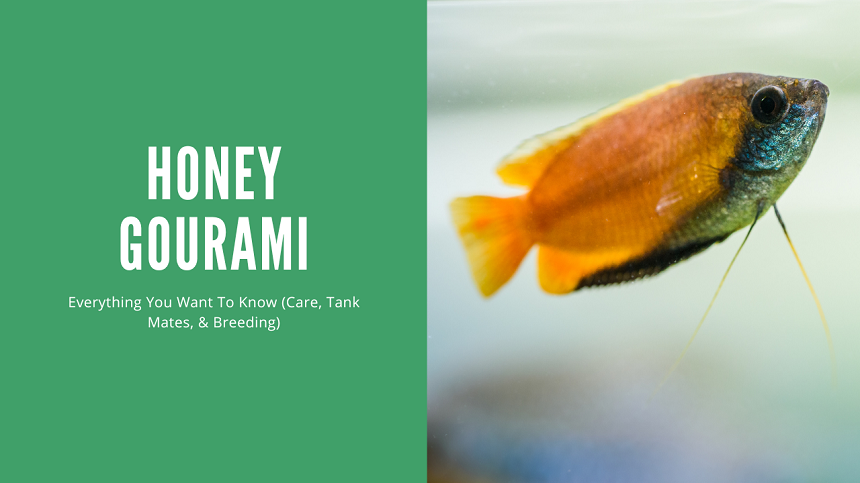
The Honey Gourami is one of the most misunderstood fish in the hobby. After 25+ years of keeping freshwater fish — including multiple gourami species — I have watched beginners buy them expecting a peaceful, easy community fish, only to deal with aggression, disease, or slow decline caused by the wrong setup. This guide covers what those care sheets miss.
Most gourami problems start with the tank, not the fish.
Gouramis live 4 to 6 years in good conditions. That means consistent water quality, proper tank mates, and an environment that lets them feel secure enough to show their natural behavior.
The right gourami in the right tank is one of the most graceful fish in freshwater. The wrong gourami in the wrong tank is a stressed, aggressive nightmare.
What Most Care Guides Get Wrong About Honey Gourami
The biggest problem with honey gouramis isn’t the fish itself. It’s misidentification at pet stores. What gets sold as a “honey gourami” is frequently a color morph of the dwarf gourami, not Trichogaster chuna at all. Real honey gouramis have a more subtle, golden-amber coloration that’s distinctly different from the bright red-orange “sunset” varieties that are actually dwarf gourami hybrids. I’ve seen this mix-up at every major chain store I’ve visited. The other myth is that they’re shy, boring fish. In a properly set up tank with floating plants and dim lighting, honey gouramis are active, curious, and surprisingly bold.
The Reality of Keeping Honey Gourami
Disease susceptibility is a real issue with commercially bred stock. Dwarf gouramis in particular carry Iridovirus at alarming rates. Even honey gouramis from mass-production facilities arrive stressed and immune-compromised. Buying from a reputable source matters more with gouramis than with almost any other community fish.
Males get territorial. The “peaceful community fish” label on gouramis is misleading. Male gouramis of most species will harass other males, especially in tanks under 30 gallons. One male per tank is the safest approach for most setups.
Surface access is non-negotiable. Gouramis are labyrinth fish. They breathe air from the surface. Strong surface agitation or tall tanks with limited surface area stress them out. Leave the top of the tank calm with floating plants for cover.
Biggest Mistake New Owners Make
Keeping multiple male gouramis in the same tank. One dominant male will relentlessly chase and stress the others. In a community setup, stick with one male and two or three females at most.
Expert Take
I always tell new gourami keepers the same thing. Buy from a breeder, not a chain store. The quality difference in health and coloration is worth the extra cost every single time. Of all the gourami species I’ve kept — pearl, dwarf, three-spot — honey gouramis are the most reliably peaceful and the hardiest. They don’t have the iridovirus susceptibility issues that plague dwarf gouramis from most importers, and they genuinely get along in a community tank without drama. If you’re new to gouramis, start here.
Table of Contents
- An Overview of Honey Gourami
- Classification
- What is Honey Gourami?
- Origin and Habitat
- Appearance
- The Difference Between with a Dwarf Gourami
- Lifespan
- Average Size
- Care
- Common Health Problems
- FAQs
- Closing Thoughts
- The Reality of Keeping Honey Gourami
- What It Is Actually Like Living With Honey Gourami
Don’t worry! Honey Gourami got you covered. It is a freshwater fish species that allows you to diversify your attention. Because they do well with a number of fish, you can easily monitor them and their tank mates.
An Overview of Honey Gourami
| Scientific Name | Trichogaster chuna |
| Common Names | Sunset Honey Gourami, Red Flame Gourami, Red Honey Gourami, Honey Dwarf Gourami, Sunset Gourami |
| Family | Osphronemidae |
| Origin | India, Bangladesh, Nepal |
| Diet | Omnivore |
| Care Level | Easy |
| Activity | Active |
| Lifespan | 5 to 8 years |
| Temperament | Peaceful |
| Tank Level | Middle to Top |
| Minimum Tank Size | 10 gallons |
| Temperature Range | 74° F to 82° F |
| Water Hardness | 4 to 15 KH |
| pH Range | 6 to 8 |
| Filtration/Water Flow | Low to moderate |
| Water Type | Freshwater |
| Breeding | Egg layer |
| Difficulty to Breed | Easy |
| Compatibility | Community tanks |
| OK, for Planted Tanks? | Yes |
What is Honey Gourami?
Honey Gourami, scientifically identified as Trichogaster chuna, is part of the Osphronemidae family from order Anabantiformes.
They are tropical fish known for their deferential behavior, colorful body, and labyrinth organ. This organ helps them breathe dry air and survive in areas where the water is low oxygenated. In aquarium trades or even in the wild, coming across a fish like Honey Gourami is pretty rare.
They enjoy freshwaters and prefer sticking to the middle to upper levels of water. Blending in with other fish species isn’t their thing, they like being solo. They accumulate themselves once they feel nothing would threaten their peace and freedom of swimming around.
Origin and Habitat
They originate from the regions of India, Bangladesh, and Nepal. They were first sighted in 1822 by Francis Buchanan, also known as Francis Hamilton.
The male and female Honey Gourami were mistaken for two different species initially. But with study and close inspection, Francis Buchanan identified them as male and female fish from the same species.
In their natural habitats, you can find thick vegetation throughout and poor water quality. They are naturally intimate with slow-moving water with moderate pH levels and warm water temperatures.
Appearance
Due to some similarities between a Dwarf Gourami and a Honey Gourami, they are often confused. Before planning to buy your intended fish, it is better to understand their appearance differences.
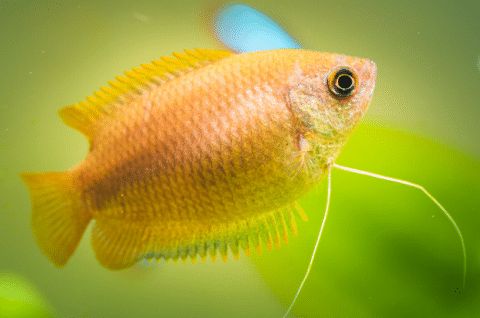
A Honey Gourami features golden-yellow, clay-orange, red, and honey shades. Some of them look silver, gray, and brown, which are mostly female Honey Gouramis. There’s a cool brown-colored band starting from around the eyes and ending at the caudal peduncle.
A Honey Gourami is small, reaching up to only 2.5 inches. While most of them are this size, a few of them were recorded stretching themselves up to 3 inches.
They have 7 fins on them, including a pair of small pectoral fins, a dorsal and anal fin, and a caudal fin. You can also see thread-like pelvic fins attached right below their bodies.
The dorsal fin begins from around the forehead, running down towards the caudal fin. Then there is the anal fin that travels side by side with the dorsal fin on the ventral area. Honey Gouramis have tiny pectoral fins attached to their bodies, with a beautiful and long threadlike fin right below that.
The simplest way to tell apart the difference between the male Honey Gourami and the female Honey Gourami is by looking at their coloration, fins, and sizes.
As with most fish species, the males display brighter shades than the females. The females have silver-colored bodies to pale yellow body coloration. The males, however, are bright yellow or orange.
Almost all males change their color to a brighter shade as growing up or during breeding. Whereas in females, you don’t see any color alterations as compared to males. Apart from this, males have prominent fins, while females get rounded anal and dorsal fins. And the males are also slightly bigger than the females.
But both sexes appear thin from the sides and look large from the middle of their bodies. Also, they have white abdomens, which turn dark in and around the breeding season.
The Difference Between with a Dwarf Gourami
Want a peaceful labyrinth fish for a community tank? Get a honey gourami. Want more color and size? Get a pearl gourami. Avoid dwarf gouramis from chain stores unless you are willing to gamble on Iridovirus.
Because of bad identification, you can often find a Dwarf Gourami labeled and sold as a Honey Gourami in fish stores. Though there are a few similarities between them, one can easily tell them apart.
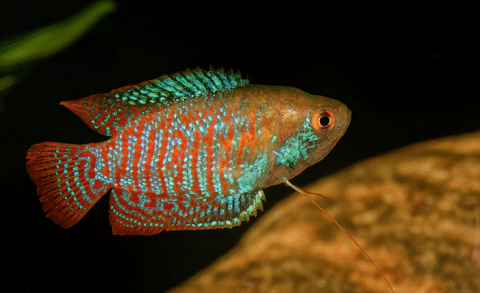
Honey Gouramis have narrow bodies and they have smaller dorsal and anal fins. A Dwarf Gourami is 4 inches on average, while Honey Gouramis are only 2 inches, making them the smallest fish of their group.
Another major difference is their body coloring. A Honey Gourami looks solid yellow, orange, red, or honey-colored. And a Dwarf Gourami looks red or blue and is paler. Other than that, Honey Gouramis have eyes closer to their mouths and Dwarf Gouramis don’t.
Lifespan
A Honey Gourami lives up to 8 years in captivity. In the wild, due to various reasons, they can’t keep predators and health problems at bay. And this results in shortened lifespans.
To improve the overall quality of life, gauging the right water parameters, as well as preventing them from taking stress, is important.
They thrive in freshwater with a temperature ranging from 74 to 82 F. But, there’s more to their basic requirements that we will discuss in more depth.
Average Size
The Honey Gourami is the shortest member of its family. Their maximum size is only 2.5 inches and, in some rare cases, 3 inches.
Like other freshwater fish, they take almost 2 years to reach their full size. The males are slightly larger than females – almost about an inch.
Care
As a novice, the hardest part is to go make water conditions ideal, the aquarium setup, dietary requirements, and finding compatible tank mates for the fish. Any shortcoming in fulfilling any of this is dangerous for your fish.
Aside from giving a spectrum touch to your aquariums, a Honey Gourami can also withstand slight water condition changes. So instead of fussing over intricate details, you can actually think about starting your journey right away.
In your aquarium, you can replicate natural conditions and provide your Honey Gourami with a solid home. They thrive in warm water temperatures, ranging from 74° F to 82° F.
Because this hardy fish moves in groups, a larger aquarium is necessary for this active fish. Honey Gouramis are familiar with living around thick vegetation, so introduce thick plants to your tank.
Since Honey Gourami appreciates social gatherings and hardly shows any aggression, handling it becomes completely trouble-free for beginners. But, under certain circumstances, the male Honey Gourami is likely to become aggressive to its tank mates and females around.
Unlike other more sensitive freshwater fish, they are not susceptible to serious diseases. But neglect in managing them properly is dangerous. Here are some essential things to consider before housing a Honey Gourami.
Aquarium Setup
The fish Honey Gourami hails from South Asia where the water be slow-moving and warm.
In South Asia, specifically in India, Bangladesh, and Nepal, they inhabit rivers, lakes, and ditches and can also be found throughout flooded areas.
The waters of these fields are slightly acidic and moderate to high in hardness. Also, there are thick plants that work to provide them with shade and hiding spots.
Honey Gouramis flourish in a stress-free environment. So, try to mimic their natural habitat as closely as possible to stem the flow of anxiety.
Gouramis do their best solo or in pairs. If you pair them, make sure you give than a larger tank to curb aggression.
Because Honey Gouramis are active and prefer spending their time exploring their surroundings, jumping out of the aquarium is likely. To ensure their safety, keep a tight lid on the tank.
Tank Size
Since they are quite small, you don’t need to arrange enormous tanks for them. However, they are social fish and do not enjoy living alone. If you want to house only a pair of them, then a 15-gallon tank is ideal. But if want a group of 6 Honey Gouramis living together, go for a 30-gallon tank.
Water Parameters
Their ability to put up with subtle water changes is worth mentioning. But, they do need properly measured water parameters to thrive. Remember that they come from South India where the streams, rivers, and pond waters are warm.
While going over the water conditions, do not heat up the aquarium too much. It should be above 74° F and below 82° F, with water hardness between 4 to 15 KH. The pH levels should be around 6.0 to 8.0. And that’s ideal for them. Make sure ammonia and nitrite levels stay at 0. Keep your nitrates reasonable with under 30PPM being ideal.
Filtration/Aeration
Another key factor that leads up to the overall health maintenance of your Honey Gourami is filtration. Since the fish is small, it doesn’t produce a lot of waste. However, in groups and in planted tanks, there is more waste production to consider that would make a higher quality filter more appropriate.
I recommend using a strong filtration system to keep the water quality up to the mark. You can use a sponge filter or a hang-on-back filter to strain the water thoroughly. Also, regular weekly water changes ( 20-50% depending on the bio-load) will keep your aquarium in a healthy condition.

The Best Aquarium Power Filter
The worlds best selling and most reliable power filter on the market. Unchanged for years because it’s so reliable and versatile
Honey Gouramis can’t withstand strong water currents. So, make sure any filtration system that you are using doesn’t disturb the water flow.
Lighting
You don’t need any artificial lighting for your Honey Gourami. A moderate amount of natural lighting is enough for the fish and plants.
But to keep a check on their day-to-day activity, you can use Led lights that are not too bright. Bright lights can disturb them and force them to hide in caves or under thick aquarium plants.
Aquatic Plants and Decoration
With staying mostly on the top areas of tanks, a Honey Gourami hardly travels down to the bottom. Therefore, live floating plants are ideal for them.
In the wild, a Honey Gourami uses thick leafy plants as a shelter. And since you want to make them feel at home, I recommend considering live aquarium plants for their tanks.
Unlike other fish species, you will never see your Honey Gourami attacking a plant. They might nip at the plants, but only because of curiosity.
They need plants to use as a hideout. Also, they build their bubble nests into plants, so make sure they have a good amount of floating plants in the tank.
Even though a Honey Gourami uses its labyrinth organ to breathe air if there is not enough of oxygen, other fish prone to low oxygen levels can’t do that.
Apart from filtering their water using strong filtering systems, live plants can help filter our excess nutrients like nitrates from their tanks.
In their natural habitat, Honey Gouramis travel to the surface areas of water to draw breath. While setting up their tank, don’t cover the surface completely with plants.
Some great recommendations for underwater and floating plants are:
Pro Tip: Avoid using too many plants and manufactured caves. This will result in preventing you from keeping a check on them.
Tank Maintenance
Cleaning the tank of your honey Gourami is totally hassle-free. These small fish feature so many irresistible characteristics that make you fall in love with them.
Because the fish prefers to live in a thickly planted aquarium in groups, cleaning their tank is more than necessary. Here are some simple steps to get you started.
How to clean the tank?
- Start off with cleaning the walls with an algae scrapper.
- Trim the plants occasionally and take out the clippings.
- Clean decor and plants with a soft toothbrush.
- Skim surface of the substrate if sand is used and gravel vac if gravel is used. Avoid uprooting plants
Pro Tip: During the breeding season, make sure you don't damage your Honey Gourami's bubble nest while cleaning the plants.
Substrate
Creating a substrate that mimics their natural environment is as essential as other things. While they adhere to the middle and surface levels, you still need a good substrate for this labyrinth fish.
Layer the base of the tank using fine grains of the substrate. You can use both sand and gravel to create the base. In the wild, you can find plenty of rocks, plants, and driftwoods. Keep that in mind while creating their substrate.
Keep the substrate at least 2 inches deep. And make sure underwater plants or decorative items are firmly fixed on it.
Pro tip: A dirty substrate can make the aquarium cloudy. So, clean it beforehand to avoid any issues.
Is the Honey Gourami Right for You?
Before you commit to this species, here’s an honest assessment of whether it fits your setup and experience level.
- One of the best gouramis for beginners. Hardy, peaceful, and forgiving of minor water quality issues. Everything a first gourami should be.
- Perfect for 20-gallon planted community tanks. They shine in smaller setups where larger gouramis would feel cramped.
- Great alternative to dwarf gouramis. You get similar personality and beauty without the iridovirus risk that plagues dwarf gouramis.
- Not ideal if you want a bold, flashy centerpiece. Their beauty is subtle and they is overshadowed by more colorful tank mates.
- Requires floating plants for confidence. Without surface cover, they will hide and never show their best colors or behavior.
- Is kept in small groups. Unlike dwarf gouramis, you can keep a male with 2-3 females for more natural and interesting behavior.
Community Tank Mates
Honey Gouramis are shy and need considerable time to blend in with their tank mates. They are peaceful fish and can easily get along with a good range of fish species.
But since they are reserved, pay great attention to the species you will house them with. Their ideal tank mates should not be fin nippers. Also, they are quite small, so choose a fish that can can’t fit them in their mouths.
They are social and humble but can act aggressively, especially males. If the amount of food that you are putting in isn’t enough, you will see the males hostile towards their mates. So it is good to focus on these areas.
Here’s a list of some great tank mates for your Honey Gourami.
- Rosy Barb
- Dwarf Barb
- Cherry Barb
- Sparkling Gourami
- Cory Catfish
- Zebra Danio
- Celestial Pearl Danio
- Kuhli Loach
- Oto Catfish
- Ember Tetra
- Rabbit Snail
- Mystery Snail
Poor Tank Mates
As much as they are good at grouping up with different fish, they are small and thus an easy target for these fish species.
One rule I never break: don’t mix gourami species. Honey gouramis, dwarf gouramis, pearl gouramis — keeping two species together almost always ends in stress or aggression. They recognize each other as competitors and the territorial behavior that emerges is subtle but persistent. Stick to one gourami species per tank.
Breeding
Breeding Honey Gouramis is pretty simple and intriguing. In this guide up till now, I have walked you through their origin to their aquarium setup. And now comes the most important part.
Unlike the complex details of Betta fish breeding, the breeding requirements of the Honey Gourami are fairly simple for a beginner. Honey Gouramis are sexually dimorphic, which means there are visible differences between a male and a female. Here is a video above by Todor Vankov that shows the cycle.
But before we get started, make sure males and females are equal in amount. If there are too many males, they will start fighting one another to win over the limited females.
Purchase a separate breeding tank for them. A 10-gallon water tank is ideal. While setting up their breeding tank, keep the water 6 to 7 inches high.
Then, heat up the water up to 84° F. You can either use a heater for that or go for a towel to cover the surface. Keep the acidic level at 7.0 with the water hardness around 8 KH.
Apart from gauging the water conditions, feed them a good-round diet.
Also, introduce thick vegetation to the breeding tank throughout. Males will use them to build a bubble nest.
Before spawning, the males become more vibrant and develop a deep black or light brown stripe. The stripe is apparent from their heads to the end. You can also see its throat turning deep blue, which is a clear spawning indication.
Before approaching a female, the male will build a bubble nest. Once the fish is done, it will start swimming around the female until she is convinced to follow him to the bubble nest.
At the time of spawning, the male will hold the female to prompt spawning. Once the female swells with eggs, it will start laying eggs in water. The male will instantly catch the eggs with his mouth to lay in the bubble nest.
After they are done spawning, separate the female. Even though Honey Gouramis are not aggressive fish, males will show hostility towards the mothers. They are possessive and don’t appreciate anyone around the eggs.
Female Honey Gourami can lay up to 300 eggs in different spawning rounds. The male monitors them and fertilizes the honey gourami eggs, which takes 2 to 4 days.
The fry will start swimming after 2-3 days and it is good to remove the male at this point. Because the babies are puny, they need to be looked after properly. Once the larvae is hatched, they will use their yolk sacs for a couple of days.
Start feeding them infusoria and liquid fry food after a week or two. Once they are bigger and stronger, give them access to baby brine shrimps.
If you want to ensure a solid growth of the labyrinth organ, I recommend covering the aquarium surface with plastic wrap. This will increase humidity, leading to proper labyrinth organ growth in babies.
Food and Diet
In the wild, they are fed on a variety of diets. Even though they are omnivorous fish, you can call them carnivorous fish, too. Because they can consume both plants and protein-filled foods.
My food recommendations: After keeping honey gouramis for years, the two foods I reach for consistently are Fluval Bug Bites (the small granule version) and frozen bloodworms. Bug Bites are ideal for daily feeding — the insect protein matches what they’d eat naturally, and the small pellet size is right for their mouths. Frozen bloodworms once or twice a week keep them in peak color and condition. Skip the generic flake food if you can — it works, but these fish visibly respond better to protein-forward options.
Honey Gouramis love to see variations in their diet. So, making them happy while keeping honey gouramis healthy at the same time holds great value.
To boost their longevity, give them a mixed diet of vegetables and meat. Some great recommendations for vegetables are vegetable tablets, plant material, lettuce, and cucumber. While trimming the plants, you can offer them that, too. This will help you prevent them from attacking the plants.
But meaty foods remain the core diet, so don’t skip that. You can give them bloodworms, white worms, mosquito larvae, flakes, pellets, and brine shrimp. Fluval bug bites are a great staple and will enhance their color.
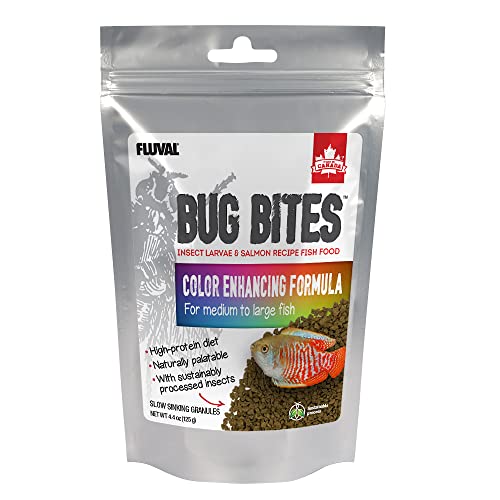
Fluval bug bites tropical fish is an excellent staple food for most tropical fish. Made of black solider fly larvae
While baby brine shrimp is the primary source of protein for baby honey gouramis, you can you large brine shrimps for adults.
As compared to other fish, they are shy. Other fish who are fed on the same diet can easily eat off their share, leaving them starving. While feeding the fish separately is almost impossible, you can make changes to their timings.
Lastly, feed them twice or thrice a day, and notice that they finish the food odd within 3 minutes.
Common Health Problems
They can withstand environmental changes, but their labyrinth organ is sensitive to drastic temperature shifts.
An unclean water tank can lead to a bacterial infection called fin rot. There are other diseases too that they are prone to. To keep these ailments at bay, keep the tank clean and manage the diet as recommended.
Fin Rot
They are susceptible to fin rot, a common disease caused by unclean water.
The symptoms are:
- Black, while or brown spots on fins or other body parts.
- Inflammed skin
- Lethargy
- Loss of appetite
Ich
This is a common fish disease. Honey Gouramis are resilient, but other fish suffering from ich can easily affect them.
The symptoms are:
- White spots on the body
- Scraping the body against the aquarium surface
Velvet Disease
Velvet disease primarily occurs due to the presence of parasitic dinoflagellates.
The symptoms are:
- Scratching against rough objects or surfaces
- Loss of appetite
- Loss of color
- Clamped fins
These ailments is avoided if you maintain water quality and keep overall health preservation. Velvet spreads rapidly and, in case your honey gourami is affected, isolate it from other fish.
What It Is Actually Like Living With Honey Gourami
Gouramis move slowly and deliberately through the tank, using their modified pelvic fins to “feel” their surroundings. Watching them gently tap plants, substrate, and decorations with those threadlike feelers is genuinely mesmerizing.
Males display regularly, spreading their fins and deepening their colors. In good conditions, this happens daily and is one of the most visually striking behaviors in freshwater fishkeeping.
Gouramis surface breathe. You will see them rise to the top and gulp air several times an hour. This is normal labyrinth organ function, not a sign of low oxygen.
In a well-planted tank, gouramis are surprisingly curious. They investigate new decorations, follow your finger along the glass, and react to activity outside the tank.
FAQs
Are they fin nippers?
No. Honey Gouramis are not fin nippers. Actually, they are vulnerable to get their fins nipped if you house them with barbs or neon tetras.
Can they live with Dwarf gourami?
Dwarf Gourami and Honey Gourami do well together. But Honey Gouramis are small as compared to Dwarf Gouramis, so it is better to house the latter with their same species.
How many should be kept together?
Honey Gouramis is kept in groups and solo. They are one of the most peaceful Gourami breeds.
Can they live in a 5-gallon tank?
The minimum water requirement of a honey Gourami is 10 gallons. A 5-gallon tank is too small to allow it to enjoy free swimming. Besides, Honey Gouramis don’t lead a solitary life, and keeping them in this small tank is impossible.
Are Honey Gouramis Dwarfs?
Because of their small size, they are often referred to as dwarf gourami. And because of this, people often confuse them with their cousin, which is Dwarf Gourami.
Are they peaceful?
They are very peaceful fish that do well with a number of fish species. As a beginner, this gives you excellent motivation to start your fish-keeping journey with them.
How the Honey Gourami Compares to Similar Species
Want a peaceful labyrinth fish for a community tank? Get a honey gourami. Want more color and size? Get a pearl gourami. Avoid dwarf gouramis from chain stores unless you are willing to gamble on Iridovirus.
The obvious comparison is the dwarf gourami, and I’ll be blunt: for most keepers, the honey gourami is the better fish. Dwarf gouramis are flashier, no question. A fully colored male dwarf gourami is one of the most striking small fish in the hobby. But the prevalence of Dwarf Gourami Iridovirus (DGIV) in commercial stock makes them a gamble. Honey gouramis don’t carry this disease, they’re hardier overall, and they live just as long when properly cared for. The only real advantage of the dwarf gourami is raw color intensity.
The sparkling gourami is worth considering if you have a nano tank setup. Sparklers are tiny (under 1.5 inches) and make audible croaking sounds, which is genuinely delightful. They’re more sensitive than honey gouramis and need very calm tank mates, but in a dedicated nano setup they’re fantastic. Honey gouramis are the more versatile choice for general community tanks, while sparkling gouramis are specialists for smaller, quieter setups.
ASD Keeper’s Rating: Honey Gourami
After keeping Honey Gouramis alongside Dwarf Gouramis and other labyrinth fish for years, here’s how I score them on dimensions that actually matter to hobbyists:
Difficulty: 4/10 (very manageable) | Aggression: 2/10 (genuinely peaceful) | Hardiness vs Dwarf Gourami: Significantly hardier — far less prone to DGD (Dwarf Gourami Disease) | Community-Safe: ✅ Yes | Beginner-Friendly: 8/10 | Color Display: 7/10 (males in breeding color are stunning, but subtler than Dwarfs) | ASD Overall: 8.2/10
ASD take: For most hobbyists — especially those who’ve been burned by sick Dwarf Gouramis — the Honey Gourami is the better long-term choice. Lower disease risk, genuinely peaceful temperament, and easier to keep make it one of my go-to recommendations for community tanks.
Closing Thoughts
If you’re looking for a peaceful, colorful fish to add to your community tank or planted aquarium, the honey gourami is perfect for you. These little guys are social and get along well with other fish, making them an ideal choice for those who want a lively tank without any drama. Have you kept honey gouramis before? Let us know your experience in the comments!
- About the Author
- Latest Posts

I’m Mark Valderrama, founder of Aquarium Store Depot and a fishkeeper with over 25 years of hands-on experience. I started in the hobby at age 11, worked at local fish stores, and have kept freshwater tanks, ponds, and reef tanks ever since. I’ve been featured in two best-selling aquarium books on Amazon and built this site to share practical, experience-based fish keeping knowledge.

Leave a Reply to Mark Valderrama Cancel reply