
Last Updated: June 25, 2026
Thank you for visiting! By the way… any links on this page that lead to products on Amazon and other stores/partners are affiliate links Aquarium Store Depot earns a commission if you make a purchase.
Table of Contents
- Key Takeaways
- Species Overview
- Classification
- Origin & Natural Habitat
- Appearance & Identification
- Average Size & Lifespan
- Care Guide
- Tank Mates
- Food & Diet
- Breeding & Reproduction
- Reality of Keeping
- What People Get Wrong
- Maingano vs. Similar Species
- Should You Get This Fish?
- Common Health Issues
- Common Mistakes to Avoid
- Where to Buy
- FAQ
- Closing Thoughts
The Maingano Cichlid is the fish that converts community hobbyists into mbuna keepers. That deep navy body with electric blue horizontal stripes is unlike anything you’ll find in a South American or Southeast Asian tank ” and once you’ve seen a dominant male in full display, it’s hard to go back. Melanochromis cyaneorhabdos is endemic to a single island in Lake Malawi, listed as Critically Endangered in the wild, and yet thriving in the hobby through captive breeding. That combination of striking looks, manageable temperament, and genuine conservation significance makes the Maingano one of the most compelling entry points into African cichlids.
But “manageable” does not mean easy, and it definitely does not mean peaceful. This is still an mbuna ” territorial, aggressive toward its own kind, and completely unforgiving of bad stocking decisions.
The entire Maingano care guide can be summarized in one rule: one male per tank. Everything else is details.
One important note: despite its wild beauty, this species is listed as Critically Endangered on the IUCN Red List. Captive-bred specimens are what you’ll find in the hobby, and keeping them successfully helps maintain healthy captive populations of this increasingly rare fish.
Hard Rule: One male per tank. Not one male per species — one male, period, unless your tank is 125+ gallons with heavy rockwork and you’re prepared to intervene when it goes sideways. In a standard 55- or 75-gallon mbuna setup, a second male is not a calculated risk — it’s a ticking clock.
ASD Difficulty Rating: Intermediate | 5/10
Maingano are not a beginner fish, but they’re far more manageable than most mbuna once you understand the fundamentals. The learning curve is: Lake Malawi water chemistry (non-negotiable), aggression management through proper stocking ratios, and a strictly plant-based diet. Master those three and Maingano are surprisingly hardy and easy to keep long-term.
Key Takeaways
- Striking blue-on-blue coloration ” Dark blue body with lighter blue horizontal stripes; both sexes display similar colors
- Moderately aggressive ” Less aggressive than many mbuna species but still territorial, especially males
- Small footprint ” Reaches only 3″4 inches (7.6″10 cm), making them suitable for 55-gallon tanks
- Critically Endangered in the wild ” IUCN Red List status makes captive breeding important for species conservation
- Omnivore with herbivore leanings ” Plant-based diet should make up the majority of their food
- Easy to breed ” Maternal mouthbrooder; one of the easier mbuna species to spawn in captivity
- One male rule is non-negotiable ” Multiple males in most tank sizes results in sustained aggression and injury
Species Overview
| Common Name | Maingano Cichlid |
| Scientific Name | Melanochromis cyaneorhabdos |
| Care Level | Intermediate |
| Temperament | Moderately Aggressive |
| Max Size | 3″4 inches (7.6″10 cm) |
| Min Tank Size | 55 gallons (208 liters) |
| Diet | Omnivore (primarily herbivorous) |
| Lifespan | 5″8 years |
| Water Temp | 76″82°F (24″28°C) |
| pH | 7.8″8.6 |
| Origin | Likoma Island, Lake Malawi, Africa |
| Conservation Status | Critically Endangered (IUCN) |
Classification
| Kingdom | Animalia |
| Phylum | Chordata |
| Class | Actinopterygii |
| Order | Cichliformes |
| Family | Cichlidae |
| Genus | Melanochromis |
| Species | M. cyaneorhabdos Bowers & Stauffer, 1997 |
Origin & Natural Habitat
The Maingano Cichlid is endemic to Lake Malawi in East Africa, specifically found around Likoma Island in the eastern portion of the lake. Their natural range is extremely limited ” we’re talking about one island ” which is precisely why they’re Critically Endangered in the wild. In the wild, they’re part of the mbuna group, rock-dwelling cichlids that spend their entire lives among the boulder-strewn shoreline.
In their natural habitat, Maingano live among rocky reefs at relatively shallow depths, typically between 3 and 30 feet (1″10 meters). They graze on aufwuchs ” the biofilm of algae, tiny invertebrates, and microorganisms that covers the rocky surfaces. The clear, warm, alkaline waters of Lake Malawi provide an incredibly stable environment with very little seasonal variation in temperature or water chemistry. That stability is why they react badly to swings in the aquarium ” they’ve never evolved to handle it.
The name “Maingano” comes from a specific collection point on Likoma Island where the species was originally found and described in 1997 by Bowers and Stauffer.
Appearance & Identification
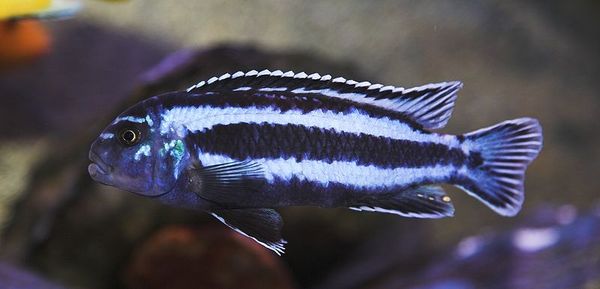
The Maingano’s coloration is what makes it such a standout aquarium fish. The body is a deep, saturated dark blue ” almost navy ” with two vivid lighter blue horizontal stripes running from behind the eye to the base of the tail. The fins share the dark blue base color, often with lighter blue edging. Under quality LED lighting, the contrast between the two blues is genuinely electric. There’s nothing subtle about this fish.
People sometimes confuse Maingano with Johanni Cichlids (Melanochromis johannii), which is understandable since they’re in the same genus. The key difference: the Maingano’s horizontal stripes are light blue, while the Johanni male shows yellow-gold stripes on a dark body ” and the female Johanni is a completely different color (bright orange-yellow). The Maingano also stays smaller and has a more uniformly blue appearance throughout its life, in both sexes.
Male vs. Female
Sexing Maingano is genuinely difficult ” this is one of those species where you really have to look closely. Unlike many cichlids with dramatic sexual dimorphism, both males and females are blue on blue. The differences are subtle and become more reliable as fish mature.
| Feature | Male | Female |
|---|---|---|
| Color Intensity | Deeper, more vivid blue | Slightly lighter blue overall |
| Belly Color | Same dark blue as body | Lighter blue belly |
| Egg Spots | More prominent on anal fin | Fewer or smaller egg spots |
| Size | Slightly larger, up to 4 inches (10 cm) | Slightly smaller, around 3 inches (7.6 cm) |
| Behavior | More territorial and aggressive | More social, less confrontational |
Average Size & Lifespan
Maingano Cichlids are a compact mbuna species, typically reaching 3″4 inches (7.6″10 cm) in aquarium conditions. Males are generally the larger sex at around 4 inches (10 cm), while females usually top out around 3 inches (7.6 cm). That small size is part of their appeal ” they deliver full mbuna personality in a package that works in a 55-gallon.
A well-cared-for Maingano lives 5″8 years in captivity. Reaching the upper end of that range requires consistent water quality, a proper diet, and a stress-free environment. Chronic aggression stress ” usually from bad stocking ratios ” shortens that lifespan significantly. Good genetics and healthy stock at purchase also matter, which is why sourcing from reputable breeders is worth the effort.
Care Guide
Tank Size
A 55-gallon (208-liter) tank is the minimum for a small group of Maingano. I’d recommend 75 gallons (284 liters) if your budget and space allow, especially if you’re planning a mixed mbuna community. These fish are active swimmers and use the full length of the tank. A tank that’s at least 4 feet (120 cm) long is essential ” horizontal space matters more than height for mbuna. A tall 55-gallon gives you less usable territory than a longer 55-gallon. If you’re choosing between the two, always go longer.
Water Parameters
| Temperature | 76″82°F (24″28°C) |
| pH | 7.8″8.6 |
| General Hardness (dGH) | 10″20 dGH |
| Carbonate Hardness (dKH) | 10″15 dKH |
| Ammonia | 0 ppm |
| Nitrite | 0 ppm |
| Nitrate | <20 ppm |
Stability matters more than hitting exact numbers. Lake Malawi is one of the most chemically consistent large bodies of water on earth ” these fish evolved in a place where nothing changes. Use crushed coral or aragonite in your substrate or filter to naturally buffer pH upward if your tap water runs soft or acidic. Avoid anything in the tank (driftwood, peat, Indian almond leaves) that drops pH. Those items have no place in a Lake Malawi setup.
Filtration & Water Flow
A quality canister filter is the standard for Lake Malawi cichlid tanks. Target a filter that turns over the tank volume at least 6″8 times per hour. A powerhead provides supplemental water movement and increases dissolved oxygen ” both important for replicating the well-oxygenated conditions of Lake Malawi’s open rocky shoreline.
Weekly water changes of 25″30% are the baseline. In a heavily stocked mbuna tank ” which is actually a legitimate aggression management strategy ” bump that up to twice weekly. Mbuna produce substantial waste, and nitrates climb faster than most people expect.
Lighting
Moderate lighting works well for Maingano. They originate from well-lit shallow waters, so they’re comfortable under standard aquarium LED fixtures. A photoperiod of 8″10 hours daily keeps things natural. Good lighting also brings out the true depth of the blue coloration ” a dark, dim tank makes these fish look flat. Put them under decent LEDs and the blue-on-blue pattern really opens up.
Plants & Decorations
Rockwork is the entire point of the décor. Build stacked rock formations that create caves, tunnels, and crevices ” each fish needs its own territory and an escape route. Use limestone, ocean rock, or lava rock to build structures from the substrate toward the water surface. The more visual barriers and distinct territories you create, the less sustained chasing you’ll see. A flat, open tank with a few scattered rocks is a recipe for a problem. Stack it up.
Hardy plants like Anubias and Java Fern attached to rocks can work in a Maingano tank, but most mbuna will eventually damage or uproot rooted plants. Vallisneria sometimes survives due to its tough leaves and rapid growth. Don’t plan your aquascape around plants holding up ” plan it around the rock structures, and treat any surviving plants as a bonus.
Substrate
Fine sand is ideal ” pool filter sand, play sand, or aragonite sand all work. Aragonite and crushed coral naturally buffer your water to the high pH that Lake Malawi cichlids need. Maingano sift through sand as part of their natural foraging behavior, so sand also provides behavioral enrichment. Avoid gravel ” it traps waste, is harder to clean, and provides no buffering benefit.
Tank Mates
Best Tank Mates
Maingano can coexist with other mbuna of similar size and temperament, as long as you choose species with distinctly different color patterns. The principle is simple: the more a tank mate looks like another Maingano, the more aggression it will absorb. Go for contrast. Good options include:
- Yellow Lab (Labidochromis caeruleus) ” Contrasting yellow color, relatively peaceful, the classic mbuna community companion
- Red Zebra (Metriaclima estherae) ” Bold orange-red color, holds its own without being a bully
- Rusty Cichlid (Iodotropheus sprengerae) ” Peaceful mbuna, won’t compete hard for territories, brown-purple coloration stands out clearly
- Acei Cichlid (Pseudotropheus acei) ” Uses the upper water column, occupies a different niche
- Synodontis catfish ” Great bottom-dwelling cleanup crew; the Synodontis petricola or multipunctatus are natural Lake Malawi/Tanganyika tank mates
Tank Mates to Avoid
- Johanni Cichlid (Melanochromis johannii) ” Same genus, similar enough in appearance to trigger sustained aggression, hybridization risk is real
- Auratus (Melanochromis auratus) ” Same genus, hybridization risk, and Auratus are significantly more aggressive than Maingano
- Demasoni (Pseudotropheus demasoni) ” Blue coloration overlap triggers territorial aggression
- Peacock cichlids (Aulonocara spp.) ” Too docile for a mbuna tank; they’ll be bullied relentlessly
- Any long-finned or slow-moving fish ” Fins will be nipped; slow fish will be harassed
- Haplochromis species ” Generally too docile for the aggression level of a mbuna community
Food & Diet
Maingano are omnivores that need a primarily plant-based diet. In the wild, they graze on aufwuchs and algae almost exclusively ” that’s what their digestive system is built around. Spirulina-based flakes or pellets form the core of their diet in captivity. A quality African cichlid pellet works great as a daily staple.
Supplement with blanched vegetables ” lettuce, peas, cucumber slices, and zucchini are all good choices. Occasional protein treats like brine shrimp or daphnia are fine once or twice a week. Don’t overdo it. Avoid bloodworms and beef heart ” these high-protein foods can trigger Malawi Bloat, which moves fast and can be fatal. The gut of a mbuna is not built to process the same diet as a carnivorous cichlid, and feeding them like one is a mistake I’ve seen take fish down within days.
Feed 2″3 small meals per day, offering only what the fish can consume within about 5 minutes each time. Overfeeding is one of the fastest ways to degrade water quality in a mbuna tank. These fish will act hungry constantly ” that’s not a signal to feed more, that’s just mbuna behavior.
Breeding & Reproduction
Maingano are one of the easier mbuna species to breed in captivity. They’re maternal mouthbrooders with a fascinating reproductive process ” and if you’ve set up the tank correctly, spawning tends to happen without much intervention on your part.
Spawning Behavior
The male claims a territory ” typically a flat rock or cleared area of substrate ” and displays intensely to passing females. When a female is receptive, she follows him to the spawning site. She deposits a small number of eggs, then immediately picks them up in her mouth. The male then presents his anal fin, which features egg-shaped spots called egg dummies. As the female tries to collect these false eggs, she inhales the male’s milt, fertilizing the real eggs in her mouth. It’s one of the more elegant evolutionary tricks in the fish world.
Mouthbrooding & Fry Care
The female carries the eggs for 12″14 days. She won’t eat during this period, her jaw will appear visibly swollen, and she’ll become more reclusive than usual. Once the fry are fully developed and released, they’re free-swimming immediately and large enough to accept crushed flake food and baby brine shrimp right away.
For the best fry survival rates, move the holding female to a separate tank a few days before she’s due to release. Maintain a ratio of one male to at least three females ” though four or five females per male is better, because it distributes the male’s attention and prevents any single female from being run ragged. If you buy juveniles, purchase at least six and plan to rehome extra males once they sex out.
Reality of Keeping
Here’s what life with Maingano actually looks like day to day ” because care parameters only tell you half the story.
The dominant male is the center of the tank’s social universe. He’ll spend a significant portion of his day patrolling his territory, flaring at subordinate fish, and displaying to females. That display is something ” he’ll intensify his colors, spread every fin, and circle in a way that makes him look twice his actual size. It’s one of the more impressive behavioral shows you’ll get from a fish under 4 inches (10 cm).
Feeding time is an event. The whole tank activates the moment food hits the water ” Maingano are aggressive feeders that will push smaller or more timid tank mates out of position if you’re not careful. Feed in multiple spots simultaneously, or the most dominant fish eats first and the submissive fish starve slowly. I’ve seen this mistake tank a Yellow Lab in a Maingano community over the course of a month ” the lab looked fine until it didn’t.
The tank dynamic shifts as fish settle in over the first few weeks. New Maingano are stressed and chaotic ” there’s a lot of chasing and boundary-testing while the hierarchy establishes. That’s normal. What’s not normal is sustained, one-sided aggression where one fish never escapes pursuit. If you see that after the first two weeks, your stocking ratio is off, your rockwork is insufficient, or you have a second male hiding in plain sight.
Once the hierarchy stabilizes, the tank settles into a rhythm. The male holds his territory, females move around more freely, and the low-level posturing becomes background behavior rather than a crisis. At that point, Maingano are genuinely enjoyable fish to observe ” active, colorful, behaviorally complex in a way most community fish simply are not.
Expert Take
Start with a group of 12 or more in a 55-gallon (208-liter) minimum. Use aragonite or crushed coral substrate to buffer pH naturally. Feed spirulina-based food as the staple. Stack rocks to create territories. This formula works for Maingano and most other mbuna. After 25 years in the hobby and time managing fish stores, the biggest mistake I see — beyond understocking — is people adding any blue-barred species thinking it’ll be fine. It won’t. The Maingano reads any similar coloration pattern as a rival. And if you end up with two males by accident, you’ll know within a week. One fish will disappear behind the rocks and stop eating. Don’t wait — pull the second male before it’s too late.
Mark Valderrama, AquariumStoreDepot
What People Get Wrong
The two most common misconceptions about Maingano, and both of them cause real problems:
Misconception #1: “The Maingano is peaceful enough to keep with Yellow Labs and Peacocks in a community setup.” The Yellow Lab comparison is fair ” Maingano and Yellow Labs do coexist well. But Peacocks are a different story. Peacock cichlids (Aulonocara spp.) are significantly more docile than mbuna, and putting them in a Maingano tank is setting them up to be harassed constantly. Maingano belong in mbuna communities, not mixed hap/peacock tanks.
Misconception #2: “I can keep multiple males as long as I have enough rockwork.” Rockwork helps distribute aggression, but it does not solve the male-on-male problem in a standard home aquarium. Two Maingano males in a 55- or 75-gallon will eventually come to a decisive conclusion ” and the losing male will either die from stress and injury or spend its life cowering behind a rock eating scraps. More rockwork buys you time, not a solution. The solution is one male.
Maingano vs. Similar Species
If you’re deciding between Maingano and its close relatives, here’s how to think about it:
Maingano vs. Johanni Cichlid
These two are in the same genus and are the most commonly confused mbuna at the fish store counter. The Johanni male is dark blue with yellow-gold horizontal stripes; the female is bright orange-yellow ” a completely different look. The Maingano is blue-on-blue in both sexes, which gives it a more uniform, electric appearance throughout the group. The Maingano also tends to be slightly less aggressive than the Johanni and stays a bit smaller.
Choose the Maingano if you want a uniformly blue fish where both males and females look striking together. Choose the Johanni if you want dramatic sexual dimorphism and a bolder color contrast across the group. Do not keep both species in the same tank ” they’re close enough in appearance and genetics that sustained fighting and hybridization are legitimate risks.
Maingano vs. Auratus
The Auratus (Melanochromis auratus) is the Maingano’s more aggressive cousin ” same genus, very different temperament. Auratus males are notoriously belligerent, capable of seriously injuring or killing tank mates that most other mbuna would simply posture at. The Auratus is also a hybridization risk when kept with Maingano. Aquariums that house both tend to end badly.
Choose the Maingano if you want mbuna personality without the extreme aggression ceiling. The Maingano is the right fish for someone stepping into African cichlids for the first time ” it has the temperament, the color, and the behavior without requiring you to manage a tank full of land mines. Choose the Auratus only if you’re an experienced mbuna keeper who specifically wants a more aggressive species and has the tank size and experience to manage it. Keep these two species separate ” they should never share a tank.
Should You Get This Fish?
Good Fit If:
- You have experience with community fish and are ready to step into African cichlids for the first time
- You have a 55-gallon (208-liter) or larger tank with at least 4 feet (120 cm) of horizontal space
- You’re prepared to commit to the one-male rule and source enough females to balance the group
- You want a fish with genuine personality ” territorial displays, breeding behavior, and active swimming ” rather than a passive fish that hides in plants
- You’re interested in keeping a Critically Endangered species and contributing to a healthy captive population
- You want the bold look of mbuna without the extreme aggression level of species like Auratus or Demasoni
Avoid If:
- You’re a first-time fish keeper ” get experience with community fish before jumping into mbuna
- You have a peaceful community tank with livebearers, tetras, or other soft-water fish ” Maingano are not compatible and the water chemistry requirements conflict entirely
- You want to keep a mixed hap/peacock setup ” Maingano belong in mbuna communities, not with docile Aulonocara
- You already have Johanni or Auratus in your tank ” keep these species separate to avoid fighting and hybridization
- Your tank is under 55 gallons (208 liters) ” a smaller tank simply does not provide enough territory for a proper group
- You’re not ready to commit to weekly 25″30% water changes and the maintenance demands of a mbuna tank
Common Health Issues
Malawi Bloat
The number one health concern for any mbuna keeper. Malawi Bloat is triggered by stress, poor water quality, or an improper diet ” specifically too much protein. Symptoms include abdominal swelling, loss of appetite, white stringy feces, and rapid breathing. It moves fast: a fish can go from visibly normal to critical within 24″72 hours. Treatment involves Metronidazole in a hospital tank, but prevention through proper diet and clean water is far more effective than any cure. By the time you’re treating Malawi Bloat, you’re already behind.
Ich (White Spot Disease)
Stress from transport, temperature drops, or poor water quality triggers ich in Maingano. Watch for small white specks on the body and fins. Gradually raise the temperature to 82°F (28°C) and treat with a quality ich medication. Maingano are hardy fish that generally respond well to treatment when caught early.
Bacterial Infections
Injuries from territorial disputes open the door to secondary bacterial infections when water quality slips. Cloudy eyes, fin rot, and red patches on the body are the warning signs. The fix is always the same: pristine water first, antibacterial medication second. Treating an infection in dirty water is largely pointless ” fix the root cause.
Common Mistakes to Avoid
- Keeping multiple males ” Males fight aggressively. In a standard home aquarium, a second male is not a calculated risk ” it’s a problem waiting to happen. One male, period.
- Mixing with Johanni or Auratus ” These are the biggest mistake I see with Maingano tanks. Johanni look similar enough to trigger sustained aggression, and both Johanni and Auratus carry hybridization risk. Keep Melanochromis species separate unless you know exactly what you’re doing.
- Skimping on rockwork ” Without ample hiding spots and distinct territories, aggression escalates rapidly and never settles. Build the rockwork first, then add the fish.
- Overfeeding protein ” A plant-heavy diet is essential. Too much protein leads to Malawi Bloat. Bloodworms and beef heart have no regular place in a Maingano diet.
- Insufficient water changes ” Maingano need clean water with low nitrates. Weekly 25″30% changes are the baseline, not the ceiling.
- Too small a group ” Keeping just a pair leads to the male fixating on the single female relentlessly. Start with at least 4″6 fish at a 1:3 or better male-to-female ratio.
- Buying juveniles without planning for extra males ” Sexing juveniles is unreliable. Buy more fish than you need and plan to rehome extra males when they mature. This is not optional ” it’s part of the process.
Where to Buy
Maingano Cichlids are widely available in the hobby, both at local fish stores and through online retailers. They’re one of the more affordable mbuna species, typically priced between $4″$10 per fish depending on size and source. For the healthiest stock, consider these trusted online sellers:
- Flip Aquatics ” A great source for quality African cichlids with reliable shipping
- Dan’s Fish ” Trusted retailer with a wide selection of mbuna species
Purchase a group of at least 4″6 juveniles, aiming for one male to three or more females. Since sexing juveniles is genuinely difficult with this species, buying a larger group and rehoming extra males later is the smarter play ” not just a backup plan, but the standard approach for anyone setting up a Maingano tank properly.
FAQ
Is a Maingano the same as a Johanni Cichlid?
No, though they’re commonly confused. Both are in the Melanochromis genus, but the Maingano (M. cyaneorhabdos) has light blue horizontal stripes, while the Johanni (M. johannii) male has more yellowish-gold stripes ” and the female Johanni is bright orange-yellow, a completely different fish visually. The Maingano stays smaller and tends to be less aggressive. They should never be kept together due to sustained fighting and hybridization risk.
Can I keep multiple male Maingano?
In most home aquariums, no. Males are highly territorial toward each other and will fight ” often resulting in serious injury or death for the subordinate male. In very large tanks (125+ gallons) with extensive rockwork, two males might coexist, but it’s a genuine risk and requires careful monitoring. For a standard 55- or 75-gallon mbuna setup, one male is the rule, not a recommendation.
Are Maingano good for beginners?
They’re a reasonable choice for someone new to mbuna who already has experience with community fish. Maingano are hardier and less aggressive than many mbuna species, making them more forgiving of minor mistakes than, say, Auratus or Demasoni. But if you’re completely new to fishkeeping, start with community fish first ” get comfortable with water chemistry, tank maintenance, and stocking decisions before stepping into African cichlids. Maingano are the right gateway mbuna; they’re just not a gateway fish overall.
What’s the best male-to-female ratio?
One male to 3″5 females is the target. This spreads out the male’s attention and prevents any single female from being harassed to exhaustion. If you buy juveniles, purchase at least six, expect to end up with more males than you planned for, and rehome the extras once they sex out. That’s part of the process ” not a problem, just the reality of buying unsexed juveniles.
Why is my Maingano hiding all the time?
Constant hiding is a stress signal. Common causes: being bullied by a dominant fish, poor water quality, insufficient rockwork (which paradoxically makes them more stressed, not less), or simply being new to the tank. Check your water parameters first, then evaluate the social dynamics. If one fish is being singled out by the dominant male relentlessly, you either have two males or a stocking ratio problem.
Are Maingano Critically Endangered?
Yes. Melanochromis cyaneorhabdos is listed as Critically Endangered on the IUCN Red List due to its extremely limited natural range around Likoma Island in Lake Malawi. The fish in the hobby are virtually all captive-bred ” wild collection pressure is minimal, but the species’ natural range is so small that it remains vulnerable. Keeping and breeding them responsibly helps maintain genetic diversity in captive populations and ensures the species persists regardless of what happens in the wild.
Can I keep Maingano with Peacock cichlids?
Not recommended. Peacock cichlids (Aulonocara spp.) are significantly more docile than mbuna, and in a tank with Maingano they’ll absorb a disproportionate amount of aggression. The water chemistry requirements are similar, but the temperament mismatch is a real problem. Maingano belong in mbuna-specific communities ” mix them with other mbuna of similar size and aggression level, not with the more passive haplochromis and peacock species.
Closing Thoughts
The Maingano Cichlid hits a sweet spot that very few fish occupy ” genuinely striking in a way that stands out in any aquarium, manageable enough for intermediate keepers, and small enough to work in a 55-gallon setup. Watching a dominant male in full display is one of those moments that reminds you why mbuna keepers get so obsessive about this group. There’s real personality here, real behavior, and a level of visual impact that most community fish simply can’t match.
The care fundamentals are not complicated: one male, plenty of females, serious rockwork, and a plant-heavy diet. Get those four things right and your Maingano tank will reward you with years of bold color and genuinely interesting behavior. And there’s something meaningful about keeping a fish that’s Critically Endangered in the wild ” your captive group is part of a larger story, and that’s worth taking seriously.
This is the fish that converts community hobbyists into mbuna keepers. If you’re on the fence about stepping into African cichlids, start here.
This article is part of our Lake Malawi Cichlid Species Directory: Complete A-Z Care Guide List. Visit the hub page to explore care guides for all 28 Lake Malawi cichlid species we cover.
Recommended Video
References
- Seriously Fish. (n.d.). Melanochromis cyaneorhabdos. https://www.seriouslyfish.com/species/melanochromis-cyaneorhabdos/
- FishBase. (n.d.). Melanochromis cyaneorhabdos. https://www.fishbase.se/summary/Melanochromis-cyaneorhabdos.html
- Practical Fishkeeping. (n.d.). Maingano Cichlid species profile. https://www.practicalfishkeeping.co.uk
- The Aquarium Wiki. (n.d.). Melanochromis cyaneorhabdos. https://www.theaquariumwiki.com/wiki/Melanochromis_cyaneorhabdos
- Bowers, N.J. & Stauffer, J.R. Jr. (1997). New species of rock-dwelling cichlid (Pisces: Cichlidae) from Lake Malawi, Africa. Copeia, 1997(3), 572″578.
- About the Author
- Latest Posts

I’m Mark Valderrama, founder of Aquarium Store Depot and a fishkeeper with over 25 years of hands-on experience. I started in the hobby at age 11, worked at local fish stores, and have kept freshwater tanks, ponds, and reef tanks ever since. I’ve been featured in two best-selling aquarium books on Amazon and built this site to share practical, experience-based fish keeping knowledge.
Leave a Reply