
Last Updated: June 25, 2026
Thank you for visiting! By the way… any links on this page that lead to products on Amazon and other stores/partners are affiliate links Aquarium Store Depot earns a commission if you make a purchase.
Table of Contents
- What Care Guides Get Wrong
- The Reality of Keeping Six-Banded Barb
- Key Takeaways
- Species Overview
- Classification
- Origin & Natural Habitat
- Appearance & Identification
- Average Size & Lifespan
- Care Guide
- Is It Right for You?
- Tank Mates
- Food & Diet
- Breeding & Reproduction
- Common Health Issues
- Common Mistakes to Avoid
- Where to Buy
- Frequently Asked Questions
- Species Comparison
- Closing Thoughts
- Recommended Video
- References
The six-banded barb is a rare species with striking vertical banding that makes it instantly recognizable to anyone who knows barbs. It is not a fish you find at chain pet stores. It is a fish you track down through specialty dealers, and that hunt is part of the appeal. It reaches about 4 inches, needs a group, and thrives in a planted tank with soft water.
For the hobbyist who has moved past common species and wants something genuinely different, the six-banded barb delivers. This guide covers the care it needs, because the six-banded barb is a collector’s fish. If you know what it is, you are already past beginner level.
This is not a fish you stumble into. It is a fish you go looking for. And it is worth the search.
Some fish are rare because they’re hard to keep. This one is rare because nobody thought to market it.
The Reality of Keeping Six-Banded Barb
The six-banded barb is a small, attractively patterned species with six dark vertical bands on a golden body. At 2 to 2.5 inches, it fits tanks starting at 20 gallons.
It is peaceful, hardy, and adaptable, making it suitable for a wide range of community setups. The banded pattern provides consistent visual interest.
Availability is moderate. Not common at chain stores but regularly available from specialty sellers.
Biggest Mistake New Owners Make
Not providing enough group members for comfortable schooling. Six-banded barbs are confident in groups of six or more but nervous and pale in smaller numbers.
Six-banded barbs (Desmopuntius hexazona) are a slender, attractively striped barb suitable for community tanks with active fish. They are hardy and peaceful in appropriate group sizes of 8 or more.
Expert Take (Mark Valderrama, AquariumStoreDepot)
The six-banded barb is the clean, geometric barb that adds pattern without drama. A group of eight in a 20-gallon with dark substrate makes the golden body and dark bands pop. It is a reliable, attractive fish that works in any peaceful community.
Key Takeaways
- Six distinct vertical black bands are the defining feature that separates this species from its close relative, the Five-Banded Barb (D. Pentazona), which has only five
- A true blackwater species that thrives in soft, acidic water with pH as low as 4.0. Tannin-stained water from driftwood and Indian almond leaves brings out the best in this fish
- Peaceful and schooling. Keep in groups of at least 6 to 8. Unlike Tiger Barbs, Six-Banded Barbs are not fin nippers and make excellent community residents
- A 20-gallon tank is the minimum, with soft water, subdued lighting, and plenty of plant cover to replicate their peat swamp origins
- Moderate care level due to their preference for specific water chemistry. They’re not difficult to keep, but they won’t thrive in hard, alkaline tap water
- Often mislabeled in the trade. Confirm your fish has six bands before assuming you have the correct species
Species Overview
| Field | Details |
|---|---|
| Scientific Name | Desmopuntius hexazona (Weber & de Beaufort, 1912) |
| Common Names | Six-Banded Barb, Hexazona Barb, Six-Striped Tiger Barb |
| Family | Cyprinidae |
| Origin | Borneo (Sarawak, Kalimantan), Malay Peninsula |
| Care Level | Moderate |
| Temperament | Peaceful |
| Diet | Omnivore |
| Tank Level | Middle |
| Maximum Size | 2 inches (5 cm) |
| Minimum Tank Size | 20 gallons (76 liters) |
| Temperature | 73 to 79°F (23 to 26°C) |
| pH | 4.0 to 7.0 |
| Hardness | 1 to 5 dGH |
| Lifespan | 4 to 6 years |
| Breeding | Egg scatterer |
| Breeding Difficulty | Moderate |
| Compatibility | Community (soft water species) |
| OK for Planted Tanks? | Yes |
Classification
| Taxonomic Level | Classification |
|---|---|
| Order | Cypriniformes |
| Family | Cyprinidae |
| Subfamily | Barbinae |
| Genus | Desmopuntius |
| Species | D. Hexazona (Weber & de Beaufort, 1912) |
The Six-Banded Barb was originally described by Weber and de Beaufort in 1912 as Barbus hexazona. Like many small Asian barbs, it has been bounced around taxonomically. Spending time in Puntius before landing in Desmopuntius, a genus established by Kottelat in 2013 for a small group of banded Southeast Asian barbs. The genus includes the closely related Five-Banded Barb (D. Pentazona) and the Four-Line Barb (D. Johorensis). If you see this fish listed under Puntius hexazona or Barbus hexazona in older references, it’s the same species.
Origin & Natural Habitat
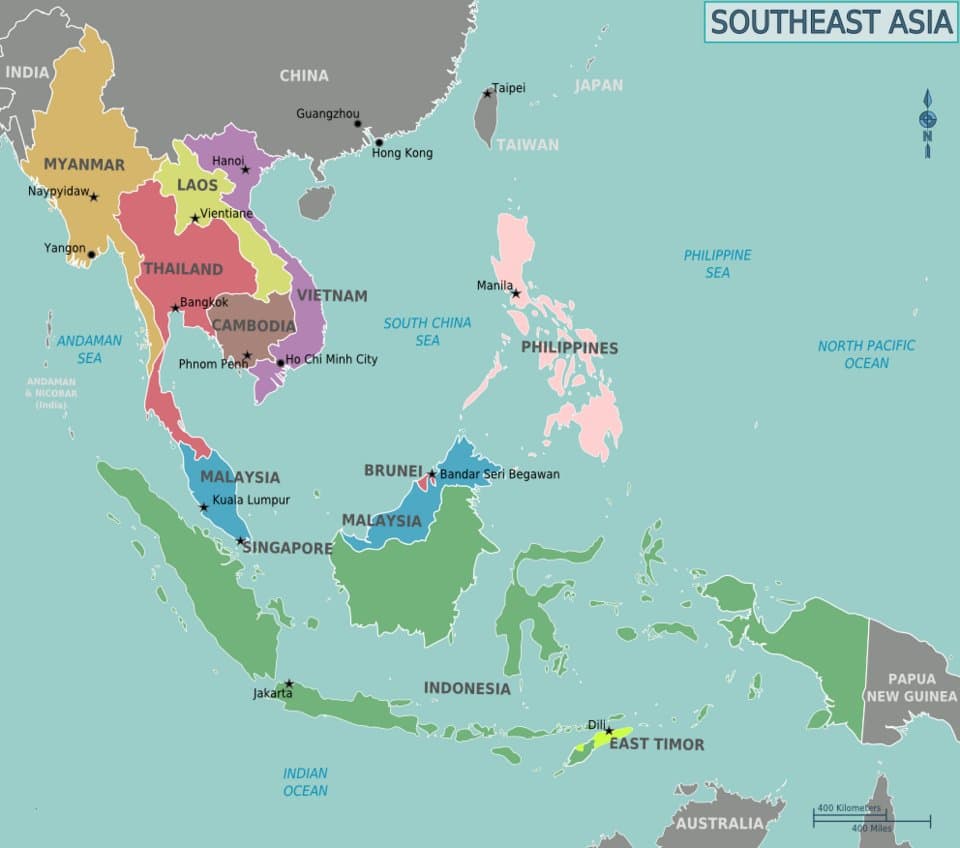
The Six-Banded Barb is native to Borneo. Specifically the Malaysian state of Sarawak and the Indonesian province of Kalimantan. As well as portions of the Malay Peninsula. Its natural range encompasses some of the most ecologically unique freshwater habitats in the world: tropical peat swamps and blackwater streams running through dense lowland rainforest.
These are not your typical clear-water tropical streams. Peat swamp forests produce some of the most extreme freshwater conditions on the planet. The water is stained a deep tea-brown by humic acids and tannins leaching from thick layers of decomposing plant material. The pH regularly drops below 4.0, the water is extraordinarily soft with almost no measurable mineral content, and the substrate is a thick carpet of fallen leaves, branches, and peat. In this dim, tannin-rich environment, Six-Banded Barbs live among submerged roots and leaf litter, feeding on small invertebrates, insect larvae, and organic detritus. Understanding this natural habitat is the key to keeping them successfully in captivity.
Appearance & Identification
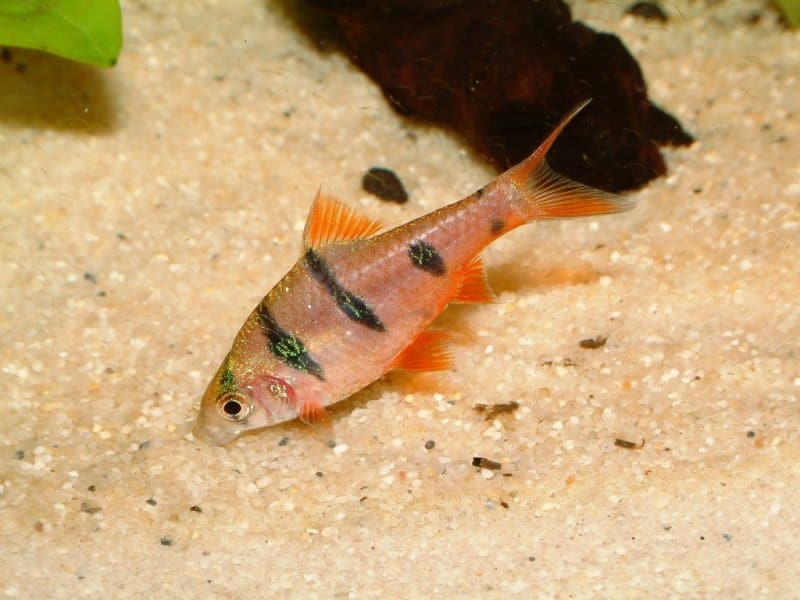
The Six-Banded Barb is a small, laterally compressed fish with a rounded body profile typical of the smaller Desmopuntius species. The base body color is a warm copper-orange to reddish-brown, which deepens considerably in well-conditioned fish kept in appropriate blackwater setups. Across this body, six bold, dark vertical bands run from the dorsal area down toward the belly. These bands are the species’ most distinctive feature and the easiest way to identify it.
Here’s where things get interesting. And where a lot of hobbyists get confused. The Six-Banded Barb looks almost identical to the Five-Banded Barb (Desmopuntius pentazona). Same body shape, similar coloration, overlapping geographic ranges. The primary difference is right there in the name: D. Hexazona has six vertical bands while D. Pentazona has five. The first band (running through the eye) and the last (at the caudal peduncle) will be faint, making a quick count tricky. Both species are regularly mislabeled in the trade, so always count the bands yourself rather than trusting the tank label. The fins are largely transparent to slightly yellowish, with well-conditioned specimens showing reddish tints in the dorsal and pelvic fins.
Male vs. Female
Sexing is moderately straightforward once the fish are mature. Males are slightly smaller and slimmer, with more vivid reddish-copper body color, especially in breeding condition. Females are noticeably rounder and deeper-bodied, particularly when carrying eggs, with a more subdued golden-brown tone. The vertical bands are equally prominent in both sexes, so banding pattern alone won’t help you tell them apart.
Average Size & Lifespan
Six-Banded Barbs are a compact species, reaching a maximum size of about 2 inches (5 cm) in total length. Most specimens in home aquariums will top out around 1.5 to 2 inches (4 to 5 cm). Their small size is part of what makes them well-suited for modestly sized community tanks.
With proper care, Six-Banded Barbs have a lifespan of 4 to 6 years. The key factors that influence longevity are water quality, appropriate water chemistry (soft and acidic), a varied diet, and being kept in a proper school. Fish that are kept in hard, alkaline water or in groups that are too small are more stressed and may not reach the upper end of that range.
Care Guide
Tank Size
A 20-gallon (76-liter) tank is the minimum for a group of Six-Banded Barbs. These are active schooling fish that need horizontal swimming space, and a group of 6 to 8 requires that footprint to stay comfortable. If you’re planning a community setup with other species, a 30-gallon (114-liter) or larger tank gives everyone more room and makes it easier to maintain stable water chemistry. Which matters more with this species than with many other barbs because of their soft-water requirements.
Water Parameters
| Parameter | Recommended Range |
|---|---|
| Temperature | 73 to 79°F (23 to 26°C) |
| pH | 4.0 to 7.0 |
| Hardness (dGH) | 1 to 5 |
| Ammonia / Nitrite | 0 ppm |
| Nitrate | Below 20 ppm |
Water chemistry is where the Six-Banded Barb diverges from many other commonly kept barbs. This is a true blackwater species, and while commercially bred specimens tolerate a wider range than wild-caught fish, they genuinely thrive in soft, acidic conditions. A pH between 5.0 and 6.5 with very low hardness is the sweet spot for bringing out their best coloration and natural behavior. If your tap water is hard and alkaline, you’ll need RO (reverse osmosis) water remineralized with a product designed for soft-water species, or mix RO water with your tap to reach the desired softness. Trying to force hard, alkaline tap water to work for this species is a losing battle.
Filtration & Water Flow
A sponge filter or gentle hang-on-back filter works well. In their natural peat swamp habitat, water movement is minimal, so gentle flow is ideal. Avoid powerful canister filters or powerheads that create strong currents. A turnover rate of about 3 to 4 times the tank volume per hour is plenty. Adding peat granules to your filter media is a traditional blackwater approach. It naturally acidifies the water, reduces hardness, and releases tannins. Monitor pH regularly if you go this route since peat can lower it gradually.
Lighting
Subdued lighting is strongly recommended. In the wild, Six-Banded Barbs live under dense tropical forest canopy in dark, tannin-stained water. Bright aquarium lighting will wash out their colors and make them feel exposed. If you’re running a planted tank with moderate to high lighting, use floating plants to create shaded zones where the barbs can retreat. Their coppery coloration looks dramatically better under softer, warmer-toned light, especially when the water has a slight amber tint from tannins.
Plants & Decorations
A planted tank with plenty of cover is ideal. Choose plants that tolerate soft, acidic water. Cryptocorynes are a perfect match since many species come from similar Southeast Asian habitats. Java fern, Java moss, Bucephalandra, and Anubias all do well in low-light, soft-water setups. Floating plants like Salvinia or Amazon frogbit help dim the lighting and provide overhead cover.
Driftwood is practically essential. It releases tannins that acidify and stain the water, mimicking their natural blackwater habitat. Malaysian driftwood, mopani wood, and spider wood are all great options. Add a generous layer of dried Indian almond leaves or oak leaves to the bottom of the tank. They release beneficial tannins, create a natural biofilm the fish will graze on, and replicate the leaf litter substrate of their wild habitat.
Substrate
A dark substrate brings out the best coloration in Six-Banded Barbs and creates a more natural-looking setup. Dark sand, black gravel, or an aquasoil-type planted substrate all work well. Active substrates like ADA Amazonia or Fluval Stratum have the added benefit of slightly buffering the water toward acidic conditions, which aligns perfectly with this species’ preferences. Light-colored substrates will make the fish look washed out and feel less secure.
Is the Six-Banded Barb Right for You?
Before you buy, run through this honest checklist. The Six-Banded Barb is a great fish for the right keeper, but it is not for everyone.
- You enjoy tight schooling behavior and can keep 8-10+ individuals
- You have a 20-gallon or larger planted tank
- You want a peaceful barb with bold vertical banding
- Your tank has subdued lighting where the banding creates visual contrast
- You keep other small, non-aggressive community species
- You appreciate a species that becomes more impressive in large schools
Tank Mates
Six-Banded Barbs are genuinely peaceful community fish that lack the nippy attitude that gives some barbs a bad reputation. The most important consideration when choosing tank mates isn’t temperament. It’s water chemistry. Any fish you pair with them needs to be comfortable in soft, acidic water. Keeping them with hard-water species forces an impossible compromise.
Best Tank Mates
- Other soft-water barbs (Cherry Barbs, Five-Banded Barbs, Pentazona Barbs)
- Rasboras (Harlequin Rasboras, Lambchop Rasboras, Chili Rasboras, Dwarf Rasboras)
- Small tetras (Ember Tetras, Cardinal Tetras, Rummy Nose Tetras, Neon Tetras)
- Corydoras catfish (Pygmy Corys, Habrosus Corys. Species that tolerate softer water)
- Gouramis (Chocolate Gouramis, Sparkling Gouramis, Licorice Gouramis)
- Loaches (Kuhli Loaches, Dwarf Loaches)
- Small plecos (Otocinclus, Bristlenose Plecos)
- Freshwater shrimp (Amano Shrimp, adult Cherry Shrimp)
Tank Mates to Avoid
- Large, aggressive cichlids (Oscars, Jack Dempseys, Convicts) that will eat or terrorize these small barbs
- Hard-water species (African Rift Lake cichlids, most livebearers like Mollies and Guppies) since their water parameter needs are incompatible
- Aggressive or nippy barbs (Tiger Barbs in small groups can harass them)
- Very large fish of any type that could view 2-inch barbs as a meal
- Highly territorial bottom-dwellers that may stress them out when they venture near the lower parts of the tank
Food & Diet
Six-Banded Barbs are omnivores that are easy to feed. In the wild, they eat small invertebrates, insect larvae, worms, algae, and organic detritus found among leaf litter. In captivity, they’ll accept most standard aquarium foods without fuss.
A high-quality micro-pellet or crushed flake food makes a good daily staple. Look for products that contain both animal and plant-based ingredients to cover their omnivorous dietary needs. Supplement regularly with small frozen or live foods to enhance coloration and overall health. Daphnia, baby brine shrimp, cyclops, bloodworms (in moderation), and mosquito larvae are all excellent choices. Live foods in particular seem to bring out more active, natural foraging behavior.
If you maintain a leaf litter layer (which you should for this species), the barbs will naturally graze on the biofilm that develops on decomposing leaves between meals. Feed small amounts two to three times daily rather than one large feeding. These are small-mouthed fish that do best with frequent, appropriately sized meals.
Breeding & Reproduction
Breeding Six-Banded Barbs is achievable in captivity but requires more attention to water conditions than many other barb species. They’re egg scatterers with no parental care, which is typical for the genus.
Breeding Difficulty
Moderate. The spawning itself isn’t complicated, but getting the water chemistry right is the main challenge. These fish are much more likely to spawn in very soft, acidic water. Conditions that requires deliberate setup for most hobbyists.
Spawning Tank Setup
Set up a dedicated breeding tank of at least 10 gallons (38 liters) with shallow water, about 6 to 8 inches (15 to 20 cm) deep. Use a bare bottom or cover it with a layer of glass marbles to protect the eggs from being eaten by the parents. Fine-leaved plants like Java moss or spawning mops give the eggs something to land on and also provide some visual security for the breeding pair.
Keep the lighting very dim. A small floating plant cover is ideal. A gentle sponge filter provides biological filtration without creating dangerous suction for eggs or newly hatched fry.
Water Conditions for Breeding
This is where it gets specific. Use very soft water. Ideally below 2 dGH. With a pH between 5.0 and 6.0. RO water with just a trace of remineralizer is the easiest way to achieve this. Raise the temperature slightly to the upper end of their range, around 77 to 79°F (25 to 26°C). The addition of peat extract or Indian almond leaf extract can help create the tannin-rich water that seems to encourage spawning in this species.
Conditioning & Spawning
Separate males and females for one to two weeks before breeding, feeding heavily with live and frozen foods like daphnia, brine shrimp, and mosquito larvae. Introduce a conditioned pair or small group (two males to three females works well) into the breeding tank in the evening. Spawning typically happens the following morning. The male courts the female with fin displays and chasing, and the pair scatters eggs among fine-leaved plants or across the substrate. A healthy female can produce around 50 to 100 eggs per spawning event.
Egg & Fry Care
Remove the adults immediately after spawning. They will eat the eggs without hesitation. The eggs are small, slightly adhesive, and will hatch in approximately 24 to 48 hours depending on temperature. Keep the tank dark or very dimly lit during this period, as the eggs are somewhat light-sensitive.
The fry become free-swimming about 24 hours after hatching, once they’ve absorbed their yolk sacs. Start with infusoria or liquid fry food, then graduate to freshly hatched baby brine shrimp after about a week. As they grow, introduce finely crushed flake food and micro-worms. Keep the water extremely clean with small, daily water changes using aged water of the same chemistry. Growth is steady but not rapid. Expect several months to reach juvenile size.
Common Health Issues
Six-Banded Barbs are reasonably hardy when kept in appropriate water conditions. Most health problems with this species trace back to being kept in water that’s too hard or alkaline for their long-term health. Here are the most common issues to watch for.
Ich (White Spot Disease)
Ich can affect Six-Banded Barbs when they’re stressed by sudden parameter changes or poor acclimation. Look for small white spots on the body and fins, along with flashing against objects. Gradually raising the temperature to 82 to 84°F (28 to 29°C) and treating with a commercial ich medication is the standard protocol.
Bacterial Infections & Fin Rot
Frayed fins or reddened patches on the body are signs of bacterial infection, usually caused by poor water quality. The naturally acidic, tannin-rich water these barbs prefer has mild antibacterial properties. Another reason to maintain proper blackwater conditions. Mild cases often resolve with improved water quality alone. More severe cases requires antibiotic treatment.
Velvet Disease
Caused by the parasite Piscinoodinium, velvet appears as a fine gold or rust-colored dust on the body. Affected fish often clamp their fins and breathe rapidly. Copper-based medications are the standard treatment, and reducing lighting helps since the parasite has a light-dependent life stage.
Stress from Improper Water Chemistry
This isn’t a disease, but it’s the single most common issue with Six-Banded Barbs. Fish kept in hard, alkaline water show chronic stress: faded colors, clamped fins, reduced appetite, and increased susceptibility to actual diseases. If your fish look consistently pale and listless, test your hardness and pH. Chances are the chemistry is the problem.
Common Mistakes to Avoid
- Ignoring water chemistry. This is the biggest mistake people make with Six-Banded Barbs. They’re not a fish you can just throw into average tap water and expect to thrive. Soft, acidic water isn’t optional. It’s essential for their long-term health and coloration.
- Keeping too few. Like all schooling barbs, Six-Banded Barbs need a group of at least 6, and 8 to 10 is better. In smaller numbers, they become stressed, shy, and lose their color.
- Confusing them with Five-Banded Barbs. Both species are regularly mislabeled in stores. Always count the bands yourself. Care requirements are virtually identical between the two, but if accurate identification matters to you, take the time to verify.
- Too much light, not enough cover. These are peat swamp fish that live under dense forest canopy. Blasting them with high-intensity LED lighting in a sparsely decorated tank is a recipe for stressed, pale fish. Use floating plants, subdued lighting, and plenty of driftwood and cover.
- Skipping the tannins. Indian almond leaves, driftwood, and peat filtration aren’t just decorative choices for this species. They’re functional. The tannins acidify the water, provide natural antibacterial properties, and create the blackwater conditions these fish have evolved in.
- Pairing with hard-water species. Keeping Six-Banded Barbs with Mollies, African cichlids, or other fish that need hard, alkaline water forces an impossible compromise. One group will always be in the wrong water.
Where to Buy
Six-Banded Barbs are not a common fixture at big-box pet stores, and when they do appear, they’re frequently mislabeled as Five-Banded Barbs or generic “Tiger Barbs.” Your best bet for correctly identified, healthy specimens is a specialty retailer. For quality fish shipped to your door, I recommend these trusted online retailers:
Both are reputable sellers who take good care of their livestock and ship responsibly. Availability of less common species like the Six-Banded Barb varies, so check their sites regularly and sign up for stock notifications if available. When you do find them, buy enough for a proper school. You’ll want at least 6 to 8.
Frequently Asked Questions
What is the difference between Six-Banded and Five-Banded Barbs?
The primary difference is the number of vertical black bands: Desmopuntius hexazona has six bands while D. Pentazona has five. The two species are otherwise very similar in appearance, size, and behavior. Care requirements are virtually identical. They are frequently mislabeled in the trade, so always count the bands yourself rather than relying on the store’s label.
How many Six-Banded Barbs should I keep together?
Keep a minimum group of 6, though 8 to 10 is even better. In larger groups, they feel more secure, swim more actively in the open, and show better coloration. Males display more vibrantly when they have other males to compete with.
Are Six-Banded Barbs aggressive?
Not at all. They’re one of the most peaceful barb species available. They lack the fin-nipping tendencies Tiger Barbs are famous for and generally mind their own business. Males may chase each other occasionally, but it’s harmless sparring that never results in real damage.
Can Six-Banded Barbs live in regular tap water?
It depends entirely on your tap water. If it’s naturally soft and slightly acidic, they may do fine. But if your tap is hard and alkaline. Which is common in many areas. You’ll need to modify it with RO water, peat filtration, or a combination. Commercially bred specimens are more adaptable than wild-caught fish, but long-term health and coloration depend on appropriately soft, acidic conditions.
Do Six-Banded Barbs need a heater?
In most homes, yes. Their preferred temperature range of 73 to 79°F (23 to 26°C) is comfortable room temperature in some climates, but a heater provides stability and prevents the dangerous temperature drops that can occur overnight or during cooler seasons. A reliable adjustable heater set to 75 to 77°F (24 to 25°C) is a safe choice.
Can Six-Banded Barbs live with shrimp?
Adult Amano Shrimp and Cherry Shrimp are safe, though baby shrimp will likely become snacks. Provide dense Java moss if you want shrimplets to survive. Also make sure your shrimp can tolerate the soft, acidic water these barbs require. Caridina shrimp are often a better match than Neocaridina for very soft setups.
Are Six-Banded Barbs good for beginners?
They’re rated as moderate care for a reason. The fish themselves aren’t demanding in terms of behavior or feeding, but their water chemistry requirements make them less ideal as a true beginner fish. If you’re new but willing to learn about water chemistry and invest in RO water or peat filtration, they’re perfectly manageable. If you want something more forgiving for your first tank, consider Cherry Barbs or Harlequin Rasboras instead, and come back to Six-Banded Barbs once you’re comfortable managing water parameters.
How the Six-Banded Barb Compares to Similar Species
Six-Banded Barb vs. Five-Banded Barb
Nearly identical in care and behavior, the difference is literally in the band count. Both are peaceful schoolers that look best in groups. Choose whichever is available. They are often sold interchangeably in the trade, and honestly, counting bands on a moving fish is harder than it sounds.
Six-Banded Barb vs. Checker Barb
The Checker Barb has a more checkered pattern rather than clean vertical bands. Both are peaceful and easy to keep. The Six-Banded Barb has a more striking pattern when kept in a large school, while the Checker Barb shows more individual charm.
What It Is Actually Like Living With Six-Banded Barb
Six-banded barbs are the patterned fish option for keepers who find spots boring and stripes too simple. The vertical banding creates a visual effect that is distinctive without being busy.
They school with a loose formation that tightens when excited or startled. The banding effect multiplies when the group compresses.
Hardy enough to forgive minor mistakes and attractive enough to reward good care. That balance makes them an excellent choice for developing hobbyists.
Closing Thoughts
The six-banded barb is the geometric barb that adds pattern without drama. It does its job and never causes a problem.
The Six-Banded Barb rewards the hobbyist who’s willing to put in a little extra effort. Set up a proper blackwater tank with soft, acidic water, dim lighting, and a generous leaf litter bed, and a school of these barbs will reward you with warm copper-and-black beauty that you can’t get from more mainstream species. They’re peaceful, small enough for modestly sized tanks, and they connect you to one of the most fascinating freshwater ecosystems in the world. The peat swamps of Borneo.
Are they for everyone? Probably not. If you don’t want to deal with RO water or water chemistry adjustments, there are easier barbs. But if you enjoy dialing in a biotope-style setup and watching a species behave the way it was meant to, the Six-Banded Barb is well worth your time. Get a proper school, set up the water right, and let them do what they do. You won’t be disappointed.
Recommended Video
References
- Froese, R. And D. Pauly, Editors. FishBase. Desmopuntius hexazona (Weber & de Beaufort, 1912). https://www.fishbase.se/summary/Desmopuntius-hexazona.html
- Seriously Fish. Desmopuntius hexazona. Six-banded Barb. https://www.seriouslyfish.com/species/desmopuntius-hexazona/
- Kottelat, M. (2013). The Fishes of the Inland Waters of Southeast Asia: A Catalogue and Core Bibliography of the Fishes Known to Occur in Freshwaters, Mangroves and Estuaries. The Raffles Bulletin of Zoology, Supplement No. 27, 1-663.
- Tan, H.H. & Kottelat, M. (2009). The fishes of the Batang Hari drainage, Sumatra, with description of six new species. Ichthyological Exploration of Freshwaters, 20(1), 13-69.
- About the Author
- Latest Posts

I’m Mark Valderrama, founder of Aquarium Store Depot and a fishkeeper with over 25 years of hands-on experience. I started in the hobby at age 11, worked at local fish stores, and have kept freshwater tanks, ponds, and reef tanks ever since. I’ve been featured in two best-selling aquarium books on Amazon and built this site to share practical, experience-based fish keeping knowledge.
Leave a Reply