
Last Updated: June 25, 2026
Thank you for visiting! By the way… any links on this page that lead to products on Amazon and other stores/partners are affiliate links Aquarium Store Depot earns a commission if you make a purchase.
Table of Contents
- What Care Guides Get Wrong
- The Reality of Keeping Five-Banded Barb
- Key Takeaways
- Species Overview
- Classification
- Origin & Natural Habitat
- Appearance & Identification
- Average Size & Lifespan
- Care Guide
- Is It Right for You?
- Tank Mates
- Food & Diet
- Breeding & Reproduction
- Common Health Issues
- Common Mistakes to Avoid
- Where to Buy
- Frequently Asked Questions
- Species Comparison
- Closing Thoughts
- Recommended Video
- References
The five-banded barb is a rare, beautifully marked species that most hobbyists will never find in a local pet store. It reaches about 5 inches, needs a group, and does best in a soft-water planted tank. It is not difficult to keep, but it is difficult to find, and that rarity is both its appeal and its challenge.
For the keeper who wants something outside the usual cherry-and-tiger lineup, the five-banded barb offers bold vertical banding and active schooling behavior in a package that stands out. This guide covers what you need to know if you manage to find them, because the five-banded barb is for the hobbyist who has kept everything common and wants something nobody else has.
Finding this fish is harder than keeping it. If you spot them for sale, do not hesitate.
Cherry barbs got famous, five-banded barbs got forgotten. But the pattern speaks for itself.
The Reality of Keeping Five-Banded Barb
The five-banded barb is a small, uncommon species with five dark vertical bands on a golden body. At under 2 inches, it is a nano-sized barb that works in tanks starting at 15 gallons.
Availability is limited. This is not a fish you will find at chain stores. Specialty retailers and online sellers stock them occasionally, and when they appear, they sell quickly.
They are peaceful and shy, making them suitable for quiet community setups but poor choices for tanks with boisterous or aggressive tankmates.
Biggest Mistake New Owners Make
Putting them with active, pushy fish that dominate feeding time. Five-banded barbs are timid feeders that will lose out to faster species. They need calm tankmates and designated feeding strategies.
Five-banded barbs are a small, peaceful barb species suitable for community tanks with similarly sized, active fish. They are hardy and adaptable, tolerating a range of water parameters.
Expert Take (Mark Valderrama, AquariumStoreDepot)
The five-banded barb is the collector’s nano barb. If you enjoy rare species that most hobbyists have never seen, this is your fish. A group of eight in a well-planted 15-gallon creates a display that is unique to your tank. Nobody else on your block has these fish.
Key Takeaways
- Minimum tank size is 20 gallons (76 liters) for a school of 8-10
- One of the most peaceful barbs in the hobby, shy and non-aggressive
- Micropredator that thrives on a varied diet of frozen and live foods alongside quality dry foods
- Best for intermediate keepers due to preference for soft, acidic water
- Looks best in a heavily planted, dimly lit tank with tannin-stained water
Species Overview
| Field | Details |
|---|---|
| Scientific Name | Desmopuntius pentazona |
| Common Names | Five-Banded Barb, Pentazona Barb, Fiveband Barb |
| Family | Cyprinidae |
| Origin | Malay Peninsula, Borneo (Sarawak) |
| Care Level | Moderate |
| Temperament | Peaceful |
| Diet | Omnivore (micropredator) |
| Tank Level | Mid |
| Maximum Size | 2 inches (5 cm) |
| Minimum Tank Size | 20 gallons (76 liters) |
| Temperature | 73-79°F (23-26°C) |
| pH | 4.0-7.0 |
| Hardness | 1-5 dGH |
| Lifespan | 4-6 years in captivity |
| Breeding | Egg scatterer |
| Breeding Difficulty | Moderate to Difficult |
| Compatibility | Community |
| OK for Planted Tanks? | Yes |
Classification
| Taxonomic Level | Classification |
|---|---|
| Order | Cypriniformes |
| Family | Cyprinidae |
| Subfamily | Smiliogastrinae |
| Genus | Desmopuntius |
| Species | D. Pentazona (Boulenger, 1894) |
The genus Desmopuntius was erected relatively recently to separate these smaller, peaceful barbs from the broader Puntius group. This fish was originally described as Barbus pentazona and has moved through several genera over the years. You may still see it listed under older names, but Desmopuntius pentazona is the current accepted classification.
Origin & Natural Habitat
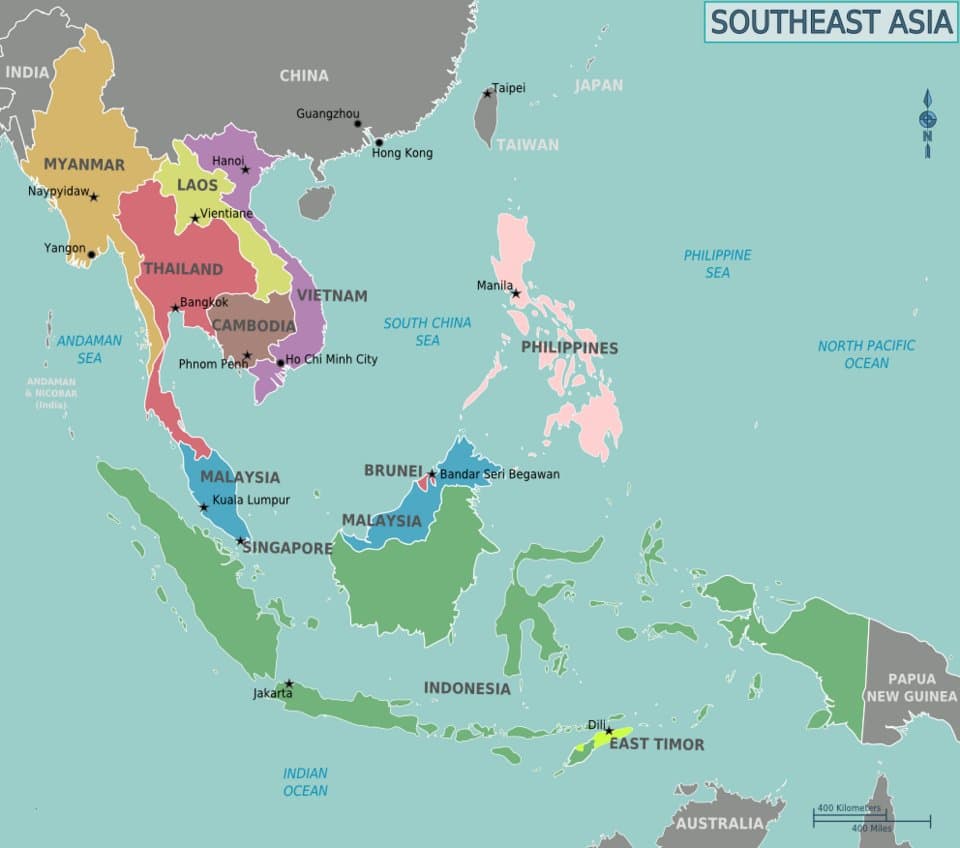
The five-banded barb is native to Southeast Asia, found across parts of the Malay Peninsula and the island of Borneo, primarily in the Malaysian state of Sarawak. These are lowland fish that inhabit slow-moving forest streams and peat swamp forests in densely vegetated tropical environments.
In the wild, five-banded barbs live in heavily shaded waterways where the forest canopy filters out most sunlight. The water is stained deep amber by tannins from decomposing leaves and wood. These are classic blackwater and peat swamp conditions with extremely soft, acidic water, where the pH can drop as low as 4.0. The substrate is a mix of sand, mud, and thick layers of leaf litter, with submerged roots and fallen branches providing structure and cover.
Very little aquatic plant life grows in the darkest peat swamps, but marginal vegetation provides shade and debris. Five-banded barbs share these habitats with other soft-water species like rasboras, small gouramis, and various loach species.
Appearance & Identification
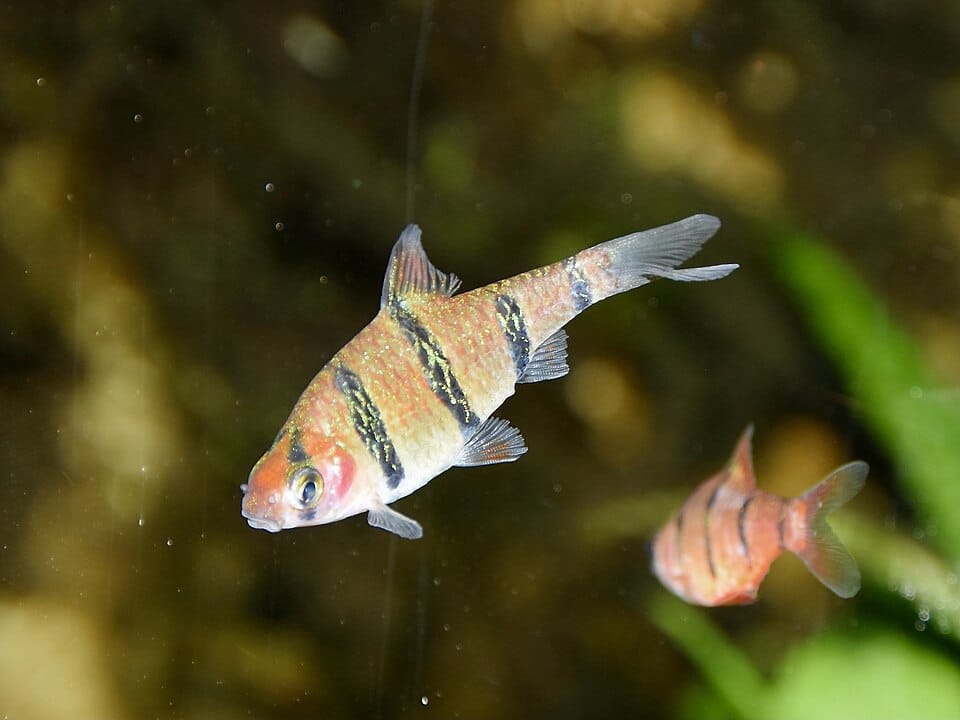
The five-banded barb has a compact, laterally compressed body with a warm golden to reddish-copper base color. The defining feature is five bold vertical black bands running from the dorsal area down toward the belly, evenly spaced from just behind the eye to the base of the caudal fin. The fins are mostly transparent to slightly yellowish, and the body shape is more streamlined than the deeper-bodied tiger barb.
Adults reach about 2 inches (5 cm) in total length. When healthy and comfortable, the golden base color takes on a warm reddish hue that stands out beautifully against a dark background. This species is sometimes confused with the closely related Desmopuntius hexazona (six-banded barb), which carries six bands instead of five. Counting the bands is the most reliable way to tell them apart, though the two are sometimes mislabeled in the trade.
Male vs. Female
Males are slimmer and more intensely colored, with a deeper reddish-gold tone, particularly when in breeding condition. Females are noticeably rounder and fuller-bodied, especially when carrying eggs. Outside of breeding season the differences can be subtle, so keeping a group of 8-10 ensures you’ll have a good mix of both sexes.
Average Size & Lifespan
Adult five-banded barbs reach approximately 2 inches (5 cm) in standard length. They’re a small species that works well in modestly sized tanks, though they need the swimming space that comes with a proper school.
With good care, expect a lifespan of 4 to 6 years in captivity. Stable water quality and a varied diet are the biggest factors in reaching the upper end of that range.
Care Guide
Tank Size
A 20-gallon (76-liter) tank is the minimum for a school of 8-10. Keeping them in anything smaller leads to stress and washed-out colors. A 30-gallon (114-liter) long is even better for a community setup, giving you space for tank mates while maintaining the horizontal swimming length these barbs prefer.
Water Parameters
| Parameter | Ideal Range |
|---|---|
| Temperature | 73-79°F (23-26°C) |
| pH | 5.0-7.0 |
| Hardness | 1-5 dGH |
| KH | 1-4 dKH |
This is where the five-banded barb gets more demanding than your typical community fish. They strongly prefer soft, acidic water, and while captive-bred specimens are somewhat more adaptable, they look and behave their best on the softer side. If your tap water is hard or alkaline, you’ll likely need RO water or peat filtration to get things right. They also prefer slightly cooler water than many tropical fish at 73-79°F (23-26°C).
Filtration & Water Flow
Gentle to moderate flow is the way to go. These barbs come from slow-moving forest streams, so strong currents will stress them. A sponge filter works great for species tanks, while a hang-on-back or canister filter with a spray bar suits larger community setups. Weekly water changes of 20-25% will keep things stable.
Lighting
Subdued lighting is essential. Bright, open lighting makes them shy and pale. Floating plants create the dappled shade that brings out their confidence and color. Under dim conditions against a dark background, the golden-copper tones really come alive.
Plants & Decorations
A heavily planted tank with plenty of cover is ideal. Java fern (Microsorum), Java moss (Taxiphyllum), and various Cryptocoryne species all thrive in the same low-light, soft-water conditions these barbs prefer. Driftwood serves double duty, providing cover while releasing tannins that soften the water and mimic their blackwater habitat. Adding Indian almond leaves on the substrate completes the biotope look and feeds beneficial microfauna.
Substrate
Dark sand or a fine planted tank substrate is strongly recommended. It brings out the golden coloration far better than light gravel and helps the fish feel at home.
Is the Five-Banded Barb Right for You?
Before you buy, run through this honest checklist. The Five-Banded Barb is a great fish for the right keeper, but it is not for everyone.
- You want a small, peaceful barb with clear vertical banding
- You have a 20-gallon or larger tank with dark substrate
- You can keep a group of 8+ for tight schooling behavior
- You enjoy collecting less common barb species
- Your tank has moderate lighting and live plants
- You keep other small, peaceful community species
Tank Mates
Tank mate selection matters with this shy species. You want calm companions that won’t intimidate them or outcompete them for food. Stick with other soft-water Southeast Asian species for the most natural pairing.
Best Tank Mates
- Harlequin rasboras – classic Southeast Asian companion with overlapping water requirements
- Chili rasboras – tiny, calm fish that share the same soft-water preference
- Chocolate gouramis – shy species from similar blackwater habitats
- Sparkling gouramis – small, peaceful anabantoids
- Kuhli loaches – gentle bottom dwellers that stay out of the mid-level zone
- Corydoras habrosus – smaller cory species suited to softer water
- Dwarf pencilfish – peaceful fish that occupy a different niche
- Ember tetras – calm tetras with complementary warm coloration
- Cherry shrimp – generally safe, though tiny shrimplets may be eaten
- Otocinclus catfish – gentle algae eaters
Tank Mates to Avoid
- Tiger barbs – too boisterous and nippy
- Large cichlids – big enough to view these small barbs as food
- Chinese algae eaters – become territorial and aggressive as they mature
- Fast, aggressive feeders – will outcompete these shy barbs at feeding time
- Livebearers (mollies, platies) – need harder, more alkaline water
Food & Diet
In the wild, five-banded barbs are micropredators feeding on small insects, worms, and crustaceans. A high-quality micro pellet or crushed flake works as a daily staple, but don’t rely on dry foods exclusively. Offer frozen daphnia, brine shrimp, cyclops, or bloodworms several times per week. Live foods are even better and will bring out noticeably more vivid coloration.
Feeding frequency: Once or twice daily, only what they can consume in about 2 minutes.
Pro tip: Five-banded barbs can be shy at feeding time. Drop food near plant cover or driftwood where they hang out so the shyer individuals can eat without competing with faster tank mates.
Breeding & Reproduction
Breeding five-banded barbs is possible in the home aquarium, but it requires some effort and attention to water conditions. This isn’t a species that will spawn on its own in a general community tank.
Breeding Difficulty
Moderate to difficult. The main challenge is providing the very soft, acidic water conditions that trigger spawning and support egg development. If you can nail the water chemistry, the actual spawning process is fairly straightforward.
Spawning Tank Setup
Set up a separate 10-15 gallon (38-57 liter) breeding tank with very dim lighting. Line the bottom with Java moss or spawning mops, and place a mesh screen above the substrate to prevent adults from eating fallen eggs. Use a gentle air-powered sponge filter.
Water Conditions for Breeding
Very soft, acidic water is critical. Aim for a pH of 5.0-6.0, hardness below 2 dGH, and a temperature of 77-79°F (25-26°C). RO water or peat-filtered water is almost always necessary to achieve these conditions. Adding Indian almond leaves or alder cones to the breeding tank helps acidify the water naturally and introduces beneficial compounds.
Conditioning & Spawning
Condition 2-3 pairs with live and frozen foods for 1-2 weeks. When females are visibly plump and males show their most intense coloration, introduce them to the breeding tank. Spawning typically occurs in the morning. The fish scatter adhesive eggs among the plants, and you should remove adults promptly afterward to prevent egg predation.
Egg & Fry Care
Eggs hatch in 24-36 hours, and fry become free-swimming around 3-4 days after hatching. Start with infusoria or liquid fry food, graduating to microworms and freshly hatched baby brine shrimp as they grow. Keep the tank dark during early stages since eggs and fry are light-sensitive. Growth is slow, so patience is key. Most five-banded barbs in the trade are either wild-caught or commercially bred in Southeast Asia.
Common Health Issues
Five-banded barbs are hardy once established, but they can be sensitive during initial acclimation, especially wild-caught specimens.
Ich (White Spot Disease)
Five-banded barbs can develop ich when stressed, typically after introduction to a new tank or a sudden temperature drop. Gradually raising the temperature to the upper end of their range (around 79°F / 26°C) combined with a standard ich treatment is usually effective.
Bacterial Infections
Five-banded barbs kept in water that’s too hard or alkaline can become susceptible to bacterial issues including fin rot. Maintaining the soft, acidic conditions they prefer goes a long way toward prevention.
General Prevention
Quarantine all new fish for at least two weeks before adding them to your main tank. This is especially important with five-banded barbs, as wild-caught specimens may carry parasites. Maintain stable water parameters and keep up with your water change schedule. A well-established, biologically mature tank is the best foundation for keeping these fish healthy.
Common Mistakes to Avoid
- Keeping too few – They need at least 8-10. Smaller groups lead to stressed, hiding fish that lose their color.
- Water that’s too hard or alkaline – They genuinely need soft, acidic water. Hard tap water causes chronic stress even if they survive initially.
- Housing with boisterous tank mates – Pairing with aggressive species like tiger barbs results in stressed fish that never show their best colors.
- Bright, open lighting – Without floating plants or shade, they’ll hide and look washed out.
Where to Buy
Five-banded barbs aren’t as commonly stocked as tiger barbs or cherry barbs, so check specialty fish stores with a good Southeast Asian selection. Prices typically range from $4-8 per fish. For online purchases, check Flip Aquatics and Dan’s Fish for availability. Since this is a less mainstream species, stock may come and go, so sign up for restock notifications.
Frequently Asked Questions
How many five-banded barbs should be kept together?
A minimum of 8-10. They’re a tight-schooling species that become stressed in small groups. A proper school lets them swim in the open and display their best coloration.
What size tank does a five-banded barb need?
A 20-gallon (76-liter) tank is the minimum for a school of 8-10. A 30-gallon (114-liter) long is better for community setups.
Are five-banded barbs easy to care for?
Moderate difficulty. The main challenge is their preference for soft, acidic water. Once you have the water chemistry dialed in, they’re straightforward to maintain.
Can five-banded barbs live with bettas?
It’s not ideal. While five-banded barbs won’t nip fins, they need larger groups that produce more activity than most bettas are comfortable with. The water parameter overlap is also limited.
Are five-banded barbs fin nippers?
No. Unlike tiger barbs, five-banded barbs are not fin nippers. They’re one of the most peaceful barb species available and pose no threat to long-finned tank mates.
How long do five-banded barbs live?
With proper care, 4 to 6 years in captivity. Stable water quality and a varied diet are the keys to reaching the upper end of that range.
What is the difference between five-banded and six-banded barbs?
They’re closely related species that look very similar. The simplest way to tell them apart is counting the vertical black bands. They require identical care and are occasionally mislabeled in the trade.
How the Five-Banded Barb Compares to Similar Species
Five-Banded Barb vs. Six-Banded Barb
Nearly identical in care and behavior, the main difference is band count. Both are peaceful schoolers that look best in large groups. They are frequently sold interchangeably in the trade. Either works well; choose based on availability.
Five-Banded Barb vs. Striped Barb
The Striped Barb has horizontal stripes while the Five-Banded Barb has vertical bands. Both are peaceful and easy to keep. They create an interesting visual contrast if kept together in a large enough tank.
What It Is Actually Like Living With Five-Banded Barb
Five-banded barbs are wallflowers. They drift through the tank in a loose school, pausing near plant cover and rarely drawing attention to themselves. In a quiet tank, that subtlety is the appeal.
The five distinct bands are crisp and clean on healthy specimens, creating a barcode effect that is simple but distinctive.
They become more confident over time. The first month is mostly hiding. By month three, they school in the open and come to the front glass at feeding time.
Closing Thoughts
The five-banded barb deserves far more attention than it gets. If you appreciate soft-water Southeast Asian biotopes and enjoy building natural planted tanks, this species is well worth seeking out. A large school in a dimly lit, tannin-stained tank is one of the more rewarding displays you can create. For more barb species, check out our care guides for cherry barbs, tiger barbs, and Odessa barbs.
Have you kept five-banded barbs? Drop a comment below!
Recommended Video
Check out our barb species video where we cover some of the best barbs for your aquarium:
References
- Desmopuntius pentazona Profile – Seriously Fish
- Desmopuntius pentazona (Boulenger, 1894) – FishBase
- Five-Banded Barb – Practical Fishkeeping
- About the Author
- Latest Posts

I’m Mark Valderrama, founder of Aquarium Store Depot and a fishkeeper with over 25 years of hands-on experience. I started in the hobby at age 11, worked at local fish stores, and have kept freshwater tanks, ponds, and reef tanks ever since. I’ve been featured in two best-selling aquarium books on Amazon and built this site to share practical, experience-based fish keeping knowledge.
Leave a Reply