
Last Updated: June 25, 2026
Thank you for visiting! By the way… any links on this page that lead to products on Amazon and other stores/partners are affiliate links Aquarium Store Depot earns a commission if you make a purchase.
Table of Contents
- What Care Guides Get Wrong
- The Reality of Keeping Silvertip Tetra
- Key Takeaways
- Species Overview
- Classification
- Origin & Natural Habitat
- Appearance & Identification
- Average Size & Lifespan
- Care Guide
- Is It Right for You?
- Tank Mates
- Food & Diet
- Breeding & Reproduction
- Common Health Issues
- Common Mistakes to Avoid
- Where to Buy
- Frequently Asked Questions
- What It Is Actually Like Living With Silvertip Tetra
- Species Comparison
- Closing Thoughts
- Recommended Video
- References
The silvertip tetra is one of the most active and feisty small tetras in the hobby. Keep them in a proper school of 8+ and they put on a constant display of chasing and flashing. Keep fewer than 6 and they redirect that energy into nipping every other fish in the tank.
Silvertip tetras in a big school are electric. In a small group, they are bullies. The number is everything.
ASD Difficulty Rating
Beginner-Intermediate | 4/10
Easy to care for, but not for every tank. Water parameters are forgiving and they accept all common foods. The difficulty is entirely in tank mate selection – they are persistent fin-nippers that cannot be kept with slow-moving, long-finned, or passive species. If you have the right tank mates, this is a beginner-level fish. If you don’t plan ahead, the damage happens fast.
Expert Take (Mark Valderrama, AquariumStoreDepot)
At the stores I managed, silvertip tetras were the fish I used when someone came in wanting “something with personality” but didn’t want to commit to a large cichlid. I would point at the school display tank and tell them to watch for five minutes. Nine times out of ten, they were sold before the five minutes were up. The constant in-group chasing, the sparring, the energy of a proper school in motion – it is genuinely entertaining in a way that most tetras are not. What I tell people: this is not a community fish in the traditional sense. It is a tank personality fish. You build the rest of the community around it – active, robust tank mates that can keep up and that don’t have long fins to tempt them. Get that right and silvertips are one of the most satisfying tetras you can keep. Get it wrong and you have a fin-nipping problem on day two.
Hard Rule: No bettas, no angelfish, no fancy guppies. The fin-nipping is permanent.
This is not a compatibility preference. It is a behavioral certainty. Silvertip tetras will fin-nip slow-moving, long-finned fish regardless of tank size, school size, feeding schedule, or anything else you try. The damage accumulates. The betta’s fins will be ragged within a week. The angelfish will be stressed into illness. There is no workaround for this. Choose your tank mates before you buy silvertips, not after.
The Reality of Keeping Silvertip Tetra
They nip fins. Plan for it. Silvertip tetras are semi-aggressive and will target slow-moving fish with long fins. Bettas, angelfish, and fancy guppies are not compatible. This is not occasional nipping. It is persistent and will cause visible damage over time.
The copper body color is the real attraction. Most people buy silvertip tetras for the silver tips on their fins. But the real beauty emerges over time as mature fish develop a warm copper-gold body color that is genuinely unique among common tetras. This color only appears in well-fed, healthy fish kept in groups.
A larger group reduces aggression. In a school of 4 or 5, the dominant fish terrorize the weaker ones. In a school of 8 to 12, the aggression is distributed and the nipping stays manageable. Group size is the biggest factor in making this species work.
Biggest Mistake New Owners Make
Mixing them with bettas or angelfish. This combination fails within days and the damage is immediate and visible. If you have slow-moving, long-finned fish, do not add silvertips.
Key Takeaways
- Minimum tank size is 20 gallons (75 liters) for a school of 8–10 – these are active swimmers that need room
- Peaceful but feisty – avoid keeping them with slow-moving or long-finned fish like bettas and fancy guppies
- Omnivore – accepts flake food, pellets, frozen and live foods readily
- Great beginner fish – very hardy and tolerant of a wide range of water conditions
- Unique among tetras – one of the few that naturally lacks an adipose fin

Species Overview
| Field | Details |
|---|---|
| Scientific Name | Hasemania nana |
| Common Names | Silvertip Tetra, Silver Tip Tetra, Copper Tetra |
| Family | Acestrorhamphidae |
| Origin | São Francisco River basin, eastern Brazil |
| Care Level | Easy |
| Temperament | Peaceful (can be nippy in small groups) |
| Diet | Omnivore |
| Adult Size | 1.2–2 inches (3–5 cm) |
| Lifespan | 5–10 years |
| Minimum Tank Size | 20 gallons (75 liters) |
| Temperature | 71–82°F (22–28°C) |
| pH Range | 6.0–8.0 |
| Hardness | 5–19 dGH |
| Breeding | Egg scatterer |
Classification
The silvertip tetra was originally described as Tetragonopterus nanus by Lütken in 1875, with specimens collected from Lagoa Santa in Minas Gerais state, Brazil. It was later moved to the genus Hasemania, which was established by Ellis in 1911. The genus name honors John Haseman, an American ichthyologist who collected fish extensively across South America.
Under the 2024 Melo et al. Reclassification, Hasemania nana was moved from the traditional family Characidae into the family Acestrorhamphidae, subfamily Stichonodontinae – a change that affected many tetra genera. The genus Hasemania is small, containing only about eight described species, all endemic to Brazil. Of these, H. Nana is by far the most well-known in the aquarium hobby.
What makes Hasemania taxonomically distinctive is the absence of an adipose fin – that small, fleshy fin between the dorsal and caudal fins that most tetras and other characins possess. This is one of the defining features that Ellis used to separate the genus, and it’s a handy identification trait in the fish store.
Origin & Natural Habitat

The silvertip tetra is endemic to the São Francisco River basin in eastern Brazil, one of the largest river systems in South America. Within this basin, the species is found in the state of Minas Gerais, where it inhabits small creeks, tributaries, and streams rather than the main river channel itself.
In the wild, silvertip tetras are found in both clear and tannin-stained blackwater environments. Their natural habitat is slow-moving water with sandy or muddy substrates, plenty of fallen branches and leaf litter, and relatively little aquatic vegetation. The water in these tributaries is typically soft and slightly acidic, though the species has proven remarkably adaptable to a wide range of conditions in captivity.
The São Francisco basin flows through the Brazilian cerrado – a tropical savanna ecosystem – so these streams can experience seasonal fluctuations in water level and temperature. This likely contributes to the species’ hardiness and tolerance of varying conditions, making it well-suited for aquarium life.
Appearance & Identification
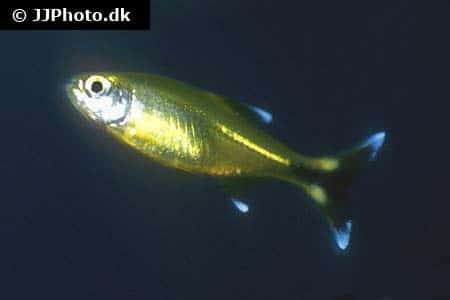
The silvertip tetra is a compact, torpedo-shaped fish that earns its name from the brilliant silver-white tips on its fins. The body color varies between the sexes and deepens significantly with age and good care. Males develop an intense coppery-orange body color that practically glows under aquarium lighting, while females and juveniles tend toward a more translucent lemon-yellow hue.
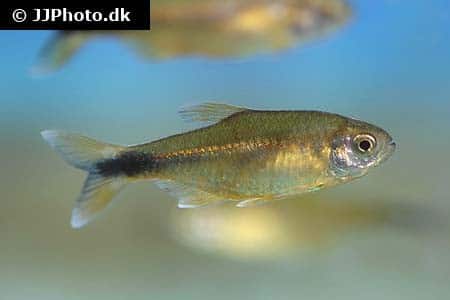
The signature silver tips appear on the dorsal, caudal, anal, and pectoral fins. The forked caudal fin also features a short black stripe in the middle, creating a nice contrast with those bright tips. Males will have more vivid and sharply defined silver tips compared to females.
The most distinctive anatomical feature of the silvertip tetra – and the entire Hasemania genus – is the complete absence of an adipose fin. While most tetras have this small, fleshy fin positioned between the dorsal and caudal fins, silvertips lack it entirely. This is an easy way to confirm identification, especially when distinguishing silvertips from similarly colored species.
Average Size & Lifespan
Silvertip tetras are small fish, typically reaching 1.2–1.5 inches (3–4 cm) in standard length in aquariums, with exceptional specimens reaching up to 2 inches (5 cm). Males are slightly slimmer than females, which develop a rounder body shape when mature and well-fed.
With proper care, silvertip tetras can live 5–10 years in captivity – a surprisingly long lifespan for such a small tetra. Most will comfortably hit the 5-year mark with basic good husbandry, and reaching 7–8 years isn’t uncommon. Factors that contribute to longevity include stable water conditions, a varied diet, proper group size, and adequate swimming space.
Care Guide
Tank Size
A 20-gallon (75-liter) tank is the recommended minimum for a school of 8–10 silvertip tetras. These are active, fast swimmers that use every inch of horizontal space you give them, so a longer tank is always better than a tall one. If you plan to keep a larger group or a community setup, 30 gallons (115 liters) or more is ideal.
I wouldn’t recommend keeping silvertips in anything smaller than 20 gallons. In cramped tanks, their natural energy and mild competitive streak can turn into actual fin-nipping problems – the extra space lets them sort out their hierarchy without causing real damage to each other or to tankmates.
Water Parameters
| Parameter | Ideal Range |
|---|---|
| Temperature | 72–79°F (22–26°C) |
| pH | 6.0–7.5 |
| General Hardness (GH) | 5–15 dGH |
| Carbonate Hardness (KH) | 3–10 dKH |
| Ammonia / Nitrite | 0 ppm |
| Nitrate | Below 20 ppm |
One of the big advantages of the silvertip tetra is its adaptability. While they originate from soft, acidic water, captive-bred specimens (which make up virtually all of the aquarium supply) do well across a broad range of parameters. They can handle pH levels from 6.0 all the way up to 8.0, making them viable even for moderately hard water setups.
That said, they’ll show their best colors in slightly softer, mildly acidic water with some tannin staining. A few catappa leaves or a piece of driftwood helps replicate those São Francisco basin conditions without any complicated water chemistry adjustments.
Tank Setup
Silvertip tetras look best against a dark substrate – dark sand or fine gravel really makes that copper body color pop. They appreciate a well-planted tank with open swimming areas in the center and plants around the sides and back. Java fern, anubias, vallisneria, and floating plants all work well.
Interestingly, their natural habitat is largely devoid of aquatic plants – the wild biotope features driftwood, leaf litter, and sandy substrates. If you want to create a biotope-accurate setup, use plenty of driftwood branches, dried leaves (catappa or oak), and a sandy bottom with dim lighting. But honestly, they look fantastic in planted tanks too – the green plants against their copper bodies create a beautiful contrast.
Moderate water flow is fine, but avoid creating a river-style current. These fish come from slow-moving creeks, so a gentle filter output or sponge filter suits them well. Make sure you have a tight-fitting lid – like many active tetras, silvertips are capable jumpers.
Filtration & Maintenance
Any standard aquarium filter rated for your tank size will work. Hang-on-back filters, sponge filters, and canister filters are all fine choices. Silvertips don’t have any special filtration needs – just keep up with regular 25–30% weekly water changes and don’t let nitrates creep above 20 ppm.
These are hardy fish that tolerate minor fluctuations well, but like all tetras, they don’t do well with sudden parameter swings. Consistency is the name of the game.
Is the Silvertip Tetra Right for You?
Honest assessment before you buy. The silvertip tetra is one of the most entertaining tetras in the hobby – and one of the easiest to get wrong.
Good fit if:
- You want an active, feisty tetra with a genuine personality – constant motion, in-group sparring, and real hierarchy behavior
- You can keep a school of 8–10 minimum – smaller groups redirect their energy into fin-nipping other fish
- Your tank already has active, robust tank mates like danios, barbs, black skirt tetras, or red eye tetras that can hold their own
- You have a 20-gallon or larger tank with open swimming space – cramped quarters amplify the aggression
- You want a tetra that develops stunning copper-gold body color over time that deepens significantly with a varied diet
- You are interested in a species with a genuinely interesting taxonomic identity – the only common tetra without an adipose fin
Think twice if:
- You have bettas, angelfish, or fancy guppies in the tank – the fin damage will start within days and won’t stop
- You are building a peaceful, slow-paced community tank – silvertips disrupt calm setups
- You want to keep fewer than 6 to 8 fish – a small group is a fin-nipping group, every time
- You want a species that is compatible with virtually everything – try ember tetras or glowlight tetras if you need universal compatibility
Tank Mates
Here’s where the silvertip tetra needs a little nuance. They’re generally peaceful community fish, but they have a mildly assertive personality that can cause problems with certain tankmates. In groups of 8 or more, they mostly direct their energy at each other – establishing hierarchies, sparring, and chasing within the school. In smaller groups, that energy gets redirected at other species, and that’s when fin-nipping becomes an issue.
Good Tank Mates
- Other similarly-sized tetras (black neon tetras, red eye tetras, bloodfin tetras)
- Rasboras (harlequin rasboras, chili rasboras)
- Danios (zebra danios, celestial pearl danios)
- Corydoras catfish (any species)
- Bristlenose and other small plecos
- Cherry barbs and other peaceful barbs
- Dwarf gouramis
- Small loaches (kuhli loaches, pygmy chain loaches)
Tank Mates to Avoid
- Bettas – those long, flowing fins are too tempting for silvertips
- Fancy guppies – same fin-nipping risk with long tails and flowing fins
- Angelfish – their trailing fins make them targets, and adults may eat silvertips
- Slow-moving species – anything that can’t keep up will get harassed
- Large aggressive cichlids – silvertips are too small to hold their own
- Shrimp – adult cherry shrimp may be fine, but shrimplets will be eaten
The most important factor is group size. A school of 10+ silvertips in a well-sized tank will mostly leave other species alone. A group of 4–5 in a cramped tank is a recipe for fin-nipping problems. If you’re going to keep them, commit to a proper group – your other fish will thank you.
Food & Diet
Silvertip tetras are enthusiastic, unfussy omnivores that will eat just about anything you offer. They feed in the mid-water column and at the surface, and they’re fast enough to beat most tankmates to the food – something to keep in mind if you have slower feeders in the same tank.
A good feeding schedule for silvertip tetras includes:
- Staple diet: High-quality flake food or micro pellets – feed once or twice daily, only what they can finish in 2–3 minutes
- Frozen foods: Bloodworms, brine shrimp, daphnia – offer 2–3 times per week for variety and color enhancement
- Live foods: Baby brine shrimp, micro worms, daphnia – excellent for conditioning breeding fish
- Treats: Freeze-dried tubifex, spirulina flakes – occasional variety
Color-enhancing foods with carotenoids and astaxanthin will bring out the best copper tones in males. The difference between a silvertip on a basic flake diet versus one getting regular frozen and live foods is genuinely striking – the copper deepens and the silver fin tips become almost blindingly bright.
Breeding & Reproduction
Silvertip tetras are egg scatterers and easy to breed compared to some other tetra species. Like most tetras, they show no parental care and will readily eat their own eggs and fry, so a dedicated breeding setup is essential if you want to raise a decent number of young.
Sexing
Males and females are fairly easy to tell apart once they’re mature (around 5–8 months old). Males are slimmer, more intensely copper-orange in body color, and have brighter, more sharply defined silver tips on their fins. Females are fuller-bodied – especially when gravid with eggs – and display a paler, more yellowish body tone with less vivid fin tips.
Breeding Setup
Set up a separate 10–15 gallon (38–57 liter) breeding tank with the following conditions:
- Temperature: 78–82°F (26–28°C) – slightly warmer than their normal range
- pH: 6.0–6.5
- Hardness: 2–4 dGH (soft water)
- Substrate: Bare bottom with plastic craft mesh raised slightly off the bottom to protect eggs
- Plants: Dense clumps of java moss or spawning mops underneath and around the mesh
- Lighting: Very dim – eggs and fry are light-sensitive
- Filtration: Air-driven sponge filter only
Spawning Process
Condition breeding pairs or groups (3 males to 3 females works well) separately with plenty of live and frozen foods for 1–2 weeks. When the females are visibly plumper and the males are at their most colorful, introduce them to the breeding tank in the evening.
Spawning typically occurs in the early morning hours. The female scatters her adhesive eggs among the plants and mesh while the male fertilizes them. A healthy female can produce up to a few hundred eggs per spawning event. Remove the adults immediately after spawning – they will eat every egg they can find.
Eggs hatch in 24–36 hours, and the fry become free-swimming 3–4 days later. Feed infusoria or commercially prepared liquid fry food for the first few days, then transition to baby brine shrimp nauplii and micro worms as they grow. Keep the tank dimly lit throughout the early development period, as both eggs and fry are photosensitive. Adding a couple of catappa leaves helps tint the water and provide natural biofilm for the fry to graze on.
Common Health Issues
Silvertip tetras are among the hardier tetra species and aren’t especially prone to any specific diseases. That said, they’re susceptible to the usual freshwater fish ailments:
- Ich (white spot disease): The most common issue, usually triggered by temperature drops or stress. Look for white salt-grain spots on the body and fins. Treat by slowly raising the temperature to 86°F (30°C) and/or using an ich medication.
- Neon tetra disease: Despite the name, this Pleistophora parasite can affect many tetra species including silvertips. Symptoms include color loss, erratic swimming, and wasting. Unfortunately, there’s no reliable cure – prevention through quarantining new fish is key.
- Fin rot: Usually caused by poor water quality. Ragged, deteriorating fins are the telltale sign. Improve water quality and treat with antibacterial medication if needed.
- Columnaris: A bacterial infection that presents as white or grayish patches. Maintain clean water and treat with appropriate antibiotics.
The best prevention for all of these is straightforward: maintain clean, stable water conditions, quarantine new arrivals for 2–4 weeks, avoid overcrowding, and provide a varied diet. Silvertips that are kept in proper conditions with a good group size rarely develop health issues.
Common Mistakes to Avoid
- Keeping too few: This is the #1 mistake with silvertips. Groups under 6 will fin-nip other fish. Keep 8–10 minimum – more is always better.
- Mixing with long-finned fish: Bettas, fancy guppies, and angelfish are poor choices. Their trailing fins are irresistible targets for active silvertips.
- Undersized tanks: These are hyperactive swimmers. A 10-gallon tank is too small – they need at least 20 gallons to burn off their energy properly.
- Skipping the lid: Silvertips jump, especially when startled or during feeding frenzies. A well-fitting lid or cover is essential.
- Boring diet: They’ll survive on flakes alone, but they won’t thrive. Regular frozen and live food additions bring out dramatically better color and behavior.
Where to Buy
Silvertip tetras are widely available and affordable, typically priced between $2–4 per fish. Since they need to be kept in groups, buying 8–10 at once is standard. Here are some reliable sources:
- Flip Aquatics – Great source for healthy, well-acclimated freshwater fish with live arrival guarantees
- Dan’s Fish – Excellent selection of tetras with competitive pricing for group purchases
- Local fish stores – Silvertips are common enough that most decent LFS will carry them or can order them
When shopping, look for active fish with bright silver fin tips and clear eyes. Avoid any fish with clamped fins, white spots, or faded coloring – these are signs of stress or disease. Since virtually all silvertips in the trade are captive-bred, they are hardy shippers, but always acclimate new arrivals slowly and quarantine before adding to an established tank.
Frequently Asked Questions
Are silvertip tetras fin nippers?
They are, especially in small groups. In schools of 8 or more, they mostly direct their chasing and sparring behavior at each other. In groups under 6, they’re much more likely to nip at slower-moving or long-finned tankmates. The solution is always to keep a proper-sized group and give them enough space.
How many silvertip tetras should I keep together?
A minimum of 8, with 10–12 being ideal. Larger groups display better schooling behavior, more natural color, and significantly less aggression toward other species. In a big enough tank, a group of 15–20 silvertips is an absolutely stunning display.
Why don’t my silvertip tetras have an adipose fin?
That’s completely normal! The silvertip tetra belongs to the genus Hasemania, which naturally lacks an adipose fin. This is actually one of their defining characteristics and a key way to identify them. Your fish aren’t missing anything – they were born that way.
Can silvertip tetras live with bettas?
This combination is not recommended. Silvertip tetras are active, fast swimmers with a tendency to nip at flowing fins, which makes betta fins an obvious target. Even in larger groups, the risk is higher than with calmer tetras like ember tetras or glowlight tetras.
Do silvertip tetras need a heater?
In most homes, yes. They prefer temperatures between 72–79°F (22–26°C). Unless your room temperature stays consistently in this range year-round, a heater is essential for maintaining stable conditions. Temperature fluctuations stress these fish and can trigger disease.
What It Is Actually Like Living With Silvertip Tetras
What the care parameters don’t capture.
A school of twelve is a different organism from a school of five. Five silvertip tetras drift loosely, show mild color, and nip at whatever is nearby. Twelve silvertip tetras form a coordinated unit – they travel together, turn together, and the in-group energy is so intense that they mostly leave other tank mates alone. The copper bodies flash in unison as the school turns, the silver fin tips catch the light, and it becomes the visual center of the tank. You cannot see what this species is until you have seen it in the right numbers.
The hierarchy is real and visible. Within weeks of establishing a school, you will identify the dominant fish. It positions itself slightly ahead of the group, gets first access to food, and is the most brilliantly colored individual in the tank. Other fish establish their positions below it. This social structure is the reason you keep them in groups – not because they school for protection, but because the group dynamic is the entire point of the species.
The copper color develops over time. A juvenile silvertip tetra bought from a store is pale and underwhelming – lemon-yellow body, modest silver tips. A mature male that has been fed a varied diet with regular frozen and live foods for a year is a genuinely striking fish. The body deepens from pale yellow to intense copper-orange that practically glows under warm lighting. The silver fin tips become high-contrast against that background. The transformation from juvenile to mature male is one of the best payoffs in the tetra hobby.
Feeding time is a spectacle. Silvertips hit the surface the moment food drops, outcompeting almost everything in the tank. They are fast, assertive, and relentless. If you have slower feeders – corydoras, bottom-dwelling loaches – make sure food reaches the bottom while the silvertips are occupied at the surface. They will not deliberately target bottom feeders, but they will eat everything they can reach first.
How the Silvertip Tetra Compares to Similar Species
Silvertip Tetra vs. Serpae Tetra
Both are semi-aggressive, fin-nipping tetras that require compatible, active tank mates. The Serpae Tetra has more intense red coloring but is widely considered the more difficult community fish – serpae fin-nipping is more persistent and more likely to cause serious damage. The Silvertip Tetra is more versatile across community setups and the copper body color is distinctive in a way the Serpae’s red is not. Choose the Serpae Tetra if you want maximum red saturation and are keeping it in a species-only or same-temperament group. Choose the Silvertip Tetra if you want a semi-aggressive personality tetra that fits a wider range of community setups, with the warm copper coloration and silver fin tips that develop with age.
Silvertip Tetra vs. Glowlight Tetra
These two species represent opposite ends of the tetra personality spectrum. The Glowlight Tetra is genuinely peaceful – no fin nipping, compatible with virtually any community fish, calming to watch. The Silvertip Tetra is assertive, active, and incompatible with slow-moving or long-finned species. Both are beautiful in their own way. Choose the Glowlight Tetra if you want a peaceful, universally compatible community schooler with consistent warm-glow coloring. Choose the Silvertip Tetra if you want a personality-driven tetra with more in-group energy, better schooling behavior, and the copper color that develops over time – and your tank can handle the compatibility restrictions.
Closing Thoughts
The silvertip tetra is one of those species that deserves way more attention than it gets. In a hobby dominated by neons and cardinals, the silvertip brings something different to the table – that active, feisty personality combined with gorgeous copper coloring and those distinctive flashing silver fin tips. They’re not the right choice for a slow, peaceful betta community tank, but in a lively setup with other active species, they’re absolutely fantastic.
Keep them in a proper group, give them room to swim, and feed them well – you’ll be rewarded with a school of shimmering copper fish that never stops moving and never gets boring to watch. In my 25+ years in the hobby, I can confidently say these are one of the most underrated tetras available.
Recommended Video
Check out our tetra tier list video where we rank the most popular tetras in the hobby, including the silvertip tetra:
References
- Hasemania nana – Seriously Fish
- Hasemania nana – FishBase
- Hasemania – Wikipedia
- About the Author
- Latest Posts

I’m Mark Valderrama, founder of Aquarium Store Depot and a fishkeeper with over 25 years of hands-on experience. I started in the hobby at age 11, worked at local fish stores, and have kept freshwater tanks, ponds, and reef tanks ever since. I’ve been featured in two best-selling aquarium books on Amazon and built this site to share practical, experience-based fish keeping knowledge.
Leave a Reply